
1. Introduction
Breast cancer is the most frequently diagnosed life-threatening cancer in women.[1] Neoadjuvant chemotherapy (NCT) followed by surgery is a commonly used modality for locally advanced breast cancer and is likely influenced by better outcome in these patients.[2] Administration of NCT in breast cancer patients may be followed by changes in estrogen receptor (ER), progesterone receptor (PR) and human epidermal growth factor receptor 2 (HER2) status. Before the initiation of NCT, core-needle biopsy (CNB) is taken to confirm diagnosis and to assess the hormone receptor (HR) status (estrogen and progesterone), human epidermal growth factor receptor 2 (HER2), although this status is known to be changed after (NCT).[3]
Some studies have proved that NCT can change the status of HR and HER2, and those patients who manifested changes of HR (+) to HR (−) experienced less benefit from NCT in comparison to patients who had no changes or conversions.[4, 5, 6, 7]
This study was conducted to evaluate the changes in hormone receptors, HER2, after NCT and the influence of these changes on the patient's outcome.
2. Patients and Methods
This study was performed at Medical Oncology Department, Clinical Oncology and Nuclear Medicine Department, Pathology Department and General Surgery Department in Zagazig University, Faculty of Medicine, Egypt, approved by the Ethical Committee in the period from December 2015 to December 2018.
We included 110 of 160 patients with locally advanced breast cancer who received NCT, 50 patients were excluded from the study as they achieved pathological complete response (pCR) and have no residual tissue for detection of change in HR and HER2 status after NCT. Patients were followed up and data were recorded in the patients’ files in the shared departments; we have used the AJCC staging system for breast cancer staging,[9] and the Nottingham (Elston-Ellis) modification of the Scarff. Bloom Richardson grading system for breast cancer (BC) grading.[10]
The primary diagnosis of invasive breast cancer of patients with locally advanced breast cancer was done by core needle biopsy (CNB) before receiving NCT to prove the diagnosis and to assess HR and HER2 status.
NCT regimens were administrated to our patients consisting of FAC (5-fluorouracil, Doxorubicin and Cyclophosphamide) every 3 weeks for 6 cycles, CEF (Cyclophosphamide, Epirubicin and 5-fluorouracil) every 3 weeks for 6 cycles, AC (Doxorubicin and Cyclophosphamide, every 3 weeks) followed by T (Paclitaxel) for 12 weeks, CMF (Cyclophosphamide, Methotrexate and 5-fluorouracil) every 3 weeks for 6 cycles, AC-D (Doxorubicin, Cyclophosphamide) every 3 weeks followed by Docetaxel every 3 weeks (each for four cycles). Modified radical mastectomy within 4 weeks after NCT was done for 95 patients, while breast conserving surgery (BCS) was done for 15 patients according to the surgery team decision. Radiotherapy was applied after surgery either as a part of primary treatment in patients with BCS or as adjuvant radiotherapy.
All the patients with ER, PR positive tumors before NCT or ER, PR positive residual tumors after NCT received endocrine therapy either tamoxifen for premenopausal patients or aromatase inhibitor for postmenopausal patients for 5 years, 31 of 38 patients with HER2 (+) before NCT or HER2-positive residual tumors after NCT received trastuzumab and was completed for 1 year for all those who were indicated.
All the patients were followed up every three months, and the follow-ups ended in December 2018. The median follow-up was 27(7–36) months.
2.1. Immunohistochemical Staining
Immunohistochemical (IHC) analysis for ER, PR and HER2 status was performed on fresh tumor tissue that was fixed with formalin and embedded in paraffin. Tissue sections obtained for analysis were from breast tumor specimens of CNB and surgical resections before and after NCT.
ER and PR positivity were determined according to positive nuclear staining that was present at ≥1% of tumor cells. HER2 (+) status scoring for strong membrane staining in ≥10% of tumor cells were defined as 3(+) according to circumferential membrane staining (HercepTest; Dako Cytomation). Tumor cells with a HER2 score of 2(+) were further evaluated and confirmed by fluorescence in situ hybridization (FISH).[7] For IHC evaluation for ER, PR and HER2, we used: ER (M7047, clone 1D5, Dako, Produktionsvej, Glostrup, Denmark), PR (M3569, clone PgR636, Dako), HER2 (A0485, polyclonal rabbit antibody, Dako).
2.2. Statistical Analysis
The collected data were statistically analyzed, continuous variables were expressed as the mean ± SD and median (range), and the categorical variables were expressed as a number (percentage). Continuous variables were checked for normality by using Shapiro–Wilk test. Mann–Whitney U test was used to compare data between more than two groups of non-normally distributed variables. Disease free survival (DFS) was calculated as the time from date of surgery to relapse or the most recent follow-up in which patient was relapse free. Overall survival (OS) was calculated as the time from diagnosis to death or the most recent follow-up contact (censored). Stratification of DFS and OS was done according to different conversion groups. These time-to-event distributions were estimated using the method of Kaplan-Meier plot, and compared using two-sided exact log-rank test. Cox regression analysis was performed to study the relationship between different conversion groups and both disease free survival and overall survival. A p-value < 0.05 was considered as significant. All the statistics were performed using SPSS 20.0 for windows (SPSS Inc., Chicago, IL, USA) and MedCalc windows (MedCalc Software bvba 13, Ostend, Belgium).
3. Results
3.1. Patient Characteristics
The detailed clinico-pathological data of our patients are fully illustrated in Table 1.
Table 1
Patients and tumor characteristics.
| Characteristics | All patients (N=110) | |
|---|---|---|
| No. | % | |
| Age (years) | ||
| Mean±SD | 50.84 | ±10.83 |
| Median (Range) | 51 | (27 – 73) |
| <35 years | 10 | 9.1% |
| ≥35 years | 100 | 90.9% |
| Side | ||
| Right breast | 47 | 42.7% |
| Left breast | 63 | 75.3% |
| Menopause | ||
| Premenopausal | 50 | 45.5% |
| Postmenopausal | 60 | 54.5% |
| Initial Grade | ||
| Grade II | 37 | 33.6% |
| Grade III | 73 | 66.4% |
| Pathological type | ||
| IDC | 93 | 84.5% |
| ILC | 11 | 10% |
| Other | 6 | 5.5% |
| Initial T | ||
| T1 | 8 | 7.3% |
| T2 | 32 | 29.1% |
| T3 | 46 | 41.8% |
| T4 | 24 | 21.8% |
| Initial N | ||
| N1 | 30 | 27.3% |
| N2 | 50 | 45.5% |
| N3 | 30 | 27.3% |
| Initial Stage | ||
| Stage IIIA | 60 | 54.5% |
| Stage IIIB | 22 | 20% |
| Stage IIIC | 28 | 25.5% |
| Initial LVI | ||
| Negative | 46 | 41.8% |
| Positive | 57 | 51.8% |
| Unknown | 7 | 6.4% |
| Initial ER status | ||
| Negative | 45 | 40.9% |
| Positive | 65 | 59.1% |
| Initial PR status | ||
| Negative | 52 | 47.3% |
| Positive | 58 | 52.7% |
| Initial HER2 status | ||
| +1 | 64 | 58.2% |
| +2 | 23 | 20.9% |
| +3 | 23 | 20.9% |
| Initial HER2 FISH | ||
| Negative | 17 | 15.4% |
| Positive | 6 | 5.5% |
| Pre-NCT Tumor Phenotype | ||
| HER2−ve & HR+ve | 67 | 60.9% |
| HER2+ve & HR+ve | 6 | 5.5% |
| HER2+ve & HR−ve | 13 | 11.8% |
| HER2−ve & HR−ve | 24 | 21.8% |
| Neoadjuvant chemotherapy | ||
| CMF | 8 | 7.3% |
| FAC | 44 | 40% |
| FEC | 22 | 20% |
| AC-T | 27 | 24.5% |
| AC-D | 9 | 8.2% |
| Surgery | ||
| BCS | 15 | 13.6% |
| MRM | 95 | 86.4% |
| ER status at surgery | ||
| Negative | 52 | 47.3% |
| Positive | 58 | 52.7% |
| PR status at surgery | ||
| Negative | 52 | 47.3% |
| Positive | 58 | 52.7% |
| HER2 status at surgery | ||
| Negative | 8 | 7.3% |
| +1 | 57 | 51.8% |
| +2 | 20 | 18.2% |
| +3 | 25 | 22.7% |
| HER2 FISH at surgery | ||
| Negative | 16 | 14.6% |
| Positive | 4 | 3.6% |
| HR conversion | ||
| Negative to negative | 39 | 35.5% |
| Positive to positive | 44 | 40% |
| Negative to positive | 15 | 13.6% |
| Positive to negative | 12 | 10.9% |
| HER2 conversion | ||
| Negative to negative | 72 | 65.5% |
| Positive to positive | 21 | 19.1% |
| Positive to negative | 8 | 7.3% |
| Negative to positive | 9 | 8.2% |
| Tumor Phenotype Conversion | ||
| Concordant nTN | 53 | 48.2% |
| Concordant TN | 12 | 10.9% |
| Discordant nTN | 28 | 25.5% |
| Discordant TN | 17 | 15.5% |
| Adjuvant Herceptin | ||
| No | 7 | 6.4% |
| Yes | 31 | 28.1% |
| Adjuvant Hormonal | ||
| No | 39 | 35.5% |
| Yes | 71 | 64.5% |
| Radiotherapy | ||
| No | 29 | 26.4% |
| Yes | 81 | 73.6% |
| Recurrence | ||
| No recurrence | 39 | 35.5% |
| Recurrence | 71 | 64.5% |
| Mortality | ||
| Alive | 100 | 90.9% |
| Died | 10 | 9.1% |
| Follow-up duration (months) | ||
| Mean±SD | 24.11 | ±8.75 |
| Median (Range) | 27 | (7 – 36) |
[i] Continuous variables were expressed as mean ± SD & median (range); categorical variables were expressed as number (percentage).
[ii] FAC (5-fluorouracil, Doxorubicin and Cyclophosphamide), CEF (Cyclophosphamide, Epirubicin and 5-fluorouracil), AC (Doxorubicin and Cyclophosphamide) followed by T (Paclitaxel; CMF (Cyclophosphamide, Methotrexate and 5-fluorouracil), AC-D (Doxorubicin, Cyclophosphamide followed by Docetaxel) HER2: human epidermal growth factor receptor 2; HR: hormone receptor; NCT: neoadjuvant chemotherapy; nTN: non-triple-negative; TN: triple-negative.
3.2. Alterations in Receptor Expression
In our study, we divided the patients according to HR and HER2 status before and after receiving NCT into groups; first group: from positive to positive, second group: from negative to negative, third group: from Positive to negative and fourth group :from negative to positive. The HR in 27 patients (24.5%) was changed after NCT, 12 (10.9%) patients with HR (+) were changed to HR (−) and 15 patients (13.6%) showed a conversion in HR status from (−) to (+). Seventeen patients (15.5%) showed a discordant HER2 status; 8 (7.3%) patients were converted from HER2 (+) to HER2 (−), and 9 (8.2%) were converted from HER2 (−) to HER2 (+). We classified the tumor according to their phenotypes into: HR(−)/HER2 (−), HR (+)/HER2 (−), HR (−)/HER2 (+) and HR (+)/HER2 (+). Twenty-eight patients (25.5%) developed discordance in tumor phenotypes, they were converted to non-triple negative (nTN), and 17 patients (15.5%) were converted to TN (Table 1).
3.3. Relation Between Changes in HR, HER2 Status and Patient Outcomes
Survival analyses done according to Kaplan–Meier for disease-free survival (DFS) and overall survival (OS) in the four groups according to HR and HER2 status are shown in Tables 2 and 3, and Figures A and B. DFS and OS were significantly worse in patients who had conversion in the HR status from (+) to (−) after NCT than the other three groups of patients (P < 0.001), (P < 0.001), respectively (Figures A and 2A). Patients who had HER2 (−) before and after NCT had better DFS rather than those who were converted from HER2 (−) to HER 2(+) (P < 0.001) (Figure B), but no significant difference was observed in OS (P = 0.365) (Figure 2B).
Table 2
Comparison of disease Free Survival (DFS) in the different conversion groups.
| Group | Total N | N of events | Censored N (%) | Disease Free Survival (DFS) | p-value† | |||
|---|---|---|---|---|---|---|---|---|
| Median | 1-year | 2-year | 3-year | |||||
| HR conversion | ||||||||
| Negative to negative | 39 | 23 | 16 (41%) | 25 months | 71.8% | 45% | 39.4% | <0.001 |
| Positive to negative | 15 | 15 | 0 (0%) | 7 months | 0% | ---- | ---- | |
| Negative to positive | 12 | 2 | 10 (83.3%) | NR | 91.7% | 83.3% | 83.3% | |
| Positive to positive | 44 | 31 | 13 (29.5%) | 22 months | 79.5% | 44.6% | 26% | |
| HER2 conversion | ||||||||
| Negative to negative | 72 | 44 | 28 (38.9%) | 25 months | 73.6% | 69.4% | 36.9% | <0.001 |
| Positive to negative | 8 | 5 | 3 (37.5%) | 12 months | 50% | 37.5% | 37.5% | |
| Negative to positive | 9 | 9 | 0 (0%) | 9 months | 0% | ---- | ---- | |
| Positive to positive | 21 | 13 | 8 (38.1%) | 25 months | 81% | 51.6% | ---- | |
| Tumor Phenotype Conversion | ||||||||
| Concordant nTN | 53 | 29 | 24 (45.3%) | 27 months | 84.9% | 65.2% | ---- | <0.001 |
| Concordant TN | 12 | 7 | 5 (41.7%) | 20 months | 66.7% | 50% | 41.7% | |
| Discordant nTN | 28 | 25 | 3 (10.7%) | 9 months | 21.4% | 14.3% | ---- | |
| Discordant TN | 17 | 10 | 7 (41.2%) | 22 months | 58.8% | 47.1% | 41.2% | |
Table 3
Comparison of Overall Survival (OS) in the different conversion groups.
| Group | Total N | N of events | Censored N (%) | Overall Survival (OS) | p-value† | |||
|---|---|---|---|---|---|---|---|---|
| Median | 1-year | 2-year | 3-year | |||||
| HR conversion | ||||||||
| Negative to negative | 39 | 5 | 34 (87.2%) | NR | 97.4% | 89.4% | 85.7% | <0.001 |
| Positive to negative | 15 | 4 | 11 (73.3%) | ---- | 69.1% | ---- | ---- | |
| Negative to positive | 12 | 1 | 11 (91.7%) | NR | 91.7% | 91.7% | 91.7% | |
| Positive to positive | 44 | 0 | 44 (100%) | NR | 100% | 100% | 100% | |
| HER2 conversion | ||||||||
| Negative to negative | 72 | 5 | 67 (93.1%) | NR | 94.3% | 92.7% | 92.7% | 0.365 |
| Positive to negative | 8 | 0 | 8 (100%) | NR | 100% | 100% | 100% | |
| Negative to positive | 9 | 1 | 8 (88.9%) | ---- | 88.9% | 88.9% | ---- | |
| Positive to positive | 21 | 4 | 17 (81%) | NR | 90.5% | 85.4% | 79.3% | |
| Tumor Phenotype Conversion | ||||||||
| Concordant nTN | 53 | 3 | 50 (94.3%) | NR | 98.1% | 96.2% | 93.9% | 0.219 |
| Concordant TN | 12 | 2 | 10 (83.3%) | NR | 90.9% | 81.8% | 81.8% | |
| Discordant nTN | 28 | 4 | 24 (85.7%) | ---- | 84.8% | 84.8% | ---- | |
| Discordant TN | 17 | 1 | 16 (94.1%) | NR | 94.1% | 94.1% | 94.1% | |
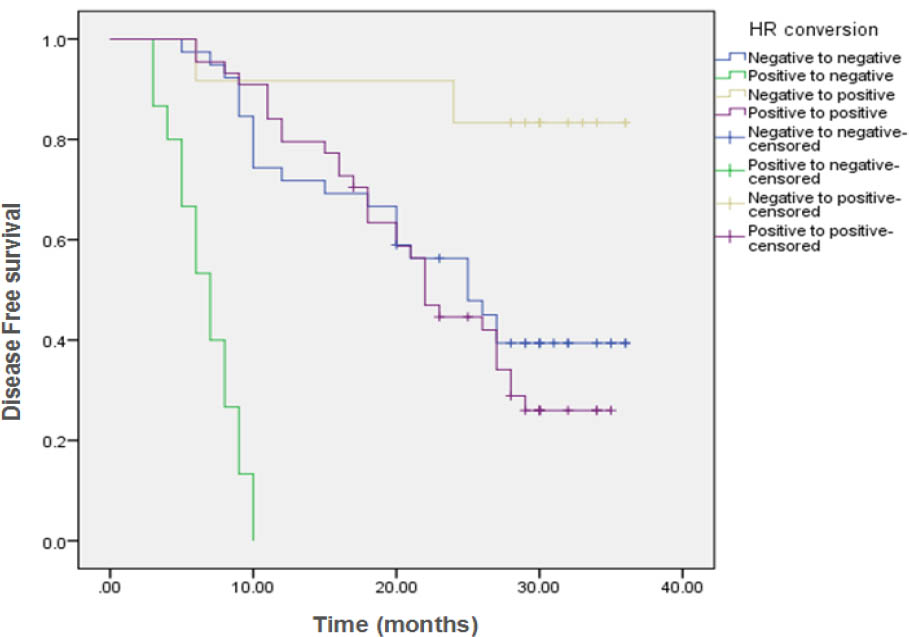
Figure (A)
Kaplan Meier curve shows comparison of Disease Free Survival (DFS) in HR conversion group.
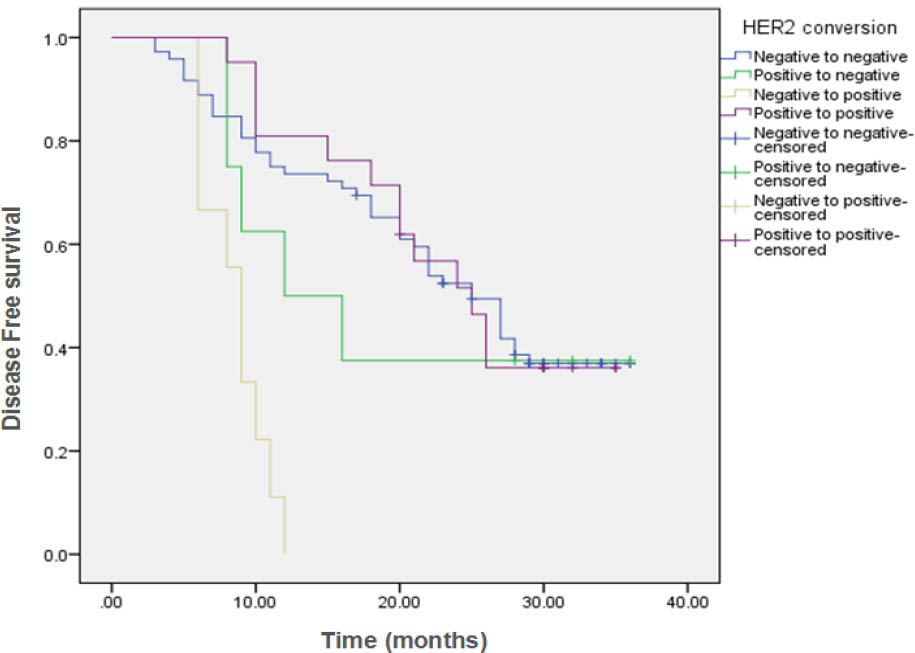
Figure (B)
Kaplan Meier curve shows comparison of Disease Free Survival (DFS) in HER2 conversion group.
We evaluated the difference in patients’ survival according to the changes in HR and HER2 status after NCT by univariate Cox regression analyses for DFS and OS (Table 4), HR and HER2 conversion were statistically significant (P < 0.001), (P < 0.001) respectively for DFS only but not significant for OS, HR (P = 0.127) and HER2 (p = 0.557). The groups of patients who were converted to HR(−) had significantly worse survival outcomes (Hazard ratio, HR = 12.606, P < 0.001 for DFS; but not for OS HR = 578737.963, P = 0.924) in comparison to the positive patients with a concordant HR status (HR = 1 for DFS and OS), and patients who were converted to HR (+) (HR = 0.159, P = 0.012 for DFS; but not significant, P = 0.936 for OS). The change in HER2 status from positive to negative alone had no significant worse outcome for DFS or OS.
Table 4
Univariate Cox regression analysis for Disease Free Survival and Overall Survival.
| Group | Total N (%) | DFS | OS | ||
|---|---|---|---|---|---|
| HazR (95% CI) | p-value | HazR (95% CI) | p-value | ||
| HR conversion | <0.001 | 0.127 | |||
| Negative to negative | 39 (35.5%) | 0.818 (0.477 – 1.405) | 0.467 | 114437.447 | 0.933 |
| Positive to negative | 15 (13.6%) | 12.606 (5.762 – 27.581) | <0.001 | 578737.963 | 0.924 |
| Negative to positive | 12 (10.9%) | 0.159 (0.038 – 0.667) | 0.012 | 67638.402 | 0.936 |
| Positive to positive | 44 (40%) | 1.000 | 1.000 | ||
| HER2 conversion | <0.001 | 0.557 | |||
| Negative to negative | 72 (65.5%) | 1.023 (0.551 – 1.901) | 0.943 | 0.381 (0.102 – 1.420) | 0.151 |
| Positive to negative | 8 (7.3%) | 1.295 (0.461 – 3.638) | 0.624 | 0.000 | 0.987 |
| Negative to positive | 9 (8.2%) | 6.104 (2.461 – 15.136) | <0.001 | 0.650 (0.072 – 5.864) | 0.701 |
| Positive to positive | 21 (19.1%) | 1.000 | 1.000 | ||
| Tumor Phenotype Conversion | <0.001 | 0.276 | |||
| Concordant nTN | 53 (48.2%) | 1.000 | 1.000 | ||
| Concordant TN | 12 (10.9%) | 1.298 (0.568 – 2.966) | 0.536 | 3.557 (0.593 – 21.328) | 0.165 |
| Discordant nTN | 28 (25.5%) | 4.548 (2.617 – 7.904) | <0.001 | 3.771 (0.823 – 17.280) | 0.087 |
| Discordant TN | 17 (15.5%) | 1.376 (0.670 – 2.826) | 0.385 | 1.100 (0.114 – 10.577) | 0.935 |
[i] HazR: Hazards Ratio; 95% CI: 95% Confidence Interval; DFS: disease-free survival; HER2: human epidermal growth factor receptor 2; HR: hormone receptor; nTN: non-triple-negative; OS: overall survival; TN: triple-negative
3.4. Discordance in Tumor Phenotype and Patient Outcomes
Kaplan–Meier analyses were done for tumor phenotype conversion (Figure C). Patients who had no changes in the tumor phenotype had better outcomes in comparison to the discordant cases (P < 0.001 for DFS but not significant P = 0.219 for OS) (Figures C and 2C).
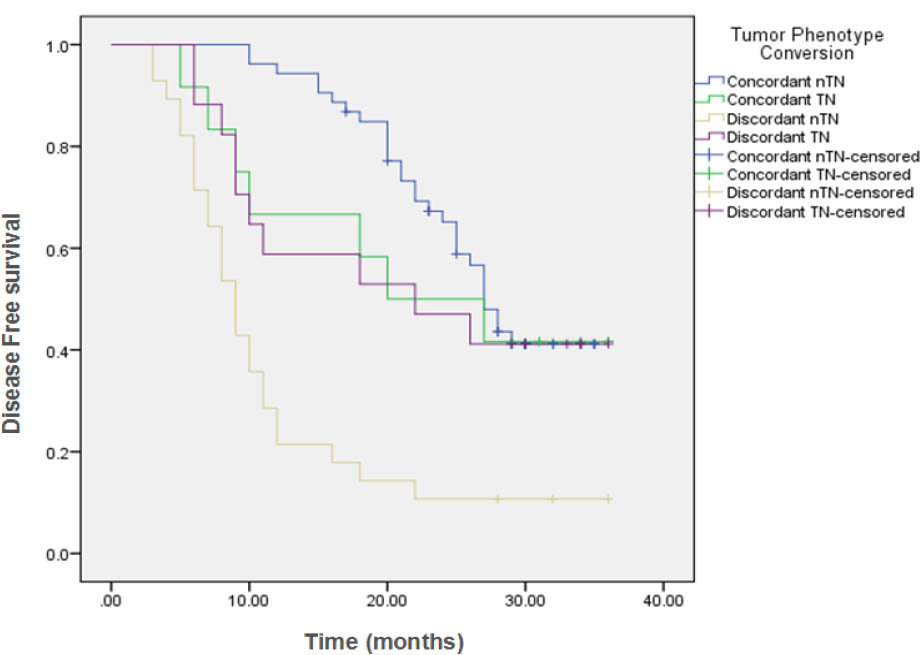
Figure (C)
Kaplan Meier curve shows comparison of Disease Free Survival (DFS) in Tumor Phenotype Conversion group.
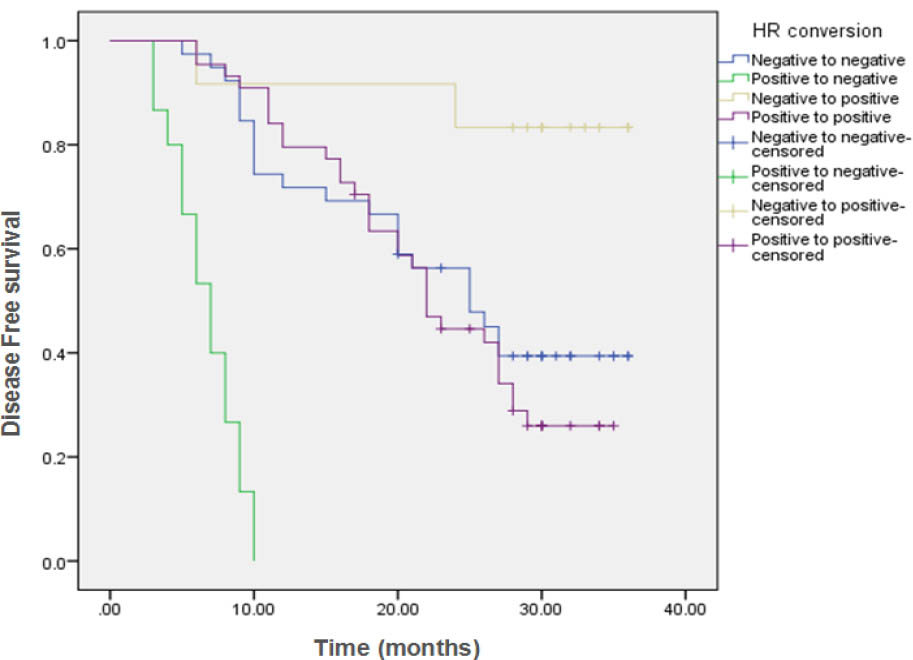
Figure (2A)
Kaplan Meier curve shows comparison of Overall Survival (OS) in HR conversion group.
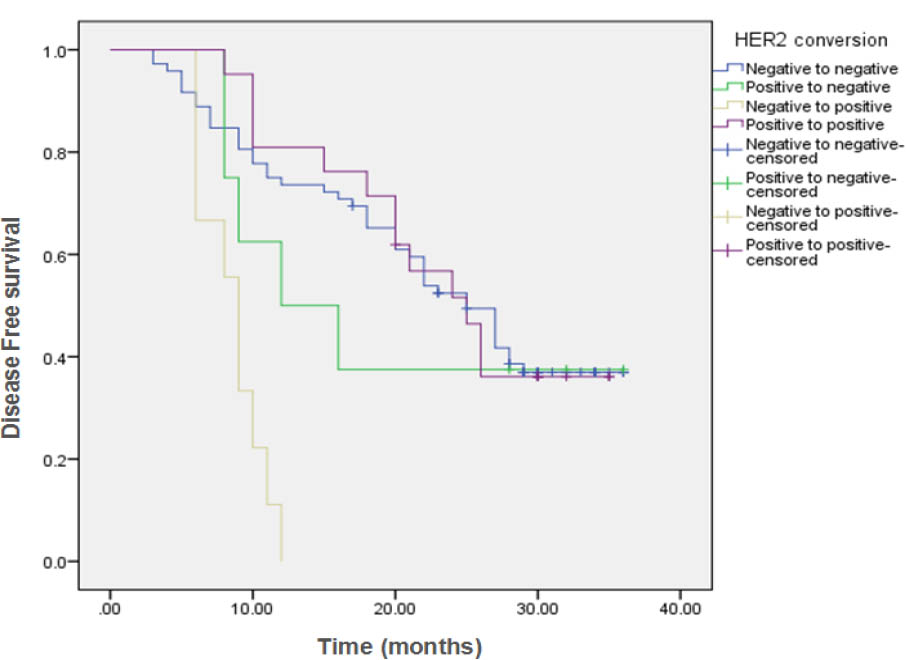
Figure (2B)
Kaplan Meier curve shows comparison of Overall Survival (OS) in HER2 conversion group.
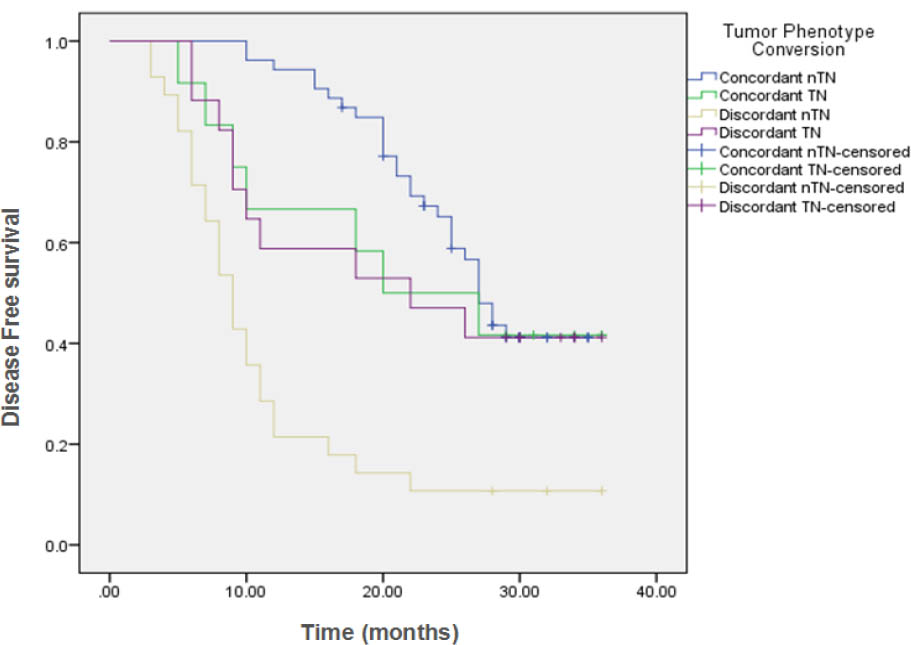
Figure (2C)
Kaplan Meier curve shows comparison of Overall Survival (OS) in Tumor Phenotype Conversion group.
Patients with discordant nTN tumor phenotype (the tumor phenotype was changed) had significantly worse DFS (HR = 4.548, P < 0.001) but not significant for OS (HR = 3.771, P = 0.087) in comparison to patients with concordant TN (the tumor phenotype was TN and unchanged) (HR = 1.298, p = 0.536 for DFS and HR = 3.557, p = 0.165 for OS) and discordant TN (the tumor phenotype was changed) (HR = 1.376, P = 0.385 for DFS, HR = 1.100, P = 0.935 for OS) in univariate analyses (Table 4, Figures C and 2C).
4. Discussion
The result of conversion of HR and HER2 status after NCT in breast cancer patients still have conflicting data.[8]
Locally advanced breast cancer was a problem in the past years, but with the development of neoadjuvant chemotherapy, the patients now can have a better control of the disease.[6, 7, 8, 9, 10, 11, 12]
In our prospective cohort study, we described that patients with locally advanced breast cancer whose HR were changed from HR (+) to HR (−) after NCT had a worse prognosis, while the effect of HER2 conversion alone did not have a significant effect on the prognosis.
Xi Jin et al. reported that HR conversion from positive to negative had worse disease-free survival (DFS) and overall survival (OS) in multivariate survival analysis.[16] Chen et al. found that patients for whom HR changed from positive to negative after NCT had negative impact in DFS and OS.[7]
Hirata et al. (2009) did not find a significant difference in DFS and OS between the HR-positive group and HR-conversion group.[15] However, in our study, patients who had been converted from HR (+) to (−) after NCT had significantly worse DFS (P < 0.001) and worse OS (P < 0.001).
The mechanism of HR and HER2 status conversion after NCT is complicated. The intratumoral heterogeneity may be due to the presence of different types of clones with different phenotypes within the same individual tumors.[13–14]
Bines et al. and Rose et al. mentioned that ovarian function and adrenal glands can be suppressed by chemotherapy,[18–19] and the change of HR status from (+) to (−) after NCT may be due to decrease in the hormones caused by this suppression.[11] This mechanism of suppression might be the main cause for HR conversion from (+) to (−) after NCT.
Niikura et al. (2016) reported that the change in HER2 status regardless of pre-NCT HR status, had different results (21.4% for HER2 positive-to-negative change and 3.4% for HER2 negative-to-positive change) from our study, where 8 (7.3%) of the patients were changed from HER2 (+) to HER2 (−), and 9 (8.2%) changed from HER2 (−) to HER2 (+).[20] In our study, in HER2 conversion groups, patients who remained HER2 (−) after NCT had better DFS rather than those who were converted from HER2 (−) to HER2(+) (P < 0.001), but no significant difference was observed in OS (P = 0.365). In spite of the conversion of HER2 status after NCT, this conversion was not significant when compared with patients who did not receive NCT.[12]
Our study focused on the discordance of tumor phenotype and HR status before and after NCT and the effect on patient's prognosis.
We have several limitations in our study. First, the patients didn’t receive the same regimens of NCT, so we can’t decide if receptor conversion is due to special or multiple factors. Some studies mentioned that patients with high level of Ki-67 expression that had reduction after NCT had better prognosis.[21–22] In our study, we did not mention the effect of reduction of Ki-67 expression on patients’ prognosis. Future studies will be required to identify the prognostic value of receptor conversion.
5. Summary and Conclusion
Our prospective cohort study indicated the presence of discordance in HR, HER2 status and loss of receptor positivity after NCT had poor outcome and negative prognostic impact. These results might help for the selection of adjuvant therapy and improve patients outcome and survival. NCT may be the direct cause of tumor phenotype conversion with the changes in tumor receptors but the mechanism of conversion needs further studies.
6. Recommendation
Because of discordance between HR and HER2 expressions in primary diagnostic and residual breast tissue after NCT, it is helpful to retest the HR and HER2 status after NCT as this may have a prognostic value and may help in the selection of subgroup of patients who need further evaluation of treatment plan.