
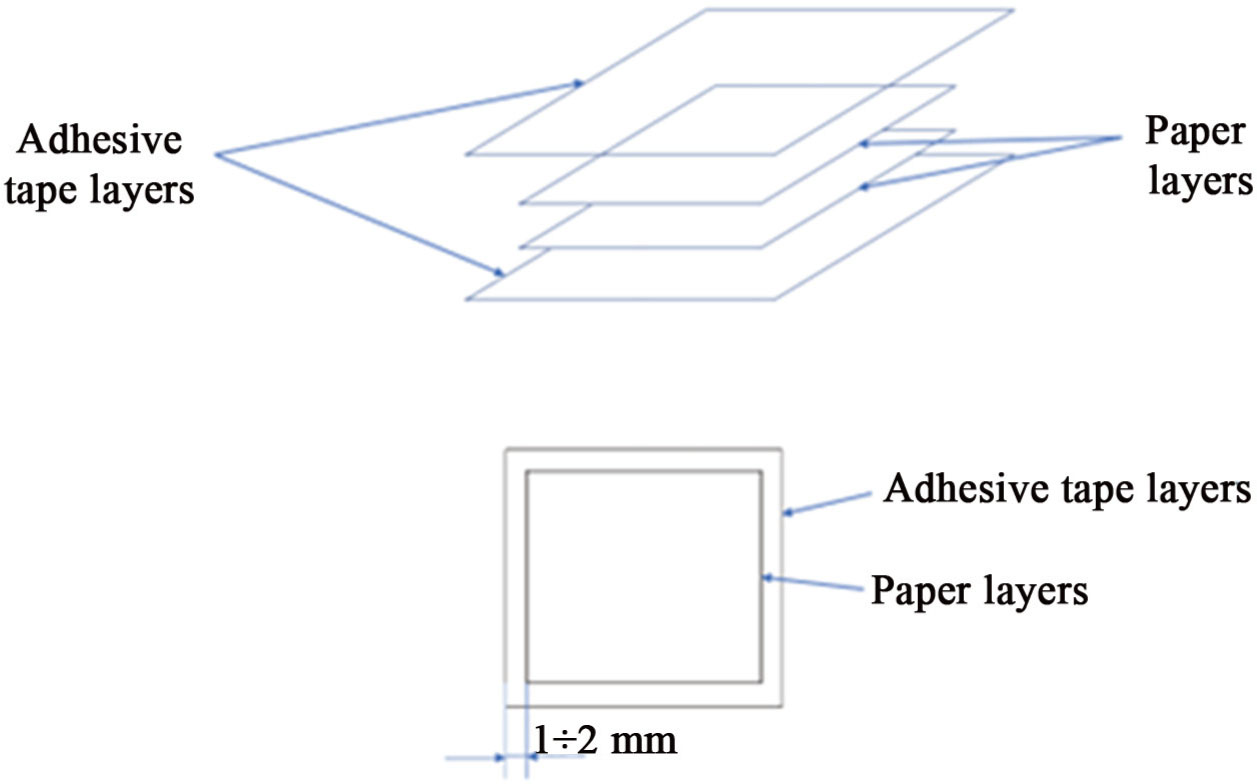
Figure 1.
Paper inserts used to simulate interlayer foreign-body inclusions.
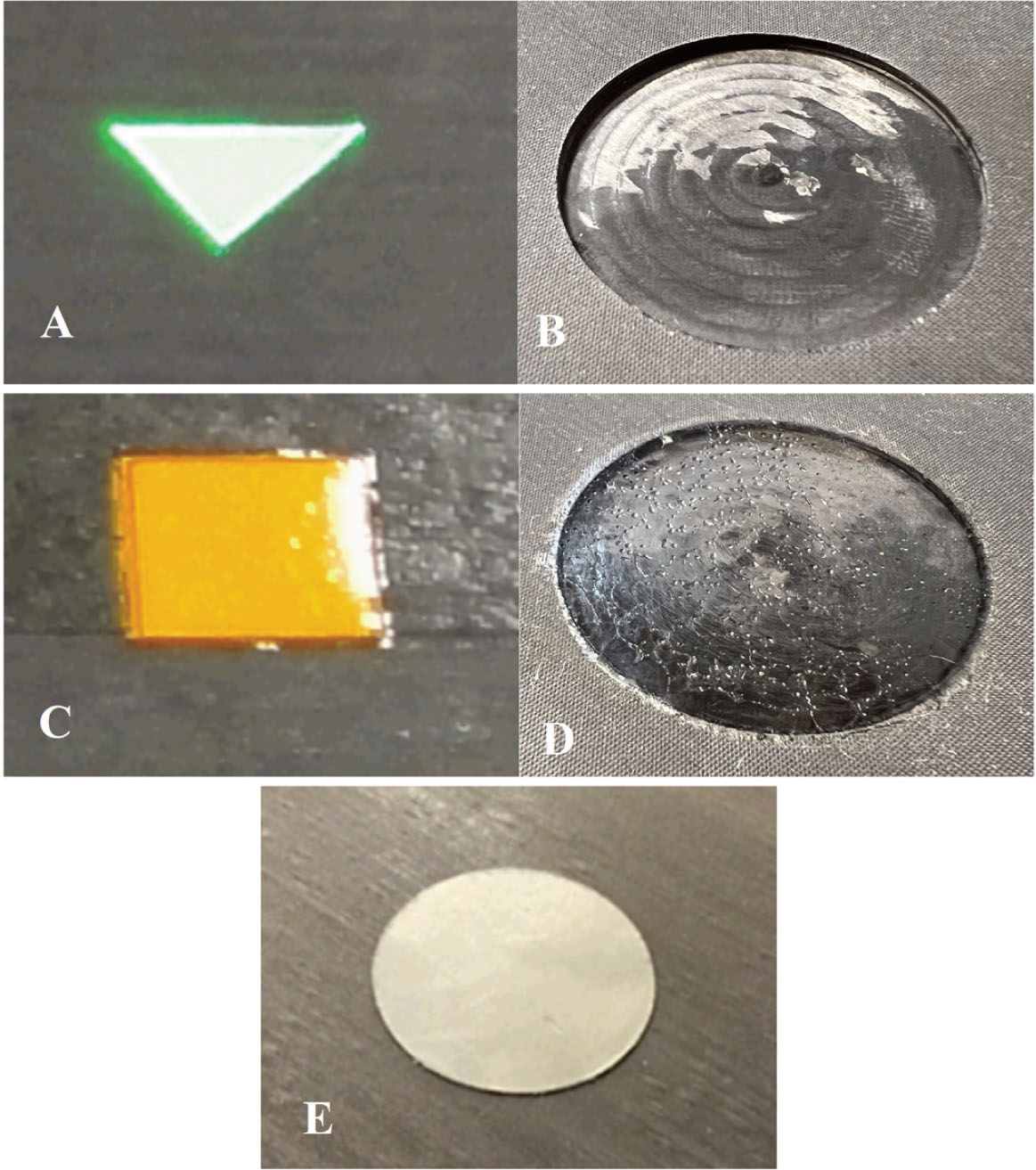
Figure 2.
A – Prepreg foil; B – Flat-bottom hole; C – Paper insert; D – Flat-bottom hole filled with epoxy resin; E – Graphite foil.
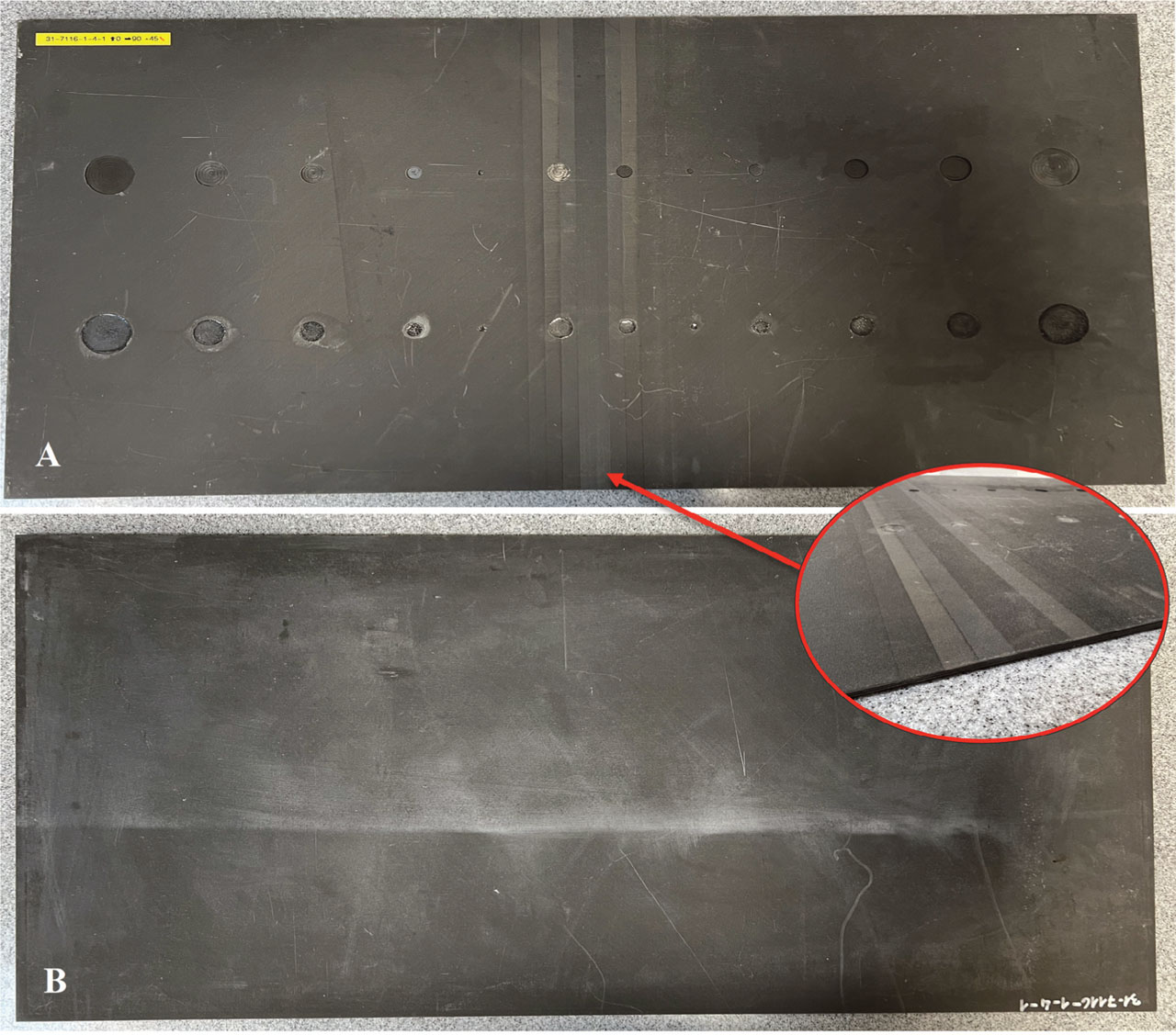
Figure 3.
Photographs of the specimen (A – bottom side, B – top side).
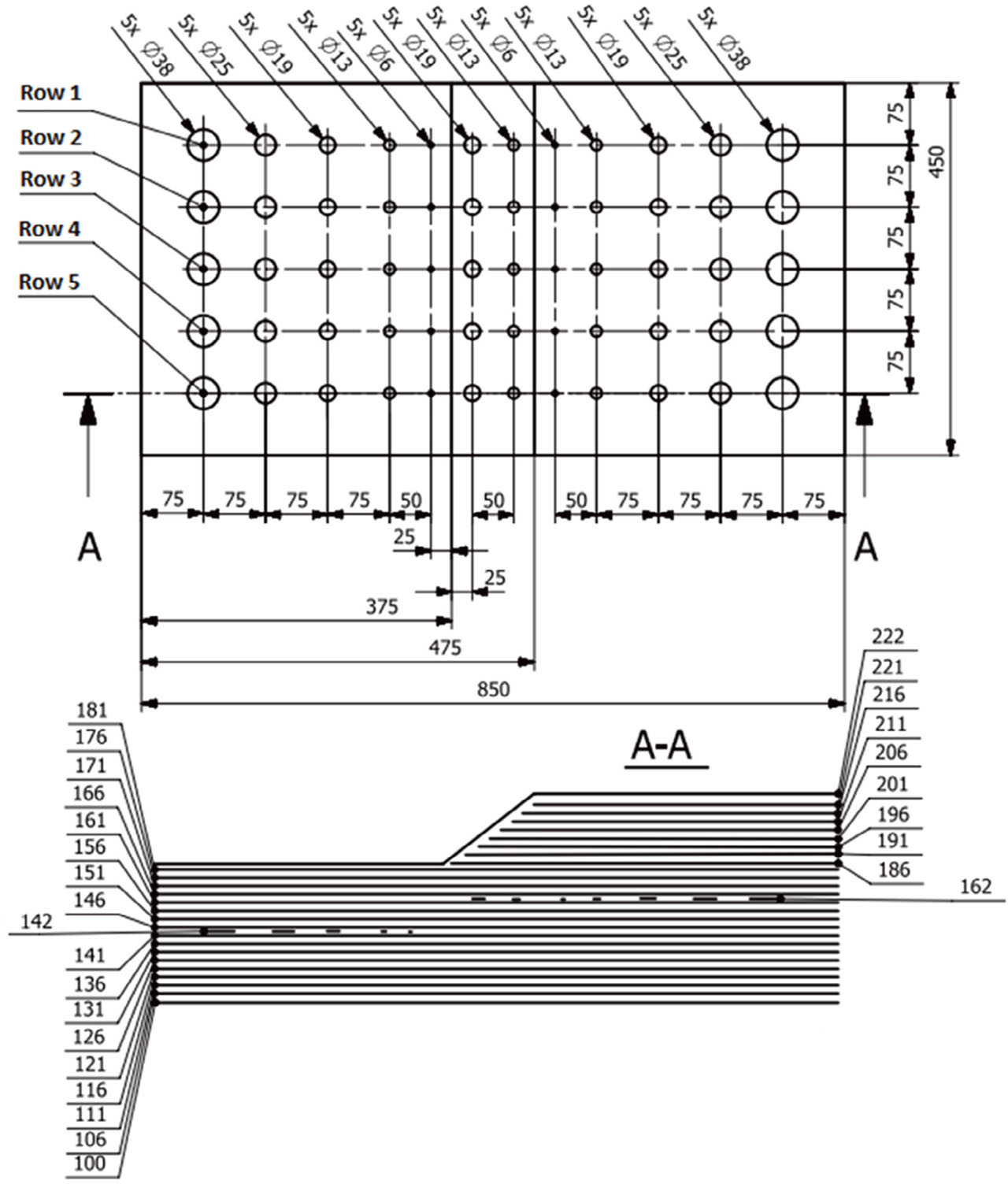
Figure 4.
Schematic diagram of the specimen.
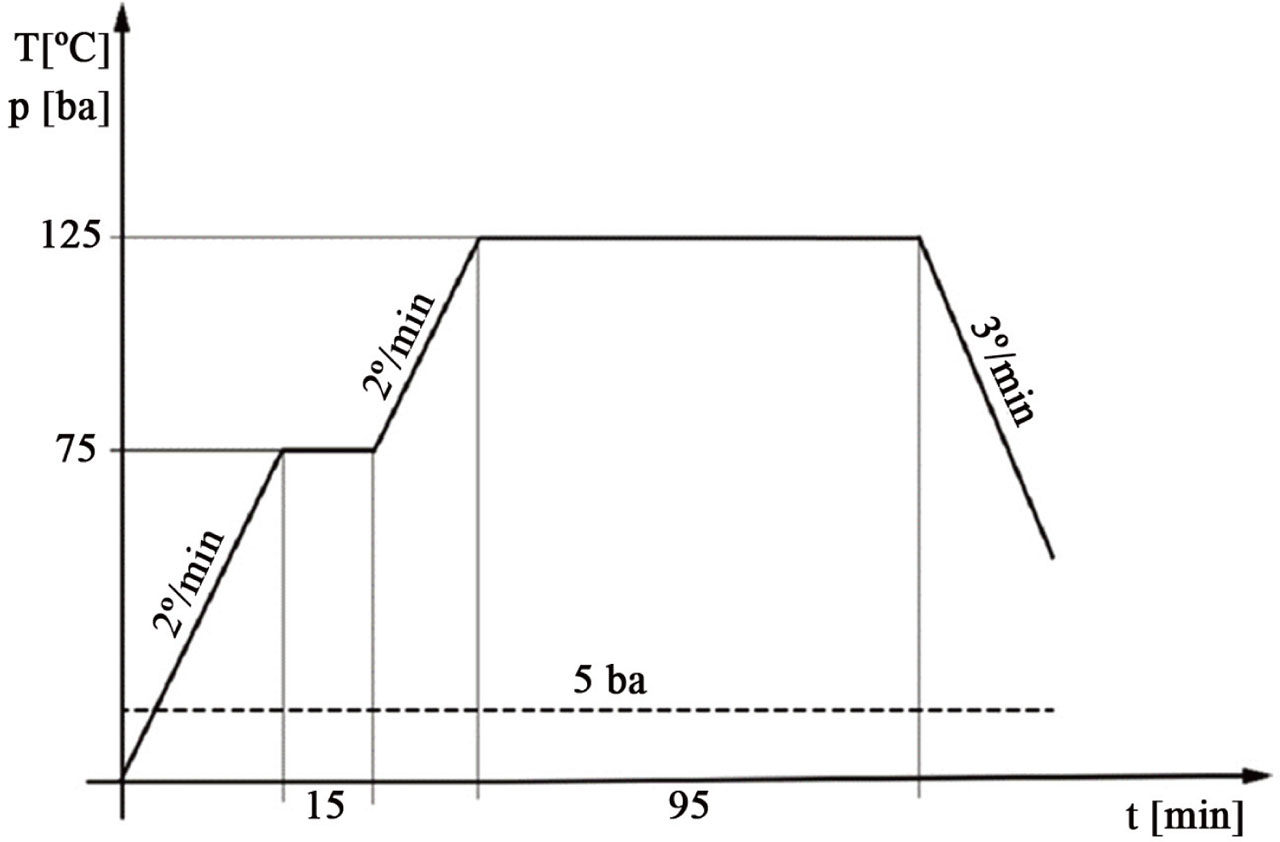
Figure 5.
Heating cycle graph for specimen manufacturing.
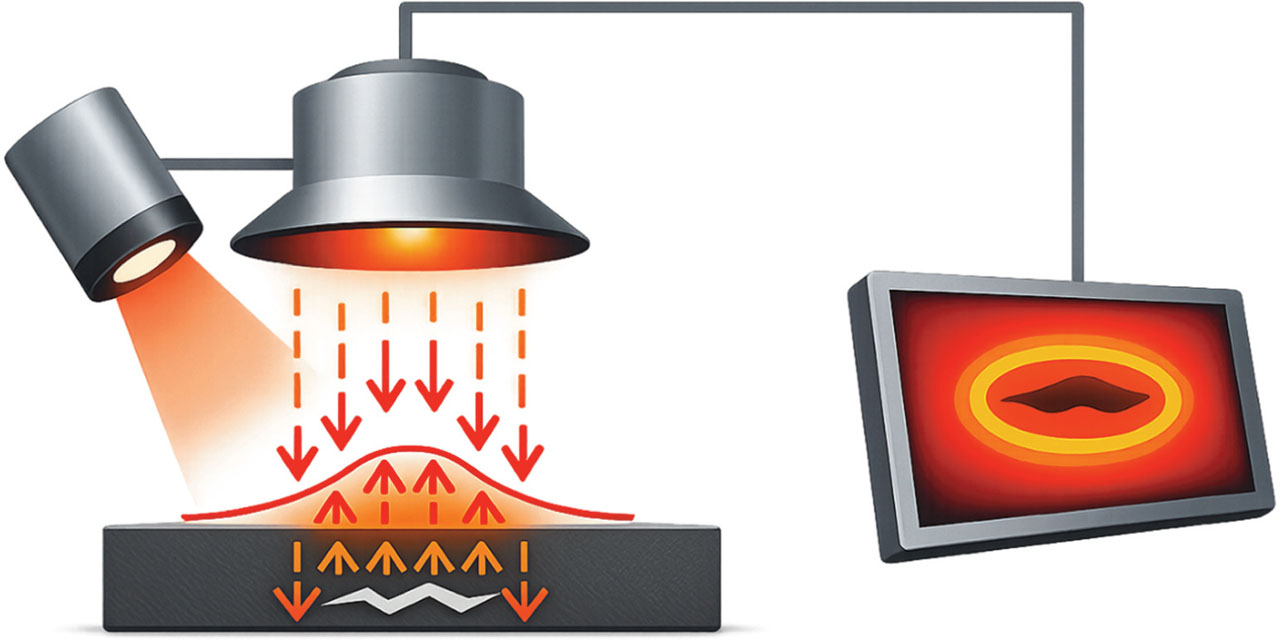
Figure 6.
Schematic diagram of the thermography test configuration.
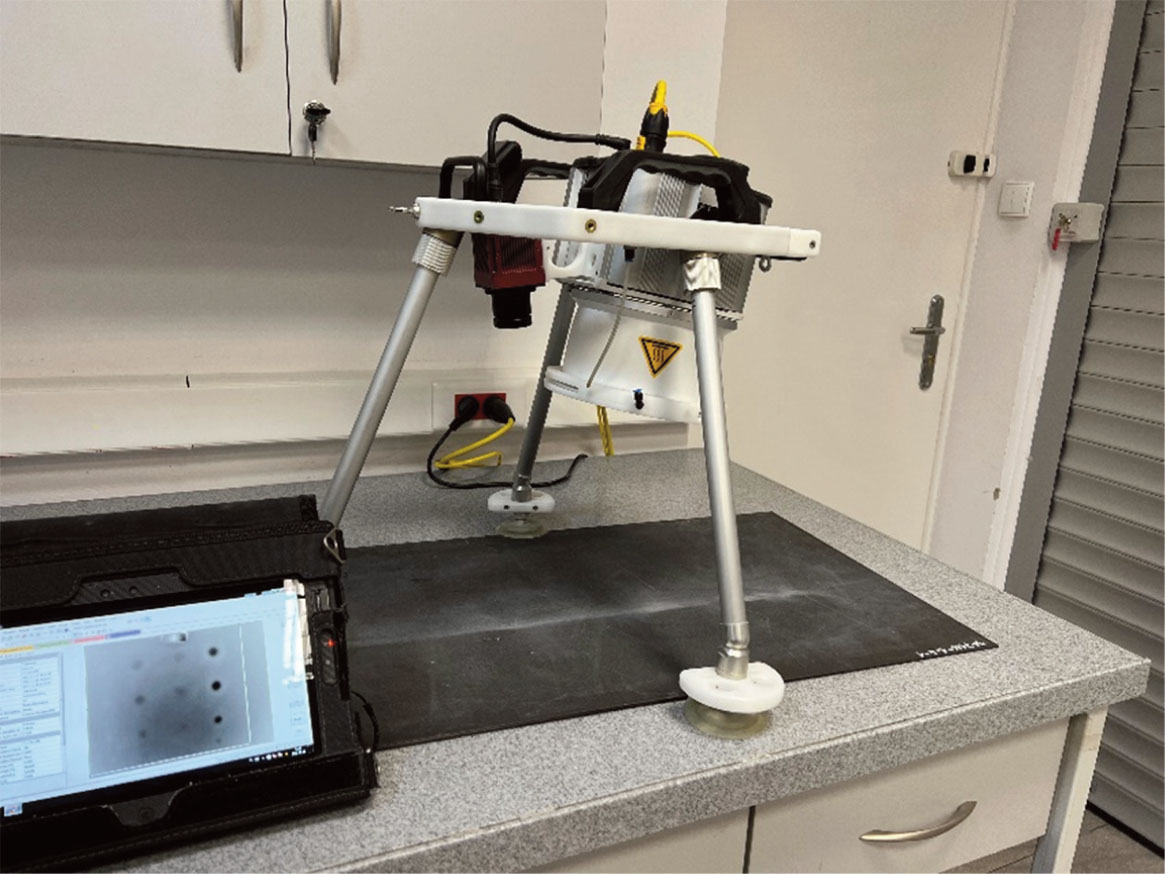
Figure 7.
Photograph of the C-CheckIR system during specimen testing.
Table 1.
Acquisition parameters.
| Parameters | Value |
|---|---|
| Sync Mode | Free run |
| Acquisition duration | 120 [s] |
| Acquisition frame rate | 5 [Hz] |
Table 2.
Excitation parameters.
| Parameters | Value |
|---|---|
| Modulation | Rect. |
| Amplitude low | 0 [%] |
| Amplitude high | 90 [%] |
| Excitation period | 120 [s] |
| Duty time | 10 [s] |
| Rising ramp time | 0.8 [s] |
| Falling ramp time | 0.8 [s] |
| Number of measurements | 359 |
| Best results measurement | 346 |
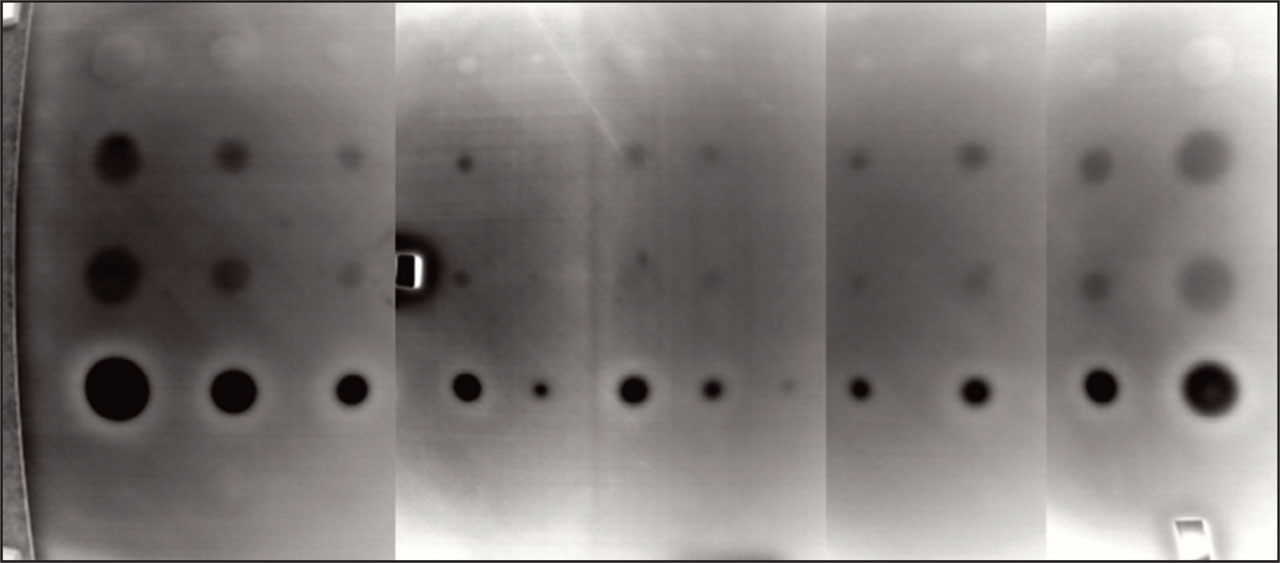
Figure 8.
Representative LPT response of the CFRP panel. The five rows correspond to the defect classes defined in Figure 2: Row 1 – prepreg foil; Row 2 – flat-bottom holes; Row 3 – paper inserts; Row 4 – flat-bottom holes filled with epoxy resin; Row 5 – graphite foil. The displayed indications represent thermographic footprints of equivalent-diameter responses; lateral heat diffusion smooths the triangular and square geometries, which is why the indications do not reproduce sharp non-circular edges.
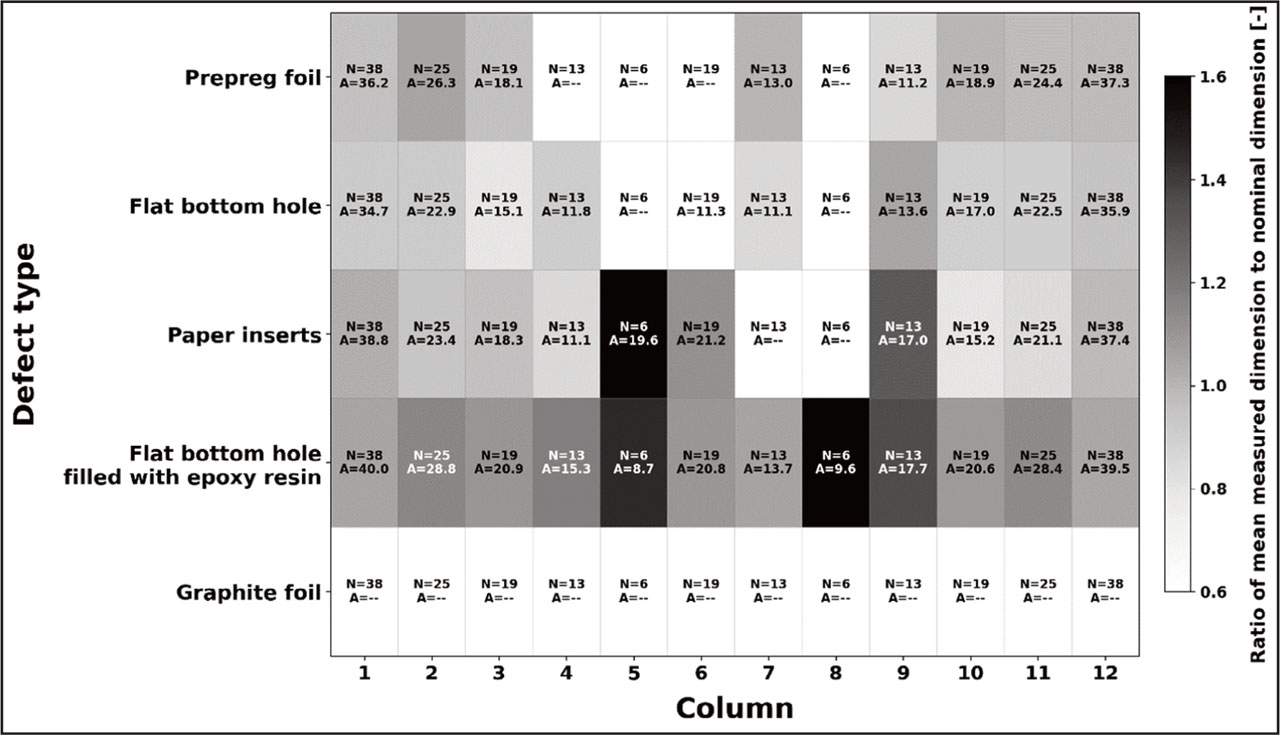
Figure 9.
Distribution of defects and mean measured dimensions in the panel grid. Each cell contains the nominal dimension (N) and the mean measured dimension (A). The grayscale background represents the ratio A/N, indicating whether a defect was underestimated, accurately reproduced, or overestimated by LPT.
Table 3.
Summary of LPT detectability, sizing error, and repeatability by defect type.
| Defect type | Detected / total | Detection rate [%] | Mean error [mm] | Mean error [%] | Mean SD [mm] |
|---|---|---|---|---|---|
| Prepreg foil | 8 / 12 | 66.7 | −0.58 | −2.9 | 1.41 |
| Flat bottom hole | 10 / 12 | 83.3 | −2.61 | −12.4 | 1.33 |
| Paper inserts | 10 / 12 | 83.3 | 0.82 | 21.0 | 0.94 |
| Flat bottom hole filled with epoxy resin | 12 / 12 | 100.0 | 2.51 | 19.3 | 0.92 |
| Graphite foil | 0 / 12 | 0.0 | — | — | — |
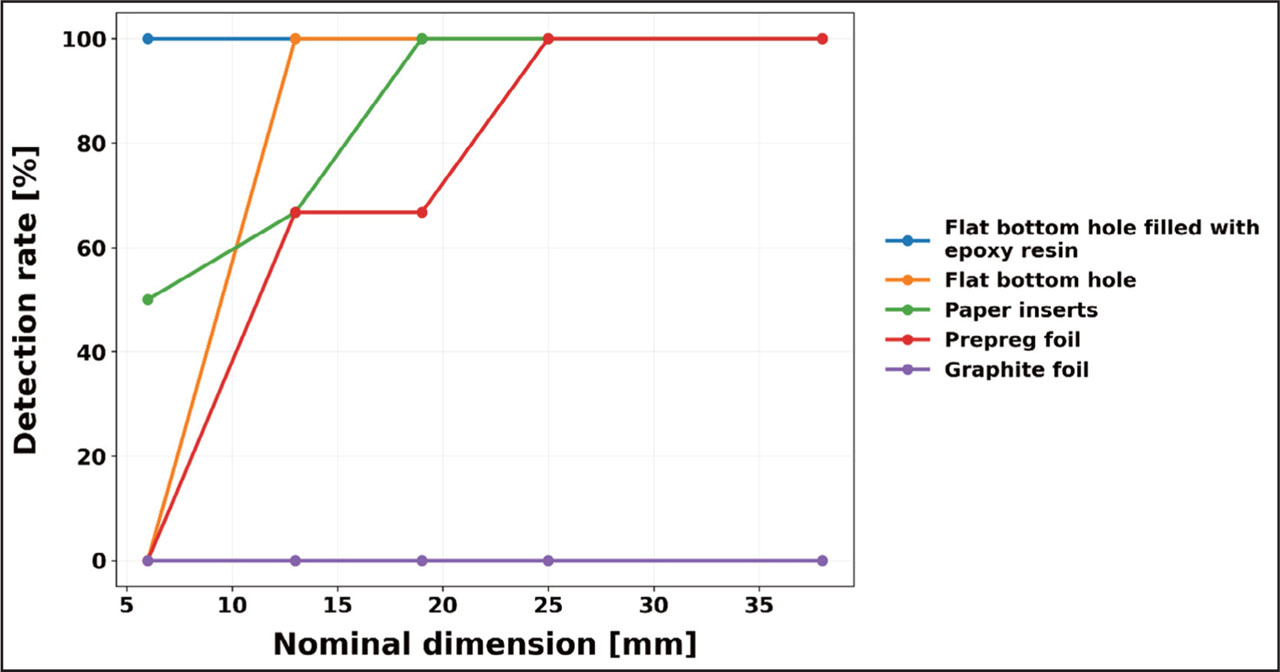
Figure 10.
Detection rate as a function of nominal defect dimension for each defect type. The figure shows that 6 mm defects are generally below the robust LPT detectability limit, whereas detectability increases markedly from approximately 13 mm onward.
Table 4.
Detection rate as a function of nominal defect dimension.
| Nominal dimension [mm] | Detected / total | Detection rate [%] |
|---|---|---|
| 6 | 3 / 10 | 30.0 |
| 13 | 10 / 15 | 66.7 |
| 19 | 11 / 15 | 73.3 |
| 25 | 8 / 10 | 80.0 |
| 38 | 8 / 10 | 80.0 |
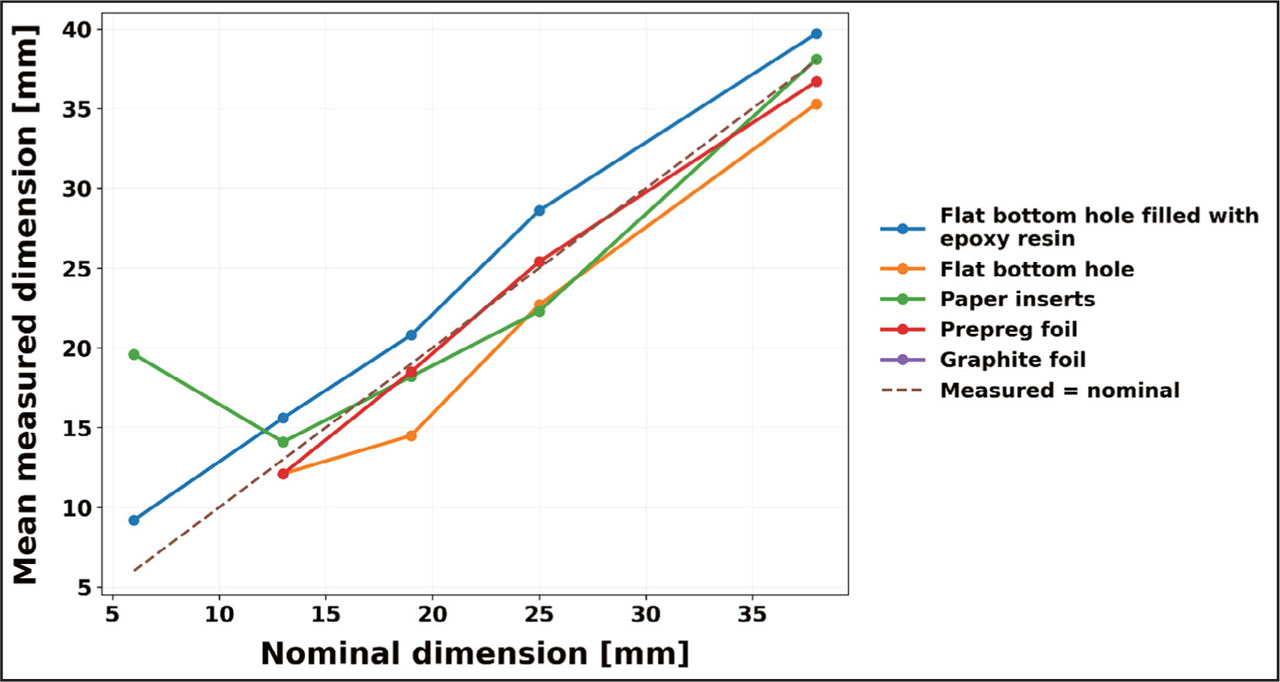
Figure 11.
Mean measured dimension versus nominal dimension for each defect type. The diagonal line represents perfect agreement between the measured and nominal dimensions. Flat-bottom holes are predominantly underestimated, whereas flat-bottom holes filled with epoxy resin are systematically overestimated.