
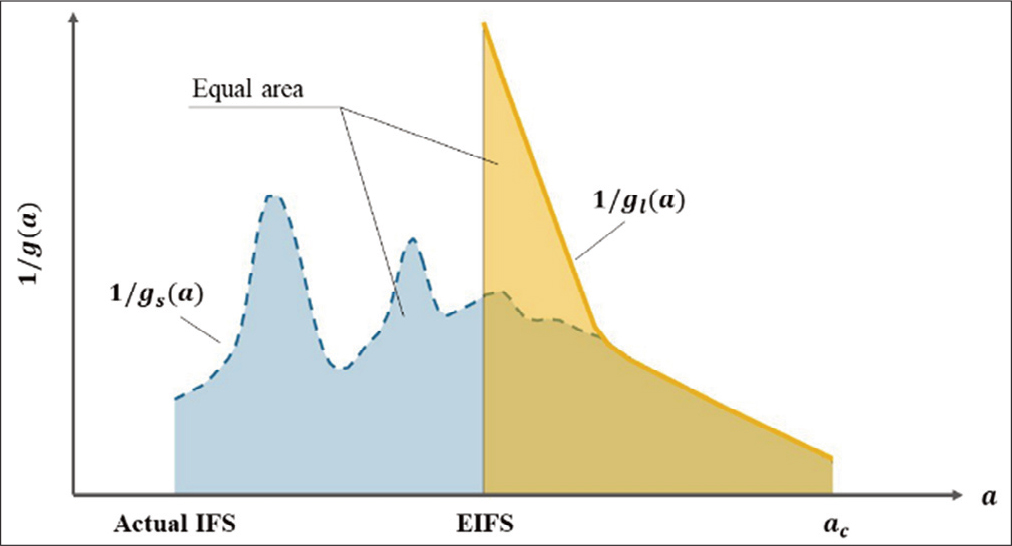
Figure 1.
Graphical illustration of the EIFS concept as an model calibration parameter compared to the physical parameter IFS (Sankararaman et al., 2011).
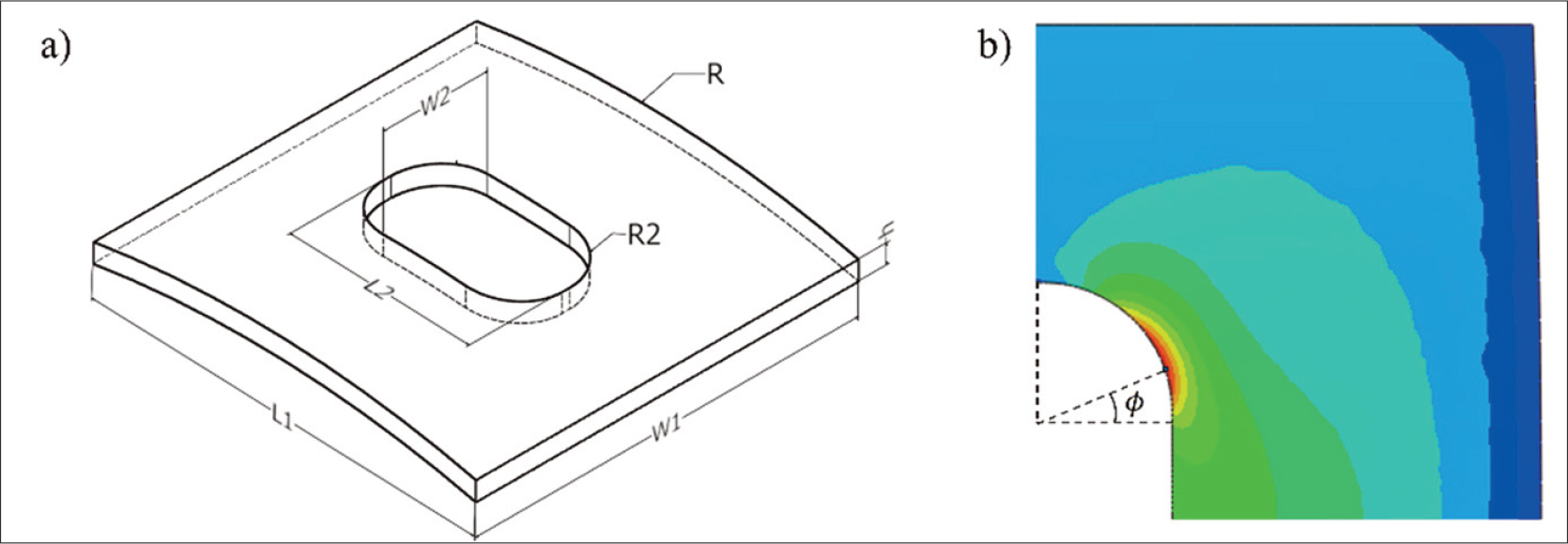
Figure 2.
a) The geometry of the shallow shell fuselage window structure. b) FEA results indicating the stress concentration location with ϕ = 29.24°.
Table 1.
Details of the shell structure parameters and the random variables used in the EIFS inference.
| Parameter | Description | Distribution | Mean | COV |
|---|---|---|---|---|
| W2 | Inner width | Lognormal | 0.468 m | 0.01 |
| L2 | Inner length | Lognormal | 0.273 m | 0.01 |
| R2 | Inner radius | Lognormal | 0.127 m | 0.01 |
| h | Thickness | Lognormal | 0.01 m | 0.01 |
| RK | Radius of curvature | Lognormal | 2.73 m | 0.01 |
| α | Crack initiation angle | Lognormal | 29.24° | 0.05 |
| P | Domain pressure | Lognormal | 7.1 Psi | 0.04 |
| C | Paris law constant | Lognormal | 0.1 | |
| m | Paris law exponent | Lognormal | 3.59 | 0 |
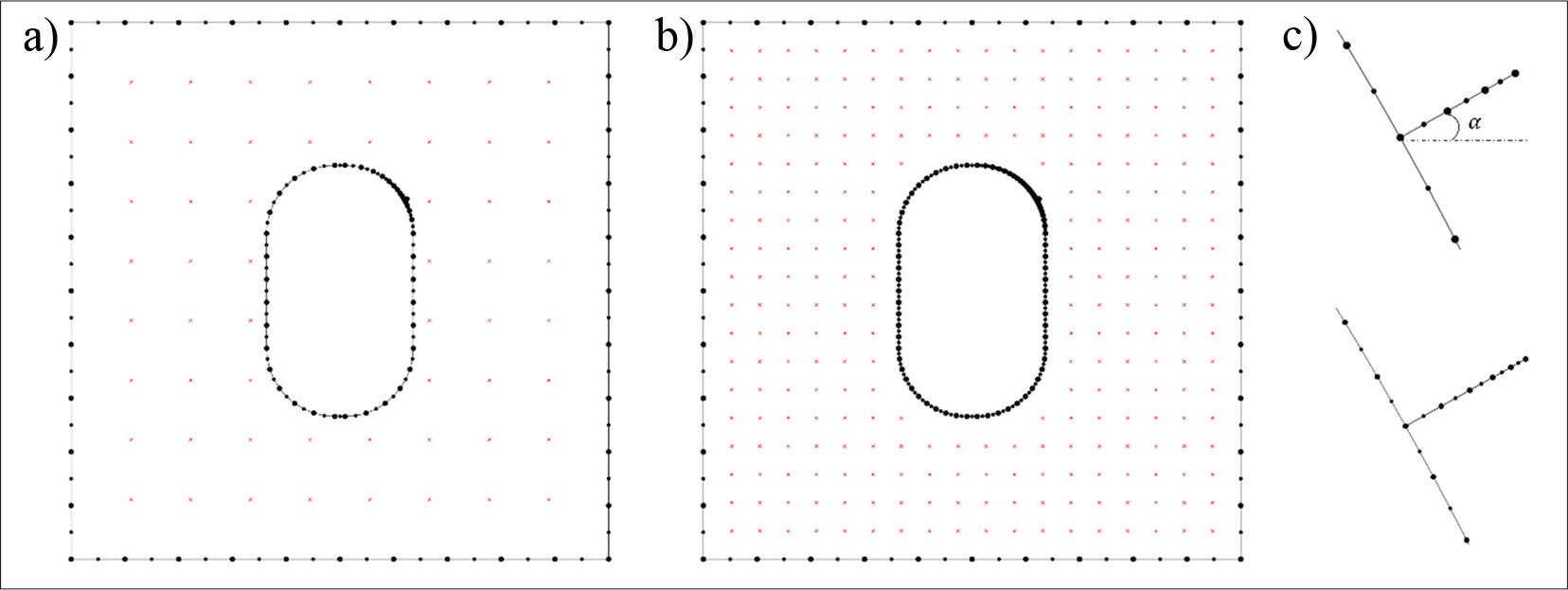
Figure 3.
BEM mesh of the structure: a) coarse mesh used in the low-fidelity model; b) fine mesh used in the high-fidelity model. The DRM points are indicated by red crosses; c) detailed view of the crack tip region for both meshes, along with the definition of the crack initiation angle α.
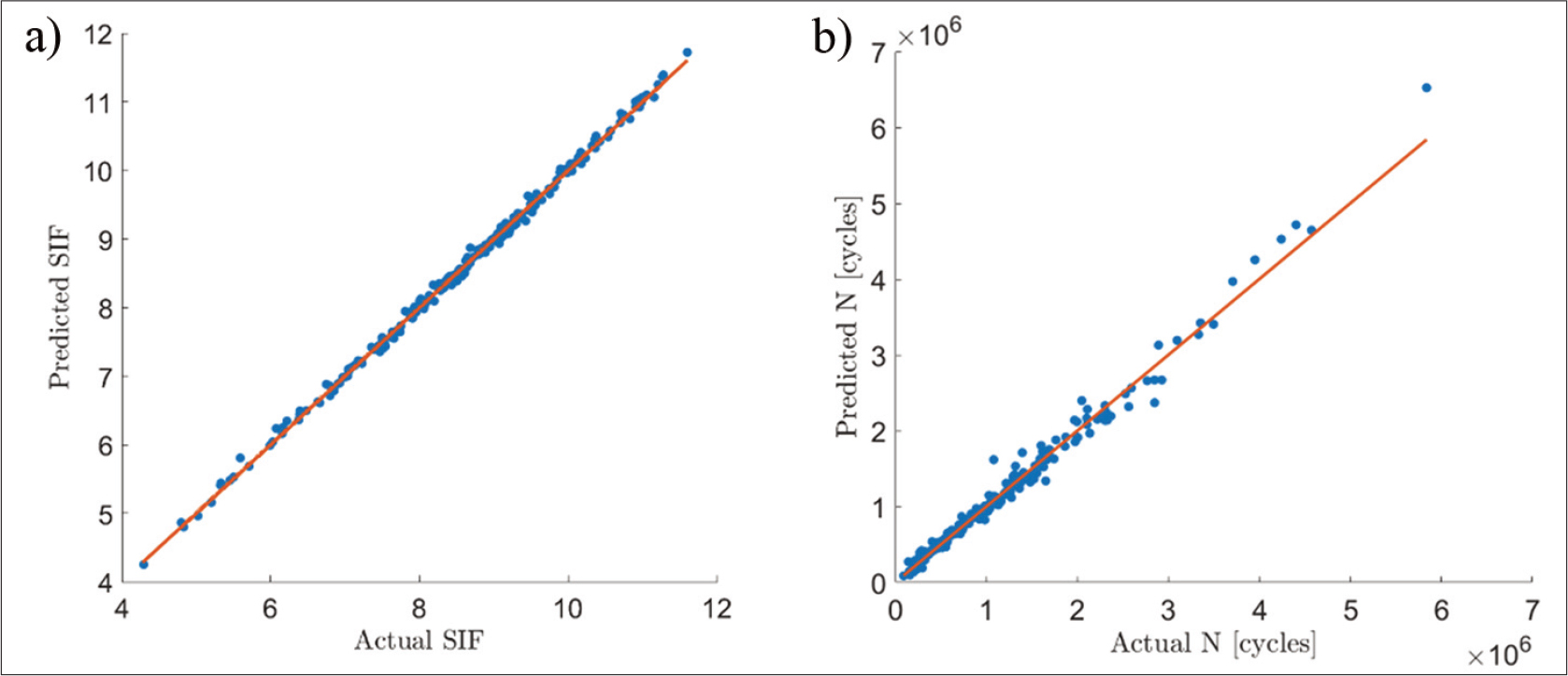
Figure 4.
Prediction errors of the Co-Kriging model compared to the true values generated from DBEM for a) Keff and b) N.
Table 2.
Model errors of the Co-Kriging predictions for Keff and N, compared to the test dataset.
| Model | RRSE (%) | MAPE (%) | MAE | RMSE | R2 |
|---|---|---|---|---|---|
| Keff | 4.613 | 0.621 | 0.998 | ||
| N | 12.376 | 78.035 | 6.887×10⁴ cycles | 1.112×10⁵ cycles | 0.985 |
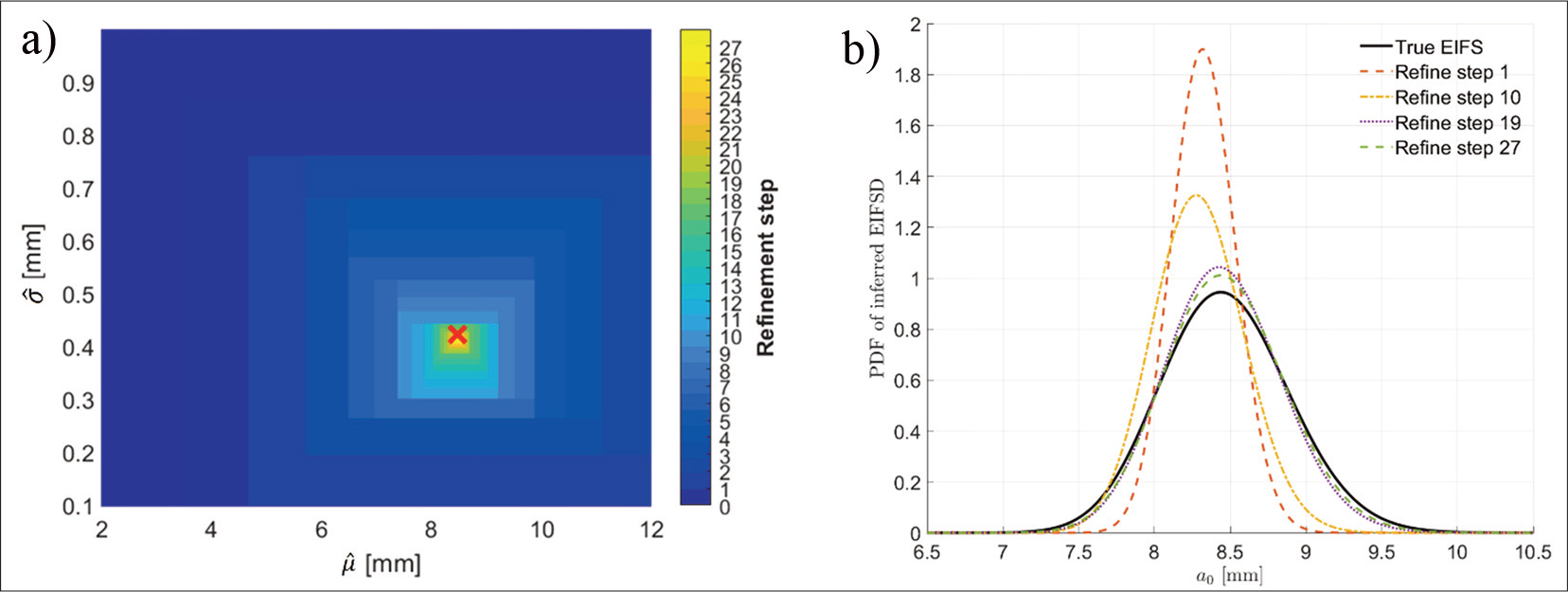
Figure 5.
a) Schematic of the adaptive grid sampling strategy, showing the progressive subdivision of the trial space into regions with higher posterior probability; b) Comparison of the inferred EIFSD at the end of each refinement step.
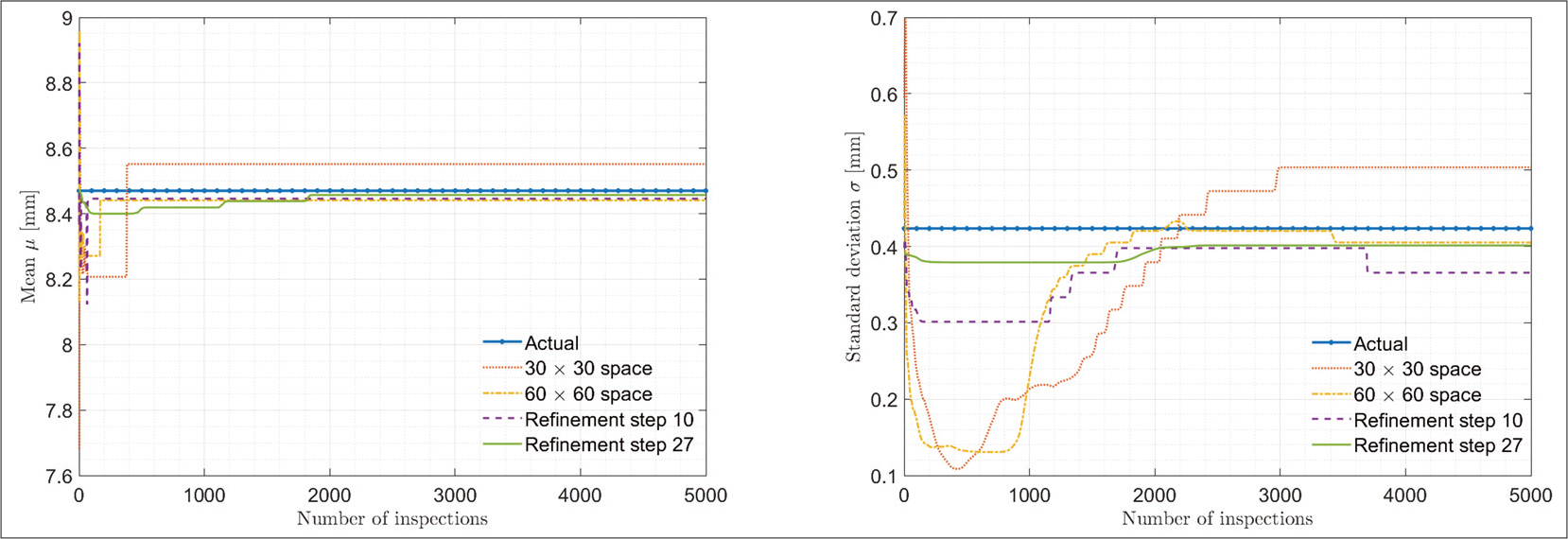
Figure 6.
Convergence of the EIFSD mean and standard deviation from Bayesian inference with different ntrial of the trial space.
Table 3.
Convergence results of the inferred mean and standard deviation from Bayesian inference, along with the associated computational cost in terms of CPU time.
| CPU time | ||||||
|---|---|---|---|---|---|---|
| Model | θμ | error (%) | θσ | error (%) | Bayesian (s) | MCS (hrs) |
| True EIFSD | 8.470 | × | 0.424 | × | × | |
| ntrial = 30 | 8.552 | 0.968 | 0.503 | 18.9 | 7.88 | 1.15 |
| ntrial = 60 | 8.440 | 0.354 | 0.406 | 4.02 | 79.46 | 4.59 |
| Adaptive (27 steps) | 8.465 | 0.059 | 0.401 | 5.20 | 75.12 | 2.21 |