
Table 1.
Configuration of the analysed series of FMLs
| Series | Configuration of FRP laminate layers | Laminate code |
|---|---|---|
| S1_0 | 3x PA6-GF60 | [0G/90G/0G/Alu]s |
| S1_90 | 3x PA6-GF60 | [90G/0G/90G/Alu]s |
| S2_0 | 3x PA6-GF60 | [0G3/Alu]s |
| S2_90 | 3x PA6-GF60 | [90G3/Alu]s |
| S3_0 | 1x PA6-CF60/4x PA6-GF60 | [0C/0G4/Alu]s |
| S3_90 | 1x PA6-CF60/4x PA6-GF60 | [90C/90G4/Alu]s |
| S4_0 | 1x PA6-CF60/4x PA6-GF60 | [0C/90G/0G/90G/0G/Alu]s |
| S4_90 | 1x PA6-CF60/4x PA6-GF60 | [90C/0G/90G/0G/90G/Alu]s |
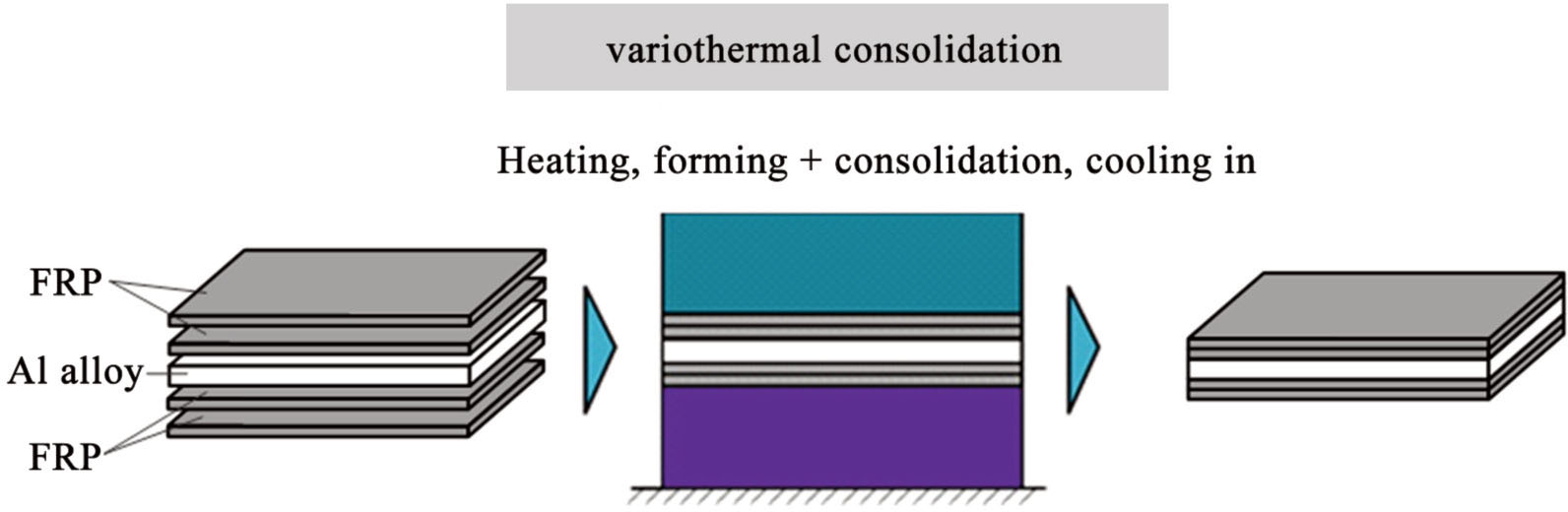
Figure 1.
Diagram of the process of forming an analysed FML (InverTec laminate). FMLs, fibre metal laminates; FRP, fibre-reinforced polymer.
Table 2.
Parameters of variothermal consolidation of InverTec inverted laminate sheets
| Pressure (bar) | Temperature (°C) | Time (min) | |
|---|---|---|---|
| Heating and plasticising of polymer matrix | 20 | 260 | 6.5 |
| Consolidation of the FRP composite | 30 | 260 | 3.5 |
| Cooling phase and solidification of the polymer melt | 30 | 601 | 6.5 |
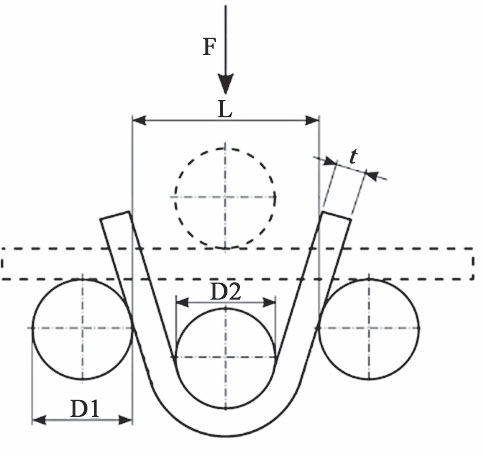
Figure 2.
Scheme of the three-point bend test.
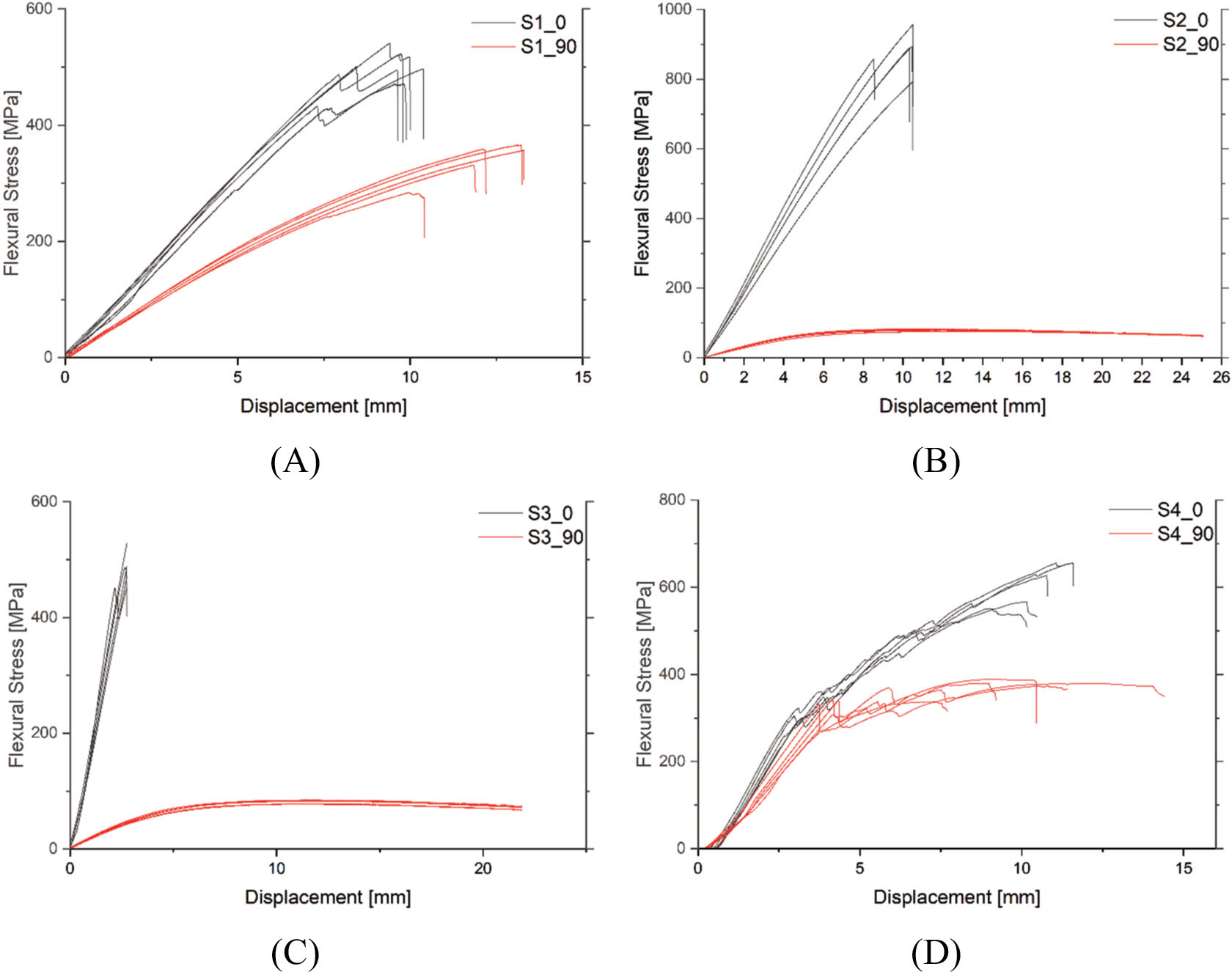
Figure 3.
Results of the static three-point bend tests presented by flexural stress vs. displacement graphs, for specimens’ series: S1 (A), S2 (B), S3 (C) and S4 (D).
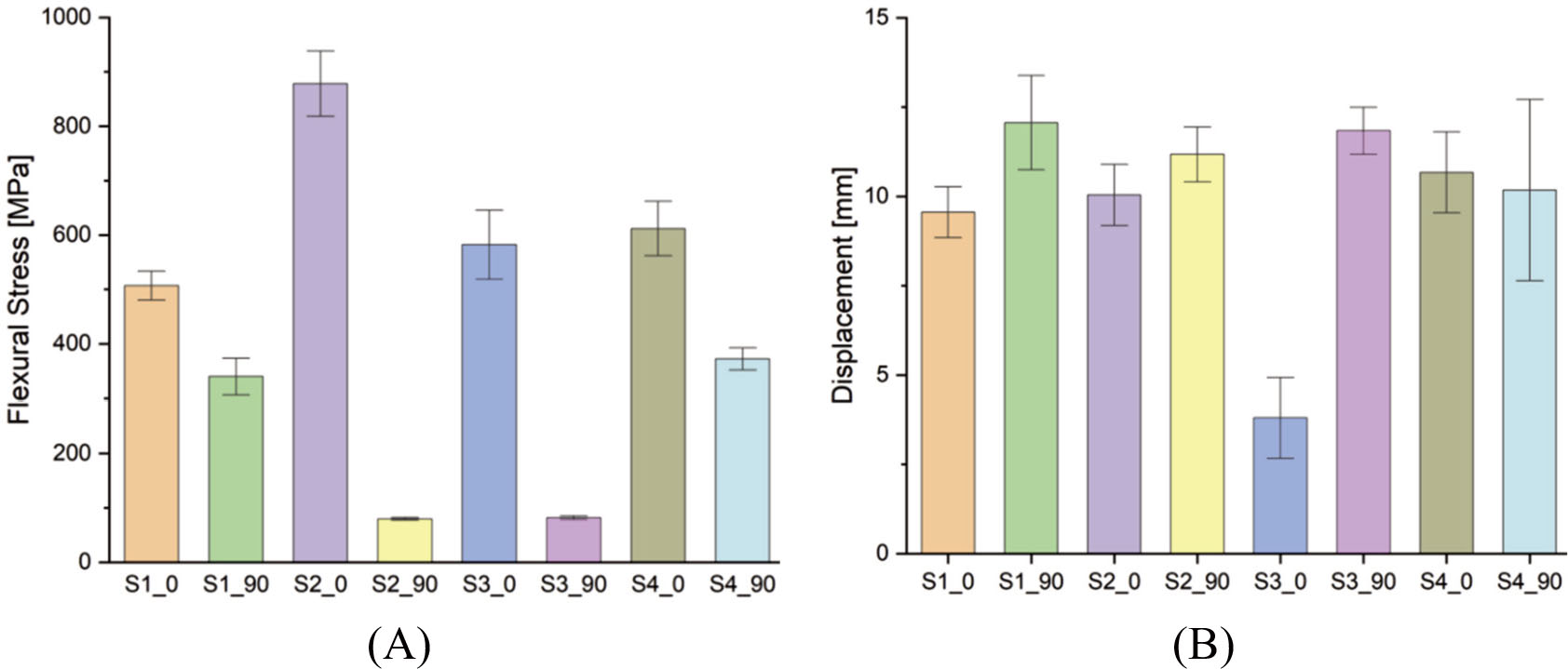
Figure 4.
Results of the static three-point bend test: values of flexural stress (A) and displacement to failure (B).
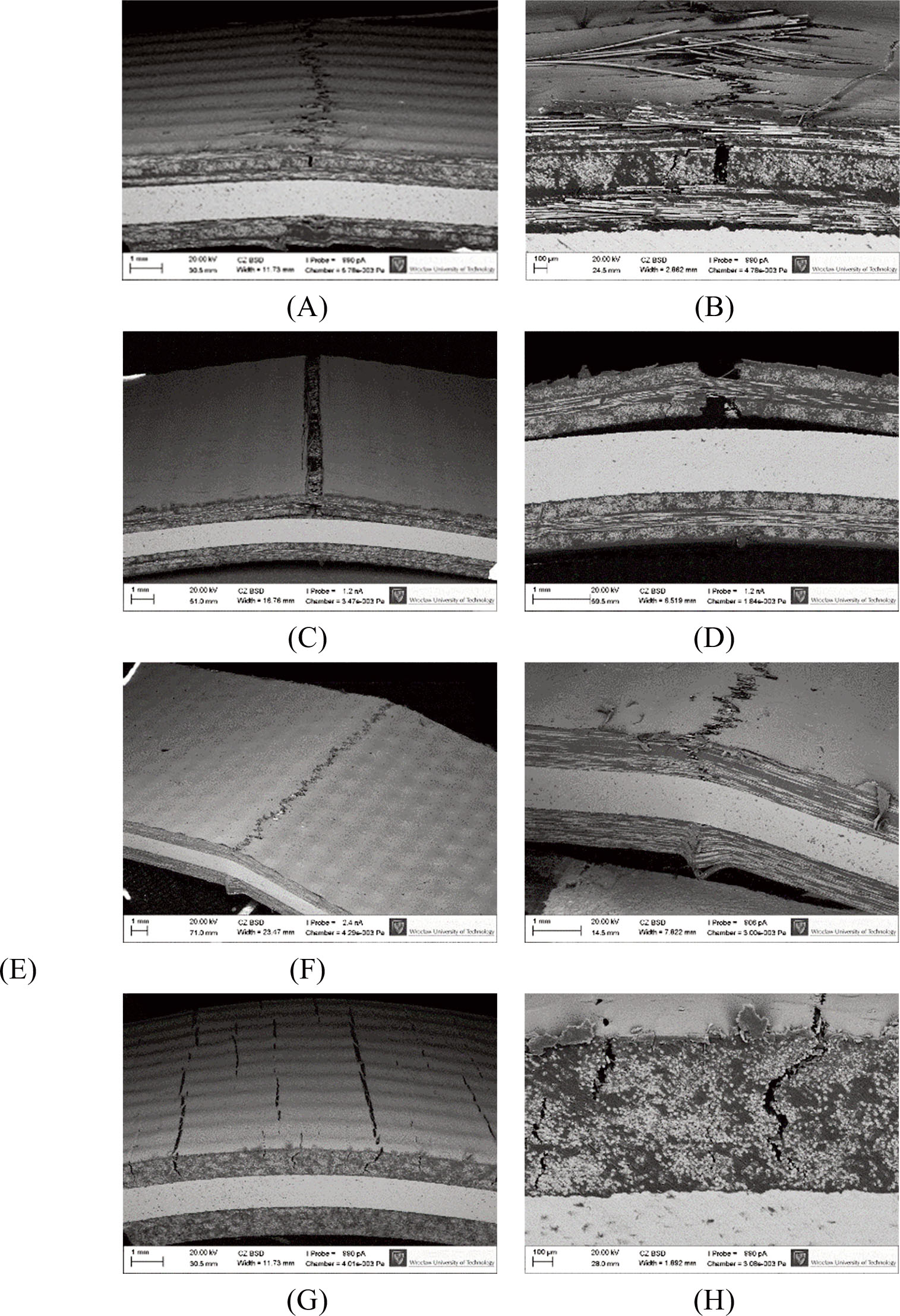
Figure 5.
Views of the damage of specimens caused by the bending test for series: S1_0 (A), (B), S1_90 (C), (D), S2_0 (E), (F), S2_90 (G), (H).
Table 3.
Results of the fatigue bend test of the S1_0 series specimen
| S1_0 | ||||||
|---|---|---|---|---|---|---|
| No. | Amplitude (mm) | Max. fatigue flexural stress (MPa) | % of flexural stress | Min. fatigue flexural stress (MPa) | % of flexural stress | Number of cycles |
| 1 | 4,04 | –245.61 | 44.69 | −35.11 | 6.39 | 1,000,000 |
| 2 | 4,04 | −346.30 | 63.01 | −99.78 | 18.16 | 396,453 |
| 3 | 4,02 | −365.06 | 66.42 | −102.85 | 18.71 | 335,125 |
| 4 | 4,03 | −254.22 | 46.25 | −37.51 | 6.86 | 1,000,000 |
| 5 | 4,03 | −261.55 | 47.59 | −39.35 | 7.16 | 1,000,000 |
| 6 | 4,04 | −332.21 | 60.45 | −90.44 | 16.45 | 452,144 |
Table 4.
Results of the fatigue bend test of the S2_0 series specimen
| S2_0 | ||||||
|---|---|---|---|---|---|---|
| No. | Amplitude (mm) | Max. fatigue flexural stress (MPa) | % of flexural stress | Min. fatigue flexural stress (MPa) | % of flexural stress | Number of cycles |
| 1 | 4,04 | −508,63 | 57.93 | −203.81 | 23.21 | 183,521 |
| 2 | 4,19 | −539,37 | 61.43 | −219.80 | 25.03 | 78,751 |
| 3 | 4,04 | −549,72 | 62.61 | −220.78 | 25.14 | 131,413 |
| 4 | 4,04 | −479,31 | 54.59 | −139.82 | 15.92 | 1,000,000 |
| 5 | 4,03 | −543,90 | 61.94 | −220.66 | 25.13 | 132,752 |
| 6 | 4,04 | −496,08 | 56.50 | −166.29 | 18.94 | 1,000,000 |
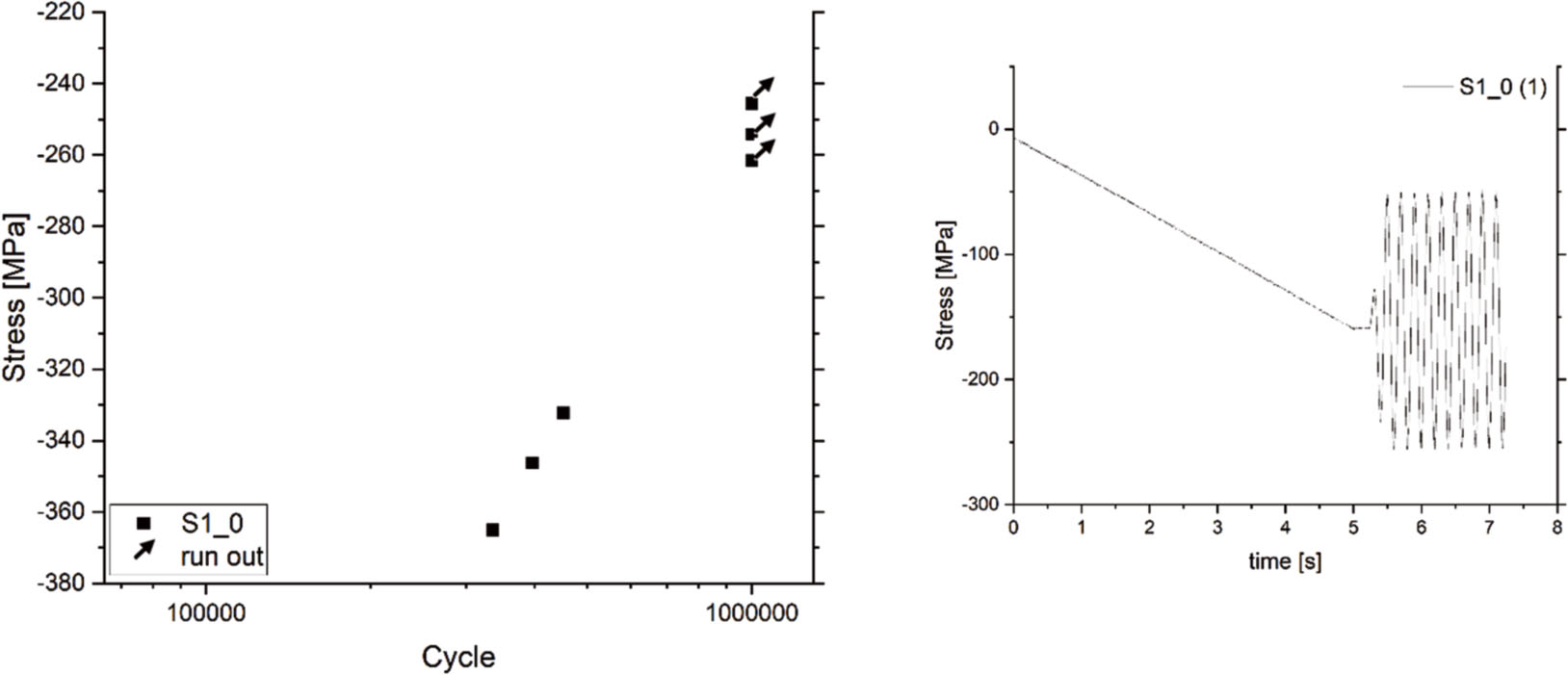
Figure 6.
Results of the fatigue test for S1_0 series specimens. (A) S-N curve and (B) flexural stress–time curve.

Figure 7.
Results of the fatigue test for S2_0 series specimens: (A) S-N curve and (B) flexural stress-time curve.

Figure 8.
Views of the fatigue damage of the specimen series 2 occurred after 130,000 cycles.
Table 5.
Comparison of the static and fatigue flexural strength of the Invertec, CARALL and CAPPAL FMLs
| Type of FML | InverTec FML | CARALL | CAPPAL* | |
|---|---|---|---|---|
| S1_0 | S2_0 | Case 1 Bellini et al. (2019) | Case Zopp et al. (2019) | |
| Static flexural strength (MPa) | 506 ±20 | 878 ±43 | 644–734 | 645 ±16 |
| Fatigue flexural strength (max. number of cycles) | 106 cycles, up to 7% max flexural stress | 106 cycles, up to 19% flexural stress | n.d. | 106 cycles, up to 32% maximum force of bending test |
1* CAPPAL – carbon fibre-reinforced polyamide/ aluminium laminate (Zopp et al., 2019).