
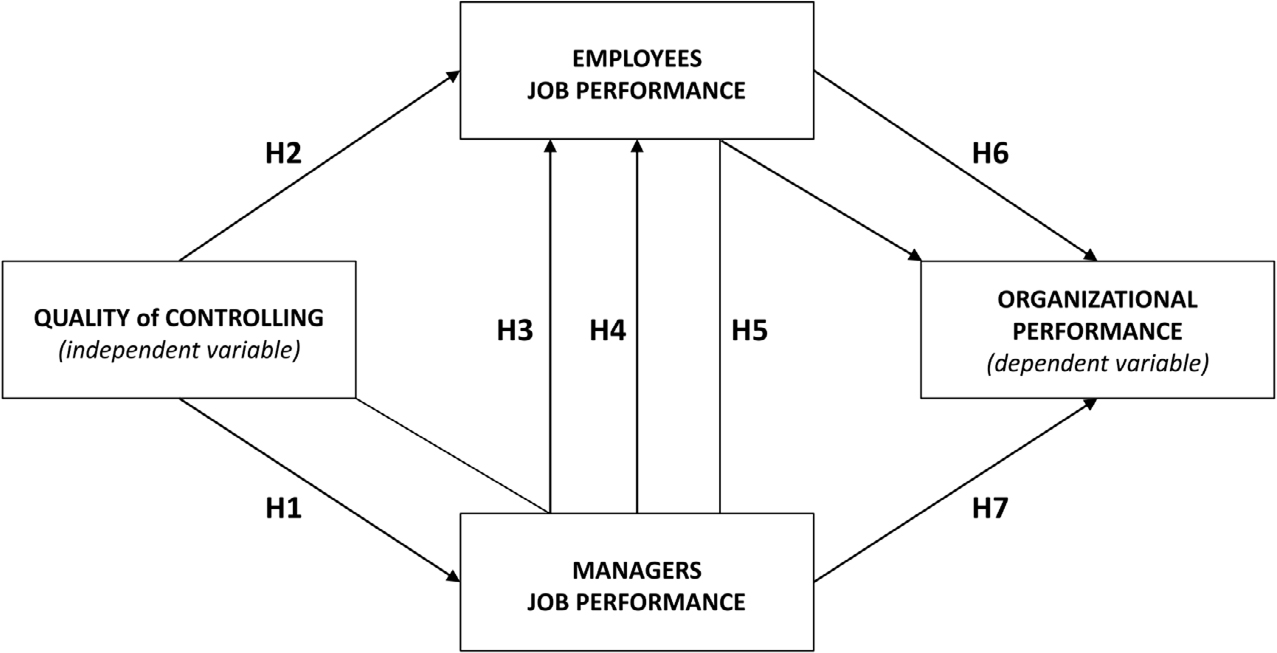
Fig. 1
Structure of the Controlling Effectiveness Model
Tab. 1
Research sample characteristics concerning organisation size and the implementation of controlling
| Organisation sizecontrolling implementation | Controlling is implemented | Controlling is not implemented | Total |
|---|---|---|---|
| Micro (below 10 people) | 21 | 14 | 35 |
| Small (11–50 people) | 66 | 11 | 77 |
| Medium (51–250 people) | 57 | 4 | 61 |
| Large (above 250 people) | 42 | 14 | 56 |
| Total | 186* | 43 | 229 |
Tab. 2
Normality of distribution of control variables
| Control variables | Kołmogorow-Smirnowa | Shapiro-Wilk | ||||
|---|---|---|---|---|---|---|
| Statistic | df | p | Statistic | df | p | |
| The company’s environment is constantly changing | 0.233 | 232 | 0.000 | 0.885 | 232 | 0.000 |
| Changes in the company’s environment are unpredictable | 0.203 | 232 | 0.000 | 0.901 | 232 | 0.000 |
| The company’s environment is complex | 0.264 | 232 | 0.000 | 0.868 | 232 | 0.000 |
| The company offers a lot of different products | 0.250 | 232 | 0.000 | 0.887 | 232 | 0.000 |
| The manufacturing process is routine; tasks are repetitive | 0.214 | 232 | 0.000 | 0.906 | 232 | 0.000 |
| Organisational culture is strong, and employees are sharing it willingly | 0.247 | 232 | 0.000 | 0.890 | 232 | 0.000 |
| Most employees have a higher degree of education | 0.191 | 232 | 0.000 | 0.911 | 232 | 0.000 |
Tab. 3
Defined variables together with the results of the reliability analysis of scales and the test of collinearity
| Variable | No. of Scales | Cronbach’s a | Factor analysis (%) | M | SD | VFI |
|---|---|---|---|---|---|---|
| QCON | 8 | 0.883 | 54.958 | 3.4051 | 0.77834 | 1.936 |
| MPER | 4 | 0.839 | 67.473 | 3.5664 | 0.84513 | 2.283 |
| JPER | 4 | 0.848 | 68.657 | 3.6283 | 0.90450 | 2.354 |
| ORGPER | 10 | 0.883 | 48.762 | 3.4239 | 0.69953 | - |
Tab. 4
Correlation analysis between analysed variables
Tab. 5
Regression Weights
| Estimate | S.E. | C.R. | p | |
|---|---|---|---|---|
| MPER <--- QCON | 0.589 | 0.067 | 8.811 | *** |
| JPER <--- MPER | 0.579 | 0.057 | 10.085 | *** |
| JPER <--- QCON | 0.408 | 0.062 | 6.547 | *** |
| ORGPER <--- JPER | 0.385 | 0.049 | 7.857 | *** |
| ORGPER <--- MPER | 0.307 | 0.052 | 5.856 | *** |
Tab. 6
Standardised Total Effects
| QCON | MPER | JPER | |
|---|---|---|---|
| MPER | 0.589 | 0.000 | 0.000 |
| JPER | 0.749 | 0.579 | 0.000 |
| ORGPER | 0.469 | 0.529 | 0.385 |
Tab. 7
Standardised Direct Effects
| QCON | MPER | JPER | |
|---|---|---|---|
| MPER | 0.589 | 0.000 | 0.000 |
| JPER | 0.408 | 0.579 | 0.000 |
| ORGPER | 0.000 | 0.307 | 0.385 |
Tab. 8
Standardised Indirect Effects
| QCON | MPER | JPER | |
|---|---|---|---|
| MPER | 0.000 | 0.000 | 0.000 |
| JPER | 0.341 | 0.000 | 0.000 |
| ORGPER | 0.469 | 0.223 | 0.000 |
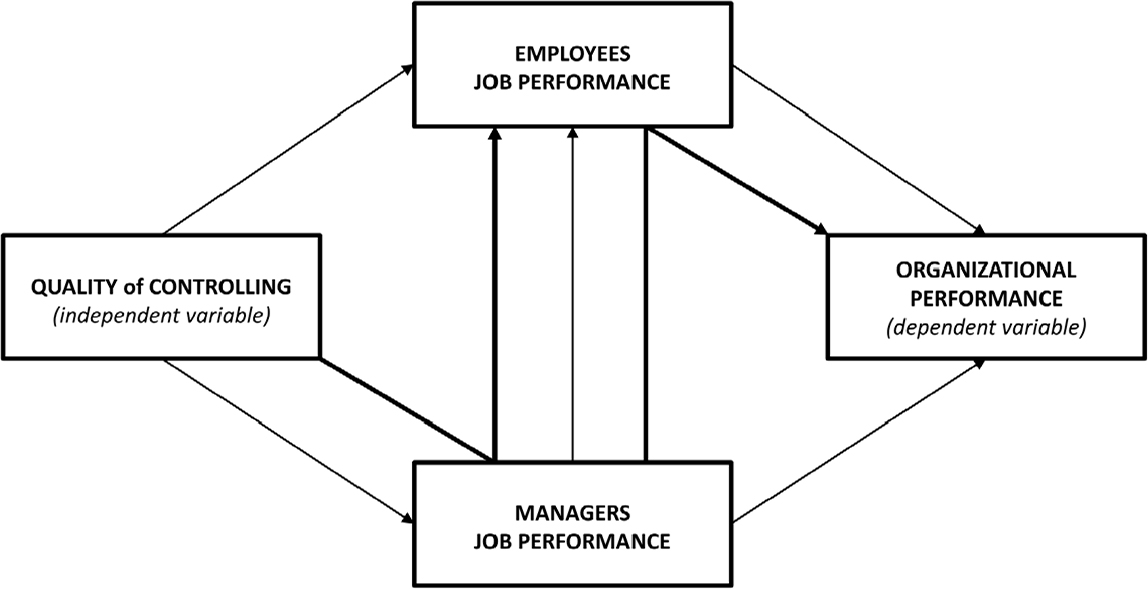
Fig. 2
Verified Controlling Effectiveness Model
Tab. A1
Factor analysis for the variable “quality of controlling”
| Factor analysis | ||
|---|---|---|
| Quality of controlling | Before separation | After separation |
| Reports and analyses provided by controlling do not contain any errors | 1.000 | 0.470 |
| Reports and analyses of controlling are valid and delivered on time | 1.000 | 0.582 |
| The information contained in reports and controlling analyses is reliable | 1.000 | 0.563 |
| The information contained in reports and controlling analyses is indispensable in decision-making processes/improve decision-making | 1.000 | 0.518 |
| Budgets developed by controlling allow rationalising the costs in the company | 1.000 | 0.567 |
| Budgets developed by controlling are an effective control tool in the company | 1.000 | 0.522 |
| Budgets developed by controlling bring order to particular areas of the company | 1.000 | 0.585 |
| Controlling coordination has a positive effect on the objectives of the organisation as a whole | 1.000 | 0.590 |
Tab. A2
Factor analysis for the variable “job performance of employees”
| Factor analysis | ||
|---|---|---|
| Job performance of employees | Before separation | After separation |
| Job quality | 1.000 | 0.701 |
| Job efficiency | 1.000 | 0.699 |
| Punctuality | 1.000 | 0.679 |
| Effectiveness of achieving goals at the workplace | 1.000 | 0.668 |
Tab. A3
Factor analysis for the variable “job performance of managers”
| Factor analysis | ||
|---|---|---|
| Job performance of managers | Before separation | After separation |
| Decision-making effectiveness (accuracy of decisions in terms of substantive expectations, timeliness of decisions, etc.) | 1.000 | 0.721 |
| Work efficiency (saving the resources available to the company) | 1.000 | 0.695 |
| Speed and precision of information transfer | 1.000 | 0.653 |
| Effectiveness of achieving goals at the workplace | 1.000 | 0.629 |
Tab. A4
Factor analysis for the variable “organisational performance”
| Factor analysis | ||
|---|---|---|
| Organisational performance | Before separation | After separation |
| Overall financial situation of the company | 1.000 | 0.461 |
| Job performance | 1.000 | 0.484 |
| Quality of products or services (reliability, diligence) | 1.000 | 0.439 |
| Innovativeness of products or services | 1.000 | 0.438 |
| Modernity of applied technological solutions | 1.000 | 0.468 |
| Efficiency of the organisation management | 1.000 | 0.541 |
| Reliability of business processes | 1.000 | 0.471 |
| Market share | 1.000 | 0.490 |
| Customers satisfaction | 1.000 | 0.567 |
| Employee satisfaction | 1.000 | 0.517 |