
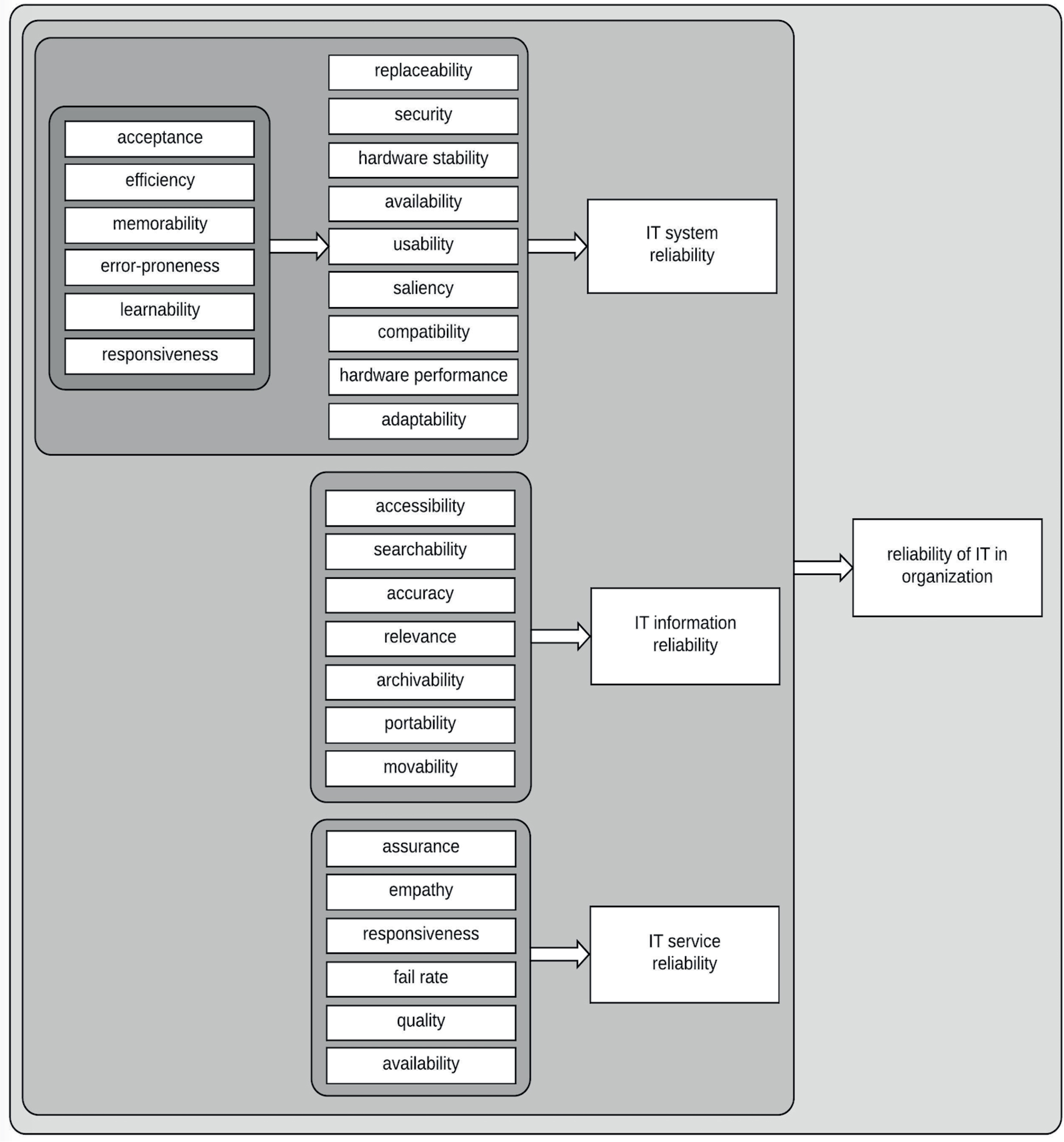
Fig. 1
Verified IT reliability model
Source: (Tworek, 2019).
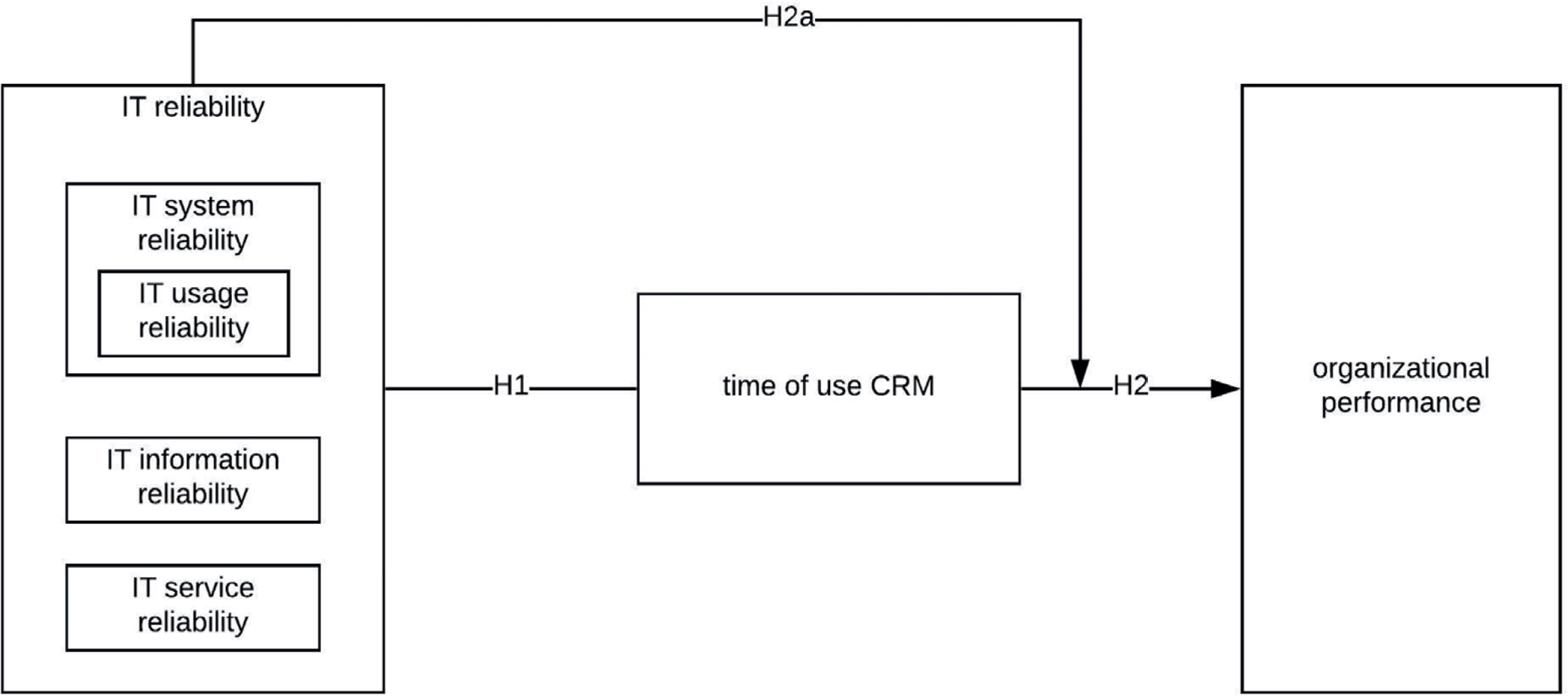
Fig. 2
Developed hypotheses
Tab. 1
Research sample characteristics
| Organisation’s size | Manufacturing organisations | Service organisations | Trade organisations | Total |
|---|---|---|---|---|
| Micro (below 10 people) | 130 | 64 | 27 | 221 |
| Small (11–50 people) | 87 | 144 | 43 | 274 |
| Medium (51–250 people) | 63 | 112 | 73 | 248 |
| Large (above 250 people) | 120 | 184 | 75 | 379 |
| Total | 400 | 504 | 218 | 1122 |
Tab. 2
Defined variables together with the results of the reliability analysis of scales
| No. | Variable | No. of scales | Cronbach’s α |
|---|---|---|---|
| 1 | IT reliability | 28 | 0.953 |
| 2 | CRM time-of-use | 1 | -- |
| 3 | Organisational performance | 4 | 0.911 |
Tab. 3
Correlation analysis between IT reliability and the CRM time-of-use
| Correlation | IT reliability | IT system reliability | IT information reliability | IT service reliability |
|---|---|---|---|---|
| CRM time-of-use | r(1036)=0.408**, p<0.001 | r(1102)= 0.406**, p<0.001 | r(1111)= 0.367**, p<0.01 | r(1115)= 0.394**, p<0.01 |
Tab. 4
Correlation between the CRM time-of-use and the organisational performance
| Organisational performance | |
|---|---|
| CRM time-of-use | r(1117)=0.529**, p<0.001 |
Tab. 5
Research sample characteristics
| Model description | R2 | Delta R2 | Moderator coef. | Standard error | t Stat | P Value |
|---|---|---|---|---|---|---|
| CRM time-of-use, IT reliability, Moderator dependent v.: performance | 0.666 | 0.039 | 0.483 | 0.018 | 2.661 | 0.007 |
| CRM time-of-use, IT system reliability, Moderator dependent v.: performance | 0.668 | 0.040 | 0.474 | 0.016 | 2,801 | 0.005 |
| CRM time-of-use, IT information reliability, Moderator dependent v.: performance | 0.637 | 0.054 | 0.539 | 0.017 | 3.135 | 0.002 |
| CRM time-of-use, IT service reliability, Moderator dependent v.: performance | 0.639 | 0.001 | 0.299 | 0.016 | 1,818 | 0.069 |