
Tab. 1
Definitions and interpretations of RRI
| Author(s) | Definition/Interpretation | Distinguishing elements |
|---|---|---|
| Sutcliffe (2011) | 1. The deliberate focus of research and the products of innovation to achieve a social or environmental benefit 2. The consistent, ongoing involvement of society, from beginning to end of the innovation process, including the public & non-governmental groups, who are themselves mindful of the public good 3. Assessing and effectively prioritising social, ethical and environmental impacts, risks and opportunities, both now and in the future, alongside the technical and commercial 4. Where oversight mechanisms are better able to anticipate and manage problems and opportunities and which are also able to adapt and respond quickly to changing knowledge and circumstances 5. Where openness and transparency are an integral component of the research and innovation process | Social or environmental benefit as the main goal Involvement of society Assessing social, ethical and environmental risks Anticipatory and adaptive Open and transparent |
| Grunwald (2011) | RRI as a new umbrella term with new accentuations which may be characterized by: - involving ethical and social issues more directly in the innovation process by - integrative approaches to development and innovation; - bridging the gap between innovation practice, engineering ethics, technology assessment, governance research and social sciences (STS); - giving new shape to innovation processes and to technology governance according to responsibility reflections in all of its three dimensions mentioned above; - in particular, making the distribution of responsibility among the involved actors as transparent as possible | Distribution of Responsibility Reflection about responsibility at all levels of the innovation process |
| Geoghegan-Quinn (2012) | Responsible Research and Innovation means that societal actors work together during the whole research and innovation process in order to better align both the process and its outcomes, with the values, needs and expectations of European society. RRI is an ambitious challenge for the creation of a Research and Innovation policy driven by the needs of society and engaging all societal actors via inclusive participatory approaches | Alignment of processes and its outcomes with the society’s values, needs and expectations |
| von Schomberg (2012) | A transparent, interactive process by which societal actors and innovators become mutually responsive with a view to the (ethical) acceptability, sustainability and societal desirability of the innovation process and its marketable products (in order to allow a proper embedding of scientific and technological advances in our society) | Multidirectional (mutual) responsibility of societal actors Ethical acceptability Social desirability |
| van den Hoven (2013 and 2014) | Responsible Innovation is an activity or process which may give rise to previously unknown designs either pertaining physical world (...), the institutional world (...) or combinations of these, which when implemented expand the set of relevant feasible options regarding solving a set of moral problems | Providing new options for solving pertaining moral/ethical problems |
| Stigloe et al. (2013) | Responsible innovation means taking care of the future through collective stewardship of science and innovation in the present | Future-oriented look at collective responsibility |
| Owen et al. (2013) | The first and foremost task for responsible innovation is then to ask what futures do we collectively want science and innovation to bring about, and on what values are these based? | Collective nature of RRI processes Future orientation |
| Stahl (2013) | RRI is a higher-level responsibility that aims to shape, maintain, develop, coordinate and align existing and novel research and innovation-related processes, actors and responsibilities with a view to ensure desirable and acceptable research outcomes | RRI as meta-responsibility |
| Pavie and Carthy (2013) | RRI is an iterative process throughout which the project’s impacts on social, economic and environmental factors are, where possible, measured and otherwise taken into account at each step of development of the project, thereby guaranteeing control over, or at least awareness of, the innovation’s impacts throughout the entire life cycle | Relevance for business context Reflection on impact through the entire product life cycle |
| Wilford (2015) | RRI re-engages the individual with personal responsibility at the same time as reinforcing institutional responsibility. This means that RRI creates a step-change in the way that those who are engaged in research and innovation should consider the impact of what they do | Combination of personal responsibility and institutional responsibility |
| Gianni (2016) | RRI is a model and an active process by which we can achieve the social objectives set by the European Commission, i.e. the development of research and innovation for the sake of increasing the general level of well-being in democratic societies. | Duality of RRI: model (normative dimension) and process (processual dimension) RRI valid in a democratic society |
Tab. 2
Conceptual distinction between normative and processual approach to RRI
| Responsible Research and Innovation | RRI as a normative goal | To tackle the Grand Challenges, solve moral/ethical issues connected scientific and technological development |
| RRI as a normative process | Making sure that the R&I activities follow the principles of anticipation, inclusion, reflexivity and responsiveness |
[i] Source: author’s elaboration on the basis of (Ceicyte, 2019).
Tab. 3
Boundaries of the research field and research focus regarding RRI
| Responsible Research and Innovation | ||||||||
|---|---|---|---|---|---|---|---|---|
| Research Subdiscipline | Public Governance | Science and Technology Studies | Business Ethics / CSR | Philosophy of Management | Innovation and Technology Management | |||
| Systemic dimension | micro | meso | macro | |||||
| Sectoral dimension | Industry/Business | Public Administration/Policy Bodies | Universities and Research Institutions | |||||
| Organisational dimension | Micro (individuals in an organisation) | Meso (teams) | Macro (organization as a whole) | |||||
| Place in innovation ecosystem | Input | Throughput | Output | |||||
| Innovation type | Low-tech innovation | High-tech innovation | ||||||
[i] Source: author’s elaboration on the basis of (Ceicyte, 2019).
Tab. 4
Examples of RRI maturity models
| Maturity level | Level name byPavie et al. (2014) | Level name-byStahl et al. (2017) | Level name-byHedstrom (2019) |
|---|---|---|---|
| 1 | Comply with the law | Unaware | Engaging |
| 2 | Anticipating future legal requirements | Exploratory/reactive | Accelerating |
| 3 | Thinking the value chain as an ecosystem | Defined | Leading |
| 4 | Developing responsible products and services | Proactive | Transforming |
| 5 | Leading the change (communicating and educating to responsibility, create standards, developing responsible business models) | Strategic | - |
[i] Source: author’s elaboration on the basis of (Stahl et al., 2017; Pavie et al., 2014).
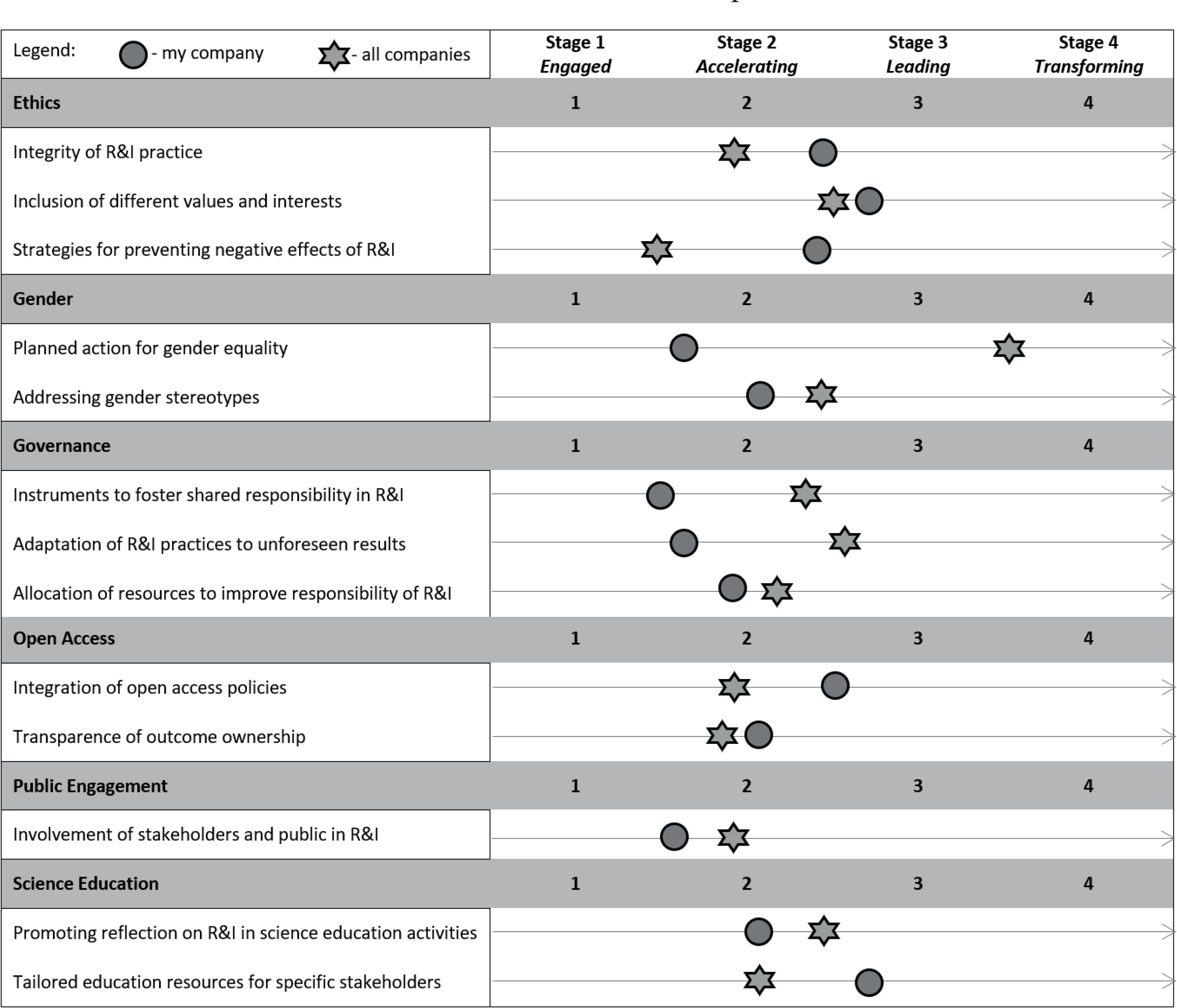
Fig. 1
Example of a RRI scorecard
Source: author’s elaboration on the basis of (Pavie et al., 2014; Hedstrom, 2019) and RRI Tools.