
1. Introduction
Hunting tourism is a very specialized form of tourism, but it is also a part of hunting and game management. The primary objective is to provide tourists with an active stay focused on recreational hunting experiences in a preserved natural environment (Matejevic et al., 2022). Hunting tourism activities are primarily motivated by the opportunity to hunt specific game species (Brainerd, 2007; Leader-Williams, 2009; Nygård & Uthardt, 2011). In addition to this main motive, research has shown that a whole range of other motives also drive hunters to travel to remote hunting destinations.
As Żywiołek et al. (2023) indicate, hunters could be seen as tourists with special requirements. In their study, they emphasise that in hunting tourism nowadays, besides hunting, it is becoming more important to offer newer technological solutions, comfort, and modernity to hunters. Hence, it is important for those who organise hunting tourism activities to know how they can satisfy the tourists’ expectations in accordance with sustainable development principles. A hunting tourism destination should be developed in a manner that ensures optimal conditions for the wildlife species and provides appropriate conditions for the sustainable implementation of hunting tourism activities.
However, there has been insufficient research on hunting tourism destinations. These destinations are distinctive because they serve both as wildlife habitats and as settings for hunting tourism activities. Many authors have analysed destination attractiveness in general, identified its dimensions, and measured attractiveness from a supply and demand perspective (Formica & Uysal, 2006; Gearing et al., 1974; Vengesayi et al., 2009). However, the attractiveness of hunting tourism destinations has not been the subject of much research so far. Previous studies focused primarily on hunter satisfaction and defined factors influencing hunting tourism behaviour (Brunke & Hunt, 2007; Gigliotti, 2000; Gruntorad et al., 2020; Manfredo et al., 2004; Matejevic et al., 2022; Matejevic et al., 2023; Schroeder et al., 2018, 2019; Vaske et al., 1982). Hunting tourism could be an important factor in rural development and bring significant economic benefits to rural communities (Mbaiwaa & Stronza, 2010; Naidoo et al., 2016; Samuelsson & Stage, 2007; Sharp & Wollscheid, 2009;). Funds raised by hunting tourism are returned to rural regions by direct investment in sustainable wildlife management (Leader-Williams, 2009). A deeper understanding of hunting tourism destination could provide opportunities for additional improvements and development of rural areas.
The concept of hunting tourism destination attractiveness is insufficiently conceptualised in the literature, since most destination attractiveness models have been developed for general tourism or nature-based tourism and do not account for specific characteristics of hunting tourism destinations such as wildlife-related attributes, professional management, safety standards, and hunting tourism infrastructure. There is a lack of a structured evaluation framework that can integrate wildlife, hunting, and tourism-related dimensions into a unified model of hunting tourism destination attractiveness.
This paper aims to evaluate the attractiveness of hunting tourism destinations from the experts’ point of view. In the context of hunting tourism, the presence of public criticism can make it challenging for tourist hunters to engage in surveys. Additionally, hunting destination managers often hesitate to approach them with such requests. As a result, only a limited number of studies in the literature specifically focused on surveys targeting tourist hunters, particularly within Europe. Most existing research tends to include hunters in general, without distinguishing between those who are tourists and those who are not or assessing their frequency of participation in hunting tourism activities. Thus, the present study focused on experts’ opinions. To evaluate the criteria weight for the selection of key factors that are important for hunting destination attractiveness from the experts’ point of view, the authors first developed a hierarchy-structured model (Figure 1) and then applied the Analytic Hierarchy Process (AHP) method. The overall goal of the study was the identification of the most important elements of hunting tourism destinations that influence their attractiveness. To achieve this aim, a hierarchical multi-criteria model was developed, structuring hunting tourism destination attractiveness into a system composed of an overall goal, main criteria, and sub-criteria. The AHP method was employed to determine the relative weights of the identified factors based on expert judgement. This approach enables a systematic and transparent evaluation of hunting tourism destinations, characterised by multiple interrelated attributes, and contributes to the theoretical understanding of hunting tourism by extending the concept of destination attractiveness to a very specialised form of wildlife tourism.
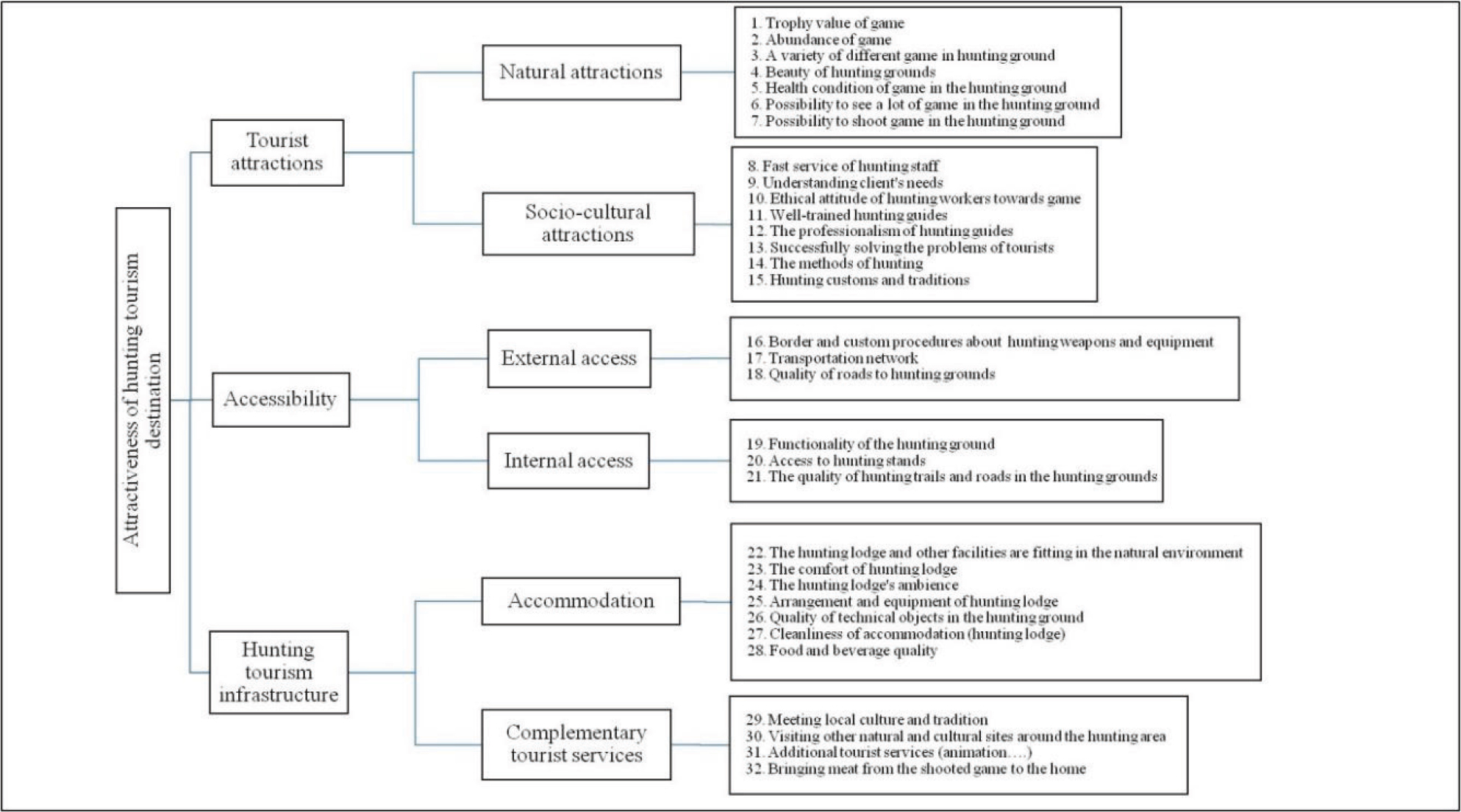
Figure 1:
Hierarchical multi-criteria model of attractiveness of hunting tourism destination
2. Literature review
The hunting tourism product represents an integrated set of products, services, and other tourist values in the function of satisfying hunters, and it should be designed to meet the demands of hunter tourists (Matejevic et al., 2023). Bauer and Herr (2004) pointed out that a hunting tourism product is an organised and paid trip where the main goal is the satisfaction of the needs of hunters in the natural environment. In addition to the act of hunting itself, hunters participate in hunting activities to discover new hunting destinations, gain new hunting experiences, escape everyday life, meet friends and new hunters, and mostly to be in clean, untouched nature and observe wild animals in their natural environment (Gigliotti, 2000; Manfredo et al., 2004; Radder, 2005).
However, hunting is still the main motivation for hunters, and it is especially important for them that hunting activities are professionally organised (Matejevic et al., 2022; Matejevic et al., 2023). Kalábová (2023) points out that hunters increasingly travel to remote countries to hunt, searching for adrenaline experiences, but expecting quality accommodation and additional services. Suni (2018) investigated the motivation and preferences of Finnish hunters and concluded that they are not a homogeneous group. His results showed that Finnish hunters are motivated by novelty, new experiences, and the social aspects.
Previous research on hunting tourism has focused predominantly on the demand side. Some of this research has analysed the relationship between the quality of hunting tourism products and tourist satisfaction, as well as hunters’ preferences when choosing hunting destinations (Gruntorad et al., 2020; Han & Radder, 2011; Schroeder et al., 2019). However, most research has focused on hunters in general, not on tourist hunters specifically. Decker et al. (1980) analysed satisfaction in 12 components of hunting (wildlife hunting skills, social interactions, and nature/sport), and Vaske et al. (1982) examined overall hunting satisfaction based on wildlife dimensions, social dimensions, and nature/sport dimensions. However, later studies by Gigliotti (2000) and Brunke & Hunt (2007) suggested that other success-related factors (for example, observing game or having the opportunity to harvest) had a more significant influence on overall hunter satisfaction. The most recent studies on hunting satisfaction (Gruntorad et al., 2020; Schroeder et al., 2018, 2019) have suggested that harvesting has only a moderate impact on hunter satisfaction, highlighting the importance of appreciative experiences, such as enjoying nature, particularly among non-successful hunters.
Suni (2018) was among the first to investigate the push and pull factors motivating hunting tourists. He identified several pull motivators for Finnish hunting tourists, including tourism services (accommodation, accessibility, additional services), destination novelty (the opportunity to observe and hunt new species and to experience new cultures), costs (accommodation prices and hunting licence fees), and hunting ground and destination suitability (attributes such as size, travel distance, accessibility of the hunting ground, proximity of accommodation, and number of hunters in the area).
On the other hand, Matejevic et al. 2022 and Matejevic et al. 2023) analysed the relationship between the quality of hunting tourism products and overall tourist satisfaction among European hunting tourists. The results of these studies showed that accommodation elements (comfort, ambiance, arrangement, and equipment of the hunting lodge) and additional tourist services were not important for overall satisfaction. They found that hunting tourists highlight natural characteristics of hunting grounds (game-specific factors and habitat) and human resources (professional and experienced hunting managers) as the most important elements of the hunting tourism product (Matejevic et al., 2023). Other research showed that “opportunity to see” and “to shoot game” most affected hunter satisfaction and that the variety of game species, large population size, health of game populations, and the trophy value of game were significant determinants of hunter tourists’ satisfaction (Matejevic et al., 2022). Sainsbury et al. (2024) discovered that waterfowl hunter trip preferences are influenced by factors such as the harvest availability, aversion to difficult access, shorter travel distances, and the desire to see large numbers of waterfowl without competition or interference from other waterfowl hunters. These findings align with previous research conducted by Vaske et al. (1986), Schroeder et al. (2006), and Brunke & Hunt (2007).
Many studies have been conducted on the attractiveness of tourism destinations. Lee et al. (2010) pointed out that the most common approach to estimating the attractiveness of a tourism destination is through a panel of experts, since they are familiar with destination resources and are in contact with consumer groups. Gearing et al. (1974) defined five groups of attractiveness attributes: (1) natural factors, (2) social factors, (3) historical factors, (4) recreational and shopping facilities, and (5) infrastructure, food, and shelter. Formica and Uysal (2006) distinguished four dimensions of a destination’s attractiveness: tourism services and facilities, cultural/historical elements, rural lodging, and outdoor recreation. Vengesayi et al. (2009) stated that destination attractions are the most important determinants of destination attractiveness. They point out that attractions, support services, and people-related factors influence the attractiveness of a destination, but they have different effects on destination attractiveness. According to Vengesayi et al. (2009) accommodation facilities and services and people-related factors are secondary determinants of destination attractiveness. However, they also indicated that people-related factors make a higher contribution than supporting services.
Lee et al. (2010) analysed the attractiveness of forest recreation tourism using the AHP method and identified tourist attractions as the most important dimension, followed by accessibility. Within this dimension, they found natural resources as the strongest factor influencing attractiveness. The most crucial element in terms of accessibility was external access.
Gu et al. (2022) focused their research on evaluating the attractiveness of nature-based tourism destinations using a fuzzy AHP approach. They distinguished four dimensions of attractiveness: tourist attractions, accessibility, development conditions, and complementary services. The results were very similar to those of Lee et al. (2010). Tourist attractions and accessibility were the most important dimensions, with natural attractions and external access being the most influential factors.
Studies evaluating destination attractiveness have increasingly applied multi-criteria decision-making (MCDM) methods. For instance, Lee et al. (2010) employed the AHP method to assess forest recreation destinations and identified attractions and accessibility as dominant dimensions. Similarly, Gu et al. (2022) applied fuzzy AHP in nature-based tourism destinations and confirmed the primacy of natural attractions and external access. More recent research has explored hybrid and fuzzy decision-making frameworks. Qin et al. (2025) proposed a hybrid model integrating fuzzy neural networks (FNN) with AHP-FCE (fuzzy comprehensive evaluation) to evaluate tourism resources, demonstrating how neural learning mechanisms can enhance weighting accuracy in hierarchical evaluation systems. Jewpanya et al. (2025) applied both AHP and fuzzy AHP to optimise tourist destination selection based on individual preferences, illustrating methodological differences in addressing uncertainty and subjective judgements. These studies highlight methodological differences in handling expert judgements, uncertainty, and weighting criteria, and they demonstrate the flexibility of hierarchical decision-making methods in tourism research. However, these studies focus on general or nature-based tourism and do not address the specific ecological, managerial, and regulatory characteristics of hunting tourism destinations. Unlike other forms of nature-based tourism, hunting tourism depends on game population quality, professional wildlife management, safety standards, and controlled resource use.
In the context of hunting tourism, the destination is specific and has its own special elements. On the one hand, a hunting tourism destination is the habitat of certain game species. On the other hand, a hunting tourism destination is a place where tourist hunting activities are carried out and represents a very specific tourist destination (Prentovic, 2014). As a game habitat, the destination must provide optimal conditions for different wild animals. However, it is also very important for hunting tourism destinations to be functional and to allow for tourist hunts that will, above all, be safe for all participants and the environment. Matejevic et al. (2022) identified several fundamental elements of a hunting tourism destination, such as attractions, facilities and services, and accessibility. The primary attractions of a hunting tourist destination are game species of sufficient quality and abundance, as well as suitable hunting areas, hunting facilities. and personnel working in hunting grounds (Matejevic et al., 2022; Prentovic, 2014). Accessibility (distance to the major traffic corridors, airports, or waterways; quality of roads, etc.) is another important element of a hunting tourist destination, as well as the accommodation facilities available for tourist hunters.
Hunting tourism destinations, like other tourism destinations, vary considerably in their attractiveness. One of the primary elements of a destination is the presence of specific wild game species. However, the existence of a particular game species in high quality and significant quantity does not always imply that a large number of tourists will be attracted by these characteristics. As mentioned above, other factors also significantly influence tourist satisfaction with hunting tourism products. Given that the attractiveness of a hunting tourism destination is a multidimensional construct encompassing ecological, infrastructural, and managerial components, a structured evaluation method is required. AHP is a suitable method because it enables the hierarchical organisation of criteria and the estimation of their relative importance.
Although AHP has been widely used in tourism destination evaluation, its application to hunting tourism remains limited. This study addresses that gap by adapting destination attractiveness theory to hunting tourism and by empirically applying AHP to determine the relative importance of its key dimensions. In doing so, the study advances the conceptualisation of attractiveness in this specific tourism niche and provides a practical decision-support tool for destination management.
3. Methodology
3.1. Research design
AHP is a method for measuring for destination attractiveness that incorporates expert evaluations of existing attractions and resources at a given destination. Developed by Saaty (1980), AHP is designed to address decision-making challenges in complex, multi-criteria scenarios. AHP facilitates decision-making involving numerous interrelated and often conflicting criteria, and it establishes priorities among decision criteria when they are established within the context of the decision objective (Shapira & Goldenberg, 2005).
Božić et al. (2015) emphasised that AHP has been utilised in various tourism contexts that involve complex decision-making. Their findings indicated that AHP is one of the most commonly employed Multi-Criteria Decision Making (MCDM) methodologies within the tourism and hospitality sectors, with key areas of research including location selection, service quality, ecotourism, marketing, and tourist destinations. They also noted that the majority of studies using AHP depend on expert opinions.
The AHP method uses responses gathered from participants to systematically assess different options and evaluate their influence on the ultimate decision-making objective. The objective of AHP is to decompose even the most intricate problem into a hierarchical structure, facilitating systematic analysis. This organisation demons trates that AHP is a technique that considers multiple factors. The various components of the hierarchy are interrelated, making it readily apparent how modification of one element impacts the others (Harker & Vargas, 1987).
The preferences for the set of elements at a specific level of a decision-making hierarchy are determined by the specific comparative technique used with the AHP method. This technique employs pairwise comparisons of the elements with regard to the elements at the higher level. This employs Saaty’s scale, which is comprised of 1, 3, 5, 7, and 9, where 1 indicates equal importance and 9 indicates the absolute significance of one element over another (Table 1).
Table 1:
Scales of relative importance
| Intensity of importance on an absolute scale | Definition |
|---|---|
| 1 | Equal importance |
| 3 | Moderate importance of one over another |
| 5 | Essential or strong importance |
| 7 | Very strong importance |
| 9 | Extreme importance |
| 2, 4, 6, 8 | Intermediate values between the two adjacent judgements |
[i] Source: Saaty, T. L. (1980). The Analytic Hierarchy Process. McGraw-Hill
A relevant index value is assigned to the matrix A if element i is more significant than element y. Conversely, if the judgement is that y is more significant than i, the reciprocal of the relevant index value is assigned to matrix A. Positive reciprocal quadratic matrices are utilised to store the outcomes of each comparison. The subsequent phase of the AHP method involves the calculation of the eigenvector for each matrix using the conventional AHP method. The principal eigenvector of a comparison matrix is employed to calculate the local priority vector, as suggested by Saaty (1980). This is illustrated in greater detail in the subsequent section. The outcome of comparing elements i and y is recorded in matrix A at position a.
The reciprocal value of the comparison results is placed in position ayi to maintain consistency in the judgements. Respondents compare n elements and input the results into matrix A. Once all pairwise comparison matrices are established, the weight vector w = [w1, w2,…,wn] is calculated using Saaty’s eigenvector method. This calculation involves two steps: first, normalizing the pairwise comparison matrix A=[aij]n×n using Equation (1), and then computing the weights with Equation (2).
Normalisation:
Weights calculation:
for all i = 1, 2,…, n.Saaty (1980) demonstrated that the pairwise comparison matrix A and the vector weights w are interdependent. The final stage of the decision-making process evaluation is to calculate the consistency ratio (CR) to ascertain the consistency of the judgements among respondents and, as a result, to determine the generalisability of the results across multiple respondents. The judgements are more consistent among respondents as λmax approaches n. The level of inconsistency in responses can be measured using the difference λmax –n. However, Saaty defined a consistency index (CI) that is calculated using the formula (λmax – n)/(n–1). Lastly, the CR can be determined by dividing the CI by the random index (RI) and applying the formula CR = CI/RI (Saaty, 1980; 1992). The random index RI (Table 2) is derived from a large number of randomly generated n x n matrices. If the CR is less than 0.10, the result is sufficiently precise and does not necessitate any comparison or recalculation adjustments. If the CR is significantly greater than 0.10, the judgements are untrustworthy, and a reanalysis of the results is necessary to determine the causes of inconsistencies.
Table 2:
Random index
| n (matrix size) | 1 | 2 | 3 | 4 | 5 | 6 | 7 | 8 | 9 | 10 | 11 | 12 | 13 | 14 | 15 |
|---|---|---|---|---|---|---|---|---|---|---|---|---|---|---|---|
| RI | 0.0 | 0.0 | 0.58 | 0.90 | 1.12 | 1.24 | 1.32 | 1.41 | 1.45 | 1.49 | 1.51 | 1.48 | 1.56 | 1.57 | 1.59 |
[i] Source: Saaty T. L. (1980). The Analytic Hierarchy Process. McGraw-Hill
3.2. Survey instrument and procedure
The analysis was conducted using the Expert Choice 2000 software package, which facilitated the construction of the hierarchical model, input of pairwise comparison matrices, and calculation of priority weights using Saaty’s eigenvector method. The consistency of each comparison matrix was evaluated through the consistency ratio (CR), and only matrices with CR below 0.10 were considered reliable and retained for further analysis.
The graphic representation of the AHP methodology of the study (Figure 1) presents a hierarchy consisting of the goal, three criteria, six sub-criteria and 32 attributes. When the hierarchical model of the problem is formed, the decision-maker performs a pairwise comparison of the elements at each level of the hierarchy in relation to the element at a higher level. Thus, the weighting coefficients of all elements are obtained. For the decision-maker, the weight coefficients represent a measure of the relative importance of the elements (Jandrić & Srđević, 2000).
This study included a questionnaire for experts. The participants were selected according to the principle of convenient sampling, respecting the criterion that they have knowledge, skills, and experience in the field of hunting and hunting tourism. They were asked to choose between various pairs of items to evaluate the importance of three dimensions, six factors, and 32 attributes (Table 3). The attributes were determined via literature reviews (Gu et al., 2022; Hann & Radder, 2011; Lee et al., 2010; Matejevic et al., 2022; Matejevic et al., 2023; Schroeder et al., 2019) and interviews with hunting tourism outfitters and hunting destination managers. Data analysis was conducted with an Expert Choice 2000 software package.
Table 3:
List of attributes
| No. | Attribute | |
|---|---|---|
| A1. | Trophy value of game | Matejevic et al. (2022); Matejevic et al. (2023) |
| A2. | Abundance of game | Han & Radder (2011) |
| A3. | A variety of different game in hunting ground | Matejevic et al. (2022); Matejevic et al. (2023) |
| A4. | Beauty of hunting grounds | *new |
| A5. | Health condition of game in the hunting ground | Matejevic et al. (2023) |
| A6. | Possibility to see a lot of game in the hunting ground | Schroeder et al. (2019) |
| A7. | Possibility to shoot game in the hunting ground | Schroeder et al. (2019) |
| A8. | Fast service of hunting staff | Han & Radder (2011) |
| A9. | Understanding client’s needs | Han & Radder (2011) |
| A10. | Ethical attitude of hunting workers towards game | Han & Radder (2011) |
| A11. | Well-trained hunting guides | Han & Radder (2011) |
| A12. | The professionalism of hunting guides | Han & Radder (2011) |
| A13. | Successfully solving the problems of tourists | Han & Radder (2011) |
| A14. | The methods of hunting | Matejevic et al. (2023) |
| A15. | Hunting customs and traditions | *new |
| A16. | Border and custom procedures about hunting weapons and equipment | Matejevic et al. (2022); Matejevic et al. (2023) |
| A17. | Transportation network | Lee et al. (2010), Gu et al. (2022) |
| A18. | Quality of roads to hunting grounds | *new |
| A19. | Functionality of the hunting ground (paths through forest…‥) | Matejevic et al. (2022); Matejevic et al. (2023) |
| A20. | Access to hunting stands | *new |
| A21. | The quality of hunting trails and roads in the hunting grounds | *new |
| A22. | The hunting lodge and other facilities are fitting in the natural environment | Han & Radder (2011), Lee et al., 2010 |
| A23. | The comfort of hunting lodge | Han & Radder (2011) |
| A24. | The hunting lodge’s ambience | Matejevic et al. (2022); Matejevic et al. (2023) |
| A25. | Arrangement and equipment of hunting lodge | Matejevic et al. (2022); Matejevic et al. (2023) |
| A26. | Quality of technical objects in the hunting ground | Matejevic et al. (2022); Matejevic et al. (2023) |
| A27. | Cleanliness of accommodation (hunting lodge) | Han & Radder (2011) |
| A28. | Food and beverage quality | Han & Radder (2011) |
| A29. | Meeting local culture and tradition | Gu et al. (2022) |
| A30. | Visiting other natural and cultural sites around the hunting area | Matejevic et al. (2023) |
| A31. | Additional tourist services (animation…) | Lee et al. (2010); Matejevic et al. (2022); Matejevic et al. (2023) |
| A32. | Bringing meat from the hunted game to the home | Schroeder et al. (2019) |
Group judgements from the 16 experts were aggregated using the geometric mean method, following standard AHP group decision-making procedures (Saaty, 1980). The selection of AHP over alternative MCDM methods, such as fuzzy AHP, TOPSIS, or DEMATEL, was based on the study objectives. AHP was deemed most appropriate because the goal was to determine the relative importance of hierarchically structured criteria rather than to rank alternatives or analyse causal relationships among factors. Additionally, the evaluations were provided by experienced experts capable of precise pairwise comparisons, making fuzzy extensions unnecessary. This approach ensured methodological transparency and produced interpretable results suitable for supporting decisions in hunting tourism destination management.
3.3. Study sample
The questionnaire was distributed among Serbian and Czech hunting tourism experts from universities, municipalities, hunting destinations, and hunting tourism agencies. The expert questionnaire was sent in March 2024 via mail survey. Initially, 21 experts were invited to participate in the research: five declined to participate citing the time-consuming nature of completing the questionnaire. The final sample included 16 experts (hunting managers, hunting outfitters, hunting enterprises, and academic scholars) who evaluated the importance of each dimension, factor, and attribute in relation to others. This sample size aligns with findings from prior studies that utilised the AHP model, such as Božić et al. (2015) with 20 experts, Göksu and Kaya (2014) with 12 experts, Chen (2014) with 23 respondents, and Tsaur and Wang (2007) with 16 experts. In collective decision-making with AHP, groups consisting of two to five individuals are defined as small-sample groups, while groups consisting of more than five people are defined as large-sample groups (Ossadnik et al., 2016). Teng (2002) suggested that a group of five to fifteen experts is an appropriate size for effective decision-making. The AHP is a subjective technique that does not require a large panel of experts; rather, a small group of key informants can provide sufficient insights to yield reliable and useful results (Lee, 2010), and small sample sizes are acceptable (Cheng & Li, 2001).
4. Results
4.1. Study sample
The study sample consisted mostly of men, dominated by experts from the academic sector who are engaged in research in the field of hunting and hunting tourism. More than half of the respondents had significant experience in the field of hunting and hunting tourism (more than 15 years of experience, over 50%). Highly educated experts were predominant.
Table 4:
Sociodemographic characteristics of the respondents (N = 16)
| Gender (%) | Age (%) | ||
|---|---|---|---|
| Male | 87.5 | Up to 40 | 31.3 |
| Female | 12.5 | 41–50 | 56.3 |
| 51–60 | 12.5 | ||
| Education (%) | Work experience in years (%) | ||
| Secondary school | 6.3 | 6–10 | 18.8 |
| Faculty (Bachelor degree) | 6.3 | 11–15 | 25.0 |
| MSc degree | 18.8 | 16–20 | 25.0 |
| PhD degree | 68.8 | More than 20 | 31.3 |
| Sector (%) | |||
| Ministry and state administration | 6.3 | ||
| Hunting industry | 25.0 | ||
| Tourism industry | 12.5 | ||
| Academic sector | 56.3 |
4.2. Results of Analytical Hierarchy Process
The results show that at the first level of the hierarchy, the most important criterion of attractiveness is hunting tourism infrastructure (0.500), followed by accessibility (0.257), and tourist attractions (0.243). The consistency ratio (CR) is 0.02, which indicates that the study is reliable and accurate and there is no need for a new evaluation of the weight criteria. The factors natural attractions (0.850), accommodation (0.677), and external access (0.597) were the most important among all factors (Table 5).
Table 5:
Total weight values for criteria, sub-criteria, and attributes
| Criteria (determinants) | Local weights | Sub-criteria (factors) | Local weights | Attributes (items) | Local weights | Global weights |
|---|---|---|---|---|---|---|
| Tourist attractions | (0.243) | Natural attractions | (0.850) | Trophy value of game | (0.061) | (0.013) |
| Abundance of game | (0.135) | (0.028) | ||||
| A variety of different game in hunting ground | (0.099) | (0.020) | ||||
| Beauty of hunting grounds | (0.070) | (0.015) | ||||
| Health condition of game in the hunting ground | (0.259) | (0.053) | ||||
| Possibility to see a lot of game in the hunting ground | (0.177) | (0.036) | ||||
| Possibility to shoot game in the hunting ground | (0.199) | (0.041) | ||||
| Socio-cultural attractions | (0.150) | Fast service of hunting staff | (0.029) | (0.001) | ||
| Understanding client’s needs | (0.098) | (0.004) | ||||
| Ethical attitude of hunting workers towards game | (0.148) | (0.005) | ||||
| Well-trained hunting guides | (0.189) | (0.007) | ||||
| The professionalism of hunting guides | (0.205) | (0.007) | ||||
| Successfully solving the problems of tourists | (0.122) | (0.004) | ||||
| The methods of hunting | (0.142) | (0.005) | ||||
| Hunting customs and traditions | (0.067) | (0.002) | ||||
| Accessibility | (0.257) | External access | (0.597) | Border and custom procedures about hunting weapons and equipment | (0.539) | (0.083) |
| Transportation network | (0.264) | (0.041) | ||||
| Quality of roads to hunting grounds | (0.197) | (0.030) | ||||
| Internal access | (0.403) | Functionality of the hunting ground | (0.374) | (0.039) | ||
| Access to hunting stands | (0.382) | (0.040) | ||||
| The quality of hunting trails and roads in the hunting grounds | (0.244) | (0.025) | ||||
| Hunting tourism infrastructure | (0.500) | Accommodation | (0.677) | The hunting lodge and other facilities are fitting in the natural environment | (0.163) | (0.055) |
| The comfort of hunting lodge | (0.080) | (0.027) | ||||
| The hunting lodge’s ambience | (0.112) | (0.038) | ||||
| Arrangement and equipment of hunting lodge | (0.103) | (0.035) | ||||
| Quality of technical objects in the hunting ground | (0.155) | (0.052) | ||||
| Cleanliness of accommodation (hunting lodge) | (0.242) | (0.082) | ||||
| Food and beverage quality | (0.145) | (0.049) | ||||
| Complementary tourist services | (0.323) | Meeting local culture and tradition | (0.260) | (0.042) | ||
| Visiting other natural and cultural sites around the hunting area | (0.321) | (0.052) | ||||
| Additional tourist services (animation…) | (0.197) | (0.032) | ||||
| Bringing meat from the hunted game home | (0.223) | (0.036) | ||||
| Consistency ratio: 0.02 | ||||||
As can be seen in Table 5, the most valued attributes within the factor of natural attractions were the health condition of the game in the hunting ground (0.259) and the possibility of shooting (0.199) and observing (0.177) game in the hunting ground. As for accommodation, experts pointed to the cleanliness of accommodation (hunting lodge) (0.242), and the hunting lodge and other facilities fitting in the natural environment (0.163) as most important for attractiveness. Among attributes related to external access, border and custom procedures about hunting weapons and equipment (0.539) were the most important. However, ranking for all attributes showed that the most important were: (1) border and custom procedures about hunting weapons and equipment (0.083), (2) cleanliness of accommodation (hunting lodge) (0.082); (3) the hunting lodge and other facilities are fitting in the natural environment (0.055); (4) health condition of game in the hunting ground (0.053); (5) quality of technical objects in the hunting ground (0.052); (6) food and beverage quality (0.049); (7) meeting local culture and tradition (0.042); (8) possibility of shooting game in the hunting ground (0.041); (9) transportation network (0.041); (10) access to hunting stands (0.040); (11) functionality of the hunting ground (0.039). The least important attributes were the fast service of hunting staff (0.001) and hunting customs and traditions (0.002).
5. Discussion
As one of the first studies to focus specifically on the attractiveness of hunting tourism destinations, this could be considered a pilot study, since the results of this study can be compared only to conclusions about tourism destinations in general.
Of the three proposed dimensions, the most valued was hunting tourism infrastructure. Within that dimension, experts pointed to the cleanliness of the hunting lodge and its integration into the natural environment as most significant for destination attractiveness. Among six factors, hunting experts identified natural attractions as the most important factor related to game species and their characteristics. Since the opportunity to hunt game is one of the main motivations for undertaking a hunting trip, this result is expected. This finding is compatible with previous research on tourism destinations in general. Gearing et al. (1974) distinguished natural factors as important for destination attractiveness in general. Similarly, Vengesayi et al. (2009) identified tourist attractions as the most important determinant of destination attractiveness. Lee et al. (2010) and Gu et al. (2022) also found that natural resources and natural attractions are the strongest factors influencing destination attractiveness.
In a hunting tourism context, previous research among hunters showed this attribute to be of similar importance to hunters’ satisfaction after the hunting journey. Previous research on hunting tourism satisfaction showed that tourists most appreciate game species and their characteristics (Brunke & Hunt, 2007; Gigliotti, 2000; Manfredo et al., 2004). Other research has shown that satisfaction with the hunting tourism experience depends largely on natural resources, including the natural environment and the quality and abundance of preferred game species (Gruntorad et al., 2020; Radder, 2005; Schroeder et al., 2018, 2019). Also, natural resources are recognised as the most important elements of the hunting tourism product (Matejević et al., 2023; Prento-vic, 2014).
Regarding the attractiveness of a hunting destination, the experts singled out the health condition of game as the most important characteristic. The opportunity to see and shoot game in the hunting ground is important to tourist hunters (Brunke & Hunt, 2007; Gigliotti, 2000; Matejevic et al., 2022; Matejevic et al., 2023), which is confirmed by hunting tourism experts in this study. Suni (2018) distinguished similar items (possibility to see and shoot new species and to learn new cultures) as pull motivators for tourists.
Results further showed that experts rated sociocultural attractions as less important. This factor includes all elements related to human resources. Previous research in hunting tourism showed that these elements are significantly appreciated by tourist hunters (Matejevic et al., 2022; Matejevic et al., 2023). These studies showed that human resources influence hunting satisfaction. They pointed out that hunting managers and workers welcome tourist hunters at hunting destinations, and organise safe tourist hunts, making them very important for successful hunting tourism arrangements. However, although the experts in the present study considered the professionalism of hunting guides to be the most important human resource attribute, they regarded human resource attributes overall as having only a minor influence on a destination’s attractiveness.
From the point of accessibility, experts perceived external access as a very important determinant of hunting destination attractiveness for tourists. In particular, they considered border and custom procedures for transporting hunting weapons and equipment as the most significant accessibility attribute. These findings are consistent with those of Lee et al. (2010) & Gu et al. (2022), who also highlighted external access as the most important component of accessibility. The results of the present study show that experts consider all attributes of internal access to be almost equally important. Hunting tourism destinations should be functional, with well-arranged and well-maintained hunting trails and roads, as well as good access to hunting stands.
Such well-organised and well-maintained infrastructure enables favourable conditions for successful hunting.
The findings also showed that complementary tourist services contribute the least to the attractiveness of a hunting tourism destination. This is consistent with previous research on hunting satisfaction, which likewise found this factor to be of relatively low significance from the tourist point of view (Gruntorad et al., 2020; Matejevic et al., 2022; Matejevic et al., 2023; Schroeder et al., 2018, 2019). However, within this factor, experts identified the proximity of natural and cultural sites as the most important complementary service.
Among the 32 evaluated destination attributes, experts identified the following as the strongest contributors to destination attractiveness: border and custom procedures for hunting weapons and equipment, cleanliness of accommodation, the integration of hunting lodges and other facilities into the natural environment, the health condition of the game population, and the quality of technical objects in the hunting ground. In addition to natural resources, experts assessed accessibility and functionality as very important determinants of destination attractiveness. Some of the factors that Suni (2018) identified as pull motivators for tourists were also accommodation, accessibility, and a destination’s suitability for hunting.
Previous research on hunters and tourist hunters has shown that individuals who travel to remote areas to hunt particularly value destinations where they expect to see an abundant, healthy game population in a well-preserved natural environment where hunting activities will be organised in a safe and sustainable manner. Therefore, tourists value to a significant extent the workers responsible for planning and implementing these activities. However, the experts in this study emphasised that the most important characteristics of an attractive hunting destination are high-quality game species, clean hunting lodges, and good accessibility.
6. Conclusions
This paper makes a contribution to the literature on hunting tourism and offers important practical insights for policymakers. It underlines the specific factors that contribute to the attractiveness of hunting tourism destinations. Bearing in mind that tourist hunters’ satisfaction is influenced by both the quality of the game and the professionalism of people organising the hunt, and that the functionality of a destination can enhance its attractiveness, managers can gain a clearer understanding of what needs to be improved to either make a hunting destination more attractive or maintain its current attractiveness. The findings are especially useful for managers in the early stages of developing a hunting destination. Distinguishing attributes that strongly contribute to destination attractiveness (such as the cleanliness of accommodations, the health condition of game, and accessibility) provides guidance for stakeholders in the hunting tourism sector. The results of this study can help operators focus their resources in order to increase tourist satisfaction. It is essential that the decision-making process also takes into account the demand side by examining what tourist hunters perceive as the most important factors for a destination’s attractiveness.
Hunting tourism destination managers should be very attentive to the destination’s development of tourist offerings and pay attention to meeting the main needs of tourist hunters. To do this successfully, it is necessary to know the target groups of tourists well and, accordingly, to emphasise improving certain elements of the tourist product.
Theoretical implications. In the scientific literature, there is a lack of material on hunting tourism destinations, and further research is needed to contribute both theoretically and practically to the development of hunting tourism. By analysing, identifying, and classifying key attributes that influence hunting destination attractiveness, this study increases the theoretical understanding of how these factors interplay within the specific context of hunting tourism. This study provides a framework for understanding the particular attributes that contribute to a deeper understanding of the attractiveness of hunting tourism destinations and could be a basis for future studies to expand on these findings.
Practical/managerial implications. This study highlights the unique aspects of hunting destinations in comparison to other types of tourism, emphasising the need for tailored approaches in marketing and management strategies in hunting tourism. The proposed hierarchical model could be a decision-support tool for destination planning and resource allocation and can support policymakers in designing development strategies for rural areas. This model could help the tourism sector to recognise and appreciate the specific demands and characteristics of niche markets like hunting tourism and to improve destination attributes in order to develop long-term sustainable use of wildlife resources.
Future research. Research in the future should continue to explore the attractiveness of hunting tourism destinations in order to develop a framework that supports the modelling of government policies and management practices focused on increasing destination attractiveness.
Notes
[6] Conflicts of interest Conflicts of Interest
The authors of this article declare no conflict of interest.