
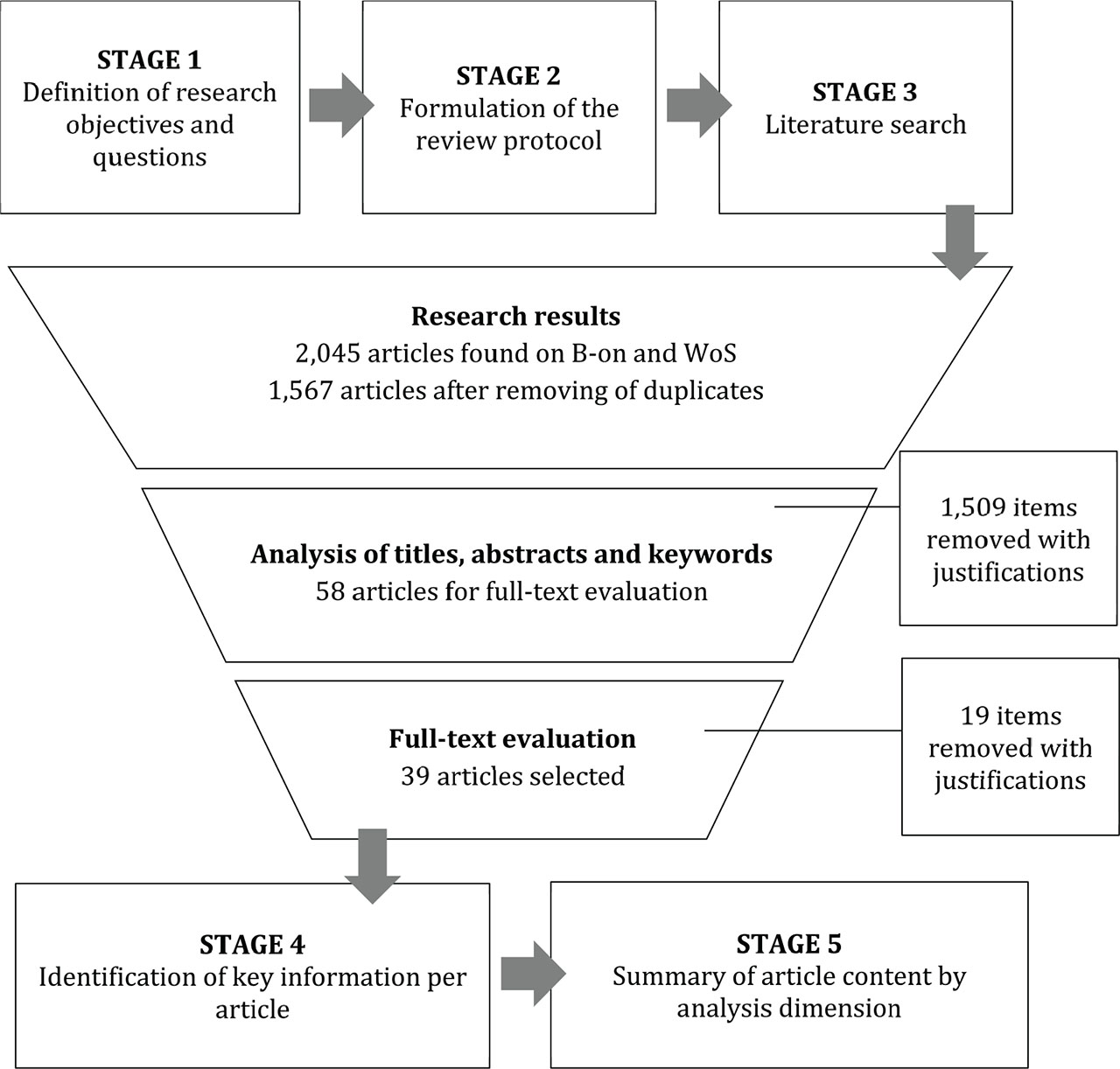
Figure 1:
Systematic literature review process
Source: Adapted from Le et al. (2019)
Table 1:
Databases, key terms and Boolean operators used in the search and number of results obtained
| Databases | Key terms and Boolean operators | Results without filters | Results with filters |
|---|---|---|---|
| B-on | SU (online reviews OR tourists reviews OR travelers reviews OR user generated reviews OR consumer generated reviews OR online ratings OR tourists ratings OR travellers ratings OR user generated ratings OR consumer generated ratings OR user generated content OR consumer generated content OR eWOM OR electronic word of mouth) AND SU (hotel management OR hotel sector OR hospitality and tourism OR hotel data analysis OR hotel text analysis) | 1,142 | 1,074 |
| Wos | online reviews OR tourists reviews OR travelers reviews OR user generated reviews OR consumer generated reviews OR online ratings OR tourists ratings OR travellers ratings OR user generated ratings OR consumer generated ratings OR user generated content OR consumer generated content OR eWOM OR electronic word of mouth (Topic) AND hotel management OR hotel sector OR hospitality and tourism OR hotel data analysis OR hotel text analysis (Topic) | 1,502 | 971 |
Table 2:
Filters applied in the search
| B-on | Wos | |
|---|---|---|
| Review period | Starts on 1 January 2008. Based on the study by Oliveira et al. (2020). | |
| Types of sources/Documents | Peer-reviewed academic journals. | Articles and review articles. |
| Disciplines/Categories | Library and Information Science; Social Sciences and Humanities; Sports and Leisure; Business and Management. | Information Science, Library Science; Social Sciences Interdisciplinary; Hospitality, Leisure, Sports, Tourism; Management; Business. |
| Language | English, Spanish and Portuguese. | |
Table 3:
Number of articles per scientific journal
| Journal name | No. of articles | % | Journal ranking |
|---|---|---|---|
| International Journal of Hospitality Management | 7 | 18% | 5th |
| Tourism Management | 5 | 13% | 1st |
| International Journal of Contemporary Hospitality Management | 4 | 10% | 7th |
| Information Technology & Tourism | 2 | 5% | 24th |
| Journal of Hospitality Marketing and Management | 2 | 5% | 10th |
| Journal of Vacation Marketing | 2 | 5% | 27th |
| Others | 17 | 44% | - |
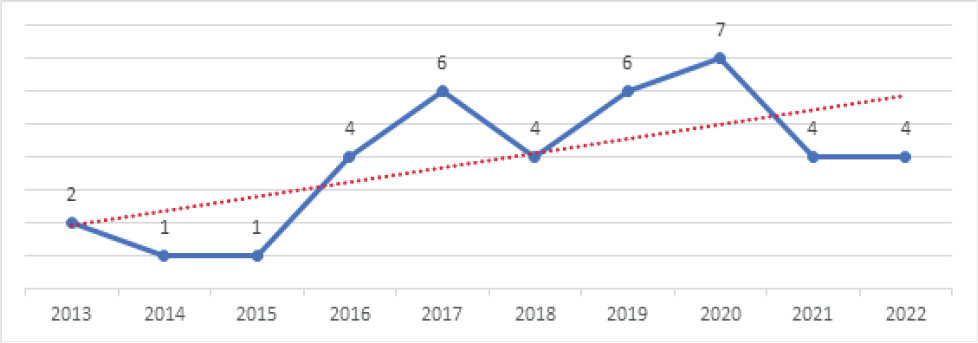
Figure 2:
Number of articles by year of publication
Source: Own work
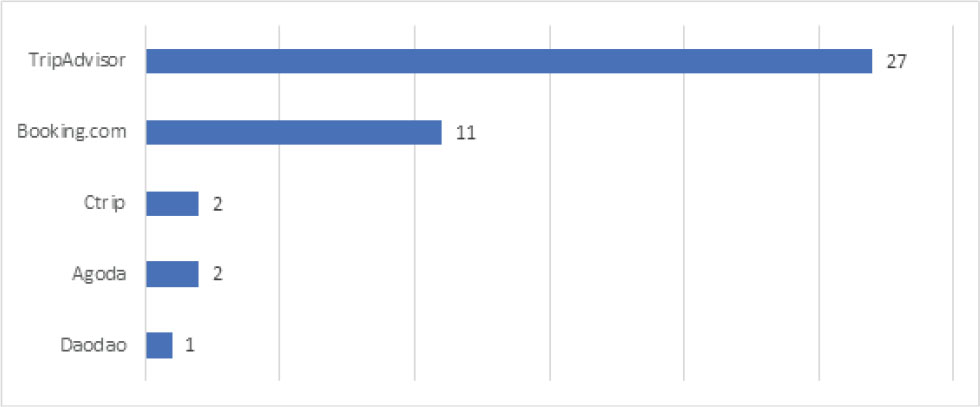
Figure 3:
Number of studies by booking and opinion platform used
Source: Own work
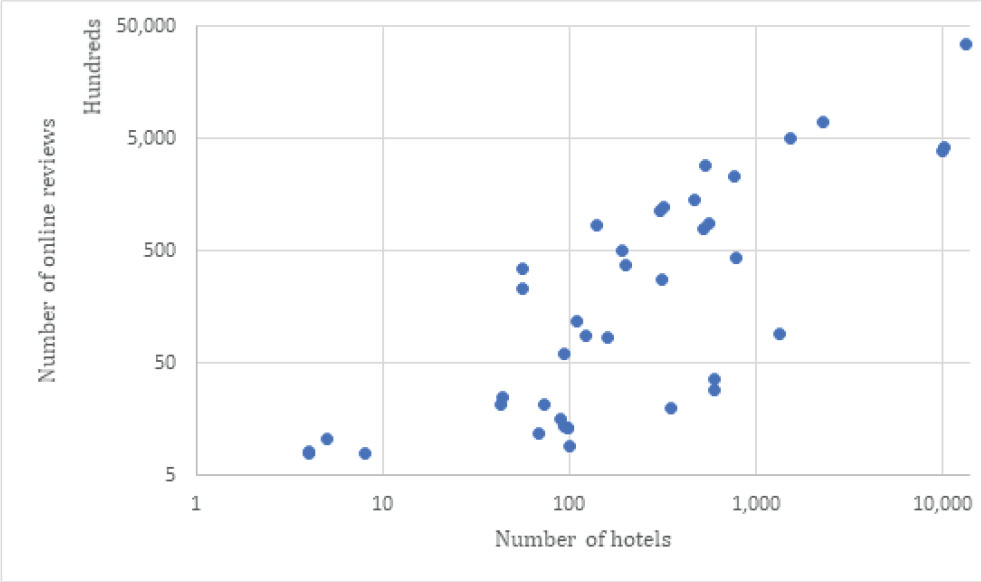
Figure 4:
Number of hotels and number of online reviews per article
Source: Own work
Table 4:
The profile of tourists in four- and five-star hotels based on previous studies that used online reviews
| Source | Purpose | Geography/ Category/ No. of reviews | Key findings |
|---|---|---|---|
| Zhou et al. (2014) | Provide comparative and benchmarking insights about customer satisfaction. |
| Tourists from Oceania, China and the United States expressed greater satisfaction, in contrast to the Western European and Southeast Asian markets. |
| Wu et al. (2017) | Evaluate the experiences of international clients. |
| Tourists from Oceania and North America expressed greater satisfaction, while customers from North-East Asia showed less satisfaction. |
| Tsiotsou (2019) | Identify cross-cultural differences in the evaluations of tourists from Central, Eastern, Northern and Southern Europe. |
| The ranking of tourists goes down in order of Northern, Eastern, Western, and Southern Europeans. |
| Tsiotsou (2022) | Identify critical value-creation elements of luxury services and examine cross-cultural differences of customers from four European regions (East, North, South and West). |
| Northern, Eastern, Western and Southern Europeans valued the staff, the hotel's physical attributes/environment, the basic products (room and food) and the services, respectively. |
| Kitsios et al. (2021) | Examine and compare aspects of guest satisfaction and dissatisfaction. |
| Customer satisfaction is significantly affected by factors related to location, staff, rooms and services. |
| Moro et al. (2022) | Understand how countries of origin and respective embedded cultures influence tourists’ perceptions. |
| Regardless of cultural origin, location and price were the attributes that satisfied the most and the least customers, in order, in four- and five-star hotels. |
| Kim et al. (2016) | Identify and compare factors known as satisfiers and dissatisfiers. |
| Location was the attribute that satisfied the most customers in four- and five-star hotels. |
| Schuckert et al. (2015) | Explore the distribution and difference in the rating behaviour of English-speaking and non-English-speaking guests. |
| Customers who wrote in English were the most satisfied and the most likely to stay in four- and five-star hotels. |
| Pacheco (2016) | Explore the distribution and differences in rating behaviour of English, Portuguese, Spanish, French and Brazilian guests. |
| Customers who wrote in Brazilian Portuguese were the ones who gave the highest ratings to four- and five-star hotels. In contrast, guests who wrote in Spanish and French gave the lowest ratings. |
| Pacheco (2017) | Study the impact of specific satisfaction attributes on overall satisfaction. |
| Room and service were the predictor attributes of guest satisfaction in four- and five-star hotels. |
| Liu et al. (2017) | Offer new insights into the determinants of hotel customer satisfaction by differentiating customers by language group. |
| Guests rated positively the five-star hotels. Several four-star hotels were rated very highly by international guests, but received a lower rating from national guests. |
| Antonio et al. (2018) | Understand how guests from different origins and different international destinations evaluate hotels. |
| Reviews written in English obtained higher ratings in four- and five-star hotels when compared to reviews written in Spanish and Portuguese. |
| Francesco & Roberta (2019) | Investigate whether there are differences in the way Italians, Americans and Chinese travellers perceive and emphasise several hotel attributes. |
| Location was the attribute most emphasised by Italian tourists in four- and five-star hotels, while American and Chinese customers highlighted cleanliness and service attitude, respectively, in five-star hotels. |
| Xu et al. (2017) | Examine customer satisfaction and dissatisfaction toward attributes of hotel products and services. |
| Guests at four- and five-star hotels showed less satisfaction with hotel attributes and services compared to customers staying in lower categories. |
| Li et al. (2013) | Illustrate that online hotel reviews can be used to systematically identify customer satisfaction factors. |
| Some factors that guests consider important when booking four- and five-star hotels, such as the bed, the room and reception services, did not meet their expectations. |
| Padma & Ahn (2020) | Understand the attributes of luxury hotels that contribute to guest satisfaction and dissatisfaction. |
| Guests in five-star hotels have much higher expectations compared to those staying in lower-rated hotels. |
| Li et al. (2020) | Unravel how the role of hotel attributes can differ in accordance with different hotel star ratings and distinct customer segments. |
| Cleanliness, location, rooms, service and value are basic factors for customer satisfaction in four- and five-star hotels. |
| Fernandes & Fernandes (2018) | Characterise complainers’ profile and online complaints and determine which factors may impact them. |
| Guests in four- and five-star hotels expressed greater dissatisfaction with the service, particularly customer care, location and value. |
| Hu et al. (2019) | Investigate how customer complaints vary across different hotels grades. |
| Service and value were the factors with the most complaints in the four- and five-star hotels. |
| Sann et al. (2020) | Investigate the online complaint behaviour targeting six different hotel attributes. |
| |
| Ahani et al. (2019) | Identify the important factors for hotel selection. |
| Guests who travelled with family and as a couple were those who expressed greater satisfaction in four- and five-star hotels. |
| Tsiotsou (2019) | Identify cross-cultural differences in the evaluations of tourists from Central, Eastern, Northern and Southern Europe. |
| |
| Wu et al. (2017) | Evaluate the experiences of international clients. |
| Business travellers presented lower satisfaction compared to other travellers in four- and five-star hotels. |
| Ahn et al. (2017) | Demonstrate how different compositions of group members can influence people's travelling experiences. |
|
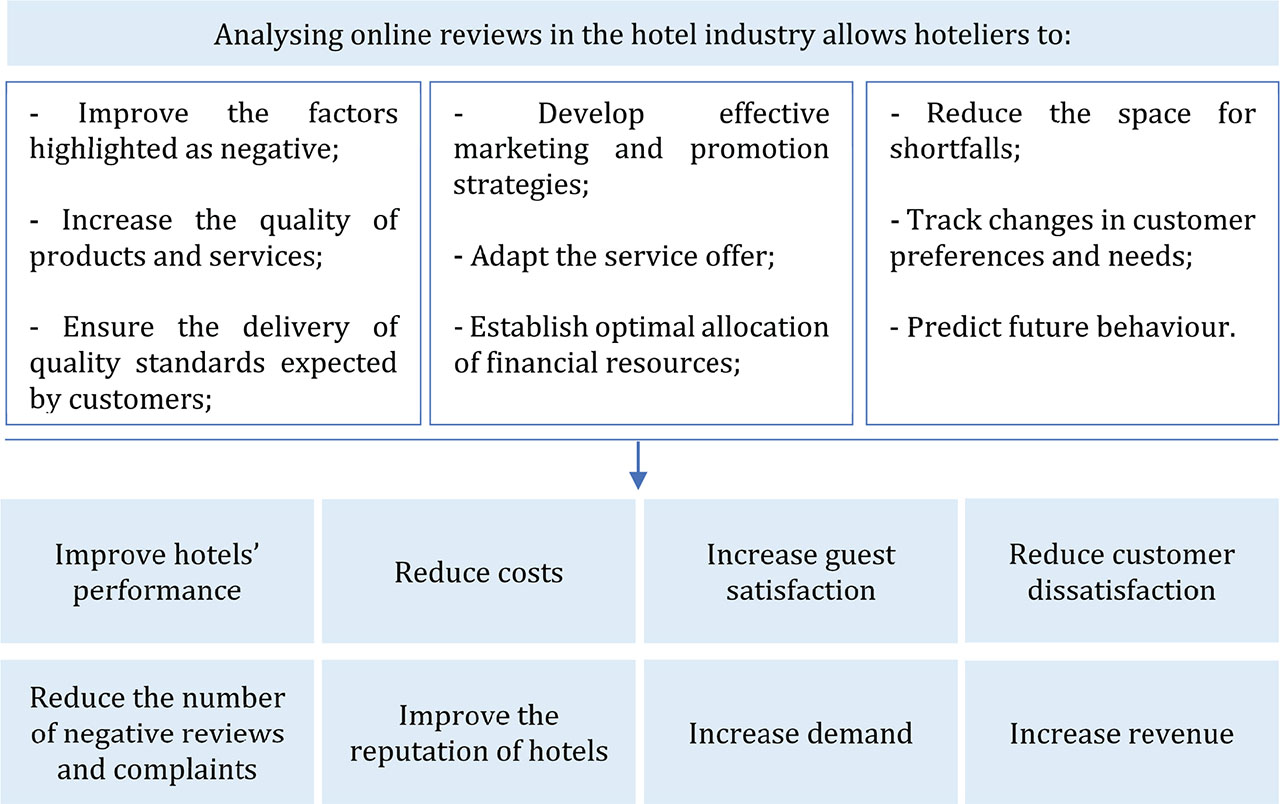
Figure 5:
Benefits of hoteliers getting to know their customers by analysing online reviews.
Source: Based on the results of studies by Ahani et al. (2019), Ahn et al. (2017), Antonio et al. (2018), Fernandes & Fernandes (2018), Francesco & Roberta (2019), Hu et al. (2019), Kitsios et al. (2021), Li et al. (2013), Liu et al. (2017), Moro et al. (2022), Padma & Ahn (2020), Sann et al. (2020), Schuckert et al. (2015), Tsiotsou (2019, 2022), Xu et al. (2017) and Zhou et al. (2014).