Have a personal or library account? Click to login
The 3M Concept: Biomedical Translational Imaging from Molecules to Mouse to Man Cover

The 3M Concept: Biomedical Translational Imaging from Molecules to Mouse to Man

Open Access
|Jul 2021

Figures & Tables

Figure 1

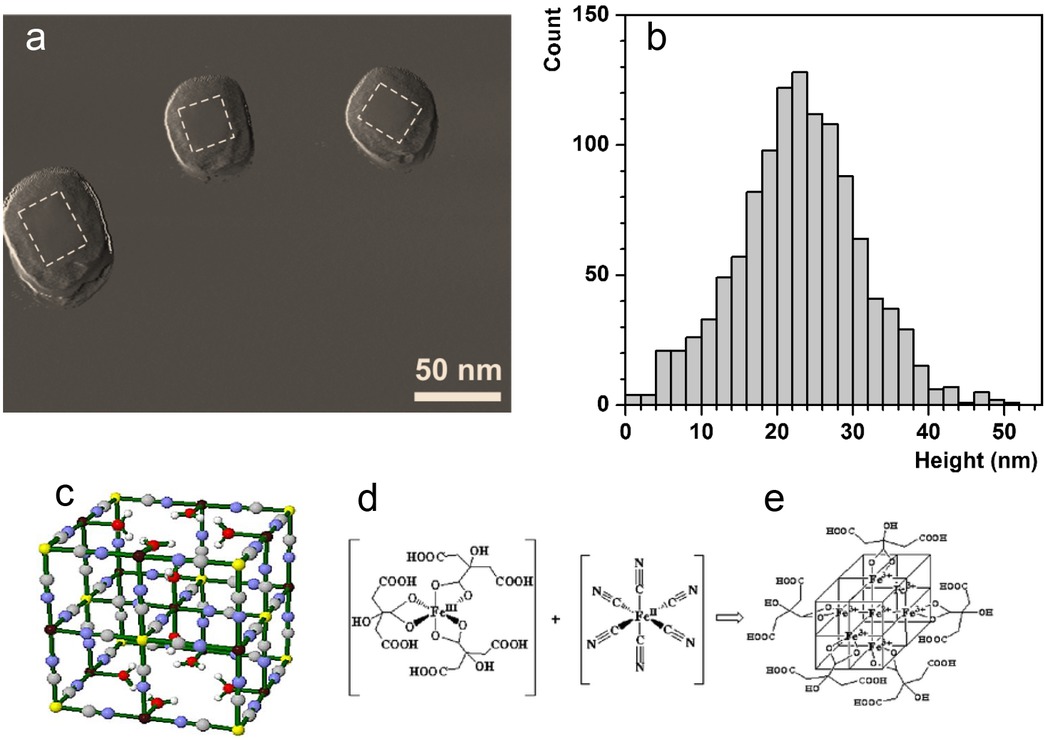
Topographical structure, size distribution and chemical constituents of Prussian Blue nanoparticles (PBNP). a. High-resolution Atomic Force Microscopic (AFM) image of PBNPs. The cuboid shape of individual particles is highlighted by the segmented lines that enclose a flat rectangular area on their surface. b. Distribution of the maximal topographical height obtained by automated particle analysis on 1147 particles. Crystal structure (c), and the schematics (d) and spatial arrangement (e) of coordinated constituting ions of citrate-coated PBNPs. Figure adapted from (12) and (15), copyright the Authors.
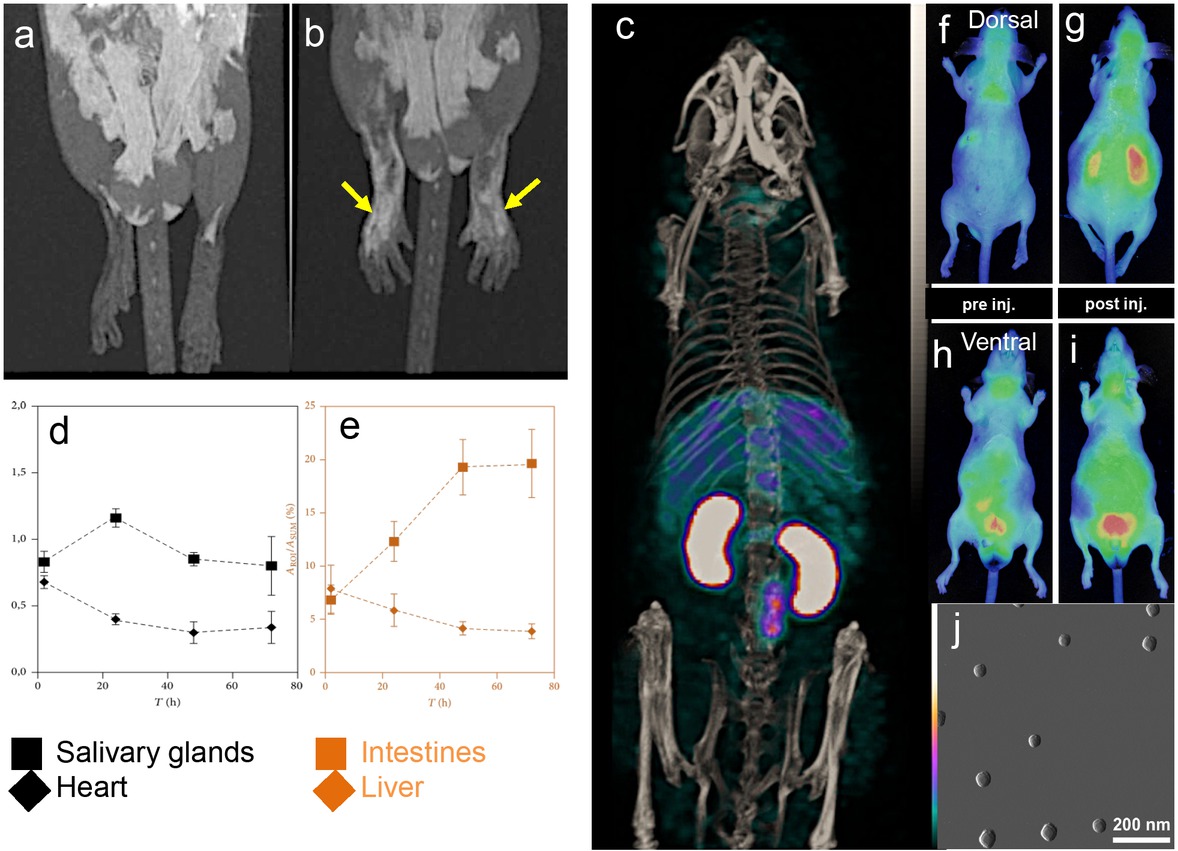

Figure 2

Multimodal contrast-enhancing properties of labeled biocompatible Prussian Blue nanoparticles (PBNP). a. Pre-injection T1-weighted MR image of a mouse injected with PBNP. Subcutaneous injection of 60 uL methylene blue-labeled, polyethyelene-glycol-capped particles in both hindlimbs caused noticeable T1 contrast increase in 24hours after injection. b. Post-injection T1 contrast increase in the hindpaws (yellow arrows). c. A similar PBNP preparation, labeled with 201Tl isotope reaches salivary glands, liver and kidneys in 24 hour post intravenous injection. Maximum intensity projection single photon emission computed tomography/X-ray computed tomography (SPECT/CT) image of the mouse is depicted. CT densities are shown in grayscale, SPECT Activities in the Regions of Interest (ROI) are shown in colour scale in % proportion of ROI radioactivity to total injected activity. d and e illustrate the biodistribution of PBNPs over time from SPECT volumes. f and h show dorsal and ventral whole-body autofluorescence images, respectively, of a mouse before injection with the PBNP preparation labeled with methylene blue. Fifteen minutes after intravenous injection the fluorescence signal was captured from the entire mouse body, with greates intensities above the kidneys, as shown in post-injection images in g (dorsal view) and i (ventral view). j. AFM images of PBNPs injected into animals. Figures adapted and modified from (12) and (15), copyright the Authors.
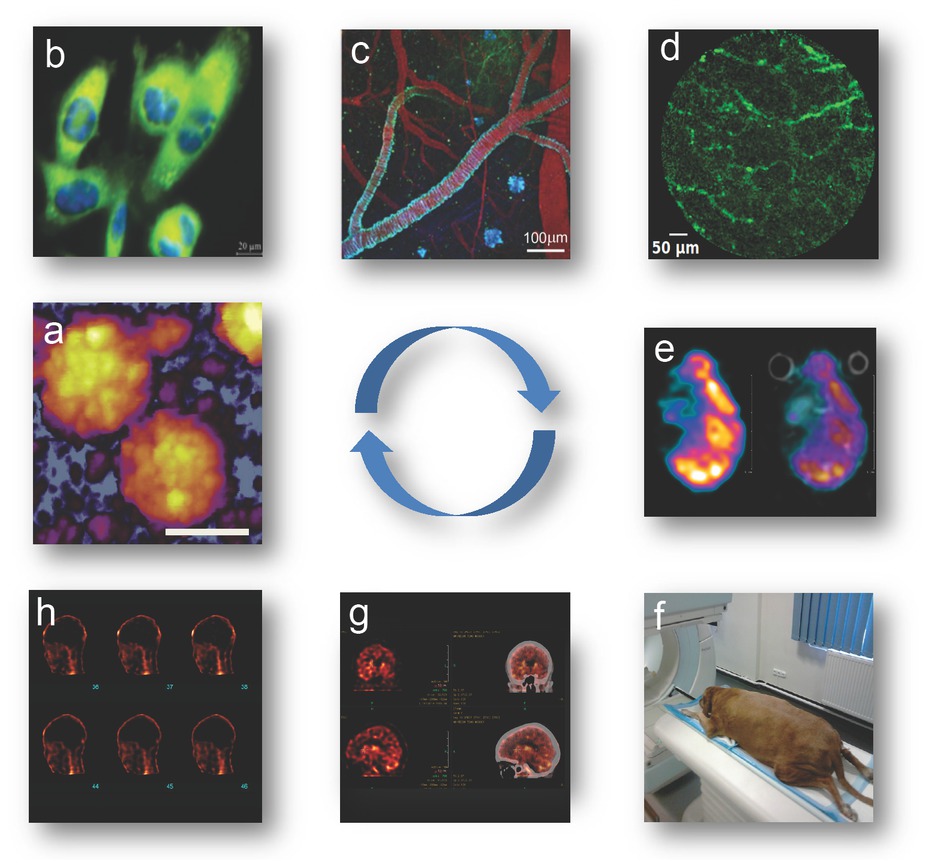

Figure 3

The concept of multi-scale imaging from molecules-to-mose-to-man (”3M”). Logical elements of the 3M pipeline are indicated clockwise, from a through h. a. Height-contrast AFM image of substrate-adsorbed SARS-CoV-2 virions displaying their surface proteins (scale bar, 100 nm), b. Fluorescence images of glioma cells loaded with a fluorescent dye (NBD) and Hoechst-blue for nuclear staining, c. In vivo multiphoton fluorescence image of a mouse brain with green fluorescent protein (GFP)-expressing neurons. Texas Red-labeled dextran in red fluorescence was used as a vascular marker, blue fluorescence indicates perivascular amyloid. d. NBD-loaded liposome vascular contrast in a live animal glioma xenograft measured by using confocal fiber optic fluorescence microscopy. e. 99mTc-hydroxymethylydene-paraamino-oxime (HMPAO) perfusion SPECT brain image coupled to gradient echo MRI in a mouse stroke model. f. Experimental setup of a living dog SPECT imaging study. g. HMPAO human brain perfusion SPECT/ CT. h. Human bone scan using 99mTc-labeled bisphosphonate.
Language: English
Page range: 155 - 160
Published on: Jul 24, 2021
Published by: European Biotechnology Thematic Network Association
In partnership with: Paradigm Publishing Services
Publication frequency: 4 issues per year

© 2021 Domokos Máthé, Bálint Kiss, Bernadett Pályi, Zoltán Kis, László Forgách, Nikolett Hegedűs, Zoltán Varga, Krisztián Szigeti, Kinga Karlinger, Miklós S Z Kellermayer, published by European Biotechnology Thematic Network Association
This work is licensed under the Creative Commons Attribution-NonCommercial-NoDerivatives 4.0 License.