
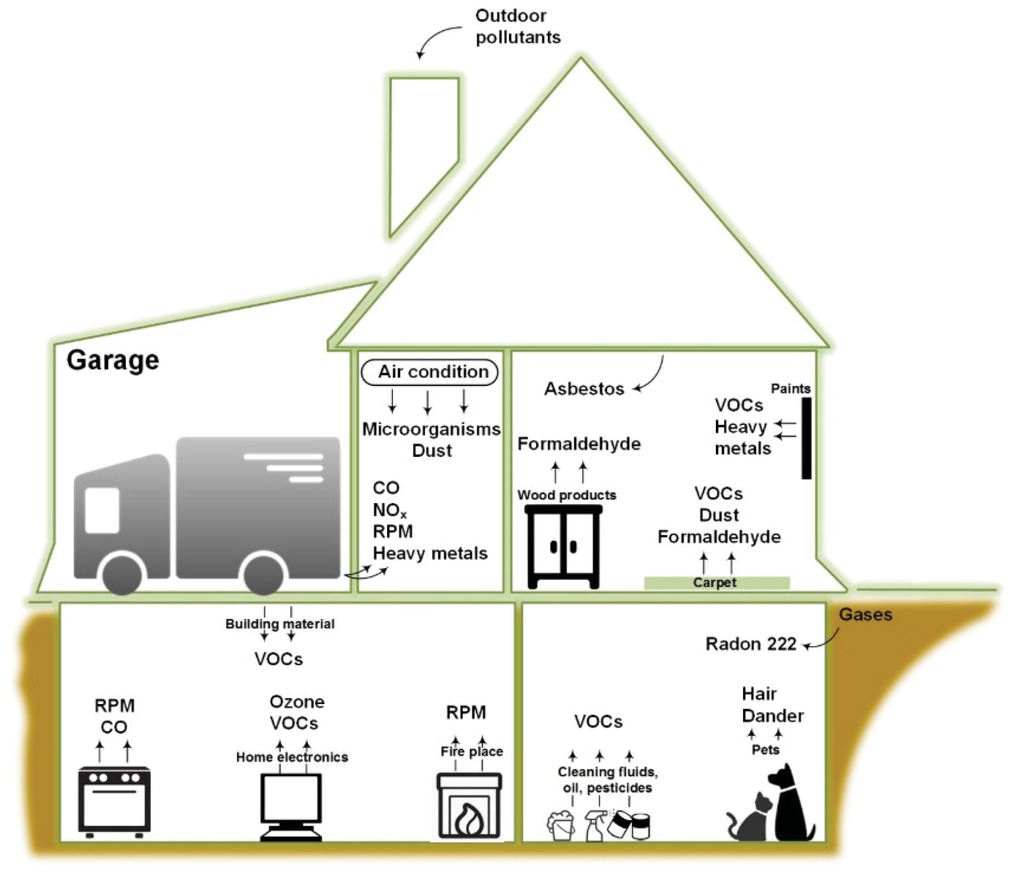
Figure 1
Sources of indoor air pollutants.
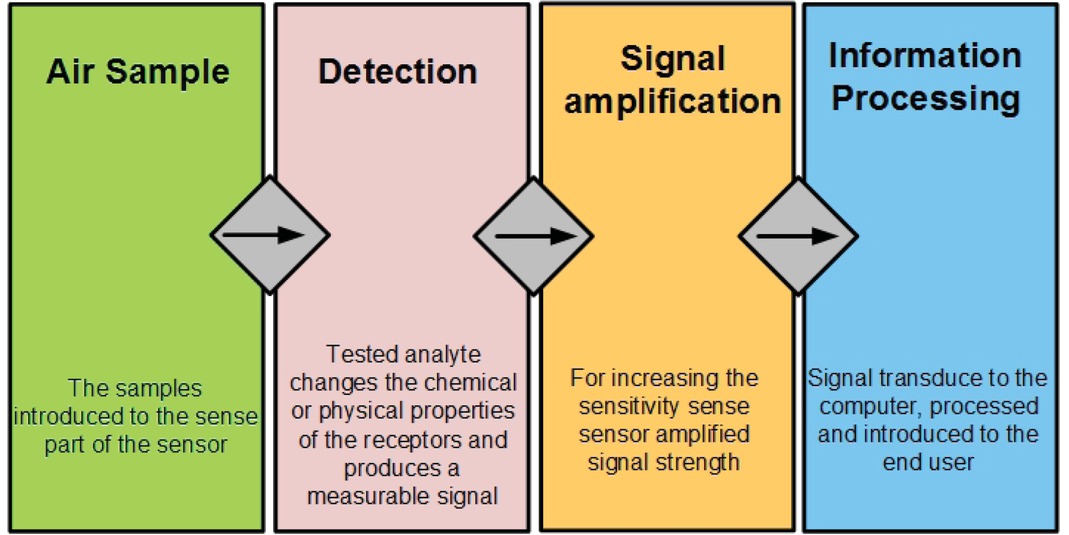
Figure 2
Green box: “Samples introduced to the sensing part of the sensor”; Pink box: “Tested analyte changes the chemical or physical properties of the sensing part and produces a measurable signal”; Orange box: “For increasing the sensitivity of the sensor and amplifying signal strength”; Blue box: “Signal transduced to the computer, processed and introduced to the end user”.
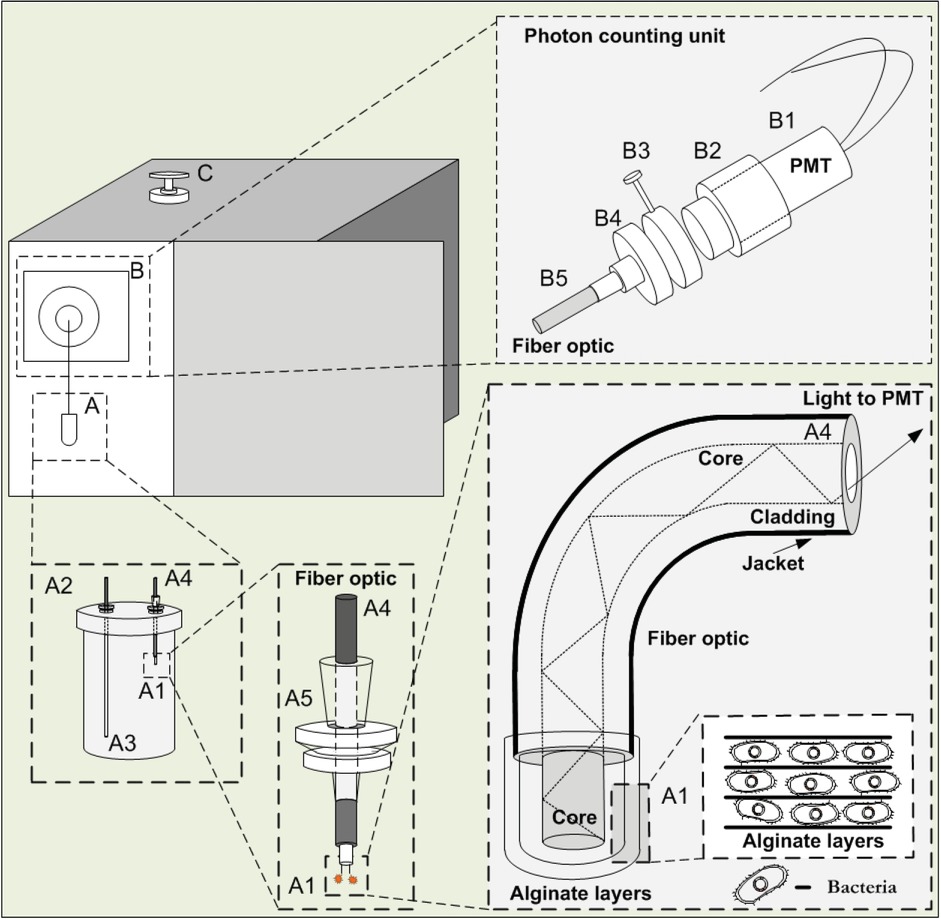
Figure 3
Descriptive scheme of the fiber optic based setup for real time monitoring of toxicity in the air. A, detection unit; A1, hermetic chamber; A2, alginate matrix with bacteria immobilized on the fiber optic core; A3, needle for air pollutant entrance; A4, fiber optic; A5, fiber optic holder; B, photon counting unit; B1, Hamamatsu HC135-01 PMT Sensor Module; B2, PMT fixation ring; B3, manual shutter (71430, Oriel); B4, fiber holder that prevents the movement of the fiber inside the photon counting unit; B5, fiber optic; C, outside handle of manual shutter that enables light access to the PMT (1).