
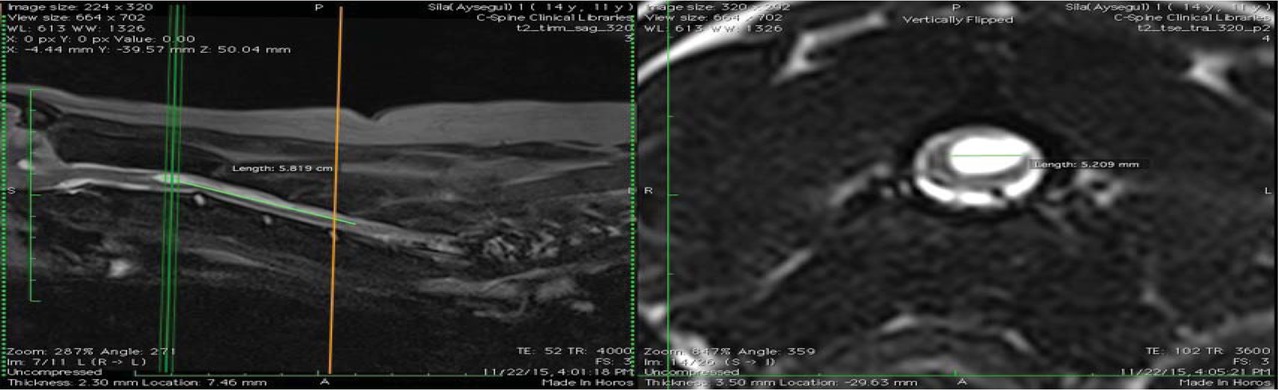
Figure 1
T2-weighted sagittal (left) and transverse (right) images of the cervical and spinal cord in a Cavalier King Charles Spaniel showing severe neuropathic pain. The green line marks the location of the transverse figure on the sagittal image - the second cervical vertebrae. The maximum diameter of the syrinx is 5.2 mm, measured in transverse plane.
Table 1
Classification grades of syringomyelia (adapted after British Veterinary Association and The Kennel Club SM grading scheme)
| Grade | Severity of syringomyelia |
|---|---|
| 0 | none |
| 1 | central canal dilation under two millimetres |
| 2 | central canal dilation of more than 2 millimetres, a pre-syrinx or syrinx |
Table 2
The clinical features in 37 Cavalier King Charles Spaniel dogs diagnosed with Chiari-like malformation and Syringomyelia
| Clinical sign | Number of dogs affected | Percentage (%) |
|---|---|---|
| Neuropathic pain | 37 | 100 % |
| Spontaneous vocalization | 37 | 100 % |
| Scratching | 30 | 81% |
| Facial rubbing | 11 | 29.7% |
| Paw licking | 4 | 10.8% |
| Air licking | 4 | 10.8% |
| Tail chasing | 2 | 5.4% |
| Seizures | 1 | 2.7% |
| Unilateral facial paralysis | 1 | 2.7% |
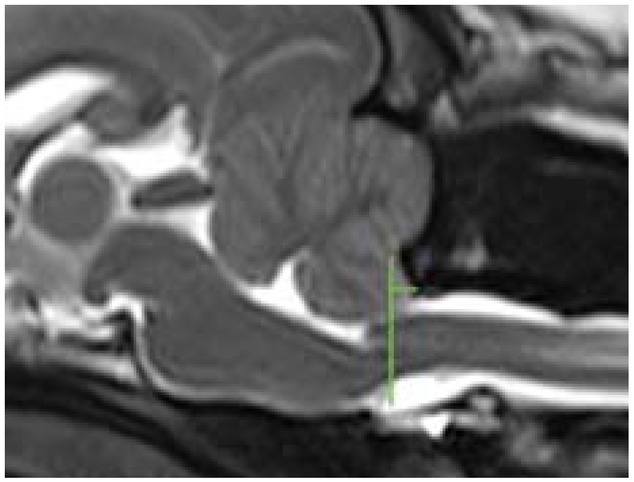
Figure 2
Mid-sagittal T2-weighted image showing cerebellar herniation. The horizontal line represents the length of the cerebellar herniation engaged within the foramen magnum.
Table 3
Magnetic resonance imagining results in 37 Cavalier King Charles Spaniel dogs included in the study
| MRI finding | Number of cases affected | |
|---|---|---|
| Cerebellar herniation | 37 | |
| Degree of caudal displacement of the | Grade 1 | 24 |
| cerebellar vermis | Grade 2 | 13 |
| Syringomyelia | Grade 1 | 15 |
| Grade 2 | 22 | |
| Medullary kinking | 33 | |
| Presyrinx | 19 | |
| Ventriculomegaly | 8 |