
1. Introduction
In recent times, producing more sustainable products has been regarded as a moral imperative, addressing issues related to legal technologies, conventional practices, and other external factors, such as extant institutions (Seo et al., 2025; Peprah et al., 2025). The concept of moral market, as explained by Zak (2011), entails businesses focusing on ethical considerations such as fair wages, sustainability, and exchange mechanisms above profit maximization to ensure equitable access to resources and goods. Additionally, the moral market upholds principles such as honesty, fairness, and corporate social responsibility (Malja & Afrasiabi, 2025). This implies that achieving sustainability involves producing more environmentally friendly products and establishing and implementing procedures and guidelines that support social justice, resource conservation, and environmental preservation (Tacanho, 2025; Amoah, 2020). It is increasingly recognized as a sustainability strategy and a means to achieve superior competitive advantage (Bürgi, 2010; Lewis & Juravle, 2010). Although it was often viewed as a financial burden for an organization, it is now more widely accepted as a catalyst for improving productivity, increasing product value, and fostering stakeholder trust, often leading to sustainable practices (Painter-Morland & Dobie, 2014). Regarded as the engine of developing economies, small and medium enterprises (SMEs) comprise 80–90% of businesses in developing countries, offering job opportunities and social inclusion (Kraus et al., 2020; Álvarez Jaramillo et al., 2019).
For SMEs, sustainability means balancing their financial, human, and material resources with the social and economic context in which they operate. SMEs' inability to develop a sustainable strategy and view sustainability investments as a competitive advantage is frequently attributed to a lack of funding and time. Despite substantial investments by SMEs towards sustainable practices and growing recognition of the positive impact of moral market on SME sustainability strategies (Abdelzaher & Abdelzaher, 2017), many SMEs in developing countries continue to rely on profit maximization to sustain themselves, rather than focusing on ethical considerations like moral principles, fair wages, sustainability, and exchange mechanisms (Winczorek, 2022). This reflects how firms, including SMEs, have failed to adopt ethical practices and achieve sustainable performance.
The extant literature reveals three significant gaps that motivate this investigation. First, while the antecedents of sustainability and firms' performance have been studied in the context of SMEs in emerging nations (Kraus et al., 2020; Bürgi, 2010), the dynamic interplay of morality and market realities in shaping SMEs' sustainability strategies remains underexplored (Winczorek, 2022). Second, earlier studies on the moral market as a tool to achieve sustainable development for SMEs in developing countries have produced mixed results (Jonkutė et al., 2011; Sulaiman, 2025), which call for further investigation. Lastly, research on SMEs' sustainable strategies in developing economies has overlooked antecedents of the moral market and market realities (stakeholder pressure, competitive advantage, and cognitive ability) in investigating SMEs' sustainable practices. These gaps are particularly consequential because, without understanding the antecedents of sustainable strategies, achieving sustainable performance would remain ineffective (Cohen et al., 2017). The correlation between SMEs' morals, market realities, and sustainability strategies warrants investigation, as moral markets can serve as a catalyst for sustainable practices among SMEs that intend to adopt them. Moreover, empirical evidence linking market realities to SME sustainable strategies remains underexplored in developing countries (Csibi, 2026; Sarma et al., 2024). To address these gaps, this study employed a paradox theory framework to investigate the moral market and its effects on SMEs' sustainable strategies. Paradox theory provides a lens for examining the interrelated elements of sustainable strategies over time. This theoretical approach advances the literature by bridging the moral and ethical strategies for SMEs and providing a nuanced understanding of SMEs' moral market towards sustainable practices.
This study examines how moral market dimensions influence sustainable practices among SMEs in Ghana. Drawing on paradox theory, the research examines (a) how moral and market realities drive sustainability strategies for ethical SMEs, and (b) investigates how organizational slack moderates the relationship between cognitive ability and sustainable strategies. The research findings are further compared with the situation in Central European countries (Czech Republic, Hungary, Poland, Slovakia, and Croatia) to identify institutional contingencies and cross-regional patterns in the formation of SME sustainability strategies. The remainder of the paper is structured as follows: Section 2 discusses the theoretical background, including literature review and hypothesis development. Section 3 explains the research framework, and Section 4 discusses the empirical analysis results and findings. The last section provides the overall conclusion and recommendations for future research.
2. Theoretical background and justification of the use of the theory: Paradox theory
The theory of paradox offers an effective approach to the study of organizational management in the face of contradictory and interdependent pressures that do not allow for simple either-or decisions (Smith & Lewis, 2011). The theory identifies paradoxes as key concepts that contain tensions between interdependent elements that persist in complex systems. Organizations face paradoxes, including instrumental goals such as profitability and competitiveness alongside normative goals such as social responsibility and environmental sustainability. In this regard, the theory of paradox indicates that organizations need to adopt a both/and approach, which entails leveraging their capabilities to manage dynamic balances (Lewis, 2000; Smith et al., 2017). This approach has been prominent in the management and information systems literature, especially amid growing demands for corporate sustainability. This is because organizations are faced with conflicting demands from various stakeholders, such as consumers who demand ethical products, the government, which requires environmental compliance, investors who demand compliance with environmental, social, and governance criteria, and society, which demands social compliance (Hahn et al., 2015; Sundaramurthy & Lewis, 2003). On the other hand, organizations are expected to be efficient in their operations despite market volatility. Paradoxes can cause organizations to perform sub-optimally or stagnate if they are managed unproductively, but productive paradox management is vital for encouraging innovation and resilience (Iqbal & Piwowar-Sulej, 2022).
2.1. Stakeholder Pressure
Stakeholder pressure has been a relevant topic across the research on the SMEs' ethical and sustainability strategies. More importantly, recent scholars have established that stakeholder pressure not only drives SMEs to adopt sustainable practices (Ahinful et al., 2022) but also compels them to pursue ethical strategies (Kulsum et al., 2025; Qalati et al., 2024). Specifically, SMEs operate under resource constraints, yet stakeholder pressures play a crucial role in ethical strategies, thereby benefiting all parties involved. Nguyen & Adomako (2022), for instance, reveal that stakeholder pressure drives eco-friendly practices, international orientation, and eco-innovation. Their work suggests that incorporating stakeholders in a company's decision-making process is both a moral obligation and a useful strategic tool for gaining a competitive edge.
Empirical research indicates a positive correlation between sustainability strategies and ethical SMEs (Csibi, 2026), and it establishes that sustainability core strategies have implications for safeguarding and brand reputation, competitive advantage, and fostering long-term growth. Strong stakeholder pressure influences how SMEs engage customers, pursue green innovation, and allocate resources to achieve sustainability goals. Additionally, SMEs that engage and involve stakeholders in decision-making are more likely to develop both ethical and sustainability strategies, as indicated by Kulsum et al. (2025). Following the earlier literature, the study hypothesized that:
H1: A significant relationship exists between stakeholder pressure and cognitive ability
2.2. Competitive advantage
Competitive advantage, as defined by Kaleka & Morgan (2017), is the firm's ability to outperform competitors in the same market or industry through greater effectiveness, higher quality, or a unique offering (products or services) that competitors find difficult to match. Wang et al. (2025a) acknowledged that these elements enable the productive unit to outperform competitors in its market in terms of sales or profit margins. In the context of SMEs, numerous elements, such as cost structure, branding, product quality, distribution network, intellectual property, and customer service, are linked to sustainable competitive advantages as mentioned by Awamleh et al. (2025). When firms, such as SMEs, uphold these elements, they are more likely to achieve superior competitive advantage and translate it into ethical and sustainable initiatives (Metzker, 2025).
Researchers (El Nemar et al., 2025; Farmanesh et al., 2025) have established that these ethical and sustainable lenses help SMEs to improve operational efficiency, manage risks, and adapt to changing customer needs. However, other studies have highlighted the importance of cognitive ability for competitive advantage among SMEs. For instance, findings from Adesanya et al. (2025) recently maintained that the leadership cognitive ability of SMEs positively affects their sustainable and ethical initiative. The authors focused on the Nigerian SMEs. Further work by Wang et al. (2025b) supported the hypothesis that competitive advantage significantly affects cognitive ability in the context of sustainable strategies in SMEs. This study examines how competitive advantages are likely to affect the cognitive abilities of SME firms and their impact on ethical and sustainable strategies. Hence, the study hypothesized that:
H2: A significant relationship exists between competitive advantage and cognitive ability
2.3. Cognitive ability
Caputo et al. (2018) defined cognitive ability in the context of SMEs as the mental capacities of owners and managers for information processing, learning, reasoning, and complex problem-solving in dynamic, frequently unpredictable circumstances. Researchers have stated that cognitive ability influences strategic decision-making, innovation, and adaptation and is a crucial factor in determining the survival and performance of SMEs (Caputo et al., 2018; Kryeziu et al., 2024). Forbus et al. (2017) explored SMEs' ability to handle large-scale cognitive modeling and identified the following as key cognitive abilities: cognitive adaptability, cognitive flexibility, and innovative thinking. Their study reveals a significant effect on SMEs' sustainable performance, including business survival, sales growth, strategic decision-making, and the drive for sustainable initiatives.
Research shows that although many SME owners have moderate levels of these cognitive abilities, there is still significant room for improvement to enhance long-term viability and competitive advantage. In response, Caputo et al. (2018) noted that adopting certain sustainability initiatives positively influences SMEs' economic performance. Considering that an SME's cognitive ability in sustainability strategies affects performance, this paper proposes the following hypothesis:
H3: A significant relationship exists between cognitive ability and Sustainable Strategies
2.4. The moderating role of organizational slack
Organizational slack, as defined by Näslund (1964), is the “excess capacity maintained by an organization.” Organizational Slack is a crucial safeguard that enables a business to explore and adapt strategically while withstanding risks in both internal and external environments. Scholars have acknowledged the benefits of organizational slack in terms of innovativeness, flexibility, and operational efficiency (McHugh & Cross, 2021; Franquesa & Brandyberry, 2009). Again, companies can better respond to legislative demands and take advantage of transformation opportunities by allocating financial, human, and material resources to long-term sustainable strategies (Näslund, 1964). On the other hand, companies with limited resources could afford only low-cost, compliance-driven solutions, thereby preventing them from pursuing sustainable strategies (Vuorio et al., 2022).
Franquesa and Brandyberry (2009), for instance, investigated the relationship between organizational slack and information technology innovation adoption in the context of SMEs and indicated that potential slack and access to external credits have a significant effect on SMEs' technology adoption. Investigating the relationship between cognitive ability and SMEs' sustainable strategies, George et al. (2026) argued that cognitive flexibility plays a role in their shift toward sustainable digital solutions. Their work indicated a moderating role of organizational role in cognitive ability and SMEs' sustainable strategies. Additionally, Zhao & Yan (2023) used organizational slack as a moderator to assess manufacturing firms' sustainable digital innovation and strategic flexibility. This study suggests that firms are more likely to adopt sustainable strategies when they have ample spare resources. Based on these considerations, we propose the following hypothesis:
H4: Organizational slack positively moderates the relationship between cognitive ability and SMEs' sustainable strategies
2.5. Sustainable strategies
Sustainable Strategies, as defined by Galpin et al. (2015), encompass combining economic activity with planning to generate long-term benefits for the company, its stakeholders, and society at large. According to White (2009), the objective of a sustainable business plan is to meet the demands of the company, its customers, staff, and other stakeholders while safeguarding resources and developing procedures and policies that will endure over the long term. Shields and Shelleman (2015) aver the importance of achieving sustainability in SME strategy. The authors highlighted the growing concern among SMEs about developing strategies to proactively address sustainability issues and meet the rapidly expanding global sustainability reporting standards.
A study by Parhankangas et al. (2014) and Figura & Vevere (2025) argued that SMEs should evaluate, monitor, and even develop strategies to support widespread sustainability reporting and proactively adapt to broader sustainability needs. Prior studies (Hasu et al., 2025; Lu et al., 2026; Arroyabe & Arranz, 2026) also highlight the role of sustainable strategies in contemporary businesses, shifting from efforts focused solely on compliance to incorporating environmental, social, and governance (ESG) principles for long-term competitiveness. However, Alzayani et al. (2024) stated that many SMEs without sustainable strategies are less likely to achieve a competitive advantage and are more likely to be excluded from the supply chain.
3. Methodology
This research employs a quantitative methodology, using a cross-sectional survey, to test the proposed links among competitive advantage and stakeholder pressure as independent variables, sustainable strategies as the dependent variable, organizational slack as the moderator, and cognitive ability as the mediating variable. The choice of quantitative methods stems from the need to validate the paradox theory (Bruce et al., 2025), which includes direct and indirect relationships as depicted in Figure 1. A standardized questionnaire facilitates consistent data collection across a wide range of SMEs, improving data quality and enabling robust comparisons. In contrast to qualitative techniques that prioritize in-depth insights, this design enables impartial evaluation of trends, validation of causal links, and scalable conclusions to guide policy and business decisions.
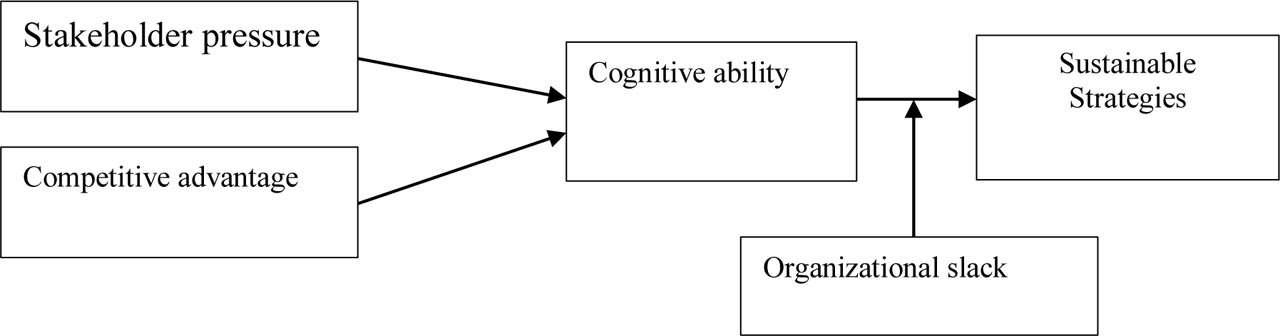
Figure 1:
Proposed conceptual framework
Source: own research
3.1. Population and sample
This research targeted registered SMEs active in the manufacturing sector. This was due to their unique position at the intersection of resource constraints and tangible environmental impacts as compared with service-based SMEs. Only SMEs in the manufacturing sector from the Greater Accra and Western Regions were used in the study. These regions house the majority of the manufacturing firms. SMEs in Ghana contribute massively to the country's revenue generation and employment creation. The study used a simple random sampling technique. The sampling technique was adopted because it enhances research reliability and ensures unbiased representation, free of researcher bias. The study used Krejcie and Morgan's formula in determining the sample size (Morgan, 1970). In all, 415 responses were used, affirming that the populations for SMEs exceed 10,000. Owner-managers were the sole respondents in the study, based on their level of knowledge regarding the study's constructs. Data collection took place from November 2025 to January 2026. Table 1 details the breakdown of the respondents.
Table 1:
Respondents' Profile
| Demographic Characteristic | Greater Accra (n=250) | Western Region (n=165) | Total (N=415) |
|---|---|---|---|
| Gender | |||
| Male | 140 (56%) | 90 (55%) | 230 (55%) |
| Female | 110 (44%) | 75 (45%) | 185 (45%) |
| Age Group | |||
| 18–30 years | 75 (30%) | 40 (24%) | 115 (28%) |
| 31–45 years | 125 (50%) | 85 (52%) | 210 (51%) |
| 46+ years | 50 (20%) | 40 (24%) | 90 (22%) |
| Education Level | |||
| Masters | 15 (6%) | 20 (12%) | 35 (8%) |
| SSSCE/Diploma | 120 (48%) | 90 (55%) | 210 (51%) |
| Degree | 115 (46%) | 55 (33%) | 170 (41%) |
3.2. Ethics and quality assurance
The study instituted several measures to uphold data quality, trustworthiness, and dependability. The survey instrument underwent initial pre-testing and a pilot phase involving 55 owner-managers from the manufacturing SMEs, allowing adjustments based on input to enhance item clarity, contextual fit, and suitability, therefore bolstering content validity. The data collection process was assisted by 10 master's students, who were trained to adhere to uniform guidelines during questionnaire administration. Anonymity, confidentiality assurances, and voluntary involvement helped counter non-response and social desirability issues. Statistical checks between early and late respondents revealed no meaningful differences, confirming negligible non-response bias. Robust procedures protected data quality throughout the process. During data collection, surveys were reviewed for full completion, and data preparation eliminated duplicates and anomalies. Digital records remained secure on encrypted, password-guarded systems accessible only by project personnel. The study sought approval of ethical clearance after scrutinizing the research aims, procedures, and privacy protocols. Before embarking on the data collection, participants received clear details on the study's goals, voluntary withdrawal options, and data applications. Signed consent forms were collected from all, reinforcing the investigation's ethical foundation.
3.3. Questionnaire design
The survey instrument was thoughtfully developed by adapting established items from established scholarly works, all rated on a 5-point Likert scale from 1 (Strongly Disagree) to 5 (Strongly Agree). Constructs were defined to align with theoretical foundations while ensuring practical measurability. The study constructs: Stakeholder pressure (Kowalczyk, 2020), Competitive advantage (Sigalas et al., 2013), Cognitive ability (Dilchert, 2018), Sustainable Strategies (Udomsap & Hallinger, 2020), and Organizational Slack (Marlin & Geiger, 2015) were all adapted from existing studies. Several quality control steps were implemented to ensure the accuracy and methodological soundness of data collection. All the study constructs used were secured by experts in the field. Before analysis, the datasets were checked for missing values and extreme outliers.
4. Data analysis and results
The researchers opted for Partial Least Squares Structural Equation Modeling (PLS-SEM) 4.1, based on three critical factors that aligned with our research goals. The use of PLS-SEM was driven by its strength in handling intricate models with numerous latent constructs and structural paths (Hair et al., 2019; Gbongli et al., 2019; Bruce et al., Baidoo, 2025). Additionally, the method excels in predictive analysis for exploratory studies focused on forecasting rather than strict hypothesis testing (Biecek & Burzykowski, 2021). Finally, PLS-SEM effectively accommodates non-parametric data and mitigates measurement issues (Hair et al., 2019). The results from the SmartPLS 4.1 on evaluating factor loadings, composite reliability (CR), Cronbach's alpha (CA), and Average Variance Extracted (AVE) all met the minimum thresholds. In relation to covariance-based SEM (CB-SEM), which prioritizes overall model fit for confirming established theories, PLS-SEM optimizes variance explained (R2), suiting nascent fields lacking firm theoretical agreement. It thrives with moderate sample sizes, sidesteps multivariate normality requirements, and proves resilient even when datasets frequently defy traditional assumptions. Path significance, moderation strength, and indicator reliability were evaluated through 5,000 bootstrap iterations. Ultimately, PLS-SEM aligned with the study's forecasting aims, dataset profile, and conceptual design, yielding precise estimates of the hypothesized linkages.
4.1. Common method bias
To mitigate the risk of common method bias (CMB) despite the model's strong predictive performance, a blend of procedural controls and statistical diagnostics was applied. Harman's single-factor test, via an exploratory factor analysis (EFA) of all indicators, yielded several factors with eigenvalues above 1, with the leading factor explaining just 38.5% of variance, falling short of the 50% cutoff and signaling no dominant common source (Podsakoff et al., 2003). Additionally, SmartPLS full collinearity checks produced VIF scores ranging from 1.444 to 4.118 across constructs, comfortably below PLS-SEM's key threshold of 5.0 (Kock, 2015); even where a couple edged past the stricter 3.3 limit, they posed no threat to validity. These safeguards confirm that CMB does not undermine the results, preserving their methodological integrity and confidence.
4.2. Constructs reliability and validity
PLS-SEM was used to evaluate construct reliability and validity using Cronbach's Alpha (CA), Composite Reliability (CR), and Average Variance Extracted (AVE). Values exceeding 0.70 for CA and CR signal robust internal consistency, whereas AVE surpassing 0.50 verifies convergent validity, guaranteeing precise measurement of latent variables. Table 2 below presents the outcomes of these reliability and validity assessments.
Table 2:
Construct reliability and validity
| Constructs | Cronbach alpha | Composite reliability (rho_a) | Composite reliability (rho_c) | Average Var. extracted (AVE) |
|---|---|---|---|---|
| Cognitive Ability | 0.850 | 0.867 | 0.909 | 0.769 |
| Competitive Advantage | 0.811 | 0.821 | 0.888 | 0.727 |
| Organizational Slack | 0.916 | 0.919 | 0.947 | 0.858 |
| Stakeholder Pressure | 0.814 | 0.852 | 0.890 | 0.732 |
| Sustainable Strategies | 0.865 | 0.867 | 0.918 | 0.788 |
Table 2 results confirm excellent reliability and validity for all five constructs used. All Cronbach's Alpha (CA) and Composite Reliability (CR) figures exceed the 0.70 cutoff, with values ranging from 0.916 to 0.999, indicating exceptional item consistency within each scale. AVE scores also exceeded 0.50 across the board, with an AVE of 0.858, indicating that its indicators capture a large share of the construct's variance. These metrics affirm the measurement model's strength and conceptual accuracy, paving the way for dependable PLS-SEM path analysis.
4.3. Construct measurement, VIF, and factor loadings
Table 3 reveals robust measurement qualities for items across the five key constructs: Cognitive Ability, Competitive Advantage, Organizational Slack, Stakeholder Pressure, and Sustainable Strategies. Crucially, every factor loading exceeds the 0.70 threshold, with the highest at 0.958, affirming solid convergent validity and scale coherence. Cognitive ability had the highest loadings of 0.915, followed by competitive advantage (0.893), Organizational Slack (0.958), Sustainable Strategies (0.923), and Stakeholder Pressure (0.926). These strong metrics build trust in the measurement framework's dependability and clarity, enabling reliable PLS-SEM structural paths and hypothesis testing. They also signal SMEs' growing use of significant tactics in their ethical behavior. Figure 2 illustrates the path coefficients linking the constructs, along with item loadings.
Table 3:
Construct Measurement, VIF and factor loadings
| Construct | Indicator | Factor Loading | VIF |
|---|---|---|---|
| Cognitive Ability | CA2: My business leadership effectively anticipates market changes and adjusts strategies proactively. | 0.810 | 1.478 |
| CA3: I consistently evaluate risks and opportunities using logical reasoning before making key decisions. | 0.915 | 2.255 | |
| CA4: Our team learns quickly from setbacks and innovates solutions to complex operational challenges. | 0.902 | 2.135 | |
| Competitive Advantage | COA2: Our SME offers unique products/services that stand out from competitors in the market. | 0.779 | 1.703 |
| COA3: We maintain lower operational costs than rivals, allowing competitive pricing without sacrificing quality. | 0.893 | 2.622 | |
| COA4: Customer loyalty to our business provides a strong edge over other firms in our industry. | 0.882 | 2.484 | |
| Organisational Slack | OS1: Our business maintains excess financial resources to handle unexpected challenges or opportunities. | 0.882 | 2.423 |
| OS2: We have unused capacity in staff, equipment, or inventory that allows quick adaptation to market demands. | 0.958 | 4.113 | |
| OS3: Extra operational buffers enable us to experiment with new sustainability initiatives without risking core stability. | 0.936 | 4.118 | |
| Stakeholder Pressure | SP2: Customers increasingly demand sustainable practices from our business, influencing our operational choices | 0.728 | 1.444 |
| SP3: Regulatory bodies or government policies push our SME to adopt environmentally friendly strategies | 0.926 | 2.922 | |
| SP4: Investors or partners expect us to prioritise ethical and green initiatives to maintain their support | 0.900 | 2.540 | |
| Sustainable Strategies | SS2: Our SME actively incorporates eco-friendly materials and processes into core production or operations. | 0.856 | 2.067 |
| SS3: We pursue innovative green practices (e.g., energy efficiency or waste reduction) to gain a competitive edge. | 0.923 | 3.074 | |
| SS4: Sustainability goals are embedded in our long-term business planning and resource allocation. | 0.883 | 2.282 |
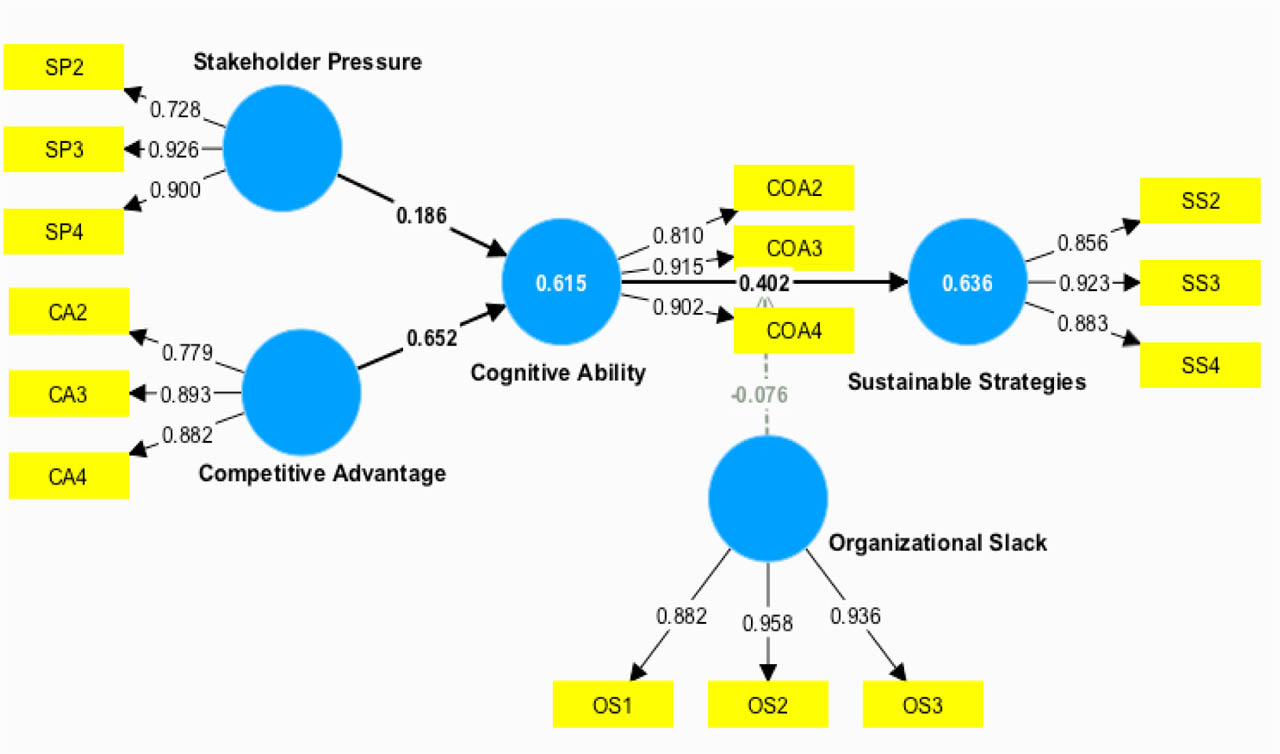
Figure 2:
Results of the model
Source: Data processing from PLS-SEM
Table 3 below presents collinearity statistics, revealing Variance Inflation Factor (VIF) scores ranging from 1.444 to 4.118, all comfortably below the standard 5.0 limit, confirming that there is no serious multicollinearity among the predictors. Such low correlations prevent instability in regression estimates within the structural model. Consequently, path coefficients remain trustworthy and free of distortion from overlapping variables, affirming the PLS-SEM framework's stability. All loadings that fell below the thresholds were deleted, that is, CA1, COA1, SP1, and OS1.
4.4. Discriminant validity
In PLS-SEM analysis, discriminant validity confirms that each construct stands apart from others in the model. Key approaches include the Fornell-Larcker criterion, in which the square root of a construct's AVE must exceed its correlations with other constructs, with a threshold of 0.50, and the Heterotrait-Monotrait (HTMT) ratio, with values below 0.90 indicating sufficient distinction (Sakyi et al., 2025). These complementary checks verify that constructs capture distinct phenomena, boosting model precision and clarity. Findings from these assessments appear in Table 4. However, the study used the Fornell-Lacker to establish discriminant validity, as shown in Table 4 below. Relatedly, the Fornell-Larcker matrix in Table 4 shows that the square root of each construct's AVE (on the diagonal) exceeds its correlations with other constructs (off-diagonal entries). This reinforces the notion that constructs represent distinct elements, confirming the model's structural stability and the trustworthiness of the path estimates that follow.
Table 4:
discriminant validity-Fornell Lacker
| Constructs | Cognitive Ability | Competitive Advantage | Organizational Slack | Stakeholder Pressure | Sustainable Strategies |
|---|---|---|---|---|---|
| Cognitive Ability | 0.877 | ||||
| Competitive Advantage | 0.771 | 0.853 | |||
| Organizational Slack | 0.541 | 0.554 | 0.926 | ||
| Stakeholder Pressure | 0.604 | 0.642 | 0.452 | 0.856 | |
| Sustainable Strategies | 0.693 | 0.723 | 0.692 | 0.555 | 0.888 |
4.5. Assessment of the measurement model
Hypothesis testing in structural equation modeling is a pivotal phase that rigorously examines the significance and magnitude of the postulated links between constructs within the proposed framework. Drawing from established theory and prior empirical evidence, the study's hypotheses probe both direct pathways and indirect (mediated) dynamics linking Stakeholder Pressure and Competitive Advantage to Cognitive Ability, with organizational slack serving as a moderator. Leveraging Partial Least Squares Structural Equation Modeling (PLS-SEM), each proposition is evaluated through path coefficients, accompanying t-statistics, and p-values to ascertain empirical support for the theorized associations. Detailed outcomes of this analysis are presented in Table 5 below. Hypothesis testing was conducted, with results outlined in Table 5 and Figure 2. Findings support hypotheses H1, H2, and H3, while H4 is rejected.
Table 5:
Hypothesis Testing
| Standard Bootstrap Results | ||||||
|---|---|---|---|---|---|---|
| Effects | Original coefficient | Mean value | Standard Deviation | t-value | p-value | Interpretation |
| H1: Stakeholder Pressure -> Cognitive Ability | 0.186 | 0.185 | 0.065 | 2.844 | 0.004 | Accepted |
| H2: Competitive Advantage -> Cognitive Ability | 0.652 | 0.652 | 0.053 | 12.404 | 0.000 | Accepted |
| H3: Cognitive Ability -> Sustainable Strategies | 0.402 | 0.394 | 0.078 | 5.184 | 0.000 | Accepted |
| H4: Organisational Slack -> Cognitive Ability -> Sustainable Strategies | −0.076 | −0.107 | 0.065 | 1.173 | 0.241 | Not Accepted |
6. Discussion
The current research supports the proposition that stakeholder pressure significantly enhances SMEs' dynamic cognitive abilities. Consistent with the literature (e.g., Hahn et al., 2015; Bansal & Roth, 2000), H1 was empirically verified. This finding implies that when SMEs face heightened demands and expectations from key stakeholders, such as discerning customers, regulatory authorities, impact-driven investors, and the local community, this heightened pressure acts as a powerful catalyst for organizational learning. The strength and composition of stakeholder pressure, however, vary significantly across institutional environments. In post-socialist transition economies, where civil society traditions are less deeply embedded, and consumer environmental awareness emerged more recently, the landscape of stakeholder influence differs markedly from that in Western European settings. As demonstrated by studies (e.g., Alfirević et al., 2025) of SMEs in post-socialist contexts, regulatory and legislative frameworks constitute the dominant source of stakeholder influence, rather than diffuse societal or market-based pressures.
Soulsby et al. (2021) attribute Central Europe's weak institutional trust to post-socialist legacies, making regulatory frameworks the dominant source of stakeholder pressure. Perényi et al. (2020) note that leaders there rely on personal integrity and informal networks rather than formal ethics programs. In contrast, Ghana faces community-based, religious, and kinship pressures. Zvaríková et al. (2023) find that Visegrád SME managers' report high personal ethics but acknowledge common unethical practices, such as tax optimization by competitors, a pattern that may resonate with Ghana's informal economy, albeit under different cultural logics. Svoboda et al. (2026) further elaborated on this paradox, noting that companies in the Czech Republic face considerable challenges in adapting to sustainability and recommend the integration of human rights due diligence in their core operations. This external pressure compels managers to move beyond routine thinking and actively engage in sensemaking to interpret complex and often conflicting signals. Consequently, this process sharpens their interpretive and analytical skills, forging enhanced cognitive capabilities specifically oriented toward integrating sustainability concerns into core strategic decision-making and problem-solving.
Furthermore, the study confirms H2, demonstrating that competition also serves as a significant driver of the development of advanced strategic cognition in SMEs. To survive and thrive, firms must constantly refine their market positioning strategies. This competitive imperative forces them to develop more sophisticated cognitive abilities, enhancing their capacity for complex problem-solving, particularly when addressing sustainability challenges. This finding aligns with the work of Porter and Kramer (2011) and Andriopoulos and Lewis (2009), who suggest that rivalry is not merely a threat but a catalyst for internal capability development, including managerial cognition and strategic flexibility. However, competitive pressure operates differently in Ghana versus Central Europe. Soulsby et al. (2021) show that Central European SMEs face competition shaped by weak post-socialist institutional trust, leading to reliance on informal networks rather than transparent rivalry. Perényi et al. (2020) add that leaders experience tension between ethical values and competitive realities. By contrast, Ghanaian SMEs face competition mediated by community-based norms and relational accountability, where unethical competitive behavior carries strong social sanctions from trade associations and kinship structures, potentially making competition a more ethically constrained driver of cognition.
Additionally, Petráková and Karácsony (2024) found that Hungarian SMEs perceive competitive pressure more acutely than their regional counterparts, yet this pressure does not uniformly translate into proactive sustainability strategies. Essentially, uncertainty about returns on investment constitutes the most serious cognitive barrier for Central European SMEs, rather than competitive pressure itself. Alfirević et al. (2025) confirmed that entrepreneurial capabilities, risk-taking, opportunity recognition, and strategic flexibility enable SMEs to overcome competitive barriers, with waste minimization and material savings representing the most leveraged responses. In essence, the pressure to outperform rivals pushes SMEs to think more creatively and systemically, thereby honing the very cognitive skills needed to formulate robust sustainability strategies. Given that competitive pressure drives strategic cognition, the translation of this cognition into sustainability outcomes depends on enabling institutional frameworks. Thus, studying cognitive abilities is a key mechanism through which competitive pressure translates into proactive sustainability action.
This research strongly supports (H3), establishing that a firm's cognitive abilities are pivotal to the development and execution of a robust sustainability strategy. The findings indicate that SMEs with superior sensemaking, interpretive, and problem-solving skills are fundamentally better equipped to navigate the inherent tensions between economic performance and ethical, social, and environmental demands. Petráková and Karácsony (2024) found that SME managers in the Visegrad countries who possess stronger interpretive skills are better equipped to translate regulatory pressures into operational efficiencies. Rybarova et al. (2023) affirmed that firms with advanced problem-solving capabilities perceive lower barriers to low-carbon adaptation, as they can more accurately assess return on investment and payback periods. Ogrean and Herciu add that cognitive abilities mediate the relationship between competitive pressure and sustainability outcomes, with firms demonstrating higher strategic cognition achieving better circularity metrics.
However, the cognitive skills required for sustainability strategy differ between Ghana and Central Europe due to distinct ethical landscapes. Soulsby et al. (2021) note that Central European managers must develop interpretive abilities to navigate complex, often conflicting post-socialist and EU-derived regulations. Zvaríková et al. (2023) and Belas et al. (2024) add that Visegrád SME managers face a paradox: high self-reported ethics alongside common competitors' unethical practices, requiring cognitive skills to detect and manage hypocrisy. In contrast, Ghanaian managers require different cognitive competencies, synthesizing communal ethical expectations, religious norms, and informal trade association pressures with formal compliance demands, making sensemaking more socially embedded than regulation-focused. These advanced cognitive capabilities enable managerial teams to act as active agents of change. Rather than viewing sustainability as a constraint, they leverage their cognition to translate external demands and complex information into opportunities for innovation. This process, consistent with the insights of Hahn et al. (2015) and Miron-Spektor et al. (2018), allows them to drive both eco-efficiencies that reduce costs and differentiation that creates unique value, proving that strong managerial cognition is a cornerstone of proactive sustainability.
Interestingly, the study found that H4 was not supported, as the moderation effect of slack resources on the relationship between cognitive abilities and sustainable strategy development was non-significant. Empirical research from Poland supports the non-significant moderation of slack resources. Ciszewska-Milnaric et al. (2025) reiterated that SMEs in transition economies sustain strategic renewal through cognitive negotiation of paradoxes, specifically, rapid expansion vs. resource constraints using bricolage rather than resource abundance. This proposition challenged the conventional assumption that having an abundance of financial, human, or technological resources automatically amplifies the translation of good ideas into action (Morgan-Thomas et al., 2026). Instead, the findings from these SMEs suggest that cognitive quality is the primary driver; excess resources alone do not inherently strengthen the link between a manager's understanding of sustainability issues and the implementation of effective strategies to address them.
This non-significant moderation effect may manifest differently across Ghana and Central Europe due to divergent resource environments. Soulsby et al. (2021) observe that Central European SMEs operate within post-socialist systems in which informal networks substitute for formal access to resources, making slack resources less relevant than relational capital. Perényi et al. (2020) add that leaders there rely on personal integrity and trust networks rather than resource abundance to resolve ethical dilemmas. By contrast, Ghanaian SMEs face more acute resource scarcity, with the lack of financial slack acting as a binding constraint. Zvaríková et al. (2023) and Belas et al. (2024) confirm that Visegrád SME managers' report tax optimization and informal payments as common competitor practices, suggesting that, in resource-constrained Central European environments, cognitive bricolage may compensate for the absence of slack. A finding that likely holds even more strongly for Ghanaian SMEs operating with thinner institutional safety nets.
This outcome aligns with Adams et al. (2016) research, underscoring the primacy of mindset and interpretation over mere structural advantages. It suggests that a scarcity of resources may even sharpen cognitive focus, whereas abundance does not guarantee more or better sustainability action. Paradox theory, as discussed by Smith and Lewis (2011), provides a valuable backdrop here, suggesting that the ability to cognitively accept and navigate tensions is more critical than resource munificence in developing strategies that create lasting value. Bratnicka-Myśliwiec and Ingram (2022) demonstrated that while slack resources explain organizational creativity, a paradoxical mindset drives creative novelty in family businesses, yet resource abundance alone does not amplify this relationship. Crucially, a Croatian policy analysis identified that the primary obstacles for SMEs are knowledge, information systems, and institutional frameworks, not access to finance, directly supporting the finding that cognitive and informational capacities, not resource munificence, are the binding constraints.
7. Implications
7.1. Theoretical implications
This research makes several theoretical contributions to the literature on sustainability and strategy in SMEs by applying paradox theory to ethical SMEs, where a both/and approach to profitability and sustainability is required. First, the results confirm that stakeholder and competitive pressures serve not only as constraints but also as cognitive catalysts. Contrary to expectations, these pressures do not force SMEs into reactive postures but instead serve as catalysts for managerial sensemaking and interpretation, thus improving cognitive capabilities and enabling constructive handling of sustainability paradoxes. This research contributes to paradox theory by empirically demonstrating that external tensions can serve as catalysts for cognitive capabilities that help organizations cope with sustainability paradoxes. Moreover, the results confirm the importance of organizational cognition as a crucial mediator between external pressures and sustainability strategies. Unlike previous paradox research, which has often focused on structural or behavioral aspects, this research shows that cognitive capabilities are the micro-foundations of paradox management, especially in SMEs. Organizations with higher cognitive capabilities are better able to understand sustainability paradoxes and develop strategies to address them. Third, the insignificant moderating effect of organizational slack contradicts the sustainability and resource-based views that more resources are needed to support sustainability actions. The results indicate that cognitive interpretation of paradoxical pressures may be more important than resource abundance, particularly in SMEs, where strategic flexibility and cognitive interpretation are often more important than resource abundance. This research contributes to paradox theory by demonstrating that cognitive capabilities enable SMEs to turn sustainability paradoxes into strategic opportunities.
7.2. Practical implications
The results have several key implications for managers of small to medium-sized enterprises (SMEs) seeking to balance ethical accountability with competitive viability. Firstly, SME managers should start viewing stakeholder pressure as a strategic learning opportunity rather than merely a limiting force. Stakeholder pressures, whether from the government, customers, or communities, can prompt more fundamental strategic thinking about sustainability. Second, competitive pressures should not be seen solely as threats. When interpreted through a sustainability perspective, they can foster the development of advanced cognitive skills, including strategic flexibility, sustainability awareness, and problem-solving abilities, which support differentiation and long-term legitimacy. Third, the findings highlight the importance of enhancing managerial cognitive abilities. SME owners and managers need to invest in training and developing their strategic thinking and knowledge about sustainability and ethical decision-making, thereby improving their capacity to incorporate sustainability into strategic planning. Lastly, the lack of significance of slack resources indicates that developing sustainability strategies is not limited to resource-rich organizations. Resource-constrained SMEs can also cultivate meaningful, sustainable practices if their managers possess strong interpretive and problem-solving skills.
8. Conclusion
The study investigated Navigating Moral and Market Realities: Sustainability Strategies for Ethical SMEs among manufacturing SMEs within two business regions, with organizational slack serving as a moderating variable. Paradox theory was applied as the theoretical foundation. The findings indicated that three of the hypotheses were significant, while the moderating hypothesis was insignificant. The results offer compelling evidence backing a holistic model that links moral and Market Realities with Sustainability Strategies. This research enriches the theory by broadening ethical and moral principles within the manufacturing SMEs in developing markets. On the practical front, Owners and managers of SMEs should prioritize training to sharpen their strategic mindset and deepen expertise in sustainability and ethical choices, enabling seamless integration of green practices into core business planning. In essence, the findings affirm organizational cognition's pivotal role as a mediator linking external pressures to sustainability strategies. Taken together, Central European SMEs face ethical pressures from weak institutional trust and regulatory frameworks, whereas Ghanaian SMEs are shaped more by community expectations, religious norms, and kinship accountability.
8.1. Limitation of study
This research has limitations that call for careful interpretation and future refinement. Notably, The study only dwells on SMEs in the manufacturing sector, leaving out SMEs in other sectors, which poses a limitation. Additionally, the cross-sectional approach limits the establishment of causal relationships over time. Future longitudinal designs could track changes in SME ethical knowledge. Finally, self-reported data raises concerns about social desirability. Subsequent studies might incorporate blended surveys, in-depth interviews, and case analyses from firms for richer validation. Lastly, targeting Ghanaian SMEs provides valuable local insights but limits broader applicability. Extending the research to diverse nations with varying moral and ethical realities would more precisely define the model's scope.