
INTRODUCTION
Nonsteroidal anti-inflammatory drugs (NSAIDs) are widely prescribed for treating pain, inflammation, and fever, with therapeutic action arising from cyclooxygenase (COX) inhibition and reduced prostaglandin synthesis (1). Among them, naproxen is a propionic acid derivative with well-documented clinical efficacy, particularly in musculoskeletal disorders and dysmenorrhea (2). Despite this, structural modification of naproxen remains a relevant medicinal chemistry strategy for improving biological profiles, minimizing adverse effects, and modulating physicochemical and biopharmaceutical characteristics. Thiourea derivatives constitute a versatile chemical class displaying anti-inflammatory, anticancer, antimicrobial, and enzyme inhibitory effects due to their ability to establish hydrogen bonding and conformational interactions with biological targets (3,4).
Naproxen-based thiourea compounds have been synthesized with the aim of retaining key pharmacophoric elements of the parent drug while introducing new substituents that potentially alter selectivity or biological activity. The results indicate that these derivatives may modulate COX-2 or 5- lipoxygenase (5-LOX) activity, as well as exhibit cytotoxic effects against selected tumor cell lines (5,6). These structural modifications generate compounds with altered lipophilicity or hydrogen bonding patterns.
Considering that NSAIDs are predominantly administered orally, understanding the gastrointestinal absorption of these derivatives is essential to anticipate their in vivo performance. For orally administered drugs, passive transcellular diffusion represents the predominant intestinal absorption mechanism for compounds without carrier-mediated transport (7,8). Experimental assessment of passive permeability therefore plays a central role in early drug profiling. Several in vitro and in silico tools have been established to estimate passive gastrointestinal absorption. However, chromatographic biomimetic systems have gained attention due to their reproducibility, low material consumption, and capability to mimic membrane-like environments without reliance on biological systems. Biopartitioning micellar chromatography (BMC) is a modified micellar chromatographic technique in which nonionic surfactants are added to the aqueous mobile phase at concentrations exceeding the critical micellar concentration (9,10). In BMC systems, surfactant monomers adsorb onto the hydrophobic stationary phase, while excess monomers form micelles within the mobile phase. This arrangement mimics structural features of biological membranes: hydrophobic surfactant chains resemble phospholipid tails, polar headgroups simulate membrane interfaces, and micellar aggregates approximate extracellular aqueous domains (9,10,11). Under these conditions, solute retention reflects distribution between stationary phase, aqueous phase, and micellar phase, providing an indirect measure of passive permeability and membrane partitioning (Figure 1). The usefulness of the BMC method in predicting drug permeation across biological barriers, including the blood-brain barrier, skin, and the gastrointestinal tract, has been demonstrated (10,11,12).
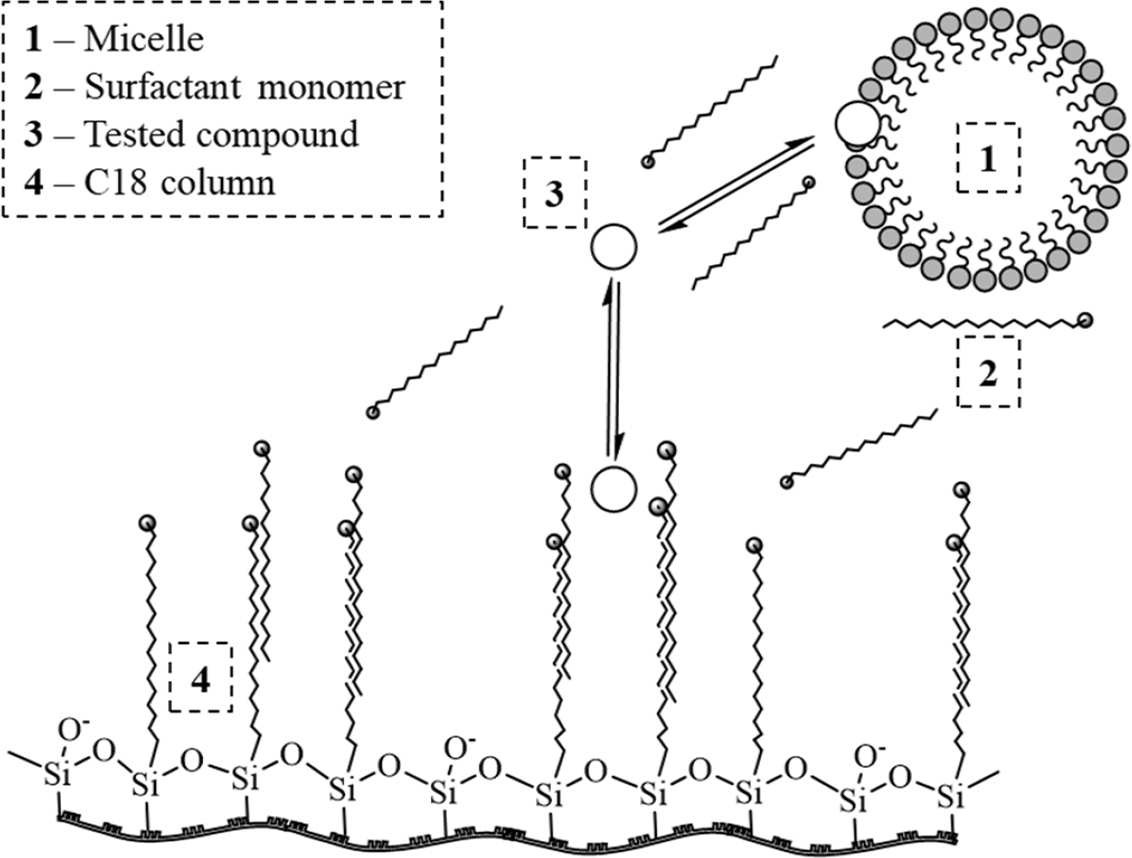
Figure 1.
Schematic illustration of the micellar chromatography mechanism
Beyond chromatographic assessment, chemometric modeling provides further insight into structural determinants of retention and permeability. Quantitative structure-retention relationship (QSRR) analysis correlates chromatographic retention with molecular descriptors that encode physicochemical, geometric, or electronic features (13,14). QSRR models allow the identification of structural features influencing retention in biomimetic systems and facilitate computational prediction of chromatographic behavior for new derivatives. The integration of BMC with QSRR thus represents a rational dual approach for evaluating passive gastrointestinal absorption potential and interpreting structure-retention relationships within a single experimental framework (14).
Considering the biological potential of naproxen-based thiourea derivatives and the need to assess their oral absorption characteristics, this study was focused on evaluating passive gastrointestinal permeation using a BMC model as a biomimetic in vitro surrogate. Additionally, a QSRR analysis was performed to elucidate structural determinants of retention within the BMC system. It should be noted that the present study examines a limited number of compounds belonging to a previously synthesized series of naproxen-based thiourea derivatives. The seven molecules included in this work were selected as representative members of the main structural subgroups within that series, based on previously obtained physicochemical data, particularly lipophilicity measurements and PAMPA permeability results. Although the relatively small dataset represents a limitation from a statistical standpoint, the selected compounds cover the principal structural variations and the range of permeability-related properties observed in the broader series.
MATERIALS AND METHODS
Chemicals
Brij 35 and HPLC grade acetonitrile were purchased from Sigma-Aldrich Chemie Gmbh (Steinheim, Germany), while disodium hydrogen phosphate (Na2HPO4) and o-phosphoric acid (85%) were from Merck (Darmstadt, Germany). Dimethyl sulfoxide (DMSO) was acquired from Fisher (Loughborough, UK). Deionized water was prepared using a TKA water-purification system (Niederelbert, Germany).
Tested thiourea derivatives of naproxen (compounds 2–7 and 11) were synthesized as previously described (5,6). Their chemical structures are presented in Figure 2. The numbering of the compounds corresponds to the previously reported synthetic series, and only selected derivatives (compounds 2–7 and 11) were included in the present study. Test solutions (0.01 mg/mL) were prepared by diluting stock solutions of the tested compounds in DMSO (5 mM) with the mobile phase to obtain the desired concentration.
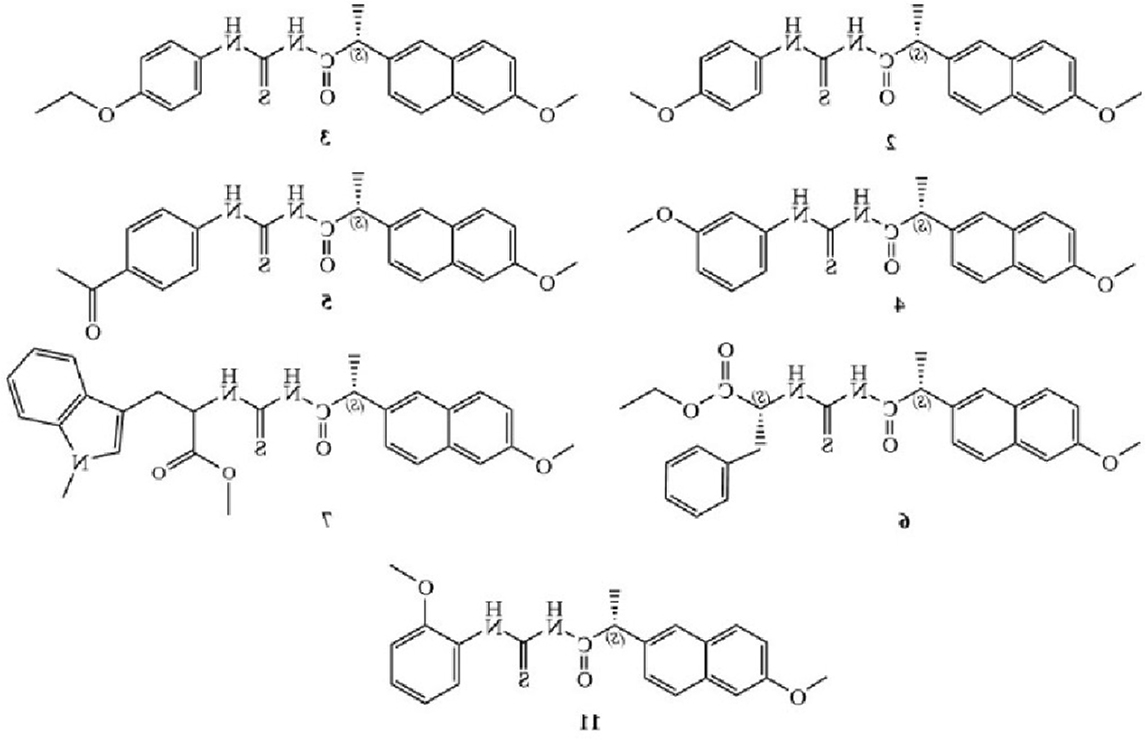
Figure 2.
Chemical structures of tested compounds
BMC Analysis
The chromatographic analysis was performed using an HPLC chromatograph (Agilent Technologies 1200 Series Systems, Santa Clara, CA, USA) equipped with a binary pump, manual injector (injection volume 20 μl), and DAD detector. Zorbax Extend-C18 column (150 × 4.6 mm; 5 μm particle size) was used in this study. The mobile phase consisted of acetonitrile and 40 mM polyoxyethylene lauryl ether (Brij 35) dissolved in 7 mM solution of Na2HPO4 (30:70 v/v). Previous research has demonstrated that a 0.04 mol/L Brij 35 solution can be combined with up to 30% acetonitrile while still maintaining the formation of stable micelles (15). The pH value of the mobile phase was adjusted to 5.5 by the addition of o-phosphoric. The column temperature was set to 36.5°C, the mobile phase flow rate to 1 ml/min, and the detection wavelength to 280 nm for the synthesized compounds and 230 nm for DMSO. Corresponding retention factors (k) were calculated according to the following equation:
where tR is the retention time of the tested compounds and tR(0) corresponds to the dead time determined using DMSO as a non-retained marker (10,12,16).QSRR analysis
QSRR analysis was conducted to elucidate the relationship between chromatographic retention and molecular structure of the investigated compounds. Specifically, correlations were tested between the experimentally determined retention factors (k) obtained from the BMC chromatographic system, used as dependent variables, and a set of selected geometric, thermodynamic, physicochemical, and electronic molecular descriptors serving as independent variables. For QSRR model development, retention data for seven compounds analyzed within the BMC system were utilized.
Prior to descriptor calculation, the molecular structures of all investigated compounds were subjected to geometry optimization. Initial optimization was carried out using the semiempirical PM3 method, followed by further refinement employing the Hartree-Fock method with the 3–21G basis set to obtain energetically stable conformations (17). A comprehensive set of molecular descriptors was subsequently calculated using the alvaDesc software package (18). An intercorrelation analysis was subsequently conducted to obtain suitable subsets of molecular descriptors for the QSRR study. Descriptor pairs exhibiting intercorrelation coefficients greater than 0.95 were evaluated, and in each case, the descriptor showing a stronger relationship with the dependent variable (retention factor k) was retained for further analysis.
Statistical analysis and model construction were performed using STATISTICA software (19). Descriptor selection for the multiple linear regression model (MLR(k)) was achieved through the combined application of Feature Selection and Variable Screening (FSVS) and the forward stepwise Multiple Linear Regression (MLR) approach. During the forward stepwise MLR procedure, the inclusion and exclusion criteria were set to F-to-enter = 9 and F-to-remove = 4, respectively, while in the FSVS method the parameter k was set to 10. Given the small number of analyzed compounds, which represents a limitation of the present study, the QSRR analysis was intentionally designed as exploratory and restricted to the simplest statistical framework. Accordingly, only a single statistically significant descriptor was included in the model in order to reduce the risk of overfitting and to enable identification of the dominant structural factor governing retention behavior. Consequently, the final QSRR model was developed using the Mor20u descriptor without dividing the dataset into training and test subsets.
Due to the limited dataset size (n = 7), external validation procedures such as dataset splitting or cross-validation would not yield statistically reliable estimates of predictive performance. Therefore, the model should be interpreted strictly as an exploratory structure-retention relationship rather than a predictive QSRR model.
RESULTS AND DISCUSSION
Retention behavior of the tested compounds in the BMC system
BMC was applied to a series of seven thiourea derivatives of naproxen. The experiments were carried out using Brij 35, a nonionic surfactant commonly employed in BMC studies. Chromatographic conditions, including pH, temperature, and ionic strength, were adjusted to biomimetic conditions mimicking biological membranes. Under these conditions, analyte retention is primarily governed by specific interactions with both the modified stationary phase and the micellar pseudophase in the mobile phase (9). Consequently, the elution process reflects a complex interplay between micelles, the stationary phase, and the aqueous medium (20). A critical aspect of method optimization involves establishing an appropriate ratio between the organic modifier and the aqueous phase. Previous investigations have demonstrated that micelle formation is maintained in systems containing 40 mM Brij 35 with up to 30% (v/v) acetonitrile (12). Chromatographic behavior was evaluated using retention time (tR), retention factor (k), and logarithmic retention factor (logk), with the corresponding results summarized in Table 1.
Table 1.
Retention factors of the tested compounds in the BMC system.
| Compound | tR(s) | k | logk |
|---|---|---|---|
| 2 | 37.24 | 30.03 | 1.48 |
| 3 | 35.54 | 28.62 | 1.46 |
| 4 | 42.06 | 34.05 | 1.53 |
| 5 | 27.57 | 21.98 | 1.34 |
| 6 | 57.90 | 47.25 | 1.67 |
| 7 | 43.94 | 35.62 | 1.55 |
| 11 | 37.90 | 30.58 | 1.49 |
The obtained results revealed that the retention factor (k) values varied between 21.98 and 47.25. The highest retention was observed for compounds 6 (phenylalanine ethyl ester derivative) and 7 (N-methyl tryptophan methyl ester derivative), indicating that thiourea derivatives containing esterified aromatic amino acids are likely to possess enhanced potential for passive gastrointestinal absorption. In contrast, the lowest k value was recorded for derivative 5, corresponding to the p-aminoacetophenone derivative, suggesting a reduced absorption potential for naproxen thiourea derivatives incorporating aromatic amines with a carbonyl functionality. These findings are consistent with our previously published results obtained using the PAMPA assay, which demonstrated superior passive gastrointestinal permeability for aromatic amino acid ester derivatives (21). In contrast, derivative 5, which in the present study exhibited the lowest predicted potential for passive gastrointestinal absorption, demonstrated moderate permeability across an artificial membrane in a previous PAMPA assay (21).
It should be emphasized that BMC retention represents an indirect physicochemical surrogate reflecting solute partitioning in a biomimetic micellar environment and cannot be considered equivalent to experimentally measured permeability. Consequently, the obtained results should be interpreted as complementary indicators of passive diffusion potential rather than direct measurements of gastrointestinal absorption. It should also be noted that oral absorption is a multifactorial process influenced not only by passive membrane permeability but also by ionization state, dissolution kinetics, intestinal transporters, metabolic stability, and efflux mechanisms. Therefore, chromatographic retention parameters should be interpreted within this broader pharmacokinetic context.
QSRR analysis
Given the limited number of compounds, the simplest statistical model (MLR) was applied, as the aim of the QSRR study was to gain an initial understanding of the key factor governing their retention behavior. Relevant molecular descriptors for the MLR(k) model were identified through a two-stage approach involving FSVS and subsequent forward stepwise MLR. The FSVS procedure selected the VE2sign_A descriptor. However, it was not possible to construct a valid MLR(k) model with this descriptor. Using the MLR forward stepwise method, the selected descriptor was Mor20u, which yielded a valid model. This model is characterized by high R and R2 values of 0.977 and 0.955, respectively. The resulting MLR(k) model equation is as follows:
Although the obtained correlation coefficients (R and R2) indicate a strong relationship between retention and the selected descriptor, these values should be interpreted with caution due to the limited dataset size. In small datasets, high correlation coefficients may reflect dataset-specific relationships rather than true predictive performance. Therefore, the presented regression should be considered an exploratory structure-retention relationship within this compound series rather than a validated predictive QSRR model.
Statistical analysis showed that the Mor20u was identified as the descriptor most strongly associated with retention behavior in the BMC system. Mor20u belongs to the 3DMoRSE group of molecular descriptors (22), which encode informations related to atomic properties, including polarizability, and their three-dimensional distribution within the molecule. However, it should be emphasized that 3DMoRSE descriptors are abstract numerical representations and their mechanistic interpretation is not straightforward. (23,24,25,26). Studies have shown that the presence of aromatic systems and unsaturated bonds increases the values of these descriptors (26). Since 3D-MoRSE descriptors take into account the three-dimensional arrangement of atoms in a molecule and do not depend on molecular size, they can be applied to a broad range of structures (23). The Mor20u descriptor is generally associated with molecular polarizability and three-dimensional distribution of atomic properties (27). In this context, the observed relationship between Mor20u and retention should be interpreted as a statistical correlation rather than a direct mechanistic explanation of solute-micelle or solute-stationary phase interactions. The highest descriptor values were recorded for compounds 6 (phenylalanine ethyl ester derivative) and 7 (N-methyl tryptophan methyl ester derivative), indicating that high Mor20u values are characteristic of aromatic amino acid ester derivatives. Conversely, the lowest descriptor value (2.76) within the examined set was observed for compound 5 (p-aminoacetophenone derivative). These observations may indicate that esterified aromatic amino acid derivatives tend to exhibit higher retention within this compound series. From a physicochemical perspective, increased aromatic surface area and molecular polarizability may enhance hydrophobic and dispersive interactions with both the C18 stationary phase and the hydrophobic core of micelles, which can contribute to increased retention. Aromatic substituents may also facilitate π-π and van der Waals interactions within the chromatographic system. It should be noted that increasing lipophilicity or molecular polarizability, although potentially beneficial for passive membrane permeability, may be associated with trade-offs such as reduced aqueous solubility, altered distribution, or increased risk of off-target interactions. Therefore, optimization of absorption-related properties should be considered within a broader pharmacokinetic and safety framework (28,29).
However, these interpretations remain qualitative and should be considered as plausible explanations rather than definitive mechanistic conclusions. Due to the limited size of the dataset, the developed QSRR model should be considered exploratory rather than predictive. Additional studies involving a larger and more structurally diverse set of compounds will be required to confirm the robustness and general applicability of the identified relationship.
CONCLUSIONS
In this study, BMC proved to be an effective tool for evaluating the retention behavior and passive absorption-related properties of naproxen-based thiourea derivatives under biomimetic conditions mimicking biological membranes. The obtained results indicated that retention in the BMC system is strongly influenced by molecular structure, particularly the presence of esterified aromatic amino acid moieties, which were associated with higher retention factors and, consequently, a greater potential for passive gastrointestinal absorption. In contrast, incorporation of aromatic amines bearing a carbonyl group resulted in lower retention and reduced absorption potential. The QSRR analysis indicated that the Mor20u descriptor was selected as a key variable in the MLR(k) model. This descriptor effectively described the relationship between molecular structure and chromatographic retention, emphasizing the importance of molecular polarizability and aromatic character. Taken together, results demonstrate that the combined application of BMC and QSRR represents a powerful and complementary approach for the early assessment of biopharmaceutical properties and may provide preliminary insight that could support future design considerations, which require validation on larger datasets and through complementary experimental approaches.
Notes
[1] FUNDING
This research was supported by the Science Fund of the Republic of Serbia, 7739840, Utilization of interplay between inflammation and cancer in the development of compounds with anticancer activity - INFCANPLAY. The research was also supported by the Ministry of Science, Technological Development and Innovation, Republic of Serbia, through Grant Agreements with the University of Belgrade - Faculty of Pharmacy (No 451-03-136/2025-03/200161 and No 451-03-137/2025-03/200161) and with Faculty of Medical Sciences, University of Kragujevac No 451-03-34/2026-03/200111, as well as by the Faculty of Medical Sciences, University of Kragujevac (Junior Project 11/20).
ACKNOWLEDGMENTS
Not applicable.