
Table 1.
Eligibility criteria for study selection.
| Domain | Inclusion criteria | Exclusion criteria |
|---|---|---|
| Study design | Original quantitative, qualitative, or mixed-methods studies | Reviews, meta-analyses, editorials, commentaries, conference abstracts, case reports |
| Population | Women eligible for or invited to mammography-based breast cancer screening in the general population or specific subgroups | Studies focused exclusively on high-risk genetic surveillance populations or symptomatic/diagnostic populations |
| Screening focus | Studies examining barriers, determinants, or facilitators related to participation in or effectiveness of mammography-based screening programmes | Studies focused exclusively on diagnostic mammography, imaging accuracy, or technical performance without behavioural, programmatic, or access-related context |
| Barriers / determinants of interest | Individual, socio-cultural, economic, health-system, provider-related, geographic, or informational barriers affecting screening uptake or effectiveness | Studies not addressing factors associated with screening participation, non-participation, or programme effectiveness |
| Geographic context | Studies from all geographic regions and income settings were eligible | No exclusions based solely on geographic region; however, studies outside the scope of organised or programme-based mammography screening were excluded |
| Publication characteristics | Peer-reviewed full-text articles published in English from 2000 onward | Non-English publications, unavailable/incomplete full-text articles, and studies published before 2000 |
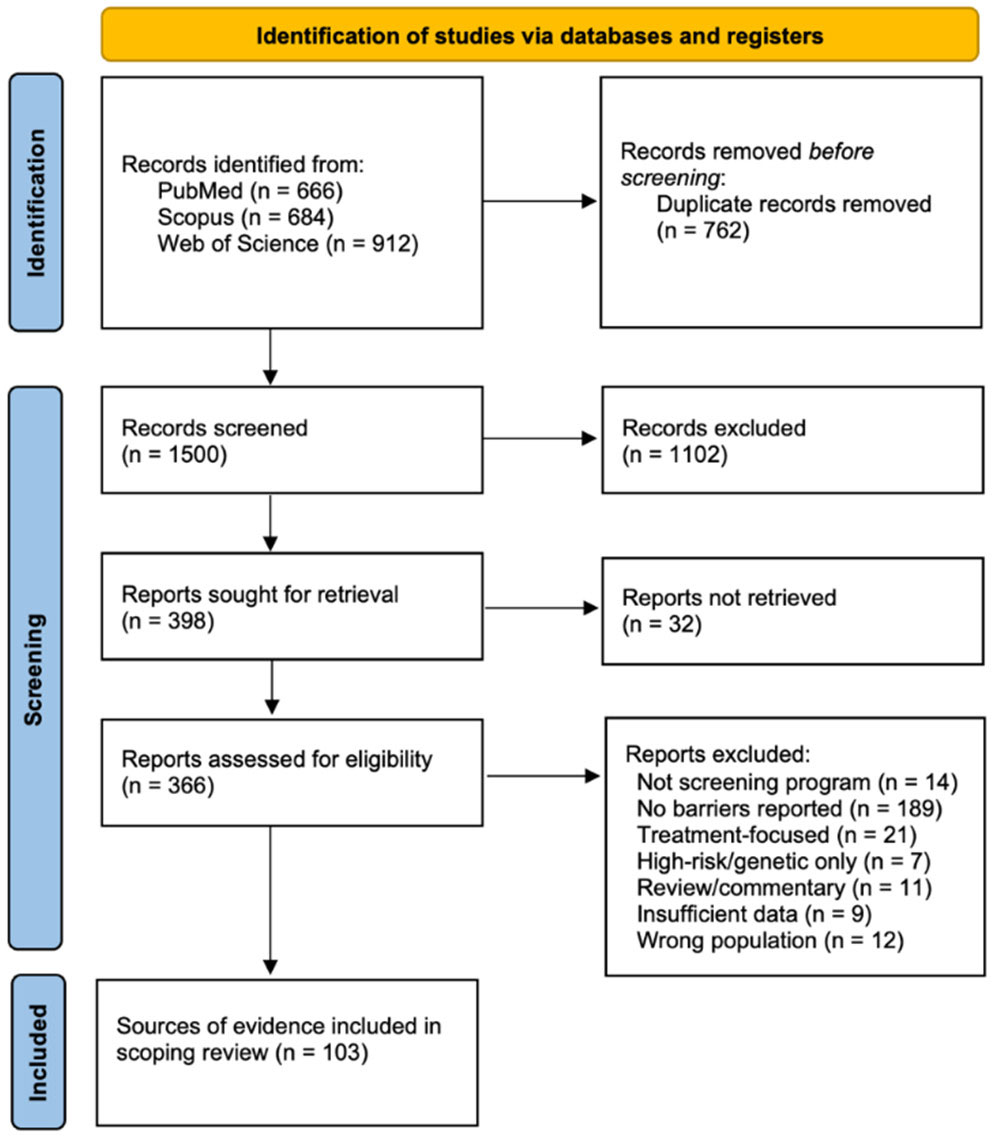
Figure 1.
PRISMA flow chart
Table 2.
Characteristics of included studies (n = 103)
| Characteristic | n (%) |
|---|---|
| Publication period | |
| 2000–2009 | 36 (35.0%) |
| 2010–2019 | 46 (44.7%) |
| ≥2020 | 21 (20.4%) |
| Geographic region | |
| Europe | 45 (43.7%) |
| North America | 35 (34.0%) |
| Asia-Pacific | 21 (20.4%) |
| Africa | 0 (0.0%) |
| Latin America | 1 (1.0%) |
| Multinational | 1 (1.0%) |
| Study design | |
| Quantitative | 71 (68.9%) |
| Qualitative | 21 (20.4%) |
| Mixed-methods | 11 (10.7%) |
| Screening context | |
| Organized | 50 (48.5%) |
| Opportunistic | 23 (22.3%) |
| Mixed / unclear | 30 (29.1%) |
| Target population (primary focus) | |
| General population | 80 (77.7%) |
| Low socieconomic status | 3 (2.9%) |
| Migrant / ethnic minorities | 14 (13.6%) |
| Rural / remote | 2 (1.9%) |
| Other | 4 (3.9%) |
Table 3.
Distribution of reported barriers to breast cancer screening across included studies (n = 103)
| Barrier domain | Studies reporting barrier, n (%) |
|---|---|
| Patient-level barriers | 78 (75.7%) |
| Access-related barriers | 63 (61.2%) |
| Health system / organizational barriers | 59 (57.3%) |
| Socioeconomic and cultural barriers | 43 (41.7%) |
| Provider-related barriers | 33 (32.0%) |
Table 4.
Key barriers to breast cancer screening reported across included studies
| Barrier domain | Key barriers (representative examples) |
|---|---|
| Patient-level barriers | Fear of pain during mammography; fear of cancer diagnosis or treatment; low perceived personal risk; absence of symptoms; anxiety related to radiation exposure; previous negative screening experiences; competing life priorities (work, caregiving, illness). |
| Socioeconomic and cultural barriers | Low income; lack of health insurance or underinsurance; indirect costs (transport, time off work); low educational attainment; limited health literacy; social deprivation; financial insecurity despite availability of free screening. |
| Access-related barriers | Long distance to screening facilities; transportation difficulties; inconvenient appointment times; limited service availability; long waiting times; poor physical accessibility for women with disabilities; urban–rural disparities in service provision. |
| Health system / organizational barriers | Failure or delay in invitation letters; inaccurate population registries; lack of reminder or recall systems; fragmented care pathways; non-personalized screening processes; insufficient screening capacity; long screening intervals; administrative complexity. |
| Provider-related barriers | Absence of physician recommendation; inadequate communication about screening benefits and procedures; limited counseling time; inconsistent or unclear screening guidance; lack of cultural competence; language barriers during clinical encounters. |