
INTRODUCTION
Breast cancer screening is one of the most effective tool for early disease detection and improved oncological outcomes. Mammography, as a gold standard is age specific recommended and international health initiatives emphasize the importance of organised, population-based approaches (1). However, programme effectiveness and real-world screening uptake vary significantly across health systems and settings. Previous reports have shown that access to screening and participation is influenced by a wide range of factors.
Regardless of widely available organized breast cancer screening programs in many countries, effective coverage rate remains a persistent challenge. European and international analyses point out that screening access and uptake are affected by a numerous constrains, such as (but not limited to) socioeconomic inequalities, geographic access, personal preferences, health system capacities (2).
The suboptimal screening participation underlying factors are multifactorial, describing multilevel barriers, identifying patient-centered determinants (fear, discomfort, cultural beliefs among others), systemic and health organizational determinants (infrastructure, costs, health care professional availability), and provider-related factors (such as communication and recommendation practices) (3). Those determinant may especially affect underserved groups, contributing to sustained disparities in screening uptake (4).
These barriers may be especially relevant for underserved, contributing to persistent inequalities in screening uptake. Although previous publications have explored screening participation determinants, current available evidence remains heterogeneous in terms of study design, context, populations under investigation, and a concise definitions of barriers. In addition, a number of published results come from high-income countries with long-established screening programmes, whereas low- and middle-income settings and vulnerable or underrepresented populations remain less thoroughly documented.
Evidence, obtained from real world data, indicate the significance of tailored interventions, such as educational approaches and screening system, to enhance breast cancer screening uptake, particularly in countries/populations without long standing, well organized screening programmes, as well as in resource-challenged systems (5).
Literature data is diverse and heterogeneous, in screening context, study design, ranging from interviews, surveys, observational analysis, mixed studies combining qualitative and qualitative approach to qualitative studies, surveys and implementation-focused work, accompanied with various definitions of barriers and screening successfulness. Additionally, quality assurance policies and standards, considering inadequate screening programme performance, emphasizing necessity for screening program and provider service redesign, as well as individualisation of approaches (6).
Given the complexity of the topic and the need for a broader mapping of the evidence, we conducted a scoping review to identify and categorize barriers affecting the effectiveness of breast cancer screening across different healthcare systems and populations.
The aim of this review was not only to summarize previously reported barriers, but also to provide findings relevant to programme improvement, policy development, and highlight potential interventions to improve screening uptake, particularly in settings where screening remains inadequate.
MATERIALS AND METHODS
Inclusion and exclusion criteria
Based on clearly defined, pre-established inclusion and exclusion criteria, studies aligned with the research objectives of this scoping review were selected. The selected publications included qualitative and quantitative research, as well as studies using combined methodologies, and addressed barriers, that is, factors determining the effectiveness of mammography screening for the purpose of early detection of breast cancer in different health systems.
The selected studies examined limitations encountered at different levels of the screening pathway, including the organization of the health care system, infrastructure, availability of services, and provider-related factors.
Barriers related to the target population itself (here, healthy women without known risk factors, screened with the aim of potential early detection of breast malignancy) were expanded to include psychological, socioeconomic, and cultural determinants. Geographic region or specific population characteristics were not considered exclusion criteria, nor were the pattern of screening program organization or national income level.
Studies were considered eligible if they were published as full-text articles, in English, in peer-reviewed scientific journals, within the period from 2000 to 2025. This timeframe was chosen to allow for monitoring the development of breast cancer screening programs, as well as for evaluating their effectiveness and identifying potential challenges to effective screening.
A summary of the eligibility criteria is presented in Table 1, while full publication details are provided in Supplementary material (Supplementary Table).
Table 1.
Eligibility criteria for study selection.
| Domain | Inclusion criteria | Exclusion criteria |
|---|---|---|
| Study design | Original quantitative, qualitative, or mixed-methods studies | Reviews, meta-analyses, editorials, commentaries, conference abstracts, case reports |
| Population | Women eligible for or invited to mammography-based breast cancer screening in the general population or specific subgroups | Studies focused exclusively on high-risk genetic surveillance populations or symptomatic/diagnostic populations |
| Screening focus | Studies examining barriers, determinants, or facilitators related to participation in or effectiveness of mammography-based screening programmes | Studies focused exclusively on diagnostic mammography, imaging accuracy, or technical performance without behavioural, programmatic, or access-related context |
| Barriers / determinants of interest | Individual, socio-cultural, economic, health-system, provider-related, geographic, or informational barriers affecting screening uptake or effectiveness | Studies not addressing factors associated with screening participation, non-participation, or programme effectiveness |
| Geographic context | Studies from all geographic regions and income settings were eligible | No exclusions based solely on geographic region; however, studies outside the scope of organised or programme-based mammography screening were excluded |
| Publication characteristics | Peer-reviewed full-text articles published in English from 2000 onward | Non-English publications, unavailable/incomplete full-text articles, and studies published before 2000 |
Studies with the exclusive aim of investigating diagnostic mammography or those focusing on the assessment of technical aspects were not considered. Meta-analyses, systematic reviews, narrative reviews, letters to the editor, editorials, conference abstracts, and case reports were not included in the analysis. In addition, populations with known risk factors (e.g., healthy BRCA-positive carriers), individuals with a predefined high risk of developing breast cancer, as well as experimental and animal studies, were excluded. Studies that did not provide information relevant to the identification of barriers or factors influencing the effectiveness of breast cancer screening were also not considered. Incomplete or unavailable full-text articles were, among the aforementioned parameters, was considered as exclusion criteria.
Sources of Information
A comprehensive and systematic literature search was performed, in order to identify relevant eligible publications, in following databases: PubMed/MEDLINE, Scopus, and Web of Science, on 14 January 2026. Selection of this databases was due to extensive coverage of public health, biomedical and health services publications in per-review scientific journals.
The review protocol was prospectively registered on the Open Science Framework (OSF), in order to assure rigor in methodology and transparency - publicly available under the DOI https://doi.org/10.17605/OSF.IO/GCZJV, and complete project details can be accessed at https://osf.io/vqsc8.
Search Strategy
A systematic database search strategy was designed to identify relevant literature while accounting for potential variations in terminology, with the aim of recognise publications that examined factors influencing the effectiveness of breast cancer screening. Searches were conducted across databases using combinations of relevant keywords and Boolean operators, with a focus on studies addressing screening, access, and barriers.
Full texts were retrieved through institutional access provided by the Faculty of Medical Sciences, University of Kragujevac, Serbia, where available. Reference lists of relevant articles were also screened to identify additional eligible studies. Grey literature was not systematically searched and was not included in this review.
The following search string was used in aforementioned databases, with database-specific adaptations, where required: (“breast neoplasms” OR “breast cancer”) AND (“screening program*” OR “population-based screening” OR “organized screening” OR “mass screening” OR invitation OR registry) AND (barrier* OR determinant* OR uptake OR participation OR attendance OR nonattendance) NOT (diagnos* OR treatment OR therap* OR surviv*)
The asterisk (*) was used to denote truncation, allowing requisition of multiple word variants (e.g., therap* → therapy/therapeutic) and improving the sensitivity of the search strategy. Equivalent versions of this strategy were adjusted for PubMed/MEDLINE, Scopus, and Web of Science, regarding specificities in indexing systems and search functionality. The full search strategies for each database are provided in the Supplementary Material.
Studies Selecting Process
Deduplication of publication was initial step in the process – obtained references were then exported, following importation into Zotero (7) for duplicate removal, performed on January, 15th 2026, prior to screening. The records remaining, were lather uploaded to Rayyan (8), in order to facilitate a transparent and reproducible workflow of the screening process (January, 17th 2026).
Two independent reviewers (M.G., and N.M.) screened titles and abstracts, respecting eligibility criteria, where potentially relevant records, by either reviewer, then accessed in full text, with subsequent confirmation of eligibility. If discrepancies occurred in any screening stage, and not resolved by consensus, a third reviewer (M.S.) was engaged to provide a final judgment.
The study selection process and reporting were conducted in accordance with the PRISMA Extension for Scoping Reviews (PRISMA-ScR) framework, maintaining transparent documentation of screening process.
Extraction of Data and Variables
Two reviewers were assigned to independently perform data extraction (M.G., and N.M.), using previously strandardised data-charting form, aiming to identify essential attributes within included studies.
Extracted data are presented in Supplementary Table and relate to study characteristics, including the first author’s name, year of publication, country, study design, and screening context. When a target population was defined, it was recorded separately, including information on population subgroups where it was explored (e.g., minority groups, rural populations, and persons with disabilities). Characteristics of screening programs, indicators of screening performance, and measures of access were also among the extracted data.
Barriers to effective screening were documented as reported by the study authors and subsequently grouped into predefined thematic domains, including barriers related to screening participants (i.e., the target population), cultural and socioeconomic barriers, access-related barriers, and barriers related to organizational capacity at the health system level. When selected publications addressed multiple thematic domains, all relevant barriers were recorded without classification. Where available, potential recommendations or guidance for program improvement were also extracted and presented.
Given the objectives of this scoping review, as well as the heterogeneity of the included studies and terminology used, no additional outcome classification, pooling of estimates, or reanalysis of data was performed. Data were extracted as presented in the original studies, in line with the aim of mapping existing evidence without assessing effectiveness or introducing performance indicators.
Data Synthesis and Grouping of Evidence
In accordance with the study objectives, data synthesis was conducted using a structured narrative approach. Given the diversity of the extracted data, a descriptive presentation was used rather than a quantitative synthesis.
Studies were grouped according to key thematic domains, encompassing study characteristics and screening context, target populations, and, where reported, indicators of screening effectiveness. Identified barriers were categorically defined where appropriate; when studies pointed to the expected multifactorial nature of barriers to successful screening, all relevant thematic domains were included.
A quantitative synthesis was not attempted because of substantial heterogeneity across the included studies in terms of design, target populations, screening contexts, definitions of barriers, and outcome reporting, which did not allow meaningful result pooling Therefore, narrative synthesis was considered the most appropriate method for mapping and interpreting the available evidence for defining screening barriers.
RESULTS
Study selection
A total of 2,262 records were identified in literature search, across PubMed, Scopus, and Web of Science. Following 762 duplicates removal, 1,500 unique records were screened based on titles and abstracts and 1,102 records were excluded, due to failing to meet eligibility criteria.
Full texts were sought for 398 records, where 32 of them could not be retrieved. The remaining 366 articles were then assessed at the full-text level. Additionally, 263 articles were removed from consideration, due to failure to report barriers for screening or program effectiveness, or due to treatment focus, or limited to predefined risk population.
All eligibility criteria met 103 studies and included in the scoping review. The study selection process is summarized in the PRISMA flow diagram (Figure 1).
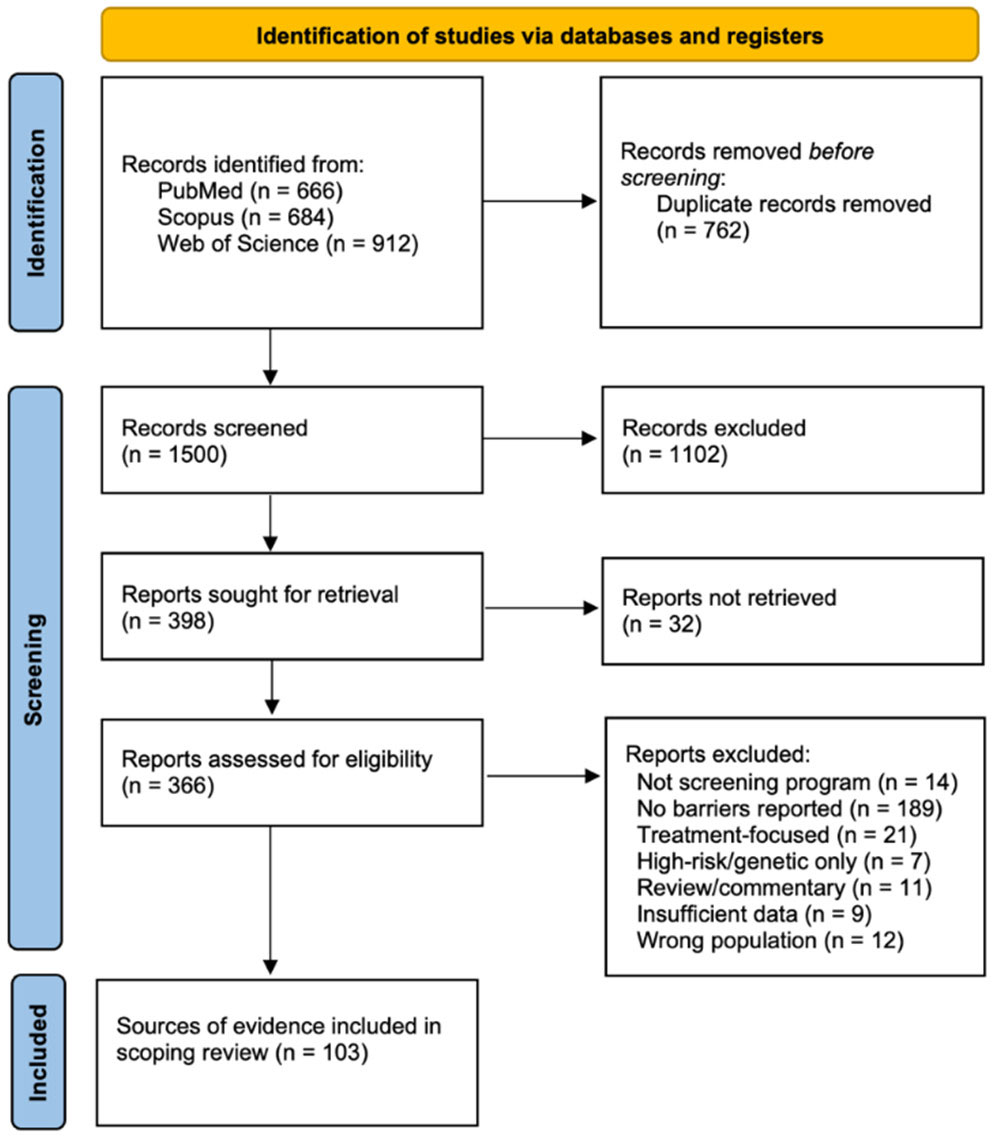
Figure 1.
PRISMA flow chart
Included studies characteristics
Although review included studies published between 2000 and 2025, encompassing more than two decades of research, most studies were published after 2010, with 46 studies (44.7%) published between 2010 and 2019 and a further 21 studies (20.4%) published from 2020 to 2025. The median year of publication was 2012, reflecting growing focus on efficacy, participation and equity-related factors. An overview of the all included study characteristics, including publication period, geographic distribution, study design, screening context, and target population, is summarised in Table 2.
Table 2.
Characteristics of included studies (n = 103)
| Characteristic | n (%) |
|---|---|
| Publication period | |
| 2000–2009 | 36 (35.0%) |
| 2010–2019 | 46 (44.7%) |
| ≥2020 | 21 (20.4%) |
| Geographic region | |
| Europe | 45 (43.7%) |
| North America | 35 (34.0%) |
| Asia-Pacific | 21 (20.4%) |
| Africa | 0 (0.0%) |
| Latin America | 1 (1.0%) |
| Multinational | 1 (1.0%) |
| Study design | |
| Quantitative | 71 (68.9%) |
| Qualitative | 21 (20.4%) |
| Mixed-methods | 11 (10.7%) |
| Screening context | |
| Organized | 50 (48.5%) |
| Opportunistic | 23 (22.3%) |
| Mixed / unclear | 30 (29.1%) |
| Target population (primary focus) | |
| General population | 80 (77.7%) |
| Low socieconomic status | 3 (2.9%) |
| Migrant / ethnic minorities | 14 (13.6%) |
| Rural / remote | 2 (1.9%) |
| Other | 4 (3.9%) |
As expected, study data were predominantly obtained from high-income countries. Europe accounted for the largest proportion of studies (43.7%), followed by North America (34.0%). A further 20.4% of studies were conducted in the Asia–Pacific region, while only a small number originated from Latin America (1.0%) or multinational settings (1.0%). None of analysed studies were conducted exclusively in African continent. Reflecting well established and organized screening programs, most frequently represented countries were United States of America, England, the Netherlands, Denmark, Sweden, Italy, and Australia.
The review included studies with a heterogonous design, with domination of quantitative methodology as much as 71 studies (68.9%), included cross-sectional surveys, registry-based analyses, spatial or ecological studies, and observational cohort designs. Qualitative methodologies were used in 21 studies (20.4%), via focus group interviews, exploring women’s perceptions, and decision-making process. Mixed-method studies occupied 10.7% of all studies combining quantitative data with qualitative insights.
In terms of screening context, 48.5% included studies focused primarily on organized, screening programmes in age specific population and centralized program oversight. Majority of this studies investigated failure to respond to screening invitation, participation coverage in different socioeconomic and geographic groups. Opposed to organized screening, opportunistic screening was elaborated in of 22.3% of studies, reflecting health based systems and provider recommendation. Almost third of included studies (29.1%) addressed mixed or unclear screening contexts, in terms of comparing organized and opportunistic approaches.
Majority of studies (77.7%) targeted age specific population, but a notable subset examined specific, disadvantage populations, where barriers for effective screening are expected to be more pronounced, such as migrant or ethnic minorities (13.6%), women of low socioeconomic status (2.9%), and rural and/or remote populations (1.9%). A smaller group of studies (3.9%) addressed other specific subgroups, such as women with false-positive screening results or women with disabilities, reflecting socioeconomic and cultural inequalities in screening participation.
Failure to respond to screening invitation or non-attendance was exploited among various study designs, without unique, widely acceptable definition, where qualitative studies defined as non-attendance within a specified interval, focused on perceived barriers and prior experiences, other studies distinguished between women that never participated in screening, or the ones that undergo screened outside organized programs.
Barriers to effective breast cancer screening
Analysing included studies, barriers to effective breast cancer screening were observed covering multiple, frequently interrelated domains (Table 3), accentuating multifactorial nature of screening coverage – identified barriers at more than one level, rather than a single determinant. Representative examples of commonly reported barriers within domains are shown in Table 4.
Table 3.
Distribution of reported barriers to breast cancer screening across included studies (n = 103)
| Barrier domain | Studies reporting barrier, n (%) |
|---|---|
| Patient-level barriers | 78 (75.7%) |
| Access-related barriers | 63 (61.2%) |
| Health system / organizational barriers | 59 (57.3%) |
| Socioeconomic and cultural barriers | 43 (41.7%) |
| Provider-related barriers | 33 (32.0%) |
Table 4.
Key barriers to breast cancer screening reported across included studies
| Barrier domain | Key barriers (representative examples) |
|---|---|
| Patient-level barriers | Fear of pain during mammography; fear of cancer diagnosis or treatment; low perceived personal risk; absence of symptoms; anxiety related to radiation exposure; previous negative screening experiences; competing life priorities (work, caregiving, illness). |
| Socioeconomic and cultural barriers | Low income; lack of health insurance or underinsurance; indirect costs (transport, time off work); low educational attainment; limited health literacy; social deprivation; financial insecurity despite availability of free screening. |
| Access-related barriers | Long distance to screening facilities; transportation difficulties; inconvenient appointment times; limited service availability; long waiting times; poor physical accessibility for women with disabilities; urban–rural disparities in service provision. |
| Health system / organizational barriers | Failure or delay in invitation letters; inaccurate population registries; lack of reminder or recall systems; fragmented care pathways; non-personalized screening processes; insufficient screening capacity; long screening intervals; administrative complexity. |
| Provider-related barriers | Absence of physician recommendation; inadequate communication about screening benefits and procedures; limited counseling time; inconsistent or unclear screening guidance; lack of cultural competence; language barriers during clinical encounters. |
The most frequently were patient-centered barriers, identified in 78 out of 103 studies, including fear of pain during mammography, fear of anticipated diagnosis or oncological treatment, anxiety due to radiation exposure, and low perceived personal risk of breast cancer, particularly among younger, asymptomatic women. Emotionally conditioned responses (fear, anxiety and fatalism) were emphasized, as expected, qualitative based studies related to previous negative experiences, such as pain and discomfort or a spectrum of negative emotional responses due to false-positive results. Growing personal and professional needs and limitations, accompanied comorbidities were among frequent reasons for postponed or canceled screening.
Socioeconomic barriers were observed in 41.7% and frequently overlapping with patient-centered factors, which are often not clearly distinguishable. Lack of financial stability or low income, lack of health insurance as well as and indirect costs of screening process (e.g. transportation, time off work, unpaid leave) were often seen as a barrier to screening participation emphasizing role of financial constrains despite the absence of direct screening costs. Cultural and social factors were particularly underlined across the studies, focusing on subpopulations such as migrant or ethnic minorities, where language barriers, compromised health literacy, cultural perception of breast cancer and preventive care, modesty concerns, and questionable trust of healthcare systems contributed to inadequate screening coverage rate.
Access-related barriers were reported in large number of the studies (61.2%) as one of most consistently identified structural barrier to effective breast cancer screening, where the most common emphasized obstacles are distance to medical facilities, transport related issues and limited service availability and they are especially pronounced in rural or remote. Even in urban or well-resourced health systems, number of studies showed that inappropriate scheduling, long waiting times or access related difficulties for women with disabilities will negatively affect participation in screening process, suggesting that access related barriers can have variable effect, depending on personal preference or limitations.
Health system and organizational barriers were described in 57.3% of studies, especially prominent in studies related to organized screening programs. Frequently reported issues refers to failures or delays in invitation letters, inaccurate population registries, absence of reminder or recall systems, and uninformed, organised screening pathways. Missed invitations, lack of follow up, long screening interval, lack of personalization or administrative errors or complex procedures were investigated in several studies.
Provider-related barriers were reported in 32.0% of analysed studies. Inadequate communication, inadequacy of clear recommendations for screening, as well as limited consultation time, were among reported barrier in this domain. Besides the aforementioned factors, language barrier can additionally contribute to ineffective screening in disadvantage populations.
DISCUSSION
Breast cancer is the most frequently diagnosed malignant tumour among women worldwide (9). Trends observed over the two past decades demonstrate a consistent increase in breast cancer incidence in many regions accompanied by declining mortality rates in high-income countries (10, 11). Projections for the next two decades show a substantial rise in breast cancer incidence worldwide, with region-specific increases across continents (12).
The economic burden of breast cancer treatment varies substantially and is highly dependent on disease stage, with annual health-care costs ranging from approximately $15,600 for early stage to $137,300 for stage IV disease (13).
Breast cancer represents one of the malignancies for which a clearly defined screening strategy exists, constituting a form of secondary prevention aimed at early disease detection (14).
Mammography is a broadly available and effective imaging modality that enables visualization of breast tissue abnormalities (15) and is widely used in countries with organized screening programmes as the primary method for early detection of suspicious breast lesions (16). Countries with established breast screening programmes have experienced decline breast cancer mortality compared with those without regular screening, emphasising the impact of organised breast cancer screening (17) Most of the high-income countries in Europe, North America and Asia-Pacific region have implemented organized screening programmes (1) while, some developed countries, including Greece and Bulgaria, did not have a fully implemented national organised mammography screening programme as of 2022 (18).
Participation rates in breast cancer screening vary considerably, ranging from less than 30% in countries such as Turkey to over 80 % in countries with well organized, well-established organized screening programmes, such as Finland and Netherland (18, 19). The reasons for inadequate participation in screening mammography are multifactorial and may be related to individual-level factors, accessibility, health system organization, and other structural barriers (20). Identifying and analysing these limitations, with the aim of proposing potential strategies for improving breast cancer screening programmes, constitutes the primary objective of this narrative review.
Topic of this scoping review was addressed because barriers to breast cancer screening cannot be predominantly attributed to a single domain, such as the patient or the health care system alone. Rather, an individual’s decision to participate in screening is predominantly multifactorial, resulting from a complex interplay of personal, social, organizational, and structural determinants. Contemporary publications have largely focused on screening failure within specific populations defined by single determinant, wether young age, socioeconomic status, race, ethnicity ot other. However, although disparities across these groups are well documented, the underlying barriers to screening are inherently complex and frequently overpass and overlape beetwen categories. As a result, breast cancer screening remains insufficiently effective across a broad range of settings and populations, even in countries with established screening programmes (19). In this context, we conducted a scoping review to comprehensively map the existing evidence on barriers to breast cancer screening. A total of 103 studies, published beetwen 2000. and 2025. were included following a structured selection process involving systematic database searching, shown in PRISMA flow diagram (Figure 1).
Since eligible studies were published between 2000 and 2025, certain relevant barriers in identified earlier publications may not have been recognised. Interventions to improve screening uptake were not a primary focus of this review; therefore, studies describing such interventions were included only when detailed information was provided, and their selection was not systematic.
The most of included publications were published between 2010 and 2019, a period following the implementation and maturation of organized screening programmes in many countries. This timeframe allowed researchers sufficient data, leading to numerous evaluations of screening uptake and determinants, and subsequential publication screening effectivenes and limitation. At the same time, there was growing emphasis in public health on disparities and social determinants. Systematic reviews, analysing screening uptake show an extensive ampunt of research in these years, particularly for breast cancer screening, reflecting its global public health importance and the need to understand low participation across diverse contexts (21).
As expected, the majority of published studies comes from high-income countries with a long tradition of well-established, population-based breast cancer screening programmes, including the United States (as far as 34%), England, the Netherlands, Denmark, Sweden, Italy, and Australia. From a geographical perspective, Europe accounts for the largest share of publications – 43.7%, reflecting a large number of countries with implementation of organized screening programmes and the evaluation of long-term programme data.
Overall, the geographic distribution of the included studies demonstrates a pronounced concentration of evidence originating from countries with well-established, organized breast cancer screening systems. In contrast, there is comparatively limited data from low- and middle-income regions, where organized screening programmes are less effectively implemented or have been introduced more recent, reflecting differences in health system infrastructure and data availability. Since the data were obtained from high-income countries, the results and potential implications cannot be generalized to all countries, particularly developing and underdeveloped countries.
The included studies showed a range of methodology designs, with a clear predominance of quantitative methodologies (Table 2, Suplementary Table). while small number of studies (10.7%) were using mixed-methods designs that integrated both qualitative and quantitative approaches (Table 2), where comparison between subject perceptions and objectively measured screening participation can be evaluated. The predominance of quantitative analyses can be explained by the availability of data sources such as registry-based analyses and observational cohort designs, which were used retrospectively and could not be matched with participants’ perceptions at the time of data processing and publication. Breast cancer screening can be performed as organized (population-based), opportunistic, or risk-adapted (personalised approaches). - tend to individualize screening based on estimated risk and at the same time retaining key elements of organized programmes, but their real world practice implementation is still limited (22, 23).
In our review, the analysis showed that nearly half of the included studies focused on organized, population-based screening programmes. In contrast, studies addressing opportunistic screening accounted for 22.3% of the included literature (Table 2). In these studies, screening participation was typically assessed using data from primary health care settings and medical services (Supplementary Table), where screening uptake was largely driven by individual motivation and physician recommendation rather than systematic invitation (24). However, almost one-fifth of all included studies compared organized and opportunistic screening approaches without clearly distinguishing between these screening contexts, often drawing conclusions based on overlapping or poorly defined definitions.
The majority of included studies examined the general population of age-eligible women, accounting for 77.7% of all analysed publications. This predominance reflects the design of most organized breast cancer screening programmes, which target women within predefined age ranges and generate large, routinely collected datasets suitable for population-level analyses.
A substantial proportion of studies (13.6%) focused on migrant populations (25,26,27,28,29,30,31,32,33,34,35) or ethnic minority groups (36,37,38,39,40). There are a consistent evidence emphasising lower screening participation in these populations, attributed to factors such as language barriers, limited health literacy, cultural beliefs, mistrust of health systems, and structural obstacles related to access. Migrants are less likely to participate in mammography screening programmes compared with local-born populations in Europe (30). Migrant women, born in countries with breast cancer low incidence are more likely to perceive higher risk of developing breast cancer with length of stay in developed county, with higher breast cancer incidence (30). Opposite to that, 87% of Asian immigrant to Canada had mammogram during their lifetime, at least once (organized or opportunistic) (25). A study, conducted by Kristiansen et al. using data from 1991–2008, showed that lack of contact with medical professionals and unemployment significantly affect efficacy of breast cancer screening, in negative way (27). Among ethnic minority group, greater perceived discrimination was associated with poorer health care–a results published by Gonzales et al, showed that among American Indian women, discrimination in health care settings may contribute to lower participation in breast and other cancer screening services (37).
Vulnerable populations remain insufficiently represented relative to their importance for screening equity. Minority based approach to breast cancer screening should take into account targeted culturally adapted strategies, rather than using general, population-wide approaches. Potential interventions that are derive from this results can be community based communication, multilingual education and investing efforts in strengthening connections and trust between these vulnerable groups and healthcare providers.
In contrast, only 2.9% of studies specifically addressed women of low socioeconomic status (41,42,43), despite well-documented associations between socioeconomic disadvantage and reduced screening uptake. Similarly, women residing in rural or geographically remote areas were underrepresented, with only 1.3% of studies focusing on this population, accentuating distance, transportation difficulties, and limited availability of health services as key barriers (42, 44). Fewer than 4% of the included studies examined women with disabilities or those with a previous false-positive screening result (45,46,47,48,49,50). Studies involving women with disabilities reported barriers related to physical accessibility and inadequate communication within screening services, whereas studies addressing women with prior false-positive results emphasized psychological distress, anxiety, and reduced trust in screening, which negatively affected further screening participation.
Overall, the literature highlights social, cultural, and geographic inequalities in breast cancer screening participation, indicating that these disparities remain insufficiently addressed across different health care systems and population groups. Data are presented in Table 2 and Supplementary Table. This heterogeneity is consistent with the objectives of a scoping review and enabled comprehensive mapping of the wide range of barriers affecting breast cancer screening participation across different healthcare systems and sociocultural contexts.
The multifactorial nature of barriers to effective breast cancer screening is clearly illustrated in Table 3, where substantial overlap between different limitations can be clearly observed in Table 4. Nevertheless, for the purposes of this review and in accordance with the published literature, barrier domains were categorized into the following groups (Table 3): patient-level barriers; access-related barriers; health system and organizational barriers; socioeconomic and cultural barriers; and provider-related barriers. The key barriers identified across these domains are summarized in Table 4.
Patient-level barriers were the most frequently reported, identified in 78 studies (75.7%). These barriers primarily encompassed fear of mammography-related pain, anxiety about a potential cancer diagnosis or subsequent treatment, fear from radiation exposure, and low perceived personal risk of breast cancer, particularly among asymptomatic women (51,52,53,54,55,56,57,58,59,60,61,62,63,64,65,66,67,68,69,70,71,72,73,74,75,76,77,78,79).
This clear predominance of patient-centered barriers should not be perceived as proof that women themselves are primary reason for screening non-participation. Number of here-defined individual barriers show substantial connection to structural and social determinants (transport limitations, competing work, low health literacy, financial insecurity, cultural marginalization, etc.). These reasons are notably significant in underserved populations, where barriers may accumulate across several domains at the same time. These findings clearly support establishing a broader interpretative framework for the reasons behind non-participation in screening, encompassing not only personal beliefs and choices, but also factors related to the healthcare system and inequalities between the groups being studied. A study conducted by Speedy and Hase, investigated influence of health beliefs—response efficacy, perceived seriousness, concern, susceptibility, and perceived barriers—on the likelihood of attending breast cancer screening. Compared with women who had not undergone mammography, screening participants were more health-conscious, more likely to have previously undergone mammography, more aware of the protective role of mammography in reducing severe breast cancer, and less concerned about the screening procedure (68). Using theory of planned behaviour, Steadman ad Rutter, included over 1600 patient planned for screening mammography in UK for a questionnaire, showing determining important association and subjective norm measures have positive prediction for screening attendance (57). When difference between organized and opportunistic screening are considering, women using opportunistic screening perceived higher breast cancer risk but expressed limited awareness and concerns regarding organized screening, whereas non-screened women showed polarized risk perceptions, questioned screening usefulness, and held negative views toward mammography (78). Multivariate analyses indicated that defensive avoidance of breast cancer screening was associated with lower perceived susceptibility and response efficacy, higher breast cancer–related fear, and breast self-examination behavior – as reported in study conducted by Ivanova and Kvalem (55).
These findings direct system toward potential practical implication, that screening uptake improvements must extend beyond patient knowledge and basic health education and therefore adopt a multilevel approach, taking into account individual and structural determinants of non-participation. Potential measures here can include concern adapted education, organized transportation and reminder system as well as patient navigation, which can be especially effective in vulnerable populations, where barriers often cross over multiple domains simultaneously.
Patient-related barriers are deeply connected with social determinants of health - they interact synergistically, affecting screening participation. Across the reviewed literature, the most frequently reported limitations included low income, lack of health insurance or underinsurance, and indirect costs such as transportation expenses and loss of income due to time off work. These financial constraints were further accompanied often by low educational attainment, limited health literacy, and social deprivation, which collectively reduced awareness of screening potential usefulness. Notably, financial insecurity persisted as a significant barrier even in settings where breast cancer screening was provided at no direct cost (80,81,82,83,84,85,86,87,88,89,90,91,92,93,94,95).
Here, in must be noted that a majority of available evidence in high-income countries with long-established organized screening programmes. On the other side, evidence from low- and middle-income countries and/or settings with less developed screening infrastructure is quite limited or non-existing. This imbalance, as noted before, limits the generalizability of the available evidence and suggests that important barriers in resource-constrained settings may remain overlocked.
Deficits in health literacy and social deprivation, together with financial barriers, have been consistently reported across the globe, irrespective of countries’ income level. These barriers persist across diverse health-care systems and screening models, suggesting that economic development alone is insufficient to ensure equitable screening participation (80, 81, 87, 90, 95). A cross-sectional study conducted in 2017. showed that participation in breast cancer screening programs was associated with woman health insurance, while breast cancer awareness was associated with lack of social deprivation and woman occupation (85). A Flanders study showed that patient with crowded households, population densities and employment status will more likely to undergo outside organized screening system, that has more coverage rate (86). A study by Zhao et al, published in 2025. showed that Gross Domestic Product (GDP) per capita has negative influence on mammography nonattendance, while urbanization showed positive correlation (90).
Access-related barriers are encompassing geographic and service-related constraints. Key barriers included long distances to screening facilities, transportation difficulties, inconvenient appointment times, limited availability of screening services, and prolonged waiting times. These challenges were particularly pronounced in rural and remote areas, contributing to difference in urban/rural disparities (89). In addition, inadequate accessibility of screening and/or facilities is a significant barrier for women with disabilities, further accentuating inequities in screening participation (50). Access-related barriers are wide term, overlapping with health system and provider barriers (95,96,97,98,99,100).
Among previously unscreened women from disadvantaged areas, screening uptake was higher among those living closer to screening clinics (95), while women with private vehicle would not ephasise time as a barier to further mamography facility (97). In favour to acessibility, speaks a large study in Denmark, on almost 150.000 participants, stating that a long travel distance is associated with an increased risk of non-participation (100).
Literature findings emphasize that improving screening participation should prioritize accessibility and social equity, together with advances in healthcare infrastructure, such as mobile screening services, shorter waiting lists, adapted facilities, thus reducing structural disadvantages across healthcare settings.
Health system and organizational barriers reflected structural inefficiencies within screening programmes, including delayed or failed invitation processes, registry inaccuracy, and the absence of effective, well established reminder system. Additional obstacles included insufficiently defined care pathways, lack of individual approach, insufficient screening capacity causing prolonged intervals, and administrative complexity and errors, all of which collectively undermined adequate access to screening participation, as shown in included studies (101,102,103,104,105,106,107,108,109,110,111).
Several studies highlighted deficiencies in reminder systems—including inadequate, delayed, or absent reminders—as a key organizational barrier, emphasizing their critical role in sustaining engagement and continuity in breast cancer screening participation (101, 106, 109, 110). Confirmation requirements constitute an obstacle mainly for women invited for the first time, while having little influence on participation among those with previous screening experience (108).
Provider-related barriers primarily reflected limitations in provider (medical staff)-subject interactions and communication processes. These included the lack of sufficient physician recommendations for screening, short counseling time, and inadequate communication regarding the benefits, risks, and procedures of mammography. In addition, unclear screening guidelines, limited cultural competence, and language barriers during clinical encounters further hindered informed decision-making and reduced screening participation, particularly among socioeconomically and culturally diverse populations, especially the ones with language barriers (112,113,114,115,116,117,118,119,120,121,122,123,124).
Women who had undergone mammography were more likely to report receiving a recommendation for screening, having an established primary care provider, and being cared for by a female primary care provider (113). A brief, qualitative study, conducted by Sterlingova and Lunden identified non-personalization of the screening system as a dominant theme, reflecting participants’ perceptions of limited individualization (115).
In a twenty-year-old study and with still actual barriers, published by Aro et al, the most common reason for non-attendance was having undergone mammography outside the organized programme. Other reported reasons included logistical barriers, fear and anxiety, limited screening knowledge, and organizational issues. Non-attenders could be broadly classified into two groups; women screened elsewhere were typically urban, socioeconomically advantaged, health-proactive, perceived themselves at higher risk of breast cancer, and expected the examination to be painful (117).
These findings clearly illustrate the complexity and interrelated nature of barriers influencing decisions to participate in screening. Simplified classification models may be insufficient to identify the true constraints of non-attendance, with important implications for the design and optimization of screening programmes.
From a practical perspective, the findings indicate that isolated interventions are unlikely to substantially improve screening uptake. More effective strategies are likely to require coordinated, multilevel approaches that combine public education, culturally and linguistically appropriate communication, improved invitation and reminder systems, easier appointment scheduling, better physical and geographic access to services, and stronger provider engagement in screening recommendation and counseling. In organized screening programmes, particular attention should be given to registry quality, invitation accuracy, recall systems, and continuity of follow-up. In underserved populations, tailored outreach strategies and more flexible service delivery models may be especially important.
A small number of studies (n = 3) did not provide sufficiently precise definitions of screening barriers; however, their research focus was considered methodologically relevant and aligned with the objectives of this review (124,125,126,127).
Although the analyzed data from the included studies provided valuable insight into breast cancer screening programs and identified key target domains in which major barriers to effective screening implementation can be recognized—potentially serving as a framework for future guidance and for the development of efficient, organized screening systems—several limitations should be acknowledged to inform further actions aimed at improving screening. First, this scoping review included studies published between 2000 and 2025; consequently, some barriers identified earlier may not have been captured. However, given the extended period evaluated, it can be reasonably assumed that such barriers have by now been clearly identified and, in many cases, appropriately addressed. Nevertheless, despite the fact that breast cancer screening remains insufficiently effective in many countries, there is a notable lack of data from the past five years—particularly studies that would identify emerging barriers to successful screening, as well as those indicating whether barriers reported in earlier studies have been successfully resolved.
In addition to that, grey literature was not systematically searched, and intervention studies were not the primary focus of this review; therefore, some potentially relevant implementation evidence may not have been captured.
The included studies were methodologically heterogeneous in terms of design, populations, screening settings, and reported outcomes, which precluded quantitative synthesis.
Finally, the predominance of evidence from high-income countries limits the transferability of the findings to low-resource settings. Despite these limitations, the scoping approach allowed broad mapping of the literature and identification of recurring domains that may inform future research and programme redesign.
CONCLUSION
This scoping review defined key domains encompassing participant- or population-level factors, access and health system organization, cultural and socioeconomic domains, as well as factors related to healthcare providers and the health system. Most of the available evidence originates from high-income regions with well-organized screening systems and high population coverage, whereas data from low- and middle-income countries, where breast cancer screening remains less effective, are scarce. Disadvantaged populations, as previously defined, have been insufficiently represented in research, despite a growing emphasis in recent years on equity-sensitive and vulnerable populations. The findings of this review may help support future screening improvement efforts by emphasizing the need for coordinated action across multiple domains, rather than isolated interventions targeting a single barrier.
Notes
ACKNOWLEDGMENTS
This work was supported by the Ministry of Education, Science and Technological Development of the Republic of Serbia (Agreements No. 451-03-34/2026-03/200111).
This research has also received funding from the Faculty of Medical Sciences, University of Kragujevac, Serbia (JP04/24).