
Table 1.
Characteristics and inpatient duration of proton pump inhibitor (PPI) use among cases (n = 185)
| Variable | Value (%) |
|---|---|
| Patients under active treatment with PPIs, n | 185/370 (50.0%) |
| Specific PPI used, n | |
| – Pantoprazole | 112/185 (60.5%) |
| – Lansoprazole | 38/185 (20.5%) |
| – Omeprazole | 24/185 (13.0%) |
| – Esomeprazole | 11/185 (6.0%) |
| Treatment duration in hospital* | |
| – Mean ± SD (days) | 19.03 ± 6.17 |
| – Median (days) | 17 |
| – Mode (days) | 14 |
| – Range (days) | 14 – 49 |
| Daily dose, mg† (mean ± SD) | |
| – Pantoprazole | 40.2 ± 8.6 |
| – Lansoprazole | 28.7 ± 6.4 |
| – Omeprazole | 27.5 ± 7.9 |
| – Esomeprazole | 22.0 ± 5.3 |
| Route of administration, n† | |
| – Oral | 166/185 (89.7%) |
| – Intravenous | 19/185 (10.3%) |
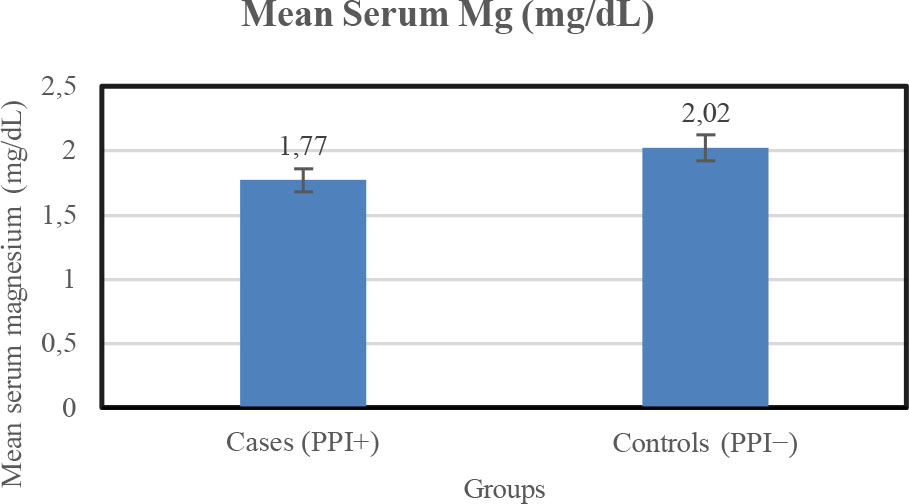
Figure 1.
Mean serum magnesium values by PPI users
Table 2.
Association between timing of recent H2RA use and case–control status
| Timing of Most Recent H2RA Prescription (a) | Case Patients (n = 185) | Control Patients (n = 185) | Unadjusted Odds Ratio (95% CI) | Adjusted Odds Ratio (95% CI) (b) |
|---|---|---|---|---|
| ≤ 90 days (Current use) | 15 (8.1%) | 20 (10.8%) | 0.72 (0.35–1.49) | 0.84 (0.38–1.83) |
| 91–180 days (Recent use) | 8 (4.3%) | 10 (5.4%) | 0.79 (0.31–1.99) | 0.91 (0.33–2.52) |
| 181–365 days (Remote use) | 6 (3.2%) | 9 (4.9%) | 0.64 (0.23–1.80) | 0.76 (0.25–2.27) |
| No H2RA exposure | 156 (84.3%) | 146 (78.9%) | - | - |
Table 3.
Characteristics of patients enrolled as cases and controls
| Variable | Category / Statistic | Cases (PPI+) (n = 185) | Controls (PPI−) (n = 185) | χ2 / t value | p-value |
|---|---|---|---|---|---|
| Demographics | |||||
| Age (years), mean ± SD | 53.8 ± 13.4 | 52.6 ± 12.9 | 0.89 (t) | 0.37 | |
| Age group | 18–30 yr | 14 (7.6%) | 29 (15.7%) | 5.92 | 0.052 |
| 31–50 yr | 75 (40.5%) | 68 (36.8%) | — | — | |
| ≥51 yr | 96 (51.9%) | 88 (47.6%) | — | — | |
| Sex | Male | 104 (56.2%) | 106 (57.3%) | 0.04 | 0.84 |
| Female | 81 (43.8%) | 79 (42.7%) | — | — | |
| Comorbidities | |||||
| Diabetes mellitus | Yes | 68 (36.8%) | 61 (33.0%) | 0.50 | 0.47 |
| Hypertension | Yes | 74 (40.0%) | 70 (37.8%) | 0.17 | 0.68 |
| Cardiovascular disease | Yes | 28 (15.1%) | 23 (12.4%) | 0.52 | 0.47 |
| Chronic liver disease | Yes | 11 (5.9%) | 9 (4.9%) | 0.14 | 0.71 |
| Chronic kidney disease | Yes | 8 (4.3%) | 7 (3.8%) | 0.07 | 0.79 |
| Systemic malignancy | Yes | 5 (2.7%) | 4 (2.2%) | 0.10 | 0.76 |
| Clinical Characteristics | |||||
| Type of admission | Medical | 121 (65.4%) | 118 (63.8%) | 0.08 | 0.78 |
| Surgical | 36 (19.5%) | 41 (22.2%) | 0.35 | 0.55 | |
| ICU admission | Yes | 14 (7.6%) | 10 (5.4%) | 0.64 | 0.42 |
| QTc-prolonging drugs | Yes | 27 (14.6%) | 21 (11.4%) | 0.83 | 0.36 |
| Systemic corticosteroid use | Yes | 19 (10.3%) | 14 (7.6%) | 0.67 | 0.41 |
| Number of concomitant medications (median (IQR)) (a) | 7 (5–10) | 5 (3–8) | 3.45 (t) | 0.001* | |
| Biochemical Parameters | |||||
| Serum magnesium (mg/dL), mean ± SD | 1.77 ± 0.48 | 2.02 ± 0.43 | 5.63 (t) | <0.001* | |
| Serum magnesium category | < 1.8 mg/dL | 101 (54.6%) | 48 (25.9%) | 32.00 | <0.001* |
| 1.8–2.2 mg/dL | 52 (28.1%) | 91 (49.2%) | — | — | |
| > 2.2 mg/dL | 32 (17.3%) | 46 (24.9%) | — | — |
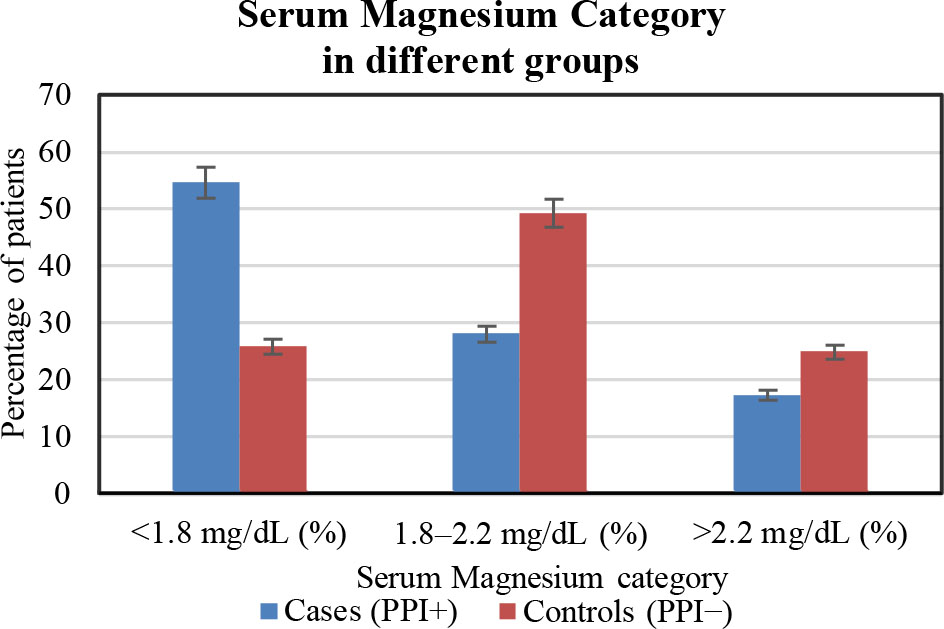
Figure 2.
Serum Magnesium category in different groups
Table 4.
Regression analysis and distribution of serum magnesium levels in cases (PPI users) and controls.
| Variable | Category | Unadjusted OR | Adjusted OR | 95% CI (Lower–Upper) | p-value | Serum Magnesium Levels (%) | Total (%) |
|---|---|---|---|---|---|---|---|
| Age | — | 1.002 | 1.000 | 0.985–1.015 | 0.986 | — | — |
| Gender | Male | 1 (ref) | 1 (ref) | — | — | — | — |
| Female | 1.82 | 1.94 | 0.773–1.845 | 0.424 | — | — | |
| Group | Control | 1 (ref) | 1 (ref) | — | — | <1.8 = 25.91.8–2.2 = 49.2>2.2 = 24.9 | 100 |
| Cases | 2.145 | 2.475 | 1.605–3.816 | <0.001* | <1.8 = 54.61.8–2.2 = 28.1>2.2 = 17.3 | 100 | |
| Overall Total | — | — | — | — | — | <1.8 = 40.31.8–2.2 = 38.6>2.2 = 21.1 | 100 |
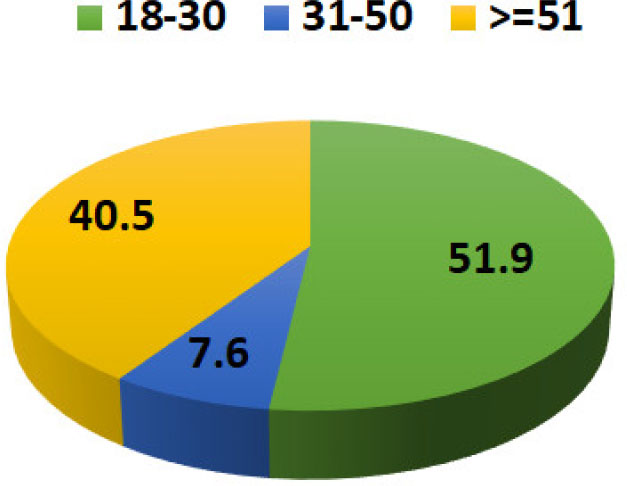
Figure 3.
Frequency Distribution (%) of ages in cases