
INTRODUCTION
Proton pump inhibitors (PPIs) constitute one of the most potent and extensively prescribed classes of acid-suppressive pharmacologic agents, capable of attenuating both basal and stimulated gastric acid secretion by approximately 80–95% (1). Their mechanism of action involves the covalent binding to cysteine residues on the H+/K+-ATPase enzyme located in the secretory canaliculi of gastric parietal cells, thereby irreversibly inhibiting the terminal step of gastric acid production (2). This pharmacodynamic property renders PPIs indispensable in the management of acid-related gastrointestinal disorders such as gastroesophageal reflux disease (GERD), peptic ulcer disease, Zollinger–Ellison syndrome, and stress-induced mucosal injury. Owing to their robust efficacy, favorable tolerability profile, and ease of use, PPIs rank among the top three most frequently dispensed medications globally. In India, hospital-based studies indicate elevated prescription rates among inpatients, often extending beyond evidence-based indications. However, despite their established therapeutic benefits and perceived safety, accumulating evidence has linked prolonged PPI therapy with a spectrum of adverse health outcomes, including increased risks of osteoporotic fractures, vitamin B12 deficiency, chronic kidney disease, enteric infections, and electrolyte imbalances, most notably hypomagnesemia.
Magnesium, the second most abundant intracellular cation, is an essential cofactor in over 300 enzymatic reactions, playing pivotal roles in nucleic acid and protein synthesis, energy metabolism, neuromuscular excitability, and regulation of transmembrane ion fluxes. Deficiency in serum magnesium can precipitate a wide range of clinical manifestations, encompassing nonspecific symptoms such as fatigue, nausea, and muscle cramps to severe neurological and cardiovascular complications, including paresthesias, seizures, cardiac arrhythmias, hypotension, and, in extreme cases, sudden cardiac death. The mechanism of PPI-induced hypomagnesemia is thought to involve reduced intestinal absorption and alterations in magnesium transporters due to changes in intraluminal pH. Several case reports and observational studies have described this association, although findings remain inconclusive. The U.S. FDA had issued warnings recommending serum magnesium monitoring in long-term PPI users, especially those receiving concomitant medications such as diuretics or digoxin that further predispose them to hypomagnesemia. Given the widespread and often prolonged use of PPIs in Indian hospital settings, it is clinically important to assess their impact on serum magnesium. This study was therefore undertaken to evaluate the association between prior PPI use and serum magnesium levels in hospitalized patients. PPIs are commonly used for peptic ulcers, GERD, Zollinger–Ellison syndrome, erosive gastritis, and NSAID-induced ulcers. The most frequently prescribed agents include omeprazole, pantoprazole, lansoprazole, rabeprazole, esomeprazole, and dexlansoprazole. By irreversibly inhibiting the gastric H+/K+-ATPase pump, PPIs effectively suppress both basal and stimulated gastric acid secretion, making them more potent than H2 receptor antagonists (4). Although generally considered safe, prolonged use of PPIs has been associated with adverse outcomes such as gastrointestinal and respiratory infections, osteoporosis, vitamin B12, iron, calcium deficiencies, and chronic kidney disease (3,5). In 2011, the FDA issued a safety update cautioning that long-term PPI therapy may lead to hypomagnesemia, particularly in patients receiving diuretics or digoxin (6). Several case reports and clinical studies have described symptomatic hypomagnesemia during long-term PPI use, with patients presenting with seizures, arrhythmias, hypocalcemia, and hypokalemia (7,8,9). Magnesium levels typically normalize after discontinuation of PPI therapy, but fall again upon rechallenge, irrespective of PPI type. A meta-analysis by Srinutta et al. confirmed that chronic and high-dose PPI use increases the risk of hypomagnesemia (10,11). In elderly Japanese patients, long-term PPI use was associated with significantly lower serum magnesium levels. A South Indian cross-sectional study reported that nearly 90% of inpatients were prescribed PPIs, highlighting high usage and potential for drug interactions. Taken together, existing literature supports a possible association between PPIs and hypomagnesemia, but findings remain inconclusive, warranting further evaluation in hospital-based populations. The primary objective of this study was to compare serum magnesium levels between patients with and without prior PPI use over the past six months or more, while secondary objectives included assessing age and gender-related differences in magnesium levels and estimating the risk of hypomagnesemia associated with PPI therapy.
METHODS
Study population
We prospectively recruited a total of 372 hospitalized patients between May 23 and Dec 23 in the Department of General Medicine at Apollo Institute of Medical Sciences & Research (AIMSR), Hyderabad, India. Enrollment was consecutive, and patients were stratified into two groups according to prior exposure to PPIs.
Inclusion Criteria
The study included adults aged 18 to 75 years who were hospitalized under the Department of General Medicine at the Apollo Institute of Medical Sciences & Research (AIMSR), Hyderabad, India. Participants were consecutively enrolled between May 2023 and December 2023. The case group comprised patients with documented proton pump inhibitor (PPI) use for at least five days per week over a minimum duration of six months, while the control group included patients with no prior PPI exposure. Only individuals who provided written informed consent were included in the study.
Exclusion criteria
Patients with a history of malignancy, renal impairment, or chronic diarrhea, those receiving magnesium supplementation at the time of evaluation, and individuals who were unable or unwilling to provide informed consent were excluded from the study.
Sample size
The sample size was determined a priori based on conventional power analysis methods. Considering a prevalence of PPI exposure of approximately 46% among the general hospitalized population, and anticipating an odds ratio (OR) of 1.8 for the primary outcome (hypomagnesemia), the calculation was performed using a two-tailed α level of 0.05 and a statistical power of 80% (β = 0.20) to detect a significant association between PPI use and reduced serum magnesium levels. Based on these assumptions, the minimum required sample size was estimated to be 186 participants per group, resulting in a total of 372 subjects. This estimation ensured adequate power to detect clinically meaningful differences between PPI users and non-users. To maintain methodological rigor, demographic, clinical, and laboratory data were collected prospectively at the time of enrollment. Medication histories were meticulously reviewed to verify prior PPI exposure and ensure accurate classification into case and control groups.
Data Collection
Comprehensive demographic and clinical data were systematically collected for all enrolled participants using standardized case record forms to ensure consistency and reliability. Patients in the case group had documented outpatient PPI use for at least six months prior to admission. During hospitalization, the mean duration of continued PPI therapy was 19 days, with most patients clustered within 2–3 weeks of treatment and a maximum recorded exposure of seven weeks. The recorded demographic variables included age, sex, and relevant lifestyle factors. Clinical parameters encompassed the presence of comorbid conditions, including but not limited to diabetes mellitus, systemic hypertension, dyslipidemia, chronic kidney disease, and other long-standing systemic disorders that could influence disease progression or therapeutic response. Detailed documentation was also maintained for the admitting clinical diagnosis, baseline laboratory investigations, and concurrent pharmacological therapies to minimize potential confounding effects. In participants with a history of proton pump inhibitor (PPI) use, specific details regarding the prescribed PPI agent, dosage regimen, cumulative duration of therapy, indication for use, and route of administration were meticulously recorded. Where applicable, adherence patterns and any prior modifications to PPI therapy were also assessed to facilitate a more nuanced evaluation of exposure-outcome relationships.
MEASUREMENTS
Assessment of PPI Exposure
Patients were categorized based on documented PPI exposure over the preceding six months or longer, encompassing agents such as omeprazole, pantoprazole, lansoprazole, and esomeprazole. In participants with a history of proton pump inhibitor (PPI) use, a comprehensive exposure assessment was undertaken through systematic review of medical records, prescription charts, and institutional electronic pharmacy databases. Detailed information was extracted on the specific PPI agent prescribed, indication for therapy, daily dosage, frequency of administration, route of administration, and cumulative duration of use prior to inclusion in the study. For individuals who received more than one course of PPI therapy, cumulative exposure was quantified by summing the total duration of all treatment episodes. To ensure data accuracy, medication histories were cross-verified between patient charts and electronic dispensing records, and discrepancies were resolved by consulting treating physicians or pharmacy logs. The formulation and route of administration—oral or intravenous were recorded for each participant. Oral therapy represented the predominant route of administration, consistent with outpatient and maintenance therapy, whereas intravenous PPI formulations were typically reserved for inpatient use, particularly in cases of acute gastrointestinal bleeding, stress ulcer prophylaxis, or when oral intake was clinically contraindicated. To minimize pharmacologic confounding, concurrent or prior exposure to histamine-2 receptor antagonists (H2RAs) was systematically evaluated. The timing of the most recent H2RA prescription was categorized into three exposure windows: recent use (91–180 days before enrollment), remote use (181–365 days before enrollment), or no prior exposure. This temporal classification facilitated differentiation between residual pharmacodynamic effects of H2RA therapy and true non-exposure, thereby improving the specificity of PPI-related outcome assessment. Venous blood samples (2 mL) were obtained from each participant at the time of admission, prior to initiation of inpatient therapy, for the measurement of serum magnesium concentration and for routine biochemical investigations. Serum magnesium levels were compared between patients with prior PPI exposure and those without, to determine whether sustained acid-suppressive therapy contributes to hypomagnesemia. Secondary analyses examined demographic influences, specifically age and gender-related variations in serum magnesium, and quantified the risk of hypomagnesemia attributable to PPI therapy through adjusted regression modeling. This stratified analytical approach was intended to discern both the direct and confounding effects of prolonged PPI use on electrolyte homeostasis.
Estimation of Serum Magnesium
Serum samples were collected and analyzed by the Department of Biochemistry, the central laboratory of Apollo Institute of Medical Sciences & Research, following standardized protocols to ensure consistency and reliability. Serum magnesium concentration was determined using the modified methylthymol blue (MTB) colorimetric method, a validated and widely adopted technique for the quantitative assessment of serum electrolytes (12). The analyses were performed on a Beckman Coulter AU5800 automated clinical chemistry analyzer (Beckman Coulter Inc., Brea, CA, USA), which operates on the principle of complex formation between magnesium ions and methylthymol blue, producing a blue-colored chelate measurable spectrophotometrically at 520 nm. To ensure analytical precision and accuracy, internal quality control sera at both normal and pathological levels were included in each analytical batch, and the analyzer was calibrated daily using manufacturer-supplied traceable standards. All measurements were performed in duplicate, and the mean of the two readings was used for statistical analyses. Strict adherence to standard operating procedures and quality assurance protocols minimized both pre-analytical and analytical variability. For this study, hypomagnesemia was defined as a serum magnesium concentration of <1.8 mg/dL, in accordance with the institutional reference interval (1.8–2.2 mg/dL). All biochemical estimations were conducted by trained laboratory personnel blinded to participants’ clinical data to reduce potential measurement bias.
Sensitivity Analysis for Hypomagnesemia Specificity
To evaluate the robustness, specificity, and internal validity of the observed association between proton pump inhibitor (PPI) use and hypomagnesemia, we conducted a comparative sensitivity analysis using prescriptions for histamine H2 receptor antagonists (H2RAs) as a reference drug class. H2RAs were selected because they share similar therapeutic indications with PPIs, but have no established mechanistic or causal relationship with magnesium depletion. By examining serum magnesium levels among H2RA users, we aimed to ascertain whether the observed effect was specific to PPI exposure or merely reflected a nonspecific association related to acid-suppressive therapy or confounding comorbidities. All statistical models were adjusted for potential confounders exhibiting standardized differences greater than 0.10, including the number of medications dispensed in the year preceding the index date (a validated measure for comorbidity), systemic corticosteroid use within the previous year, any documented history of diabetes mellitus or heart failure during the three years prior to the index date, and the presence of systemic malignancy in the preceding year.
Assessment of covariables
Assessment of covariables in the present study was performed according to the standardized protocols similar to those described by Hoffmans et al 13. Diabetes mellitus was defined as a fasting plasma glucose concentration ≥126 mg/dL, a nonfasting plasma glucose concentration ≥200 mg/dL (if fasting samples were unavailable), or the use of glucose-lowering medication, including oral hypoglycemic agents or insulin. Hypertension was defined as an average systolic blood pressure ≥140 mm Hg and/or an average diastolic blood pressure ≥90 mm Hg, or the use of antihypertensive medication. Cardiovascular disease, including coronary heart disease and stroke, was ascertained through medical history, clinical examinations, and verification via medical records or linkage with hospital discharge data, and adjudicated by qualified physicians. Chronic liver disease and systemic malignancy were determined based on self-reported physician diagnoses, hospital discharge summaries, and registry data. Chronic kidney disease was defined using estimated glomerular filtration rate (eGFR) values calculated with the CKD-EPI creatinine equation, with eGFR <60 mL/min/1.73 m2 indicating reduced kidney function.
Statistical Analysis
Data analysis was performed using the Statistical Package for the Social Sciences (SPSS), version 24.0 (IBM Corp., Armonk, NY, USA). Continuous variables were initially assessed for normality using the Shapiro–Wilk test. Those variables following a normal distribution were summarized as mean ± standard deviation (SD), while non-normally distributed variables were presented as median with interquartile range (IQR). Intergroup comparisons for normally distributed continuous variables were conducted using the unpaired Student's t-test. In contrast, non-parametric alternatives such as the Mann–Whitney U test were considered for skewed data. Categorical variables were expressed as absolute frequencies and percentages, with differences between groups evaluated using the chi-square (χ2) test or Fisher's exact test when expected cell counts were less than five. To examine the independent association between PPI use and the occurrence of hypomagnesemia, multivariate logistic regression analysis was performed, adjusting for potential confounding factors including age, sex, comorbidities, and concurrent medication use. The results of the logistic regression were presented as odds ratios (OR) along with 95% confidence intervals (CI) to quantify the strength and precision of associations. All statistical tests were two-tailed, and a p-value of <0.05 was considered indicative of statistical significance. Model goodness-of-fit was assessed using the Hosmer–Lemeshow test, and multicollinearity among independent variables was evaluated through variance inflation factors (VIFs) to ensure the robustness of the regression model.
Ethical Considerations
The study protocol was reviewed and approved by the Institutional Ethics Committee of Apollo Institute of Medical Sciences & Research (AIMSR), Hyderabad, India (Approval No: EC/NEW/INST/1527/2023/09/142). The study was conducted in accordance with the Declaration of Helsinki and applicable Good Clinical Practice (GCP) guidelines. Written informed consent was obtained from all participants prior to enrollment, and patient confidentiality was maintained throughout the study.
RESULTS
Baseline Characteristics
The study included 370 participants: 185 PPI users (cases) and 185 non-users (controls). The mean age was comparable between groups (cases: 50.4 ± 13.2 years; controls: 47.9 ± 15.0 years; p = 0.10). Gender distribution was also similar (male: 56.2% vs. 57.3%; p = 0.83) (Table 1).
Table 1.
Characteristics and inpatient duration of proton pump inhibitor (PPI) use among cases (n = 185)
| Variable | Value (%) |
|---|---|
| Patients under active treatment with PPIs, n | 185/370 (50.0%) |
| Specific PPI used, n | |
| – Pantoprazole | 112/185 (60.5%) |
| – Lansoprazole | 38/185 (20.5%) |
| – Omeprazole | 24/185 (13.0%) |
| – Esomeprazole | 11/185 (6.0%) |
| Treatment duration in hospital* | |
| – Mean ± SD (days) | 19.03 ± 6.17 |
| – Median (days) | 17 |
| – Mode (days) | 14 |
| – Range (days) | 14 – 49 |
| Daily dose, mg† (mean ± SD) | |
| – Pantoprazole | 40.2 ± 8.6 |
| – Lansoprazole | 28.7 ± 6.4 |
| – Omeprazole | 27.5 ± 7.9 |
| – Esomeprazole | 22.0 ± 5.3 |
| Route of administration, n† | |
| – Oral | 166/185 (89.7%) |
| – Intravenous | 19/185 (10.3%) |
Among the 185 patients receiving PPIs, pantoprazole was the most frequently prescribed agent, followed by lansoprazole, omeprazole, and esomeprazole. The majority of patients were treated orally, with intravenous use reserved for a minority. The average inpatient duration of therapy was approximately 19 days, with most patients clustered around 2–3 weeks of treatment and a maximum observed duration of seven weeks. Mean daily doses for each PPI were within standard therapeutic ranges, indicating that hypomagnesemia in this cohort was not attributable to excessive dosing but rather to the chronicity and continued use of therapy (Figure 1).
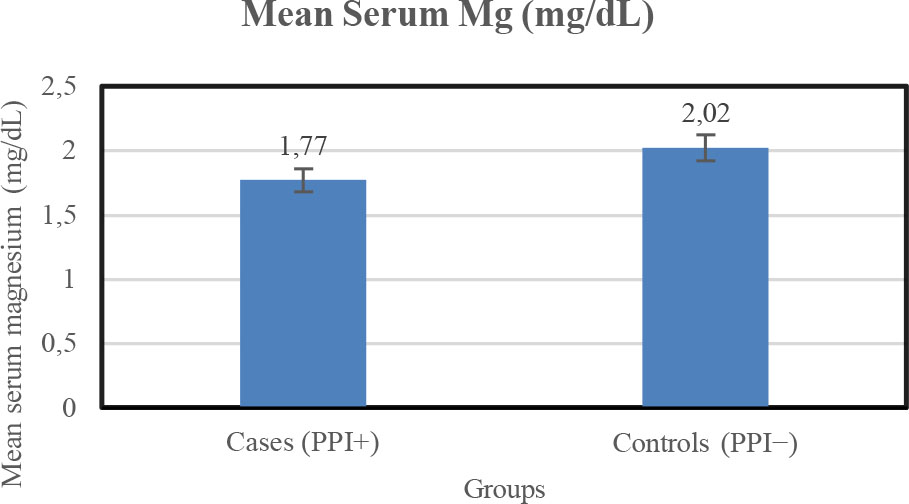
Figure 1.
Mean serum magnesium values by PPI users
Sensitivity Analysis for Hypomagnesemia Specificity
Table 2.
Association between timing of recent H2RA use and case–control status
| Timing of Most Recent H2RA Prescription (a) | Case Patients (n = 185) | Control Patients (n = 185) | Unadjusted Odds Ratio (95% CI) | Adjusted Odds Ratio (95% CI) (b) |
|---|---|---|---|---|
| ≤ 90 days (Current use) | 15 (8.1%) | 20 (10.8%) | 0.72 (0.35–1.49) | 0.84 (0.38–1.83) |
| 91–180 days (Recent use) | 8 (4.3%) | 10 (5.4%) | 0.79 (0.31–1.99) | 0.91 (0.33–2.52) |
| 181–365 days (Remote use) | 6 (3.2%) | 9 (4.9%) | 0.64 (0.23–1.80) | 0.76 (0.25–2.27) |
| No H2RA exposure | 156 (84.3%) | 146 (78.9%) | - | - |
In the sensitivity analysis using histamine H2 receptor antagonist (H2RA) exposure as a comparator, no significant association was observed between H2RA use and hypomagnesemia across any exposure window. The adjusted odds ratios for current, recent, and remote H2RA use were 0.84 (95% CI: 0.38–1.83), 0.91 (95% CI: 0.33–2.52), and 0.76 (95% CI: 0.25–2.27), respectively, all of which crossed unity, indicating a lack of statistically significant effect. These findings suggest that the association between proton pump inhibitor (PPI) therapy and reduced serum magnesium levels is not a class effect of acid-suppressive drugs in general. The absence of a similar relationship with H2RA exposure reinforces the specificity and internal validity of the observed link between chronic PPI use and hypomagnesemia, supporting a plausible mechanistic basis unique to PPIs rather than confounding by indication or comorbid conditions.
Association of Demographics and Magnesium Levels with PPI Use
Table 3.
Characteristics of patients enrolled as cases and controls
| Variable | Category / Statistic | Cases (PPI+) (n = 185) | Controls (PPI−) (n = 185) | χ2 / t value | p-value |
|---|---|---|---|---|---|
| Demographics | |||||
| Age (years), mean ± SD | 53.8 ± 13.4 | 52.6 ± 12.9 | 0.89 (t) | 0.37 | |
| Age group | 18–30 yr | 14 (7.6%) | 29 (15.7%) | 5.92 | 0.052 |
| 31–50 yr | 75 (40.5%) | 68 (36.8%) | — | — | |
| ≥51 yr | 96 (51.9%) | 88 (47.6%) | — | — | |
| Sex | Male | 104 (56.2%) | 106 (57.3%) | 0.04 | 0.84 |
| Female | 81 (43.8%) | 79 (42.7%) | — | — | |
| Comorbidities | |||||
| Diabetes mellitus | Yes | 68 (36.8%) | 61 (33.0%) | 0.50 | 0.47 |
| Hypertension | Yes | 74 (40.0%) | 70 (37.8%) | 0.17 | 0.68 |
| Cardiovascular disease | Yes | 28 (15.1%) | 23 (12.4%) | 0.52 | 0.47 |
| Chronic liver disease | Yes | 11 (5.9%) | 9 (4.9%) | 0.14 | 0.71 |
| Chronic kidney disease | Yes | 8 (4.3%) | 7 (3.8%) | 0.07 | 0.79 |
| Systemic malignancy | Yes | 5 (2.7%) | 4 (2.2%) | 0.10 | 0.76 |
| Clinical Characteristics | |||||
| Type of admission | Medical | 121 (65.4%) | 118 (63.8%) | 0.08 | 0.78 |
| Surgical | 36 (19.5%) | 41 (22.2%) | 0.35 | 0.55 | |
| ICU admission | Yes | 14 (7.6%) | 10 (5.4%) | 0.64 | 0.42 |
| QTc-prolonging drugs | Yes | 27 (14.6%) | 21 (11.4%) | 0.83 | 0.36 |
| Systemic corticosteroid use | Yes | 19 (10.3%) | 14 (7.6%) | 0.67 | 0.41 |
| Number of concomitant medications (median (IQR)) (a) | 7 (5–10) | 5 (3–8) | 3.45 (t) | 0.001* | |
| Biochemical Parameters | |||||
| Serum magnesium (mg/dL), mean ± SD | 1.77 ± 0.48 | 2.02 ± 0.43 | 5.63 (t) | <0.001* | |
| Serum magnesium category | < 1.8 mg/dL | 101 (54.6%) | 48 (25.9%) | 32.00 | <0.001* |
| 1.8–2.2 mg/dL | 52 (28.1%) | 91 (49.2%) | — | — | |
| > 2.2 mg/dL | 32 (17.3%) | 46 (24.9%) | — | — |
Baseline demographic and clinical characteristics were comparable between the PPI user group (n = 185) and the non-user control group (n = 185). The mean age of participants did not differ significantly between groups (53.8 ± 13.4 vs. 52.6 ± 12.9 years; p = 0.37), and the sex distribution was nearly identical (males: 56.2% vs. 57.3%; p = 0.84). Similarly, the prevalence of major comorbid conditions, including diabetes mellitus, hypertension, cardiovascular disease, chronic liver disease, chronic kidney disease, and systemic malignancy, did not show statistically significant differences between cases and controls (p > 0.05 for all). However, PPI users had a significantly higher number of concomitant medications compared with non-users (median (IQR): 7 (5–10) vs. 5 (3–8); p = 0.001), suggesting a greater overall drug burden among PPI-treated patients. Other clinical parameters, such as type of admission, ICU stay, corticosteroid exposure, and use of QTc-prolonging agents, were not significantly different between groups. (Table 3) The close similarity in demographic and comorbidity profiles between PPI users and controls strengthens the internal validity of the observed association between PPI therapy and hypomagnesemia by minimizing potential confounding factors. The significantly higher polypharmacy rate among PPI users may partially contribute to altered electrolyte balance, but does not independently explain the magnitude of magnesium depletion observed. Thus, the findings reinforce that reduced serum magnesium levels are more likely attributable to chronic PPI exposure rather than differences in underlying disease burden or demographic characteristics. No significant association was observed between PPI use and age category (p = 0.05) or gender (p = 0.83). In contrast, hypomagnesemia (<1.8 mg/dL) was significantly more common in PPI users (54.6%) compared with controls (25.9%; p < 0.001) (Table 3).
Relationship of PPI Use to Serum Magnesium
Use of a PPI was associated with a markedly lower serum magnesium concentration relative to non-use. Participants receiving PPIs demonstrated a mean serum magnesium level of 1.77 ± 0.48 mg/dL, whereas controls exhibited substantially higher levels (2.02 ± 0.43 mg/dL; t = 5.63, p < 0.001), indicating a clear negative shift in magnesium homeostasis attributable to PPI exposure. When evaluated categorically, this pattern became more pronounced. Over half of the PPI (54.6%) presented with hypomagnesemia (< 1.8 mg/dL), a prevalence more than double that of individuals not exposed to PPIs (25.9%), and this association was highly significant (χ2 = 32.00, p < 0.001). (Table 2) Correspondingly, normal and high-normal magnesium values (≥ 1.8 mg/dL) were more frequently observed among controls, suggesting that PPI administration not only reduces mean magnesium levels but also shifts the overall population distribution toward deficiency. These findings are consistent with the biological plausibility that PPIs impair intestinal magnesium absorption through reduced active transport in the gut, a mechanism that has been proposed in prior clinical and experimental research. The magnitude of reduction observed in this cohort reflects a clinically meaningful disturbance in electrolyte balance, reinforcing concerns regarding long-term PPI therapy. Taken together, the data strongly support a robust association between PPI exposure and diminished serum magnesium levels, stressing the need for routine monitoring—particularly in patients receiving prolonged therapy or those with additional risk factors for electrolyte depletion.
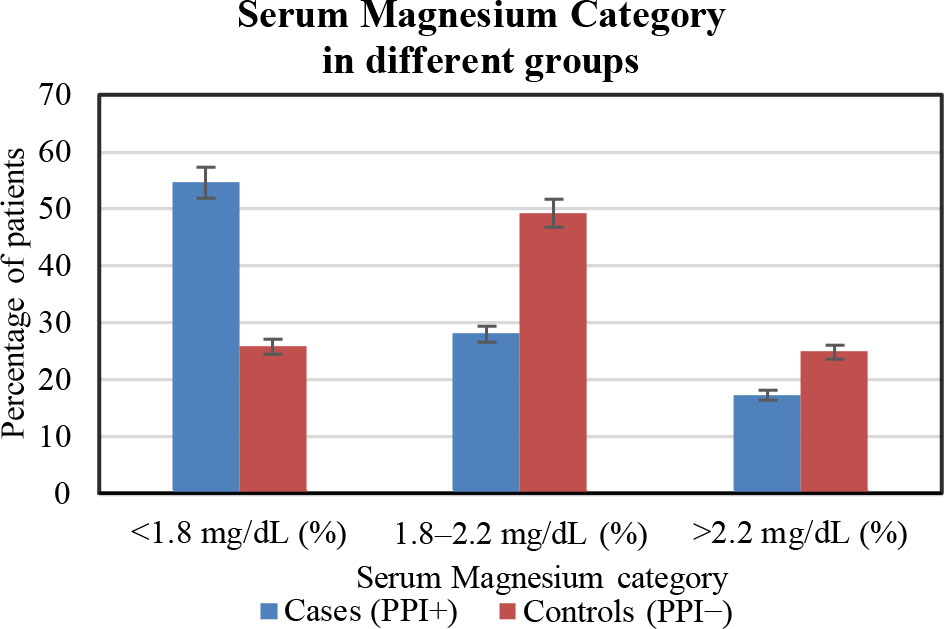
Figure 2.
Serum Magnesium category in different groups
Regression analysis of serum magnesium levels
Table 4.
Regression analysis and distribution of serum magnesium levels in cases (PPI users) and controls.
| Variable | Category | Unadjusted OR | Adjusted OR | 95% CI (Lower–Upper) | p-value | Serum Magnesium Levels (%) | Total (%) |
|---|---|---|---|---|---|---|---|
| Age | — | 1.002 | 1.000 | 0.985–1.015 | 0.986 | — | — |
| Gender | Male | 1 (ref) | 1 (ref) | — | — | — | — |
| Female | 1.82 | 1.94 | 0.773–1.845 | 0.424 | — | — | |
| Group | Control | 1 (ref) | 1 (ref) | — | — | <1.8 = 25.91.8–2.2 = 49.2>2.2 = 24.9 | 100 |
| Cases | 2.145 | 2.475 | 1.605–3.816 | <0.001* | <1.8 = 54.61.8–2.2 = 28.1>2.2 = 17.3 | 100 | |
| Overall Total | — | — | — | — | — | <1.8 = 40.31.8–2.2 = 38.6>2.2 = 21.1 | 100 |
Regression analysis (Table 4) demonstrated that PPI use was a significant independent predictor of hypomagnesemia, with cases showing 2.475-fold higher odds of reduced serum magnesium compared to controls (95% CI: 1.605–3.816, p < 0.001). Neither age nor gender showed a significant association with magnesium status (p > 0.05). Distribution analysis further highlighted this relationship, as more than half of PPI users (54.6%) exhibited serum magnesium <1.8 mg/dL, in contrast to only 25.9% of non-users, while normal magnesium levels (1.8–2.2 mg/dL) were more frequently observed in controls (49.2% vs. 28.1%). These findings indicated a robust association between chronic PPI use and hypomagnesemia, whereas demographic variables such as age and gender were not contributory.
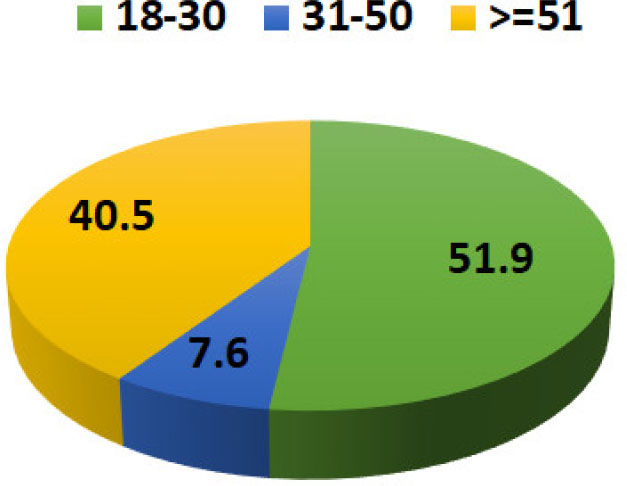
Figure 3.
Frequency Distribution (%) of ages in cases
Fig 3 PPIs were most commonly used in the age group >=51 (51.9%), followed by 30–50 (40.5%) and 18–31 years (7.6%).
DISCUSSION
In the present study, we investigated the association between chronic proton pump inhibitor (PPI) therapy and alterations in serum magnesium concentrations. Among the 185 patients receiving PPIs, pantoprazole emerged as the most commonly prescribed agent, followed sequentially by lansoprazole, omeprazole, and esomeprazole. The administered daily doses for all PPI formulations were within standard therapeutic limits, stressing that the observed hypomagnesemia was unlikely to result from supratherapeutic exposure, and it appears to be a consequence of prolonged and continuous PPI administration. Emerging clinical evidence consistently supports this duration-dependent relationship. Several observational and mechanistic studies have demonstrated that hypomagnesemia is significantly associated with PPI use extending beyond six months, even when dosing remains within recommended ranges (14). Furthermore, systematic reviews have reported that long-term PPI exposure can precipitate not only isolated magnesium depletion, but also secondary electrolyte imbalances, such as hypocalcemia and hypokalemia, reinforcing the concept that chronic therapy rather than excessive dosage is the principal determinant of these metabolic derangements (15). Baseline comparisons between PPI users and non-users revealed no significant differences in age distribution, sex, comorbid conditions, or type of hospital admission, and the concomitant use of QTc-prolonging medications was similarly balanced across groups. However, serum magnesium levels showed a striking disparity: more than half of PPI users (54.6%) demonstrated hypomagnesemia (< 1.8 mg/dL) compared with only 25.9% of non-users (p < 0.001). This finding aligns with recent research of Seah et al., who reported that nearly half of patients with severe hypomagnesemia had PPI use implicated as a contributing cause, with higher risk in those on high doses, with renal impairment, diabetes, or low BMI (16). Similarly, a study from Pakistan found hypomagnesemia in 51.5% of chronic PPI users, with longer duration, hypertension, and diabetes being independent predictors (17). Conversely, normal magnesium levels (1.8 – 2.2 mg/dL) were more prevalent among controls (49.2% vs. 28.1%). The mean serum magnesium concentration in cases (1.77 ± 0.49 mg/dL) was significantly lower than that of controls (2.02 ± 0.43 mg/dL, p < 0.001). Regression analysis further confirmed that PPI use was an independent predictor of hypomagnesemia, conferring a 2.475-fold increased risk compared with controls (95% CI: 1.605–3.816, p < 0.001). Neither age nor gender demonstrated a significant association with serum magnesium status (p > 0.05), indicating that the observed effect was specifically attributable to PPI exposure rather than demographic variables. These findings align with prior evidence that PPI-induced hypomagnesemia can occur within a relatively short period, as early as two weeks. However, cases have also been documented after several years of therapy. A reported cross-sectional study found that hypomagnesemia was associated with PPI use irrespective of the type of PPI, and demographic factors such as gender did not significantly modify serum magnesium levels after adjustment for other risk factors (18). Analysis of a Japanese adverse-drug-event database indicated that although male sex and age under 60 were risk factors, age and sex did not consistently show a strong effect across all PPI users, reinforcing the idea that hypomagnesemia risk is driven more by drug exposure than by demographic profile alone (19). Moreover, hypomagnesemia had been shown to resolve following PPI withdrawal and to recur upon re-challenge, regardless of the PPI type. Clinically, severe hypomagnesemia may manifest with convulsions, arrhythmias such as bradycardia, hypotension, or even fatal outcomes. Indeed, in patients recovering from acute kidney injury, prolonged renal magnesium loss has led to generalized seizures due to very low serum magnesium levels (20). Similarly, combined hypomagnesemia and hypokalemia have been shown to produce QT prolongation and torsades de pointes in the setting of drug-induced electrolyte disturbances, which, if not promptly treated, may culminate in fatal arrhythmias (21). Although oral magnesium supplementation is commonly employed, it does not consistently restore serum magnesium concentrations in patients affected by hypomagnesemia associated with PPI therapy. A recent case report demonstrated that even with oral replacement, hypomagnesemia recurred as long as the PPI was continued—levels normalized only after the PPI was withdrawn (22). This stresses the importance of PPI withdrawal as the cornerstone of management. For individuals requiring continued acid suppression, alternative strategies such as substitution with H2 receptor antagonists may offer partial benefit. Observational data in hemodialysis patients showed that users of H2 receptor antagonists have higher mean serum magnesium levels compared with PPI users, suggesting that switching to H2 antagonists may mitigate risk (23). Our study results provided strong evidence that PPI use is significantly associated with hypomagnesemia, independent of age, sex, or comorbid burden, reinforcing the importance of routine monitoring of serum magnesium in patients on long-term therapy.
CONCLUSION
Proton pump inhibitors (PPIs) constitute a widely prescribed class of medications with an established safety profile when administered for short durations. However, prolonged use has been increasingly associated with hypomagnesemia, a clinically relevant adverse effect. Although interindividual variation among specific PPI formulations appears minimal, sustained therapy necessitates careful monitoring. It is imperative for clinicians to periodically assess serum magnesium concentrations in patients undergoing chronic PPI treatment. In such cases, therapeutic strategies may include dosage adjustment, dietary counseling to enhance magnesium intake, or supplementation as warranted. Continuous clinical vigilance is essential to prevent, detect, and effectively manage hypomagnesemia, particularly in patients predisposed to electrolyte imbalances.
Notes
[10] Contributed by AUTHOR CONTRIBUTIONS
All authors accept full responsibility for every aspect of the work. Each made substantial contributions to the study’s conception and design, data acquisition, or analysis and interpretation. All authors participated in drafting the manuscript or critically revising it for important intellectual content, approved the final version for publication, and consented to submission to this journal. Authorship was determined in accordance with the criteria and guidelines of the International Committee of Medical Journal Editors (ICMJE).
[12] Conflicts of interest CONFLICTS OF INTEREST
The author reports no financial or any other conflicts of interest in this paper.