
INTRODUCTION
Myocarditis is an inflammatory heart disease, which is characterized by the presence of a cellular infiltrate in the myocardial interstitium, along with the degeneration and necrosis of cardiomyocytes. Clinical presentation can vary widely, from an asymptomatic disease to a severe condition that can lead to a fatal outcome. Autoimmune processes are increasingly recognized as important mechanisms in myocarditis initiation and development (1,2). Autoimmune myocarditis, also known as giant cell myocarditis, is a rapidly progressive form of myocarditis that frequently results in chronic inflammation and subsequent life-threatening complications (3). The experimental autoimmune myocarditis (EAM) animal model is a suitable platform for testing novel treatments and elucidating the potential therapeutic value of interventions in myocarditis management (4).
Hyperbaric oxygenation (HBO) has emerged as a promising and cost-effective therapeutic modality for counteracting inflammation. Notably, the interplay between hyperoxia and hyperbaric pressure modulates inflammation by targeting oxygen and pressure sensitive genes (5). Preclinical studies have demonstrated that HBO treatment significantly reduces levels of inflammatory cytokines such as intraleukin-1 (IL-1) and tumor necrosis factor-α (TNF-α) in animal models of ischemia or injury (6,7,8,9,10,11,12,13,14,15,16,17). Additionally, HBO treatment is considered as a promising adjunctive therapy for cardiovascular diseases due to growing evidence of its beneficial effects on myocardial function. Cardioprotective effects of HBO therapy has been demonstrated in streptozotocin-induced diabetic rat (18). Furthermore, clinical study conducted by Leitman et al. has shown that prolonged HBO treatment can improve ventricular function and myocardial performance (19).
Galectin 3 (Gal-3), a galactosidase binding lectin, plays multiple roles in immune responses and can be constitutively or inducibly expressed in different cell types. The expression of this protein can be induced by various inflammatory stimuli. Depending on the predominate immune mechanism in the disease, Gal-3 may either attenuate or enhance the development of inflammation (20,21,22). For example, as a toll-like receptor 4 ligand, Gal-3 has been shown to enhance inflammation, and its depletion has neuroprotective and anti-inflammatory effects in LPS-induced inflammation (23). Furthermore, HBO has been shown to regulate the expression of Gal-3 and TLR-4 genes. In a rat model of neuroinflammation treated with HBO, inhibition of these inflammatory genes expressions was observed (15).
The role of Gal-3 in cardiovascular diseases is complex and multifaceted. While some studies have shown that depletion of Gal-3 enhances the severity of myocarditis and type 2 cardiac inflammation in EAM mouse models (24), other studies have demonstrated that inhibition of Gal-3 slows the progression of myocardial inflammation, impedes myocardial fibrogenesis, and improves cardiac function (25,26,27,28,29,30). Additionally, inhibition of Gal-3 has been shown to reduce the size of infarcts and decrease tissue injury in models of myocardial ischemia/reperfusion injury both in vivo and in vitro (31). Gal-3 has been identified as a mediator of myocardial fibrosis, promoting fibroblast proliferation and heterogeneous deposition of collagen types, ultimately leading to impaired cardiac function (28,29,30, 32-33).
The current therapeutic options for myocarditis are primarily focused on symptom management, highlighting the need for novel and effective treatment strategies. Hyperbaric oxygen therapy is an attractive candidate due to its cardioprotective and anti-inflammatory effects. However, the potential effects of HBO treatment on myocarditis in animal models have not been investigated. Thus, this study aimed to evaluate the impact of HBO on both the clinical course and histochemical characteristics of EAM in Galectin 3 deficient mice.
MATERIALS AND METHODS
Experimental Animals and Animal Care
Animals used in this study were male Gal-3-deficient mice on the C57BL/6J background (Gal-3KO), aged between 6–8 weeks. They were originally obtained from the University of California Davis (Davis, CA; by courtesy of D.K.Hsu and F.T.Liu). To create Gal-3KO mice, the Gal-3 gene was targeted for disruption in C57BL/6J embryonic stem cells, resulting in the generation of mice homozygous for the disrupted Gal-3 gene (34). The genotypes of the Gal-3KO mice were confirmed by PCR. The mice were housed in the animal facilities of the Faculty of Medical Sciences, University of Kragujevac, Serbia, and maintained under standard laboratory conditions with ad libitum feeding. All animal experiments were approved by the Ethical Committee of the Faculty of Medical Sciences, University of Kragujevac, Serbia (01-2630). Experiments were in accordance with the European Union Directive for the welfare of laboratory animals (No. 2010/63/EU).
Initially, mice were randomly divided into 3 groups (6 animals per group) according to the applied protocol as follows:
Healthy control Gal-3KO mice (CTRL)
Gal-3KO mice with induced EAM (EAM)
Gal-3KO mice with induced EAM and HBO treatment (EAM+HBO)
Induction of Experimental Autoimmune Myocarditis
Myocarditogenic peptide (MyHCα334–352, Shanghai ShineGene Molecular Biotech) was used to induce EAM. The suspension was prepared by dissolving 100 μg MyHCα334–352 peptide in 100 μL of PBS and was emulsified with 100 μL of complete Freund's adjuvant (CFA) (Sigma-Aldrich, Germany) that contained 500μg Mycobacterium tuberculosis (strain H37 RA; Difco Laboratories, Detroit, MI). Subcutaneous injection of 200 μl of the prepared suspension was given to mice in the hind flanks on day 0 and day 7. In addition, each treated mouse was intraperitoneally injected with 200 ng of pertussis toxin (List Biological Laboratories, Campbell, USA) dissolved in 100 μL of distilled water on the same day and again after 48 hours. Mice were sacrificed on day 21 following immunization, and their hearts were collected for further analyses.
HBO Treatment
Mice were exposed to 100% oxygen using a hyperbaric pressure chamber (HYB-C 300, Maribor, Slovenia). Hyperbaric oxygenation was administered daily for 60 minutes at a pressure of 2 ATA, starting from the 2nd day of EAM induction until the 21st day. To avoid the effects of diurnal rhythm variations, hyperbaric oxygenation was always initiated at the same time.
Echocardiographic Analyses
The cardiac function of the animals was assessed in vivo on the 21st day using echocardiography before they were sacrificed. Prior to the procedure, the animals were anesthetized with a mixture of ketamine (75 mg/kg) and xylazine (5 mg/kg) injected intraperitoneally. Echocardiograms were obtained using a Hewlett-Packard Sonos 5500 (Andover, MA, USA) sector scanner equipped with a 15.0 MHz phased-array transducer (16). M-mode images were acquired from the parasternal long-axis view in 2-dimensional mode with a perpendicular M-mode cursor positioned on the interventricular septum and posterior wall of the left ventricle (LV) at the papillary muscle level. M-mode measurements included interventricular septal wall thickness at end-diastole (IVSd), LV internal dimension at end-diastole (LVIDd), LV posterior wall thickness at end-diastole (LVPWd), interventricular septal wall thickness at end-systole (IVSs), LV internal diameter at end-systole (LVIDs), and LV posterior wall thickness at end-systole (LVPWs). Fractional shortening percentage (FS%) was calculated using the M-mode LV diameters and the equation: ( (LVIDd − LVIDs) / LVIDd ) × 100%.
Histological assessment of EAM
Mouse hearts were harvested, fixed in 10% buffered formalin overnight, and then embedded in paraffin. The paraffin-embedded samples were sliced into 5 μm thick sections in a base-to-apex direction and stained using the hematoxylin and eosin (H&E) method. The histological assessment involved blinded microscopy by two independent investigators. The scoring system included quantification of the localization, intensity, and nature of the inflammatory infiltration, as well as the degree of degeneration and necrosis of cardiomyocytes and myocardial fibrosis.
The localization, intensity, and nature of inflammatory infiltration were quantified as follows: localization was graded as 0 (disease-free), 1 (apex), 2 (lateral wall), or 3 (septum); intensity was graded as 0 (no infiltrates in the visual field), 1 (less than 5 individual mononuclear cells in contact with the sarcolemma in the visual field), 2 (5–20 single mononuclear cells in contact with the sarcolemma in the visual field), or 3 (more than 20 individual mononuclear cells in contact with the sarcolemma in the visual field); nature was graded as 0 (no inflammatory infiltrates), 1 (small foci of inflammatory cells along the membrane), 2 (inflammatory cells grouped into confluent aggregates), or 3 (mononuclear cells diffusely scattered in the myocardium). Evaluation of the degree of degeneration and necrosis of cardiomyocytes was quantified using the following score: 0 (disease-free), 1 (discrete, unicellular), 2 (low-grade, >10% of the observed field), 3 (moderate, 10–50% of the observed field), or 4 (severe, pronounced, >50% of the observed field). Fibrosis was scored using the following system: 0 (absent or discrete, very rare connective cells), 1 (low-grade, individual connective cells), 2 (moderate, between 1 and 3), or 3 (pronounced, numerous partly grouped connective cells). The images were captured using a light microscope (Olympus) equipped with a digital camera. Scores were calculated for each tissue clip and compared with the control.
Statistical Analyses
The Statistical Package for Social Sciences v23.0 (SPSS Inc.) was used to perform the statistical analysis. Depending on the normality of the data, the differences between groups were determined using either the non-parametric Kruskal–Wallis H and Mann–Whitney U tests or parametric One-Way ANOVA and Independent Samples T-test. The data are presented as mean ± SEM and a significance level of P < 0.05 was considered statistically significant.
RESULTS
The improvement of fractional shortening percentage in Gal3-KO EAM mice was observed after the HBO treatment.
Echocardiography was performed to evaluate the effect of HBO treatment on cardiac function in mice with MyHCα334–352-induced myocarditis 21 days after immunization. A significant impairment of fractional shortening (FS) was found in EAM mice compared to the healthy CTRL group. However, a marked improvement of FS was observed in the group of EAM mice after HBO treatment compared to the non-treated EAM group. Additionally, LVIDd and LVIDs were significantly reduced in Gal-3KO mice that received HBO treatment compared to the non-treated EAM mice (Table 1).
Table 1.
Effects of HBO treatment on echocardiographic parameters: interventricular septal wall thickness at end systole and end-diastole (IVSs and IVSd), left ventricular internal diameter at end-systole and end-diastole (LVIDs and LVIDs), left ventricular posterior wall thickness at endsystole and end-diastole (LVPWs and LVPWd), and fractional shortening (FS). CTRL: healthy control Gal-3KO mice; EAM: Gal-3KO mice with induced EAM; EAM+HBO: Gal-3KO mice with induced EAM and HBO treatment. Values are presented as means ± mean standard error (SE). Kruskal–Wallis H; Mann–Whitney U tests *p< 0.05 indicates statistical significant differences between groups #compared to CTRL, *compared to EAM.
| CTRL | EAM | EAM+HBO | |
|---|---|---|---|
| IVSd (cm) | 0.064±0.052 | 0.093±0.101 | 0.100±0.032 |
| LVIDd (cm) | 0.246±0.177 | 0.210±0.134 | 0.203±0.024* |
| LVPWd (cm) | 0.058±0.062 | 0.086±0.110 | 0.092±0.016 |
| IVSs (cm) | 0.145±0.034 | 0.141±0.013 | 0.161±0.039 |
| LVIDs (cm) | 0.090±0.037 | 0.137±0.017 | 0.097±0.047* |
| LVPWs (cm) | 0.103±0.023 | 0.080±0.024 | 0.107±0.020 |
| FS (%) | 63.9±2.241 | 43.6±5.51# | 52.5±4.84* |
The severity of EAM was reduced in the hearts of Gal-3KO EAM mice after HBO treatment.
To assess the impact of HBO treatment on the severity of EAM in mice immunized with MyHCα334–352, a histological score was calculated for each experimental group. This score represented the sum of the localization, intensity, and nature of inflammation. The histological analysis showed a significantly higher score in the EAM and EAM+HBO groups compared to the healthy CTRL group. Severe myocarditis was detected in the hearts of immunized mice, characterized by the accumulation of mononuclear cells and single mononuclear cells between cardiomyocytes. Nonetheless, lower histological score and smaller inflammatory infiltrates were found in animals that received HBO treatment (Figure 1A and Figure 2, respectively).
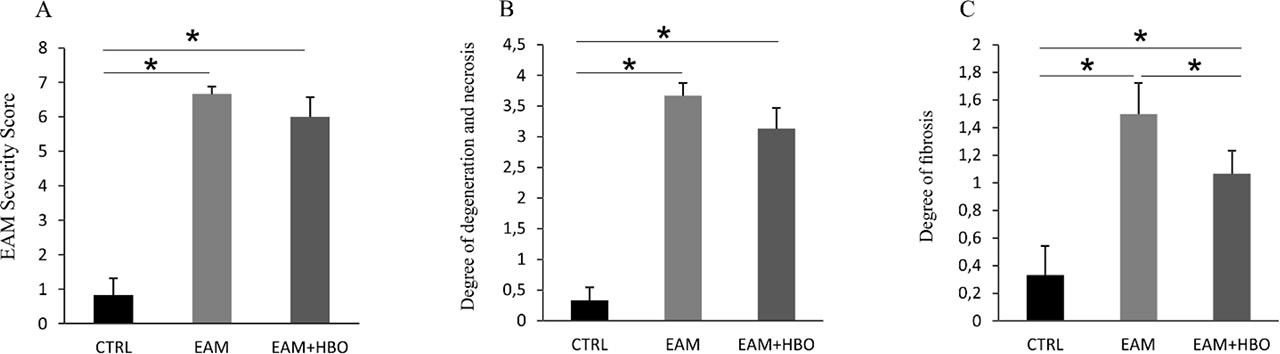
Figure 1.
Effects of HBO treatment on EAM severity score (A), degree of degeneration and necrosis of cardiomyocytes (B), and degree of fibrosis (C). CTRL: healthy control Gal-3KO mice; EAM: Gal-3KO mice with induced EAM; EAM+HBO: Gal-3KO mice with induced EAM and HBO treatment. Values are presented as means ± mean standard error (SE). Independent Samples t test; One-Way ANOVA *p< 0.05 indicates statistical significant differences between groups.
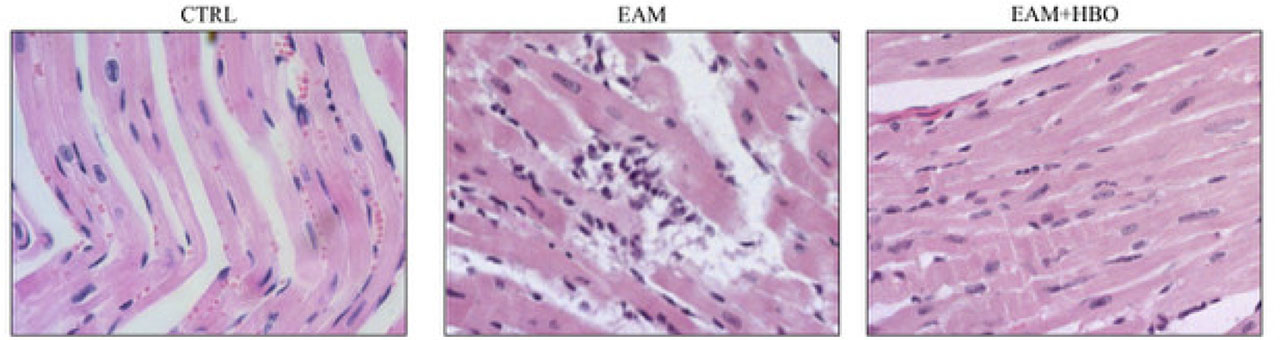
Figure 2.
Representative images of hematoxylin/eosin (H&E) staining of paraffin embedded heart tissue sections. CTRL: healthy control Gal-3KO mice; EAM: Gal-3KO mice with induced EAM; EAM+HBO: Gal-3KO mice with induced EAM and HBO treatment. Original magnification 40×.
Cardiac muscle degeneration and necrosis decreased in Gal-3KO EAM mice after HBO treatment.
Further investigation focused on assessing cardiac muscle degeneration and necrosis after HBO treatment. The results showed a significant increase of necrosis in both the EAM and EAM+HBO groups compared to healthy CTRL controls. However, EAM mice that received HBO treatment exhibited a lower degree of degeneration and necrosis compared to the non-treated EAM group, but without a statistically significant difference (Figure 1B).
Myocardial fibrosis decreased in Gal-3KO mice with EAM after HBO treatment.
The histological assessment of the HBO treatment effect proceeded with the evaluation of myocardial fibrosis in all experimental groups. A significantly higher level of fibrosis was observed in the EAM and EAM+HBO groups compared to healthy CTRL group. However, it was found that there was a significant reduction in myocardial fibrosis in Gal-3KO mice with EAM after HBO treatment compared to the untreated group of EAM mice (Figure 1C).
DISCUSSION
The results of present study indicated beneficial effects of HBO treatment in MyHCα334–352-induced autoimmune myocarditis in Gal-3-deficient mice on the C57BL/6J background. We have shown a significant improvement in FS, reduction in LVIDd and LVIDs, as well as a reduction in the severity of EAM, degeneration and necrosis of cardiomyocytes after HBO treatment. Moreover, hearts of Gal-3KO mice treated with HBO had significantly less myocardial fibrosis compared with untreated EAM group.
Myocarditis causes inflammation of heart tissue, leading to the infiltration of inflammatory cells, myocardial necrosis, and replacement fibrosis. These changes ultimately result in impaired cardiac function, dilated cardiomyopathy, and heart failure (1,2). Currently, symptomatic treatment and heart transplantation are the only therapeutic options available for myocarditis. Unfortunately, there is no known therapeutic strategy that effectively halts or reverses the disease's progression (35). However, HBO therapy presents an ideal candidate for potential myocarditis treatment due to its cardioprotective and anti-inflammatory effects, both of which are crucial for addressing the disease's underlying mechanisms.
HBO is considered a promising adjunctive therapy for cardiovascular diseases due to growing evidence of its cardioprotective effects. A recent study demonstrated that prolonged HBO treatment leads to an increase in both left and right ventricular systolic function, particularly in the apical segments, and is associated with better cardiac performance in asymptomatic patients (18). HBO therapy as an adjunct treatment in patients with acute myocardial infarction demonstrated a favourable effect on both cardiac function and the remodelling process, as evidenced by studies (36, 37). Additionally, preconditioning rats with HBO has been demonstrated to alleviate injury to the ischemic myocardium, while both hyperbaria and hyperoxia have been shown to significantly reduce infarct size and attenuate ischemia-reperfusion injury (38, 39). Moreover, a study has shown that HBO treatment increases the recovery of cardiac function and reduces infarct size in rat hearts that have undergone transplantation with mesenchymal stem cells (40). It has been shown that the cardioprotective effect, conferred by the combined exposure of hyperoxia and hyperbaria, is directly dependent on oxygen availability and mediated via the nitric oxide signalling pathway. (41). In our study, we confirmed the cardioprotective effects of HBO therapy in EAM mice. Hemodynamic measurements showed that the EAM group experienced a significant reduction in FS. However, HBO treatment resulted in a marked improvement in myocardial function, as evidenced by the significant improvement in FS. Additionally, we observed wall thinning and reduced myocardial fibrosis in the HBO-treated group. Hence, it is plausible to suggest that HBO treatment may offer a means of preventing or impeding the development of left ventricular remodelling and further progression of myocarditis.
The strong anti-inflammatory properties of HBO therapy have been demonstrated in various animal models of diseases. It has been shown that HBO treatment reduces the levels of inflammatory cytokines, IL-1α and TNF-α in these models (6,7,8,9,10,11,12,13,14,15,16,17,18). For example, HBO treatment was shown to markedly lower cardiac TNF-α levels and mitigate myocardial damage-associated inflammation (16). Moreover, recent study has reported decreased cardiac TNF-α levels in both high-fat-fed and aged rats following HBO intervention (17). Our findings are in alignment with previous studies, which provide evidence for the potent anti-inflammatory capabilities of HBO therapy. The histopathological confirmation of EAM induction was based on the distinct and severe inflammatory infiltration and augmented necrosis in the cardiac tissues. Notably, the application of HBO therapy resulted in a reduction in EAM severity and a decrease in necrosis levels.
Previously published studies have indicated that the antiinflammatory effect of hyperbaric oxygen may involve the inhibition of the Galactin-3-dependent Toll-like receptor 4 pathway in a rat model of neuroinflammation (15). However, our findings suggest that the anti-inflammatory mechanism of HBO in autoimmune myocarditis suggest to be Gal-3 independent, as the effects were observed in Gal-3-deficient mice. While Gal-3 inhibition has been demonstrated to reduce myocardial fibrogenesis (28,29,30, 32-33) and improve fractional shortening (31), our results demonstrate that Gal-3 deficient mice treated with HBO had reduced fibrosis and improved FS. Therefore, HBO could be a promising alternative therapeutic approach alone or in combination with Gal-3 inhibitors for reducing fibrosis and improving cardiac function in cardiovascular diseases.
CONCLUSION
In summary, this study has demonstrated the potential effectiveness of hyperbaric oxygen as an adjunctive therapy for autoimmune myocarditis. Our findings suggest that HBO treatment can improve cardiac function, reduce cardiac inflammatory infiltration, myocardial necrosis, and fibrosis, thereby could mitigate heart remodelling, dilated cardiomyopathy, and the subsequent development of heart failure. These results represent the initial empirical evidence supporting the therapeutic value of HBO in the context of cardiac autoimmunity. Nevertheless, further research endeavours and additional experiments are necessary to elucidate the precise mechanisms underlying the beneficial effects of HBO in experimental autoimmune myocarditis pathology.
Notes
[1] ETHICS APPROVAL
All research procedures were carried out in strict accordance with the European Union Directive for the welfare of laboratory animals (No. 2010/63/EU) and approved by the Ethics Committee for welfare of experimental animals, Faculty of Medical Sciences University of Kragujevac.
[2] Conflicts of interest CONFLICT OF INTEREST
The authors have stated explicitly that there are no conflicts of interest in connection with this article.
[3] FUNDING
This study was supported by the Ministry of Education, Science and Technological Development of the Republic of Serbia (Agreement No. 175103) and by the Faculty of Medical Sciences, University of Kragujevac, Serbia (JP 20/16; JP 08/17; JP 01/18; JP 01/20; JP 03/20; JP 06/20; JP 05/20; JP 16/20; JP 24/20; JP 33/20).