
INTRODUCTION
Polycystic ovary syndrome (PCOS) represents endocrine disorder which impacts women in the reproductive age (1). The current PCOS incidence is about 7–10% of the female population (2). Beside polycystic ovaries (PCO), this condition is mostly characterized by the presence of hyperandrogenism and ovulatory dysfunction. To diagnose PCOS it is necessary to be present at least two of these disorders. PCOS can cause cardiovascular diseases, as well as metabolic disorders such as obesity, hyperinsulinemia, diabetes mellitus type 2 (3). PCOS is stated as one of the most important causes of infertility in women (4).
The exact etiology of PCOS is still unknown (3). Many earlier studies suggested that genetics and environmental factors ad a major impact in PCOS development (5,6,7,8). It is believed that PCOS is passed down between fertile carrier males and subfertile females (9). That claim can explain the high familial incidence of diabetes mellitus type 2 and hyperandrogenism in first-degree relatives of women with PCOS. In addition, it is found a single-nucleotid polymorphism rs 13429458 associated with a greater risk of PCOS development (10). Unhealthy habits such as smoking, absence of exercise or obesity are also risk factors for PCOS (11). The highest incidence of PCOS is reported among women from Central and North America, which indicates that ethnicity could have an influence on PCOS (12).
Anovulation is still the most common clinical sing of PCOS. More than 90% patients with PCOS has some type of anovulation (13). Usually it is represented as oligomennorrhea with a different number of periods in one year, usually not more than eight. Hyperandrogenism is manifested with increased blood levels of androgens, which is clinically seen as hirsutism, acne, alopecia (14). Polycystic ovaries are the third criterion when diagnosing PCOS. It is defined as a presence of more than 12 follicles in each ovary, dimensions 2–9 mm and/or enlarged ovary volume over 10 ml (15). It is very important to know that not every polycystic ovaries are necessary associated with PCOS. Only those correlated with anovulation and/or hyperandrogenism can be diagnosed as PCOS.
Currently the usage of combined oral contraceptive pills is the first line in PCOS treatment. Those medications could regulate a menstrual cycle and decrease a production of androgens (16). Insulin-sensitizing agents and metformin (MET) therapy are also included in PCOS treatment (17). In addition, physical activity, correction of diet will help to eliminate cardiovascular and other disorders associated with PCOS.
There is a strong correlation between PCOS and obesity, as many women with this condition are reported to be overweight or obese. It is believed that obesity play a central role in the development of PCOS. Insulin resistance and hyperandrogenism, some of metabolic and hormonal disorder that are present, in women predisposed to PCOS, can lead to weight gain and eventually obesity. This indicates that obesity may be an important predictor of PCOS, and obesity, in turn, can worsen PCOS symptoms, such as further metabolic disorder and reproductive abnormalities (18).
In women with PCOS chronic excess of ovarian and/or adrenal androgens leads to an increase in the amount of abdominal adipose tissue and androgenic obesity (19). Abdominal adipose tissue promotes the release of inflammatory mediators and consequently excess androgens through the direct response of the ovaries and adrenal glands to inflammatory mediators or indirectly through the development of insulin resistance and compensatory hyperinsulinemia (20), which is a vicious cycle of PCOS and its metabolic comorbidities.
Due to the appearance of side effects of medications and the subsequent discontinuation of therapy, the influence of alternative medicine is increasing. Recent studies investigated the possible effect of some novel compounds, such as Aronia melanocarpa treatment of various disorders (21, 22). A fresh fruits of Aronia melanocapra are not suitable to be consumed due to their bitter taste. These berries are usually used as juice, jam, fruit tea. It is known that they are rich in phenolic substances (23). Among them are procyanidins, phenolic acids, anthocyanins. These compounds show potent antioxidant and immunomodulatory effects, so they can be used as adjuvant therapy in various diseases (24) (25). Knowing that oxidative stress and subclinical inflammation have their role in PCOS pathogenesis gives space to explore an effect of Aronia melanocapra in PCOS treatment (6).
The aim of this study was to investigate morphometric parameters and ovarian and adipose tissue histological structure in rats with polycystic ovary syndrome treated by standardized Aronia melanocarpa extract (SEA) and/or MET.
MATERIAL AND METHODS
Ethics statement
Experiments were conducted in accordance with the Ethics Committee of the Faculty of Medical Sciences, University of Kragujevac (Number of Ethical approval 01-17057, date 27.17.2019.). All experimental procedures were in accordance with the prescribed acts (EU Directive for the Protection of the Vertebrate Animals used for Experimental and other Scientific Purposes 86/609/EES) and principles of the Good Laboratory Practice.
Animals
The animals were obtained from the Military Medical Academy, Belgrade, Serbia. During the research, the animals were kept in the vivarium of the Faculty of Medical Sciences, University of Kragujevac. Female Wistar albino rats were used in this research. The animals were 6 weeks, had an average body weight (BW) of 150–170 g and. They were kept under controlled conditions (temperature 23±1 °C, 12:12h light/dark cycle – lights on 08:00h, air humidity of 55±5%) with unlimited access to food and water (ab libitum). Rats of this age belong to the category of post-pubertal animals.
The study included 36 animals divided into two groups: control group (n=6) and PCOS group (n=30). After applied therapy for an induction of PCOS, 6 animals from PCOS group and 6 animals from control group were sacrificed for the purpose of verification of the changes caused by PCOS. After that, the rest of 24 animals with PCOS were further divided into 4 groups according to applied therapy:
PCOS group (n=6, PCOS animals treated only with distilled water),
PCOS + MET group (n=6, PCOS animals treated with metformin),
PCOS + SEA group (n=6, PCOS animals treated with aronia melanocarpa extract),
PCOS + MET + SEA (n=6, PCOS animals treated with metformin and aronia melanocarpa extract).
PCOS induction and treatment
PCOS was induced by daily subcutaneous injections of dehydroepiandrosterone (DHEA, Millipore, Darmstadt, Germany; 60 mg/kg of body weight) dissolved in 0.2 mL of sesame oil (Sigma-Aldrich, St. Louis, MO, USA) during 5 weeks. In order to confirm PCOS, animals from the control group, as well as 6 animals from the PCOS group, were sacrificed by decapitation on the guillotine, after applying appropriate anesthesia with an intraperitoneal injection of a mixture of ketamine and xylazine (50 mg/kg ketamine and 100 mg/kg xylazine). Biochemical and histological analyzes were carried out in order to confirm the induction of PCOS in rats (hyperandrogenemia, ovary cysts, absence of corpora lutea). Cytological examination of the vaginal smears was performed during the last 12 days of PCOS treatment, in order to identify the phase of the estrous cycle.
MET (Sigma, Aldrich) was dissolved in distilled water and applied at a dose of 500 mg/kg of body weight (BW) daily (26). SEA (Pharmanova, Belgrade, Serbia) was administered at a dose of 0.45 mL/kg of BW daily (27). The extraction of SAE was performed by EU-Chem Company (Belgrade, Serbia). Based on quantitative and qualitative analyses, the following individual compounds were found in SAE and expressed in mg/mL of extract: 2.68 cyanidin 3-galactoside (80.40 mg/mL), 0.16 cyanidin 3-glucoside (4.92 mg/mL), 0.66 cyanidin 3-arabinoside (19.71 mg/mL), 0.14 cyanidin 3-xyloside (4.26 mg/mL), 0.12 rutin (3.55 mg/mL), 0.27 hyperoside (8.12 mg/mL) and 0.15 isoquercetin (4.36 mg/mL) (27, 28]. Total amount of polyphenols is 410 mg/30 mL. A study protocol lasted for 28 days. At the end all animals were decapitated using the guillotine, after receiving appropriate anesthesia.
Assessment of body weight parameters
Twice a week during, the body weight of the animals was measured. Also, the BW was measured just before sacrifice. Body mass gain was calculated as a percentage of increase compared to initial body weight values. The body length was measured at the end of the experimental protocol, using a flexible centimeter from the tip of the nose to the anal (nasoanal length), while the animals were under anesthesia, just before sacrifice. Body mass index (BMI) calculated based on the data collected by measuring body weight and body length: BMI = body weight / body length2. Body fat index (Lee index) was calculated using 3 square root body weight (g) / nasoanal length (cm) × 1000.
Assessment of estrus cycle
The stages of the estrous cycle were assessed by cytological examination of vaginal smears. Vaginal irrigation was performed using a glass pipette which was filled with a small amount of saline. The wash was mounted on a glass slide, airdried and counterstained with hematoxylin. After drying, the analysis was carried out using a light microscope. The phases of the estrous cycle are identified according to the predominance of specific cells on the preparation: proestrus — dominantly present round cells with a nucleus, estrus — dominantly present horny squamous cells, metaestrus - approximately the same representation of horned squamous cells and leukocytes, diestrus - the presence of epithelial cells with a nucleus and the dominance of leukocytes (28). Estrous cycle assessment was performed during 12 consecutive days of the PCOS induction protocol and then the PCOS treatment protocol. Also, at the beginning of the study protocol, in order to select animals that have an orderly estrous cycle and include them in the research, before any treatments, the phase of the estrous cycle was checked.
Histological analysis of ovaries and subcutaneous fat tissue
The weight of the left ovary was measured after isolation of the organ on an analytical scale, while relative ovarian weight was calculated as the quotient of ovarian weight and body weight. The left ovary and subcutaneous fat tissue were isolated, weighed and fixed in 4% formaldehyde at room temperature. After the fixation, the tissue samples was dehydrated through a series of alcohols of increasing concentration (50, 70, 96 and 100%), illuminated in xylene and molded in paraplast. Transverse serial sections 5 micrometers thick were cut on a rotary microtome. After drying, the tissue sections were deparaffinized in xylene, rehydrated in decreasing concentrations of alcohol (100, 96, 70, 50%) and washed in water. Then they were stained by using hematoxylin and 2% eosin solution. After staining, sections were mounted with DPX and coated by cover glass. Then morphometric analysis was performed in order to quantify number of cystic follicles, as well as the number of corpora lutea using a light microscope (Olympus BX51). Adipocyte area and diameter were assessed by Image J Adiposoft Software.
Statistical analysis
The data were analyzed with SPSS statistical software (version 22). Depending of the normality all date were analyzed using ANOVA or Kruskal-Wallis test. A p value of less than 0.05 was considered as statistically significant, and p value of less than 0.01 was considered to be highly statistically significant.
RESULTS
The body weight of the animals was measured twice a week, during four weeks of treatment, and results are presented in Figure 1A. There was no statistically significant difference in body weight within each individual group during the protocol. The comparison between the groups showed a statistically significantly higher body weight of the PCOS group compared to the PCOS + MET, PCOS + SEA and PCOS + MET + SEA groups (p<0.05 in the 7th measurement, as well as p<0.001 in the 8th measurement). At the end of the experiment, the final body weight was significantly higher in the PCOS group compared to the other groups (9th measurement, p<0.01). Body weight gain in animals with PCOS was statistically significantly lower after the treatment with metformin (p<0.01), and Aronia melanocarpa extract (p<0.01), as well as after their combined treatment (p<0.01), compared to the animals treated only with distilled water (Figure 1B). No statistically significant difference was observed in body length, body mass index and body fat index among the groups (p>0.05) (Figures 1C, 1D, 1E).
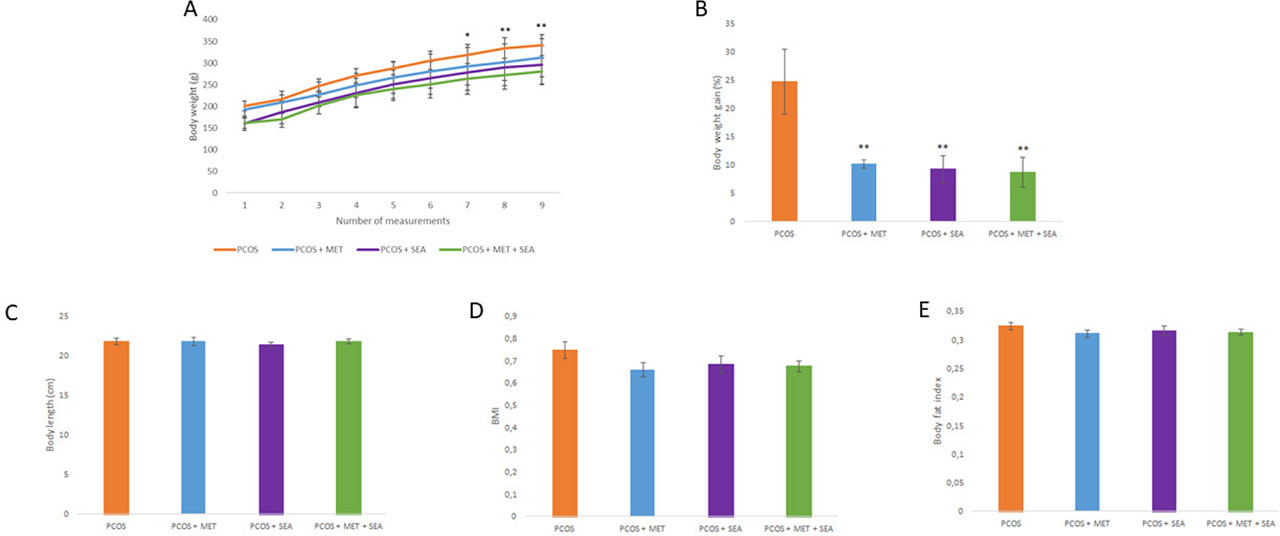
Figure 1.
The influence of usage metformin and Aronia melanocarpa extract, as well as their combined treatment on body weight parameters.
A – body weight; B –body weight gain; C – body length; D – body mass index; E – body fat. * Statistical significance at the level of p < 0.05 compared to PCOS group, ** Statistical significance at the level of p < 0.01 compared to PCOS group.
Ovary weight in groups treated with metformin (p<0.01) and Aronia melanocarpa extract (p<0.01), as well as in the group with a combined treatment of metformin and Aronia melanocarpa extract (p<0.05) was statistically significantly lower compared to the group treated with distilled water (Figure 2A).
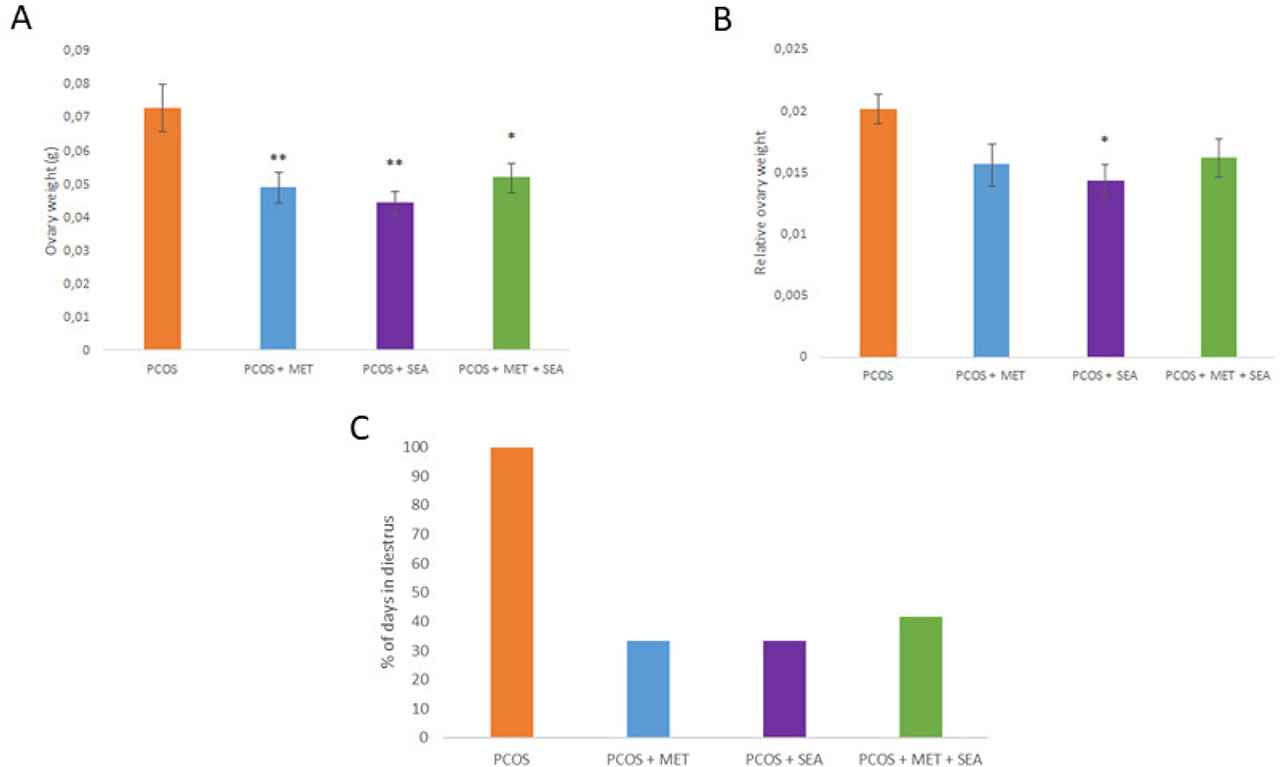
Figure 2.
The influence of usage metformin and Aronia melanocarpa extract, as well as their combined treatment on ovary weight and estrus cycle.
A – ovary weight; ** Statistical significance at the level of p < 0.01 compared to PCOS group.
The relative ovary weight was statistically significantly lower after the treatment with Aronia melanocarpa extract (p<0.05) compared to the non-treated group (PCOS). No statistically significant difference was registered between the other groups (p>0.05). Treatment with metformin alone, as well as in combination with Aronia melanocarpa extract did not cause a change in the relative ovary weight in animals with PCOS (Figure 2B).
PCOS group had 100% of days in diestrus, while the PCOS + MET group and the PCOS + SEA group had 33.33% of days in diestrus, and PCOS + MET + SEA group had 41.67% of the days diestrus during the analyzed period of 12 days (Figure 2C).
Adipocyte area was significantly decreased after treatment with MET as well as after combined treatment (Figure 3A), while adipocyte diameter was decreased only after combined treatment, compared to PCOS group (Figure 3B). The number of cystic follicles was decreased after all three type of treatments, while the number of corpora lutea was increased (Figure 3C and 3D).
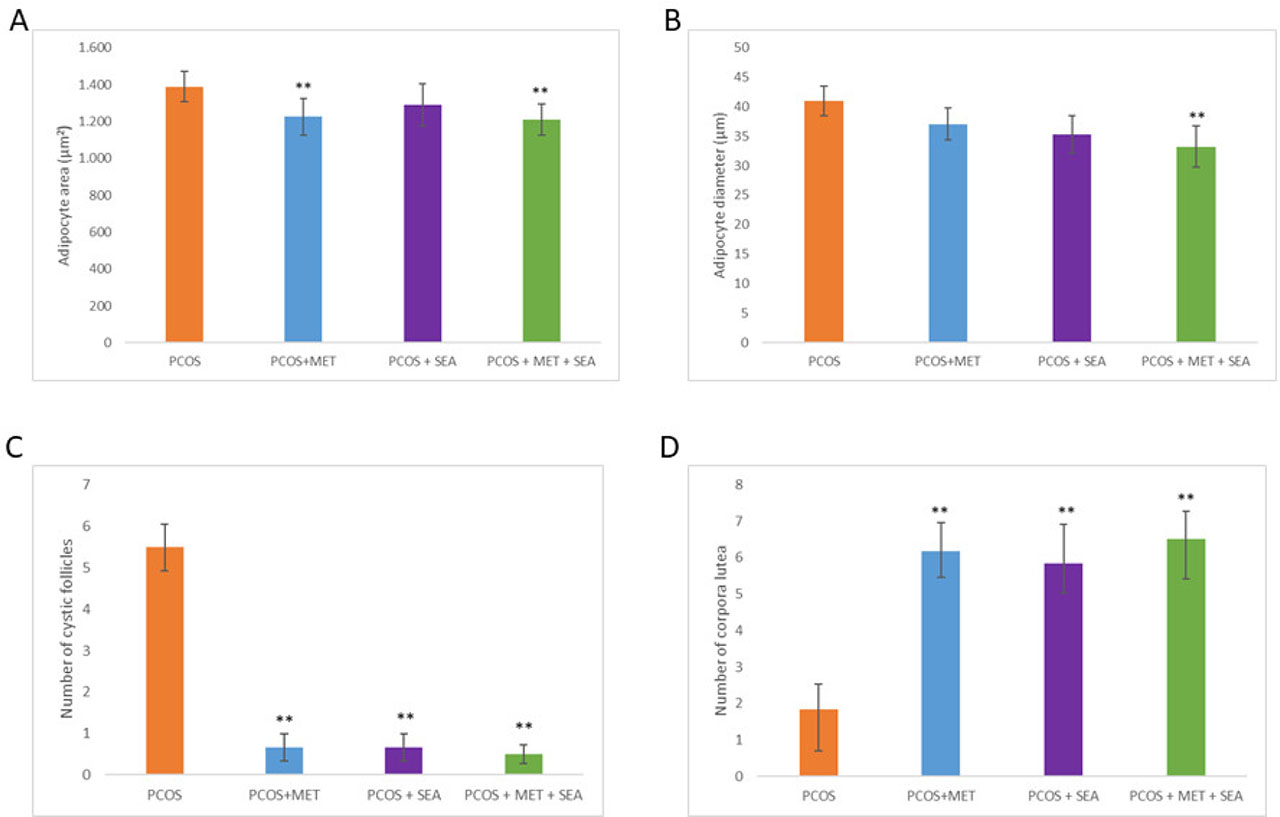
Figure 3.
The influence of usage metformin and Aronia melanocarpa extract, as well as their combined treatment on morphometric parameters of adipocytes and ovary tissues.
A - adipocyte area; B – adipocytes diameter; C - number of cystic follicles; D – number of corpora lutea ** Statistical significance at the level of p < 0.01 compared to PCOS group.
DISCUSSION
PCOS represents a very complex syndrome with still unclear basic mechanisms of etiopathogenesis. There are a plethora of health implications that have been associated with the diagnosis of PCOS, many of these constituting lifelong complications. Metabolic anomalies and their associated manifestations are some of the most common risks. The treatment of this disorder is primarily symptomatic. Since none therapeutic approach has been established yet, the aim of many researches is to discover an alternative treatment approach as well as to provide new strategies that would result with a less side effects.
The present study investigated the effects of SEA, MET, or their combination on morphometric parameters and ovarian histological structure of the DHEA-induced PCOS rat model. Our results strongly confirmed the role of SEA alone or in combination with MET in alleviating disorders associated with PCOS. Statistically significant effect was recorded on body weight, body weight gain, relative ovary weight and ovary weight. In addition, subcutaneous fat adipocyte area was significantly reduced after all three type of treatment, while adipocyte diameter was decreased only in combined treatment (MET+SEA). Opposite, no statistically significant difference was shown in the change of body length, BMI and body fat index.
A five-week DHEA treatment successfully induced PCOS in rats. Following the method applied like Kim et al has produced very similar characteristics like those in patients with PCOS (29). All rats from the PCOS group were in the constant diestrus phase, acyclic during the last 12 days of the PCOS induction protocol (30). The rats exhibited a noteworthy recuperation of their estrous cycle, which now spanned a period of 4 to 5 days, subsequent to the administration of MET. Notably, MET is a widely recognized medication employed for ovulation induction, and has demonstrated efficacy in reinstating regular menstrual cycles in women (31). While no prior studies have been published regarding the utilization of Aronia Melanocarpa extract in animal models or human subjects, our investigation yielded compelling evidence. We observed that the SEA, when administered either in isolation or in combination with MET, exhibited a promising potential in reestablishing cyclicity within the treated groups. This intriguing finding suggests that Aronia Melanocarpa extract may hold substantial clinical promise as an adjunctive therapeutic agent in the management of menstrual irregularities. Further exploration is warranted to elucidate the underlying mechanisms and optimize dosage regimens for maximal efficacy in human patients. Additionally, clinical trials involving human subjects are imperative to validate these preliminary results and ascertain the safety and efficacy profile of this combined intervention. Such research endeavors could pave the way for a novel, integrated approach to address ovulatory dysfunction and menstrual irregularities, potentially offering renewed hope for individuals struggling with these challenges.
In our results, it was shown that the PCOS model induced by DHEA in postpubertal rats imitates the PCOS phenotype in obese patients, which is similar to results of Peng et al. study (32). Even not all preclinical studies confirmed the PCOS had an effect on body weight gain, our results indicated that PCOS model caused by DHEA in postpubertal rats acts like phenotype PCOS in obese patients (33). Opposite, PCOS models induced in prepubertal animals using DHEA commonly resulted in unchanged body weight compared to groups without PCOS (31). In our investigation, the implementation of all three treatment modalities led to a notable reduction in body weight gain subsequent to the induction of PCOS, as compared to the final body weight observed in the untreated rat group. This aligns with recent findings demonstrating a comparable weight-reducing effect of MET in both women and animal models of metabolic syndrome (34, 35). Favorable impact of SEA administration on body weight loss in rats with metabolic syndrome, as well as in individuals with diabetes mellitus, further corroborated the potential therapeutic benefits of this intervention (36, 37).
Remarkably, our results revealed a significant decline in body weight among rats with PCOS following a four-week regimen of SEA treatment. Nevertheless, it is noteworthy to mention that the incorporation of polyphenols from aronia extract into human dietary practices for weight management remains a subject of debate within the clinical community. This discrepancy may arise from a multitude of factors, including the presence of various clinical or subclinical comorbidities, as well as variations in applied protocols, all of which may yield divergent outcomes (38, 39).
Building on this, animal studies have consistently affirmed the advantageous impact of polyphenols derived from aronia extract on body weight regulation. These effects are intricately linked with the modulation of key pathways associated with insulin signaling, adipogenesis, and inflammation, all of which hold significant promise in augmenting the therapeutic armamentarium against PCOS (40).
Environmental determinants, encompassing dietary habits and lifestyle choices, alongside genetic predispositions, wield a substantial influence in the pathogenesis of PCOS. Notably, obesity not only exacerbates pre-existing PCOS manifestations but also portends unfavorable treatment responses, underscoring the pivotal role of weight management in PCOS care (41). Furthermore, compelling evidence suggests that women diagnosed with PCOS face an elevated risk of miscarriage, particularly when their BMI surpasses the threshold of 25 kg/m2, underscoring the profound interplay between metabolic factors and reproductive outcomes in this context (8). In our study, all three type of treatments reduced adipocyte area compared to PCOS group. Mounting evidence indicates that an excess of androgenic hormones augments the size of adipocytes in women afflicted with PCOS. This hypertrophy of adipocytes can potentially culminate in dysfunctional adipose tissue, and the conversion of hypertrophic adipocytes into smaller counterparts could represent a viable approach for ameliorating both IR and obesity. Similar results were observed in recent study (42). Authors found decreased adipocyte area after administration of flavonoid rhamnocitrin, as well as MET, in letrozole-induced PCOS. However, additional effect of MET and SEA were observed in our study by significant decrease of adipocyte diameter in combined treatment compared to PCOS, contrary to monotreatment.
Histomorphological examination demonstrated cystic expansion within the ovaries, accompanied by a diminished count of viable follicles and a reduction in the layers of granulosa cells in the PCOS rats. Contrary, lower number of cystic formations and larger number of corpora lutea were observed in all three type of treatments, with a greater modification in combine treatment. In addition to evaluating estrous cycle regularity, the histological examination of ovarian tissue provided valuable insights into the successful induction of PCOS. This was evident in the PCOS group, where multiple follicular cysts were observed along with a notable reduction in the count of corpora lutea, indicative of diminished ovulatory events. Furthermore, a diminished presence of mature CL, coupled with a scarcity of developing follicles characterized by thicker granulosa layers exhibiting intermittent detachment and cumulus mass, as well as an enlarged stromal region, collectively suggest an underlying ovarian dysfunction akin to that observed in PCOS (38). Notably, post-treatment assessment revealed a discernible enhancement in ovarian morphology subsequent to SEA and MET administration, either individually or in combination. This was underscored by a notable reduction in the number of cysts, the presence of follicles at varying stages of growth, and a heightened abundance of corpora lutea compared to the PCOS group. These findings unequivocally underscore the beneficial impacts of both administered protocols on the ovarian microstructure. Ovary weight was reduced after all three type of treatments, while relative ovary weight was reduced only after SEA treatment. This potential of SEA was attributed to it unique polyphenols-rich content (43), which could influence body weight as well as ovarian weight (44, 45). Furthermore, the increased relative ovarian weight may be caused by the formation of follicular cysts (46), our results confirmed that SEA could exert a beneficial effects in PCOS while reduced follicular cysts are associated with obesity (47). The accompanying photomicrographs vividly illustrate the restorative effects of the administered treatments, particularly in ameliorating the cystic appearance of the ovaries. While this represents just one facet of the complex presentation of PCOS, it stands as a pivotal element in a larger mosaic of interrelated findings that collectively contribute to the understanding of this multifaceted syndrome.
Our study highlights the significant impact of these interventions on morphometric parameters, indicating their potential to address obesity, a prevalent comorbidity in PCOS. Notably, the reduction in adipocyte size and the modulation of adipose tissue morphology suggest a potential avenue for ameliorating metabolic dysregulations associated with PCOS.
Furthermore, the comprehensive assessment of ovarian histology provides crucial insights into the efficacy of the treatments in restoring ovarian function. The decrease in cyst formation and the increase in corpora lutea following treatment indicate a potential normalization of ovarian structure and function. Obesity emerge a significant determinants in the pathogenesis of PCOS, underscoring the importance of weight management strategies in PCOS care. Additionally, the heightened risk of miscarriage in women with PCOS, especially those with elevated BMI, highlights the intricate interplay between metabolic factors and reproductive outcomes. These findings may provide as a foundation for future clinical studies on the administration of SAE to women with PCOS in order to assess the specific impact of this extract on the reproductive and metabolic profiles of this patient population, particularly in those with an obese PCOS phenotype.
CONCLUSION
In conclusion, this study illuminates critical facets of PCOS, a complex and multifaceted condition with implications spanning metabolic, reproductive, and overall health. Our findings underscore the potential of SEA and MET, either in isolation or in combination, as promising interventions for mitigating PCOS-related complications.
The successful induction of PCOS in rats through DHEA treatment closely mirrors clinical presentations in obese PCOS patients, affirming the relevance of this animal model in studying the syndrome. The restoration of estrous cycle regularity following MET administration aligns with its established role in ovulation induction, further emphasizing its therapeutic promise. Moreover, the observed efficacy of SEA, a previously underexplored intervention, in reinstating cyclicity warrants further investigation to elucidate underlying mechanisms and optimize dosage regimens for human applications. This study contributes valuable knowledge towards the understanding and potential treatment of PCOS. While our investigation primarily focused on specific aspects of PCOS, it is imperative to acknowledge that PCOS encompasses a broader spectrum of clinical manifestations. Future research endeavors should aim to comprehensively address the multifaceted nature of this syndrome, with a view towards developing integrated therapeutic approaches that offer renewed hope for individuals grappling with PCOS-related challenges. Ultimately, these findings hold the potential to significantly improve the quality of life for individuals affected by PCOS.