
INTRODUCTION
Smoking is a cause of serious disease in smokers. The greatest risk of smoking-related diseases comes from burning tobacco and inhaling smoke. Tobacco Harm Reduction (THR) refers to strategies designed to reduce the health risks associated with tobacco smoking, but which may involve the continued use of nicotine or tobacco. Next Generation Products (NGPs), like E-Vapor Products (EVPs), deliver nicotine without burning tobacco and have the potential to play a role in THR. However, as these products have not been on the market long enough, evidence regarding their long-term health effects remains limited. In the absence of such evidence, their potential population-level impact can be evaluated using computational modelling. Among the available approaches, Dynamic Population Models (DPMs) are particularly well suited for this purpose, as they capture changes in patterns of tobacco and NGP use over time and estimate the associated health consequences (1,2,3,4,5,6,7,8,9). Typically, DPM compares a baseline scenario, reflecting continuation of current tobacco trends in the absence of novel products, with one or more alternative scenarios incorporating interventions such as the introduction of NGPs or regulatory changes.
In the baseline scenario, transitions represent cigarette-related behaviors only, including initiation (never smoker to current smoker), cessation (current smoker to former smoker), and relapse (former smoker to current smoker).
These transitions are commonly stratified by age and sex and often include time-since-cessation modifiers to capture the gradual decline of smoking-related risks.
The alternative scenario extends the behavioral structure to incorporate NGP-related consumer journeys such as EVP initiation, switching from smoking to vaping, initiation/cessation of dual use, and EVP-specific cessation. Transition probabilities are adjusted to reflect expected behavioral responses to the intervention and may include time-dependent effects, such as decreasing relapse risk with duration since quitting, or increasing benefit with longer-term switching. Coupled with relative risk estimates for each use pattern, DPM enables quantitative assessment of whether an intervention is likely to reduce or increase population-level mortality.
The primary aim of these models is to quantify net changes in smoking-attributable or product-attributable mortality. Model structures depend on the outcomes of interest and on the availability and quality of input data. Most frameworks integrate (i) a behavioral component describing transitions between use states, and (ii) a health component applying excess mortality risks to estimate long-term outcomes.
When NGPs are already present on the market, longitudinal cohort data are especially valuable because they allow direct observation of how the same individuals move between product-use states over time. Longitudinal data follow individuals across repeated survey waves and therefore provide empirical estimates of transition probabilities from one state at time t to another state at time t + 1. These transitions may include, for example, initiation of NGP use among never users, switching from exclusive smoking to exclusive EVP use, uptake or cessation of dual use, relapse from former use back to smoking, or complete cessation of all products. Such data therefore capture individual-level trajectories and the sequencing of behavioral changes, which are central to transition-based dynamic population models. Several studies have drawn on longitudinal data from the Population Assessment of Tobacco and Health (PATH) study (10) to derive detailed EVP transition matrices stratified by demographic groups (11, 12) in the U.S.. In these models, transition matrices summarize the probabilities of moving between all relevant use states over a defined interval, thereby providing the behavioral engine of the simulation. Similarly, Wissmann et al. (13) developed an agent-based model simulating annual smoking and EVP trajectories for the US population using survey-based transitions, including PATH and a large longitudinal dataset from Juul™ purchasers.
However, obtaining robust transition probabilities requires extensive longitudinal datasets, which may be incomplete, unavailable, or unrepresentative of the wider population in other markets. Reliable estimation generally requires repeated follow-up, adequate sample sizes within each use-state category, and sufficient duration to capture relatively infrequent transitions such as switching, relapse, or sustained cessation. In many settings, these conditions are not met, particularly where NGP uptake is recent or surveillance infrastructure is limited.
To address this gap, we propose a novel approach based on forecasting prevalence data directly from historical trends using time-series models. Repeated prevalence measurements allow the characterization of how smoking and NGP use have evolved over time, and time-series forecasting can extend these trajectories into the future without requiring detailed individual-level transition data. While less granular than cohort-based approaches, this method provides a pragmatic and scalable alternative for estimating population-level dynamics in settings where longitudinal data are unavailable, thereby expanding the applicability of dynamic population modelling.
We also propose applying this time-series framework to simulate the potential health impact of EVP availability in markets lacking longitudinal transition data, such as the UK. The objective is to estimate how EVP uptake may influence smoking prevalence and associated mortality under different scenarios. By combining historical prevalence trends with established relative risk estimates for smoking and vaping, the model provides a practical and scalable approach to assess harm-reduction potential of NGPs in data-constrained environments.
MATERIALS AND METHODS
Projection of future smoking and vaping prevalence
Future trends in smoking and vaping prevalence were projected using the Prophet forecasting model (14), implemented in R via the prophet package (15). Prophet offers several advantages over traditional Auto Regressive Integrated Moving Average (ARIMA) approaches: minimal preprocessing, robustness to missing data and irregular survey intervals, and the ability to incorporate external regressors when needed.
The model was trained with prevalences for smoking and EVP use. To represent combined cigarette-EVP behaviors, nine mutually exclusive categories were defined by crossing cigarette status (never/current/former) with EVP status (never/current/former). To ensure that predicted prevalence values remain bounded between 0 and 100%, the time series is modelled on the logit-transformed scale. Historical distributions across categories were reconstructed from prevalence reports, ensuring category proportions summed to the adult population each year.
Prophet was run with default additive components, without the seasonal component, and trend dampening was enabled to reduce overfitting in long-term forecasts.
Analyses were conducted in R v4.3.2 (16) using RStudio Server (17). The tidyverse (18) was used for data wrangling and visualization.
Estimation of smoking- and vaping-attributable mortality
Public health outcomes were estimated as the difference in smoking- and vaping-attributable deaths (SVADs) between two scenarios:
- hypothetical baseline scenario: cigarette-only market with no EVP availability.
- current-product scenario (alternative scenario): coexistence of cigarettes and EVP.
Following established frameworks (19, 20), SVADs were calculated by multiplying the number of individuals in each use category (current smokers, former smokers, current vapers) by their excess mortality rate relative to never users.
Population-level mortality was estimated using a validated US mortality model (21), which accounts for age, sex, and smoking status, including consumption gradients (e.g., one to two packs per day).
Because cross-sectional prevalence data do not capture individual histories (e.g., duration since quitting or switching), we defined representative smoking/vaping trajectories capturing typical behavioral patterns. For example, in the UK, the representative exclusive-smoker trajectory reflects an individual who remains a never user until age 20, initiates smoking at age 21, and continues exclusive cigarette use until age 50. Nine such trajectories, covering ages 18–50 and the full set of use states (exclusive smoking, exclusive vaping, dual use, former use, and non-use), are summarized in Table 1.
Table 1.
Description of representative trajectories.
| Age | Never smoker/Never EVP user | Smoker/Never EVP user | Former smoker/Never EVP user | Never smoker/EVP user | Smoker/EVP user | Former smoker/EVP user | Never smoker/Former EVP user | Smoker/Former EVP user | Former smoker/Former EVP user |
|---|---|---|---|---|---|---|---|---|---|
| 18–20 | NVR; NVR | NVR; NVR | NVR; NVR | NVR; NVR | NVR; NVR | NVR; NVR | NVR; NVR | NVR; NVR | NVR; NVR |
| 21–30 | NVR; NVR | CUR; NVR | CUR; NVR | NVR; CUR | CUR; NVR | CUR; NVR | NVR; CUR | CUR; NVR | CUR; NVR |
| 31–40 | NVR; NVR | CUR; NVR | CUR; NVR | NVR; CUR | CUR; CUR | CUR; CUR | NVR; CUR | CUR; CUR | CUR; CUR |
| 41–50 | NVR; NVR | CUR; NVR | FMR;NVR | NVR; CUR | CUR; CUR | FMR; CUR | NVR; FMR | CUR; FMR | FMR; FMR |
These trajectories enabled mapping of projected prevalence into appropriate mortality-risk categories for both scenarios.
Validation using a transition-probability simulation
This section describes the validation process for the new DPM, which was developed using a time-series approach applied to prevalence data and based on representative user trajectories.
The first part of the validation assesses the ability of the time-series model to replicate historical prevalence trends. Specifically, the Prophet forecasting model was trained on NHIS prevalence data (22) to capture underlying trends in smoking and vaping behaviours and generate projected prevalence trajectories. The model projects prevalence values for each product-use status (smoking and vaping), are then compared with observed NHIS prevalence data over the historical period (2014–2024). Figure 1 shows the projected prevalence patterns for both cigarettes and EVPs. As illustrated, the projected curves successfully reproduce both the direction and magnitude of the observed NHIS trends.
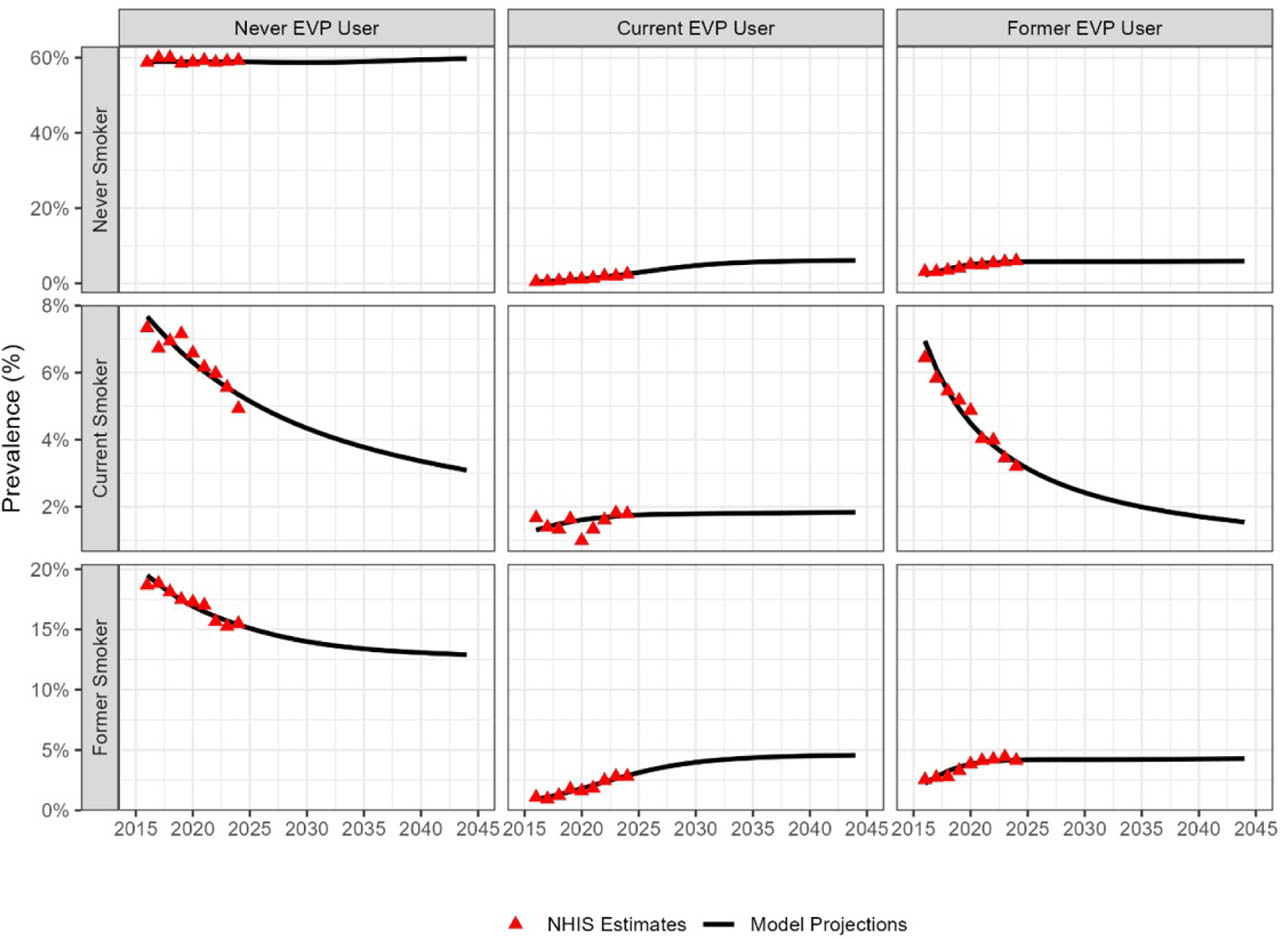
Figure 1.
Observed and projected US adult smoking and vaping prevalence, 2016–2044.
The second part of the validation compares mortality out-comes produced by the time-series–based model with those obtained from the survey-transitions–based model (8, 9, 13). This model draws on data from the PATH Study, a nationally representative longitudinal cohort study of tobacco use in the US that follows individuals over multiple survey waves. PATH includes tens of thousands of participants (approximately 30,000 adults in early waves) and collects detailed information on smoking, vaping, and other tobacco-related behaviors annually (10). For this model, annual transition probabilities among smoking, vaping, dual use, cessation, and non-use states were derived from PATH Waves 2 (2014–2015) and 3 (2015–2016), stratified by age and sex. These probabilities were incorporated into a deterministic Markov model, a modelling framework in which individuals transition between defined states over time based on estimated transition probabilities, to project annual use-state transitions. For both models, EVP use was assigned 5% of the excess mortality risk of smoking. This value was chosen for comparison purposes and does not necessarily reflect reality, although it aligns with multi-criteria decision analysis estimates (23, 24).
Figure 2 presents the cumulative difference of mortality rates using both representative trajectories in the time series-based model and individual-level trajectories in the survey-transitions based model.
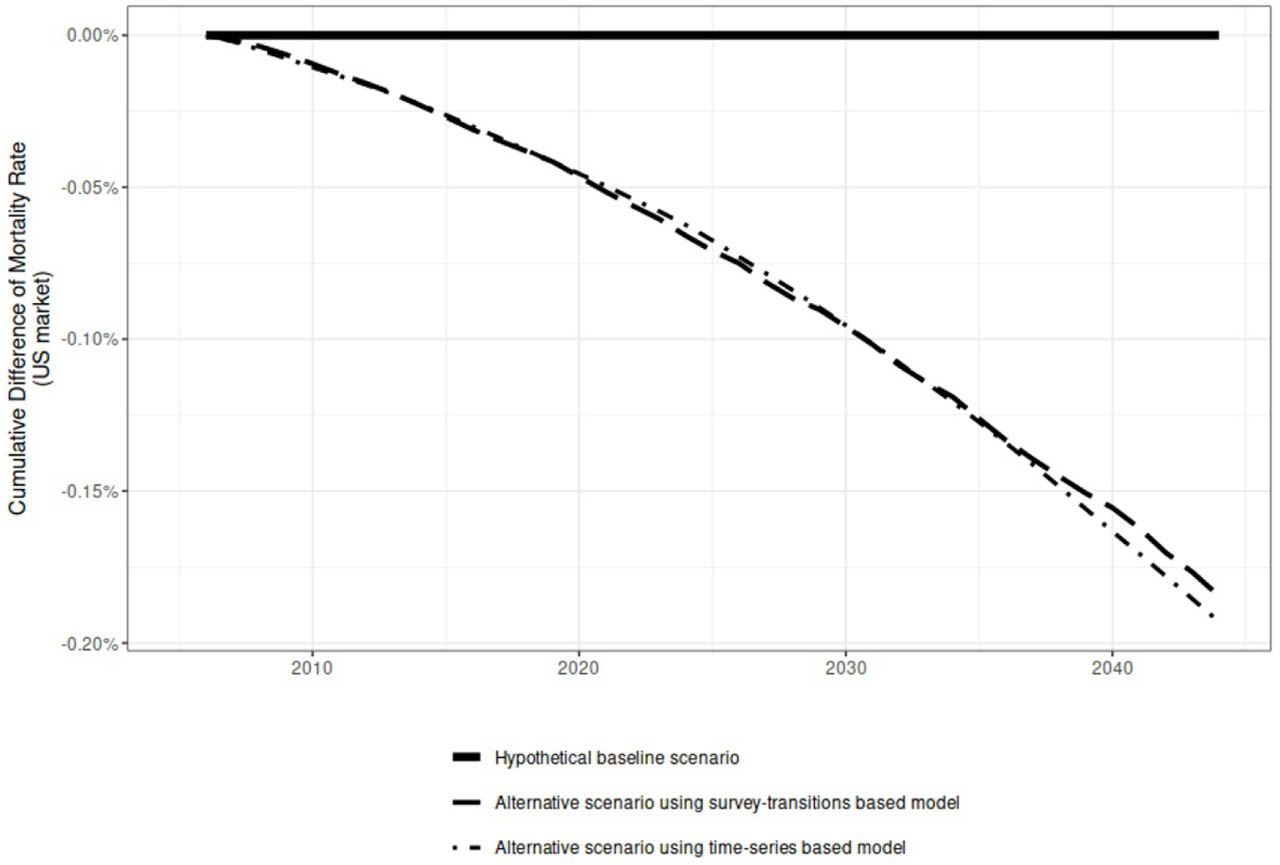
Figure 2.
Cumulative difference of mortality rate using different approaches (US market).
The mortality results from the representative-trajectory model closely align with those from the individual-level model, with no structural differences in the overall trends. These results show that the new model provides a computationally efficient alternative while preserving sufficient accuracy for population impact modelling.
Estimation of tobacco-related disease risks
To estimate the relative risk (RR) of mortality for smokers from major smoking-related diseases, i.e., lung cancer, ischemic heart disease (IHD) and stroke, we apply the equation proposed by Weitkunat et al. (25):
where ED(a) represents the equivalence dose at age a for a specific disease and ERR(a) denotes the risk at age a, associated with continued cigarette smoking for the same disease.The equivalent dose will be 0 at birth, as all individuals are then non-smokers, and so long as the individual does not start to smoke, their equivalent dose will remain at 0. If an individual starts to use a tobacco product, their relative exposure will increase, and their equivalent dose will gradually move towards the relative exposure related to their specific tobacco product use pattern. Subsequently, further switches in tobacco product use will result in further changes in relative exposure, with their equivalent dose gradually moving in the direction of the new relative exposure.
The equivalent dose (ED) at age “a” depends on the ED at age “a−1” and the current year's relative exposure (RE), adjusted by a negative exponential factor N(a) that accounts for the half-life (H) of exposure at age “a”.
The negative exponential factor for a single year, N(a), is calculated as:
Therefore, the equivalent dose values are updated using the formula:
The relative exposure is defined as 0 for a never user or former smoker and former EVP user, 1 for a current smoker, and taken between 0 and 1 for current vapers.
The estimates of excess relative risks for continued smoking and the half-lives (H) of excess risk following smoking cessation, by disease and age are derived from meta-analyses of published data and reported by Lee et al. (26). For example, the excess relative risks for lung cancer, IHD, and stroke were set to 11.68, 3.38, and 2.48, respectively. The corresponding half-lives of excess risks were set to 6.98, 1.47, and 4.78 years for people less than 49 years old.
Exploration of scenarios using the UK Market as a case study
For the UK case study, annual estimates of adult smoking and EVP use were obtained from the UK Office for National Statistics, ONS, (27) for 2014–2022. To assess the population-level health impact of EVP use in the UK, we compared two scenarios starting in 2014:
- hypothetical baseline scenario: only cigarettes available
- alternative scenario: EVPs introduced after 2010, when their use became more prevalent
The difference in cumulative SVADs between these scenarios provides a measure of the potential net population health impact of EVP use. Both scenarios were projected through 2040 to capture long-term consequences of tobacco use, which often take decades to manifest. This approach aligns with previous population modeling studies (28, 29). Sensitivity analyses were performed to assess the impact of parameter variation in two models:
1) the Excess Relative Risk (ERR) parameter for EVPs in the mortality model, varied across a range of 5% to 50% and
2) the Relative Exposure (RE) parameter for EVPs in the disease-specific mortality model, varied across a range of 0.05 to 0.5.
RESULTS
Prevalence projections
Our DPM was used to predict cigarette and EVP prevalence, in the UK, across current, former and never vaper/smoker categories. The projected adult cigarette smoking prevalence in the alternative scenario aligns with estimates reported by the ONS from 2014 to 2022. Under this scenario, smoking prevalence is projected to continue declining, while vaping prevalence increases modestly over time. In contrast, the baseline scenario, where all EVP-related users are reclassified into smoking categories, results in significantly higher smoking prevalence, with vaping prevalence dropping to zero. By 2040, the continued availability of EVPs is associated with a projected 7.4% reduction in smoking prevalence compared to the baseline scenario. These results underscore the role of EVPs in supporting cessation and reducing combustible tobacco use.
All-cause mortality projections
Applying the mortality model to the prevalence projections and the representative population trajectories, we estimated the mortality impact of each scenario. Comparing these mortality trends to the status quo enables us to assess the health impact of EVP availability on the market.
Table 2 shows the difference in cumulative premature deaths, in the UK, between the baseline scenario and the alternative scenario and under varying ERRs ranging from 5% to 50%, meaning EVP use is assumed to be between 95% and 50% less harmful than smoking. Our Dynamic Population Model projects that, by 2040, the alternative scenario, where both cigarettes and EVP are available, would result in 850,000 (for an ERR of 5%) to 360,000 (for an ERR of 50%) fewer tobacco-related premature deaths compared to the baseline scenario, which assumes only cigarettes are available. This reduction accounts for the mortality impact of both cigarette smoking and EVP use. The overall decline in mortality is driven primarily by the significant reduction in adult smoking prevalence in the alternative scenario, as described earlier, and by the transition of smokers to EVP, which are potentially less harmful. Even at the (conservative) upper end of the ERR range (50%), the alternative scenario still shows a net population benefit of 360,00 fewer premature deaths.
Table 2.
Sensitivity analysis of cumulative premature death differences between the baseline scenario and alternative scenarios across varying Excess Relative Risk (ERR) values by 2040.
| ERR | 5% | 10% | 20% | 50% |
|---|---|---|---|---|
| Cumulative difference of tobacco-related premature deaths (million) | 0.85 | 0.79 | 0.68 | 0.36 |
Applying an ERR of 5%, we examined how variations in EVP uptake influence reductions in tobacco-related premature deaths by 2040 compared to the baseline scenario. If the proportion of smokers switching to EVPs was twice as high as the initially estimated transition, then the projected health benefit would be much larger, with an estimated 1.53 million fewer premature deaths from tobacco use. Conversely, if EVP prevalence was halved, reductions dropped to 0.51 million fewer premature deaths, highlighting the critical role of behavioral uptake in maximizing harm reduction potential.
Projection of smoking-related disease risks
To estimate the potential impact of EVP uptake on smoking-related disease outcomes, we applied the disease-specific mortality model using projected prevalence and population trajectories. The analysis focused on three major disease categories: lung cancer, IHD, and stroke, which together have been reported to account for most smoking-attributable mortality (30).
In the alternative scenario, EVP use was assumed to reduce exposure to harmful constituents relative to cigarette smoking, with Relative Exposure (RE) values ranging from 0.05 to 0.5, meaning EVP exposure is 5% to 50% of cigarette exposure. Table 3 summarizes the estimated reduction compared to baseline scenario in relative risk (RR) of smoking-attributable mortality for each disease under different Relative Exposure assumptions in 2040. Among the three disease categories, lung cancer shows the greatest reduction in relative risk, with estimated decreases ranging from 23.1% at RE = 0.05 to 7.7% at RE = 0.5. Reductions for ischemic heart disease and stroke are smaller (maximum reductions of 13.7% and 8.3%, respectively), as these conditions are influenced by multiple risk factors beyond smoking. Nevertheless, all three diseases exhibit meaningful declines, reinforcing the potential population-level health benefit of EVP uptake under lower exposure assumptions.
Table 3.
Sensitivity analysis of estimated reduction in relative risk of smoking-attributable diseases under an alternative scenario with EVP Availability in 2040.
| Disease | RE = 0.05 | RE = 0.1 | RE = 0.2 | RE = 0.25 | RE = 0.5 |
|---|---|---|---|---|---|
| Lung cancer | 23.1% | 21.4% | 18.0% | 16.3% | 7.7% |
| IHD | 13.7% | 12.6% | 10.3% | 9.2% | 3.5% |
| Stroke | 8.3% | 7.7% | 6.4% | 5.8% | 2.6% |
Using a RE value of 0.2, selected solely for comparative purposes and not intended to represent real-world outcomes, although this value has been previously reported in the literature (30), we evaluated how changes in EVP adoption affect reductions in the relative risk of smoking-attributable mortality by 2040 compared with the baseline scenario.
Doubling the proportion of smokers switching to EVPs yielded estimated reductions of 35.3% for lung cancer, 23.4% for ischemic heart disease, and 13.3% for stroke, highlighting the substantial potential public health gains achievable under higher switching rates. Conversely, halving EVP prevalence reduced these benefits to 9.3% for lung cancer, 3.8% for IHD, and 3.0% for stroke, demonstrating that limited adoption significantly constrains harm-reduction potential.
DISCUSSION
The present study demonstrates that a trend-based Dynamic Population Model (DPM), grounded in repeated cross-sectional prevalence data, can provide a robust and pragmatic framework for estimating the population-level impact of EVP uptake in markets where longitudinal transition data are limited or absent. Using the UK as a case study, the model successfully reproduces historical smoking and vaping trajectories and projects substantial reductions in smoking-attributable mortality under scenarios reflecting continued EVP use.
Prevalence projections show that the rise in EVP use aligns with the accelerated decline in smoking seen from 2014 to 2022. In the alternative scenario, both cigarette and EVP prevalence continue to decrease, while a hypothetical market limited to cigarettes results in significantly higher smoking rates. These contrasting trends highlight the substantial role that EVP uptake plays in reducing combustible tobacco consumption.
When combined with the mortality model and disease-specific risk equations, these prevalence trends translate into meaningful population health gains. Across conservative to moderate assumptions regarding ERR, the model estimates that EVP would prevent between 360,000 and 870,000 million premature deaths in the UK by 2040. Sensitivity analyses further show that behavioral uptake is a critical determinant of harm reduction potential: doubling switching rates could avert up to 1.53 million deaths, whereas reducing the switching rate by half substantially diminishes the benefit.
Disease-specific analyses show the greatest relative risk reductions for lung cancer, with additional meaningful declines for IHD and stroke. These patterns reflect the distinct influence of smoking-related pathways. When applied through condition-specific risk equations, these prevalence trends translate into substantial gains for population health.
A major strength of this approach is its applicability in data-constrained environments. Unlike transition-based models that depend on large-scale longitudinal cohorts, the trend-based DPM can be implemented wherever repeated prevalence surveys exist. Its computational efficiency enables rapid updating as new data become available, and its nine-state behavioral structure, combined with representative trajectories, supports the incorporation of disease-specific relative risks and the equivalent-dose framework. Validation against a survey-transition based model con-firms that, despite its aggregated structure, the trend-based approach accurately reproduces both historical prevalence dynamics and mortality trends.
However, the modelling framework has important limitations. Because time-series models extrapolate historical patterns, they do not explicitly simulate behavioral mechanisms such as initiation, cessation, relapse, switching or duration in dual use. As a result, they may underrepresent behavioral shocks arising from major policy changes, price shifts or the introduction of new product categories. The reliance on cross-sectional data also limits the ability to incorporate duration-dependent risks, such as time since quitting or switching. Representative trajectories offer a structured approximation but cannot fully capture real-world behavioral heterogeneity.
Despite these limitations, the findings demonstrate that a time-series-based DPM, combined with mortality and disease-specific risk models, offers a practical, scalable and computationally efficient approach for evaluating the long-term public-health impact of EVPs in settings with limited longitudinal data. By leveraging historical prevalence trends and representative behavioral trajectories, the framework offers robust estimates of smoking and vaping patterns, mortality outcomes and reductions in smoking-related disease risks. Its accessibility, transparency, and adaptability make it well-suited for rapid policy assessments and regulatory scenario planning, particularly in markets lacking the detailed longitudinal data required for transition-based models. Moreover, our results suggest that both the accessibility of EVPs and the extent to which smokers adopt them are crucial factors in their full harm-reduction potential.
ACKNOWLEDGEMENTS
The authors would like to thank the internal Imperial Brands PLC Reading Committee for their critical review of the manuscript.
Notes
[4] DATA AND CODE AVAILABILITY
All prevalence inputs are from publicly available sources (27). Model code (R) and input tables are available from the corresponding author on reasonable request.