
INTRODUCTION
Since their appearance in the markets, vaping products have become a controversial subject, with research on the topic aiming to assess an appropriate balance between their potentially harmful effects and their potential benefit as harm reduction products. Among the multiple disciplines dealing with this topic in scientific literature, chemical analysis in laboratory emission studies has been the standard approach to determine exposure concentration of specific chemical groups, the data required for toxicological assessments. Collected data on experiments conducted in these studies provides useful information to infer the risks involved in usage of the devices, as well in their operational quality and safety. However, besides the appropriateness of analytic procedures and toxicological analysis, it is important to verify that the data was obtained from an aerosol generated under appropriate procedures that consider the device characteristics and approximate consumer usage as best as possible. Lack of fulfilment of these quality conditions might produce emission studies with misinterpretation or even erroneous ones (2–3).
Metallic elements released on vaping aerosols have been a long-standing concerning issue, as pointed out by communications of health institutions, regulatory agencies and the WHO (4). Consequently, this topic has motivated an ongoing trend of research quantifying metallic elements, such as nickel, chromium, cadmium, lead, arsenic, antimony and others, either in e-liquids or in aerosols (5,6,7,8,9,10,11,12). While some of these metals are specific to heating alloys (e.g., nickel, chromium), others are not part of the alloys of coils (e.g., lead used in welding points (8, 13,14,15)) that heat and vaporize the e-liquid. Metal release involves corrosion into different processes leading to different collected yields.
Recently, Salazar et al. published an emission study (1), which includes a toxicological assessment, focused on metallic elements in e-liquids and aerosols of seven unregulated but popular disposable vaping devices. Although a wealth of valuable data resulted from well conducted experiments and undertaking research on unregulated devices is necessary (and commendable), the authors’ interpretation of the data suffers from various technical problems, some of which are not dissimilar from those we found in a previously published literature review on 12 emission studies published in 2017–2022 focusing on metallic contents in vaping aerosols (2). Salazar et al. examined the following seven disposable devices: three ELF Bar, two Flum Pebble, and two ESCO Bar (1).
Although these devices are mostly used by young adults, they are generating a legitimate concern that motivates the analysis of their emissions. Particularly, the use of nicotine salt (coupled with benzoic acid (16)) avoiding nicotine throat-hit, increase their acceptability among non-smokers. However, the way in which the authors acquired the devices (in the authors’ description: ordered through online vendors) already places limitations on the scope and applicability of their analysis to the whole gender of disposable devices, even in the same brands and models that were tested. The connection between their laboratory analysis in the U.S. and the conditions of their storage, transportation and handling from China cannot be played down.
In practice, the lack of regulation and quality control might affect any vaping device type, but there are general properties of disposables that make them more susceptible to the instability of conditions. They are closed systems that isolate the liquid as soon as they are manufactured, designed with cotton in the tank to facilitate the retention of the e-liquid. As opposed to open-systems that can be stored and sold without e-liquid in the tank (to be filled and refilled by users), the e-liquid in closed disposables is continuously in contact and interacting with the metallic parts starting from the time of manufacture and (since they are designed for a single use) until disposed of by users.
Although long-time storage potentially increasing metal contents in e-liquids in closed devices has not received sufficient attention, it has been previously examined in studies providing examples of long-time storage of “old” closed devices (8, 17). Block et al. found high levels of lead, nickel and chromium in 120 e-liquids stored for years inside their original cartridges in closed-cartridge based devices sold in 2017 and 2018 (not the current disposables), while these metals were below detection in all 116 refill e-liquids (for usage in open systems) that were stored the same time in their original bottles (possibly even these e-liquids were chemically degraded but without involving metals) (18). More recently, Dong et al. (19) examined e-liquids with 2% nicotine lactate salts of present-day Chinese disposables in contact with nichrome coils for a week in a chamber at 60 °C. Although the experimental set up is not representative, it provides empiric evidence of increasing nickel levels from corrosion associated with nichrome coils and nicotine lactate salts but not for liquids with benzoate salts. This result suggests usage of nichrome coils only on open devices.
Salazar et al. were aware of the inherent irregularity of prevailing conditions in unregulated devices, hence they defined initial conditions by quantifying metals at the initial “virgin” state as acquired (before puffing the devices) and then after series of hundred puffs. However, their e-liquids “virginity” criterion strictly corresponds to the acquisition/testing date, not to the manufacture date, of which Salazar et al. are not aware of. This unknown time lapse between manufacture and acquisition/testing dates is crucial to understanding the initial conditions and resulting outcomes of Salazar et al. It is obviously impossible in an instable and highly complex large unregulated market to know how long it took from the manufacture to the acquisition/testing of the devices, but considering the data obtained by Salazar et al., we provide in this article strong arguments to suggest that this time was sufficiently long to produce through corrosion high levels of various metals already contained in the e-liquids before the devices were puffed.
As we show in this paper, the elevated metal yields in e-liquids and aerosols found by Salazar et al. when testing the devices are mostly reflective of the “pre-testing” storage and handling conditions in seven randomly selected unregulated disposables (among millions). These results should be interpreted cautiously as evidence to assess the emissions that would occur from generic vaping devices, even these disposables, that had been regulated and sold at reasonably short time after their initial manufacture. Without the above described non-ideal “pre-testing” initial conditions of e-liquids, the levels of metals in the aerosol only depend on the operation of the devices, with concerningly high levels only occurring under overheating conditions: excessive coil temperature or supplied power, or insufficient airflow (2).
We also reexamine the comparison of concentrations obtained by Salazar et al. with metal concentrations found in the literature on other vape devices and in tobacco smoke. Salazar et al. conclude that nickel and lead concentrations in the disposable devices they analyzed exceed concentrations found in a study published by Zhao et al. in 2019, which quantified enormous yields of these metals produced by a high-powered third generation SMOK device (20). However, concentrations are confusing when comparing different devices and products, since what matters in a toxicological comparison is the mass yields that provide the daily dosage. The emissions from the SMOK device tested by Zhao et al. released much higher mass yields of nickel and lead than those released by the disposables tested by Salazar et al., hence they are considerably more toxic.
In fact, the metal outcomes from this SMOK device tested by Zhao et al. is not a valid comparative standard for assessing metallic elements in vaping aerosols, since the device was puffed under extreme overheating conditions at power levels up to 200 W, despite its recommended usage in the range 40–60 W. Unfortunately, in a literature review of twelve emission studies published in 2017–2022 focused on metals in vaping aerosols, we found several studies with this and other methodological problems (2).
Salazar et al. also provide a toxicological assessment using their obtained metal concentrations to estimate non-cancer and cancer risks. However, their risk model is not realistic, as it assumes a lifetime usage of vaping devices that have shown malfunctions during testing and which have been (very likely) contaminated before their laboratory operation from adverse storage and handling conditions inherent in unregulated markets. The concentrations found by Salazar et al. correspond to devices activated under deficient initial conditions, hence risks computed with these concentrations cannot be extrapolated to devices without such initial conditions.
Salazar et al. show how these devices malfunctioned at puff numbers well below their marketed value, therefore lifetime usage of such malfunctioning devices is extremely unrepresentative. A more realistic risk estimate should be based on 1–5 years usage. Also, the non-cancer and cancer risks reported by Salazar et al. on their own concentrations may have been overestimations by 2–3 orders of magnitude, as they failed to incorporate as weight factor the appropriate scenario of exposure for vaping. Once estimated on realistic usage periods and with the correct exposure scenario, all risk indicators (health quotient and cancer risk) are below concerning levels and do not support the health concern raised by Salazar et al. in their conclusions.
We also question the comparison of Salazar et al. between yields of lead of one of the devices (the ESCO Bar) and the yield of lead in packs of cigarettes. This comparison can easily be misinterpreted, not only because it involves an unregulated device tested under deficient initial conditions, but also because comparing emissions of a single element (lead) hides the fact that risks of tobacco smoking are encoded in many more compounds besides lead.
While we commend Salazar et al. for providing valuable data that can motivate the necessity to understand and regulate the US vaping market, we question the conclusions of a recent follow up paper of their study by Olmedo and Gil (21), which uncritically considered its most hazardous conclusions as certain facts applicable to the full gender of disposable vaping devices. Olmedo and Gil specially focused on cancer risks from antimony in one of the tested brands (the Flum Pebble), ignoring the fact that Salazar et al. themselves showed evidence of large antimony yields already present in the virgin e-liquids (i.e., before puffing) in these devices. It is likely and plausible that these yields and their associate high cancer risks are a product of either external contamination and/or of long-time storage before their testing and not from the operation of these same devices without these deficient initial conditions.
FROM MEASUREMENTS TO INTERPRETATION: SEPARATING PRE-TESTING STORAGE EFFECTS FROM USE-RELATED METAL RELEASE
Metallic corrosion is fundamentally an electrochemical process. It arises from the simultaneous anodic dissolution of a metal, and the cathodic reduction of oxidants present in the environment. In prefilled vaping systems, this process starts as soon as metallic components remain in permanent contact with the liquid. Such general corrosion leads to the passive release of soluble metal ions, which may subsequently precipitate as oxides or hydroxides. The rate and extent of this process are strongly influenced by the composition of the liquid, its pH, environmental conditions (temperature and humidity) and the presence of aggressive ions.
Beyond liquid–metal interactions, aerosol generation involves boiling processes that introduce additional mechanical stresses on metallic surfaces. Under optimal operating conditions, bubble nucleation occurs within cavities, producing dynamic liquid and gas flows along the heated surface. This promotes erosive corrosion and pitting corrosion, both accentuated by the elevated temperatures required for vaporization.
When overheating arises, a transition to film boiling may occur, in which case a dry layer temporarily isolates the heating surface from the liquid. This condition drives local surface temperatures far beyond vapor–liquid equilibrium. Such excessive heating induces structural effects – including thermal dilatation, reduction of Young’s modulus, and repeated stress cycles – that can facilitate stress corrosion cracking.
Each type of corrosion thus originates from a distinct source and affects different alloys in different ways. General corrosion applies to all metallic parts in direct contact with the liquid, whereas erosion and pitting are linked to boiling dynamics during device operation. Stress corrosion cracking emerges under overheating cycles. Considering all metals under a single category of risk fails to capture the diversity of these mechanisms and may obscure the interpretation of emission data. For this reason, exposure assessments should be discussed with respect to the specific corrosion processes involved.
Baseline metal content before puffing: evidence consistent with pre-testing storage artefacts
The initial concentrations of metal elements in the e-liquids stored in the devices (the “virgin” e-liquids) are listed in the authors’ Table S2 (1). Although the devices had not been used at this stage, their e-liquids had already been subjected to previous interaction with the metallic parts (a feature that is common in closed devices, especially disposable ones). However, it is known (acknowledged and cited by the authors (9)) that storage conditions bear influence on the release of metals.
The aerosols of the ESCO Bar Clear and Flavored exhibited the highest increase of metallic elements: Ni was 451 times higher than in other devices, Cu: 14,591 times, Zn: 54 times, Sn: 66 times, Bi: 2,814 times and Pb: 4,349 times. Consequently, we suggest that this sharp increase in metals is an effect most likely caused by a long storage time before the devices were acquired, an effect that should have specially affected the composition of the e-liquid of ESCO Bar in comparison with the other devices. The fact that similar difference of metals values was found between the “clear” and “flavored” ESCO Bar supports the hypothesis that storage time is the most plausible explanation of the differences of the initial e-liquid composition in the different devices. We remark that the coloring of the cotton element (as displayed in Figures S5–S7 in (1)) suggests its deterioration, a fact that requires further analysis of the e-liquid.
Since lead has been widely used in the microchip industry as a welding alloy, its usage by the manufacturer of a Pb-alloy in a device meant for inhalation is questionable. As for the bracket/connector, the gilded part is commonly made of brass that produces the above-mentioned coloring. These alloys mostly contain copper and zinc, with a subclass of brass additionally containing lead. The initial high concentration of these metallic elements in the virgin e-liquids further highlights the likelihood that storage time is the cause of the alteration in these parts. Given the lack of information on storage conditions, we refer to the 2019 study by Gray et al. (8) on the quantification of metals in e-liquids of pod devices (a reference not cited by the authors). Gray et al. obtained metal levels for 2-year-old pod-devices with brass connectors that are comparable to those reported by Salazar et al. These pods were also closed systems, which also raises concerns about the lack of regulation.
We agree with the authors’ concern that these low-quality vaping products expose users to emissions with worryingly high levels of metals (far higher than in the other devices). The ubiquitous presence in the market of such low-quality vaping products is perhaps the main unintended consequence of the lack of regulation. This is also the case for the detected antimony in the initial “virgin” liquid of the Flum Pebble. To highlight these facts, Table 1 displays the relative deviation between initial and aged liquids (after 500 puffs). Notice (and this must be acknowledged) that extracting and analyzing unused liquids for testing purposes requires destroying the initial devices, which are strictly speaking not the same as the ones whose aerosol was tested.
Table 1 shows the highest increase in chromium and nickel for the ELF Bar Flavored (> 2,000% Cr and > 6,000% Ni) and for the Flum Pebble Flavored (> 2,000% Cr and > 1,400% Ni). The heating alloys mostly release these two metal elements during the activation (something also assumed by the authors). As a contrast, the two ESCO Bars, designed with Fe−Cr alloys, exhibit a high increase in chrome but not in nickel. The fact that copper, zinc and lead show a lower increase suggests that they are mostly transferred to the aerosol with minimal influences of the heating process. Therefore, the ESCO Bar high lead concentration follows from the initial composition, not from its usage. The high presence (and risks) of antimony in the Flum Pebble device and ESCO Bar must also be linked to contamination of their “virgin” liquids from welding alloys as pointed in Salazar et al. Table S2. The main consequence of these outcomes is the acknowledgement that these closed systems initially contain an intrinsic hazard induced by long storage, suggesting the requirement of a short expiration time.
Table 1.
Relative deviation of element concentration between initial and aged devices (re-analysis of Salazar et al. (1)). The contrasted behavior across elements is compatible with distinct source terms, including baseline/storage-driven contributions for some metals and operation-driven release for others.
| ELF Bar Flavored | 2,256% | 6,748% | — | 35% | 22% | −3% |
| ELF Bar Clear | 1,380% | 3,700% | −40% | 74% | 215% | −66% |
| ELF Bar 0% Nicotine | 3,210% | 6,054% | — | −10% | −99% | 21% |
| Flum Pebble Flavored | 2,256% | 1,408% | — | 162% | −59% | −28% |
| Flum Pebble Clear | 1,129% | 294% | 120% | 27% | −14% | −42% |
| ESCO Bar Flavored | 884% | −13% | 2% | 29% | 291% | 40% |
| ESCO Bar Clear | 503% | 70% | 2% | 23% | 15% | 38% |
Storage-related corrosion as a plausible driver of elevated baseline metals (and why it matters for interpretation)
The ESCO Bar contained high levels of lead already at its initial state, which is concerning. To assess this phenomenon, we stress again that the extraction and analysis of its e-liquid content require the destruction of the device. The extraction process is followed by a sampling process that could suggest a homogeneous concentration of the e-liquid. However, homogeneous concentration can be ruled out since corrosion, and its subsequent metal release is an interface phenomenon. During storage metal elements are transferred to the e-liquid that is in close contact with the wire or mesh, consequently, they mostly stay in the area where they were released, with limited diffusion towards the rest of the e-liquid because the porous material limits fluid movement and mixing.
Because of the e-liquid heterogeneity high metal concentrations occur in the first hundreds of puffs but decrease as the puffing sequence goes on. Figure 1 illustrates this fact for the ESCO Bar devices.
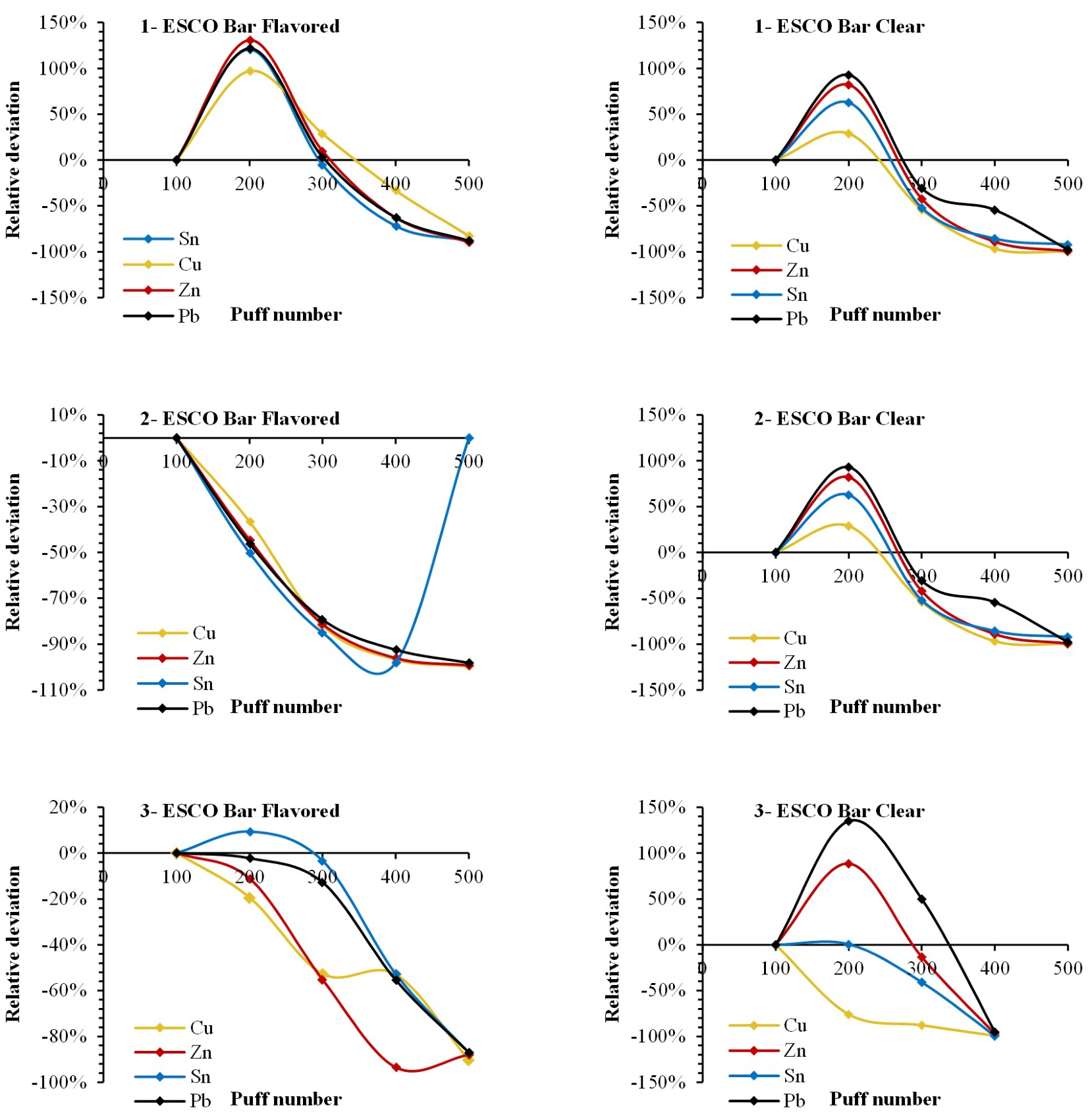
Figure 1.
Relative deviation from initial masses of Cu, Zn, Sn and Pb versus puff number for the six ESCO Bar devices (re-analysis of Salazar et al. (1)). These patterns are consistent with a strong baseline contribution and heterogeneous initial liquid rather than a stable emission regime.
From these deviations it is evident that devices puffed with fresh e-liquids would produce an aerosol with different rates of metal release. Once the metallic elements - accumulated around the wire from storage conditions - are transferred to the aerosol after successive vaporization, the remaining quantities significantly decrease, and the resulting aerosols concentrations return to (device dependent) lower rates. However, extrapolation on this issue is challenging without a comparison with “fresh” devices that were not stored and stocked for long periods. For this reason and, given the lack of information to estimate the time from manufacturing, these tests remain random tests that cannot be generalized to all the products. From the first to the last series of puffs, the average decrease of metal release rate in the ESCO Bars devices is 93% in Pb, 94% for Sn, 95% for Cu and Zn. Consequently, we can assume that concentrations would be significantly lower with new/fresh products and on the remaining life of the tested products.
Operational phase vs device degradation: patterns consistent with overheating/end-of-life effects
Different elements of the heating alloys (whether chromium or nickel) produce different behavior. This is illustrated in Figure 2, displaying the relative deviation in comparison with the first series of puffs of the three devices tested to high puff numbers.
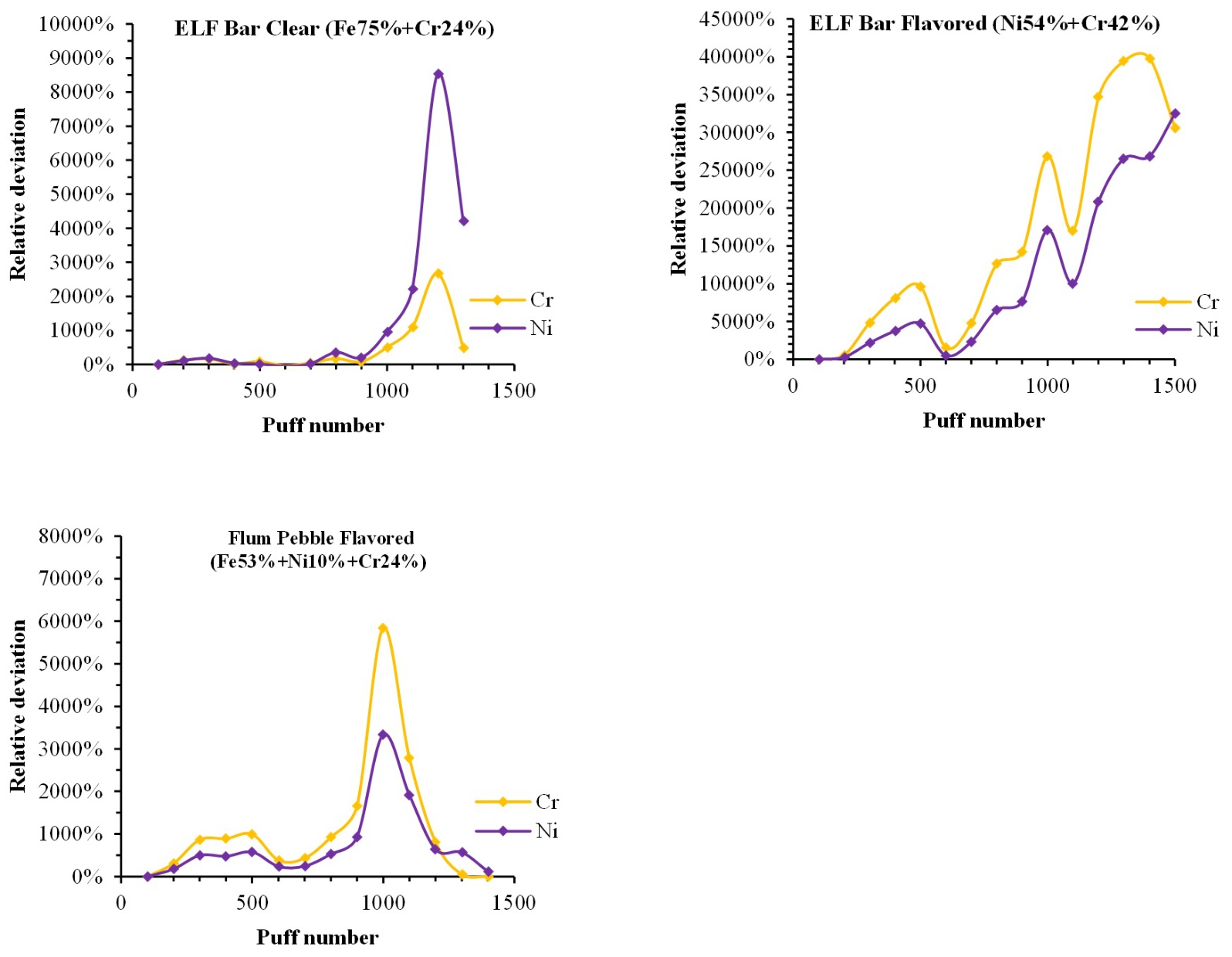
Figure 2.
Relative deviation from initial quantities of Cr and Ni for devices tested beyond 100 puffs (re-analysis of Salazar et al. (1)). The puff-dependent evolution of Cr/Ni is consistent with operation-driven release and device-state effects.
Under normal usage conditions the coil temperature is fixed and determined by the boiling regime. Therefore, it is consistent to observe a minimal increase in the mass of the elements induced by heating during the repetition of the puffs. Below 900 puffs for the ELF Bar Clear and 700 puffs for the Flum Pebble Flavored, there is a moderate relative deviation from initial series. However, from these two puff numbers onwards the metal release starts increasing, reaching a maximum at 1,200 and 1,000 puffs. The ELF Bar Flavored has a different behavior, metal elements increase from 200 puffs onwards with a drop at 600 puffs, reaching more than 30,000% of 0–100 puffs values at the end of the experiment.
Of the three tested ELF Bar Flavored devices, the one that was used up to 1,500 puffs exhibits the worst behavior in comparison with the three devices tested until 500 puffs (Figure 3). Consequently, one of the ELF Bar Flavored probably faced technical problems (mentioned by Salazar et al.), hence if one of the other devices had been puffed up to 1,500 puffs, it might have resulted in a different interpretation of the toxicity content and potential risks. Of the six ESCO Bar devices that were tested, three showed the same behavior as the one ELF Bar Flavored.
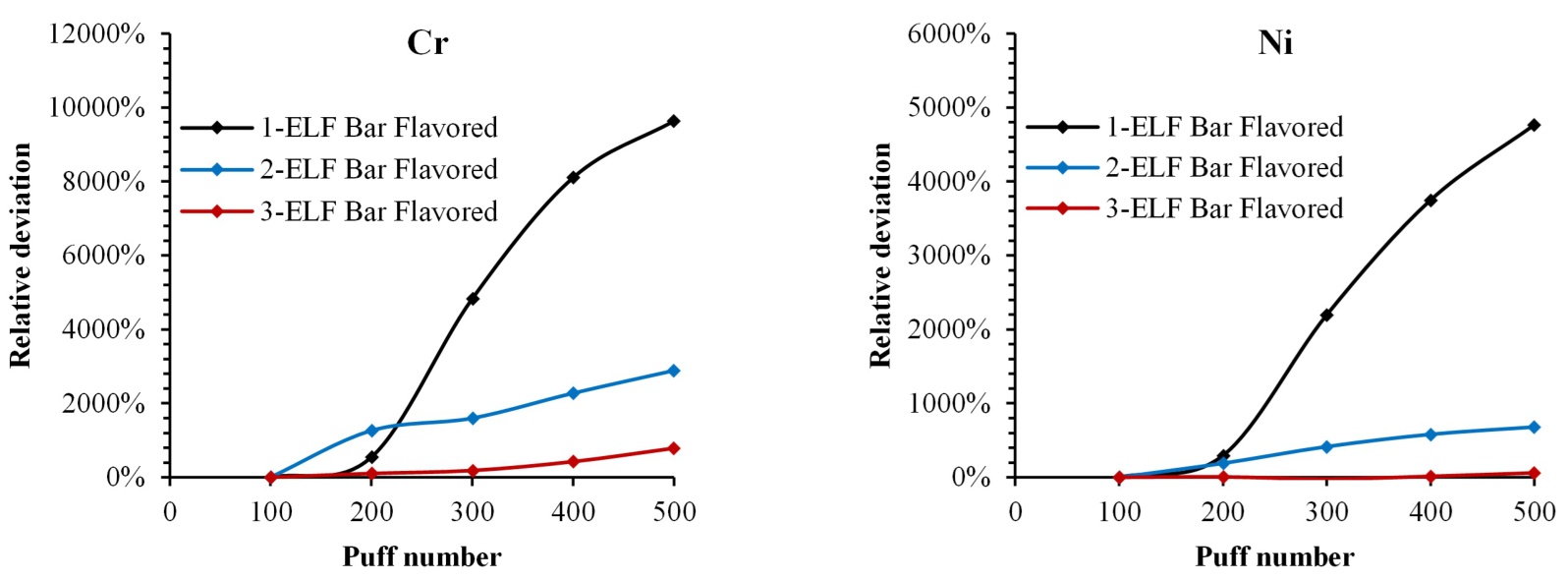
Figure 3.
Relative deviation from initial quantities of Cr and Ni versus puff number for three ELF Bar devices (re-analysis of Salazar et al. (1)). Divergence between replicates with puff progression indicates non-stationary behavior and end-of-life variability.
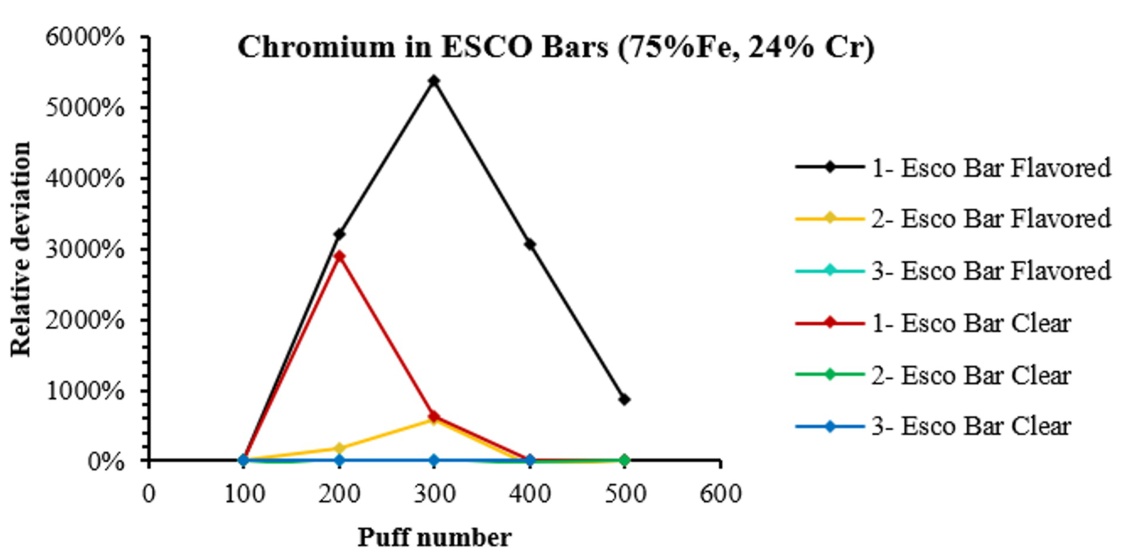
Figure 4.
Relative deviation from initial quantities of Cr versus puff number for three ESCO Bar devices (re-analysis of Salazar et al. (1). The differences between replicates support that device condition and ageing can substantially influence inferred emissions.
Since the release of metal elements also depends on coil temperatures, the data clearly illustrates the difference between normal (low to moderate increase) and abnormal (high increase) behavior. In the case of the ESCO Bar, corrosion of welding points leads to electric defects and should alter vaporization.
Liquid depletion and malfunction: linking end-of-life behavior to changes in metal release and device performance
The authors mentioned the following composition of the alloys used as heating element: Nichrome (Ni−Cr) in the ELF Bar Flavored, Kanthal A (Fe−Cr) in the ELF Bar Clear and ESCO Bar, Stainless Steel 316 (Fe−Cr−Ni) in the Flum Pebble. Notice that the Clear and the Flavored ELF Bars are not the same device despite having identical external design. This information (usually available for refillable devices) is unavailable on these disposable devices. Unfortunately, as far as we are aware, it seems that manufacturers provide no publicly available information on technical data.
Manufacturers normally specify a specific number of puffs the device should be able to deliver, though no description is provided on how they obtained or validated this number. Nevertheless, the authors validated in the tested devices a marked discrepancy between this marketed lifetime puff capacity and the actual puff numbers the devices delivered. Table 2 summarizes the authors’ data on puff number capacity and our estimated puff number count based on the mass of e-liquid vaporized per puff measured during the experiments. The above-mentioned discrepancy (remarked by the authors) is clear.
Table 2.
Comparison between estimated puff capacities and marketed capacities of the products tested by Salazar et al. (re-analysis of Salazar et al. (1)). The gap between estimated and marketed capacities supports that malfunction/end-of-life behavior can occur earlier than assumed, which constrains realistic exposure-duration scenarios.
| Devices | Volume (mL) | Density (g/mL) | Mean (mg/puff) | Estimated puff | Marketed puff |
|---|---|---|---|---|---|
| ELF Bar Flavored | 9.5 | 1.13±0.00 | 7.72±0.99 | 1,391 | 5,000 |
| ELF Bar Clear | 9.5 | 1.13±0.00 | 7.59±0.67 | 1,414 | 5,000 |
| ELF Bar 0% Nicotine | 9.5 | 1.13±0.01 | 8.22±0.79 | 1,306 | 5,000 |
| Flum Pebble Flavored | 14 | 1.13±0.00 | 8.31±0.07 | 1,904 | 6,000 |
| Flum Pebble Clear | 14 | 1.11±0.00 | 8.54±0.69 | 1,820 | 6,000 |
| ESCO Bar Flavored | 6 | 1.14±0.01 | 5.95±1.38 | 1,150 | 2,500 |
| ESCO Bar Clear | 6 | 1.12±0.00 | 4.10±2.67 | 1,639 | 2,500 |
In Figure 5, data from the authors’ Figure S10 (1) was used to display the percentage of remaining mass of e-liquid available in the devices (we used the total initial e-liquid volume in mL declared by the authors). Before puff number 1,000, the three devices exhibit an almost linear decrease of the volume contained in the tank. Visible trends in the Flum Pebble Flavored show a transition from puff 1,200 onwards to another behavior pattern, like that of the ELF Bar Clear and around puff 1,400 for the ELF Bar Flavored. The experiments were halted before this new trend could be examined.
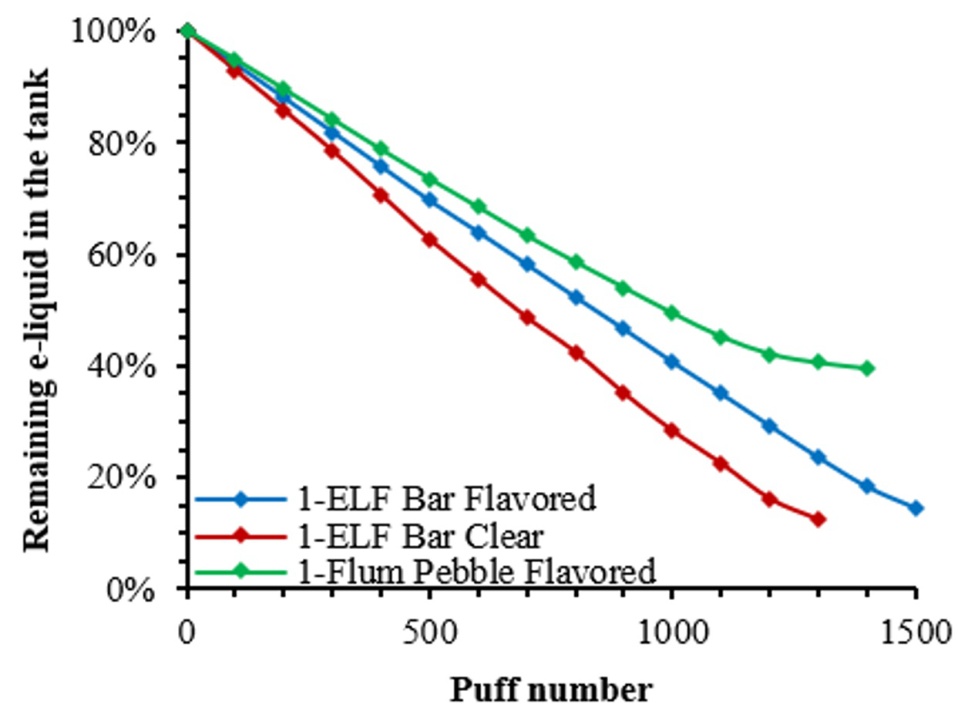
Figure 5.
Percentage of total vaporized e-liquid mass versus puff number for each device (re-analysis of Salazar et al. (1)). The non-constant consumption profile constrains exposure reconstruction and complicates comparisons based on a single assumed “mass-per-puff”.
In the three tested devices e-liquid volume was initially stocked in a porous material (Figure S4.B, Figure S5.B, and Figure S6.F in (1)). Although this fact seems to be marginal, it represents the main difference between disposable devices (whose e-liquid is necessarily stocked in a tank) and open-systems that allow users to control and/or refill of the liquid content. However, for both types of devices there is not much porous material available that is close to the heating systems (Figure S4.B, Figure S5.C, and Figure S6.C in (1)). This means that in disposable systems e-liquid flows through capillarity, whereas the flow is gravitational in open systems. Consequently, the e-liquid depletion process is different in each case: it occurs from the top to the bottom of the tank in open systems, whereas it goes from the inside to the exterior in disposable systems.
The effects of e-liquid depletion were examined in the studies by Belushkin et al. (22) and Jameson et al. (23) in terms of the notion of the “end of life” of vaping devices. Both articles found (as Salazar et al. did) an almost linear decrease in the volume capacity in the first few hundred puffs of several devices. However, as opposed to Salazar et al., Belushkin et al. and Jameson et al. tested open systems and cartridge pods beyond the linear trend and noticed the shift – initiated in Figure 4 of Salazar et al. – that illustrates a second regime in which the mass of e-liquid vaporized decreases, causing the tank depletion to slow down. In both articles this transition is correlated to an increase in the release of formaldehyde, the main aldehyde they reported. This effect is more pronounced in cartridge devices than in open systems, thus suggesting an effect of the difference of design.
To the best of our knowledge, the “end-of life” notion used by Belushkin et al. and Jameson et al. has not been investigated in disposable devices, whose tank is filled with a porous material (notice that Salazar et al. ended the experiments earlier and did not target aldehydes). However, we can reasonably assume that a similar effect occurs in disposables as the e-liquid is systematically drained to the wire.
Under these conditions the extension of the linear trend behind the estimation of Table 1 is no longer justified above the transition, with puff number capacity possibly reaching higher values.
As the e-liquid level becomes insufficient, less e-liquid reaches the wire to keep the heating surface wet. The boiling process is less efficient along the surface, which becomes drier and favors overheating of the wire, which in turn favors the heating of dry fibers close to the wire and the vaporization of e-liquid further inside the cotton. This process sustains the capacity to generate an aerosol, but its chemical composition will change because e-liquid ingredients are bound to be overheated, leading to the enhancement of aldehyde production (as observed by Belushkin et al. (22) and Jameson et al. (23)). Once the e-liquid is overheated, the resulting aerosol becomes contaminated with by-products from the pyrolysis of the cotton fibers, a degradation amplified by the decrease of the remaining e-liquid volume. The second part of the depletion curve should be avoided as it significantly increases consumer risks.
Salazar et al. should have investigated the full end of life of all tested disposables. It would have been very useful to offer a comparison of e-liquid depletion with other types of vaping devices and even to infer how manufacturers might have determined the marketed puff capacity.
CROSS-PRODUCT COMPARISONS: WHY YIELDS AND EXPOSURE SCENARIOS ARE MORE RELEVANT THAN LIQUID-BASED CONCENTRATIONS
Salazar et al. included in their article a comparison of their results on metal elements in the aerosols with data from other studies in literature. Although this comparison is valuable, their methodological approach leads to an inaccurate interpretation.
Why “µg/kg vaporized e-liquid” misinform: the need to compare mass yields and exposure
Figure 3 compares at different puff numbers the values reported by Salazar et al. with values reported in the literature, expressing metal content in terms of µg/kg of e-liquid vaporized. However, these units are inaccurate and thus fail to represent the actual phenomenon of metal release. Figure 6 compares the same results: mass of Nickel released by the two ELF Bars (Clear and Flavored) and Flum Pebble Flavored in different ways. Figure 6.a displays the concentration in the vaporized e-liquid, whereas Figure 6.b only reports the metallic masses released. To stress the inaccuracy of the comparison, the SMOK at 120 W from (20) was added assuming 25 mg per puff (though this information is not disclosed). In Figure 6, the ESCO Bar devices show the highest concentrations, which are significantly above that of the SMOK at 120 W. However, when comparing the yields of released quantities, the SMOK shows the highest value, far above those of the ESCO Bars. In practice, this inaccuracy of the comparison by Salazar et al. leads to misinformation about the risks involved between the different products.
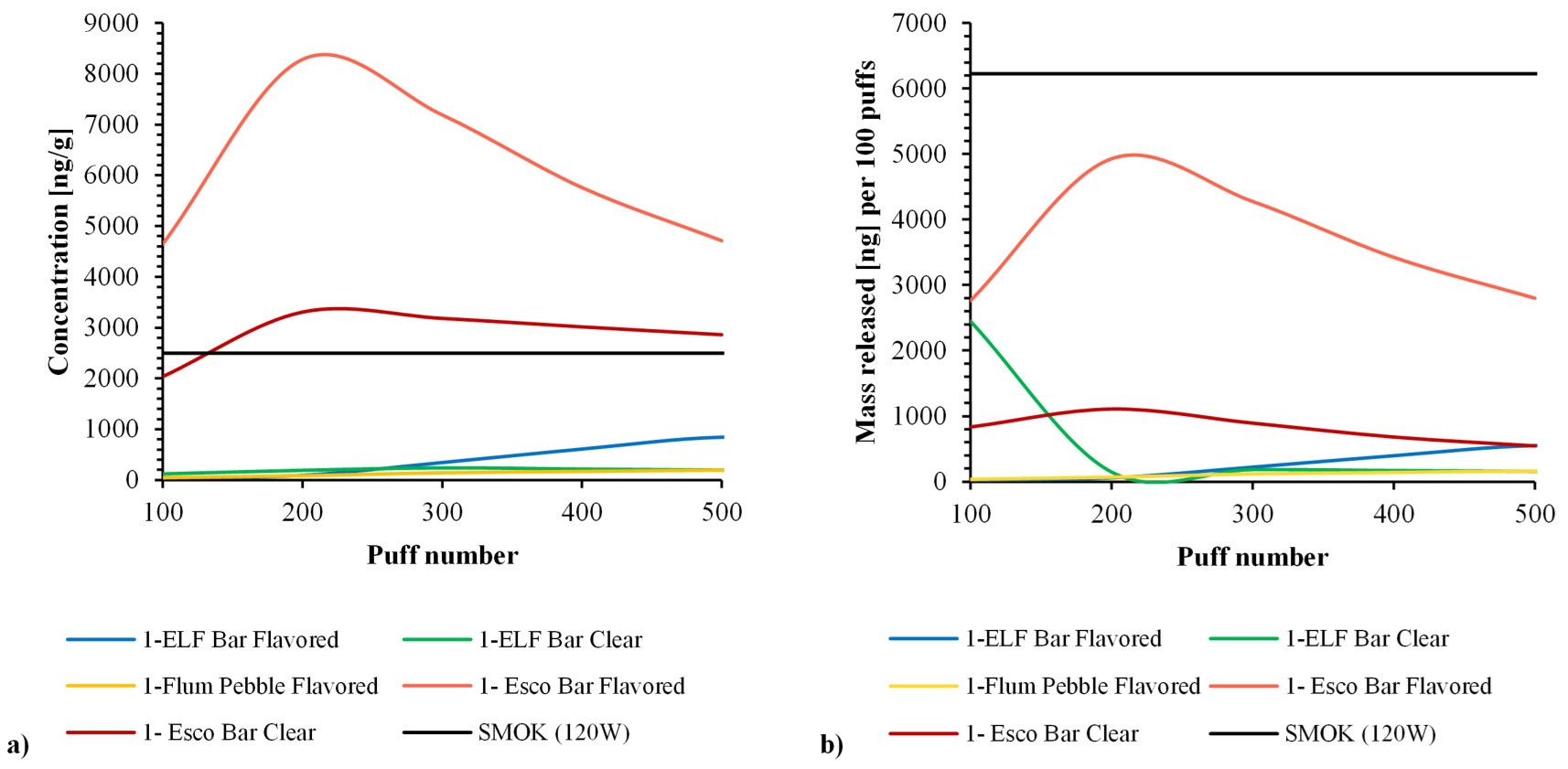
Figure 6.
Comparison of interpretation of metal released expressed in liquid concentration or in mass released (without information from Zhao et al. (20), SMOK mass of e-liquid vaporized is assumed at 25 mg per puff at 120 W). The same underlying dataset can support different conclusions depending on whether results are interpreted as concentrations or as emitted mass yields.
The comparison between products results in a ratio affected by two types of variables: storage time and temperature. For elements correlated to heating alloys, the expression is relevant as the increase of the coil temperature increases the mass of e-liquid vaporized and the mass of element released. Consequently, the ratio remains almost constant under optimal conditions and the comparison between products is useful to investigate the transfer coefficients using different alloys or conditions (nucleate vs film boiling). For other elements like Pb that are correlated to corrosion, the release in the liquid before its vaporization dilutes the masses measured in a volume not correlated from the device operation.
Consequently in this case, the ratio is no longer significant and the comparison between products becomes inaccurate, as it does not involve the storage time that is the key parameter of corrosion. From these fundamental considerations, concentrations µg/kg are inappropriate for toxicological comparison since its relevant values remain in the inhaled quantities. As shown in Figure 6, higher concentrations in aerosol do not imply a larger inhaled quantity and therefore it misrepresents the risks involved in the different devices.
Open high-power systems: contextualization requires operating regime and mass-per-puff information
The study by Zhao et al. (20) was criticized in a previously published review (2) for its testing of devices at power levels above the manufacturer’s recommendations, a testing clearly conducted under certain overheating conditions. The SMOK tested by Zhao et al. (with coil TFV8-Baby, 0.6 Ω, stainless steel coil) is a high-powered device recommended to be puffed in the power range from 40 W to 60 W. It is designed for the “direct-to-lung” inhalation vaping style that involves a deep inhalation with a high airflow rate. Yet, Zhao et al. gave limited consideration to these specifications and tested this device at 40W, 120W, 200W, applying an insufficient (thus inappropriate) airflow rate of 1L/min that is also unrepresentative of consumer usage.
Therefore, averaging the metal yields of a SMOK without recognizing it was puffed under such unrepresentative conditions leads to a biased comparison by Salazar et al. To convert the concentrations that Zhao et al. reported in terms of released mass, we arbitrarily estimate the missing information on the mass of e-liquid vaporized (MEV) of other high power devices (24); SMOK 40 W = 15 mg per puff, SMOK 120 W = 25 mg per puff and SMOK 200 W = 35 mg per puff. It should be acknowledged that these MEVs are probably underestimations of the real MEV and thus result in underestimated quantities of the metallic elements. Figure 7 summarizes the values of released masses from this estimation.
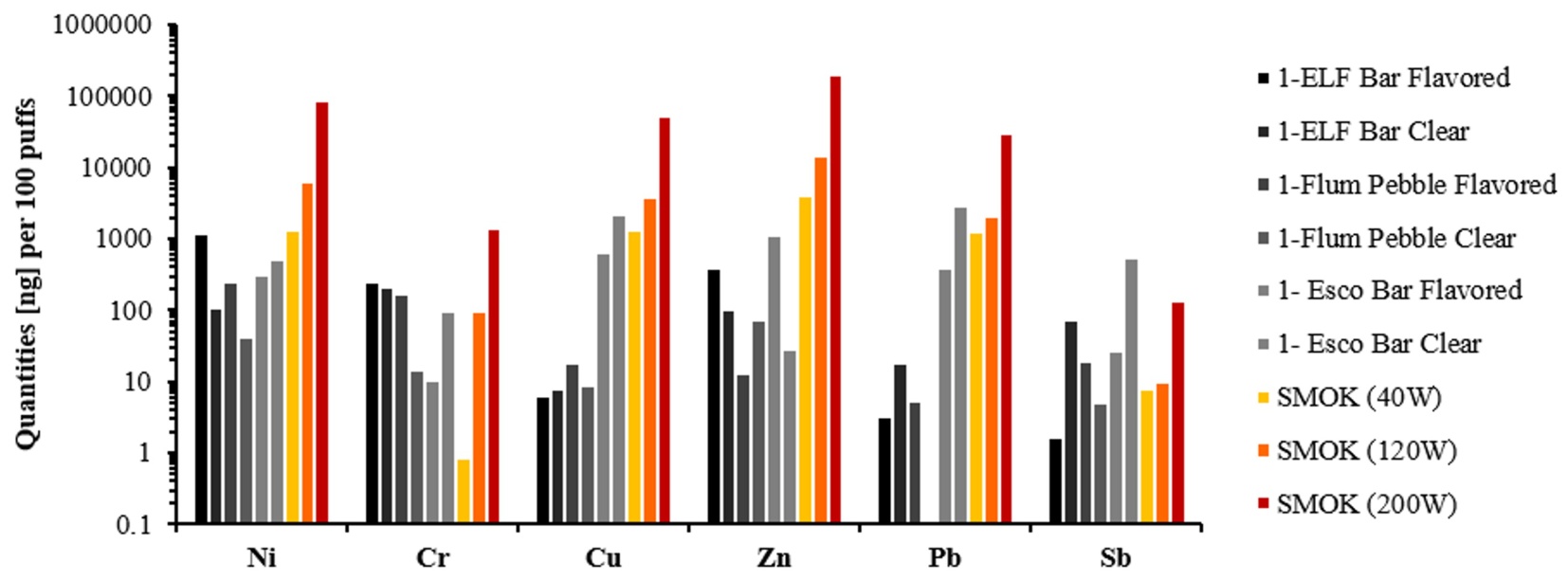
Figure 7.
Mass yields of released elements in the disposable products (re-analysis of Salazar et al. (1)) compared with SMOK results reported by Zhao et al. (20). Expressing results as yields improves interpretability for contextualization, while emphasizing that operating regime alignment remains necessary for strict comparisons.
The interpretation of this figure is significantly different from that of Figure 3 of Salazar et al. The figure shows how the SMOK at 120 W and at 200 W strongly deviates from the values for other devices, an expected consequence of the overheating conditions of the experiment of Zhao et al., which necessarily involved excessively high temperature above the boiling point of the e-liquid, all of which implies a comparison of very different conditions. We remark that the ELF Bar Clear at 1,200 puffs and Flum Pebble Flavored at 1,000 puffs reached chromium yields closer to those of the SMOK at 120 W, thus suggesting a high likelihood that these yields were obtained under similar overheating conditions (coils of these devices like those of the SMOK are made of Nichrome (nickel and chromium) as heating elements (20). Since the µg/kg values do not compare with exposure per puff, the interpretation is significantly different.
Closed low-power systems: separating storage-driven baseline from operation-driven release
Closed systems that are not disposables, such as the JUUL, can be used for comparing the results of Salazar et al. in the opposite low powered side of the comparison with Zhao et al. For comparative purposes the results of Blu, Logic, Express (Menthol and Regular) from Gray et al. (8) provide relevant information on initial corrosion of devices containing brass. Indeed, the article of Gray et al. (8) provides valuable results of fresh and old devices of cartridge devices. Their results of Cu, Zn, Sb, and Pb are integrated in Figure 8.
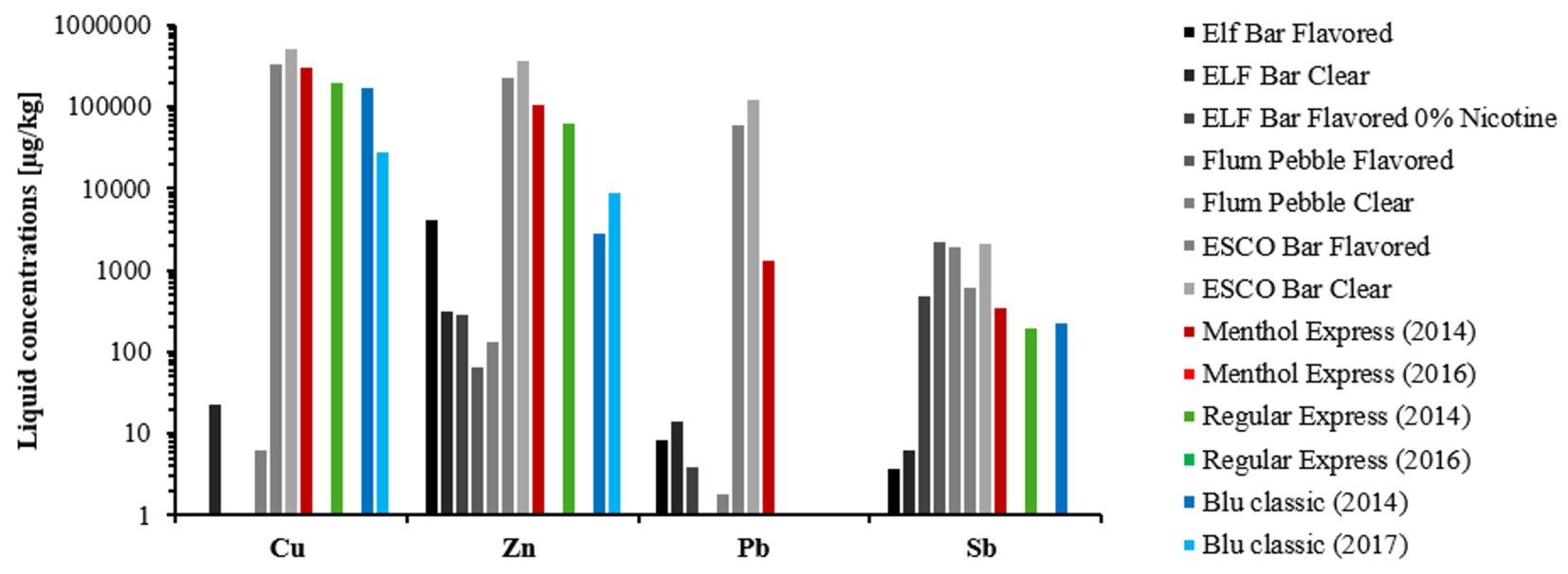
Figure 8.
Initial concentrations of released elements in the disposable products (re-analysis of Salazar et al. (1)) compared with new and old devices from Gray et al. (8). Overlap with “old device” conditions is consistent with storage-time effects and baseline contamination contributing to measured levels.
Cu, Zn and Sb of devices bought on 2014 reach the level of ESCO Bar whereas newer devices exhibit far lower quantities (mainly not quantifiable), suggesting that the ESCO Bar initial state is closer to the old devices. ELF Bars and Flum Pebble devices show Cu, Zn and Pb significantly lower than the old devices but the quantities were determined above the limit of quantifications. It can be pointed out that results from Williams et al. (17) also highlight similar levels of Cu and Zn for eight devices (unused) stocked over five years but the missing information from fresh e-liquids limits the interpretation of storage time on corrosion. In that situation, we suspect that the devices were not fresh but also stocked during a shorter time than the ESCO Bars.
The combination of all our inferences on long-time storage raises the same concern on closed systems in general (pods and disposables), as they are manufactured with a tank (cartridge or not) filled with e-liquid, which (pending on storage time) initiates a chemical interaction between alloys and e-liquid that remains active throughout the full storage time. Consequently, the toxicological evaluation of devices sold on the market has important limitations without precise information on the manufacturing date and the storage conditions. The results of the study by Salazar et al. on the ESCO Bars support our inference that the devices were probably older than the other tested products.
On another aspect, close system comparison is valuable for the generation of different elements during their operation. Figure 9 provides the results of the CD1 (Blu, cigalike) and CD2 (JUUL, Pod) from Zhao et al. (20) and others disposables devices and JUUL devices obtained from Talih et al. (25).
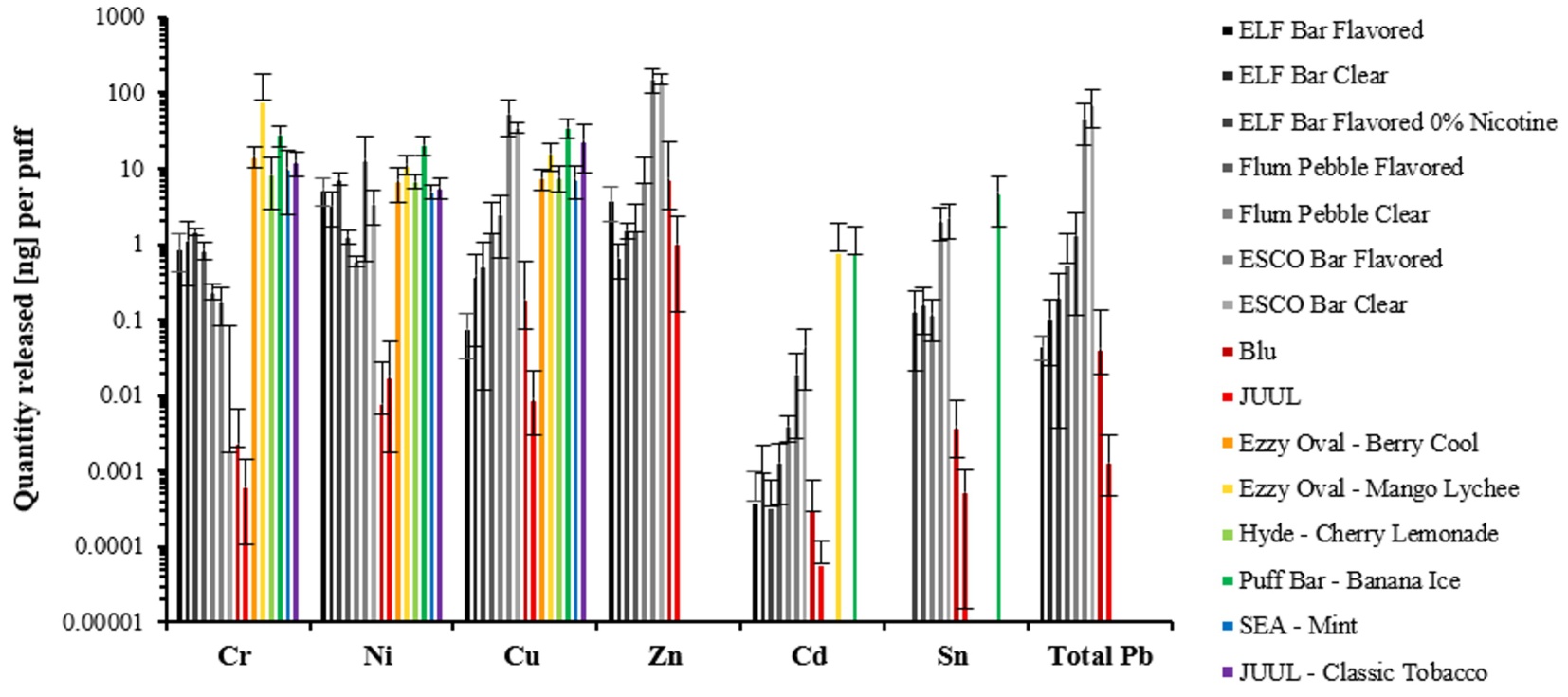
Figure 9.
Mass yields of released elements in the disposable products (re-analysis of Salazar et al. (1)) compared with results from Zhao et al. (20) (MyBlu and JUUL) and from Talih et al. (25) (Ezzy Oval – Berry Cool, Ezzy Oval – Mango Lynchee, Hyde – Cherry Lemonade, Puff Bar – Banana Ice, SEA – Mint, JUUL – Classic Tobacco). Error bars are deviations between same samples.
Results from Zhao et al. show significantly lower Cr, Ni and Cu released by Blu (multi flavors) and JUUL (multi flavors including tobacco) whereas data from Talih et al. provide similar masses (Zn was not quantified) obtained using both disposable and reusable devices (JUUL tobacco). The significant differences between the JUUL samples also question on the storage conditions and show that strict interpretation carried on a close device is challenging. Nevertheless, close devices exhibit similar levels of nickel and chromium released per puff certainly due to their nichrome coils.
Based on these nickel and chromium results, it is evident that corrosion of heating elements occurs during operation. However, these elements are also released in passive conditions and the identification of the intrinsic risks induced by optimal heating conditions is challenging. The main outcome of this operating comparison is that disposable devices exhibit significant quantities of nickel and chromium release.
Comparison with cigarettes: what is (and is not) supported when devices start from malfunctioning baseline states
As previously pointed out, Pb values found in the ESCO Bar devices were not obtained from operating them in the puff sequence, but from their initial contamination from storage conditions. The comparison of Pb yields of the ESCO Bar and Pb yields in tobacco smoke illustrates how the deterioration of long-time stocked products (as in these devices) leads to an aerosol with sufficiently large cumulative Pb mass to be comparable with the Pb mass yields in the smoke of 19 packs of tobacco cigarettes. However, this concerning comparison is supported by initially deteriorated vaping devices; fresh disposable devices would result in a different interpretation. Figure 10 reports the equivalents packs of cigarettes determined by Salazar et al. (Table S13.3 in (1)).
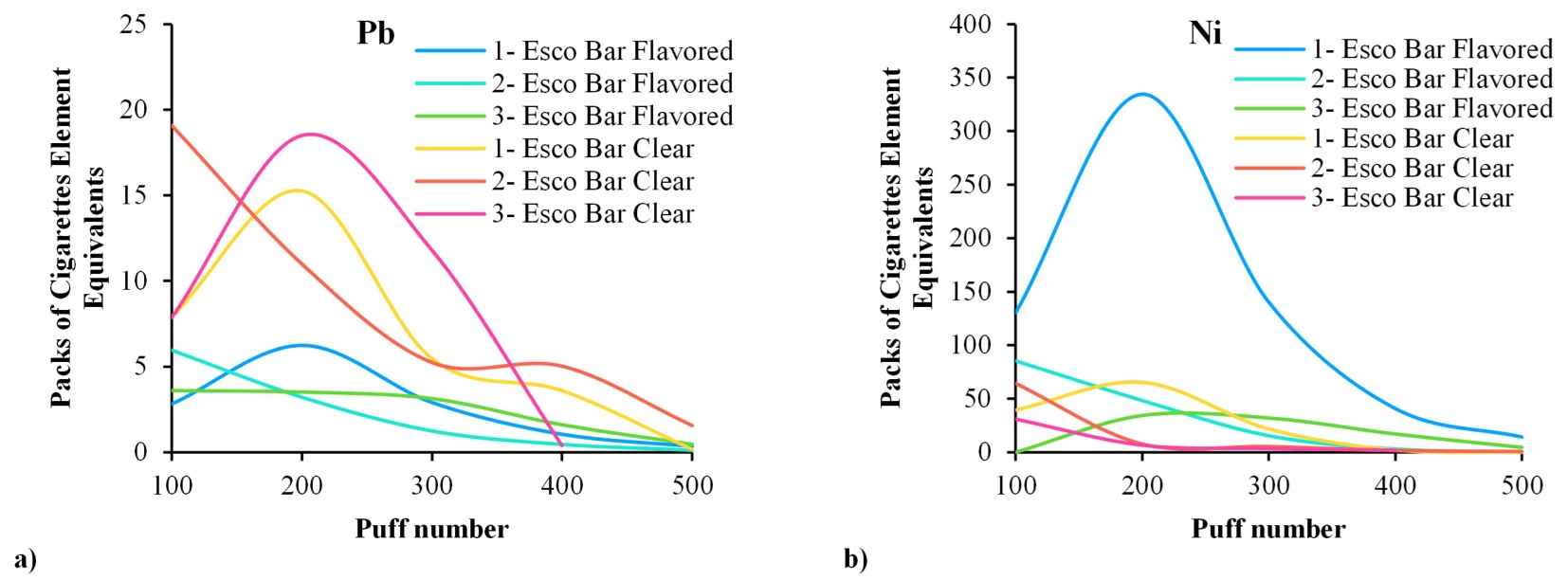
Figure 10.
Evolution of “equivalent cigarette packs” estimated from Pb and Ni released per 100 puffs for ESCO Bar devices (re-analysis of Salazar et al. (1)).
The trends displayed in the Figure 10 show how the comparison to classical cigarettes is not supported when a device is operated under deteriorated initial conditions. The cigarette pack equivalents of nickel and lead mass yields converge to zero as puff numbers approach 500, despite the visibly high values reaching around 200 puffs. We notice a 93±5% reduction in the lead release from 100 puffs to 500 puffs (Tables S10–11 in (1)). This pattern illustrates that after accumulated metal elements are transferred to the aerosol, the normal operation of the devices results in significantly lower release of these elements. This comparison would show a completely different pattern if applied to fresh devices.
Additionally, had the ESCO Bar Flavored and Clear correctly operated until 700 and 1,000 puffs (estimated earlier), the displayed long-term convergence at higher puff numbers would have most likely produced significantly lesser Pb and Ni yields, though (as observed in the other devices) the exposure scenario in the first days of use (0 to 300 puffs) would be different from the following days (300 to 600), itself different from the last days (600 to 900).
The comparison of Salazar et al. between Pb yields in the ESCO Bar and in tobacco smoke restricts the comparison to a unique element. Intriguingly, the reference used for the comparison provides more data on As, Ni, Cd, Cr (but all respective quantities are below LOQ). Arsenic, which has a lower Minimal Risk Level (MRL) than Pb, is released in larger quantity in classical cigarettes than in the ESCO Bar devices, so a comparison on these metals would highlight an opposite comparative result to that of Pb.
On a more rigorous toxicological approach, the comparison should be based on the hazard quotient or on the cancer risk calculation that requires to include all the hazardous compounds and their reference values, otherwise only quantities are compared and not products. In this context, it is important to stress that over 69 carcinogenic compounds have been identified in tobacco smoke (see the list in Table 4.4 of (26)).
Finally, focusing on a single compound (Pb) on assessing cancer risk from smoking misinforms the readers, as specialized references (25,26,27) identify low molecular aldehydes (like acetaldehyde) among the most important (and abundant) compounds behind smoking risks. Therefore, the claim that Pb mass yields in the ESCO Bar emissions is equivalent to Pb yields from smoking 19 packs of cigarettes is irrelevant when the same mass yields of aldehyde would follow from only 1–2 packs of cigarettes.
RE-ANALYSIS OF TOXICOLOGICAL INDICATORS: CORRECTED CONCENTRATIONS, ADJUSTED EXPOSURE FACTORS AND SCENARIOS
As discussed in previous sections, the quantification of released metal elements is influenced by storage conditions in closed systems, operating conditions and “end of life” identification. These factors act in combination and complicate a toxicological assessment, possibly leading to risk overestimation.
Non-heating element and storage pathways: hypotheses consistent with observed metal profiles
The Cu, Zn, and Pb aerosol mass yields in the ESCO Bar devices do not reflect normal operating conditions since the accumulated release is observable. As noted in published literature (8, 17, 18), this is a problematic issue specific to non-refillable devices and highlights the fact that the date of manufacture and an estimated time scale of optimal operation should be required specifications in the products labelling.
Given the absence of this information, a consistent interpretation of inter-product comparisons between unregulated disposables is very likely to be limited to aged devices, since large metal yields surpassing toxicological markers are much less likely to occur in fully regulated fresh products subjected to quality control. However, some short-term storage necessarily occurs between manufacture and selling points and from consumers maintenance habits, hence in closed systems some level of deterioration is unavoidable from the fact that e-liquid and metallic parts of the devices are in contact from the manufacture date. Corrosion involves mass loss that favors device malfunction, this fact applies particularly to Pb used in welding points between heating and brass metals. This is the most plausible explanation of the malfunction of the ESCO Bar devices at puff numbers well below their capacity.
Figure 11 displays the average mass of e-liquid vaporized each 100 puffs of the 7 devices tested, determined using the element concentrations (Table S3 in Salazar et al.), element masses (Table S11 in Salazar et al.).
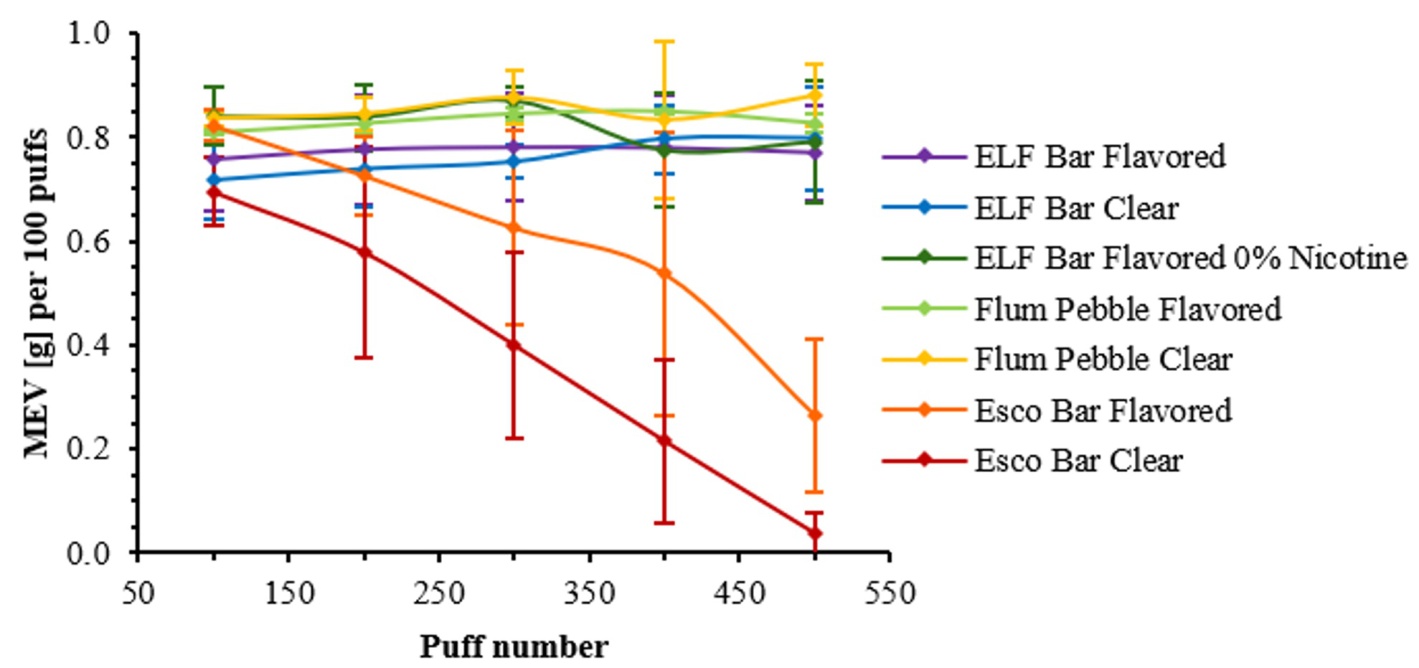
Figure 11.
Masses of e-liquid vaporized per 100 puffs determined by multiplying element concentrations (Table S3 in (1)) and element masses (Table S11 in (1)) for the seven devices tested in triplicate. Error bars are deviations between same samples.
Of the seven devices tested, the ELF Bar and the Flum Pebble exhibit relatively constant e-liquid consumptions over 500 puffs. This observation is connected to sustaining constant voltage and consequently constant power, all of which leads to an almost repeatable vaporization over the puffs. Salazar et al. pointed out the device malfunction of the ESCO Bar devices occurring after 300 puffs (28). The curves of e-liquid mass vaporized support the observation that the ESCO Bar devices were probably malfunctioning from the first puffs. Together with the corrosion induced by storage, batteries are also subjected to self-discharge, which induces a loss of capacity (≈8% per month for Li-ion batteries) (29). This affects the performance of the device in vaporizing e-liquid, with this loss of energy leading to mass of e-liquid vaporized (MEV) dropping as puffs proceed. At 400 puffs the ESCO Bar devices might become discharged even if sufficient e-liquids remained in the tanks. In practice, these malfunctions suggest the occurrence of technical problems not related to the device operation, but to the deterioration of the wire and the batteries from long term storage resulting in electric deficiencies, thus leading to decreasingly generated aerosol, which is likely also degraded by overheating. Puffing such aerosols over 500 puffs would hardly be pleasurable for a user.
The early malfunction described above implies that any average concentration of exposure up to 500 puffs is necessarily an overestimation. This is especially noticeable in the average up to 500 puffs for the ESCO Bar Clear and Flavored, since their metal yields (Figure 3 of Salazar et al.) reach a maximal average between 100 and 300 puffs and rapidly drop between 400 and 500 puffs, hence the average at 500 puffs assigns excessive weight to the highest values and negligible weight to the minimal ones. This bias is illustrated by Figure 12, where the trends of puff capacity and Pb and Ni released have been extended.
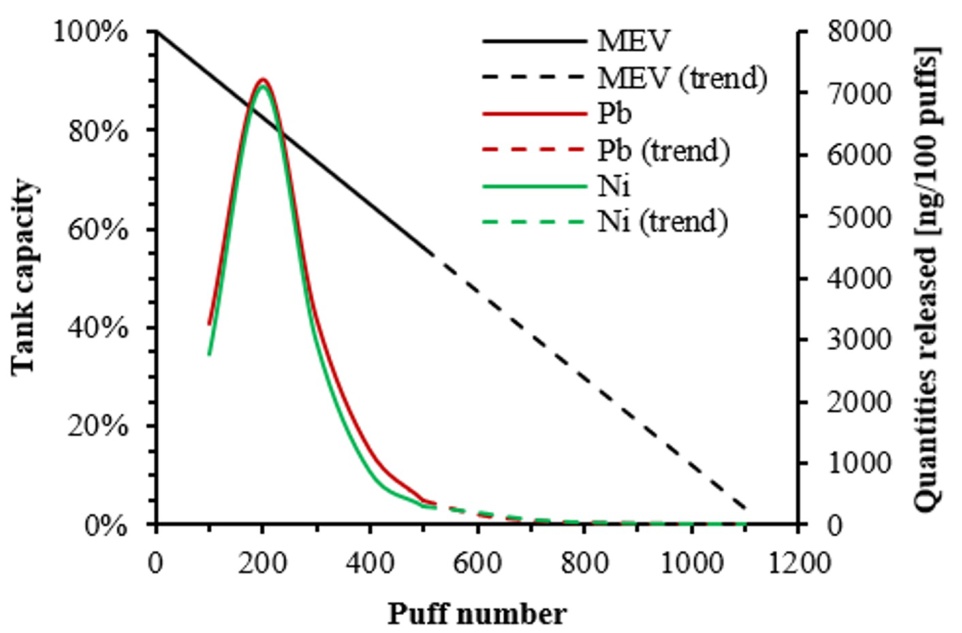
Figure 12.
Puff-course of Pb and Ni release versus puff number for device 1-EscoBar Flavored (re-analysis of Salazar et al. (1)). Distinct dynamics for Pb and Ni are consistent with different source terms, with Pb more influenced by baseline conditions and Ni more influenced by operation.
As is clearly observable, a maximum puff number would have reached around 1,100 in a correct device operation (without its malfunction), with metals yields between 500 puffs and 1,100 puffs closer to zero. Focusing only on the “0–500 puffs” range biases the resulting average concentration and gives more weight to the highest released quantities.
The main outcome from this bias is an interpretation of toxicity limited only to the puff range with highest yields, likely distinct from an average based on the full device lifetime.
The determination of an average daily concentration to characterize exposure obviously depends on the number of puffs considered and the range on which they are selected. In the case of the ESCO Bar devices their early malfunctions, which forced the early premature end of the experiments, fix a random number of puffs to be considered. In the case of a “0–500 puffs” range, concentrations are 2,800 for Ni and 3089 for Pb higher, whereas they would have been 90 and 92 times higher for the assumption of a “500–1100 puffs” range and 1300 and 1427 higher for “0–1100 puffs” range assumption (the all-life of the products).
We thus emphasize that the use of “0–500 puffs” concentration ranges in toxicological assessment is restricted to malfunctioning devices and cannot be extended to the same devices or as an upper limit of risks from the ESCO Bar devices.
Exposure scenarios and toxicological reference values: aligning intermittent vaping with inhalation guidance
The hazard quotient and Cancer Risk assessments carried out by Salazar et al. is based on the Agency for Toxic Substances and Disease Registry (ATSDR) guidance for inhalation exposure (30).
With Cpuff the average concentration of exposure over a puff; TRV, the toxicological reference value for inhalation; IUR, the inhalation unit risk and EF, the exposure factor. In case of Salazar et al., this factor has been implicitly assumed at 1 and Cair determined by reporting the “10-puffs” quantities by the daily volume inhaled (20 m3). Based on ATSDR guidelines, concentration would have to be determined by reporting these quantities to the volume of exposure around 50 L (100 times a tidal volume of 0.5 L). Then, EF would weigh these concentrations by considering the time of exposure: 3 s per puff, 100 puffs per day. In that case, EF = 0.00347 and takes care of the discontinuous consumption of vaping products whereas Cair/20 m3 implicitly assumes a volume weighting of 50 L/20 m3 = 0.0025.
Also based on ATSDR guidelines, acute exposure is a short-term exposure assumed to be below two weeks, intermediate exposure is between two weeks and a year and chronic exposure is long-term exposure exceeding a year. Since the puffing capacities of the tested devices are below 1,500 puffs and Salazar et al. assumed a daily consumption of 100 puffs, the devices would be necessarily empty two weeks after the first puffs. The use of intermediate or chronic MRLs is not representative and of limited interest, unless the authors assume that users may daily puff the same devices during many years. In practice, a more realistic risk model scenario should consider information on the variability from a representative sample of available devices (certainly more than just seven devices). In particular, since the toxicity of initial e-liquid is strongly influenced by storage conditions, extrapolation to intermediate or chronic scenarios implicitly assumes that users would not be able to perceive sensorially the defectiveness of the devices, thus a user of any of the tested ESCO Bar devices may persist in using (and paying for) a product that malfunctions and thus is clearly unsatisfactory (a counterfactual assumption that is very hard to believe). These are important unacknowledged limitations of toxicological modeling followed by Salazar et al., which lead to over-estimation of non-cancer and cancer risks.
Finally, the lack of uniformization of toxicological reference values has forced Salazar et al. to compile data from different public agencies, such as ATSDR, U.S. Environmental Protection Agency (US EPA) and Office of Environmental Health Hazard Assessment (OEHHA) and National Ambient Air Quality Standards (NAAQS). US EPA defines reference concentrations (RfC) for a lifetime exposure whereas OEHHA defines Reference Exposure Level (REL) for acute (1 h), 8-h (which can be repeated) and chronic exposure designed to address continuous exposures for up to a lifetime. While the design of reference values differs among agencies, their specific selection is also a delicate issue. Considering the lifetime of the tested devices, acute MRL and intermediate REL are more appropriate references, while the RfC should be extended to account of acute to intermediate exposure. Although the extension to chronic exposure can be (in principle) performed once representative device variability is known, the verified malfunctioning operation of the devices tested by Salazar et al. (particularly the ESCO Bars) questions a risk model based on their long-term use.
Despite being questionable, most considered elements have chronic reference values and not necessarily acute ones. Therefore, in the following subsections, the chronic scenario is assumed relevant and acute scenarios discussed when possible. For this purpose, chronic scenario assumes a 5-year consumption of these devices among the 78 years of a lifetime (EF = 5/78 = 0.00023) whereas for acute exposure EF = 0.00347). Hazard quotients of each device are provided in Supplementary Material I and Cancer Risks in Supplementary Material II.
Impact of experimental duration and averaging window on HQ estimates
Figure 13 reports the hazard quotient to nickel using ATSDR acute MRL (< 2 weeks) for the seven devices (full data or 0–500 puffs data) applying EF = 0.00347.
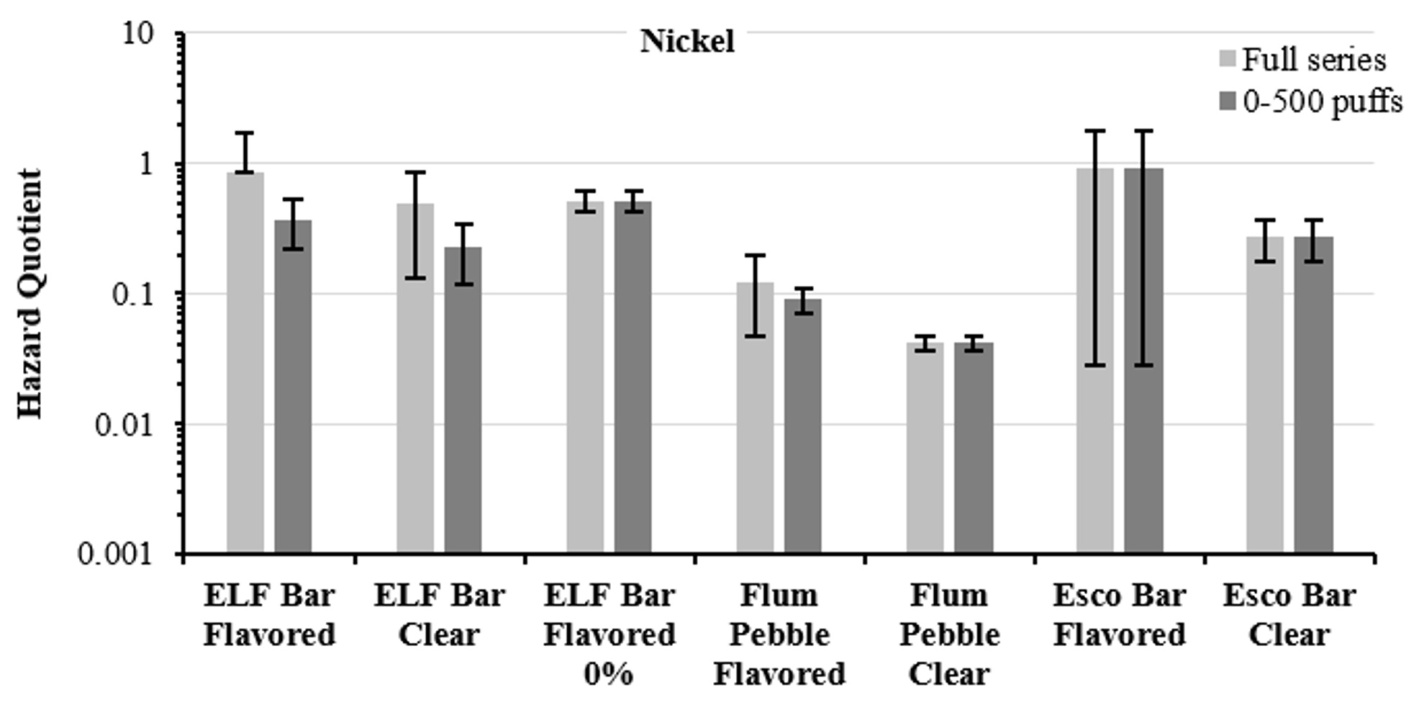
Figure 13.
Hazard quotient estimates for nickel under a 2-week scenario (re-analysis of Salazar et al. (1)). Short-duration scenarios can shift the apparent drivers of HQ, particularly when restricting to early puff windows (0-500 puffs). Error bars are deviations induced by average concentrations used.
As pointed by Figure 14, hazard quotients of one ELF Bar Flavored, one ELF Bar Clear and one Flum Pebble Flavored have been affected by the long experiments induced by the continuous use of these devices until the ends of their functioning. The important quantities measured, previously discussed, significantly increase the hazard quotients leading to values above 1 only considering the maximal possible error dispersion. Focusing on the “0–500 puffs” range, these quotients have decreased by 79% for ELF Bar Flavored, 88% for Clear, and 46% for Flum Pebble Flavored.
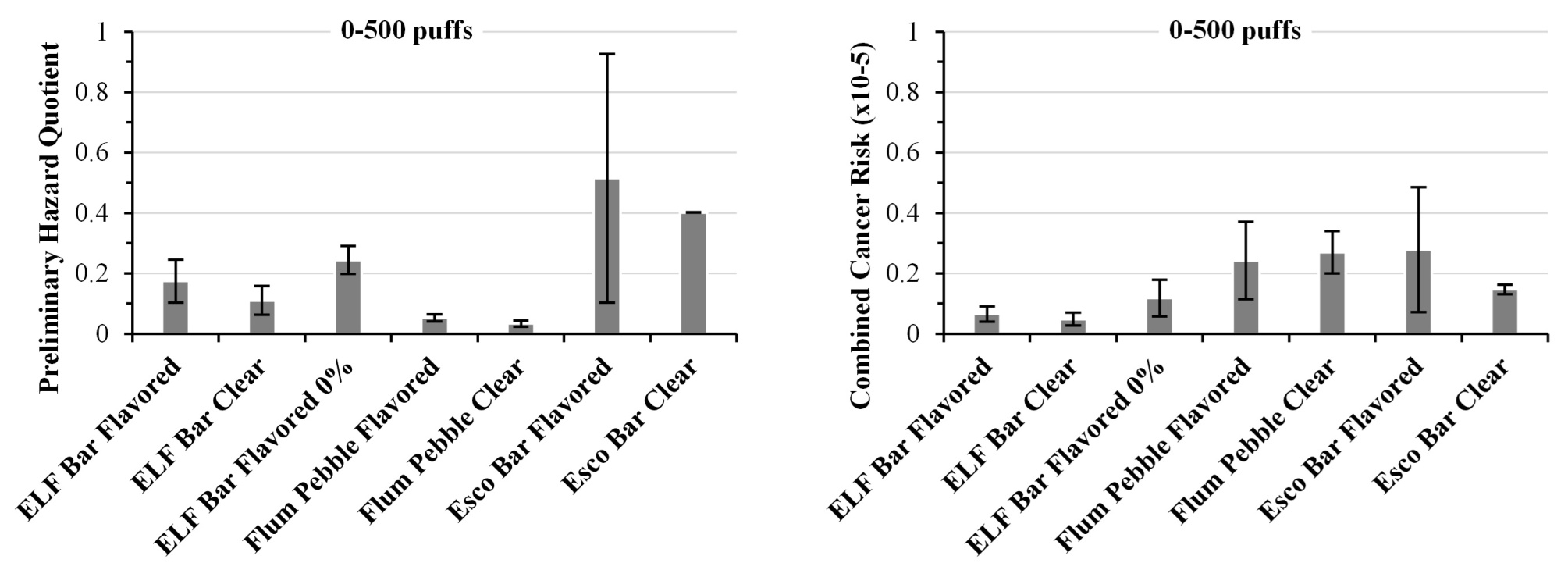
Figure 14.
Preliminary hazard quotient and combined cancer risk estimates restricted to the 0–500 puff window (re-analysis of Salazar et al. (1)). Restricting the window changes combined indicators, illustrating the impact of end-of-life behavior on risk interpretation.
Summary of revised HQ and CR: what remains robust across scenarios
Based on the ATSDR Framework for assessing health impacts of multiple chemicals, the five elements can be summoned as they affect respiratory organs (31). A preliminary hazard quotient (pHQ) and a combined cancer risk (cCR) are required to include individual HQ above 0.1 and CR above 10−6. Figure 14 provides the pHQ and cCR of each device averaged by the three samples tested. As pointed out, long experiments affected the HQ and CR. Figure 14 also reports the pHQ and cCR only considering 0 to 500 puffs.
Restricted to 0–500 puffs, the pHQ are below 1 (also valuable if all data are considered). ESCO Bar Flavored has the highest pHQ followed by ESCO Bar Clear due to one ESCO Bar Flavored and its significant contribution in nickel (HQnickel = 0.89) compared to the other ESCO Bars (HQnickel = 0.15±0.05). For the seven devices tested, their cCR are below the threshold.
DISCUSSION
Robustness of the re-interpretation, key uncertainties, and reporting recommendations
This manuscript is a secondary analysis of published measurements. It cannot experimentally verify proposed mechanisms (e.g., specific corrosion pathways) nor reconstruct the full storage, transport and handling history of the tested devices. However, this article is used to discuss the mechanisms of metal releasing using the comprehensive experiments carried out by Salazar et al. (1). Through these data, we raised three main contributions: storage conditions, operating conditions and the end-of-life of the investigated products. Without valuable assumptions, the toxicological assessment for chronic exposure using all the masses measured implicitly considers that all the contributions are unavoidable over years of daily use despite a strong part can be avoided by quality control requirements imposed to manufacturers. Following subsections discuss main implications of this article.
Storage and traceability as primary determinants of baseline metal signals in disposables
Effect of storage conditions has been investigated and evidence of important releasing of metal over time was demonstrated. E-liquid filled in the tank is maintained in contact due to their design. Therefore, alteration of metal induced by e-liquid starts from the first day of manufacturing. For this reason, most of the devices contain metal before the tests (at different levels) which are then released into the aerosol.
By analyzing the abundant experimental data obtained by Salazar et al. in the context of corrosion effects from long-term contact of e-liquids with metallic parts in closed devices, our study extends previous research on this topic, either after long period storage inside the devices (18) or “old” devices tested a year before their testing (8, 17). Our results are also consistent with the findings of a recent study (19) reporting increasing nickel yields due to corrosion in Chinese disposables with nichrome coils when e-liquids containing nicotine lactate salts were used. However, this did not occur when benzoic salts were used. Our results provide a more realistic and broader context to interpret the experiments of Dong et al. (19), which were conducted under unrepresentative conditions (e-liquids placed during 1 week in a chamber at 60 °C), nevertheless its results suggest that nichrome coils should be avoided in closed devices.
Since the devices tested by Salazar et al. are manufactured in China, their transportation to reach local distributors elsewhere with capacity to stock high volumes to sell them should take a long time. Once the devices reach the point of sale they would have already been manipulated several times with high likelihood of lost manufacturing information. Given the high quantities of Pb in the e-liquid of the ESCO Bar devices before the experiments and its malfunction during the test, it is very likely that these devices were incorrectly handled in the process between their fabrication and their acquisition by Salazar et al.
Without information on the production date and of storage conditions, at the very least the manufacturers or retailers should provide the latest recommended date for consumption, a minimal precaution to inform users that consumption after this date poses risks from a long-term interaction between metal elements and e-liquids.
Additionally, variability of the results of testing such devices might be correlated to the storage conditions rather than to the manufacturing variability which should be correlated with the e-liquid composition. Therefore, investigations of metals toxicity without considering the storage conditions do not allow for estimation of a median toxicity induced by median time of storage.
Given their extreme portability, variability and ease of use, an appropriate regulation of disposable devices is very challenging (this issue was mentioned by Block et al. (18)). The products are rapidly changing, with manufacturers constantly modifying their designs. They have already introduced the first innovation in the form of refillable disposables, but so far, they are still not “pluggable”. A second innovation might make them pluggable, a characteristic that would allow regulators to regard them as equivalent to open systems. However, without these extra innovations and without regulation the devices may be necessarily affected by metal release in the e-liquid due to corrosion from long time storage, while environmental issues related to their single use may remain. An appropriate regulation has the potential to ameliorate these problems.
The available regulations specific to metal issues should be considered. For example, the European Directive RoHS (Restriction of Hazardous Substances) (32) and the United States Electrical and Electronic Equipment Compliance Requirements applied on electric and electronic devices (33) aim specifically to restrict lead (0.1% in mass) and cadmium (0.01% in mass) in each alloy that is used. Nickel alloys have demonstrated to produce important quantities of nickel released during the aerosol formation process. The use of Fe−Cr alloys as Kanthal should be encouraged to reduce health concerns. A further requirement is to insulate the electrical connections – which are mainly made of brass – from the e-liquid. These two improvements are also applicable to cartridges and may significantly reduce risks induced by metallic elements.
Comparative toxicity across products: what cross-study comparisons can support (orders of magnitude vs equivalence)
Salazar et al. compared the yields of metallic elements released when testing different devices. However, as we have shown, an aerosol concentration in units (µg/kg) might lead to a problematic toxicological comparison, even if it is commonly applied to metal toxicity. The main variable to consider in toxicological assessments should be the released mass of the analyte, since these assessments are based on time averaged air concentrations. Therefore, in a comparison involving disposables and high-powered open devices the interpretation of outcomes must bear in mind that high powered devices vaporize large amounts of e-liquid. When such devices are puffed under overheating conditions (as the SMOK used by Zhao et al. (20)), they also produce high metal yields that are toxicologically concerning, but this toxicological effect is underestimated when using concentrations (g/kg) because the large metal yields may dilute in the large amount of vaporized e-liquid.
The authors have considered the study by Zhao et al. (20) for comparison with the seven tested disposables. Zhao et al. quantified metal element concentrations from puffing (their “OD2” device) a SMOK TFV8-Q2 0.6 Ω at power levels of 40 W, 120 W and 200 W (scarce information was provided on this quantification). They reported mean and 5–95% range for each power tested (nine times), with their mean values over the three conditions used by Salazar et al. This averaging of average values mixes distinct conditions of aerosol generation, which adds to the criticism that they tested at such high power when the coil is recommended for 40–60 W. In practice, Salazar et al. were looking at the most extreme case examined by Zhao et al., their “OD2” device, to highlight the toxicity of the tested devices (particularly the ESCO Bar), but this extreme case is not a useful comparison because it involves a device that was tested by Zhao et al. under deliberate unnecessary and unrealistic conditions. Salazar et al. would have achieved a more realistic and useful comparison with the other third generation device these authors tested (the “OD1” a device operating at lesser power).
Salazar et al. were also looking for a worst-case scenario in their comparison of Pb in the ESCO Bars and Pb released by a classical cigarette (Figure 3.B in (1)). In their graphical comparison they selected only Pb, ignoring a comparison for Cr, Ni, As, and Cd that are also reported in their Table S13.3. It would have been more useful and informative for the readership to go beyond worst-case scenarios and compare all these metal elements and the other devices besides the ESCO Bar ones. As with the comparison with the “OD2” of Zhao et al., the worst-case scenario comparison with tobacco smoke is not useful, as it involves a device whose initial conditions have (most likely) been affected by its conditions of storage. It is also confusing because Pb is just one of the compounds that defines the toxicity of tobacco smoke.
Toxicological interpretation: sensitivity to exposure assumptions and limits of secondary analyses
From their results, Salazar et al. carried out an assessment of toxicology that is limited in scope. Based on the ATSDR guidelines for inhalation exposure (30), they did not consider exposure factors even regarding the design of the toxicological reference values used. As pointed out, most of the values selected were designed for chronic exposure implying a lifetime scenario. These MRL, REL, RfC and others represent average values, and the frontal confrontation leads to considering the exposure factor equal to 1 (as done in Equations S7–S9 in (1)) meaning an all-life decades long consumption of only disposable devices as those that were tested. This unjustified assumption globally may have overestimated the hazard quotients and the cancer risks index.
In the adjusted scenario we assume that users of disposable vaping devices use them daily up to five years (assuming users aged 16 to 24 years old). Most vaping devices have a usage period restricted to a few years and a supply period that might be extended to few other months or years, meaning that five years is a consistent estimation of commercial life of the products. This is emphasized by the ongoing implementation of regulations applied to these products. On the grounds of these considerations, a choice EF = 1 leads to an inconsistent and not realistic toxicological assessment.
Finally, the long-term approach implicitly considers that users may repeatedly use the same devices. Based on the early malfunction of the ESCO Bar, this assumption is unjustified for at least two reasons. It was shown that e-liquid consumption of these devices was rapidly decreasing over puffs. For users, this means a loss in aerosol perception and may present discomfort. It also means that despite the 2,500 puffs expected to be delivered it may be usable over a maximum of 400 puffs. This second inconvenience implies an important increase in the expected cost for its users. Facing the diversity of disposable products, as pointed by Salazar et al., a user may necessarily change to more efficient available products, thus malfunctioning ESCO Bar devices would be (at best) considered for transitory usage. The same argument applies to the ELF Bar Clear and Flum Pebble Flavored that were tested continuously over 1,000 puffs and exhibited signs of (at least) an onset of overheating conditions.
While actual users of these devices would feel dissatisfaction and thus would discontinue consumption, vaping machines continue operating and releasing such (very likely) overheated aerosol. Given the high metal release from their contaminated initial conditions in the seven tested devices (especially the ESCO Bar ones), it is highly likely that even a one-puff sampling test by a human volunteer at the end of a long-term experiment would rate the machine generated aerosol as unsatisfactory and foul testing. The same considerations apply to the results of Zhao et al. in testing the SMOK device under extreme overheating and inconsistent conditions.
Toxicological assessments are valuable requirements to assess and improve public health, but as specified in the ATSDR guidelines “health assessors must evaluate all relevant human exposure pathways”. Salazar et al. justified their toxicological analysis as based only on the most protective assumptions, but several of their key assumptions used to evaluate non-cancer and cancer risks are inconsistent with ATSDR guidelines, being either extremely unrepresentative (lifetime usage of malfunctioning devices), or simply mistaken (assumption of continuous 24 h per day exposure from vaping).
CONCLUSION
The study by Salazar et al. (2025) provides an unprecedented dataset on the presence of metallic elements in disposable e-cigarettes. We have examined and analyzed this data set from the perspective of a concerning issue that has not received sufficient attention in the scientific literature and regulatory agencies: metallic element yields from corrosion effects that should arise from long-term storage that places e-liquids in contact with metallic parts of single use closed disposable devices, an issue that becomes concerning when these devices are sold in large unregulated markets without any institutional quality control.
Our study based on the careful quantification conducted by Salazar et al. of metals in virgin liquids and aerosols across several popular devices highlights real concerns regarding nickel, chromium, lead, copper, zinc, and antimony. However, our re-examination of these results shows that the highest concentrations observed are strongly influenced by storage and aging conditions inherent to closed disposable systems. The corrosion of metallic alloys in permanent contact with the e-liquid from the day of manufacture largely explains the elevated levels of Pb, Cu, Zn, and Sb detected in the virgin liquids of several devices. In contrast, the increases in Ni and Cr during puffing are more directly linked to the heating alloys, though their release remains heterogeneous and device dependent. Comparisons with tobacco cigarettes or with open-system devices tested under overheating conditions, as presented by Salazar et al., are therefore biased by methodological inconsistencies, including the choice of units and unrepresentative assumptions about device operation.
From a toxicological perspective, the exposure scenarios employed by Salazar et al. (continuous exposure over a lifetime) result in severe overestimations of both hazard quotients and cancer risks, by two to three orders of magnitude. Once corrected for realistic use patterns – discontinuous puffing, limited lifetime of disposable devices, and a maximum consumption period of a few years – the associated risks are substantially lower. In this framework, only Ni (from nichrome coils) and Pb (in some ESCO Bar units) remain matters of concern, but at levels far below those originally reported. These findings stress the importance of applying exposure models adapted to the specificities of vaping products rather than applying very strict risk thresholds under unrepresentative conditions or borrowing frameworks designed for ambient air pollutants.
Methodologically, our analysis highlights several urgent needs for future research. Devices must be tested both in fresh and aged states to disentangle the effects of storage from those of operation. Results should be expressed in harmonized units such as µg/puff or µg/100 puffs, which are directly relevant to exposure, rather than in ratios per kilogram of vaporized liquid that obscure toxicological interpretation. Scenarios of exposure must assume realistic consumer use, including discontinuous puffing, device end-of-life behavior, overheating and user sensory perception (which should be incorporated as a standard in experimental protocols). Without these improvements, risk assessments may continue to oscillate between underestimation and overstatement, limiting their utility for public health.
From a regulatory perspective, current bans focused exclusively on the “disposable” nature of these products and their youth usage have a limited efficiency as manufacturers quickly adapt by offering rechargeable yet still closed systems that might preserve the same technical flaws. A more robust regulatory framework should target the underlying causes of metallic contamination. This includes mandatory traceability of production and expiration dates for pods, compliance with RoHS-type restrictions on Pb and Cd in electronic components, substitution of nickel alloys by lower-emission alternatives such as Kanthal (Fe+Cr), and physical isolation of brass connectors from the e-liquid reservoir. Such measures, equally applicable to cartridge-based systems, would address the root causes of metal release more effectively than generic bans.
It is also useful to note the early reception of Salazar et al.’s study in the “First Reaction” commentary by Olmedo and Gil (2025) (21). While the commentary highlights the potential public health relevance of disposable devices, it discusses the findings largely at face value and provides limited consideration of key methodological constraints, including the likely influence of storage-related corrosion, device malfunction/end-of-life behavior, and exposure-scenario assumptions. In fast-moving policy contexts, such omissions can contribute to overinterpretation of preliminary evidence and complicate balanced appraisal by health officials, researchers, regulators, and the broader public.
In summary, disposable closed systems do present intrinsic hazards due to their design and storage conditions. Salazar et al. have drawn attention to this problem, but their results cannot be generalized to all devices or all usage scenarios (including disposables). The uncritical reception of these findings demonstrates the urgent need for more rigorous scientific standards and for cautious interpretation before translating results into policy. A comprehensive approach – integrating device design, storage dynamics, and realistic exposure scenarios and strict enforcement of the law to prevent adolescent usage – is essential to provide regulators and consumers with evidence that is both accurate and actionable.
Notes
[1] DATA AVAILABLE STATEMENT
The authors declare that the data supporting the findings of this study are available within the paper.
[2] Financial disclosure FUNDING
The author(s) declare that no financial support was received for the research, authorship, and/or publication of this article. Publication fees were covered by Ingésciences.
[3] Conflicts of interest CONFLICTS OF INTEREST
Dr. Soulet is employed by Ingésciences, a private company conducting research and quality control on vapor products without receiving any funding from the vapor industry and without promoting or selling these products. Ingésciences has received public funding from the Nouvelle Aquitaine region and from the European Union. Dr. Soulet has no affiliation with advocacy groups and declares this transparently. Dr. Sussman declares no conflict of interest.
[4] Supplementary material SUPPLEMENTARY INFORMATION
This publication contains supplementary material.