
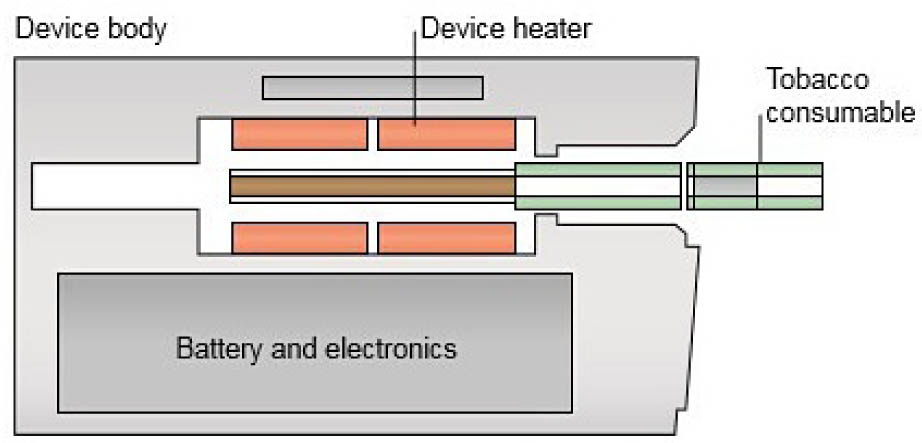
Figure 1.
Diagram of glo™ HTP with a tobacco consumable.
Table 1.
Study design.
| Study day | Study stage | ||||||||||||
|---|---|---|---|---|---|---|---|---|---|---|---|---|---|
| 1 | 2 | 3 | 4 | 5 | 6 | 7 | 8 | 9 | 10 | 11 | 12 | 13 | |
| Visit 1: product/consumption diary allocation | |||||||||||||
| Home placement 1 | |||||||||||||
| Visit 2: puffing topography & product allocation | |||||||||||||
| Home placement 2 | |||||||||||||
| Visit 3: puffing topography & product allocation | |||||||||||||
| Home placement 3 | |||||||||||||
| Visit 4: puffing topography measurements | |||||||||||||
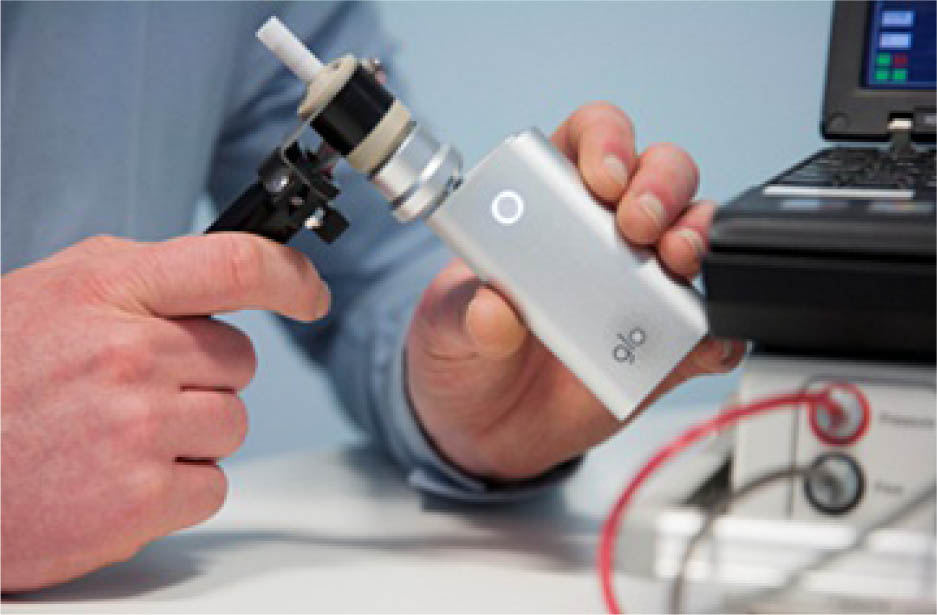
Figure 2.
Image of glo™ attached to the SA7 topography device.
Table 2.
Comparison of puffing topography data among the three consumable variants.a
| Parameter | Variant 1 comparison | Variant 2 comparison | ||||||
|---|---|---|---|---|---|---|---|---|
| Base | Variant | Difference (variant - base) | Statistical equivalenceb | Base | Variant | Difference (variant - base) | Statistical equivalenceb | |
| Puff number | 15.9 ± 8.4 | 16.4 ± 8.5 | 0.53 | – | 15.9 ± 8.4 | 14.8 ± 8.3 | −1.05 | Equivalent (90% CI: 0.86, 0.98) |
| Puff volume (mL) | 58.9 ± 31.7 | 63.4 ± 31.9 | 4.45 | Equivalent (90% CI: 1.01, 1.12) | 58.9 ± 31.7 | 58.8 ± 22.9 | −0.15 | – |
| Puff duration (s) | 2.0 ± 0.9 | 2.0 ± 0.9 | 0.08 | – | 2.0 ± 0.9 | 1.8 ± 0.7 | −0.21 | Equivalent (90% CI: 0.86, 0.93) |
| Puff interval (s) | 10.0 ± 4.8 | 9.7 ± 5.0 | −0.37 | – | 10.0 ± 4.8 | 10.0 ± 5.6 | −0.03 | – |
| Effort (mm WGs) | 500 ± 329 | 526 ± 314 | 26.2 | Equivalent (90% CI: 0.99, 1.15) | 500 ± 329 | 437 ± 279 | −63.4 | Not equivalent (90% CI: 0.80, 0.94) |
Table 3.
Comparison of ADC and MLE among the three consumable variants.a
| Parameter | Variant 1 comparison | Variant 2 comparison | ||||||
|---|---|---|---|---|---|---|---|---|
| Base | Variant | Difference (variant - base) | Statistical equivalenceb | Base | Variant | Difference (variant - base) | Statistical equivalenceb | |
| ADC study product (sticks/day)c | 4.5 ± 3.8 | 4.6 ± 3.8 | 0.10 | – | 4.5 ± 3.8 | 4.6 ± 4.0 | 0.07 | – |
| Total ADC (sticks/day)d | 12.6 ± 6.0 | 12.7 ± 6.0 | 0.03 | – | 12.6 ± 6.0 | 12.0 ± 5.5 | −0.69 | – |
| MLE to NFDPM (mg/stick) | 4.71 ± 1.86 | 5.30 ± 2.52 | 0.59 | – | 4.71 ± 1.86 | 4.59 ± 3.14 | −0.12 | – |
| MLE to nicotine (mg/stick) | 0.30 ± 0.12 | 0.30 ± 0.14 | 0.007 | – | 0.30 ± 0.12 | 0.41 ± 0.28 | 0.112 | Not equivalent (90% CI: 1.05, 1.34) |
| MLE to NFDPM (mg/day) | 22.2 ± 21.5 | 27.2 ± 33.1 | 5.00 | Equivalent (90% CI: 0.93, 1.23) | 22.2 ± 21.5 | 22.4 ± 28.7 | 0.21 | – |
| MLE to nicotine (mg/day) | 1.40 ± 1.36 | 1.56 ± 1.91 | 0,159 | – | 1.40 ± 1.36 | 2.00 ± 2.57 | 0.597 | Not equivalent (90% CI: 1.03, 1.48) |
ADC: average daily consumption; MLE: mouth level exposure; NFDPM: nicotine-free dry particulate matter.
b Equivalence between the variant consumable and base consumable was evaluated using a ratio-based, paired two-one-sided test (TOST) with a predefined equivalence margin of 0.80–1.25 and 90% confidence intervals for the mean ratio presented.
– Indicates that the difference between the variant and the base consumable was smaller than the predefined analytical threshold (see Supplementary Figure S1); such differences were classified as not measurable and equivalence testing was not applied. For ADC and parameters derived from ADC (MLE per day), equivalence testing was carried out only for participants that used the study product during home placement (Variant 1: n = 68, Variant 2: n = 66).
d Total ADC of study and non-study products, calculated using the sum of the number of study products plus the number of any non-study products consumed per day (n = 70 participants reported using their own cigarette brand during home placement of the base product; n = 68 participants reported using their own cigarette brand during home placement of Variant 1, and n = 69 participants reported using their own cigarette brand during home placement of Variant 2).
Table 4.
Comparison of ADC and MLE for the base product among three different studies.a
| Country | MLE to NFDPM (mg/stick) | MLE to nicotine (mg/stick) | ADC study product (sticks/day)b | Total ADC (sticks/day)c | Reference |
|---|---|---|---|---|---|
| Japan | |||||
| Smokers (n = 52) | 5.2 ± 3.4 | 0.3 ± 0.2 | 10.3 ± 5.5 | 12.1 ± 5.5 | (23) |
| HTP users (n = 52) | 5.0 ± 3.1 | 0.3 ± 0.1 | 8.6 ± 4.6 | 11.2 ± 6.2 | |
| Italy | |||||
| Smokers (n = 52) | 4.7 ± 2.9 | 0.3 ± 0.2 | 7.0 ± 5.5 | 11.6 ± 5.7 | (24) |
| UK | |||||
| Smokers (n = 70) | 4.7 ± 1.9 | 0.3 ± 0.1 | 4.5 ± 3.8 | 12.6 ± 6.0 | This study |
Table 5.
Percentage reduction in nine toxicants relative to cigarette smoke.a
| TobReg toxicant | Base product | Variant 1 | Variant 2 |
|---|---|---|---|
| CO | 99.76 | 99.55 | 99.90 |
| Formaldehyde | 93.92 | 95.60 | 96.32 |
| Acetaldehyde | 94.96 | 94.16 | 96.37 |
| Acrolein | 98.59 | 98.92 | 98.66 |
| 1,3-Butadiene | 99.99 | 99.99 | 99.99 |
| Benzene | 99.95 | 99.90 | 99.95 |
| Benzo[a]pyrene | 97.72 | 98.00 | 98.92 |
| NNN | 90.61 | 93.74 | 93.72 |
| NNK | 97.65 | 98.17 | 98.24 |
| Overall reduction | 97.02 | 97.56 | 97.93 |
Table 6.
Comparison of other aerosol constituents among the study products.a
| Smoke constituent | Base product | Variant 1 | Variant 2 |
|---|---|---|---|
| Nicotine (mg/stick) | 0.46 ± 0.04 | 0.38 ± 0.03 | 0.55 ± 0.03 |
| NFDPM (mg/stick) | 13.50 ± 1.20 | 11.00 ± 0.50 | 11.10 ± 0.40 |
| Water (mg/stick) | 12.10 ± 1.00 | 15.74 ± 0.44 | 12.80 ± 0.40 |
| Glycerol (mg/stick) | 3.02 ± 0.25 | 1.94 ± 0.35 | 2.74 ± 0.19 |