
1. INTRODUCTION
With approximately one billion smokers and a high burden of morbidity and premature mortality associated with smoking worldwide, the use of combustible tobacco products is a leading preventable cause of human diseases (1, 2). Most smoking-related diseases, including lung cancer, cardiovascular and respiratory diseases, are due to the inhalation of toxicants such as tobacco-specific nitrosamines and polyaromatic hydrocarbons that are present in cigarette smoke as a result of a tobacco combustion process (3, 4). Consequently, the past two decades have seen the development and marketing of alternative tobacco and nicotine products, such as electronic cigarettes, heated tobacco products (HTPs) and oral nicotine pouches. These products have the potential to offer reduced risk alternatives as compared with cigarette smoking because the tobacco is either not burnt or has been removed altogether, and therefore under machine puffing conditions many of the harmful components of cigarette smoke are either absent or present at much lower concentrations (5,6,7,8).
HTPs generally consist of a rechargeable battery-operated heating device and a tobacco rod consumable that is inserted into the device. The studied Type 1 HTP device (otherwise known as glo™) contains a mechanism which heats the tobacco rod to temperatures typically lower than 250 °C to produce an aerosol that is inhaled by the consumer (6, 9). By comparison, the temperature of a burning cigarette exceeds 800 °C (10). The glo™ HTP aerosol contains nicotine from the tobacco but, owing to the lack of combustion, has significantly lower levels of harmful and potentially harmful constituents than cigarette smoke, leading to reduced cytotoxicity under in-vitro assays (6, 8, 11,12,13). Extensive studies have demonstrated the potential of HTPs for reduced exposure to toxicants and reduced risk relative to conventional cigarettes (6,7,8,9,10,11,12,13,14,15,16,17). Consistent with this, the U.S. Food and Drug Administration recently granted modified exposure status to one HTP (iQOS 3; Philip Morris, 2022) through the Modified Risk Tobacco Product application framework (18, 19). Based on an independent review, the UK Committees on Toxicology, Carcinogenicity and Mutagenicity has also concluded that switching completely from smoking combustible cigarettes to using HTPs is likely to reduce an individual's overall risk as compared with continued cigarette smoking (20).
Substantiating the reduced risk potential of new tobacco and nicotine products, including HTPs, requires vast datasets generated through pre-clinical, clinical and population studies (7, 21). For comprehensive evaluation of new products, Murphy et al. (22) proposed a multi-disciplinary framework divided into the categories of product emissions (e.g., toxicant content and toxicology), individual exposure (e.g., nicotine pharmacokinetics and use-behaviour) and population risk (e.g., individual and population effects) to determine the risk profile of new products. This framework formed the basis of extensive evaluation of the first commercially available Type 1 HTP from British American Tobacco (BAT) (marketed as glo™ and previously referred to as THP1.0T) with a tobacco rod consumable (marketed as Kent Neostik™) in a series of studies demonstrating reduced emissions, exposure and risk potential from using this HTP relative to smoking a cigarette (6, 9).
Consumer exposure to aerosol constituents is influenced by both product emissions and the way in which consumers use the product, such as the size (volume), duration, number and frequency of puffs taken (23,24,25). Consumer use behaviour studies of puffing topography (i.e., puff volume, puff duration, inter-puff interval and number of puffs), estimated mouth level exposure (MLE) to nicotine and nicotine-free dry particulate matter (NFDPM), and average daily consumption (ADC) enable evaluation of whether HTP consumables of varying design result in comparable consumer behaviour and aerosol exposures. Such studies also provide data to help evaluate the extent to which standardised machine puffing regimes used to generate emissions data (e.g., ISO20778:2018) are reflective of actual consumer use (26, 27).
In this study, we have measured the puffing topography, MLE to nicotine and NFDPM, ADC and machine emissions of two HTP consumables that vary in tobacco flavour (Rich Tobacco, 0.85% nicotine), or both tobacco flavour and nicotine (Rich Tobacco, 1.5% nicotine) relative to a base glo™ HTP consumable (Bright Tobacco, 0.85% nicotine) that has previously undergone substantial emissions, exposure and risk potential testing in support of reduced risk relative to conventional cigarettes (6).
2. MATERIALS AND METHODS
2.1. Study products
Three king size super slim (KSSS) HTP consumables (Kent Neostiks™; BAT, London, UK) were used with the same glo™ HTP device (Nicoventures, London, UK). The glo™ device (8) is a battery-powered electronic heating device that uses a resistive heating mechanism to produce an inhalable aerosol by heating the tobacco consumable, a paper rod containing reconstituted blended tobacco, to a maximum temperature of approximately 240 ± 5 °C (Figure 1). The device provides the consumer with a fixed 3.5-min heating session. The glo™ device, when used with the Bright Tobacco consumable containing 0.85% nicotine on a dry-weight basis (dwb) (base HTP), has reduced emissions, toxicological effects and toxicant exposure relative to a conventional cigarette (6).
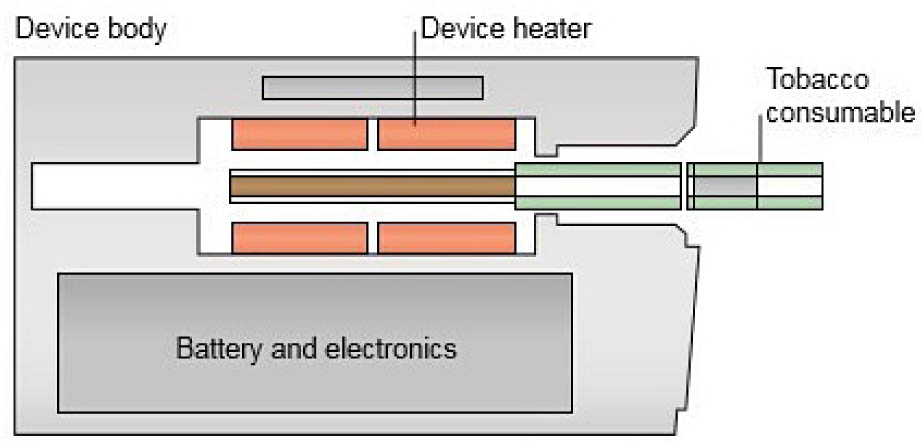
Figure 1.
Diagram of glo™ HTP with a tobacco consumable.
Here, the base HTP consumable was re-evaluated alongside two variant consumables that differed either in tobacco flavour (Rich Tobacco, 0.85% nicotine dwb; Variant 1) or in tobacco flavour and nicotine strength (Rich Tobacco, 1.5% nicotine dwb; Variant 2). The base consumable and Variant 2 were commercially available in Japan and European markets at the time of the study; Variant 1 was not commercially available at the time of the study. None of the study products were commercially available in the UK at the time of the study. All devices and consumables used by study participants were stored at ambient indoor room conditions in a locked location for the duration of the study when not in use. Temperature and relative humidity were not actively measured or controlled, as this was intended to reflect the uncontrolled environmental conditions typical of actual human use.
2.2. Topography study
2.2.1. Study population
The study aimed to enrol 72 participants who were regular cigarette smokers, with an equal split between men and women. No formal sample size or power calculation was conducted. The target sample size was selected to ensure adequate representation while remaining feasible within the study logistics and central-location testing requirements. Participants were recruited via a screening questionnaire by an independent market research agency (Kantar, UK) in accordance with the International Code on Market Opinion and Social Research and Data Analytics (28). The inclusion criteria for enrolment were aged 21–64 years inclusive, and smoking a minimum of eight 7-mg ISO “tar” cigarettes per day for the past six months or longer. Females who were pregnant or breastfeeding, and individuals with a pacemaker or other embedded electronic medical device were excluded. Age, baseline cigarettes per day and years of smoking were collected during screening for eligibility purposes only and were not included in the anonymised dataset used for analysis. Prior experience with heated tobacco products was not collected.
All participants read and signed an informed consent form prior to enrolment. A unique volunteer ID code was used to identify participants throughout the study. Participants were free to withdraw from the study at any time and received remuneration for taking part. The study protocol and informed consent form were approved by BAT's Human Research Committee (HRC; approval number HRC_RRS_18_091), and the study was conducted in accordance with the ethical principles outlined in the Declaration of Helsinki, Good Research Practice, the ICC/ESOMAR International Code on Market, Opinion and Social Research and Data Analytics, and applicable data-protection regulations.
2.2.2. Study design
In a two-week randomised crossover study conducted in London (UK) in 2018, puffing topography, MLE and ADC of the three study products were measured while each participant used a single, individually assigned glo™ device throughout the study duration. No washout period was included between product periods, as participants would have likely continued to use their usual nicotine product during any imposed abstinence. Omitting a washout therefore more closely reflected real-world transitions between products and avoided any behaviour changes associated with forced abstinence.
On the first visit to a central location facility (day 1), participants were given a glo™ device, a one-week supply of the first randomly allocated consumable (equivalent to their self-declared cigarette consumption at screening plus 20–25%) and a daily consumption diary. Participants were shown how to operate the glo™ device by study staff, and they were provided with written user instructions. The order of product use was determined by a computer-generated randomisation schedule, following a 3 × 3 Williams design. Participants were asked to use the allocated study product at home in place of their normal cigarette product for 5 days, and to record the number of study products used, as well as any non-study tobacco/nicotine products, in the daily consumption diary provided. No minimum level of product use was mandated. Compliance was assessed via the daily consumption diaries and product accountability checks at the end of each home use period, where participants returned the glo™ device along with all used and unused consumables for recording. On day 5, participants reattended the central location facility for puffing topography measurements on the home placement product. In two sessions separated by a 20-min interval, puffing topography was measured using a desktop-based puffing analyser (SA7, developed at BAT and manufactured by C-Matic Systems Ltd., Telford, UK, now Scheider Electric). Participants used the study product through the SA7 holder with a disposable plastic mouthpiece. Between the two sessions, participants completed a sensory questionnaire including questions regarding draw effort, intensity, aerosol delivery, amount of aerosol filling the mouth, irritation and taste on a magnitude scale ranging from 1 (low) to 5 (high).
On completion of the two puffing topography sessions, participants were given the next study product as per the randomisation procedure to use at home for five days before returning for further puffing topography measurements. This process was repeated until all participants had used all three products (Table 1).
2.2.3. Puffing topography measurements
Puffing topography measurements (number of puffs taken, puff volume, puff duration, inter-puff interval, session duration, pressure drop, effort and optical obscuration of aerosol) were recorded using the SA7 desktop-based puffing analyser device (Figure 2). The SA7 was originally developed to measure smoking topography, and was subsequently modified for use with products containing higher levels of humectants, such as e-cigarettes and HTPs (23, 24, 29, 30). It comprises a product holder attached to a data acquisition transmission unit. Two tubes on either side of a 2-mm diameter orifice within the product holder detect the change in pressure during puffing, which is proportional to the flow rate squared (29).
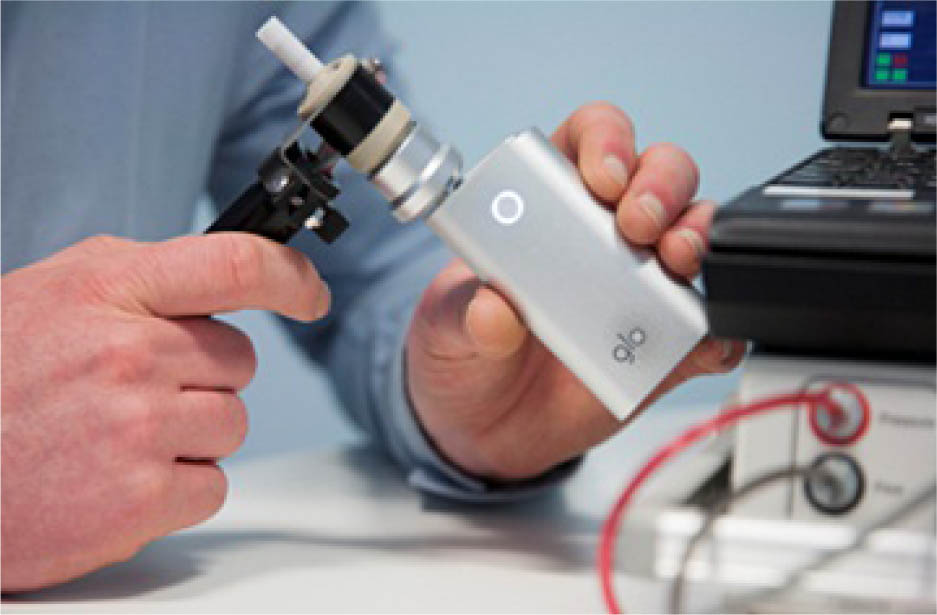
Figure 2.
Image of glo™ attached to the SA7 topography device.
2.2.4. Mouth level exposure
We estimated MLE to nicotine and NFDPM from real-time light obscuration in each puff measured by an LED in the SA7 instrument, as described previously (23, 24, 29). In brief, calibration plots of light obscuration vs. NFDPM were established by measuring the NFDPM contained in total particulate matter (TPM) collected on a Cambridge filter pad after machine-puffing the HTPs under various puffing regimes as previously described (23, 24). The amounts of water and nicotine in the collected TPM were determined by gas chromatography and used to determine the weight of nicotine-free dry particulate matter (NFDPM) (NFDPM = TPM ! nicotine ! water). The NFDPM values were then used to determine the most appropriate calculation factors to estimate ‘optical NFDPM' per stick when used by participants (29). MLE to nicotine was estimated using the relationship between NFDPM and nicotine, generated from calibration graphs, using ‘optical NFDPM' in place of actual NFDPM. The mean MLE per stick and ADC (based on the participant's diary) were subsequently used to calculate the mean MLE per day.
2.3. Machine emissions analysis
Machine emissions analysis was conducted by Labstat (Kitchener, ON, Canada) to determine the quantity of key analytes in the aerosol of the three study products and the percentage reduction of nine toxicants (TobReg9) identified by public health authorities for potential reduction in cigarette smoke, relative to smoke from a certified 3R4F reference cigarette (Center for Tobacco Reference Products, University of Kentucky, Lexington, KY, USA). Before testing, all study HTP consumables and reference cigarettes were environmentally conditioned as specified in ISO 3402 (31).
HTP aerosol was generated using the ISO 20778:2018 machine-puffing regime of puff volume 55 ± 0.5 mL, puff duration 2.0 ± 0.1 s, puff frequency 30 ± 1 s, bell-shaped profile and 0% blocking of the perforations (26, 27). Five replicate consumables were tested per study product, with eight puffs taken per consumable (determined by the fixed 3.5-min heating session of the glo™ device, and the 30-s frequency specified in the machine-puffing regime).
The 3R4F reference cigarette was machine-smoked using the Health Canada Intense (HCI) regime without modification. glo™ aerosol and cigarette smoke were collected by certified and established methods set out in accordance with the International Organization for Standardization ISO 3308:12 (32).
2.4. Study objectives
The primary objective was to demonstrate statistical equivalence within predefined margins, between the base consumable (Bright Tobacco, 0.85% nicotine) and Variant 1 (Rich Tobacco, 0.85% nicotine) or Variant 2 (Rich Tobacco, 1.5% nicotine), by comparing MLE to NFDPM and nicotine (per stick and per day), and ADC among the three consumables. The secondary objective was to compare puffing topography, including puff volume, puff duration, inter-puff interval and puff number between the three consumables.
2.5. Data analysis
Analyses were carried out using SAS v. 9.4 (SAS Institute, Cary, NC, USA). All 72 participants completed the study and were included in the analysis. Two participants had equipment errors during topography sessions, therefore topography and MLE data are reported for n = 70 participants, and ADC data are reported for n = 72 participants. Puffing topography, ADC and MLE are reported as mean ± standard deviation (SD) per product. Puffing topography and MLE data were first averaged per participant across the two repeats. ADC was derived from the self-reported daily consumption diaries, and was calculated in two ways (i) ADC of the study product alone, and (ii) the total ADC, which was calculated as the sum of study product consumption plus non-study tobacco product consumption. Participants who self-reported zero study product or non-study tobacco product use contributed valid zero values and were therefore included in the calculations of ADC. Per day consumption was first averaged per participant from days 2–4 of the home use period. Days 1 and 5 did not represent full stable use days (device initiation and return days, respectively) and therefore were excluded from ADC calculations. Prior to statistical analysis, analytical thresholds were defined for each attribute based on the limitations of the methodology (Supplementary Figure S1).
These thresholds reflect the performance characteristics of the puffing topography equipment, including measurement resolution, repeatability, calibration uncertainty and inherent variability observed during method validation.
Differences smaller than these thresholds therefore cannot be reliably distinguished from measurement variability. For a given attribute, if a difference between two product measurements was less than the defined threshold, it was deemed “unmeasurable” within the limits of the analytical method, and therefore any statistical differences were deemed insignificant. Where the difference between measurements was greater than the defined analytical threshold, a paired two-one-sided t-test (TOST) procedure on the ratio of means, with lower and upper acceptance limits of 0.80 and 1.25 and 90% confidence intervals (CI), was used to assess equivalence to the base product. To our knowledge, no other published studies have applied equivalence margins or TOST to puffing topography endpoints. We therefore adopted the European Medicines Agency guidelines of 0.80–1.25 with 90% CI, which is the regulatory standard for pharmacokinetics (PK) based equivalence in orally inhaled products (33). Since puffing behaviour and MLE contribute directly to aerosol delivery and exposure, we considered this equivalence margin appropriate for this study. In addition to the primary TOST analysis, a sensitivity analysis was conducted using a linear mixed-effects model with fixed effects for product, period and sequence, and a random effect for subject. This model was used solely to assess whether period or sequence effects influenced the product comparisons. The TOST remained the basis for equivalence decisions.
Machine emissions data are reported as a percentage reduction relative to 3R4F reference cigarette smoke. For each TobReg9 toxicant, the percentage reduction was calculated per replicate as follows:
The mean of the replicates was then determined. Where toxicants were reported as below detection level, the value was reported as half of the level of detection (LOD). Where analytes were reported as not quantifiable, the value was reported as the midpoint between the LOD and level of quantification.
3. RESULTS AND DISCUSSION
3.1. Study participants
In total, 72 smokers were recruited to participate in the study, all of whom completed the home use and central location tests for all three study products. Puffing topography and MLE data are reported for n = 70 participants due to equipment error for two participants, and ADC data are reported for n = 72 participants. Among the participants, 36 (50%) were male, 36 (50%) were female, and the age range was 21–64 years. Participant flow is shown in Supplementary Figure S2.
3.2. Puffing topography
The puffing topography attributes (number of puffs, puff volume, puff duration, inter-puff interval and effort expended) of the three products are summarised in Table 2. For Variant 1, which differed from the base consumable only in tobacco flavour, differences in puff number (16.4 vs. 15.9), puff duration (2.0 vs. 2.0 s) and puff interval (9.7 vs. 10.0 s) were smaller than the predefined analytical thresholds (Supplementary Figure S1). These differences were therefore considered not measurable, and equivalence testing was not applied. Differences in puff volume (63.4 vs. 58.9 mL; mean ratio 90% CI: 1.01, 1.12) and effort (526 vs. 500 mm WGs (millimetre water gauge seconds); mean ratio 90% CI: 0.99, 1.15) were within the predefined equivalence margin of 0.80–1.25 and were considered equivalent. For Variant 2 which differed from the base consumable in tobacco flavour and higher nicotine strength, differences in puff volume (58.8 vs. 58.9 mL) and puff interval (10.0 vs. 10.0) were smaller than the predefined analytical thresholds (Supplementary Figure S1), and therefore equivalence testing was not applied. Differences in puff number (14.8 vs. 15.9; mean ratio 90% CI: 0.86, 0.98), puff duration (1.8 vs. 2.0 s; mean ratio 90% CI: 0.86, 0.93) were within the predefined equivalence margin and were therefore considered equivalent, while the difference in effort (437 vs. 500 mmWGs; mean ratio 90% CI: 0.80, 0.94) fell outside the equivalence margin. Mixed effects modelling showed no significant period or sequence effects across all endpoints, indicating that consumer behaviour was not influenced by product order or study week.
Table 2.
Comparison of puffing topography data among the three consumable variants.a
| Parameter | Variant 1 comparison | Variant 2 comparison | ||||||
|---|---|---|---|---|---|---|---|---|
| Base | Variant | Difference (variant - base) | Statistical equivalenceb | Base | Variant | Difference (variant - base) | Statistical equivalenceb | |
| Puff number | 15.9 ± 8.4 | 16.4 ± 8.5 | 0.53 | – | 15.9 ± 8.4 | 14.8 ± 8.3 | −1.05 | Equivalent (90% CI: 0.86, 0.98) |
| Puff volume (mL) | 58.9 ± 31.7 | 63.4 ± 31.9 | 4.45 | Equivalent (90% CI: 1.01, 1.12) | 58.9 ± 31.7 | 58.8 ± 22.9 | −0.15 | – |
| Puff duration (s) | 2.0 ± 0.9 | 2.0 ± 0.9 | 0.08 | – | 2.0 ± 0.9 | 1.8 ± 0.7 | −0.21 | Equivalent (90% CI: 0.86, 0.93) |
| Puff interval (s) | 10.0 ± 4.8 | 9.7 ± 5.0 | −0.37 | – | 10.0 ± 4.8 | 10.0 ± 5.6 | −0.03 | – |
| Effort (mm WGs) | 500 ± 329 | 526 ± 314 | 26.2 | Equivalent (90% CI: 0.99, 1.15) | 500 ± 329 | 437 ± 279 | −63.4 | Not equivalent (90% CI: 0.80, 0.94) |
The mean puff volumes and durations for all products were consistent with the 55-mL puff volume and 2-s puff duration of the ISO 20778:2018 machine puffing regime used to generate emissions data (26, 27). The mean inter-puff intervals (9.7–10.0 s) were less than the 30-s frequency specified in ISO 20778:2018, indicating that participants took puffs more frequently than the machine puffing regime. Within the fixed 3.5-min heating session of the device, these shorter puff intervals allowed participants to take more puffs per session (14.8–16.4) compared with the eight puffs obtained during machine emissions testing. Consequently, emissions generated using ISO 20778:2018 may underestimate actual consumer exposure. The inter-puff intervals here were consistent with those of previous studies using the same glo™ device (7.4–11.1 s) (23,24,25), supporting that participant puffing behaviour was representative of typical glo™ use.
Our observations showed that the puffing measures were very similar across the study products despite the differences in tobacco flavour (Variant 1), and tobacco flavour and nicotine content (Variant 2) as compared with the base consumable. This finding implies that any nicotine-induced sensations initiated during the inhalation phase did not have a controlling influence on participant puffing behaviour. This is consistent with the results of Buzzi et al. (34) and Dixon et al. (35), who reported that the nicotine yield of a cigarette did not influence puff-by-puff changes in volume and duration. Additionally, Dixon et al. (35) demonstrated that puff volume and duration were influenced by sensory responses occurring during puffing process (e.g., mouthful), but not by inhalation sensations (35).
Two previous studies have measured puffing topography attributes of the glo™ HTP and base consumable via a similar approach (23, 24). The current puff duration (2.0 s) was similar to previous values (1.6–1.8 s); puff volume (58.9 mL) and puff interval (10.0 s) fell within the previously reported ranges (46.6–66.7 mL and 7.4–11.1 s, respectively); and puff number was slightly higher in the present study (15.9 vs. 10.9–15.4) (23, 24). These differences may be due to variations in the study populations: the study of Gee et al. (23) was conducted in Japan among both smokers and regular HTP users, that of Jones et al. (24) was conducted among smokers in Italy, while the present study was conducted among smokers in the UK. More broadly, studies of HTPs by Prasad et al. (25) and Li et al. (36) reported higher puff numbers of 17–21 puffs and 22 puffs, respectively, while puff volumes, durations and intervals were generally within previously observed ranges [57–81 mL volume, 1.6–1.9 s duration and 9 s interval (25); and 59–66 mL volume, 1.9–2.0 s duration and 10 s interval (36)]. These cross-study comparisons are descriptive only; formal statistical testing between studies was not conducted due to differences in study populations (smoker/HTP-user mix), geographical locations (Japan, Italy, UK) and study design.
The consumables used in the present study were KSSS sticks (diameter ~5.0 mm; tobacco weight ~260 mg). Prasad et al. (25) reported that a larger-diameter demi-slim (DS) consumable (diameter ~6.8 mm; tobacco weight ~340 mg) produced notably lower open pressure drop (~45 mmWG vs. ~70 mmWG for KSSS) and correspondingly larger puff volumes (69–81 mL vs. 57 mL for KSSS) compared with a KSSS consumable, illustrating that airflow resistance driven by consumable geometry directly influences puff volume. In the same study, MLE to NFDPM was also higher for the DS consumable (18.8–19.9 mg/stick vs. 12.5 mg/stick for KSSS), likely reflecting a combination of the larger puff volumes and greater tobacco weight, although it is worth noting that the device paired with the KSSS consumable employed resistive heating, whereas the device paired with the DS consumable employed induction heating. Consumable flavour and nicotine content were chosen as variables of interest in this study since they represent common sources of product variation that may influence sensory perception characteristics (e.g., taste, impact) and nicotine delivery, which in turn could affect puffing behaviour and exposure. Evaluating these attributes can help determine whether such product variations remain behaviourally comparable to the established base consumable.
The puffing behaviour observed in the current study falls within the established range for KSSS-format glo™ consumables and is consistent with values reported for similar products. This supports the interpretation that participants' puffing behaviour in this study reflects typical use of glo™ consumables.
3.3. Average daily consumption and mouth level exposure
The self-reported study product ADC, total ADC (sum of study product ADC plus cigarette ADC), and MLE to NFDPM and nicotine (per stick and per day) of the three products are summarised in Table 3.
Table 3.
Comparison of ADC and MLE among the three consumable variants.a
| Parameter | Variant 1 comparison | Variant 2 comparison | ||||||
|---|---|---|---|---|---|---|---|---|
| Base | Variant | Difference (variant - base) | Statistical equivalenceb | Base | Variant | Difference (variant - base) | Statistical equivalenceb | |
| ADC study product (sticks/day)c | 4.5 ± 3.8 | 4.6 ± 3.8 | 0.10 | – | 4.5 ± 3.8 | 4.6 ± 4.0 | 0.07 | – |
| Total ADC (sticks/day)d | 12.6 ± 6.0 | 12.7 ± 6.0 | 0.03 | – | 12.6 ± 6.0 | 12.0 ± 5.5 | −0.69 | – |
| MLE to NFDPM (mg/stick) | 4.71 ± 1.86 | 5.30 ± 2.52 | 0.59 | – | 4.71 ± 1.86 | 4.59 ± 3.14 | −0.12 | – |
| MLE to nicotine (mg/stick) | 0.30 ± 0.12 | 0.30 ± 0.14 | 0.007 | – | 0.30 ± 0.12 | 0.41 ± 0.28 | 0.112 | Not equivalent (90% CI: 1.05, 1.34) |
| MLE to NFDPM (mg/day) | 22.2 ± 21.5 | 27.2 ± 33.1 | 5.00 | Equivalent (90% CI: 0.93, 1.23) | 22.2 ± 21.5 | 22.4 ± 28.7 | 0.21 | – |
| MLE to nicotine (mg/day) | 1.40 ± 1.36 | 1.56 ± 1.91 | 0,159 | – | 1.40 ± 1.36 | 2.00 ± 2.57 | 0.597 | Not equivalent (90% CI: 1.03, 1.48) |
ADC: average daily consumption; MLE: mouth level exposure; NFDPM: nicotine-free dry particulate matter.
b Equivalence between the variant consumable and base consumable was evaluated using a ratio-based, paired two-one-sided test (TOST) with a predefined equivalence margin of 0.80–1.25 and 90% confidence intervals for the mean ratio presented.
– Indicates that the difference between the variant and the base consumable was smaller than the predefined analytical threshold (see Supplementary Figure S1); such differences were classified as not measurable and equivalence testing was not applied. For ADC and parameters derived from ADC (MLE per day), equivalence testing was carried out only for participants that used the study product during home placement (Variant 1: n = 68, Variant 2: n = 66).
d Total ADC of study and non-study products, calculated using the sum of the number of study products plus the number of any non-study products consumed per day (n = 70 participants reported using their own cigarette brand during home placement of the base product; n = 68 participants reported using their own cigarette brand during home placement of Variant 1, and n = 69 participants reported using their own cigarette brand during home placement of Variant 2).
The number of participants reporting continued use of their usual brand cigarettes was 70 for the base consumable, 68 for Variant 1 and 69 for Variant 2. For Variant 1, differences in study product ADC (4.6 vs. 4.5 sticks/day), total ADC (12.7 vs. 12.6 sticks/day), MLE per stick (NFDPM: 5.3 vs. 4.7 mg; nicotine: 0.30 vs. 0.30 mg) and MLE to nicotine per day (1.56 vs. 1.40 mg) were smaller than the predefined analytical thresholds (Supplementary Figure S1), and therefore equivalence testing was not applied. Differences in MLE to NFDPM per day (27.2 vs. 22.2 mg; mean ratio 90% CI: 0.93, 1.23) fell within the equivalence margin.
For Variant 2, differences in study product ADC (4.6 vs. 4.5 sticks/day), total ADC (12.0 vs. 12.6 sticks/day), and MLE to NFDPM (per stick: 4.6 vs. 4.7 mg; per day: 22.4 vs. 22.2 mg) were smaller than the predefined analytical thresholds and therefore equivalence testing was not applied. MLE to nicotine was higher for Variant 2 than for the base consumable (MLE per stick: 0.41 vs. 0.30 mg; mean ratio 90% CI: 1.05, 1.34; MLE per day: 2.00 vs. 1.40 mg; mean ratio 90% CI: 1.03, 1.48), and did not meet the equivalence margin, and therefore equivalence could not be confirmed. This is consistent with the higher amount of nicotine in the tobacco blend for Variant 2 (1.50% vs. 0.85%). The MLE estimates reported within this study are consistent with previous topography studies conducted in Japan and Italy (23, 24) using the base product (Table 4), which is again consistent with similar overall puffing behaviour (Table 2).
Table 4.
Comparison of ADC and MLE for the base product among three different studies.a
| Country | MLE to NFDPM (mg/stick) | MLE to nicotine (mg/stick) | ADC study product (sticks/day)b | Total ADC (sticks/day)c | Reference |
|---|---|---|---|---|---|
| Japan | |||||
| Smokers (n = 52) | 5.2 ± 3.4 | 0.3 ± 0.2 | 10.3 ± 5.5 | 12.1 ± 5.5 | (23) |
| HTP users (n = 52) | 5.0 ± 3.1 | 0.3 ± 0.1 | 8.6 ± 4.6 | 11.2 ± 6.2 | |
| Italy | |||||
| Smokers (n = 52) | 4.7 ± 2.9 | 0.3 ± 0.2 | 7.0 ± 5.5 | 11.6 ± 5.7 | (24) |
| UK | |||||
| Smokers (n = 70) | 4.7 ± 1.9 | 0.3 ± 0.1 | 4.5 ± 3.8 | 12.6 ± 6.0 | This study |
The ADC reported for the base product among the UK smokers in the present study (4.5 ± 3.8 sticks/day) was much smaller than previously reported in Japan and Italy (23, 24). After home placement, the ADC of the base product in Japan was 10.3 ± 5.5 sticks/day among 52 smokers and 8.6 ± 4.6 sticks/day among 52 HTP users (23), and in Italy it was 7.0 ± 5.5 sticks/day among 52 smokers (24). As well as differences in the study populations, these variations may be due to the prevalence of HTP use, which is generally lower in the UK than in Japan and Italy (37, 38). Furthermore, unlike in Japan and Italy, glo™ HTPs were not commercially available in the UK at the time of the study. Taken together, this may explain why 70 of the 72 UK smokers in the current study continued to use their usual brand cigarette in addition to the study product at home. In support of this, the total ADC of the tobacco and nicotine products (Table 3) is fairly consistent across the three studies: 12.6 ± 6.0 sticks/day in the present study; 12.1 ± 5.5 sticks/day among smokers and 11.2 ± 6.2 sticks/day among HTP users in Japan (23); and 11.6 ± 5.7 sticks/day in Italy (24) (Table 4).
In summary, most observed differences between the base consumable and the variant consumables in puffing topography, MLE and ADC were either (i) not measurable according to the predefined analytical thresholds (Supplementary Table S1), or (ii) were within the predefined equivalence margins according to a paired TOST (90% CI of mean ratio). The only exceptions were MLE to nicotine (per stick and per day) for Variant 2, which was higher than the base consumable and consistent with higher nicotine content, and effort for Variant 2, indicating that differences in tobacco flavour and nicotine strength among the study products had no significant effects on user behaviour or product consumption.
3.4. Machine emissions data
The nine TobReg9 toxicants identified by public health authorities for potential reduction in cigarette smoke were significantly reduced in machine-generated emissions from all three study products relative to the 3R4F reference cigarette (90.61–99.99% reduction), with no differences observed in overall percentage reductions across the three products (97.02–97.93% reduction) (Table 5). Some small differences were observed in the percentage reduction of formaldehyde and N-nitrosonornicotine (NNN), where the percent reduction was greater for Variant 1 and Variant 2 than for the base product (95.60–96.32% vs. 93.92% reduction for formaldehyde and 93.72–93.74% vs. 90.61% reduction for NNN). No formal between-variant significance testing was performed for machine emissions data since the primary comparisons were to 3R4F cigarette smoke and the study was not powered for small between-variant emissions differences. Small differences between consumables are expected due to variations within batches of tobacco. We also compared machine emissions of nicotine, NFDPM, water and glycerol among the study products (Table 6).
Table 5.
Percentage reduction in nine toxicants relative to cigarette smoke.a
| TobReg toxicant | Base product | Variant 1 | Variant 2 |
|---|---|---|---|
| CO | 99.76 | 99.55 | 99.90 |
| Formaldehyde | 93.92 | 95.60 | 96.32 |
| Acetaldehyde | 94.96 | 94.16 | 96.37 |
| Acrolein | 98.59 | 98.92 | 98.66 |
| 1,3-Butadiene | 99.99 | 99.99 | 99.99 |
| Benzene | 99.95 | 99.90 | 99.95 |
| Benzo[a]pyrene | 97.72 | 98.00 | 98.92 |
| NNN | 90.61 | 93.74 | 93.72 |
| NNK | 97.65 | 98.17 | 98.24 |
| Overall reduction | 97.02 | 97.56 | 97.93 |
Table 6.
Comparison of other aerosol constituents among the study products.a
| Smoke constituent | Base product | Variant 1 | Variant 2 |
|---|---|---|---|
| Nicotine (mg/stick) | 0.46 ± 0.04 | 0.38 ± 0.03 | 0.55 ± 0.03 |
| NFDPM (mg/stick) | 13.50 ± 1.20 | 11.00 ± 0.50 | 11.10 ± 0.40 |
| Water (mg/stick) | 12.10 ± 1.00 | 15.74 ± 0.44 | 12.80 ± 0.40 |
| Glycerol (mg/stick) | 3.02 ± 0.25 | 1.94 ± 0.35 | 2.74 ± 0.19 |
The nicotine delivery for Variant 2 was higher than that of the base consumable and Variant 1 (0.55 vs. 0.38–0.46 mg/stick), consistent with the higher nicotine content in the blend. Although aerosol NFDPM was slightly higher for the base product relative to variants 1 and 2 (base product: 13.5 mg/stick; Variant 1: 11.0 mg/stick; Variant 2: 11.1 mg/stick), there were no differences between the variant consumables.
Despite participants puffing more frequently than the 30-s puff duration of the ISO 20778:2018 machine puffing regime, the mean of the estimated MLE to NFDPM and nicotine per stick (Table 3) remained lower than the corresponding machine-generated emissions (Table 6). This indicates that machine emissions represent the maximum potential aerosol yields under standardised conditions, whereas actual consumer exposure may be further influenced by other factors.
4. CONCLUSIONS
The present study has compared user behaviour, ADC and MLE to nicotine and NFDPM among 72 healthy adult smokers in the UK when using a single individually assigned HTP device with three different consumable variants: an extensively tested base consumable with a large foundational dataset; and two variant consumables with different tobacco flavour and nicotine content. Differences in puffing behaviour attributes for both variant consumables were either smaller than the predefined analytical thresholds of the methodology and not measurable, or were within the predefined equivalence margins, with the exception of effort for Variant 2. The variant consumables were therefore considered equivalent to the base consumable in puffing behaviour. Differences in ADC and MLE for Variant 1 were not measurable, except for NFDPM per day, which was considered equivalent based on predefined margins. For Variant 2, differences in ADC and MLE to NFDPM were not measurable. As might be expected, however, the MLE to nicotine (per stick and per day) for this variant was higher than the base consumable, and did not meet the predefined equivalence margins. This was consistent with greater nicotine content in this variant. Consistent with observations in previous studies, the measured puff volumes (59–63 mL) and puff durations (1.8–2.0 s) were similar to the 55-mL volume and 2.0-s duration of the ISO 20778:2018 machine puffing regime used to generate emissions data, although puff intervals (9.7–10.0 s) were lower than the 30-s of ISO 20778:2018. These observations suggest that the machine-puffing regimes currently used to generate emissions data for HTPs are consistent for puff volume and duration, but not for puff interval. Despite higher puffing frequency compared to the 30-s of ISO 20778:2018, the estimated MLE to NFDPM and nicotine remained lower than the corresponding machine-generated emissions. The lack of differences in puffing topography, ADC or MLE to NFDPM suggests that, although the variant consumables differed from the extensively tested base consumable in flavour (Variant 1) and in both flavour and nicotine (Variant 2), participants' user behaviour and exposure to constituents other than nicotine remained consistent. Higher MLE to nicotine was observed for Variant 2 due to its higher nicotine content. However, these findings should be interpreted in light of two limitations: each consumable was evaluated only over a short-term use period among smokers who may have been unfamiliar with heated products, and only three variant consumables were tested. As such, the results may not extrapolate to longer-term use or to other flavours or nicotine strengths.
ACKNOWLEDGEMENT
We thank Joshua Jones and Sandra Slayford for contributions towards logistical support, management of the study and data collection; Madeleine Ashley for assistance with statistical analysis; and Stacy Fiebelkorn for data checking.
Notes
[18] Financial disclosure FUNDING
This work was funded by British American Tobacco, BAT (Investments) Ltd.
[19] ETHICS APPROVAL AND CONSENT TO PARTICIPATE
All participants read and signed an informed consent form (ICF) prior to any involvement in the study.
The study protocol and ICF were approved by the Human Research Committee (HRC), BAT's internal committee dedicated to ensuring all studies involving humans are carried out in accordance with the ethical principles outlined in the Declaration of Helsinki and other relevant guidelines (HRC_RRS_18_091).
[21] AVAILABILITY OF DATA AND MATERIALS
The datasets used and/or analysed during the study are available from the corresponding author upon reasonable request.
[22] Financial disclosure COMPETING INTERESTS
AG and LE are employees of BAT (Investments) Ltd.; KP was an employee of BAT (Investments) Ltd. at the time of the study.
[23] Contributed by AUTHOR CONTRIBUTIONS
AG conducted puffing topography fieldwork and data collection, and was the main contributor in writing the manuscript. LE contributed towards writing the manuscript. KP provided overall scientific oversight of the study.
All authors read and approved the final manuscript.
Notes
SUPPLEMENTARY INFORMATION
This publication contains supplementary material available at: Supplementary Information.