
INTRODUCTION
Cigarette smoking remains the leading preventable cause of morbidity and premature mortality in the U.S. (1). While significant progress has been made in reducing smoking (2), it has not been achieved equitably (1, 3, 4). For instance, according to the recent Surgeon General's report (1), Centers for Disease Control and Prevention (CDC) (3) and the Food and Drug Administration (FDA) (4), subgroups disproportionately affected by smoking include, but are not limited to: certain racial or ethnic populations; adults with low educational attainment and income; people with a mental health condition; and sexual or gender minorities. While less frequently emphasized by public health authorities, and often overlooked, other important populations are older adults who smoke (AWS) and male AWS, who are characterized by higher smoking prevalence, lower readiness to quit, fewer quitting attempts, and/or lower quitting success when they do make an attempt (5,6,7,8,9,10,11). Consequently, these subpopulations disproportionately affected by smoking suffer from a higher burden of smoking-related diseases such as lung cancer and chronic obstructive pulmonary disease (COPD) (12, 13), making smoking a key driver of health-related inequalities.
As non-combustible nicotine products, electronic nicotine delivery systems (ENDS) have been suggested as a practical strategy for reducing smoking-related disparities (14, 15). Encouragingly, studies show that, once ENDS are adopted, rates of complete switching are consistently high across most subgroups, including racial and ethnic minority groups, those with low income and education level, gender and sexual minorities, and people with mental health conditions (16, 17). However, their harm- and disparity-reduction potential may not be realized if there is low uptake in some sub-populations, as shown among Hispanic and Black Americans, those with low income and educational attainment, and older adults (5, 18, 19).
One possible reason for low adoption rates could be misperceptions regarding ENDS, despite growing evidence supporting their reduced-harm potential (20,21,22,23). ENDS misperceptions - the belief that they are at least as harmful or more harmful than cigarette smoking - have become more prevalent over time. For instance, between 2014 and 2019, the proportion of U.S. AWS who harbored such misperceptions increased from 46% to 83% (24). Understanding misperceptions is important because they predict whether or not AWS take up ENDS (24,25,26,27,28). However, data from English and U.S. surveys collected between 2015 and 2019 suggest that misperceptions are particularly high among certain sub-populations where smoking prevalence is high and uptake of ENDS is low, including older AWS, Hispanic and Black adults, and those with lower income and educational attainment (29,30,31,32), although findings are mixed from samples of AWS with a mental health condition (33).
From a behavioral standpoint, another important population that remains particularly vulnerable to the detrimental effects of smoking are those who are not motivated to quit smoking. However, it has been reported that ~85% of AWS in the U.S. are not planning to quit in the next 30 days (NPQ) (34, 35), a commonly used eligibility criterion when recruiting participants for smoking cessation trials (36, 37). The high proportion of AWS-NPQ suggests that traditional smoking cessation interventions are largely unsuccessful in reaching those in need. While complete abstinence from nicotine is the ideal outcome, recent studies have shown the potential of ENDS in AWS-NPQ, as evidenced by high rates (34) or significantly increased odds of smoking discontinuation (38), even among those who reported that they would never quit smoking. With a growing body of evidence suggesting positive population-level impacts of ENDS (39), especially among AWS who experience the most difficulty in smoking cessation (14, 15) risk misperception as a potential barrier to one of the first steps of harm reduction may be significant.
Using Population Assessment of Tobacco and Health Study (PATH) Wave 7 (2022–2023) data, the current analysis explores ENDS misperceptions among adults who exclusively smoke (AWES, i.e., do not currently use ENDS) and are not planning to quit in the next 30 days (NPQ). Subgroups of interest are AWES-NPQ who are disproportionately affected by smoking (i.e., racial/ethnic minority, male sex, older age, low socioeconomic status, non-heterosexual, and poor mental health, as defined by the Surgeon General (1), CDC (3), and FDA (4). Combined, the sample is expected to represent those for whom a harm-reduction (vs. cessation) approach would be most beneficial. In addition, the present analysis reports the trends in ENDS misperception among AWES-NPQ in the past seven waves of PATH, spanning approximately 10 years between 2013 and 2022. While they are not the primary focus of the current study, the trends among the larger parent groups of AWS-NPQ and AWS are also presented to provide broader perspectives on population-level trends in ENDS misperception.
METHODS
Data sources and samples
PATH is a longitudinal study of U.S. adults on tobacco product use behaviors and beliefs, with Wave 7 data collected between January 2022 and April 2023. PATH uses multistage probability sampling and oversampling of certain groups and takes attrition into account to make nationally representative estimates. Methods of the PATH Study are published elsewhere (40). This secondary data analysis of anonymized, publicly available PATH data was determined exempt from an Institutional Review Board (IRB) oversight by a qualified IRB.
The current study focuses on AWES-NPQ. The sample was defined as those who have
1) smoked more than 100 cigarettes in their lifetime and currently smoke every day or some days,
2) do not currently use ENDS (“not at all”), and
3) do not plan to quit smoking in the next 30 days.
As the analysis only considered cigarettes and ENDS, participants may be using other tobacco products.
Measures
Misperception that ENDS are at least as harmful as cigarettes
The question “Is using e-cigarettes less harmful, about the same, or more harmful than smoking cigarettes?” assessed relative risk perception between two products. Three response options were given: “More harmful”, “About the same”, (both misperceptions) or “Less harmful” (accurate) (20,21,22,23).
Subgroups of interest
Based on subgroups disproportionately affected by smoking identified by the Surgeon General, CDC, and the FDA (1, 3, 4) participants were identified using the following social determinants of health (see Table 1): race/ethnicity, sex, age, income, education, sexual orientation, and self-reported mental health. All participant characteristics (except for race/ethnicity) have been dichotomized to maximize the contrast between individuals who belong in the disproportionately affected groups and those who do not.
Table 1.
Characteristics of the adults who exclusively smoke and do not plan to quit smoking in 30 days, PATH Wave 7.
| Characteristics | Adults who exclusively smoke and do not plan to quit in 30 days |
|---|---|
| Total Sample | 3 |
| Race/ethnicity | |
| Non-Hispanic White | 2,146 (66.7%) |
| Non-Hispanic Black | 649 (13.6%) |
| Hispanic | 459 (11.7%) |
| Non-Hispanic other 227 (8.0%) | |
| Sex | |
| Male | 1,656 (55.5%) |
| Female | 1,825 (44.5%) |
| Age | |
| 18–54 | 2,180 (61.3%) |
| 55+ | 1,301 (38.7%) |
| Household income | |
| < $25,000 | 1,499 (42.0%) |
| > $25,000 | 1,826 (58.0%) |
| Education | |
| High school/GED or less | 1,926 (59.6%) |
| College educated | 1,539 (40.4%) |
| Sexual orientation | |
| Heterosexual | 3,029 (90.8%) |
| Non-heterosexual | 395 (9.2%) |
| Mental health | |
| Excellent/very good/good | 2,507 (73.7%) |
| Fair/poor | 957 (26.3%) |
Analyses
Proportions of those reporting ENDS misperceptions were calculated among subgroups of AWES-NPQ. Differences in ENDS misperceptions by participant characteristics were analyzed with logistic regression, with all seven abovementioned characteristics of participants being mutually adjusted for each other in a single regression model. Sampling and replicate weights with Fay's adjustment of 0.3 were used to take the complex study design, oversampling, and participant attrition into account in estimating variances and calculating population-representative estimates (40). Due to the use of weights, minor discrepancies between weighted and unweighted percentages are expected.
RESULTS
Among 5,169 AWS who participated in PATH Wave 7, 82% (n = 4,096) were not currently using ENDS. Over 87% (n = 3,481) of these were not planning to quit smoking in the next 30 days. The rates of ENDS misperception increased over time among all AWS and AWS-NPQ, as they did among AWES-NPQ, a sizeable subgroup that accounted for 71% of AWS in Wave 7 (Supplementary Figure). Eligible AWES-NPQ participants were majority Non-Hispanic White (67%), male (55%), and had educational attainment of high school/GED or less (60%, Table 1).
In Wave 7, 94% of AWES-NPQ perceived ENDS to be at least as harmful as cigarettes. While the rate of misperceptions slightly varied between subgroups, all exceeded 91% (Figure 1). In comparisons between subgroups, Black participants had 79% higher odds of misperceiving relative risks of ENDS (OR = 1.79 [95% CI = 1.13–2.83]) compared to White respondents (Table 2). Similarly, compared to more educated counterparts, those with only a high school education or less had more than two times higher odds (2.10 [1.47–3.01]) of holding such a misperception. Odds of reporting ENDS misperception were also 47% higher among participants aged 55 or older (1.47 [1.02–2.12]) compared to those younger than 55. On the other hand, male respondents had 45% lower odds of having misperceptions (0.55 [0.38–0.80]) compared to female participants. Other race/ethnicity, income, sexual orientation, and self-reported mental health did not demonstrate significant associations with ENDS misperceptions.
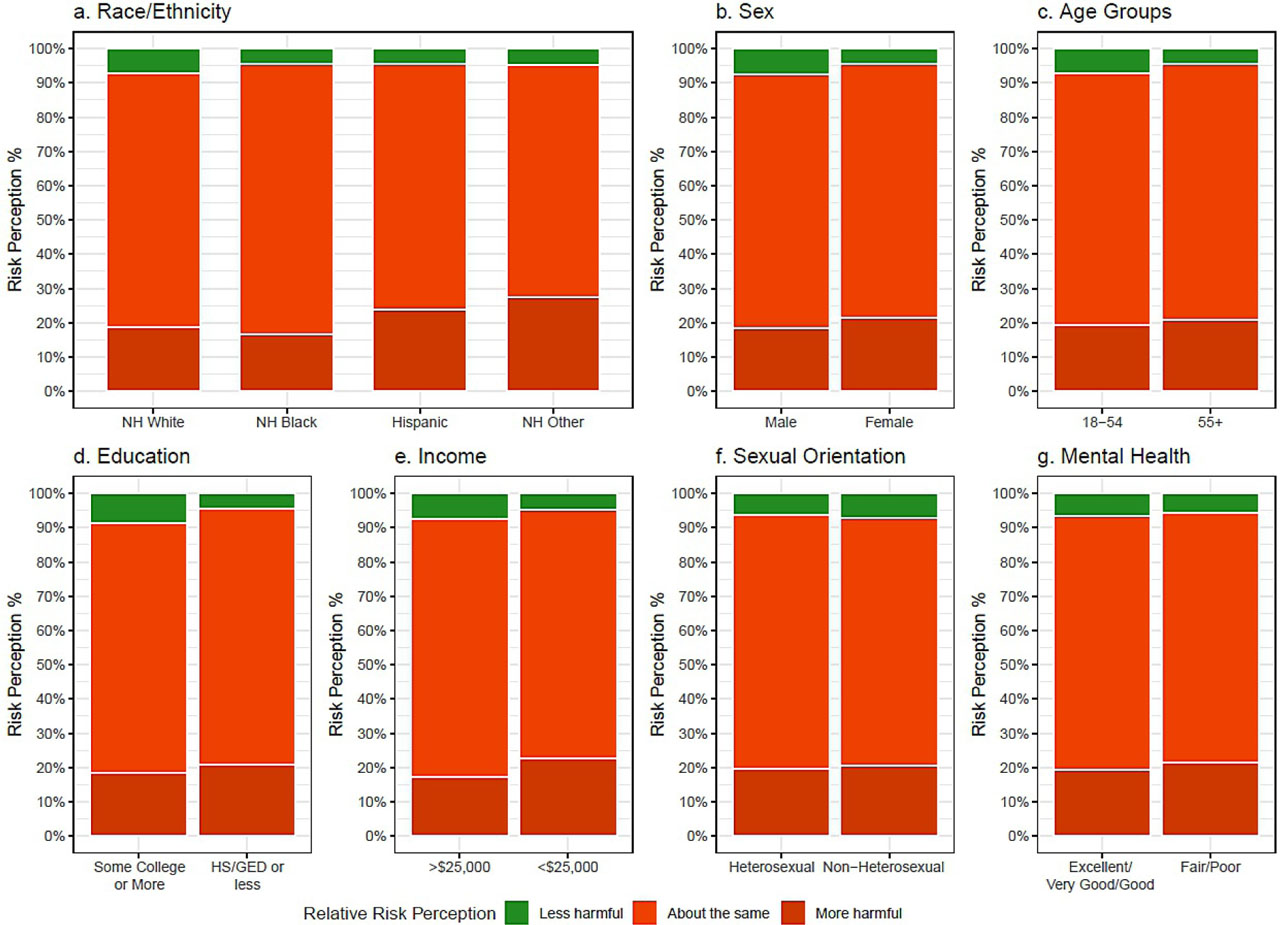
Figure 1.
Relative risk perception between ENDS and cigarettes among those who exclusively smoke.
Sample sizes are expressed as (the number of participants reporting ENDS misperception) / (the number of participants within the group) and weighted percentage.
NH White: 1,970/2,129 [92.9%], NH Black: 610/643 [95.6%], Hispanic: 432/454 [95.5%], NH Others: 213/225 [95.3%]; Male: 1,504/1,641 [92.5%], Female: 1,721/1,810 [95.4%]; ages 18–54: 2,010/2,170 [92.8%], ages 55+: 1,215/1,281 [95.5%]; some college or more: 1,396/1,528 [91.2%], HS/GED or less: 1,815/1,907 [95.5%]; > $25,000: 1,676/1,817 [92.6%], < $25,000: 1,405/1,484 [95.1%]; Heterosexual: 2,807/3,003 [93.8%], Non-heterosexual: 364/392 [92.8%]; Excellent/Very good/Good mental health: 2,318/2,487 [93.5%]; Fair/poor: 891/948 [94.4%].
Table 2.
Characteristics associated with misperception, among AWES not planning to quit in the next 30 days.
| Characteristics | OR (95% CI) |
|---|---|
| Race/ethnicity | |
| Non-Hispanic White | Reference |
| Non-Hispanic Black | 1.79 (1.13–2.83) |
| Hispanic | 1.56 (0.90–2.68) |
| Non-Hispanic Other | 1.83 (0.80–4.20) |
| Sex | |
| Female | Reference |
| Male | 0.55 (0.38–0.80) |
| Age | |
| 18–55 | Reference |
| 55+ | 1.47 (1.02–2.12) |
| Education | |
| Some college or more | Reference |
| HS/GED or less | 2.10 (1.47–3.01) |
| Household income | |
| > $25,000 | Reference |
| < $25,000 | 1.12 (0.73–1.74) |
| Sexual orientation | |
| Heterosexual | Reference |
| Non-heterosexual | 0.81 (0.48–1.36) |
| Mental health | |
| Excellent/good | Reference |
| Fair/poor 1.04 | (0.68–1.59) |
DISCUSSION
Ninety-four percent of AWES-NPQ in the U.S. perceived ENDS to be at least as harmful as cigarettes, an all-time high in the past decade. Despite a universally high prevalence of misperceptions across the sample, significantly higher rates of misperceptions were observed among Black AWES, those with low educational attainment, and older AWES. With decreased likelihood of successful cessation in these subgroups of AWES (41), replacing cigarettes with ENDS may be a pragmatic strategy to reduce tobacco-related harm and disparities (24,25,26,27). Such misperceptions may limit this potential.
The current finding that some subgroups with high smoking prevalence (e.g., Black AWS, those with low educational attainment, and older AWS) were more likely to hold ENDS misperceptions is in line with previous literature (29,30,31,32). That was not true in all cases: men, whose smoking rates have been historically higher than women's (5), were less likely to report ENDS misperception. Nevertheless, even among male AWES, the rates of misperceptions remained extremely high at 93%. Beyond some group-level differences observed in this study, the finding that almost 94% of AWES-NPQ believed that ENDS use was as harmful as or more harmful than cigarette smoking represents a substantial public health concern. This warrants attention in the broader context of population-level health communication and education.
High levels of ENDS misperception, particularly among socioeconomically minoritized subgroups of AWS, constitute a public health concern in their own right, suggesting substantial gaps between scientific evidence and public understanding of non-combustible tobacco product risks. However, perhaps more importantly, these misperceptions have meaningful behavioral implications. Previous studies have reported that individuals who perceive ENDS as equally or more harmful than cigarettes are less likely to engage in harm reduction behaviors, such as adopting ENDS, completely switching to them, and not returning to smoking (24,25,26,27,28). Furthermore, these misperceptions are not unique to the U.S., with consistent findings reported globally, including in Germany (42), UK (43), China (44), and New Zealand (45). Given the high prevalence of such misperceptions and their potential impact on subsequent behaviors and smoking-related harms, educational campaigns may be an effective strategy to reduce combusted tobacco use globally.
While the need for interventions to correct ENDS misperceptions has been acknowledged in recent years (20, 21, 23), their successful implementation is likely to be a complex undertaking, given the near-universal and persistent nature of misperception. Effective educational interventions should attempt to incorporate the public's trusted sources, such as public health organizations and healthcare providers (46). However, data suggest that healthcare providers also have high rates of misperceptions (47), suggesting a need for professional as well as public education. Tailoring the interventions to the needs and health literacy levels of target populations may further enhance effectiveness, particularly since subgroups with higher rates of ENDS misperception often overlap with those who have limited health literacy (48). Regulatory agencies, through their authority over modified risk labeling, could also offer a promising avenue to promulgate accurate risk information directly to consumers.
While the current study focused on the prevalence of ENDS misperceptions among subgroups of AWES-NPQ, future research could examine how these misperceptions influence subsequent behaviors. Specifically, high rates of ENDS misperception within certain sociodemographic subgroups may contribute to their lower rates of adoption or complete switching, highlighting the potential value of tobacco harm reduction in reducing smoking-related disparities and estimating the broader impact of addressing these misperceptions.
In terms of limitations, the sample was defined based on cigarette and ENDS use status, the two most commonly used tobacco products among U.S. adults in 2022 (49). The use of other tobacco products, especially non-combustible products such as nicotine pouches, may have an indirect impact on participants' perceptions on ENDS. The PATH questionnaire only offered affirmative responses without an option of “Don't know”. Since the subgroups examined in this study were limited to those identified in the PATH public-use data, some priority groups, such as those with disabilities and AWS living in rural areas, were not included. Its strengths include the use of a large nationally-representative study that offers detailed insights into U.S. adults' behaviors and beliefs.
CONCLUSION
Adopting and completely switching from cigarettes to ENDS provides an opportunity to reduce combustible tobacco-related harms and disparities. This pragmatic strategy is particularly relevant for those who are unlikely to quit smoking in the near future. While such behavioral changes are often preceded by the belief that ENDS are less harmful than cigarettes (24,25,26,27,28), the results of this study suggest that ENDS misperception is more prevalent than ever. Nearly 94% of U.S. adults who smoke, do not use ENDS, and do not plan to quit smoking in the next 30 days, hold incorrect perceptions regarding the relative risks of ENDS compared to cigarettes. Furthermore, some subpopulations disproportionately affected by smoking were even more likely to harbor ENDS misperceptions than their counterparts, which may lead to reduced uptake of ENDS and reduced complete switching away from cigarettes. Current efforts to reduce smoking-related harm and disparities could be significantly advanced by aligning public perceptions of ENDS with the current evidence.
ABBREVIATIONS
- AWES
Adults who exclusively smoke
- AWS
Adults who smoke
- CDC
Centers for Disease Control and Prevention
- CI
Confidence interval
- ENDS
Electronic nicotine delivery systems
- FDA
Food and Drug Administration
- GED
General Education Development
- IRB
Institutional Review Board
- NPQ
Not planning to quit in the next 30 days
- OR
Odds ratio
- PATH
Population Assessment of Tobacco and Health Study
- THR
Tobacco harm reduction
Notes
[3] Financial disclosure FUNDING
Funding for this study was provided by Juul Labs, Inc. Juul Labs, Inc. had an opportunity to comment on the near-final draft of the study, but did not have any role in data management, analysis, interpretation of data, manuscript preparation, or decision to submit the manuscript for publication.
[4] Contributed by AUTHOR CONTRIBUTIONS
SK: Conceptualization, Methodology, Software, Formal analysis, Writing – Original Draft, Writing – Review & Editing, Visualization;
AS: Conceptualization, Writing – Review & Editing, Supervision;
SS: Conceptualization, Writing – Review & Editing, Supervision;
LD: Writing – Original Draft, Writing – Review & Editing, Supervision;
JGG: Conceptualization, Writing – Review & Editing, Supervision.
[5] Conflicts of interest CONFLICTS OF INTEREST
Authors SK, LD, AS, SS, and JGG provide consulting services on tobacco harm reduction on an exclusive basis to Juul Labs, Inc. through Pinney Associates, Inc. Since October 2019, Pinney Associates has been and continues to consult to Juul Labs on nicotine vapor products to advance tobacco harm reduction. Additionally, in October to December 2024, PA has also consulted to Philip Morris International (PMI) solely on U.S. regulatory pathways for non-combustible, non-tobacco, nicotine products. PA does not consult on combustible tobacco products. AS also individually provides consulting services on behavioral science to the Center of Excellence for the Acceleration of Harm Reduction (CoEHAR) through ECLAT S.r.l., which received funding from the Foundation for a Smoke-Free World (FSFW; now the Global Action to End Smoking (GA)). Neither PMI, CoEHAR nor FSFW/GA had any role in, or oversight of, this manuscript. All authors have approved this manuscript for submission. In the past three years, LD has also individually provided consultancy services to Johnson & Johnson regarding smoking cessation products.
[6] ETHICS APPROVAL
This is a secondary analysis of the anonymized PATH data. The PATH study was conducted by Westat, Inc. and approved by Westat's institutional review board. This secondary data analysis of PATH data was determined exempt from IRB oversight by a qualified IRB. All analyses were performed in accordance with the relevant guidelines and regulations.
[8] DATA AVAILABILITY STATEMENT
The public-use data files from the Population Assessment of Tobacco and Health (PATH) Study were used: https://www.icpsr.umich.edu/web/NAHDAP/studies/36498/datadocumentation.