
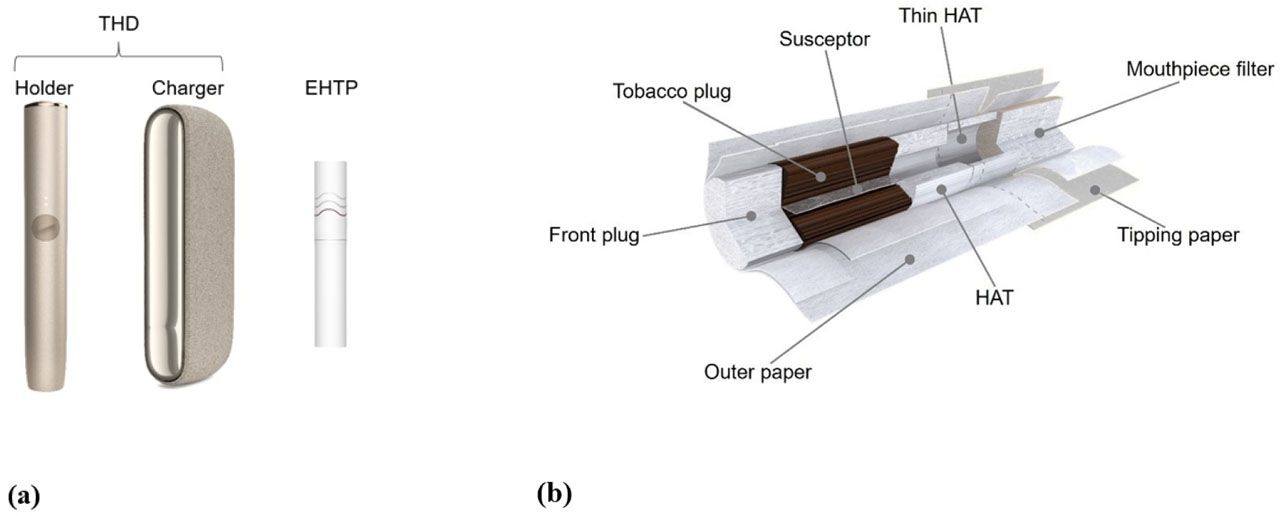
Figure 1.
The components of the (a) THS 3.0 and (b) EHTP (reproduced from (43)).
EHTP: electrically heated tobacco products; HAT: hollow acetate tube; THD: tobacco heating device; THS: Tobacco Heating System.
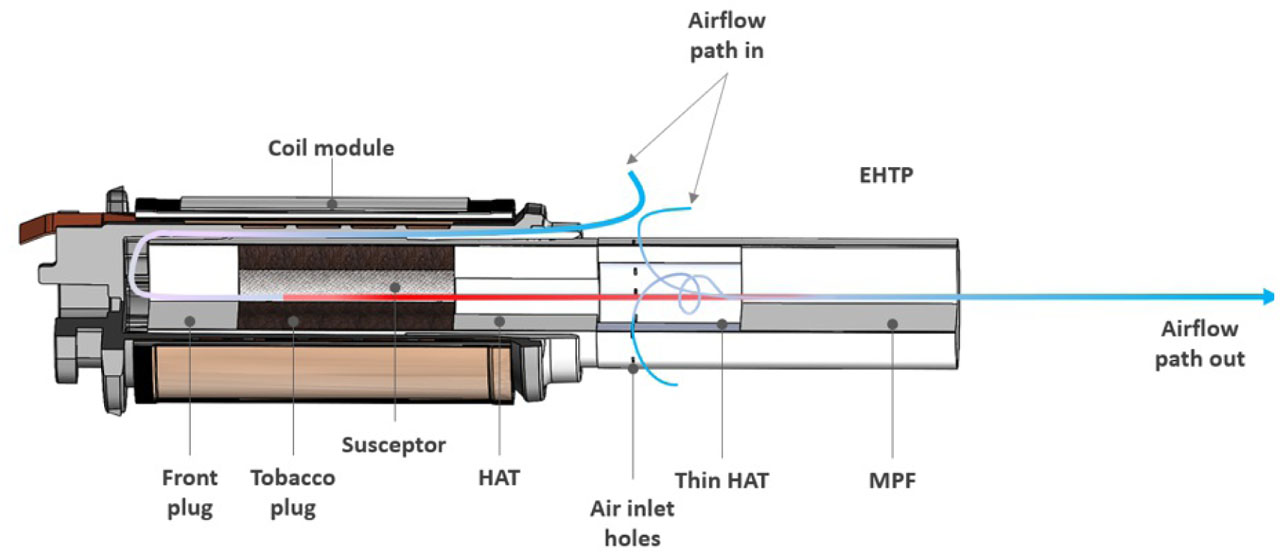
Figure 2.
Airflow path through the EHTP and holder during a puff.
EHTP: electrically heated tobacco product; HAT: hollow acetate tube; MPF: mouthpiece filter.
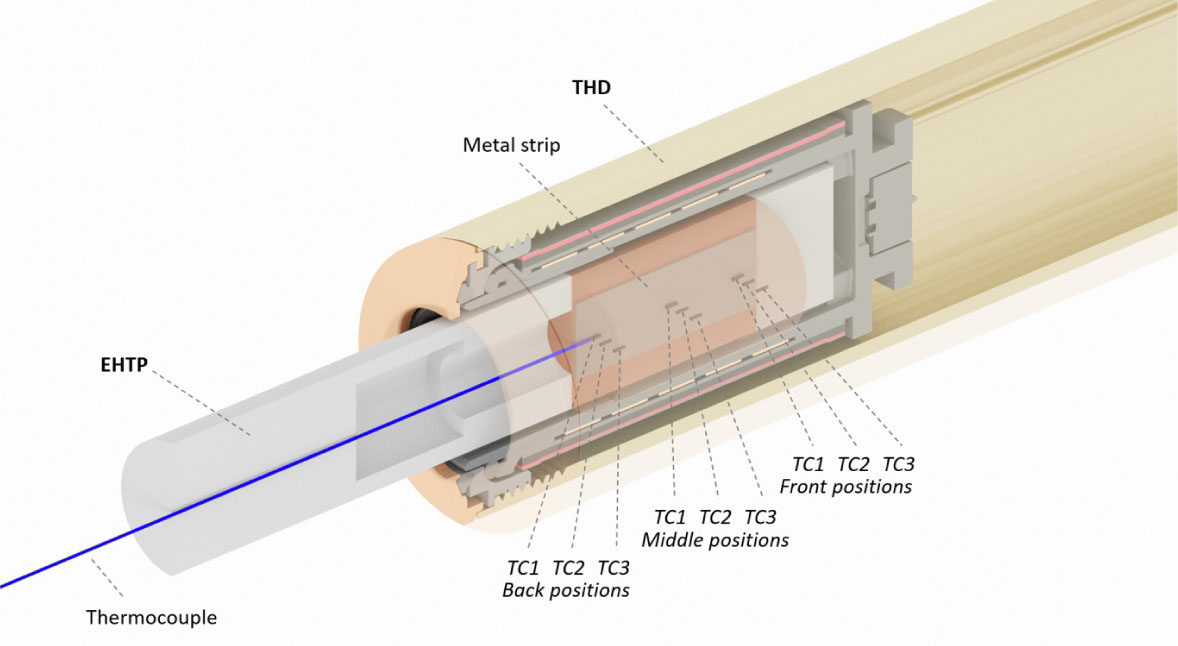
Figure 3.
Schematic representation of the positions of the thermocouples in the EHTP tobacco plug. The thermocouples TC1, TC2, and TC3 were radially positioned 0.5 mm, 1.5 mm, and 3.5 mm from the susceptor in the tobacco plug, respectively. The temperature in the tobacco substrate was measured at these three radial positions at three axial positions (front, middle, back).
EHTP: electrically heated tobacco product; TC: thermocouples; THD: tobacco heating device.
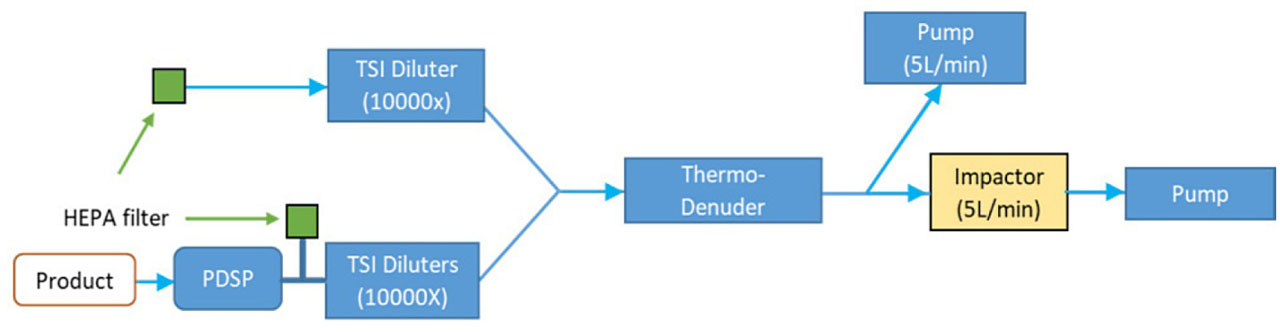
Figure 4.
Thermodenuded aerosol method: mainstream aerosol generation, thermodenuding, and collection (extracted from (37)).
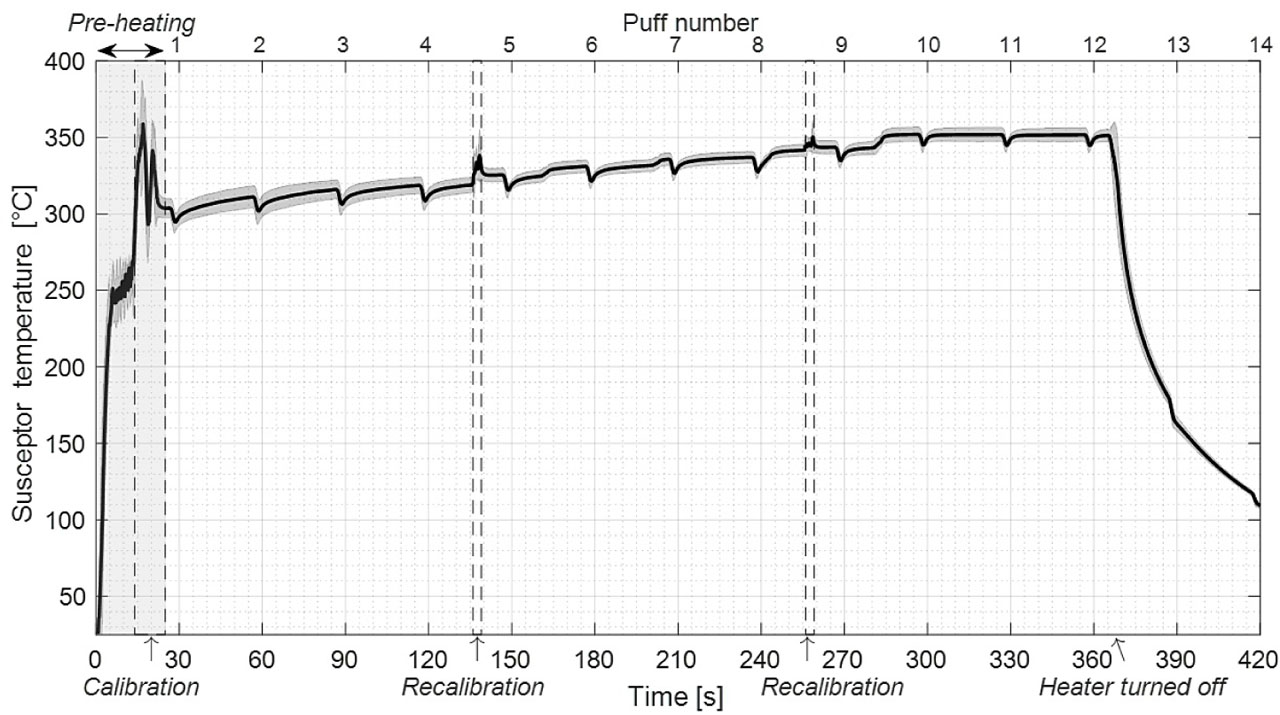
Figure 5.
Average susceptor temperature based on temperature data measured on the susceptor surface for five replicates.
The lines represent the average values, and the shaded areas indicate the range between ± one standard deviation.
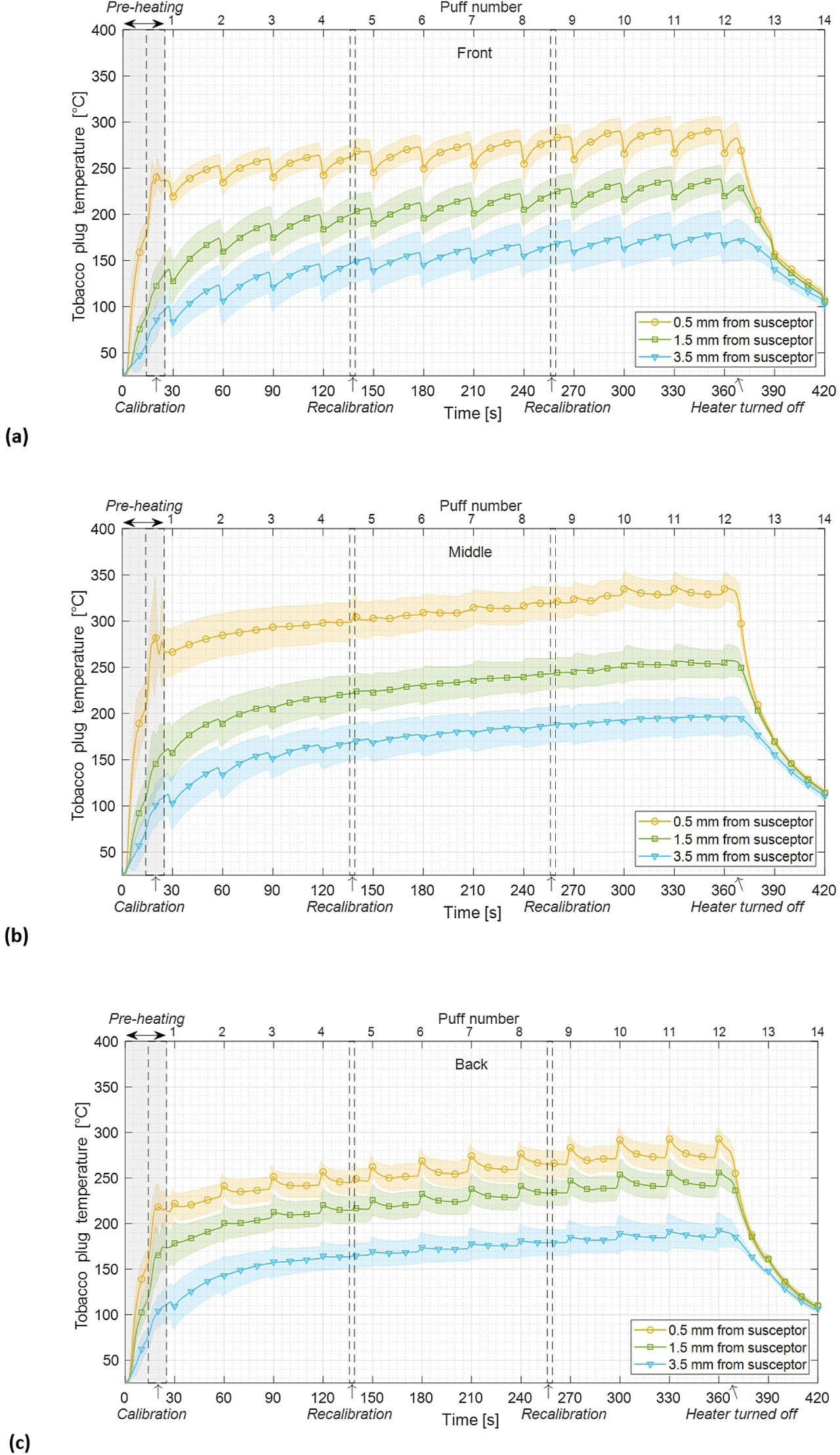
Figure 6.
Measured temperatures at (a) the front axial position, (b) the middle axial position, and (c) the back axial position at three different radial positions. The lines represent the average values of five replicates, and the shaded areas indicate the range between ± one standard deviation for each position.
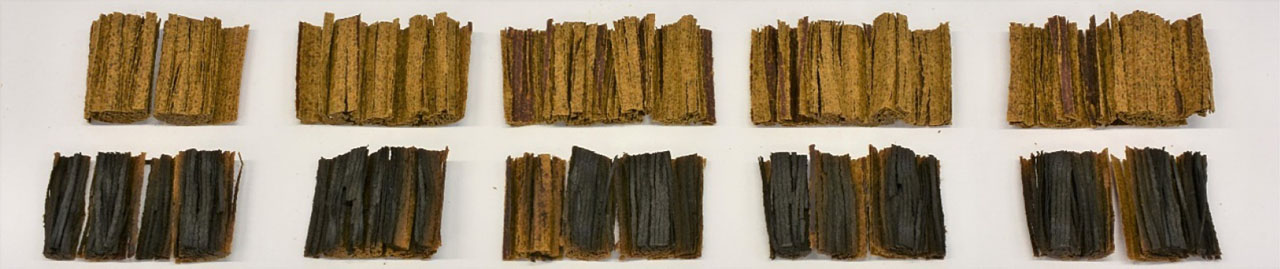
Figure 7.
Optical photographs of tobacco portions extracted from unused EHTPs (top row) and used EHTPs (bottom row) for five replicates.
Table 1.
CO, NO, NOx, and benzo[a]pyrene in reference cigarette smoke and in THS 3.0 aerosol under oxidative and non-oxidative atmospheres and ISO 20778 machine puffing regimen.
| Constituents | Units | 1R6F in air | EHTP in air | EHTP in nitrogen | |||
|---|---|---|---|---|---|---|---|
| Average | Standard deviation | Average | Standard deviation | Average | Standard deviation | ||
| CO | mg/unit | 28.91 | 2.14 | 0.19 | 0.01 | 0.14 | 0.00 |
| NO | μg/unit | 453.39 | 18.55 | 7.40 | 0.26 | 10.37 | 0.26 |
| NOx | μg/unit | 520.06 | 41.96 | 7.99 | 0.36 | 9.86 | 0.24 |
| Benzo[a]pyrene | ng/unit | 14.22 | 0.85 | 0.71 | 0.04 | 0.76 | 0.02 |
Table 2.
Comparison of analytes' concentrations in the THS 3.0 aerosol to maximum levels prescribed by BSI PAS 8850:2020 (33) under ISO 20778 machine puffing regimen.
| Analyte | Units | THS 3.0 aerosol in air | BSI PAS 8850:2020 emission thresholds | ||
|---|---|---|---|---|---|
| Average | Standard deviation | Maximum emission level | Confidence interval | ||
| CO | mg/100 cm3 | 0.029 | 0.0015 | < 0.3 | 25% |
| NO | μg/100 cm3 | 1.12 | 0.0394 | < 4.0 | 25% |
| NOx | μg/100 cm3 | 1.21 | 0.0545 | < 5.0 | 25% |
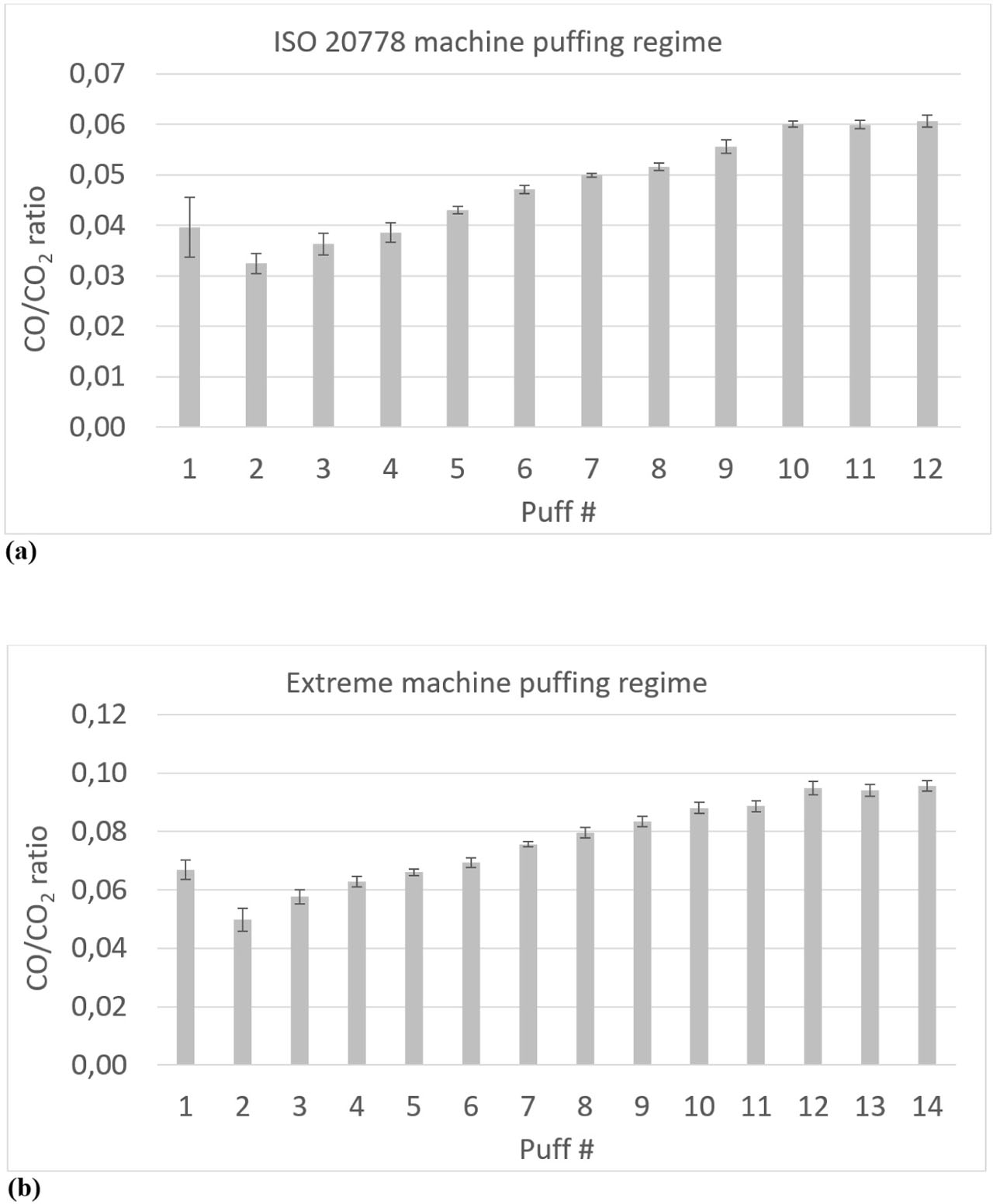
Figure 8.
CO/CO2 ratio for the THS 3.0 aerosol on a puff-per-puff basis under air using (a) ISO 20778 and (b) extreme machine puffing regimens.
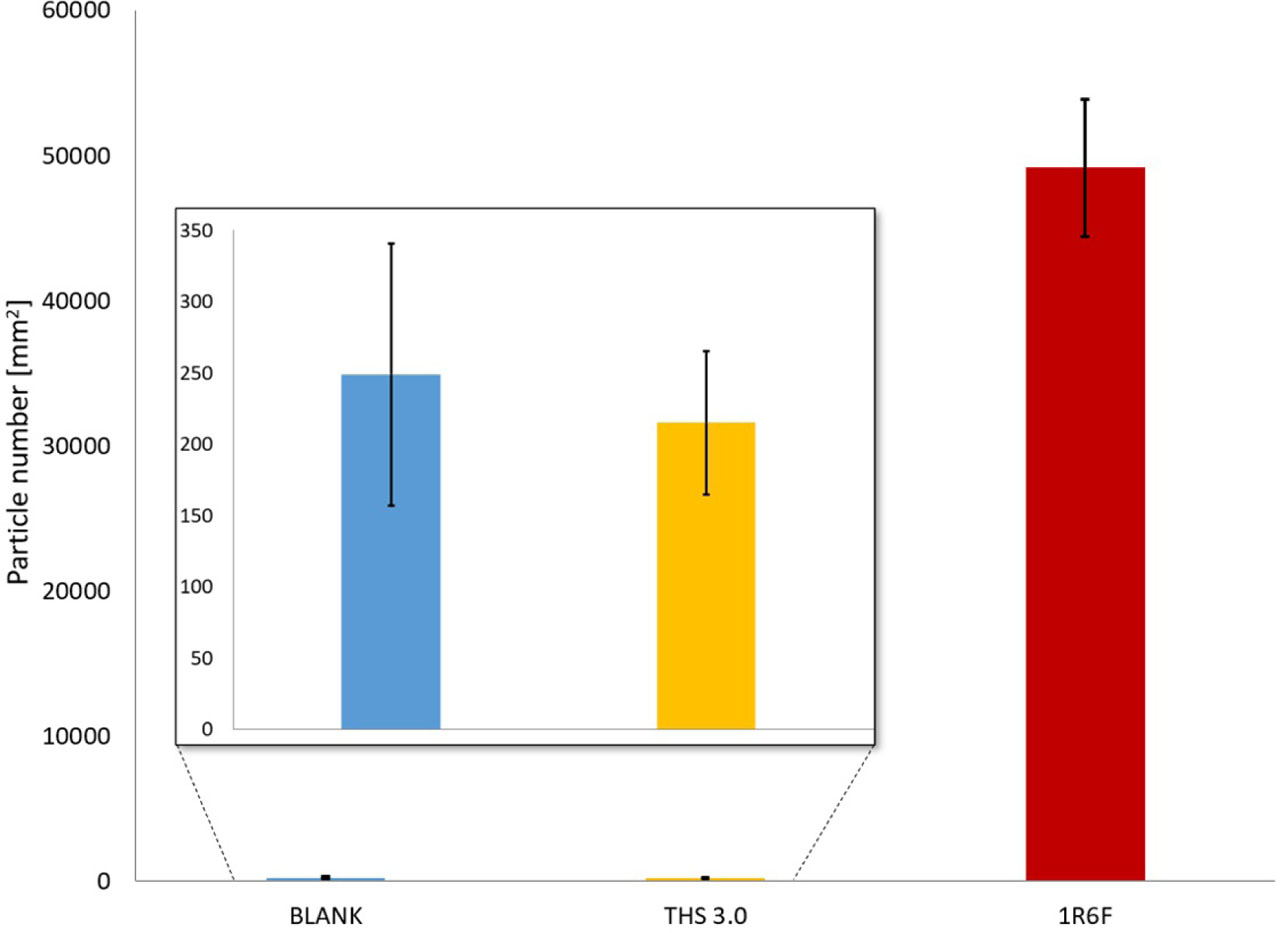
Figure 9.
The number of particles counted per mm2 for the blank air sample (blue), thermodenuded aerosol from THS 3.0 (yellow), and thermodenuded 1R6F reference cigarette smoke (red) reported as pooled average with the error bars representing ± one standard deviation.