
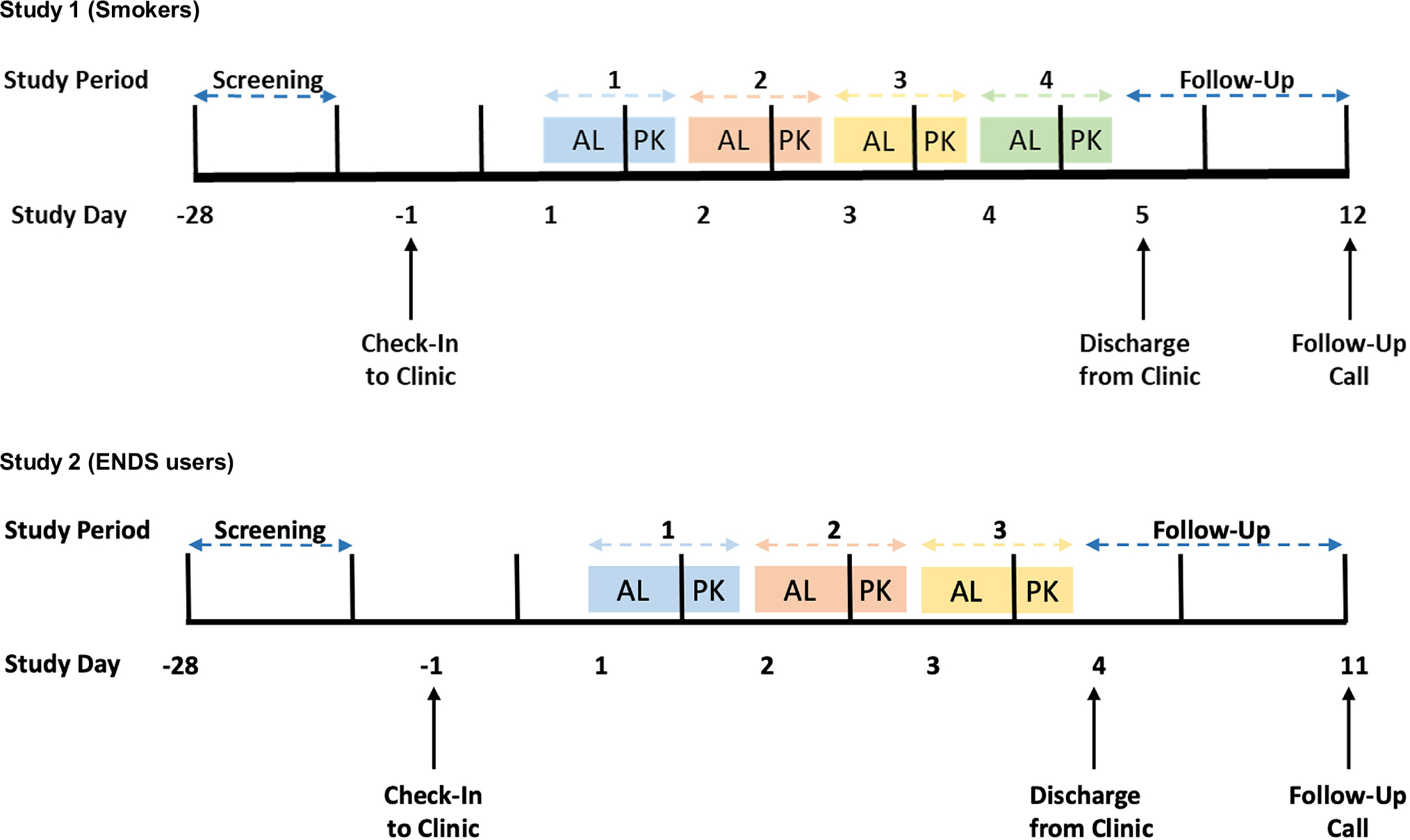
Figure 1.
Overview of study designs. In both studies, subjects underwent an 8-h ad libitum (AL) use session, after which they abstained from any nicotine product use for 10–13 h prior to nicotine pharmacokinetic (PK) sessions the following day. This sequence was followed once for each study product, in a randomized order. Each product use study period was completed over approximately 24 h. Subjects were confined to the clinic site throughout the assessments.
Table 1.
Subject demographics by study.
| Summary statistics / characteristics | Study 1 - Smokers | Study 2 - ENDS Users | |
|---|---|---|---|
| N | Number | 41 | 29 |
| Age, years a | Mean (SD) | 39.9 (9.51) | 39.8 (11.09) |
| Sex, n (%) | Male | 24 (58.5) | 17 (58.6) |
| Female | 17 (41.5) | 12 (41.4) | |
| Race, n (%) | White | 27 (65.9) | 13 (44.8) |
| Black or African | 13 (31.7) | 14 (48.3) | |
| American | |||
| American Indian or Alaska Native | 0 (0) | 1 (3.4) | |
| Other | 1 (2.4) | 1 (3.4) | |
| Ethnicity, n (%) | Not Hispanic or | 39 (95.1) | 24 (82.8) |
| Latino | |||
| Hispanic or Latino | 2 (4.9) | 5 (17.2) | |
| Body mass index (kg/m2) | Mean (SD) | 29.1 (4.86) | 26.6 (4.84) |
| PS[E]CDI total score b | Mean (SD) | 12.1 (2.8) | 11.4 (3.6) |
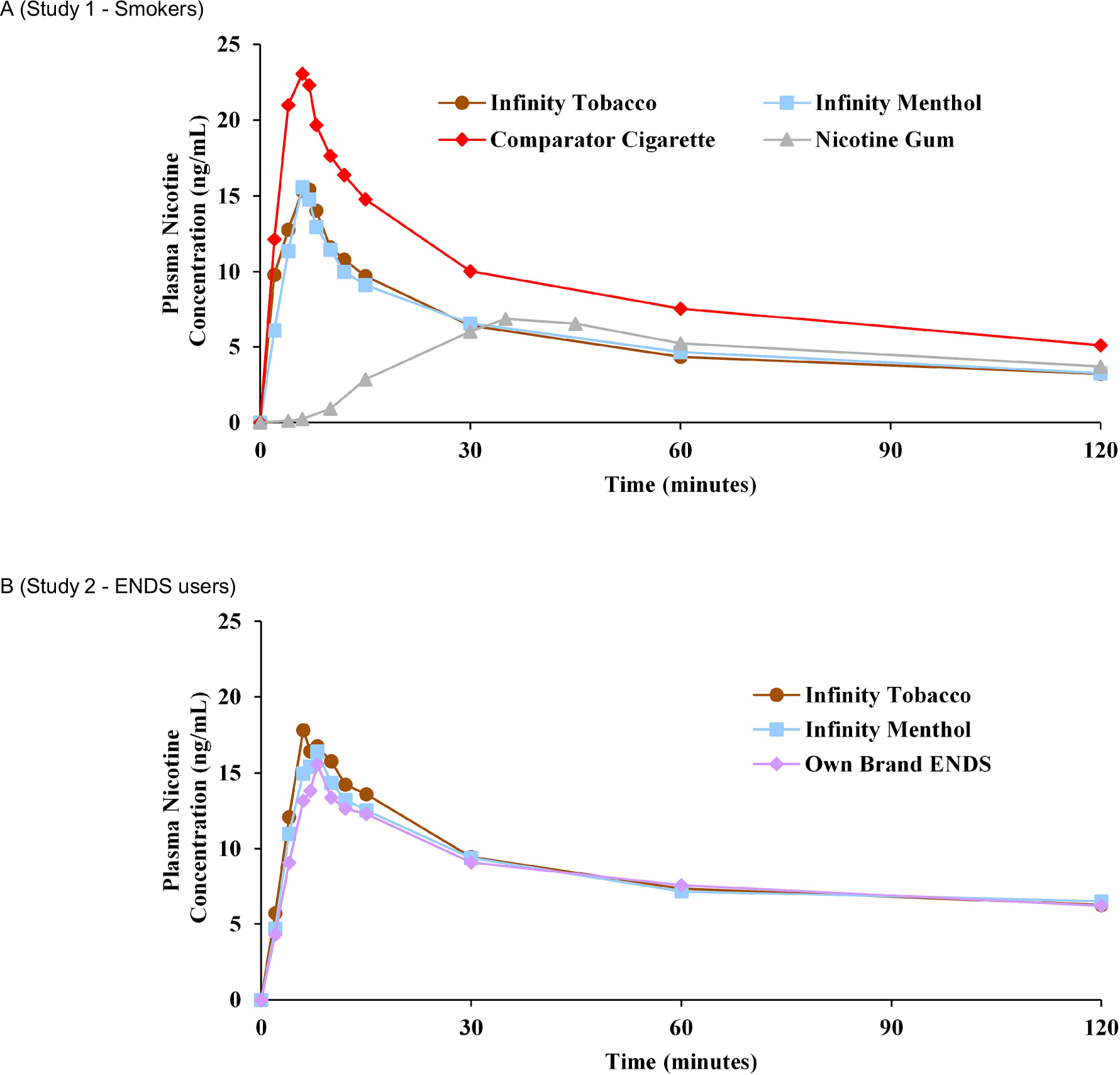
Figure 2.
Mean baseline-adjusted plasma nicotine concentration-time profiles in (a) smokers (Study 1) and (b) ENDS users (Study 2). Error bars have been removed for clarity; for variability estimates refer to Table 2.
Table 2.
Baseline-adjusted plasma nicotine pharmacokinetic parameters by study and product.
| Parameter (units) | Study 1 - Smokers | Study 2 - ENDS Users | |||||
|---|---|---|---|---|---|---|---|
| Infinity Tobacco | Infinity Menthol | Usual brand cigarette | Nicotine gum | Infinity Tobacco | Infinity Menthol | Usual brand ENDS | |
| N | 35 a | 34 | 37 b | 37 c | 27 d | 25 e | 25 f |
| Cmax(ng/mL) | 18.5 (100.2%) | 16.6 (84.9%) | 27.0 (60.5%) | 7.5 (56.2%) | 21.2 (72.5%) | 18.2 (51.4%) | 16.8 (79.7%) |
| Tmax(min) | 6.0 (2.0, 15.0) | 6.0 (2.0, 120.0) | 7.0 (2.0, 12.0) | 35.0 (15.0,122.0) | 8.0 (4.0, 123.0) | 8.0 (4.0, 123.0) | 8.0 (4.0, 28.0) |
| AUC(0–15)(ng×min/mL) | 171.6 (88.3%) | 153.5 (80.2%) | 246.00 (50.6%) | 12.1 (102.3%) | 190.2 (64.4%) | 173.5 (51.5%) | 160.4 (66.2%) |
| AUC(0–120)(ng×min/mL) | 676.5 (76.2%) | 634.1 (76.8%) | 1074.8 (31.9%) | 530.7 (59.7%) | 1046.2 (54.5%) | 990.9 (52.0%) | 1008.1 (57.2%) |
Data are presented as means (CV) for Cmax, AUC(0–15) and AUC(0–120), and median (minimum, maximum) for Tmax.
Abbreviations:
- AUC(0–15)
area under the nicotine concentration-time curve calculated from time zero to 15 minutes;
- AUC(0–120)
area under the nicotine concentration-time curve calculated from time zero to 120 minutes;
- CI
confidence interval;
- Cmax
maximum observed plasma concentration over the duration of the measurement interval after time zero;
- CV
coefficient of variation;
- LSmeans
least square means;
- N
number of observations;
- Tmax
time of maximum observed plasma nicotine concentration.
Table 3.
Statistical comparison of baseline-adjusted plasma nicotine pharmacokinetic parameters between Infinity Tobacco and Infinity Menthol and comparator products. Statistically significant p values are shown in bold text.
| Infinity Tobacco vs comparator | Infinity Menthol vs comparator | |||||
|---|---|---|---|---|---|---|
| Geometric LSmeans Ratio (%) | 90% CI (%) | p value | Geometric LSmeans Ratio (%) | 90% CI (%) | p value | |
| Usual brand cigarette (Study 1) | ||||||
| Cmax (ng/mL) | 48.3 | 35.74–65.19 | 0.0001 | 45.2 | 33.36–61.28 | < 0.0001 |
| AUC(0–15) (ng×min/mL) | 47.4 | 34.13–65.92 | 0.0003 | 44.5 | 31.99–61.86 | < 0.0001 |
| AUC(0–120) (ng×min/mL) | 45.5 | 34.95–59.20 | < 0.0001 | 43.0 | 33.02–56.03 | < 0.0001 |
| Tmax (min) | 0.8 (−0.5–2.5) | 0.00–1.50 | 0.0833 | 0.0 (−1.5–1.0) | −1.00–1.00 | 0.8504 |
| Nicotine gum (Study 1) | ||||||
| Cmax (ng/mL) | 185.6 | 137.31–250.99 | 0.0010 | 173.9 | 128.31–235.66 | 0.0032 |
| AUC(0–15) (ng×min/mL) | 1426.1 | 1027.58–1979.30 | < 0.0001 | 1337.5 | 964.61–1854.61 | < 0.0001 |
| AUC(0–120) (ng×min/mL) | 107.1 | 82.05–139.68 | 0.6715 | 101.2 | 77.55–132.16 | 0.9393 |
| Tmax (min) | −30.0 (−34.0–−26.0) | −33.00–−27.00 | < 0.0001 | −32.5 (−36.0–−27.0) | −34.00–−28.50 | < 0.0001 |
| Usual brand ENDS (Study 2) | ||||||
| Cmax (ng/mL) | 109.3 | 88.71–134.65 | 0.4784 | 109.4 | 88.45–135.20 | 0.4829 |
| AUC(0–15) (ng×min/mL) | 104.7 | 83.93–130.55 | 0.7295 | 107.5 | 86.08–134.23 | 0.5874 |
| AUC(0–120) (ng×min/mL) | 98.2 | 83.79–115.05 | 0.8466 | 103.2 | 87.98–121.08 | 0.7405 |
| Tmax (min) | 0.0 (−2.5–3.0) | −2.00–2.50 | 0.9053 | −0.5 (−3.0–5.5) | −2.50–3.00 | 0.7752 |
[i] The mixed-effect model included product, sex, day and sequence as fixed effects, and subject as a random effect. For each geometric least-squares mean, the ln-transformed estimate of the least-squares mean was exponentiated. For Cmax and AUC, the ln-transformed estimate of the least-squares mean difference was exponentiated and multiplied by 100 to obtain the geometric mean ratio and corresponding 90% CI. For Tmax, statistical significance was assessed using Wilcoxon signed-rank test.
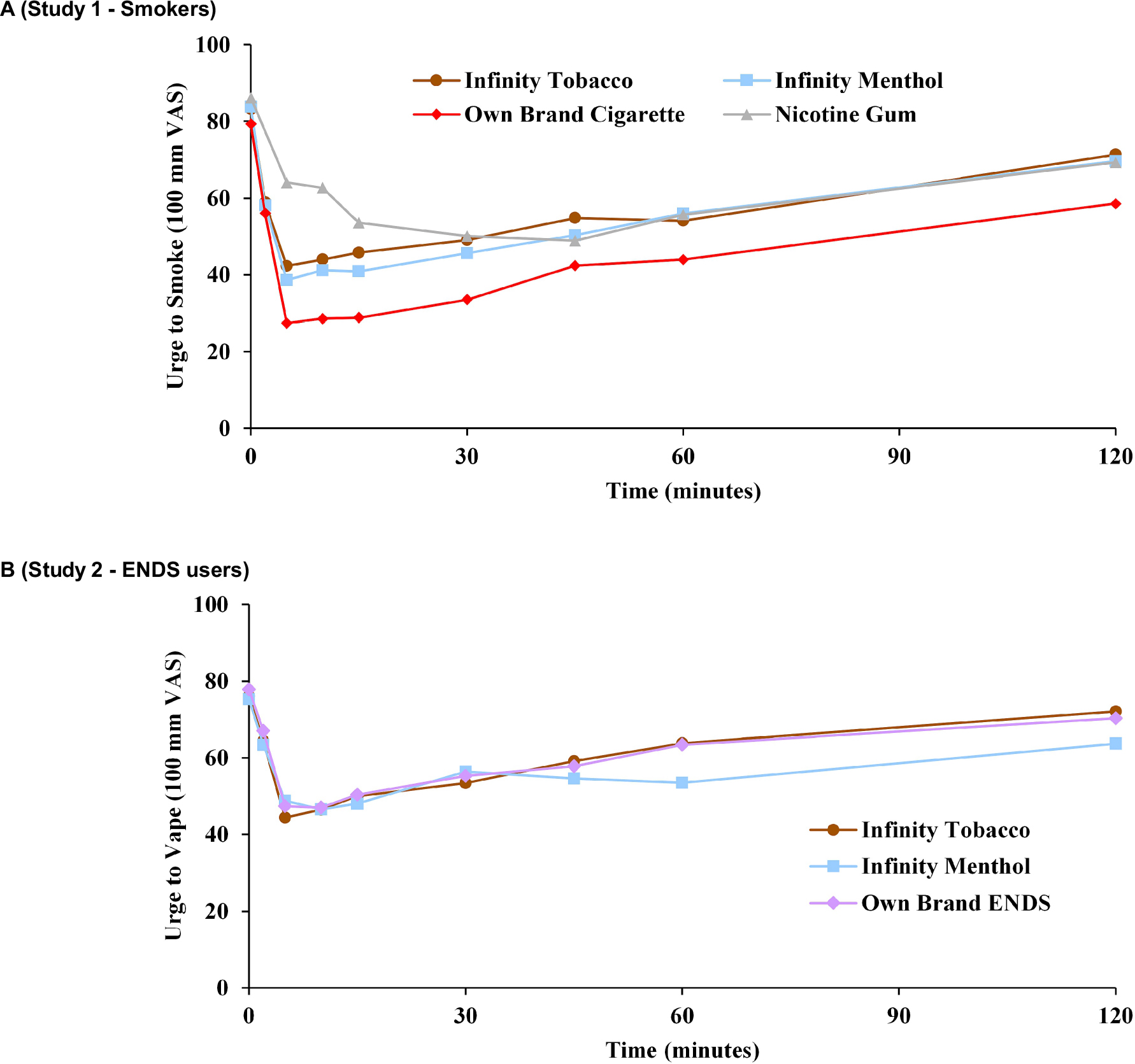
Figure 3.
Mean urge to smoke/vape VAS scores over time profiles in (a) smokers (Study 1) and (b) ENDS users (Study 2). Error bars have been removed for clarity; for variability estimates refer to Table 4.
Table 4.
Subjective effects questionnaires by study and product.
| Study 1 - Smokers | Study 2 - ENDS Users | ||||||
|---|---|---|---|---|---|---|---|
| Infinity Tobacco | Infinity Menthol | Usual brand cigarette | Nicotine gum | Infinity Tobacco | Infinity Menthol | Usual brand ENDS | |
| Urge to smoke/vape [mean (SD)] a | |||||||
| N | 38 | 38 b | 38 | 37 | 29 c | 28 d | 25 |
| Emax_R | −49.2 (37.57) | −53.0 (32.29) | −60.5 (31.41) | −48.2 (33.83) | −41.9 (28.32) | −36.8 (29.20) | −43.2 (29.52) |
| TEmax_R | 10.0 (2, 60) | 5.0 (2, 120) | 10.0 (2, 120) | 30.0 (5, 120) | 5.0 (2, 60) | 10.0 (2, 120) | 5.0 (2, 120) |
| AOE(0–15) | −8.3 (8.57) | −9.3 (6.84) | −10.4 (7.22) | −4.8 (5.58) | −6.1 (5.98) | −5.6 (6.61) | −5.8 (5.76) d |
| AOE(0–120) | −52.2 (72.28) | −56.5 (49.92) | −69.1 (65.39) | −54.0 (48.46) | −28.1 (49.20) | −38.4 (54.30) | −32.8 (39.34) |
| Modified product evaluation scale [mean (SD)] | |||||||
| N | 39 | 39 | 38 | 36 | 29 | 28 | 26 |
| Satisfaction | 3.5 (1.43) | 3.8 (1.62) | 5.2 (1.63) | 2.9 (1.19) | 3.8 (1.78) | 4.6 (1.58) | 4.5 (1.86) |
| Psychological reward | 3.1 (1.38) | 3.3 (1.26) | 4.1 (1.46) | 2.5 (1.10) | 3.2 (1.54) | 3.7 (1.68) | 3.6 (1.76) |
| Aversion | 1.4 (0.46) | 1.6 (0.63) | 1.4 (0.67) | 1.8 (0.96) | 1.7 (1.00) | 1.7 (1.35) | 1.7 (0.85) |
| Relief | 4.2 (1.44) | 4.3 (1.45) | 5.6 (1.20) | 3.5 (1.49) | 4.2 (1.48) | 4.8 (1.35) | 4.2 (1.64) |
| Concerned for dependence | 1.9 (1.48) | 1.9 (1.34) | 3.6 (2.25) | 1.5 (0.81) | 2.4 (1.70) | 2.3 (2.09) | 2.2 (1.58) |
| Product liking [mean (SD)] | |||||||
| N | 38 | 38 | 38 | 37 | 29 | 28 | 25 |
| Emax | 56.2 (32.40) | 59.6 (35.59) | 89.2 (17.15) | 47.3 (29.64) | 63.8 (32.91) | 77.5 (23.95) | 74.4 (25.49) |
| Future intent to use | |||||||
| N | 39 | 39 | 38 | 36 | 29 | 28 | 26 |
| Mean (SD) | 53.2 (33.26) | 51.8 (37.32) | 81.7 (24.69) | 37.6 (34.15) | 55.6 (36.27) | 76.5 (28.19) | 68.8 (32.99) |
| Frequency Counts | |||||||
| 0–49, n (%) | 13 (33.3) | 14 (35.9) | 4 (10.5) | 17 (43.6) | 11 (37.9) | 5 (17.2) | 7 (26.9) |
| 50, n (%) | 5 (12.8) | 3 (7.7) | 0 (0) | 2 (5.1) | 2 (6.9) | 2 (6.9) | 1 (3.8) |
| 51–100, n (%) | 21 (53.8) | 22 (56.4) | 34 (89.5) | 17 (43.6) | 16 (55.2) | 21 (72.4) | 18 (69.2) |
Abbreviations:
- AOE
area over the effect-time curve relative to pre-product use from time zero to the relevant time point;
- Emax
maximum effect among all the post-product use assessments over the duration of the measurement interval;
- Emax_R
maximum reduction post-product use from pre-product use score over the duration of the measurement interval;
- N/n
number of observations;
- SD
standard deviation;
- TEmax_R
time of the maximum reduction in response over the duration of the measurement interval.
Table 5.
Statistical comparisons of subjective effects measures between Infinity Tobacco and Infinity Menthol and comparator products. Statistically significant p values are shown in bold text.
| Infinity Tobacco vs comparator | Infinity Menthol vs comparator | |||||
|---|---|---|---|---|---|---|
| Difference | 95% CI (%) | p value | Difference | 95% CI (%) | p value | |
| Usual brand cigarette (Study 1) | ||||||
| Urge to smoke Emax_R | 13.4 (5.35) a | 2.7–24.0 | 0.0142 | 11.8 (5.34) a | 1.2–22.3 | 0.0300 |
| Urge to smoke TEmax_R | 0.0 (−6.5–5.0) b | −4.00–4.00 | 1.0000 | 0.0 (−8.0–12.5) b | −6.00–5.00 | 0.9920 |
| mPES Satisfaction | −1.6 (0.29) a | −2.2–−1.1 | <0.0001 | −1.4 (0.29) a | −1.9–−0.8 | <0.0001 |
| mPES Psychological reward | −0.9 (0.22) a | −1.4–−0.5 | <0.0001 | −0.7 (0.22) a | −1.2–−0.3 | 0.0018 |
| mPES Relief | −1.4 (0.26) a | −1.9–−0.9 | <0.0001 | −1.3 (0.26) a | −1.9–−0.8 | <0.0001 |
| mPES Aversion | 0.3 (−0.50–0.63) c | −0.25 – 0.50 | 0.3075 | 0.2 (0.119) d | −0.04 – 0.44 | 0.1045 |
| mPES Concern for dependence | −1.6 (0.30) d | −2.25–−1.02 | <0.0001 | −1.7 (0.30) d | −2.26–−1.06 | <0.0001 |
| Product liking | −23.00 (−58.00–−12.00) c | −49.00–−15.00 | <0.0001 | −22.00(−61.00–−5.00) c | −33.00–−8.00 | <0.0001 |
| Future intent to use | −27.6 (6.66) d | −41.12–−14.15 | 0.0002 | −23.0 (−49.00–−1.00) c | −34.00–−4.00 | 0.0012 |
| Nicotine gum (Study 1) | ||||||
| Urge to smoke Emax_R | −6.0 (5.39) a | −16.6–4.7 | 0.2725 | −7.6 (5.36) a | −18.2–3.1 | 0.1611 |
| Urge to smoke TEmax_R | −22.5 (−39.0–−10.0)b | −32.50–−14.00 | <0.0001 | −17.5 (−34.0–−4.0) b | −28.00–−7.50 | 0.0006 |
| mPES Satisfaction | 0.6 (0.29) a | 0.1–1.2 | 0.0336 | 0.9 (0.29) a | 0.3–1.5 | 0.0026 |
| mPES Psychological reward | 0.6 (0.23) a | 0.1–1.0 | 0.0169 | 0.8 (0.23) a | 0.3–1.2 | 0.0009 |
| mPES Relief | 0.7 (0.27) a | 0.2–1.3 | 0.0070 | 0.8 (0.27) a | 0.3–1.3 | 0.0040 |
| mPES Aversion | −0.3 (−1.13–0.25) c | −0.75–0.25 | 0.1516 | −0.2 (0.180) d | −0.56–0.17 | 0.2912 |
| mPES Concern for dependence | 1.0 (1.00–3.00) c | −1.00–4.00 | 0.0923 | 1.0 (0.00 – 2.00) c | 1.00–2.00 | 0.0768 |
| Product liking | 9.08 (5.875) d | −2.843–21.010 | 0.1311 | 11.81 (6.603) d | −1.580–25.202 | 0.0821 |
| Future intent to use | 16.9 (8.42) d | −0.17–34.05 | 0.0522 | 15.1 (8.86) d | −2.90–33.12 | 0.0972 |
| Usual brand ENDS (Study 2) | ||||||
| Urge to vape Emax_R | −0.8 (4.22) a | −9.3–7.7 | 0.8451 | 2.6 (4.24) a | −5.9–11.1 | 0.5427 |
| Urge to vape TEmax_R | 0.0 (−5.0–15.0) b | −4.00–14.00 | 0.8434 | 4.0 (−1.5–13.0) b | −1.50–12.50 | 0.1706 |
| mPES Satisfaction | −0.8 (0.33) a | −1.4–−0.1 | 0.0238 | 0.0 (0.34) a | −0.6–0.7 | 0.9421 |
| mPES Psychological reward | −0.40 (−1.20–0.40) c | −1.200–0.400 | 0.3833 | 0.20 (−0.60–0.80) c | −0.600–0.800 | 0.8145 |
| mPES Relief | 0.01 (0.313) d | −0.636–0.652 | 0.9806 | 0.20 (−0.80–1.00) c | −0.400–0.800 | 0.6776 |
| mPES Aversion | 0.05 (0.272) d | −0.512–0.608 | 0.8610 | −0.25 (−0.75–0.63) c | −0.750–0.500 | 0.8238 |
| mPES Concern for dependence | −0.15 (0.336) d | −0.846–0.538 | 0.6510 | −1.00 (−2.50–2.00) c | −3.000–3.000 | 0.3877 |
| Product liking Emax | −11.9 (6.85) a | −25.6–1.9 | 0.0885 | 1.8 (6.89) a | −12.0–15.6 | 0.7946 |
| Future intent to use | −13.5 (6.82) d | −27.58–0.50 | 0.0581 | 3.0 (−3.00–11.00) c | −3.00–11.00 | 0.8318 |
a LSmeans difference (standard error), 95% confidence interval, and p value from the linear mixed-effects model that included product, sex, day and sequence as fixed effects, and subject as a random effect.
b Median of the paired difference (quartile 1–quartile 3) and 95% confidence interval from the Hodges-Lehmann test for paired differences and p value from the Wilcoxon signed-rank test.
c The sign test was used to assess the difference between the two products, with the median of the paired difference (quartile 1–quartile 3), 95 % confidence interval, andp value presented.
d A paired t-test was used to assess the difference between the two products, with the mean difference (standard error), 95% confidence interval, and p value presented.
Abbreviations:
- CI
confidence interval;
- Emax
maximum effect among all the post-product use assessments over the duration of the measurement interval;
- Emax_R
maximum reduction post-product use from pre-product use score over the duration of the measurement interval; mPES modified Product Evaluation Scale;
- N/n
number of observations;
- SD
standard deviation;
- TEmax_R
time of the maximum reduction in response over the duration of the measurement interval.