
INTRODUCTION
Although moist smokeless tobacco (MST) use is not as prevalent as cigarette smoking, approximately 5.2 million adults in the United States (2.1%) reported they were currently using MST in a 2021 survey (1). The two primary forms of MST found in the United States (U.S.) market are loose and pouched; like loose MST, pouched MST is made from ground or cut tobacco. These are different to the rapidly emerging, newer oral tobacco-derived nicotine pouches that do not contain any cut, ground, or leaf tobacco, accounting for the low to non-quantifiable levels of tobacco-specific nitrosamines (TSNAs) and other harmful and potentially harmful components (HPHCs) and resulting exposure (2, 3). Users of loose MST self-select a pinch of the product and place it between the cheek and gum, whereas users of pouched MST place pre-portioned MST, encased in pouch material, between the cheek and gum.
Earlier studies (summarized in Supplemental Table 1) indicated that the average pinch mass among adults who use loose MST products was approximately 2 g used for ~ 45–60 min. Hatsukami et al. surveyed a local population of young U.S. college males using Copenhagen® MST (N = 56) and observed an average pinch mass of 1.97 g (range 0.62–5.91 g) that was kept in the mouth for approximately 39.9 min (4). A second study of MST use in undergraduate males (N = 30) by Hatsukami et al. found that the average dry weight of tobacco after use was 0.75 g per dip (range 0.13–3.12 g) and was kept in the mouth for an average of 39.6 min (range 19.1–106 min) (5). A small 1992 study by Baldini et al. (N = 12) reported use patterns in both “light” and “heavy” users, and found that “light” users were using an average of 1.8 cans per week and 6 dips per day, which at 34 g per can of MST can be extrapolated to approximately 1.5 g per pinch (assuming that they were daily users) (6). Lemmonds et al. reported that a population of Upper Midwestern males (N = 54) were using an average of 3.4 cans per week and 6.8 dips per day for 71.2 min, extrapolating to an average pinch mass of 2.4 g (7). Severson et al. described that a population of U.S. males (N = 94) used on average a 1.2 g pinch for 59 min (8). Gritz et al. found that a small population of undergraduate males (N = 12) used an average of 10.8 g/day for 24.2 min per pinch (9). Thomas et al. reported an average time in the mouth of 82.9 min in a population of predominantly male users (N = 68) (10).
Most recently, Nighbor et al. investigated the use topography and nicotine pharmacokinetics in loose and pouched MST products and reported an average use of a single pinch of loose MST as 2.99 g used for 53.2 min, and the average amount for portioned (pouched) MST use as 1.52 g for 45.5 min (11). The wide-ranging reported use patterns may be driven by differences in sample sizes, study specific populations, different tobacco use criteria and length of use, or study designs. Moreover, very little information exists on pouched MST users, therefore additional systematic characterization is needed to better understand the use topography of MST.
Understanding MST use topography is essential as it can directly impact exposure to harmful and potentially harmful constituents (HPHCs). Two key HPHCs in MST are nicotine and tobacco-specific nitrosamines (e.g., N-nitrosonornicotine (NNN)). Both nicotine and NNN are naturally occurring constituents found in tobacco. Nicotine, while addictive and not benign is not directly responsible for tobacco-caused cancer, lung disease, and heart diseases (12). NNN is classified as a human carcinogen by the International Agency for Research on Cancer (IARC) (13, 14). Exposure to both constituents can be measured non-invasively with biomarkers in urine.
The use behavior of MST products, such as how much (pinch mass/number of pouches), how often (number of use occasions) and how long (duration of use), have not been systematically characterized for a full day of use. Moreover, the relationship between patterns of use and the resulting exposure to HPHCs, like nicotine and NNN, have not been reported in detail. In the current study, we characterized the MST use topography and daily exposure to nicotine and NNN over an entire day. In addition, we examined the relationship between the measured use parameters and the resulting exposure to gain insights regarding the role of different product use behavior parameters on biomarkers of HPHCs linked to potential disease outcomes (15).
METHODS
Study design
We conducted a multi-site, single-blind, 2-way crossover study for the assessment of use and exposure to a test and reference MST product (not reported here). At the start of the study prior to randomization, participants used their own brand MST ad libitum, and as part of the baseline assessment the amount and duration of each use was recorded as well as 24-h urine samples; we report here the findings from the baseline measurements. This study was conducted in the U.S. at 11 sites from eight different geographically diverse states (AR, CA, KY, MO, NC, OH, TN, and TX). Study participants were under clinical confinement without access to any other tobacco products for the entire observational period. All pertinent study documents were reviewed by an independent Institutional Review Board (IRB), Advarra Institutional Review Board (Columbia, MD), prior to study initiation. The investigator and all research staff conducted the study in accordance with the ethical standards in the Declaration of Helsinki, Council for International Organizations of Medical Sciences International Ethical Guidelines, and applicable sections of the ICH GCP Guidelines (16).
Study participants
Participants included healthy adult males and females 21–65 years of age who used MST products (N = 230). All information collected on tobacco use history was by subject's self-report. Participants had to meet the following key inclusion criteria:
1) using loose and/or pouched MST products regularly (every day or some days) for at least 12 months prior to screening,
2) using at least a ½ can per day in the 30 days prior to screening, and
3) have a positive urine cotinine test (≥ 500 ng/mL) to confirm recent and consistent MST use.
Health evaluations included physical exams, measurements of vital signs, safety laboratory collections (chemistry, hematology, and urinalysis), and an electrocardiogram. Primary exclusion criteria included any clinically significant medical condition, including females who were pregnant or lactating, and those with poor oral health or dental fixtures that would prevent them from using the MST products. Participants were excluded if they self-reported plans to quit MST use in the 30 days from the screening visit or regularly used combustible cigarettes or any other tobacco- or nicotine-containing products other than MST within 5 days prior to check-in. Moreover, participants were referred to resources regarding quitting the use of tobacco products at screening and the end of the study.
Study products
Participant's own brand loose or pouched MST product were noted at screening and the brand names can be found in the Supplementary Materials (Supplemental Table 2).
Product use behavior
Participants checked into the clinical sites on Day -2 and were allowed to continue the use of their own brand MST until ~ 23:00. On Day -1 participants continued to use their own brand MST product ad libitum from 07:00 through 23:00 ( ± 5 min). All product use (number of pinches and weight of each pinch – pinch mass, number of pouches, and duration of each use occasion) was documented by the site staff and 24-h urine was collected starting at ~ 7 a.m. on Day -1 after first morning void and before product use. Through ~ 7 a.m. the following day (after the first morning void) all urine voided by each subject was collected in 24-h intervals. In addition to using their own brand products participants selected the pinch mass or the number of pouches used during each use session; participants who used pouch products could use more than one pouch simultaneously during a single use session.
Biomarkers of exposure
Nicotine equivalents were calculated as the molar sum of nicotine and five major nicotine metabolites (cotinine, cotinine glucuronide, trans-3-hydroxycotinine, trans-3-hydroxycotinine glucuronide, and nicotine glucuronide) excreted in urine over 24 h. The 24-h urine excretion of nicotine and these five metabolites (often abbreviated as Nicotine Equivalents; NE) reflects ~ 90% of the daily nicotine uptake (17). NE was determined by liquid chromatography/tandem mass spectrometry (LC-MS/MS) after solid-phase extraction (SPE) (18); NNN was also determined by LC-MS/MS after SPE (19). NNN levels are reported as ng/24 h and NE levels are reported as mg/24 h. In addition, creatinine was determined using a photometric assay, the value was used for the calculation of relative NNN levels (NNN ng/g creatinine) and NE (NE mg/g creatinine). This allows for better comparison of our findings to the reported values for NNN and NE (see DISCUSSION).
Clinical safety endpoints
Clinical safety endpoints including electrocardiograms, physical examinations (including oral exam), vital signs, hematology, clinical chemistry, and urinalysis) were assessed at the beginning and end of the study. Adverse experiences (AEs) were coded using the Medical Dictionary for Regulatory Activities (MedDRA) V21.1. AEs reported here occurred before randomization on study Day -1.
Statistical analysis
Data for overall and by exclusive use of own brand loose or pouched MST were summarized using descriptive summary statistics, including the number of participants with non-missing data, arithmetic mean, arithmetic standard deviation (SD), median, minimum, and maximum. The use behavior variables included: average pinch mass (g/use occasion), total weight of loose pinch used per day (g/24 h), the average number of pouches per use occasion, total number of pouches used per day (number/24 h), average duration of pinch or pouch in mouth per use occasion (min/occasion), total duration of pinch or pouches used per day (min/24 h), and number of use occasions of pinch or pouches used per day (number/24 h).
Data for NE and NNN were summarized by overall own brand loose or pouched MST products and by exclusive use of loose or pouched MST using descriptive statistics (N, mean, SD, minimum, median, maximum, geometric mean, and 95% confidence interval (CI). The summary statistics were calculated for the 24-h urine and creatinine-adjusted NE and NNN levels. Values of individual components below the limit of quantification (BLOQ) were set to one-half of the lower limit of quantification (LLOQ) prior to use in the calculations.
The relationship between each variable of product use behavior measurements and 24-h urine NE and NNN levels were investigated for both loose and pouched MST using linear regression analysis. Representative examples of regression plots are included in Figures 1 and 2.
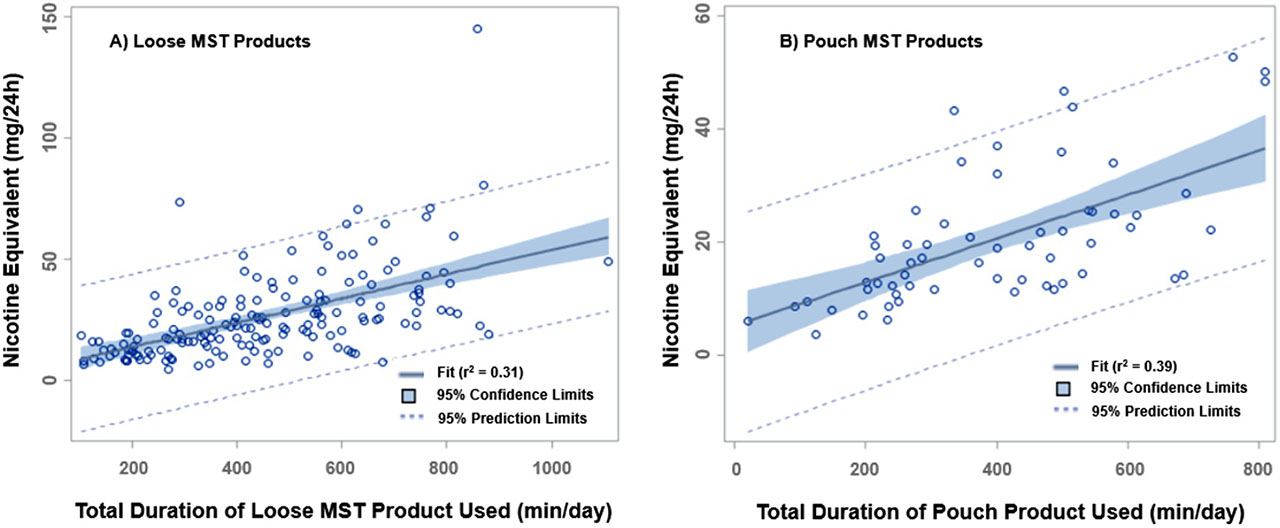
Figure 1.
Relationship between nicotine equivalents (mg/24 h) and total duration of use (min). Each symbol represents the individual daily urinary nicotine equivalent levels (mg/24 h) and daily total duration of use loose (A) or pouched (B) MST products. Total duration of loose or pouched MST product use was calculated as the sum of the measured time duration for each use occasion by each participant. Each symbol represents the individual daily urinary nicotine equivalent levels (mg/24 h) and number of loose or pouched MST product use occasions. A significant linear relationship (p < 0.05) was observed based on the linear regression analysis.
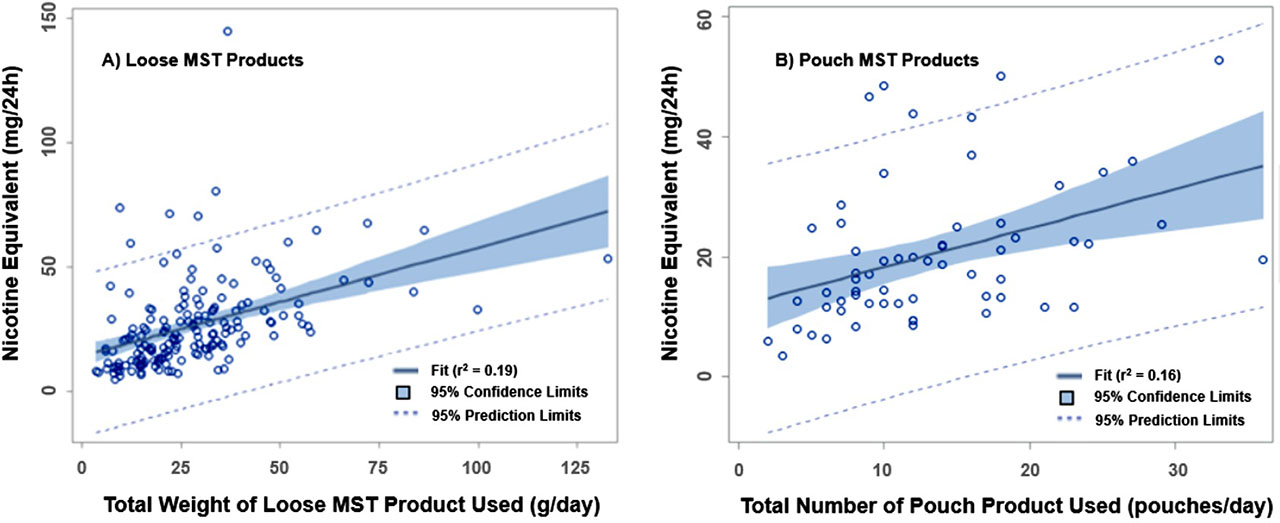
Figure 2.
Relationship between nicotine equivalents (mg/24 h) and total weight of loose MST product / Total number of pouches used per day. Each symbol represents the individual daily urinary nicotine equivalent levels (mg/24 h) and number of loose (A) or pouched (B) MST product use occasions. A significant linear relationship (p < 0.05) was observed based on the linear regression analysis.
General linear models were used to compare product form (pouch or pinch) effect on 24-h urine NE and NNN values. General linear models were utilized to test the effect of age category (≤ 45 years, or > 45 years), gender, body mass index (BMI), average duration per use, average number of pouches per use (pouch users only), average weight per use (loose MST users only), number of occasions product was used, and the two-way and three-way interaction effects of the last three main effects on the 24-h NE and NNN levels. Backward model selection was performed to select the final models. Interaction effects with p-values greater than 0.10 or main effect with p-values greater than 0.05 were dropped during the selection process.
RESULTS
A total of 230 eligible people were enrolled; one participant was excluded from this analysis due to use of both pouch and loose MST on Day -1. The demographic characteristics are shown in Table 1.
Table 1.
Demographics.
| Characteristics | Loose MST n = 168 | Pouched MST n = 61 | Overall N = 229 |
|---|---|---|---|
| Mean age (SD), years | 37.6 (11.61) | 36.9 (10.75) | 37.4 (11.37) |
| Sex, n (%) | |||
| Male | 160 (95.2) | 54 (88.5) | 214 (93.4) |
| Female | 8 (4.8) | 7 (11.5) | 15 (6.6) |
| Race, n (%) | |||
| American Indian / Alaska native | 4 (2.4) | 1 (1.6) | 5 (2.2) |
| Asian | 1 (0.6) | — | 1 (0.4) |
| Black | 16 (9.5) | 9 (14.8) | 25 (10.9) |
| White | 145 (86.3) | 50 (82.0) | 195 (85.2) |
| Multiple | 2 (1.2) | 1 (1.6) | 3 (1.3) |
| Ethnicity, n (%) | |||
| Hispanic or Latino | 3 (1.8) | 3 (4.9) | 6 (2.6) |
| Not Hispanic or Latino | 165 (98.2) | 58 (95.1) | 223 (97.4) |
| Mean BMI (SD), kg/m2 | 29.3 (5.21) | 29.4 (4.97) | 29.3 (5.14) |
Overall, the mean age was 37.4 years, and the mean BMI was 29.3 kg/m2. The majority of participants were male (93.5%), White (85.2%) or Black or African American (10.9%); only 2.6% were Hispanic or Latino. Only one participant reported using MST some days/occasionally, all others reported daily MST use.
Product use behavior
At baseline, 73% (n = 168) of participants reported using a loose format MST product, with the remaining 27% (n = 61) using a pouch product. The three most used loose MST brands were Grizzly® (34%), Copenhagen® (25%), and Skoal® (11%), and the most common flavors used were Wintergreen (65%), Straight (10%), and Mint (8%). The three most used pouch brands were Grizzly® (50%), Copenhagen® (23%), and Skoal® (13%), and the three most used flavors were Wintergreen (74%), Mint (18%), and Apple or Natural (3% each).
As shown in Table 2, those participants who used loose MST product used an average of 4.3 ± 2.20 g/pinch for an average ± SD duration of 74.0 ± 33.88 min/occasion, a total of 6.5 ± 2.24 occasions/day, for a total average weight use of 28.14 ± 18.22 g/day and a total duration of use of 451.6 ± 203.04 min over the entire study day product use period of 16 h. Pouch use was an average of 2.23 ± 0.97 pouches/occasion for an average duration of 69.1 ± 32.49 min, on 6.1 ± 2.63 occasions/day for a total duration of use of 395.8 ± 186.93 min and total number of pouches 13.3 ± 7.38, over the entire study day product use period of 16 h among those participants who used pouch products.
Table 2.
Summary statistics for product use behavior. Data reflect a product use period of 16 h.
| Product use behavior | N | Mean | SD | Min | Median | Max |
|---|---|---|---|---|---|---|
| Loose MST | ||||||
| Average duration of use (min) | 168 | 73.95 | 33.884 | 15.6 | 70.48 | 188.00 |
| Average pinch mass (g) | 168 | 4.34 | 2.194 | 0.6 | 3.91 | 14.70 |
| Total number of use occasions/day | 168 | 6.50 | 2.240 | 2.0 | 6.00 | 14.00 |
| Total duration of use (min/day) | 168 | 451.6 | 203.040 | 103.0 | 434.50 | 1108.00 |
| Total weight used (g/day) | 168 | 28.14 | 18.222 | 3.5 | 24.47 | 132.70 |
| Pouched MST | ||||||
| Average duration of use (min) | 61 | 69.07 | 32.493 | 21.0 | 61.00 | 172.30 |
| Average number of pouches per use | 61 | 2.23 | 0.966 | 1.0 | 2.00 | 7.20 |
| Total number of use occasions/day | 61 | 6.00 | 2.640 | 1.0 | 5.00 | 15.00 |
| Total duration use (min/day) | 61 | 395.84 | 186.93 | 21.0 | 400.00 | 809.00 |
| Total number used/day | 61 | 13.3 | 7.380 | 2.0 | 12.00 | 36.00 |
Biomarkers of exposure
Urinary NE levels were significantly lower (p = 0.0209) in pouched MST users at 20.4 ± 11.81 mg/24 h vs 26.3 ± 18.11 mg/24 h for loose MST users (Table 3). NNN levels were not significantly different (p = 0.2766) between pouched MST users (62.0 ± 43.71 ng/24 h) compared to loose MST users (78.0 ± 91.71 ng/24 h).
Table 3.
Summary statistics for biomarkers of exposure.
| Biomarker of exposure | MST product format | N | Mean | SD | Min | Median | Max | Geometric mean | 95% CI of Geomean |
|---|---|---|---|---|---|---|---|---|---|
| Nicotine equivalents (mg/24 h) | Loose | 168 | 26.27 | 18.111 | 4.3 | 22.29 | 144.90 | 21.62 | 19.65–23.78 |
| Pouch | 61 | 20.40 | 11.807 | 3.5 | 17.19 | 52.60 | 17.46 | 15.08–20.23 | |
| NNN (ng/24 h) | Loose | 168 | 78.00 | 91.712 | 7.3 | 53.56 | 908.80 | 53.32 | 46.80–60.76 |
| Pouch | 61 | 61.99 | 43.714 | 1.9 | 44.17 | 183.93 | 46.44 | 37.62–57.33 |
Relationship between BOE and product use behavior
The relationships between BOE and individual components of product use behavior, while linear, positive, and statistically significant in all cases, were generally weak (r2 ≤ 0.3) to moderate (r2 ≥ 0.31). Specifically for loose MST product use, we report the relationship between NE and: total duration/day (r2 = 0.314), total weight/day (r2 = 0.1945), total number of occasions/day (r2 = 0.1836), average pinch mass/occasion (r2 = 0.0804), and average duration of use/occasion (r2 = 0.0569). The relationship between NNN and loose product use behavior was weaker with the regression coefficient ranging from 0.0014 to 0.0623. Additionally, for pouched MST product use, we report the relationship between NE and: total duration/day (r2 = 0.3785), total number of pouches/day (r2 = 0.1651), total number of occasions/day (r2 = 0.2209), average number of pouches/occasion (r2 = 0.0022), and average duration of use/occasion (r2 = 0.0857).
The relationship between NNN and pouch product use behavior was weak with the regression coefficients ranging from 0.0076 to 0.2084.
Overall, the total duration of use per day, regardless for loose (r2 = 0.31) or pouch (r2 = 0.38) product, had the highest regression coefficient relative to other use behavior variables (Figure 1 (A) and (B)). The final general linear model indicated that number of use occasions, average time in mouth, and average pinch mass were the most significant factors impacting NE exposure among loose MST product users (r2 = 0.4954). The number of use occasions had a higher F-value = 113.45, relative to the average time in the mouth (F-value = 43.84) and average pinch mass (F-value = 17.19). Similarly, for NNN exposure these factors and age (data not shown) were significant factors impacting NNN exposure (r2 = 0.3328) and similar ranking of the use behavior variables was observed. For pouched MST users the relationship between BOE and use behavior had similar outcomes for NE (r2 = 0.4916) and NNN (r2 = 0.4741).
DISCUSSION
We report the most current and systematic characterization of use behavior in a relatively large sample of 229 participants using their own brand loose or pouched MST products. The observations were carefully documented by clinic staff from ad libitum use over the study day period of 16 h. Our findings indicate that for loose MST products, the average pinch mass is larger than previously reported for loose MST (~ 4 g vs ~ 2–3 g), and these products are kept in use for a longer duration (~ 74 min) and are used for ~ 6 occasions per day. We also observe that, on average, adults who use pouched MST products use ~ 2 pouches per use occasion, which lasts for ~ 70 min. The exposure to nicotine (NE) resulting from this use behavior pattern indicates that NE levels were significantly lower among pouched MST users than loose MST users, but NNN levels were not significantly different. Our analyses indicate that ~ 50% and ~ 33% of the variability in daily exposure to nicotine and NNN, respectively, can be explained by use behavior, with the number of use occasions exhibiting the highest impact. The findings reported from our analysis are unique and add to the current body of literature on how MST products are used. Most studies report consumption of cans per day or cans per week and rely on self-reported observations. Additionally, there is limited evidence regarding ad libitum use behavior over an entire day, especially for pouched products. Earlier studies have suggested that the average pinch mass among adults who use commercial MST products is approximately 2 g and used for ~ 40 min (4, 5, 8). In a recent study, Nighbor et al. (9) observed an inclinic measurement of pinch mass as 2.99 g among a relatively small sample size of 29 participants using loose MST products for 53 min and pouch users using 1.5 pouches at a time for 45 min (11). Of note was an outlier participant who used 74.7 g over the course of 8 h. Additionally, in the Nighbor et al. study, the participants took a pinch of loose or pouch for the first hour, and blood samples were collected to measure plasma nicotine for the entire hour, followed by ad libitum use for an additional seven hours with blood samples collected every hour; the interventions for blood sampling may have disrupted true ad libitum use. In comparison, in our study, the participants were using their own brand loose or pouch products under ad libitum use settings for a period of 16 h, thus reflecting a full day of product use. Overall, our study suggests that MST product use behavior (amount and duration), when systematically characterized, is higher than typically reported in published literature. Our observations generally align with those reported by Nighbor et al., where they report a higher pinch mass and longer duration of use than earlier publications. Total number of pouches may be comparable as well; participants in this study used on average a total of 13.3 (SD = 7.38) pouches over 16 h, whereas Nighbor et al. reported participants using an average total of 7.4 (SD = 3.2) pouches over 8 h (11).
Our study provides insights regarding the relationship between BOEs to nicotine and NNN and actual use behaviors. Direct comparison of BOE levels observed in our study with those reported in the literature should take into consideration differences in sampling methods (e.g., 24-h urine vs spot urine) or units of measurements (e.g., mg/24 h, mg/g creatinine, μmol/g creatinine) or differences in descriptive statistics (geometric means vs arithmetic means) for the BOE. Although we utilized analytical methods generally consistent with methods described in the literature, minor differences in the bioanalytical methods may further complicate head-to-head comparisons. Cheng et al. reported geometric mean values for NNN in spot urine collections among exclusive daily smokeless tobacco users at a population level based on spot urine collection from the PATH Wave 1 dataset as 33.9 ng/g creatinine (95% CI: 29.6–38.8) (20). In our study population, the geometric mean levels for NNN, pooled across loose and pouched MST products, were 25.0 ng/g creatinine (95% CI: 27.69–30.68). Our observations, while trending lower than those reported by Cheng et al. (CI: 29.6–38.8), have comparable and overlapping 95% confidence intervals (20). Moreover, the differences could be attributed to differences in study populations and study design. In our study, we report exposure to NNN from use of a subset of smokeless tobacco products, i.e., own-brand loose and pouched MST products, from in-clinic measurements, whereas Cheng et al. report observations based on a cross-sectional assessment of a larger set of smokeless tobacco products (20). However, the arithmetic mean values for NNN (78.0 ± 91.71 mg/24 h) were higher in our study compared to those reported by Prasad et al. (48.9 ± 34.7 mg/24 h) in 40 MST users (21). The differences in NNN levels may be attributed to the reasons described above. A potential confounder could be the large interindividual variability observed with urinary measurements of NNN. In some cases, NNN excretion in urine can be influenced by NNN formation from nitrosation of nornicotine under acidic conditions endogenously and exogenously; hence, this additional variability in urinary NNN levels may complicate product-specific exposure assessments (22, 23).
It is noteworthy that the overall mean NE values observed in our study (24.7 ± 16.84 mg/24 h) were similar to that reported by Prasad et al. (29.4 ± 20.9 mg/24 h) from a cross-sectional sample of MST users (N = 40) (21). On the other hand, our NE values were lower than those reported by Cheng et al., however, their estimates from PATH were based on TNE-2 (urinary cotinine and trans-3′-hydroxycotinine), whereas we measured total NE (nicotine + five metabolites) based on mg/24-h urine collection. Therefore, we calculated the TNE-2 levels for our sample by utilizing only the urinary cotinine and trans-3′-hydroxycotinine in μmol/g creatinine units. The geometric mean TNE-2 values ranged from 41.6 μmol/g for loose MST and 35.7 μmol/g for pouched MST. These levels were lower than those reported by Cheng et al., 68.6 μmol/g (CI: 60.2–78.2) among exclusive daily ST users. The reasons for these differences may be attributed to the factors described earlier as well as the fact that the PATH analysis was based on spot urine collections from users of ST products (at the category level) whereas our measurements were based on 24-h urine collection among exclusive MST users. Additionally likely differences in duration of product use may also account for these differences.
Our analyses of the relationships between product use behavior and BOEs indicate that overall, the individual components of product use behavior (Table 2), while statistically significant, were weak (r2 < 0.3) to moderate (r2 > 0.31). Of the different parameters related to product use behavior, total duration of use over the study period was a better predictor of BOEs (Figures 1 and 2). However, our multivariate analysis demonstrates that all three parameters related to use behavior – average duration in mouth, average weight/number of pouches, as well as total number of use occasions, were all statistically significant (p < 0.001) factors in the model for both NE and NNN regardless of pouch or loose product use. Given that the statistical model explains ~ 33–50% of the variability in BOE, this suggests that these parameters are some of the primary factors impacting exposure to nicotine and NNN. Taken together, these three parameters provide a composite measure of the overall use behavior measure. Examination of the “dose-response” relationship by Rostron et al. indicated that the BOEs to NNK (based on concentrations of NNAL, a metabolite of NNK) for chewing tobacco and snuff users consistently increased by the frequency of use in terms of the number of days that they had used the product in the past 5 (24). These observations support our findings that exposure to nicotine and NNN is associated with product use behavior, of which the number of use occasions appears to have a relatively higher contribution than other parameters.
The strengths and limitations of this study must be considered when interpreting the results. To the best of our knowledge, this is the first study with such a large sample of own brand loose and pouched MST product users, as well as the systematic characterization of each product use behavior over a period of 16 h. We also examined the relationship between product use to NE and NNN based on 24-h urinary excretion. One limitation could be that the own brand MST use behavior may not be representative of the general population of MST users. However, based on their own brands used by the participants in the study (Supplemental Table 2), we believe that the brands of MST reasonably represent the most popular brands used in the U.S. Our secondary analysis (unpublished data) of the PATH dataset between 2015–2021 indicates a typical MST use pattern of about 0.6 cans/day of loose MST, whereas in our study the participants used on average ~ 0.8 cans/day (ranging from 0.1–4 cans/day). Comparison of our observations with published literature values for MST consumption is challenging because we report actual measurements whereas daily product use in published literature is often estimated from self-reported cans/week. Additionally, although the study participants were using the MST products under ad libitum conditions in an in-clinic setting to ensure precise measurements of product use, this may be considered a limitation since participants may exhibit different consumption patterns under a real-world, naturalistic setting. Another limitation could be that the 24-h NE and NNN could potentially include carry-over from previous day product use. However, the in-clinic measurement of the 24-h urinary excretion reflects a direct measurement of the systematically characterized product use and minimizes potential confounding from possible use of other tobacco product use. In addition, the use of the participants' own brand MST product allows for the most natural use occasion; however, each product may have different levels of nicotine and NNN, and this may confound the relationship of product used to exposure to these constituents.
Nighbor et al. (11) investigated the relationship between total and free nicotine and nicotine pharmacokinetic (PK) parameters and found weak correlations for both loose and portioned MST; the correlations between total nicotine and PK parameters were negative for loose MST. Furthermore, the chemical characterization of the loose and portioned products in their study revealed a very wide range of values for total and free nicotine where product pH likely plays an important role. We did not retain samples of the products used in our study, so our data are limited by the lack of information on the specific levels of pH, total nicotine, and free nicotine. Finally, typical MST use behavior is accompanied by expectoration of the saliva while the product is being used. We did not measure expectoration (whether it occurred or how much was expectorated during use), which could provide an additional variable of use behavior that may further inform the relationship between BOEs and use behavior.
In conclusion, under the conditions of this study, loose and pouched MST use appears to be higher than reported in the literature. Importantly, and not surprisingly, as much as ~ 33–50% of the variability in daily exposure to nicotine and NNN can be explained by use behavior. Although scientific evidence, including epidemiological studies, clearly indicates that smokeless tobacco products available in the U.S. are less risky than cigarettes, they are not risk-free (26). Understanding consumption patterns and their relationship with BOEs can provide valuable insights for developing suitable alternatives.
Notes
SUPPLEMENTARY INFORMATION
This publication contains supplementary material available at https://sciendo.com/de/article/10.2478/cttr-2025-0008.