
| Column 1 | Author, year, country (Reference) | (self-explaining) | |
| Column 2 | Study type | The following types are differentiated: cross-over, cross-sectional, RCT (randomized controlled trials), longitudinal, case-control, prospective | |
| Column 3 | User groups/Duration of product use | If available number (N) in each group, duration and daily consumption of product use, mean age of group is provided. If not indicated other, groups contain both sexes. Important study design features are also provided. | |
| Column 4 | Endpoints and findings | Major endpoints are given in bold. Abbreviations, see corresponding section at the beginning of the review. | |
| Column 5 | Comments (bias, compliance, etc.) | The authors’ main conclusion is provided (labeled as such, AO). Comments on issues with product compliance (in particular exclusive use of an NGP over a longer time period), generally originate from the review authors (ARO). | |
| Column 6 | Conclusions of nicotine’s role | Statement from the study authors (indicated as such, AO) or review authors are provided (ARO). In red, a simplified code for nicotine (N)’s role in generating the reported effects is stated: | |
| ? | N’s role cannot be deduced from the study data | ||
| 0 | N is not involved in producing the effect | ||
| 0.5 | N is partly responsible, other product features probably also play a role | ||
| 1.0 | N causes the observed effect (other product features play no or only minor roles) | ||
| Combinations of codes are possible. | |||
| Column 7 | Limitations (L) / Gaps (G) / Proposals (P) | These evaluations in general originate from the review authors (AOR). Proposals are provided, if the endpoints of the study look promising and an improved study is assumed to provide valuable data. | |
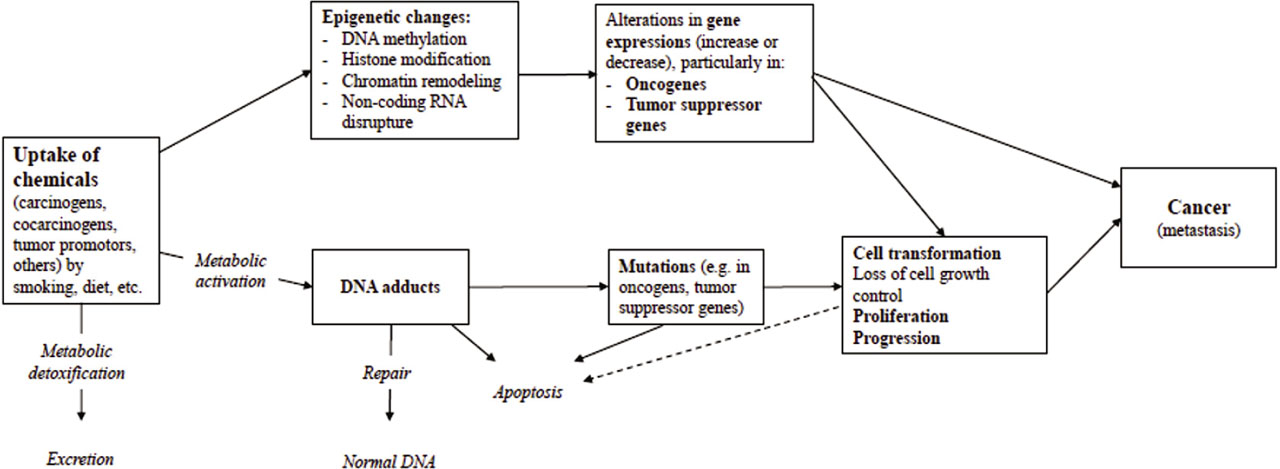
Figure 1.
Simplified scheme for mechanisms leading to smoking-related cancers (modified from (25)).
| Chronic obstructive pulmonary disease (COPD) | A preventable and treatable disease characterized by airflow limitation that is not fully reversible. The limitation is usually progressive and is associated with an abnormal inflammatory response of the lungs to noxious particles or gases, primarily caused by cigarette smoking. Although COPD affects the lungs, it also produces significant systemic consequences. |
| Emphysema | Permanent enlargement of the airspaces distal to the terminal bronchioles, accompanied by destruction of their walls and without obvious fibrosis. In patients with COPD, either condition may be present. However, the relative contribution of each to the disease process is often difficult to discern. |
| Asthma | A chronic inflammatory disease of the airways in which many cell types play a role — in particular, mast cells, eosinophils, and T lymphocytes. In susceptible persons, the inflammation causes recurrent episodes of wheezing, breathlessness, chest tightness, and cough, particularly at night and/or in the early morning. These symptoms are usually associated with widespread and variable airflow obstruction that is at least partly reversible either spontaneously or with treatment. The inflammation also causes an associated increase in airway responsiveness to a variety of stimuli. |
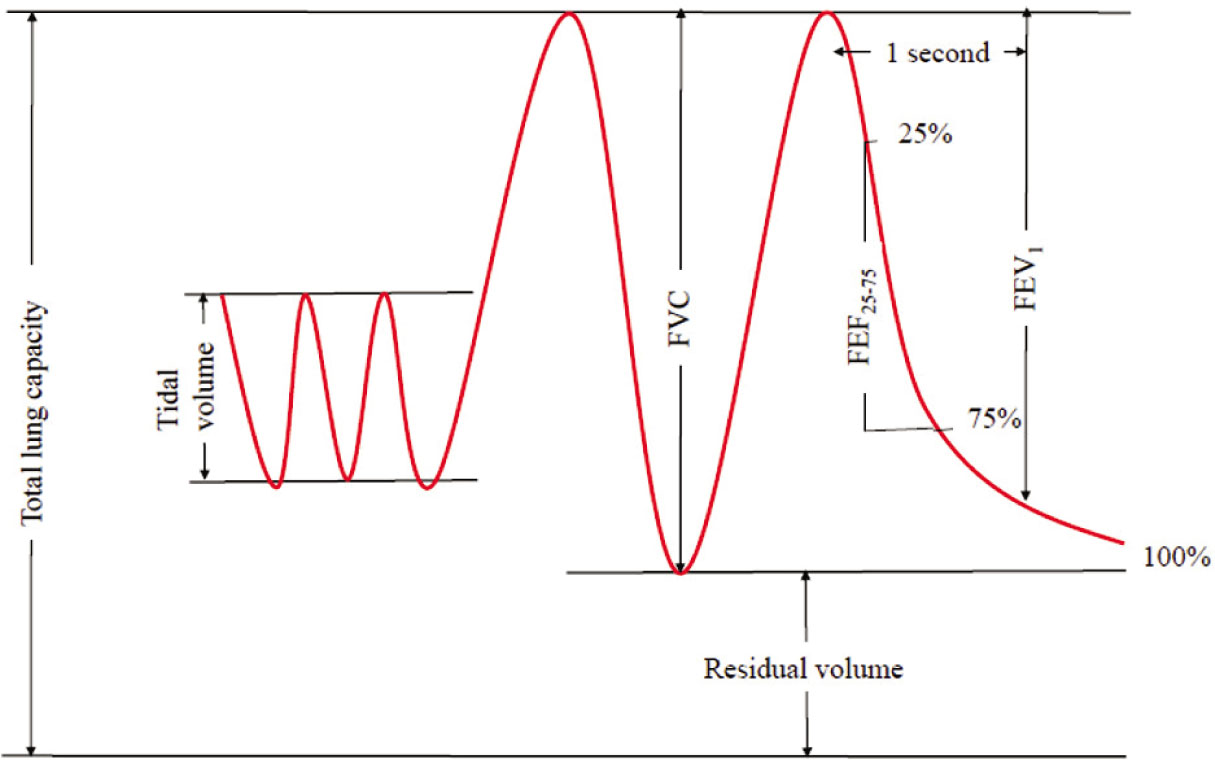
Figure 2.
Schematic spirogram for measuring the lung function parameters FVC, FEV1 and FEF25–75 (according to (190), modified).
Table 1.
CVD and CVD-related biomarkers of potential harm (BOPH).
| Author, year, country (Ref) | Study type | User groups / duration of product use | Endpoints and findings | Comments (bias, compliance, etc.) | Conclusions regarding nicotine's (N) role | Limitations (L) / Gaps (G) / Proposals (P) |
|---|---|---|---|---|---|---|
| Myocardial infarction (MI) | ||||||
| Huhtasaari et al. 1992, Sweden (39) | Case-control |
|
|
|
|
|
| 0 / ? | ||||||
| Huhtasaari et al. 1999, Sweden (40) | Case-control |
|
|
| The authors conclude that N is probably not an important contributor to ischemic heart disease in smokers. |
|
| 0 | ||||||
| Hergens et al. 2007, Sweden (41) | Prospective | 118,395 healthy, never-smoking men (construction workers), 19 years (mean) of follow-up |
|
|
|
|
| 0.5 / ? | ||||||
| Boffetta and Straif 2009, Sweden, USA (42) | Case-control and Prospective (meta-analysis) |
|
|
|
|
|
| 0.5 / ? | ||||||
| Arefalk et al. 2011, Sweden (43) | Prospective (2 studies) |
|
|
|
|
|
| 0.5 / ? | ||||||
| Alzahrani et al. 2018, USA (44) | Cross-sectional (NHIS = National Health Interview Survey) |
|
|
|
|
|
| ? | ||||||
| Vindhyal et al. 2020, USA (45) | Cross-sectional |
|
|
| ARO: N's role cannot be deduced. |
|
| ? | ||||||
| Stroke | ||||||
| Hergens et al. 2008, Sweden (48) | Prospective |
|
|
|
|
|
| 0.5 / ? | ||||||
| Parekh et al. 2020, USA (49) | Cross-sectional |
|
|
|
|
|
| 0 / ? | ||||||
| Bricknell et al. 2021, USA (50) | Cross-sectional |
|
|
|
|
|
| ? | ||||||
| Zhao et al. 2022, various countries (51) | 6 Cross-sectional studies (meta-analysis) |
|
|
| N's role in stroke cannot be deduced from these data. |
|
| ? | ||||||
| Patel et al. 2022, USA (52) | Cross-sectional |
|
|
| The authors cited evidence that N might be involved in HT, CHD and MI (other EC components involved: acrolein, particles). |
|
| 0.5 | ||||||
| Atherosclerosis, CVD, CHD and related markers | ||||||
| Wennmalm et al. 1991, Sweden (58) | Cross-sectional |
|
|
|
|
|
| ? | ||||||
| Bolinder et al. 1994, Sweden (56) | Prospective |
|
|
|
|
|
| 0–0.5 | ||||||
| Bolinder et al. 1997, Sweden (59) | Cross-sectional |
|
|
| The authors state that, while N might play a role in CVD, result show that N is not involved in the atherosclerotic process. |
|
| 0 | ||||||
| Wallenfeldt et al. 2001, Sweden (60) | Cross-sectional |
|
|
| The authors conclude that the data clearly indicate that N may not be the most important etiological factor in the atherosclerotic process. |
|
| 0 | ||||||
| Yatsuya et al. 2010, USA (57) | Prospective (1987/89, FU: median 16.7 y later) |
|
|
|
|
|
| ? | ||||||
| Nocella et al. 2018, Italy (62) | Cross-over |
|
|
|
|
|
| ? | ||||||
| Mobarrez et al. 2020, Sweden (63) | Cross-over |
|
|
|
|
|
| 1 | ||||||
| Sahota et al. 2021, USA (61) | Cross-sectional |
|
|
|
|
|
| ? | ||||||
| Arterial stiffness | ||||||
| Granberry et al. 2003, USA (65) | Cross-sectional |
|
|
|
|
|
| 1 / ? | ||||||
| Rohani et al. 2004, Sweden (66) | Cross-over |
|
|
|
|
|
| 1 | ||||||
| Skaug et al. 2016, Norway (67) | Cross-sectional |
|
|
|
|
|
| ? | ||||||
| Franzen et al. 2018, Germany (68) | Cross-over |
|
|
|
|
|
| 1 | ||||||
| Ikonomidis et al. 2018, Greece (69) | Cross-over |
|
|
|
|
|
| 0.5 | ||||||
| Charmant et al. 2018, Belgium (70) | Cross-over |
|
|
|
|
|
| 1 | ||||||
| George et al. 2019, UK (71) | RCT |
|
|
|
|
|
| 0 | ||||||
| Ikonomidis et al. 2020, Greece (72) | Cross-over | 40 S were switched to EC (12 mg N/mL) for 4 months, ad lib vaping (N = 20) or continued to smoke (N = 20) CC (own brand) |
|
|
|
|
| ? | ||||||
| Cossio et al. 2020, USA (73) | Cross-over |
|
|
|
|
|
| ? | ||||||
| Haptonstall et al. 2020, USA (74) | Cross-over |
|
|
| ARO: Nicotine is not involved in the acute decrease (impairment) of FMD. |
|
| 0 | ||||||
| Nicotine caused acute increases of HR, SBP and DBP. | ||||||
| 1 | ||||||
| Chronic use of nicotine (with CC or EC) does not lead to permanent changes in FMD, HR, SBP and DBP (at least in the population investigated). | ||||||
| 0 | ||||||
| Kuntic et al. 2020, Germany (75) | Cross-over | 20 Smokers vaped 1 EC (18 mg N/mL) with 40 puffs at 30 s intervals over 20 min, measurements for BMs were performed pre and post vaping |
|
|
|
|
| ? (human) / 0 (mice) | ||||||
| Fettermann et al. 2020, USA (76) | Cross-sectional |
|
|
| ARO: N can possibly play a role in the observed effect (but not to be deduced from the data). |
|
| 0.5 / ? | ||||||
| Podzolkov et al. 2020, Russia (77) | Cross-sectional |
|
|
|
|
|
| ? / 0 | ||||||
| Chatterjee et al. 2021, USA (78) and Caporale et al. 2019, USA (79) | Cross-over |
|
|
|
|
|
| ? | ||||||
| Antoniewicz et al. 2022, Sweden (80) | Cross-sectional |
|
|
| The authors cite (convincing) evidence that N is responsible for the observed effects. |
|
| 1 | ||||||
| Meng et al. 2022, various countries (82) | Meta-analysis (8 studies) |
|
|
|
|
|
| 1 | ||||||
| Mohammadi et al. 2022, USA (81) | Cross-sectional |
|
|
|
|
|
| ? | ||||||
| Hypertension (HT) | ||||||
| Bolinder et al. 1992, Sweden (87) | Cross-sectional |
|
|
|
|
|
| 1 / ? | ||||||
| Hergens et al. 2008, Sweden (88) | Prospective | 120,930 healthy, never-smoking men (construction workers), enrolled 1971–1978 (BL), follow-up (health-checks) 1978–1993; follow-up cohort: 42,005 (normotensive at BL) |
|
| The authors cite evidence that N can cause high blood pressure. ARO: Mechanistic involvement of N in causing increase in BP is possible. |
|
| 0.5 / ? | ||||||
| Miller et al. 2021, USA (89) | Cross-sectional |
|
|
|
|
|
| 0.5 / 1 | ||||||
| Kim et al. 2022, South Korea (90) | Cross-sectional |
|
|
|
|
|
| 0.5–1.0 | ||||||
| Heart rate (HR) and blood pressure (BP) | ||||||
| Benowitz et al. 1988, USA (92) | Cross-over |
| Comparable increases in HR, SBP, DBP under all 4 conditions (somewhat lower in NG). |
|
|
|
| 1 | ||||||
| Van Duser and Raven 1992, USA (93) | Cross-over |
|
|
| The authors ascribe the observed (acute) effects to N. |
|
| 1 | ||||||
| Bolinder et al. 1998, Sweden (94) | Cross-sectional |
|
|
|
|
|
| 0.5 / 1.0 | ||||||
| Moheimani et al. 2017, USA (95) | Cross-over |
|
|
|
|
|
| 1 | ||||||
| Boas et al. 2017, USA (96) | Cross-sectional |
|
|
|
|
|
| 0.5 / 1 | ||||||
| Ruther et al. 2018, Germany (97) | Cross-over |
|
|
|
|
|
| 1 | ||||||
| Spindle et al. 2018, USA (98) | Cross-over |
|
|
|
|
|
| 0.5 / 1 | ||||||
| Hickling et al. 2019, UK (99) | Longitudinal (6 weeks) | 50 Smokers (with schizophrenia and other mental disoders), 30 y, were provided with free ECs (4.5% N) for 6 weeks |
|
|
|
|
| ? | ||||||
| Skotsimara et al. 2019, various countries (100) | Cross-sectional | Meta-analysis of 14 studies, in total 441 participants: Healthy smokers and switchers to ECs |
|
|
|
|
| 0.5–1 | ||||||
| Pulvers et al. 2020, US (101) | RCT |
|
|
|
|
|
| ? | ||||||
| Biondi-Zoccai et al. 2019, Italy (102) | Cross-over | 20 Smokers (CC) were assigned to CC, EC and HTP, with 1 week wash-out periods. One unit of each product was used (1 CC, 9 puffs of EC, 1 stick of HTP). |
|
|
|
|
| ? | ||||||
| Maloney et al. 2019, USA (103) | Cross-over |
|
|
|
|
|
| 1 | ||||||
| Benowitz et al. 2020, USA (104) | Cross-over |
|
|
|
|
|
| ? | ||||||
| Garcia et al. 2020, USA (105) | Various (systematic review) |
|
|
|
|
|
| 1 | ||||||
| Hiler et al. 2020, USA (106) | Cross-over |
|
|
|
|
|
| 1 | ||||||
| Ip et al. 2020, USA (107) | Cross-over and cross-sectional |
|
|
|
|
|
| 1 | ||||||
| ||||||
| 0.5 | ||||||
| Gonzalez et al. 2021, USA (108) | Cross-over |
|
|
|
|
|
| 1 | ||||||
| Caponnetto et al. 2021, Italy (109) | Longitudinal (12 weeks) | 40 Smokers (schizophrenics), 48.3 y, 28 cig/d, were provided with ECs for free for 12 weeks |
|
|
|
|
| ? | ||||||
| Other BOBEs related to CVD (oxidative stress, inflammation, lipids) | ||||||
| Eliasson et al. 1991, Sweden (113) | Cross-sectional |
|
|
|
|
|
| ? | ||||||
| Siegel et al. 1992, USA (114) | Cross-sectional |
|
|
|
|
|
| 0 / ? | ||||||
| Eliasson et al. 1995, Sweden (115) | Cross-sectional |
|
|
|
|
|
| 0 / ? | ||||||
| Moffatt et al. 2000, USA (116) | Cross-over (longitudinal) | Smokers (CC, 10 m/17 f, 35 y/38 y), 29 cig/d, stopped CC at day 0, NRT (N-patch) until day 35, no CC and NRT until day 77 Non-smokers (NU, 7 m/9 f, 42 y/40 y) |
|
|
|
|
| Moheimani et al. 2017, USA (117) | Cross-sectional |
|
|
|
|
|
| 0.5 / ? | ||||||
| Ludicke et al. 2018, Japan (118) | Cross-over (longitudinal, 90 d) |
|
|
|
|
|
| ? | ||||||
| Walele et al. 2018, UK (119) | Cross-over (longitudinal, up to 24 months) |
|
|
|
|
|
| ? | ||||||
| Haziza et al. 2020, USA (120) | Cross-over (longitudinal, 90 d) |
|
|
|
|
|
| ? | ||||||
| Fettermann et al. 2020, USA (76) | Cross-sectional |
|
|
|
|
|
| 0.5 / ? | ||||||
| Kim et al. 2020, South Korea (121) | Cross-sectional |
|
|
|
|
|
| ? | ||||||
| Majid et al. 2021, USA (122) | Cross-sectional |
|
|
|
|
|
| 0–0.5 | ||||||
| Gale et al. 2021, UK (123) | Cross-over (longitudinal, 180 d) |
|
|
|
|
|
| ? | ||||||
| Amraothar et al. 2022, USA (124) | Cross-sectional |
|
|
|
|
|
| ? | ||||||
Table 2.
Cancer and cancer-related BOPH/BOBEs.
| Author, year, country (Ref) | Study type | User groups / duration of product use | Endpoints and findings | Comments (bias, compliance, etc.) | Conclusions regarding nicotine's (N)role | Limitations (L) / Gaps (G) / Proposals (P) |
|---|---|---|---|---|---|---|
| Bolinder et al. 1994, Sweden (56) | Prospective |
|
|
|
|
|
| 0 / ? | ||||||
| Accortt et al. 2002, USA (161) | Prospective |
|
|
|
|
|
| 0 / ? | ||||||
| Alguacil et al. 2004, USA (162) | Case-control |
|
|
|
|
|
| 0–0.5 | ||||||
| Murray et al. 2009, USA (163) | Prospective |
|
|
|
|
|
| 0 / ? | ||||||
| Corbett et al. 2019, USA (168) | Cross-sectional |
|
|
|
|
|
| ? | ||||||
| Flacco et al. 2020, USA (169) | Observational study (longitudinal) |
|
|
|
|
|
| ? | ||||||
| Caliri et al. 2020, USA (164) | Cross-sectional |
|
|
|
|
|
| ? | ||||||
| Richmond et al. 2021, UK (166) | Cross-sectional |
|
|
|
|
|
| ? | ||||||
| Hamad et al. 2021, USA (167) | Longitudinal (3 visits over 3 weeks) | 3 Vapers (EC, 6 mg N/mL), had not smoked for 2 months: 20 EC puffs/visit, 3 visits; blood and buccal cell samples taken before and after EC use |
|
|
|
|
| ? | ||||||
| Andersen et al. 2021, USA (165) | Cross-sectional |
|
|
|
|
|
| 0 |
Table 3.
Respiratory/Lung diseases (RLD) and RLD-related biomarkers of potential harm (BOPH).
| Author, year, country (Ref) | Study type | User groups / duration of product use | Endpoints and findings | Comments (bias, compliance, etc.) | Conclusions regarding nicotine's (N) role | Limitations (L) / Gaps (G) / Proposals (P) | |
|---|---|---|---|---|---|---|---|
| Martin et al. 2016, USA (195) | Cross-sectional |
|
|
|
|
| |
| ? | |||||||
| Campagna et al. 2016, Italy (196) | Cross-over (longitudinal, up to 1 y) |
|
|
|
|
| |
| ? | |||||||
| McConnell et al. 2017, USA (197) | Cohort study (FU after 12 months) |
|
|
|
|
| |
| ? | |||||||
| Polosa et al. 2017, Italy (198) | Longitudinal (42 months) |
|
|
|
|
| |
| ? | |||||||
| Polosa et al. 2018, Italy (199) | Longitudinal (36 months) |
|
|
|
|
| |
| ?/0 | |||||||
| |||||||
| ? | |||||||
| Lappas et al. 2018, Greece (200) | Cross-over (acute) |
|
|
|
|
| |
| ? | |||||||
| Staudt et al. 2018, USA (201) | Cross-over |
|
|
|
|
| |
| 1 | |||||||
| Meo et al. 2018, Saudi Arabia (202) | Cross-sectional |
|
|
|
|
| |
| ? | |||||||
| Coppeta et al. 2018, Italy (203) | Cross-over |
|
|
|
|
| |
| ? | |||||||
| Reidel et al. 2018, USA (204) | Cross-sectional |
|
|
|
|
| |
| ? | |||||||
| Ghosh et al. 2018, USA (205) | Cross-sectional |
|
|
|
|
| |
| 0.5 / ? | |||||||
| Walele et al. 2018, UK (119) | Cross-over |
|
|
|
|
| |
| ? | |||||||
| Ghosh et al. 2019, USA (206) | Cross-sectional |
|
|
|
|
| |
| 0.5 / ? | |||||||
| Kerr et al. 2019, UK (207) | Cross-over |
|
|
|
|
| |
| 0.5 | |||||||
| |||||||
| 0 | |||||||
| |||||||
| ? | |||||||
| Antoniewicz et al. 2019, Sweden (208) | Cross-over |
|
|
|
|
| |
| 0.5 – 1 | |||||||
| Chaumont et al. 2019, Belgium (209) | Cross-over |
|
|
|
|
| |
| 0 | |||||||
| Tsai et al. 2019, USA (210) | Cross-sectional |
|
|
|
|
| |
| 0 / ? | |||||||
| Veldheer et al. 2019, USA (211) | RCT |
|
|
|
|
| |
| ? | |||||||
| Osei et al. 2019, USA (212) | Cross-sectional (BRFSS) |
|
|
|
|
| |
| ? | |||||||
| Perez et al. 2019, USA (213) | Cross-sectional (PATH) |
|
|
|
|
| |
| ? | |||||||
| Brozek et al. 2019, Poland (214) | Cross-sectional (chronic (BL) and acute) |
|
|
|
|
| |
| ? | |||||||
| Lee et al. 2019, South Korea (215) | Cross-sectional |
|
|
|
|
| |
| ? | |||||||
| Goniewicz et al. 2020, various countries (216) | Cross-sectional (5 studies), prospective (1 study) |
|
|
|
|
| |
| ? | |||||||
| Song et al. 2020, USA (217) | RCT |
|
|
|
|
| |
| ? | |||||||
| Song et al. 2020, USA (218) | Cross-sectional |
|
|
|
|
| |
| 0 / ? | |||||||
| Ashford et al. 2020, USA (219) | Cross-sectional |
|
|
|
|
| |
| ? | |||||||
| Kaur et al. 2020, USA (220) | Cross-sectional |
|
|
|
|
| |
| ? | |||||||
| Singh et al. 2020, USA (221) | Cross-sectional |
|
|
|
|
| |
| ? | |||||||
| Chaumont et al. 2020, Belgium (222) | Cross-over |
|
|
|
|
| |
| 0 | |||||||
| |||||||
| 1 | |||||||
| Polosa et al. 2020, Italy (223) | Longitudinal (60 months) |
|
|
|
|
| |
| 0/? | |||||||
| |||||||
| Jackson et al. 2020, USA (224) | Cross-sectional |
|
|
|
|
| |
| ? | |||||||
| Kotoulas et al. 2020, Greece (225) | Cross-over |
|
|
|
|
| |
| 0.5 / ? | |||||||
| Lee et al. 2020, USA (226) | Cross-over |
|
|
|
|
| |
| 0.5 / ? | |||||||
| Shields et al. 2020, USA (227) | Cross-sectional |
|
|
|
|
| |
| ? | |||||||
| Pulvers et al. 2020, USA (101) | RCT |
|
|
|
|
| |
| ? | |||||||
| Kizhakke et al. 2021, USA (228) | Cross-sectional (acute and chronic (BL)) |
|
|
|
|
| |
| ?/1 | |||||||
| McClelland et al. 2021, USA (229) | Cross-sectional (acute resp. changes) |
|
|
|
|
| |
| ? | |||||||
| Ruther et al. 2021, Germany (230) | Cross-over study (BL and 3 months investigations) |
|
|
|
|
| |
| ? | |||||||
| Chand et al. 2021, various countries (231) | 13 Cross-sectional studies (meta-analysis) |
|
|
|
|
| |
| ? | |||||||
| Xian et al. 2021, various countries (232) | 11 Cross-sectional studies (meta-analysis) |
|
|
|
|
| |
| ? | |||||||
Table 4.
Oral mucosa/cell changes and related biomarkers of potential harm (BOPH).
| Author, year, country (Ref) | Study type | User groups / duration of product use | Endpoints and findings | Comments (bias, compliance, etc.) | Conclusions regarding nicotine's (N) role | Limitations (L) / Gaps (G) / Proposals (P) |
|---|---|---|---|---|---|---|
| Javed et al. 2017, Saudi Arabia (296) | Cross-sectional |
|
|
|
|
|
| ? / 0.5 | ||||||
| Bardellini et al. 2018, Italy (297) | Cross-sectional |
|
|
|
|
|
| ? | ||||||
| Mokeem et al. 2018, Saudi Arabia (298) | Cross-sectional |
|
|
|
|
|
| ? | ||||||
| Alqahtani et al. 2018, Saudi Arabia (299) | Cross-sectional |
|
|
|
|
|
| 0.5 / ? | ||||||
| Al-Aali et al. 2018, Saudi Arabia (300) | Cross-sectional |
|
|
|
|
|
| 0.5 / ? | ||||||
| Atuegwu et al. 2019, USA (301) | Longitudinal |
|
|
|
|
|
| ? | ||||||
| BinShabaib et al., 2019, Saudi Arabia (302) | Cross-sectional |
|
|
|
|
|
| ? | ||||||
| Alqahtani et al. 2019, Saudi Arabia (303) | Cross-sectional |
|
|
|
|
|
| ? / 1.0 | ||||||
| ArRejaiie et al. 2019, Saudi Arabia (304) | Cross-sectional |
|
|
|
|
|
| 0.5 / ? | ||||||
| AlHarthi et al. 2019, Saudi Arabia (305) | Longitudinal |
|
|
|
|
|
| 0.5 / ? | ||||||
| Tommasi et al. 2019, USA (306) | Cross-sectional |
|
|
|
|
|
| ? | ||||||
| Al-Hamoudi et al. 2020, Saudi Arabia (307) | Cross-sectional |
|
|
|
|
|
| ? | ||||||
| Karaaslan et al. 2020, Turkey (308) | Cross-sectional |
|
|
|
|
|
| ? | ||||||
| Ye et al. 2020, USA (309) | Cross-sectional |
|
|
|
|
|
| ? | ||||||
| Vohra et al. 2020, Saudi Arabia (310) | Cross-sectional |
|
|
|
|
|
| ? | ||||||
| Ibraheem et al. 2020, Saudi Arabia (311) | Cross-sectional |
|
|
|
|
|
| ? / 0.5 | ||||||
| Pushalkar et al. 2020, USA (312) | Cross-sectional |
|
|
|
|
|
| ? | ||||||
| Faridoun et al. 2021, USA (313) | Cross-sectional |
|
|
|
|
|
| ? | ||||||
| Akram et al. 2021, Saudi Arabia (281) | Longitudinal |
|
|
|
|
|
| ? / 0.5 | ||||||
| Thomas et al. 2022, USA (314) | Longitudinal |
|
|
|
|
|
| ? | ||||||
| Cheng et al. 2022, USA (315) | Longitudinal (6 months) |
|
|
|
|
|
| 0 | ||||||
| Miluna et al. 2022, Latvia (316) | Cross-sectional |
|
|
|
|
|
| ? | ||||||
| Tommasi et al. 2023, USA (317) | Cross-sectional |
|
|
|
|
|
| 0 / ? |
Table 5.
Inflammation and oxidative stress.
| Author, year, country (Ref) | Study type | User groups / duration of product use | Endpoints and findings | Comments (bias, compliance, etc.) | Conclusions regarding nicotine's (N) role | Limitations (L) / Gaps (G) / Proposals (P) |
|---|---|---|---|---|---|---|
| Chatterjee et al. 2019, USA (323) | Cross-over |
|
|
|
|
|
| ? | ||||||
| Singh et al. 2019, USA (324) | Cross-sectional |
|
|
|
|
|
| Moon et al. 2020, South Korea (325) | Cross-sectional |
|
|
|
|
|
| ? | ||||||
| Oliveri et al. 2020, USA | Cross-sectional |
|
|
|
|
|
| ? | ||||||
| Sakamaki-Ching et al. 2020, USA (327) | Cross-sectional |
|
|
|
|
|
| ? | ||||||
| Perez et al. 2021, USA (328) | Cross-sectional |
|
|
|
|
|
| ? | ||||||
| Stokes et al. 2021, USA (329) | Cross-sectional |
|
|
|
|
|
| ? | ||||||
| Tommasi et al. 2021, USA (330) | Cross-sectional |
|
|
|
|
|
| ? | ||||||
| Kim et al. 2022, USA (331) | Cross-over |
|
|
|
|
|
| 0 / ? | ||||||
| Lizhnyak et al. 2022, USA (332) | Cross-sectional |
|
|
|
|
|
| ? | ||||||
| Azzopardi et al. 2022, Denmark/Sweden (333) | Cross-sectional |
|
|
|
|
|
| 0 / ? |
Table 6.
Metabolic syndrome.
| Author, year, country (Ref) | Study type | User groups / duration of product use | Endpoints and findings | Comments (bias, compliance, etc.) | Conclusions regarding nicotine's (N) role | Limitations (L) / Gaps (G) / Proposals (P) |
|---|---|---|---|---|---|---|
| Eliasson et al. 1991, Sweden (113) | Cross-sectional |
|
|
|
|
|
| ? | ||||||
| Eliasson et al. 1996, Sweden (345) | Cross-sectional |
|
|
|
|
|
| 0.5–1 | ||||||
| Orimoloye et al. 2019, USA (346) | Cross-sectional (NHANES: 2013–2016) |
|
|
|
|
|
| 0 / ? | ||||||
| Kim et al. 2020, South Korea (121) | Cross-sectional |
|
|
|
|
|
| ? | ||||||
| Assali et al. 1999, Israel (347) | Cross-over |
|
|
|
|
|
| 0 / ? | ||||||
| ||||||
| 1 | ||||||
| Carlsson et al. 2017, Sweden (348) | Prospective (5 pooled cohort studies) |
|
|
|
|
|
| 0.5–1.0 | ||||||
| Atuegwu et al. 2019, USA (344) | Cross-sectional |
|
|
|
|
|
| ? |
Table 7.
Reproduction.
| Author, year, country (Ref) | Study type | User groups / duration of product use | Endpoints and findings | Comments (bias, compliance, etc.) | Conclusions regarding nicotine's (N) role | Limitations (L) / Gaps (G) / Proposals (P) |
|---|---|---|---|---|---|---|
| Cardenas et al. 2019, USA (359) | Cross-sectional |
|
|
|
|
|
| ? | ||||||
| Holmboe et al. 2020, Denmark (360) | Cross-sectional |
|
|
|
|
|
| ? | ||||||
| McDonnell et al. 2020, Ireland (361) | Cross-sectional |
|
|
|
|
|
| 0 | ||||||
| Harlow et al. 2021, USA (362) | Cross-sectional |
|
|
|
|
|
| ? | ||||||
| Regan et al. 2021, USA (363) | Cross-sectional |
|
|
|
|
|
| ? |
Table 8.
Other disorders and diseases (eyes, bones, physical performance, brain/mood).
| Author, year, country (Ref) | Study type | User groups / duration of product use | Endpoints and findings | Comments (bias, compliance, etc.) | Conclusions regarding nicotine's (N) role | Limitations (L) / Gaps (G) / Proposals (P) |
|---|---|---|---|---|---|---|
| Ocular disorders | ||||||
| Munsamy et al. 2019, South Africa (371) | Single (acute) vaping | 64 Subjects, 21 y (CC/EC history not reported, EC-naive); measurements pre and post vaping: 0.05 mL e-liquid (10 puffs), 8 mg N/mL | Corneal epithelial thickness and tear film quality not sign. diff. post vs pre |
|
|
|
| ? | ||||||
| Md Isa et al. 2019, Malaysia (372) | Cross-sectional |
|
|
|
|
|
| ? | ||||||
| Kalayci et al. 2020, Turkey (373) | Cross-sectional |
|
|
|
|
|
| 0.5 / ? | ||||||
| Makri et al. 2020, Greece (374) | Cross-over |
| No sign. changes in CT (choroid thickness) and CFT (central-foveal thickness) under all 4 conditions. |
|
|
|
| 0 (acute effects) / ? | ||||||
| Bone disorders | ||||||
| Agoons et al. 2021, USA (381) | Cross-sectional |
|
|
|
|
|
| ? | ||||||
| Tian et al. 2022, USA (382) | Cross-sectional |
|
|
|
|
|
| 0.5 / ? | ||||||
| Impaired physical performance | ||||||
| Bolinder et al. 1997, Sweden (387) | Cross-sectional |
|
|
|
|
|
| 0 | ||||||
| Mental disorders | ||||||
| Lee et al. 2019, South Korea (397) | Cross-sectional |
|
|
|
|
|
| 0.5–1 | ||||||
| Pham et al. 2020, Canada (398) | Cross-sectional |
|
|
|
|
|
| 0.5 / ? | ||||||
| Majdi et al. 2021, various countries (399) | Clinical trial |
|
|
|
|
|
| 1 | ||||||
Table 9.
Probability for an involvement of nicotine in various diseases, disorders, detrimental changes in NGP users (evaluations extracted from Tables 1–8).
| Diseases / disorder / detrimental changes | Number of evaluations | Class I (%) | Class II (%) | Class III (%) |
|---|---|---|---|---|
| Myocardial infarction (MI) | 7 | 28.5 | 28.5 | 43 |
| Stroke | 5 | 20 | 40 | 40 |
| Atherosclerosis (related diseases) | 8 | 25 | 50 | 25 |
| Arterial stiffness | 19 | 21 | 32 | 47 |
| Hypertension (HT) | 4 | 0 | 0 | 100 |
| Heart rate (HR) / blood pressure (BP) | 18 | 0 | 28 | 72 |
| CVD related BOBEs | 14 | 21 | 50 | 29 |
| Sum of CVD | 75 | 16 | 35 | 49 |
| Cancer (various organs or all) | 10 | 40 | 50 | 10 |
| Respiratory disorders (RD) | 43 | 16 | 65 | 19 |
| Oral health disorders | 23 | 9 | 57 | 35 |
| Inflammation / oxidative stress | 11 | 18 | 82 | 0 |
| Metabolic syndrome | 7 | 14 | 43 | 43 |
| Reproduction | 5 | 20 | 80 | 0 |
| Eye disorders | 4 | 20 | 50 | 20 |
| Bone disorders | 2 | 0 | 50 | 50 |
| Physical performance | 1 | 100 | 0 | 0 |
| Mental disorders | 2 | 0 | 0 | 100 |
| All observed disorders | 183 | 17 | 50 | 33 |
Table 10.
Frequent limitations, weaknesses and gaps in human studies investigating the association between NGP use and detrimental health effects as well as suggestions for avoidance and improvements.
| Limitations / weaknesses / gaps | Avoidance / improvements |
|---|---|
| 1. Duration of NGP use in most studies was too short for the development of diseases or disorders | Inherent weakness, due to the relative short market availability of modern NPGs (ECs, HTPs, NPs). Improvement can only come with time |
| 2. Group sizes in most studies was too small | Larger studies have to be performed in the future |
| 3. Many studies included only one sex (mostly males) | Males and females should be included |
| 4. In many studies, the NGP users were relatively young (hence also the controls) | Inherent weakness (see 1.) |
| 5. The majority of studies investigated ECs (HTPs and NPs are clearly under-represented) | All NGPs should be evaluated for the health risks. With respect to NPs (and partly also to HPTs), presently this is an inherent weakness (see 1.) |
| 6. Concealed dual use (mostly CC + NGP) was a general problem in epidemiological and field studies. Erroneously increased risks for NGP could be the consequence | Exclusive NGP use (‘NGP only’) is preferable for a reliable product risk evaluation. To achieve this goal will be quite difficult for the years to come. The application of suitable (ideally product-specific) biomarkers which indicate concurrent CC use over weeks to months could help to circumvent this problem |
| 7. The long-term use history of tobacco/nicotine products in study subjects was usually not adequately assessed | More efficient questionnaires have to be developed for this purpose. Where applicable, interviewers have to be well-trained. Combining questionnaires/interviews with suitable biomarkers would be also of advantage |
| 8. The majority of studies did not include dose-response relationships (DRR) | An existing DRR is very strong evidence for a (causal) effect. Therefore, future NGP study designs should allow to investigate DRRs |
| 9. In most studies, only one control group was included | Ordinarily, NGP studies can (and should) have a positive and a negative control group: positive controls are usually smokers (or in longitudinal studies: smokers who continue to smoke); negative controls are usually (‘life-time’) non-users (NU) (or in longitudinal studies: smokers who quit smoking) |
| 10. Almost all (long-term) human studies do not include a nicotine-free product group (only a few short-term experimental studies do) | For elucidating the role of nicotine in disease/disorder development upon NGP use, comparison to a nicotine-free NGP would be ideal. However, it appears rather unlikely that this goal can be achieved in field studies |
| 11. In many studies NGP users are former smokers, there was rarely a group of initial NGP users | For a proper evaluation of the health risk of NGP use, initial NGP user would be most suitable. However, this again is an inherent weakness. Improvement (i.e. inclusion of groups of initial NGP users) would be possible in some years from now. On the other hand, the main focus of NGP evaluation is presently to approve their suitability for tobacco harm reduction. For this purpose, no initial NGP users are required. |
| 12. Cross-sectional and case-control studies (most frequently used in epidemiology) have immanent limitation: in principle no causality can be deduced, temporality (what is first, product use or disorder?) | In principle, prospective studies can avoid these weaknesses. However, cross sectional studies are faster and much cheaper and will, therefore, always take up an important role. More important is the careful interpretation of results from cross-sectional studies, clearly pointing to weaknesses and limitations |