
Table 1
Characteristics of 1R6F and 3R4F reference cigarettes. The data were obtained from literature (12, 19, 20).
| Parameter | 3R4F | 1R6F |
|---|---|---|
| Physical data | ||
| Cigarette length (mm) | 84 | 83 |
| Tobacco rod length (mm) | 57 | 56 |
| Filter length (mm) | 27 | 27 |
| Tobacco rod circumference (mm) | 24.8 | 24.6 |
| Cigarette weight (g) | 1.1 | 0.89 |
| Filter ventilation (%) | 29 | 33 |
| Paper permeability (CU) | 24 | 45 |
| Resistance to draw (mm H2O) | 128 | 107 |
| Blend composition | ||
| Flue cured (%) | 35 | 34 |
| Burley (%) | 22 | 24 |
| Maryland (%) | 1.4 | – |
| Oriental (%) | 12 | 12 |
| Reconstituted (%) | 29.6 | 20 |
| Expanded flue cured (%) | – | 7 |
| Expanded Burley (%) | – | 3 |
| Humectants | ||
| Glycerol (%) | 2.7 | 1.7 |
| Propylene glycol (%) | – | 1 |
| Isosweet (%) | 6.4 | 6.3 |
| Yield data from supplier (ISO standard smoking regimen) | ||
| Puff count | 9.0 | 7.5 |
| TPM (mg/cig) | 11 | 10 |
| “Tar” (mg/cig) | 9.4 | 8.6 |
| Nicotine (mg/cig) | 0.73 | 0.72 |
| Carbon monoxide (mg/cig) | 12.0 | 10.1 |
| Yield data from supplier (ISO intense smoking regimen) | ||
| Puff count | a | 8.7 |
| TPM (mg/cig) | a | 46.8 |
| “Tar” (mg/cig) | a | 29.1 |
| Nicotine (mg/cig) | a | 1.90 |
| Carbon monoxide (mg/cig) | a | 28.0 |
Table 2
Analysis methods used for specific analytes in mainstream cigarette smoke.
| Analytes | Fraction (smoking machine) | Trap | Chromatograph, detection | Notes | Ref. |
|---|---|---|---|---|---|
| TSNAs | |||||
| NNK, NNN, NAB, NAT | TPM (RM20Ha) | A glass-fiber filter | HPLC; Agilent 1290 infinity system c, Triple Quad 4500 MS system d | The extract with ammonium acetate solution was syringe filtered. | 26 |
| Carbonyls | |||||
| Formaldehyde, acetaldehyde, acrolein, crotonaldehyde, acetone, propionaldehyde, n-butylaldehyde, MEK | WS (SM450RHb) | Two impingers with 2, 4-dinitrophenyl-hydrazine solution | HPLC; Agilent 1290 Infinity system c, Diode array detection | Deribatized solution was stabilized with Tris base. | 27 |
| VOCs | |||||
| 1,3-Butadiene, benzene, isoprene, acrylonitrile, toluene | GVP (SM450RHb) | Two cryogenic impingers with methanol | GC/MS; 5975C GC/MSD c, Electron impact ionization | – | 28 |
| Cyanic compound | |||||
| HCN | GVP TPM (SM450RHb) | A glass-fiber filter and an impinger with NaOH solution | Continuous flow analyzer; STAT-2000 e | The extract with NaOH was syringe filtered. | 29 |
| PAH | |||||
| B[a]P | TPM (SM450RHb) | A glass-fiber filter | HPLC; HPLC-1100 system c, Fluorescence detection | The extract with cyclohexane was syringe filtered and purified using SPE by passing through a silica cartridge and an NH2 cartridge, followed by the elution with hexane. | 30 |
| Phenols | |||||
| Hydroquinone, resorcinol, catechol, phenol, o-cresol, m-cresol, p-cresol Ammonia | TPM (SM450RHb) | A glass-fiber filter | HPLC; Agilent 1290 Infinity system c, Fluorescence detection | The extract with acetic acid was syringe filtered. | 31 |
| Ammonia | GVPTPM (RM20Ha) | A glass-fiber filter and two impingers with sulfuric acid | Cation exchange chromatograph; ICS-3000 f, Suppressed ion conductivity detection | The extract with ultrapure water was syringe filtered. | 32 |
| NOx | |||||
| NO, NOx | GVP (RM20Ha) | – | Online gas phase chemiluminescence analyzer; CLD822Mh g | – | 33 |
| SVOCs | |||||
| Pyridine, quinoline, styrene | GVP TPM (RM20Ha) | A glass-fiber filter and two cyrogenic impingers with methanol | GC/MS; 5975C GC/MSD c, Electron impact ionization | TPM was extracted with the impinger solution. | 34 |
| Aromatic amines | |||||
| 1-Aminonaphthalene, 2-aminonaphthalene, 3-aminobiphenyl, 4-aminobiphenyl | TPM (RM20Ha) | A glass-fiber filter | GC/MS; 5975C GC/MSD c, Chemical ionization source (selected ion monitoring) | The extract with hydrochloric acid solution was syringe filtered and loaded to the conditioned SPE-I with ammonia solution and methanol, and then loaded to the SPE-II with toluene. The derivatized solution with heptafluorobutyric acid anhydride solution was loaded to SPE-III. | 35 |
| Heavy metals | |||||
| Mercury | GVP (RM20Ha) | An inpinger with acidified potassium permanganate | AAS; FIMS 400 h, cold vapor atomic absorption spectrometry | Hydrogen peroxide and ultrapure water were added for microwave digestion. Hydroxlyamine hydrochloride was added. Mercury ions in the sample were reduced by stannous chloride. | 36 |
| Arsenic, cadmium, chromium, nickel, lead, selenium, beryllium, cobalt | TPM (RM20Ha) | Glass electrostatic precipitate tube | ICP/MS; Agilent 7500cxc | Collected metals with methanol were mixed with Nitric acid solution, TritonX-100 solution by ultrosonication. | – |
TPM: total particulate matter, GVP: gas vapor phase, WS: whole smoke.
TSNA: tobacco specific N-nitrosamine, NNN: N’-nitrosonornicotine, NAT: N’-nitrosoanatabine, NAB: N’-nitrosoanabasine, NNK: 4-(methylnitrosamino)-1-(3-pyridyl)-1-butanone, VOC: volatile organic compound, MEK: methyl ethyl ketone, HCN: hydrogen cyanide, PAH: polycyclic aromatic hydrocarbon, B[a]P: benzo[a]pyrene, SPE: solid phase extraction, NOx: nitrogen oxides, SVOC: semi-volatile organic compound, HPLC: high-performance liquid chromatography, GC: gas chromatography, MS: mass spectrometry, AAS: atomic absorption spectroscopy, ICP: inductively coupled plasma, RM20H: an automatic smoking machine, SM450RH: an automatic linear smoking machine Instruments purchased from:
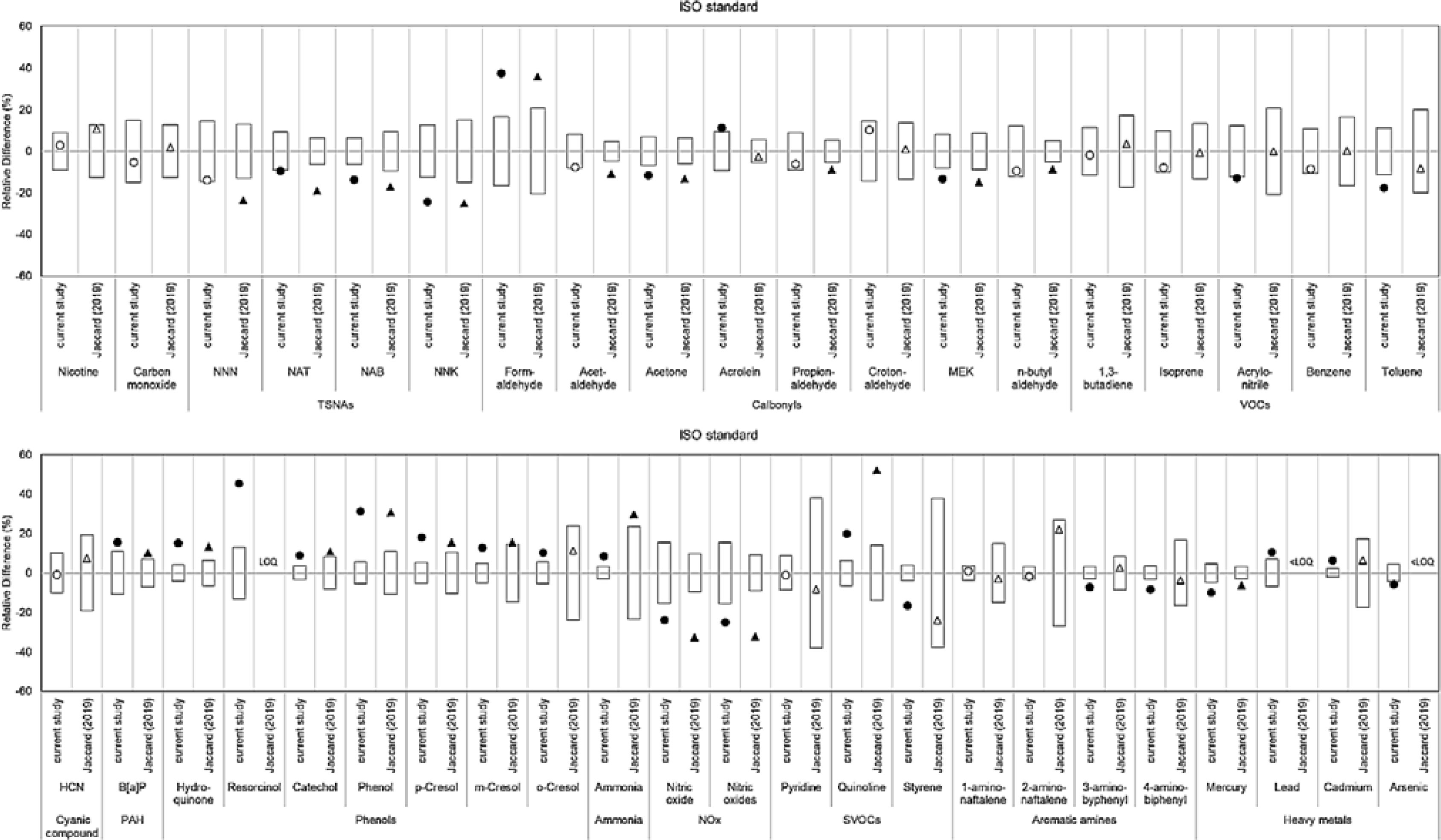
Figure 1
Relative differences in the chemical constituents of mainstream cigarette smoke between 3R4F and 1R6F under the ISO standard smoking regimen. Circles and triangles indicate the relative differences in the chemical yields of 1R6F compared with 3R4F in the current and Jaccard studies (12), respectively. The boxes show the critical difference ranges of 3R4F. “Empty” or “filled” symbols indicate whether the relative difference was within or out of the critical difference range, respectively. LOQ indicates the limit of quantitation.
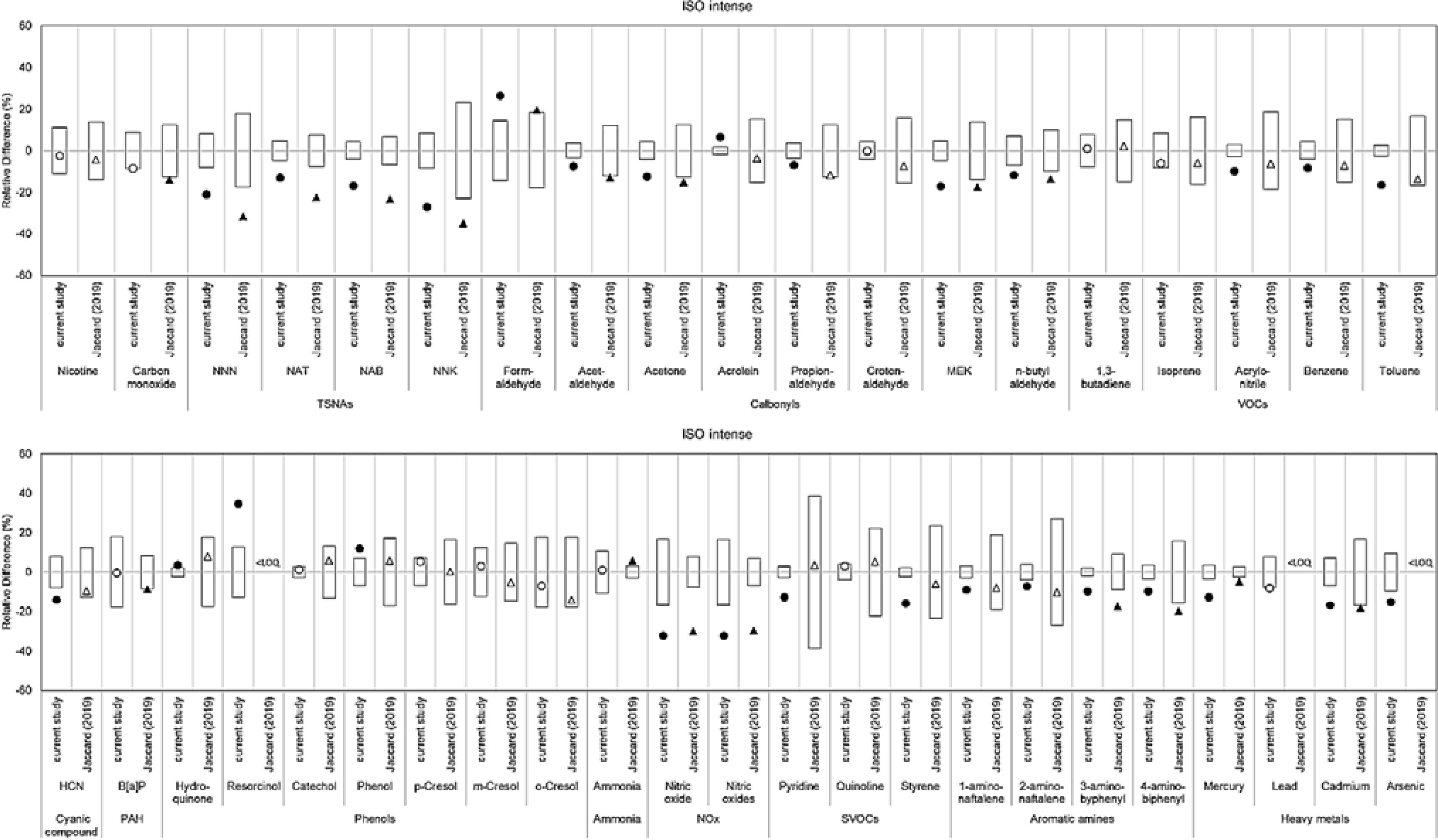
Figure 2
Relative differences in the chemical constituents of mainstream cigarette smoke between 3R4F and 1R6F under the ISO intense smoking regimen. Circles and triangles indicate the relative differences in the chemical yields of 1R6F compared with 3R4F in the current and Jaccard studies (12), respectively. The boxes show the critical difference ranges of 3R4F. “Empty” or “filled” symbols indicate whether the relative difference was within or out of the critical difference range, respectively. LOQ indicates the limit of quantitation.
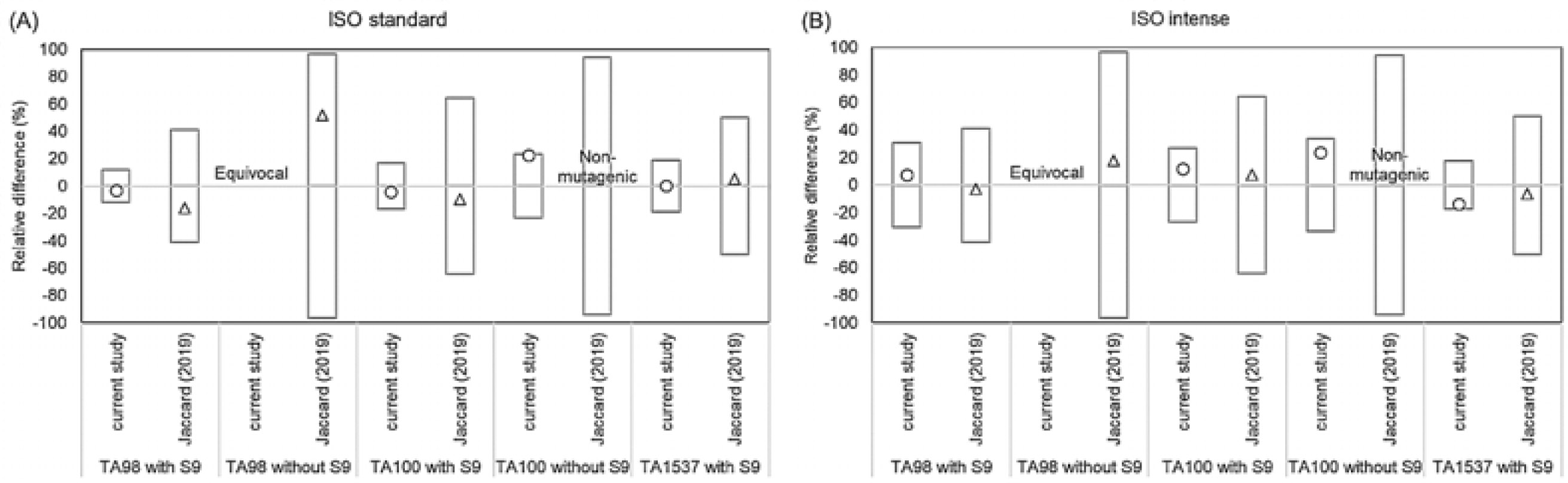
Figure 3
Relative differences between 3R4F and 1R6F in the Ames assay. (A) ISO standard smoking regimen; (B) ISO intense smoking regimen. Circles and triangles indicate the relative differences in the mutagenic slope value of 1R6F compared with 3R4F in the current and Jaccard studies (12), respectively. The boxes show the critical difference ranges of 3R4F. “Empty” symbols indicate the relative difference were within the critical difference ranges. Equivocal indicates there was no reproducible significant increase in revertants over three replicates. Non-mutagenic means there was no significant increase in revertants over three replicates.
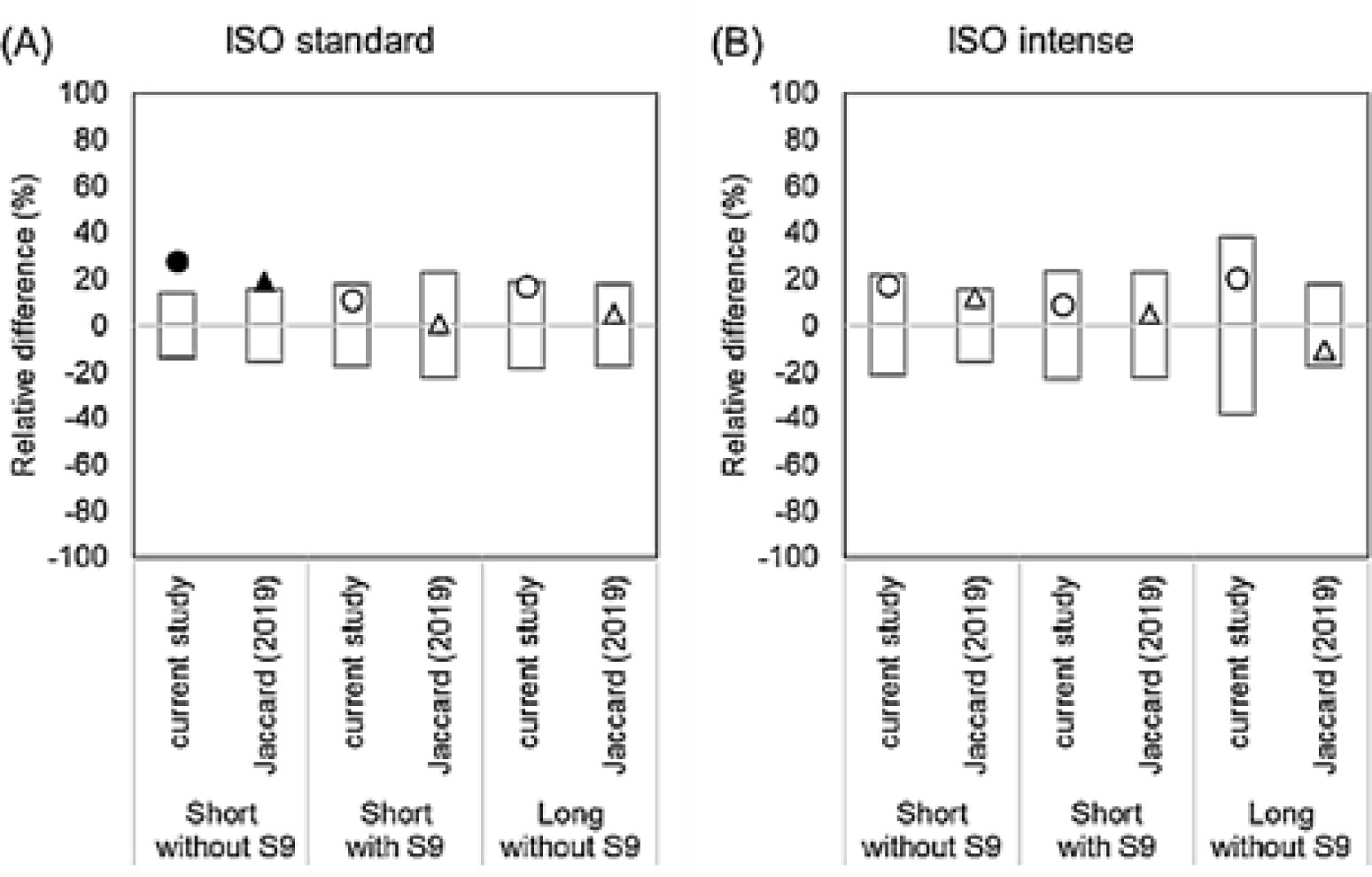
Figure 4
Relative differences between 3R4F and 1R6F in the MN assay. (A) ISO standard smoking regimen; (B) ISO intense smoking regimen. Circles and triangles indicate the relative difference in the genotoxic logit slope values of 1R6F compared with 3R4F in the current and Jaccard studies (12), respectively. The boxes show the critical difference ranges of 3R4F. “Empty” or “filled” symbols indicate whether the relative difference was within or out of the critical difference range, respectively.
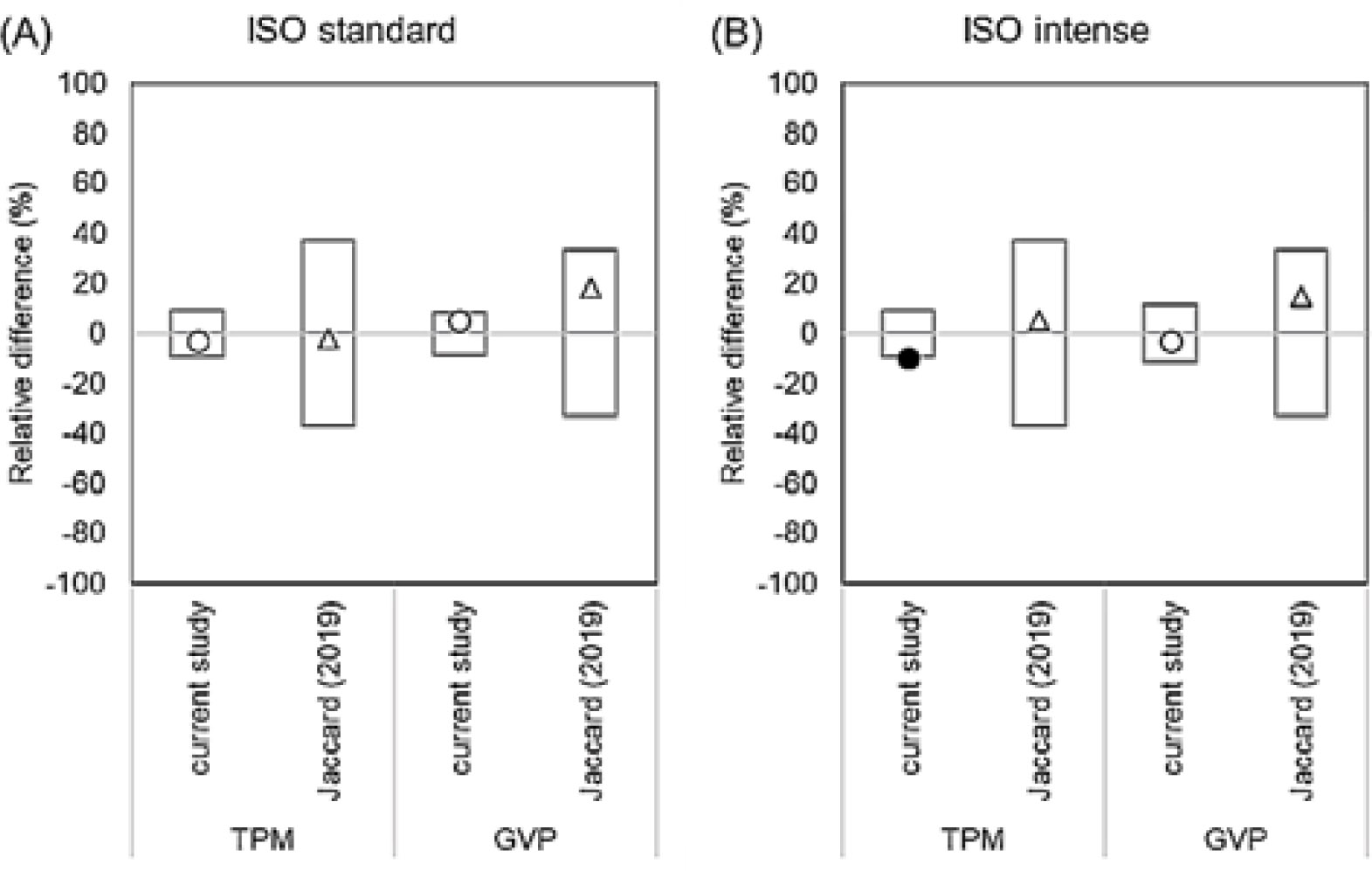
Figure 5
Relative differences between 3R4F and 1R6F in the NRU assay. (A) ISO standard smoking regimen; (B) ISO intense smoking regimen. Circles and triangles indicate the relative differences in the IC50 values of 1R6F compared with 3R4F in the current and Jaccard studies (12), respectively. The boxes show the critical difference ranges of 3R4F. “Empty” or “filled” symbols indicate whether the relative difference was within or out of the critical difference range, respectively.
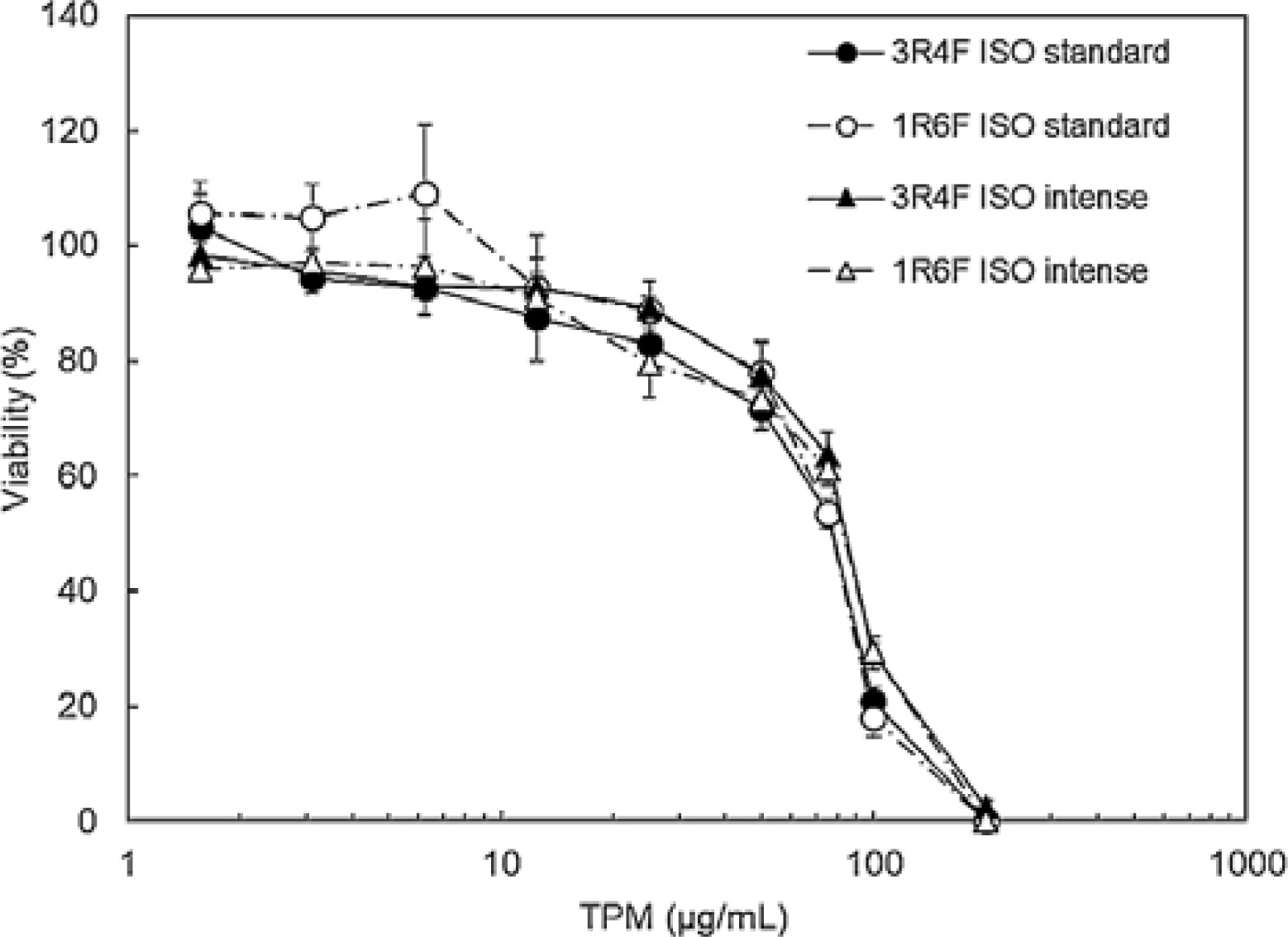
Figure 6
Dose-response curves in the cell viability assay. Cell viability was measured after 24 h exposure to TPM. The values for the solvent control were set at 100 (%). “Empty” and “filled” symbols represent the means of the viability for 1R6F and 3R4F, respectively. The error bars indicate standard error (n = 3). The solid and dotted lines indicate the dose-response curves for the ISO standard and intense smoking regimens, respectively.
Table 3
IC50 values of 1R6F and 3R4F TPM in the cell viability assay. The IC50 values were calculated by inverse estimation of the effective concentration at which the normalized fluorescence was reduced by 50%. S.E. stands for standard error. p values were calculated based on Student's t-test (n = 3).
| Smoking regimen | 1R6F IC50 (μg/mL) | 3R4F IC50 (μg/mL) | Relative difference (1R6F/3R4F) | p value (t-test) | |||
|---|---|---|---|---|---|---|---|
| Mean | S.E. | Mean | S.E. | Mean | S.E. | ||
| Standard | 75.0 | 2.44 | 73.3 | 2.19 | 1.02 | 0.0281 | 0.62 |
| Intense | 79.5 | 3.98 | 82.2 | 4.06 | 0.975 | 0.0836 | 0.67 |
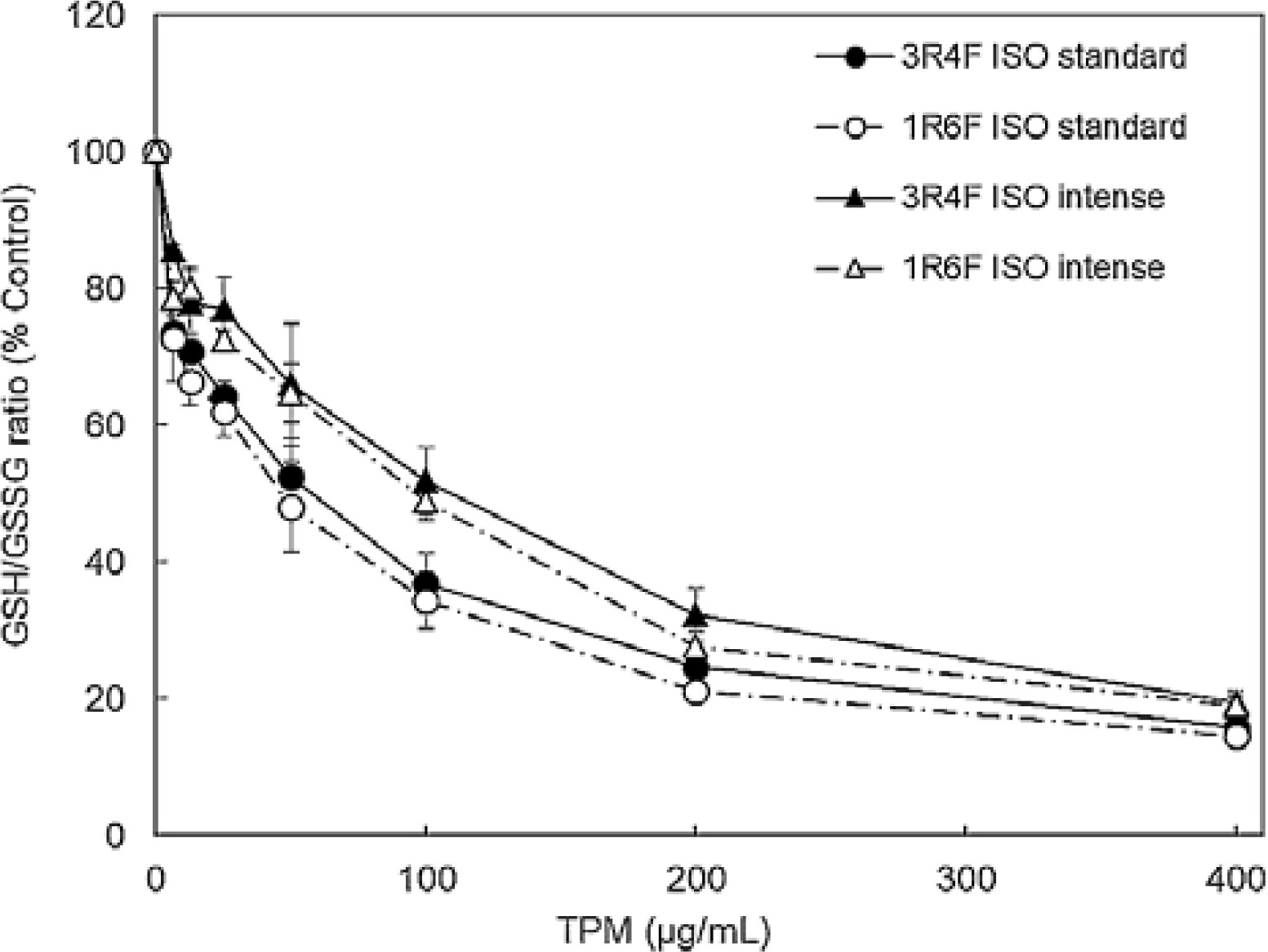
Figure 7
Dose-response curves in the GSH/GSSG assay. The intracellular GSH/GSSG ratio was determined after exposure for 2 h to the TPM. “Empty” and “filled” symbols represent the means of the GSH/GSSG ratios of 1R6F and 3R4F, respectively. The error bars indicate standard error (n = 3). The solid and dotted lines indicate the dose-response curve under the ISO standard and intense smoking regimens, respectively.
Table 4
IC50 values of 1R6F and 3R4F TPM in the GSH/GSSG assay. IC50 values in the GSH/GSSG assay were calculated by inverse estimation of the effective concentration at which the normalized luminescence was reduced by 50%. S.E. stands for standard error. p values were calculated based on Student's t-test (n = 3).
| Smoking regimen | 1R6F IC50 (μg/mL) | 3R4F IC50 (μg/mL) | Relative difference (1R6F/3R4F) | p value (t-test) | |||
|---|---|---|---|---|---|---|---|
| Mean | S.E. | Mean | S.E. | Mean | S.E. | ||
| Standard | 35.0 | 7.74 | 40.0 | 9.36 | 0.877 | 0.0128 | 0.70 |
| Intense | 66.5 | 8.25 | 73.4 | 18.9 | 0.970 | 0.139 | 0.76 |
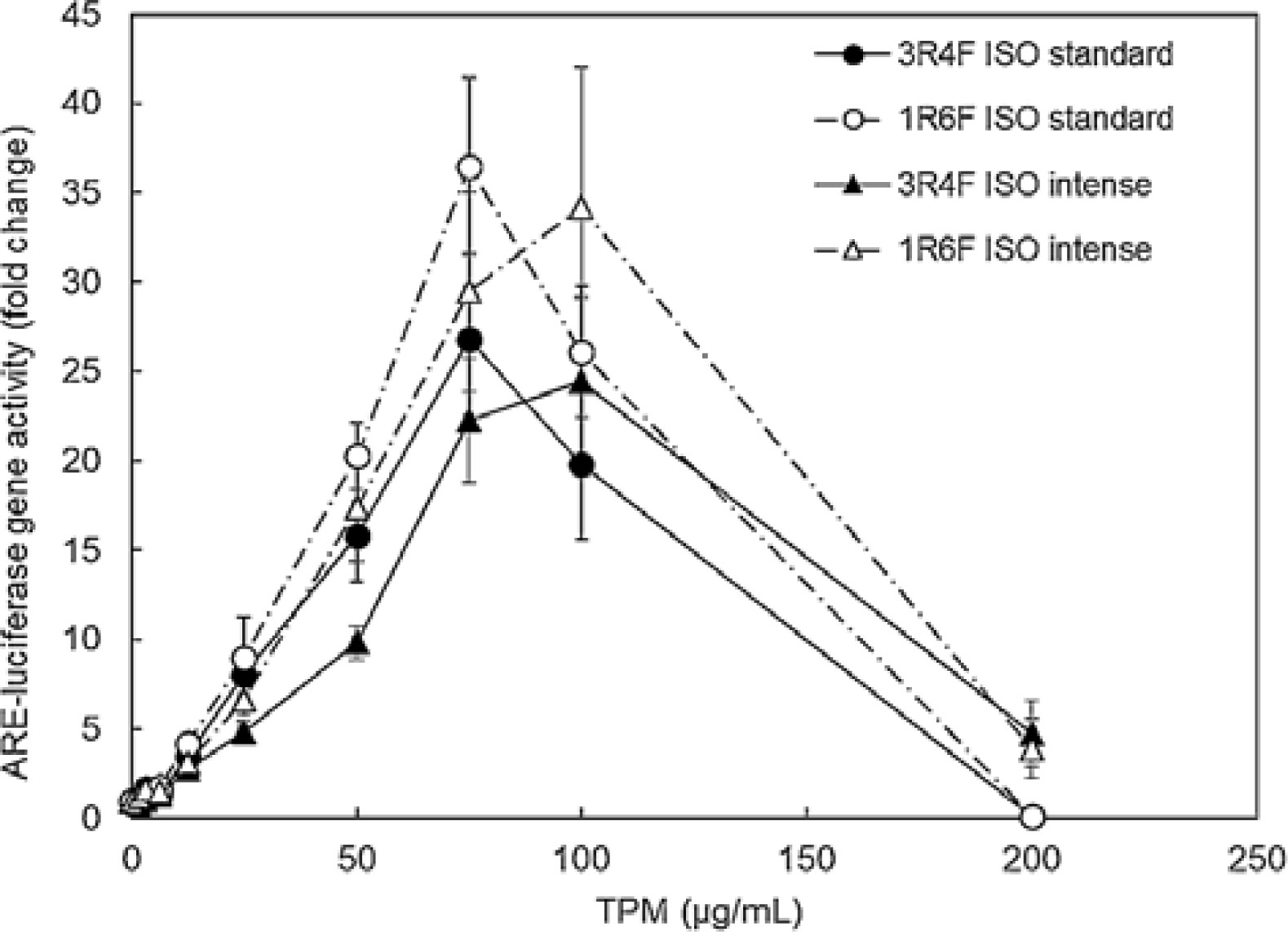
Figure 8
Dose-response curves in the ARE-luciferase reporter assay. Luciferase activity was measured after exposure to the TPM for 24 h to determine ARE gene activity. “Empty” and “filled” symbols represent the means of ARE-luciferase gene activity for 1R6F and 3R4F, respectively. The error bars indicate standard error (n = 3). The solid and dotted lines indicate the dose-response curve under the ISO standard and intense smoking regimens, respectively.
Table 5
Slope values of 1R6F and 3R4F TPM in the ARE-luciferase reporter assay. The slope values in the ARE-luciferase reporter assay were calculated by linear regression analysis over the dose range where cell viability was higher than 50%. S.E. stands for standard error. p values were calculated based on Student's t-test (n = 3).
| Smoking regimen | 1R6F slope value | 3R4F slope value | Relative difference (1R6F/3R4F) | p value (t-test) | |||
|---|---|---|---|---|---|---|---|
| Mean | S.E. | Mean | S.E. | Mean | S.E. | ||
| Standard | 0.394 | 0.0441 | 0.305 | 0.0456 | 1.32 | 0.133 | 0.23 |
| Intense | 0.377 | 0.0682 | 0.266 | 0.0376 | 1.46 | 0.292 | 0.23 |
Table A1
Chemical constituents in the mainstream smoke of 1R6F and 3R4F.
| Analyte | Unit | ISO standard smoking regimen | ISO intense smoking regimen | ||||||||||
|---|---|---|---|---|---|---|---|---|---|---|---|---|---|
| 1R6F | 3R4F | Ratio (1R6F/3R4F) | 1R6F | 3R4F | Ratio (1R6F/3R4F) | ||||||||
| mean | S.E. | mean | S.E. | mean | S.E. | mean | S.E. | ||||||
| TPM | mg/cig | 10.5 | 0.148 | 9.9 | 0.389 | 106 | (–) | 42.4 | 1.19 | 43.3 | 0.304 | 97.9 | (–) |
| Nicotine | mg/cig | 0.720 | 0.0116 | 0.700 | 0.0152 | 103 | (111) | 1.92 | 0.0326 | 1.97 | 0.0492 | 97.5 | (95.5) |
| Carbon monoxide | mg/cig | 10.0 | 0.143 | 10.6 | 0.371 | 94.3 | (102) | 27.5 | 0.38 | 30.1 | 0.622 | 91.4 | (85.9) |
| TSNAs | |||||||||||||
| NNN | ng/cig | 100 | 3.58 | 116 | 4.02 | 86.2 | (76.3) | 221 | 5.37 | 279 | 4.92 | 79.2 | (68.2) |
| NAT | ng/cig | 107 | 0.894 | 118 | 2.68 | 90.7 | (80.9) | 253 | 5.37 | 291 | 3.13 | 86.9 | (77.5) |
| NAB | ng/cig | 12.9 | 0.224 | 15.0 | 0.224 | 86.0 | (82.7) | 29.6 | 0.626 | 35.6 | 0.358 | 83.1 | (76.7) |
| NNK | ng/cig | 77.8 | 2.33 | 103 | 3.13 | 75.5 | (74.8) | 177 | 3.58 | 243 | 4.92 | 72.8 | (65.1) |
| Carbonyls | |||||||||||||
| Formaldehyde | μg/cig | 37.6 | 1.21 | 27.3 | 1.07 | 138 | (136) | 134 | 4.02 | 106 | 3.58 | 126.4 | (119) |
| Acetaldehyde | μg/cig | 548 | 9.39 | 594 | 11.18 | 92.3 | (89.1) | 1570 | 17.89 | 1697 | 14.31 | 92.5 | (87.1) |
| Acetone | μg/cig | 179 | 2.68 | 202 | 3.13 | 88.6 | (86.7) | 503 | 3.13 | 574 | 5.81 | 87.6 | (84.8) |
| Acrolein | μg/cig | 55.9 | 1.21 | 50.2 | 1.12 | 111 | (97.4) | 177 | 1.34 | 166 | 0.447 | 106.6 | (96.1) |
| Propionaldehyde | μg/cig | 40.3 | 0.626 | 42.9 | 0.805 | 93.9 | (90.9) | 115 | 0.894 | 124 | 1.34 | 92.7 | (88.1) |
| Crotonaldehyde | μg/cig | 12.2 | 0.358 | 11.1 | 0.358 | 110 | (101) | 54.8 | 0.402 | 54.9 | 0.537 | 99.8 | (92.4) |
| MEK | μg/cig | 41.8 | 0.581 | 48.3 | 0.894 | 86.5 | (85.3) | 119 | 0.447 | 143 | 1.79 | 83.2 | (82.4) |
| n-Butylaldehyde | μg/cig | 25.0 | 0.492 | 27.5 | 0.76 | 90.9 | (91.2) | 68.1 | 0.939 | 77.1 | 1.3 | 88.3 | (86.3) |
| VOCs | |||||||||||||
| 1,3-Butadiene | μg/cig | 40.9 | 0.358 | 41.5 | 1.12 | 98.6 | (104) | 96.1 | 1.21 | 95.2 | 1.7 | 100.9 | (102) |
| Isoprene | μg/cig | 314 | 3.58 | 341 | 8.05 | 92.1 | (99.3) | 766 | 15.21 | 816 | 16.1 | 93.9 | (94.1) |
| Acrylonitrile | μg/cig | 8.19 | 0.116 | 9.39 | 0.264 | 87.2 | (100) | 26.1 | 0.224 | 28.9 | 0.179 | 90.3 | (93.7) |
| Benzene | μg/cig | 42.2 | 0.358 | 46.1 | 1.16 | 91.5 | (100) | 91.2 | 0.671 | 99.4 | 1.03 | 91.8 | (92.7) |
| Toluene | μg/cig | 64.7 | 0.76 | 78.6 | 2.1 | 82.3 | (91.8) | 160 | 1.34 | 191 | 1.34 | 83.8 | (86.3) |
| Cyanic compounds | |||||||||||||
| HCN | μg/cig | 98.4 | 1.52 | 99.2 | 2.37 | 99.2 | (107) | 404 | 10.29 | 470 | 8.94 | 86.0 | (903) |
| PAH | |||||||||||||
| B[a]P | ng/cig | 7.51 | 0.121 | 6.49 | 0.17 | 116 | (110) | 16.9 | 0.268 | 16.9 | 0.716 | 100.0 | (91.4) |
| Phenols | |||||||||||||
| Hydroquinone | μg/cig | 35 | 0.402 | 30.4 | 0.313 | 115 | (113) | 87.1 | 0.984 | 84.1 | 0.447 | 103.6 | (108) |
| Resorcinol | μg/cig | 0.718 | 0.0237 | 0.494 | 0.0152 | 145 | – | 2.15 | 0.0492 | 1.6 | 0.0492 | 134.4 | – |
| Catechol | μg/cig | 40 | 0.313 | 36.7 | 0.313 | 109 | (111) | 89.3 | 0.984 | 88.1 | 0.537 | 101.4 | (106) |
| Phenol | μg/cig | 8.79 | 0.215 | 6.69 | 0.085 | 131 | (131) | 12.4 | 0.224 | 11 | 0.179 | 112.7 | (105) |
| p-Cresol | μg/cig | 5.09 | 0.107 | 4.31 | 0.0537 | 118 | (115) | 8.22 | 0.157 | 7.81 | 0.13 | 105.2 | (100) |
| m-Cresol | μg/cig | 2.01 | 0.0537 | 1.78 | 0.0224 | 113 | (115) | 3.08 | 0.085 | 2.99 | 0.0894 | 103.0 | (94.6) |
| o-Cresol | μg/cig | 2.36 | 0.0537 | 2.14 | 0.0268 | 110 | (111) | 3.47 | 0.112 | 3.72 | 0.157 | 93.3 | (85.7) |
| Other amines | |||||||||||||
| Ammonia | μg/cig | 8.72 | 0.13 | 8.04 | 0.0581 | 108 | (130) | 30.6 | 0.76 | 30.4 | 0.76 | 100.7 | (106) |
| NOx | |||||||||||||
| Nitric oxide | μg/cig | 148 | 5.63 | 194 | 7.06 | 76.2 | (67.3) | 358.86 | 15.07 | 529 | 20.89 | 67.9 | (69.9) |
| Nitric oxides | μg/cig | 163 | 6.46 | 217 | 7.92 | 75.1 | (67.8) | 399.08 | 16.94 | 589 | 23.11 | 67.7 | (70.4) |
| SVOCs | |||||||||||||
| Pyridine | μg/cig | 7.33 | 0.112 | 7.41 | 0.148 | 98.9 | (91.6) | 36.8 | 0.581 | 42.1 | 0.268 | 87.4 | (103) |
| Quinoline | μg/cig | 0.273 | 0.00178 | 0.228 | 0.00358 | 120 | (152) | 0.546 | 0.0139 | 0.53 | 0.00492 | 103.0 | (105) |
| Styrene | μg/cig | 5.68 | 0.0671 | 6.79 | 0.0626 | 83.7 | (76) | 23 | 0.224 | 27.3 | 0.134 | 84.2 | (94) |
| Aromatic amines | |||||||||||||
| 1-Aminonaftalene | ng/cig | 13 | 0.358 | 12.9 | 0.134 | 101 | (97.2) | 24.5 | 0.358 | 26.9 | 0.179 | 91.1 | (91.8) |
| 2-Aminonaftalene | ng/cig | 7.69 | 0.367 | 7.82 | 0.0581 | 98.3 | (122) | 15.5 | 0.581 | 16.7 | 0.134 | 92.8 | (89.5) |
| 3-Aminobiphenyl | ng/cig | 2.04 | 0.085 | 2.2 | 0.0179 | 92.7 | (103) | 4.71 | 0.183 | 5.21 | 0.0224 | 90.4 | (82.5) |
| 4-Aminobiphenyl | ng/cig | 1.41 | 0.0626 | 1.54 | 0.0134 | 91.6 | (96.1) | 3.35 | 0.125 | 3.71 | 0.0313 | 90.3 | (80.1) |
| Heavy metals | |||||||||||||
| Mercury | ng/cig | 2.33 | 0.0179 | 2.58 | 0.0313 | 90.3 | (93.8) | 5.26 | 0.0268 | 6.01 | 0.0537 | 87.5 | (95.1) |
| Lead | ng/cig | 11.7 | 0.268 | 10.6 | 0.179 | 110 | (–) | 31.1 | 0.581 | 33.8 | 0.626 | 92.0 | (–) |
| Cadmium | ng/cig | 36.6 | 0.671 | 34.3 | 0.179 | 107 | (107) | 95.3 | 0.984 | 114 | 1.79 | 83.6 | (81.7) |
| Chromium | ng/cig | <LOD | – | <LOD | – | – | (–) | <LOD | <LOD | – | – | (–) | |
| Nickel | ng/cig | <LOQ | – | <LOQ | – | – | (–) | <LOQ | <LOQ | – | – | (–) | |
| Beryllium | ng/cig | <LOD | – | <LOD | – | – | (–) | <LOD | <LOD | – | – | (–) | |
| Cobalt | ng/cig | <LOQ | – | <LOQ | – | – | (–) | <LOQ | <LOQ | – | – | (–) | |
| Selenium | ng/cig | <LOQ | – | <LOQ | – | – | (–) | <LOQ | <LOQ | – | – | (–) | |
| Arsenic | ng/cig | 2.41 | 0.0313 | 2.56 | 0.0268 | 94.1 | (–) | 6.72 | 0.152 | 7.92 | 0.179 | 84.8 | (–) |
[i] TPM: total particulate matter, cig: cigarette, TSNA: tobacco specific N-nitrosamine, NNN: N’-nitrosonornicotine, NAT: N’-nitrosoanatabine, NAB: N’-nitrosoanabasine, NNK: 4-(methylnitrosamino)-1-(3-pyridyl)-1-butanone; VOC: volatile organic compound, MEK: methyl ethyl ketone, HCN: hydrogen cyanide, PAH: polycyclic aromatic hydrocarbon, B[a]P: benzo[a]pyrene, NOx: nitrogen oxides; SVOC: semi volatile organic compound;
[ii] S.E.: standard error
[iii] LOD: limit of detection, LOQ: limit of quantitation;
[iv] Data in (italics) indicate results published by Jaccard et al. (12).
Table A2
Mutagenic slope values of 1R6F and 3R4F TPM in the Ames assay.
| Smoking regimen | Strain and S9 metabolic activation | 1R6F slope value (Revetants/μg) | 3R4F slope value (Revetants/μg) | Ratio (1R6F/3R4F) | ||||
|---|---|---|---|---|---|---|---|---|
| Mean | S.E. | Mean | S.E. | Mean | S.E. | |||
| Standard | TA98 with S9 | 2.31 | 0.0748 | 2.40 | 0.145 | 0.966 | (0.841) | 0.0532 |
| Standard | TA98 without S9 | equivocal | – | equivocal | – | – | (1.51) | – |
| Standard | TA100 with S9 | 0.849 | 0.0430 | 0.886 | 0.0509 | 0.959 | (0.902) | 0.00907 |
| Standard | TA100 without S9 | 0.354 | 0.0213 | 0.298 | 0.0365 | 1.23 | (–) | 0.171 |
| Standard | TA1537 with S9 | 0.300 | 0.0301 | 0.305 | 0.0455 | 1.00 | (1.05) | 0.0786 |
| Standard | TA1537 without S9 | equivocal | – | equivocal | – | – | (–) | – |
| Standard | TA1535 with S9 | non-mutagenic | – | non-mutagenic | – | – | (–) | – |
| Standard | TA1535 without S9 | non-mutagenic | – | non-mutagenic | – | – | (–) | – |
| Standard | TA102 with S9 | non-mutagenic | – | non-mutagenic | – | – | (–) | – |
| Standard | TA102 without S9 | non-mutagenic | – | non-mutagenic | – | – | (–) | – |
| Intense | TA98 with S9 | 1.10 | 0.0342 | 1.02 | 0.0368 | 1.072 | (0.971) | 0.0259 |
| Intense | TA98 without S9 | non-mutagenic | euivocal | – | – | (1.18) | – | |
| Intense | TA100 with S9 | 0.475 | 0.0213 | 0.426 | 0.0119 | 1.12 | (1.07) | 0.0756 |
| Intense | TA100 without S9 | 0.233 | 0.0178 | 0.190 | 0.0115 | 1.24 | (–) | 0.136 |
| Intense | TA1537 with S9 | 0.162 | 0.0258 | 0.187 | 9.50E-3 | 0.864 | (0.939) | 0.116 |
| Intense | TA1537 without S9 | equivocal | – | equivocal | – | – | (–) | – |
| Intense | TA1535 with S9 | non-mutagenic | – | non-mutagenic | – | – | (–) | – |
| Intense | TA1535 without S9 | non-mutagenic | – | non-mutagenic | – | – | (–) | – |
| Intense | TA102 with S9 | non-mutagenic | – | non-mutagenic | – | – | (–) | – |
| Intense | TA102 without S9 | non-mutagenic | – | non-mutagenic | – | – | (–) | – |
[i] Data in (italics) indicate results published by Jaccard et al. (12);
[ii] Equivocal: there was no reproducible significant increase in revertants over three replicates;
[iii] non-mutagenic: there was no significant increase in revertants over three replicates;
[iv] –: calculation or statistical analysis was not done because the sample was determined to be equivocal or non-mutagenic.
[v] S.E.: standard error
Table A3
Genotoxic slope parameters of the logit function of 1R6F and 3R4F TPM in the MN assay.
| Smoking regimen | Term and S9 metabolic activation | 1R6F slope parameter (mg/mL) | 3R4F slope parameter (mg/mL) | Ratio (1R6F/3R4F) | ||||
|---|---|---|---|---|---|---|---|---|
| Mean | S.E. | Mean | S.E. | Mean | S.E. | |||
| Standard | “Short” without S9 | 10.2 | 1.26 | 8.11 | 1.22 | 1.27 | (1.18) | 0.0836 |
| Standard | “Short” with S9 | 6.36 | 1.37 | 5.67 | 1.09 | 1.11 | (1.01) | 0.520 |
| Standard | “Long” without S9 | 17.8 | 3.22 | 15.2 | 2.22 | 1.17 | (1.05) | 0.100 |
| Intense | “Short” without S9 | 7.36 | 1.10 | 6.37 | 1.14 | 1.17 | (1.12) | 0.0650 |
| Intense | “Short” with S9 | 4.29 | 0.850 | 3.87 | 0.487 | 1.09 | (1.05) | 0.0750 |
| Intense | “Long” without S9 | 13.8 | 2.11 | 11.6 | 2.02 | 1.21 | (0.894) | 0.0550 |
[i] Data in (italics) indicate results published by Jaccard et al. (12).
[ii] S.E.: standard error
Table A4
IC50 values of the TPM and GVP of 1R6F and 3R4F in the NRU assay.
| Smoking regimen | Fraction | 1R6F IC50 (μg/mL) | 3R4F IC50 (μg/mL) | Ratio (1R6F/3R4F) | ||||
|---|---|---|---|---|---|---|---|---|
| Mean | S.E. | Mean | S.E. | Mean | S.E. | |||
| Standard | TPM | 68.6 | 1.32 | 70.9 | 2.67 | 0.969 | (0.979) | 0.0221 |
| Standard | GVP | 101 | 6.89 | 95.9 | 7.11 | 1.05 | (1.18) | 0.00707 |
| Intense | TPM | 94.2 | 4.84 | 105 | 1.97 | 0.901 | (1.05) | 0.0429 |
| Intense | GVP | 104 | 6.36 | 107 | 4.61 | 0.971 | (1.15) | 0.0334 |
[i] Data in (italics) indicate results published by Jaccard et al. (12).
[ii] S.E.: standard error
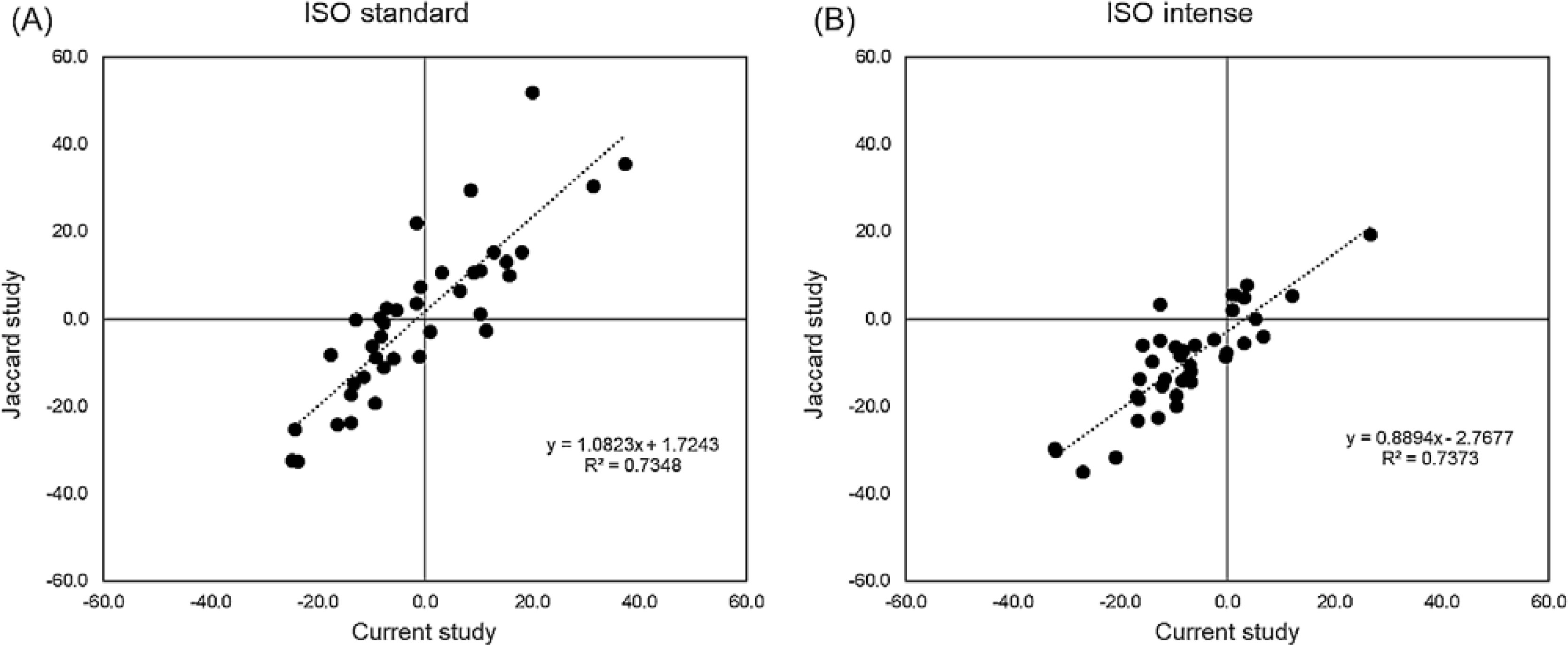
Figure A1
Correlation of the absolute values of the relative differences between 1R6F and 3R4F in chemical analysis. (A) ISO standard smoking regimen; (B) ISO intense smoking regimen. X-axis: relative differences in current study (%), Y-axis: relative differences in Jaccard study (%). The coefficients of determination under the ISO standard and intense smoking regimens were R2 = 0.73 and R2 = 0. 74, respectively.