
1. Introduction
Some basic principles of network theory are that (a) everything is part of multiple overlapping networks, (b) we both shape and are shaped by those nodes and relationships, and, (c) because of that complexity, we are aware of only a very small, nearby, sets of relationships, and do not fully understand our own lives, much less of others and our social environment. So network theory and analysis provide the concepts and tools to describe and analyze the network environment, and to help actors understand and shape those networks. However, the language of networks is generally foreign or opaque to most people (whether concepts, metrics, or analytical approaches), and because of the complex and embedded nature of networks most concepts refer to phenomena that seem abstract or even jargony.
In particular, the following two activities embed abstract, new, and technical concepts in real-time physical interaction. These activities can be used to illustrate the following network concepts, with an illustrative reference or two for each: Alter networks, Binary network links, Degree Density, Direct and Indirect Links, Directional and Nondirectional tie (Brass & Borgatti, 2019; Saqr et al., 2024); Path and other conceptualizations of network or social distance (Hanneman & Riddle, 2005, Chapter 7: Connection and distance); Egocentric networks (Borgatti et al., 2013b; Small et al., 2021); Heterophily and Homophily (McPherson et al., 2001); Horizon of observability (Friedkin, 1983); Network data collection (self-report, Internet Movie Database – IMDb) (Oracle of Bacon, n.d.; Valente, 2010); Network paths (Milgram, 1967; Small et al., 2021); Small world and Degrees of Separation (Gladwell, 1999; Milgram, 1967; Schnettler, 2009; Science of Six Degrees of Separation, n.d.); Sociogram and Sociomatrix (Brass & Borgatti, 2019; Saqr et al., 2024); Strong and weak ties (Granovetter, 1973; Kim & Fernandez, 2023); and Two-mode/dual/affiliation matrices (Borgatti et al., 2013a). There are, of course, many other excellent sources explaining network concepts, measures, and analyses.
These two activities are designed for introductory, non-computational and non-statistical, social network courses or network modules in other courses. From a general course management perspective, these activities also help reinforce participation as a class norm, foster interaction among students, and provide the instructor opportunities to get to know students better. Though there are some shared underlying concepts, these are independent activities. Activity 1 should be conducted at the beginning of the course, as it requires no prior network knowledge or concepts, but can be used to introduce some, and is easy to reference throughout the course. Activity 2 should be conducted later in the course, as it involves a bit of preparation for both students and the instructor, and discussing the process and results would require students to already be familiar with concepts such as the small world, direct and indirect links, network externality/effect, and dual-mode/affiliation network data.
2. Activity 1: Paths and alter networks
2.1. Goals
This activity is best suited for moderate-sized classes (50–90), and at the beginning of the academic term, where there are likely to be many students who do not know each other (yet). Approximate time for one round: 20 minutes. It can demonstrate several of the above foundational network concepts, such as direct and indirect paths, ego and alters, alter networks, small worlds, homophily and heterophily.
2.2. Setup
2.2.1. Materials
Obtain, format, and print the course roster, perhaps using a two-column format on two pages, in a larger type size so it’s easy to read. Use the PathMatrix1.docx (and PathMatrix2.docx if you wish to repeat the activity) template file available at https://osf.io/mp5kv. Have it ready in Word to display from your computer to a classroom screen. It is best to use a.docx file so you can add and edit information easily, whereas a.ppt requires you to toggle in and out of display mode to add new information.
2.2.2. Identify ego and target
Before the beginning of class, after most everyone has been seated, either the faculty member or a teaching assistant uses the roster and performs the following steps. Note that we assume the classroom has row seating, but the steps can be adapted for other seating arrangements. The main point is to select one (or two) initial egos.
On the left aisle seats (or any other easy way to quietly talk with students), find someone who is not a recent transfer student and not an international student (because they are not likely to know very many people), and says they know at least several other people in class (don’t ask for those names). Ask their full name. Find that name on the two-page roster. Circle that person on the roster and write A1 by their name. Then, go to the second page on the roster and ask them to point to the full names of TWO people they do not know; that is, they couldn’t identify either person, have never heard the names, don’t know anything about those persons, etc. Circle each person on the roster and write A2 or A3 by their names.
If you wish to either have a backup ego, or if you wish to repeat the activity in the same class, on the right aisle seats, do the same. Find someone who is not a recent transfer student and not an international student (because they are not likely to know very many people), and says they know at least several other people in class (don’t ask for those names). Ask their full name. Find that name on the two-page roster. Then go to the first page on the roster and ask them to point to the full names of TWO people they do not know; that is, they couldn’t identify either person, have never heard the names, don’t know anything about those persons, etc. Circle each person on the roster and write B2 or B3 by their names.
Then bring that roster to the lectern/instructor.
2.3. Procedure
2.3.1. Begin activity
When it’s an appropriate time in the class, Get the roster, and Display the PathMatrix1.docx on the screen.
2.3.2. Announce target
On the roster, look for the circled name with A2 (or A3). Explain that the target person to be named as A2 (or A3) should not show any recognition or response or identify themselves unless someone points to them and names them as part of the activity. State the name of that person A2 (or A3) as the target. Enter in that person’s first name A2 (or A3) in the last (8th) column label and row label of Matrix1.
2.3.3. Announce ego
Explain that when someone is called on, they should stand up, and stay standing up throughout the exercise. Then ask A1 to stand up. At this point, the instructor or moderator can have a brief and social interaction with that person, like a game show host. In particular, ask their name and anything else of interest, such as college level, major, where they are from, and where they currently live. (You can refer back to this later on.)
2.3.4. Start the path and filling PathMatrix1
Enter their (A1) first name into the first row and column label of Matrix1. 12. Now, ask if they can point to (named) A2 (or A3). Ideally, they will say no if they responded accurately to the initial inquiry (step 1). Then ask them to name someone they know, by name, who they think might know A2 (or A3).
Each time a person (A1n) names another person (A1n + 1), write that A1n + 1 person’s first name in the next respective row and column heading, and enter a “1” in the cell (A1n, A1n + 1) and its reciprocal (A1n + 1, A1n) so that you build up a chain of links.
Ask each new person to stand up. Have a short interaction with them. Important: after the second person, also ask each subsequent named person if they know anyone named before them (A1n-1, etc.) and if so put a 1 in that row cell. (You will refer to that later on; you can decide to treat these as non-directed or not, and explain either way.) Repeat up to 6 others after A1 (i.e., through 7 people; remember the 8th node is the target A2 (or A3)).
2.3.5. Identify the target
If someone names and points to A2 (or A3) within any of the first 6 links, everyone claps. Ask A2 (or A3) to stand up, and have a short interaction with that person.
If someone in the chain before the 6th link doesn’t know anyone else in the class, refer to the game show “Who Wants to Be a Millionaire,” and give them a “friend.” Select someone from the roster who has not yet been named. Try to pick someone as different as possible from the prior people (i.e., different gender, ethnic name, etc., but again not a recent transfer student and not an international student) to see if that can break out of the path and identify the target.
If, at the end of 7 named others, no one can name and point to A2 (or A3), reveal their identity (cell, row 8), have A2 (or A3) stand up, and have a short interaction with that person. Everyone clap.
2.3.6. End activity
Now you can discuss the completed matrix PathMatrix1 (see Lessons). Figure 1 provides an example path matrix, and Figure 2 displays a sociogram of the links in circle format.
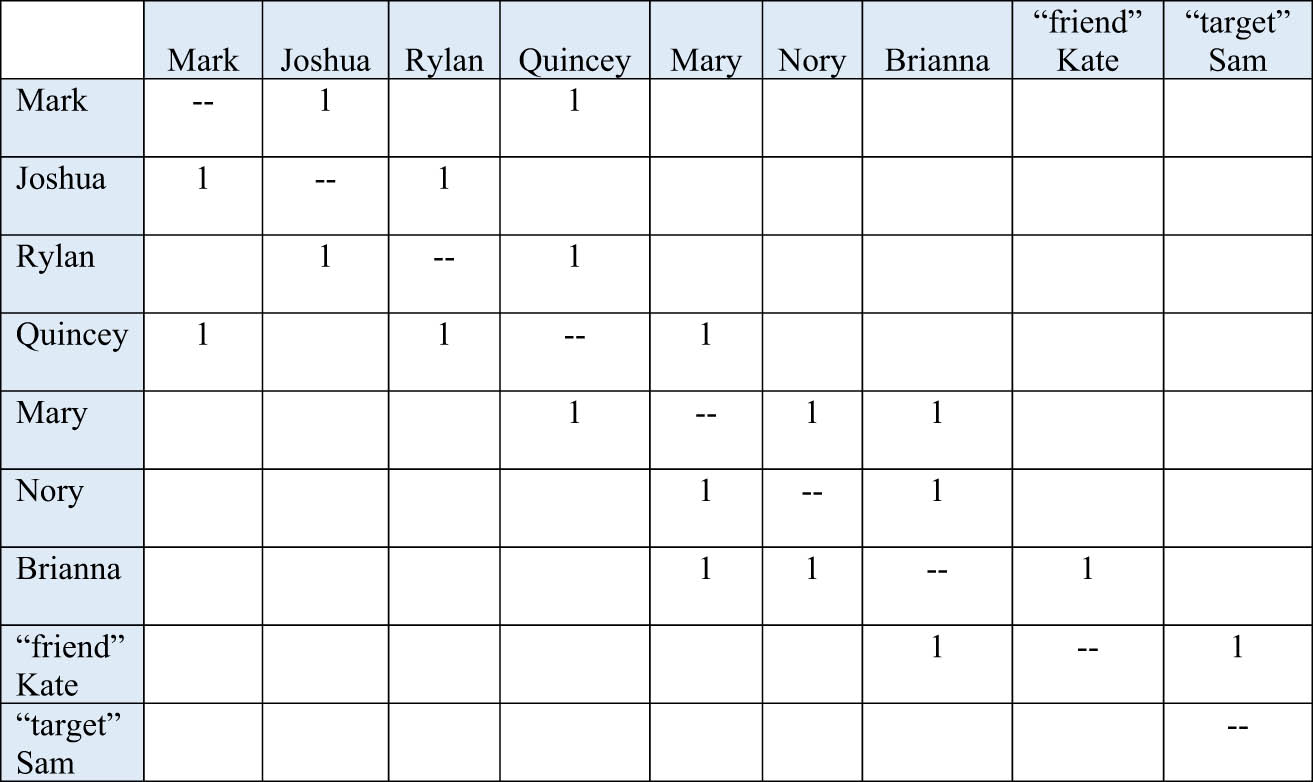
Figure 1
Example Path Matrix. Note 1. We ask each person to name another person. This can be considered a directed tie, in which case the example path matrix would not be symmetric. However, we explain that we are treating these as nondirected ties, presuming that no one would know and name someone who didn’t know them. So, we fill in the symmetric ties in the matrix. Note 2. In this example, Ego and the first three alters are a male cluster; there’s a cross-gender tie between Quincey and Mary; and then a cluster of three females who sit next to each other. Brianna says she doesn’t know anyone else in the class, so the instructor chooses a “friend” (Kate) from a different part of the classroom, perhaps a different ethnicity, trying to create a weak tie out of the physical cluster. Kate says she knows the “target,” Sam, and points to him. Sam stands up, and we all clap!
Source: Author’s contribution.
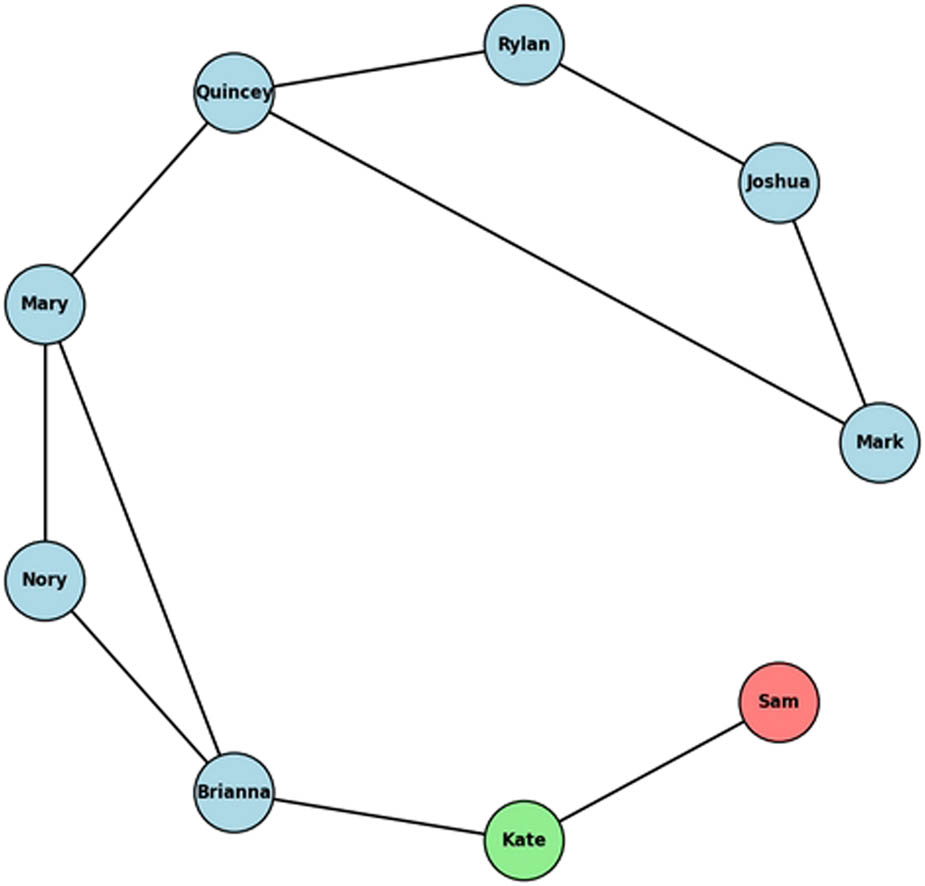
Figure 2
Sociogram of Example Path Matrix in Circle Layout.
Source: Author’s contribution.
2.4. Lessons
At the end, you can discuss a wide variety of issues, highlighting the network concepts listed above, and particular issues such as the following.
2.4.1. Network path
Discuss or ask students to discuss and report on the small world concept in general. More specifically, consider aspects of the network path, such as how many links were required, how the links are portrayed in the binary sociomatrix. Point out how some of the alters in the sociomatrix may themselves be interlinked, and the A1 person might not know that. Indeed, you can ask A1 directly if they knew subsequent alters and their interrelations. This can lead to the general, significant idea that one is embedded in larger networks, that individuals have limited awareness of alters’ networks (here, refer to Friedkin’s “horizon of observability,” 1983), and network analysis can reveal relationships that no one person can be aware of. Further, ask if they see any commonalities (homophily) across links (often the first few are actually sitting next to each other; or they are of the same gender; or live in the same residence hall; etc.).
2.4.2. The sociomatrix
Display the completed PathMatrix1. Review that this is a square matrix, typically used for a sociomatrix, where the nodes in the respective rows and columns are the same. Then explain that the entries can be directed or non-directed, and if directed, may be reciprocal or not, and why you chose to portray them as symmetric directed links. Note that the binary values here represent the presence or absence of a link could instead be strength, closeness, frequency, or binary or valued. Show how to compute individuals’ degree centralities and overall network density using that data matrix. The path (with perhaps several cross-links) in the sociomatrix generated by this activity will be too sparse to discuss more formal concepts such as geodesic, eccentricity, diameter, flow (Hanneman & Riddle, 2005), but you could return to this in-class generated simple matrix as an initial example, leading into large and more dense networks.
2.4.3. The choice of a “friend” if you needed that
Discuss why the “friend” was chosen to be as different as possible from the prior people. Note that you initially tried to pick someone as different as possible from the prior people (i.e., different gender, ethnic name, etc., but again not a recent transfer student and not an international student), to see if that can break out of the linked relationships to increase the chances of identifying the target, who is an example of diverse, out-group information. Explain how this unsuccessful path is an example of the negative aspects of homophily, and the strength of weak ties.
2.5. Reflections
Some students are not necessarily comfortable with being named and asked to stand up. But, after the first person does it, others are more willing to participate. When they stand up, you can ask them to introduce themselves or ask them a question to make the activity more social, and to increase possible awareness of the class network. It’s useful to have them all stay standing up until the end, both to visually represent the path, and to have them provide visual reinforcement to the others. Indeed, some students comment how much they appreciated seeing the network concept demonstrated in real time, through having the students stand up as they are named. You can enhance the physical engagement by providing student A1 with something (like a wrapped candy) to actually hand to the next named person, with the goal of having it delivered to the target A2(A3).
It may happen that the target A2(A3) may not in fact be in class that day! This doesn’t really change the process of being finally named or not, but can be used to discuss distinctions in types of tie (physical, temporal, virtual, etc.).
If you have a quick and easy way to display a sociogram from the PathMatrix1, do that, showing and explaining how the sociomatrix information can be displayed in sociogram mode, representing the same data in both ways, pointing out whether the links are directed or not.
Some folks create an R program to display both the matrix and the sociogram.
Depending on how long the first time took, you can do the entire process a second time, selecting and starting with B1, just to show how it can be quite different, referring to B2 (or B3), and using PathMatrix2.docx.
3. Activity 2: Actor small worlds
3.1. Goals
This activity is suited for classes of moderate size that could support multiple groups of say four, five, or six. Approximate time: 30 minutes. The activity provides opportunities for understanding and discussing some of the above-listed concepts, such as the small world concept, the tight interconnectedness of some large-scale social systems (movie industry), dual-mode matrices, objective network data, and drawing sociograms. Everyone has favorite actors, actresses, and movies, and most people like to know about connections among them. So using relationships among actors and movies as the basis for this activity naturally engages the students, who can see the forms and nature of networks within the context of what they spend time watching and talking about. (Students and instructors especially interested in movie actor networks should look at Sonnenberg-Schrank, 2020.) More subtly, the instructor can actually refer to “actors” in both the network and the media sense.
3.2. Setup
3.2.1. Assignment
Post the ActorSmallWorldAssignment.docx available at https://osf.io/mp5kv for students to complete before coming to the activity class. Explain the assignment in the prior class, especially as to what they need to bring with them (a printed-out sheet with their favorite actor/actress and the reason for that, especially referring to a specific movie).
3.2.2. Assign groups
In advance, assign class members to 5-person groups. Easiest is to do so alphabetically. Prepare this list as a.ppt to show at the beginning of the activity. If there was a prior course activity that used 5-person groups, post those same group assignments. Give each group a name (such as a network concept or a movie). (It increases superficial group identification if the groups come up with their own group name, but then you couldn’t pre-assign location signs.) Prepare a sign for each group with its name, and post that in convenient locations for 5 people in each group to gather and discuss.
3.2.3. Prepare materials
Print two copies of the ActorSmallWorldInClassHandout.docx available at https://osf.io/mp5kv for each group. Prepare to show the ActorSmallWorldInstructions.pptx available at https://osf.io/mp5kv on the classroom screen.
3.3. Procedure
3.3.1. Begin instructions
Place the group signs and the ActorSmallWorldInClassHandout.docx in the locations for each group. Indicate that each group has two copies of the Handout, and both should go to the DS. Remind everyone they should have their printed actor/actress page. Tell them not to go to their group locations until you have gone over the instructions. Go over the ActorSmallWorldInstructions.pptx. The instructions go over all the procedures and provide an example using four actors, indicating the nondirected pairs, the intermediate actors, the sociogram, the Excel raw data, and the input form from UCINET. You, of course, can use your own network program, including interactive R packages, and revise the.ppts. Note the roles of Oracle of Bacon Pilot (OBP) and the Drawer of the Sociogram (DS). Carefully go through each step. Ask if there are any questions about any of this.
3.3.2. Begin activity
Have them go to their group location and perform the procedures in the Instructions. One member (who has a laptop) should volunteer for the OBP role, and another for the DS role (who feels they have good printing and drawing skills). At the beginning of the activity, the instructor/TA should go to each group and verify they have identified an OBP and a DS. Make sure each has a copy of the Handout. See if they have any questions.
Each group member, in turn, tells the group their favorite actor/actress, and in particular what movie they were thinking of, and why. This is a fun activity for students, but don’t let them take long doing this. The DS prints and circles the names of each actor provided by the group members on the back of the sheet. The DS enters the group’s name and the members’ names on the 2nd page. The DS should create a draft on one of the handouts, but prepare the final, corrected and clean version to hand in on the second handout. However, most students do the first draft just fine.
Now that all the actors are listed on the sociogram sheet, the OBP asks the DS or the group to name the first pair of actors. The OBP then enters those two actor names into the Oracle of Bacon site (https://oracleofbacon.org/) and describes the results: the fewest intermediate actors (and movies) needed to connect the two actors. The OBP might have to try this out a few times; they should not use the default 1st actor in the Oracle of Bacon (Kevin Bacon), but add in the names of the two actors. Note: The OBP should conduct only one separate search for each pair of actors, not a different one for each direction. Do the same for all the remaining nondirected unique pairs of initial actors.
The DS enters the name of any intermediaries (NOT the movies), and draws links between them and the two initial actors. While the pair of actors has probably many paths linking them, the DS should only portray one path involving intermediaries for each pair. Note that sometimes the two actors were in the same movie, so there’s a direct path and no intermediaries. When all the paths and intermediaries are drawn on the back of the draft sheet, the DS might want to redraw a cleaned-up version on the back of the second draft sheet.
3.3.3. Complete activity
The OBP guides a discussion of what the overall conclusion is or thoughts about the results. At the end of the group activity, the DS clearly prints the group’s overall conclusion or thoughts in the discussion box at the bottom of p. 2. When each group is done, the DS hands in the completed group sheet, and each of the group members’ printed individual actor/actress sheet (the prior assignment).
The instructor can decide how to discuss and/or grade the activity. Here, concepts such as direct and indirect connections, directed and non-directed relationships, and clustering. One could select a few of the handed-in sheets and ask about the actors and the movies, as some students will be familiar with less obvious movies or can comment on what links surprised them. As to grading, you can provide 1 point to each group member for their group page, and 1 point to each group member for their own actor/actress preference page. Thus they can get 0%, 50%, or 100% for this simple participation activity.
3.4. Lessons
Clarify that the underlying nature of the data in the IMDb is a two-mode network (persons by movies). Then explain how to create two separate one-mode matrices (here, actor-by-actor or movie-by-movie networks). You can ground this in a more general explanation of how affiliation networks are pervasive and are the foundation of many network studies.
Relate their own sociogram results back to the small world concept underlying the Oracle of Bacon. Discuss how the general small world concept is very constrained in an over time interdependent social system such as the movie industry, and how the reputation and status of particular actors/actresses can influence their co-occurrence with other actors and actresses.
3.5. Reflections
Group sizes of four, five, or six seem most appropriate because if too small, there are not many links, and if too large, it gets difficult to document and draw all the links. You can use the same-sized groups to make the activity take about the same time for all groups. If you use different-sized groups, they will finish at different times, but you can then use the results to discuss the near exponential rise in possible links relative to the number of nodes, discussing the formula for computing observed and maximal nondirected or directed links, and subsequent simple computations for density, degrees, centrality, etc.
If you have time, you could have them do two separate searches for each pair of actors and record those different paths, to emphasize the concept of multiple paths. That would require rewriting several of the materials, and extending the time required. A more challenging, somewhat reversed version of this is to require each student to think of an actor/actress they know but is obscure, and to then see if they can have the Oracle of Bacon generate paths involving more than one intermediary.
If the activity is the last part of the class, they can leave when their group hands in their materials. OR when everyone returns to their seats, you can briefly browse and comment on the discussion comments and ask what the students thought about those comments.
As an extension, in the next class, you can demonstrate how to create first an overall matrix and sociogram from the combined matrices from each group, then plot that to visualize the overall structure of actor/actress preferences for the class. Also discuss how sociograms and sociomatrices represent the same data, and how such data can be combined. Additionally, you can compute centralities for the top actors. Have the students discuss the assumptions about the nature of their groups, their class, and their current pop movie culture that would make this a reasonable analysis. Figures 3 and 4 show an example from one of my classes.
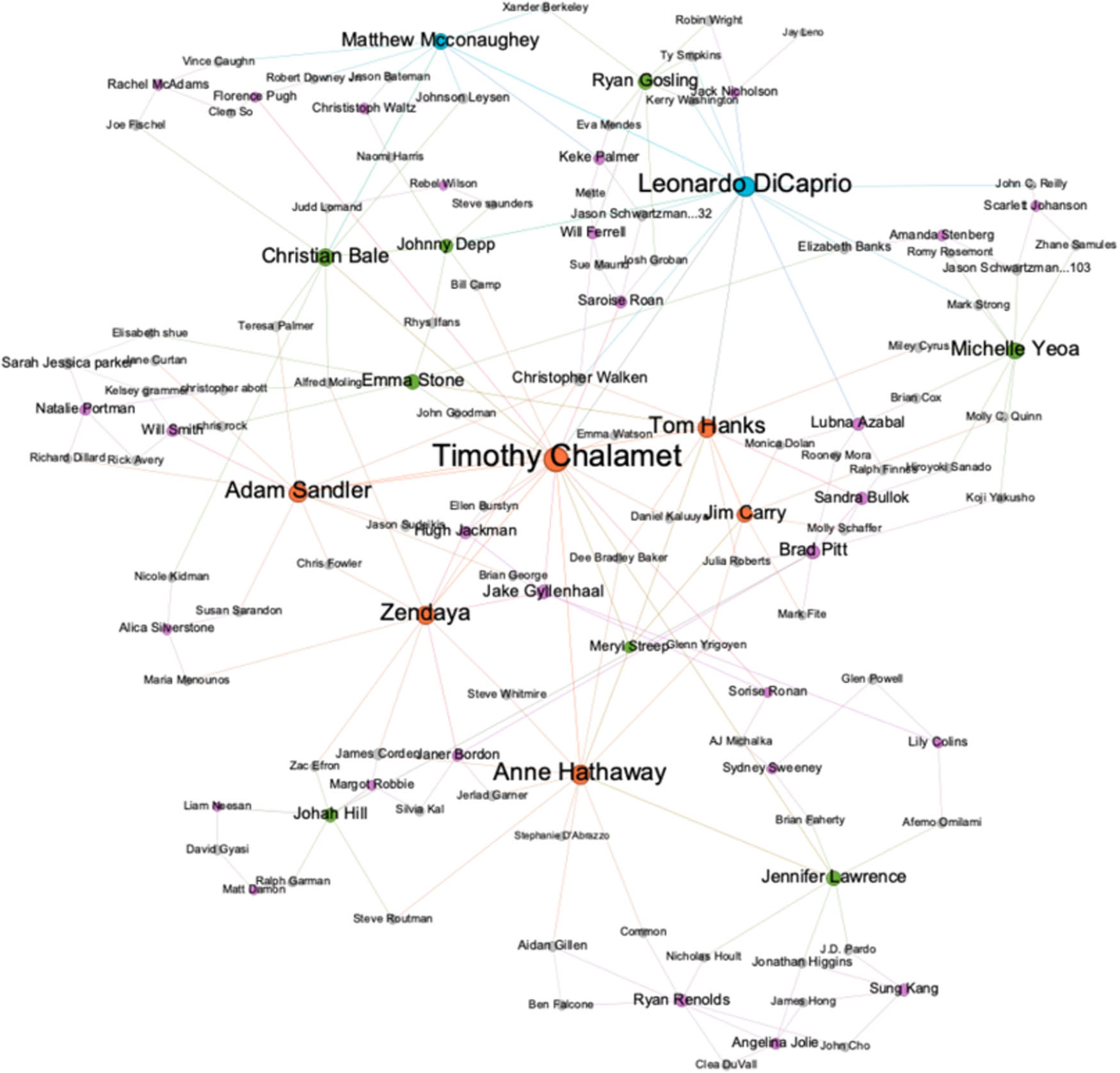
Figure 3
Example Overall Actor Sociogram Combining Sociogram Matrices from All Groups. Note. This type of result for a given class can be used to discuss actor preferences of the current class (i.e., actor preferences and network positions would vary by class, and by year), how sociograms and sociomatrices represent the same data, and how such data can be combined.
Source: Author’s contribution.
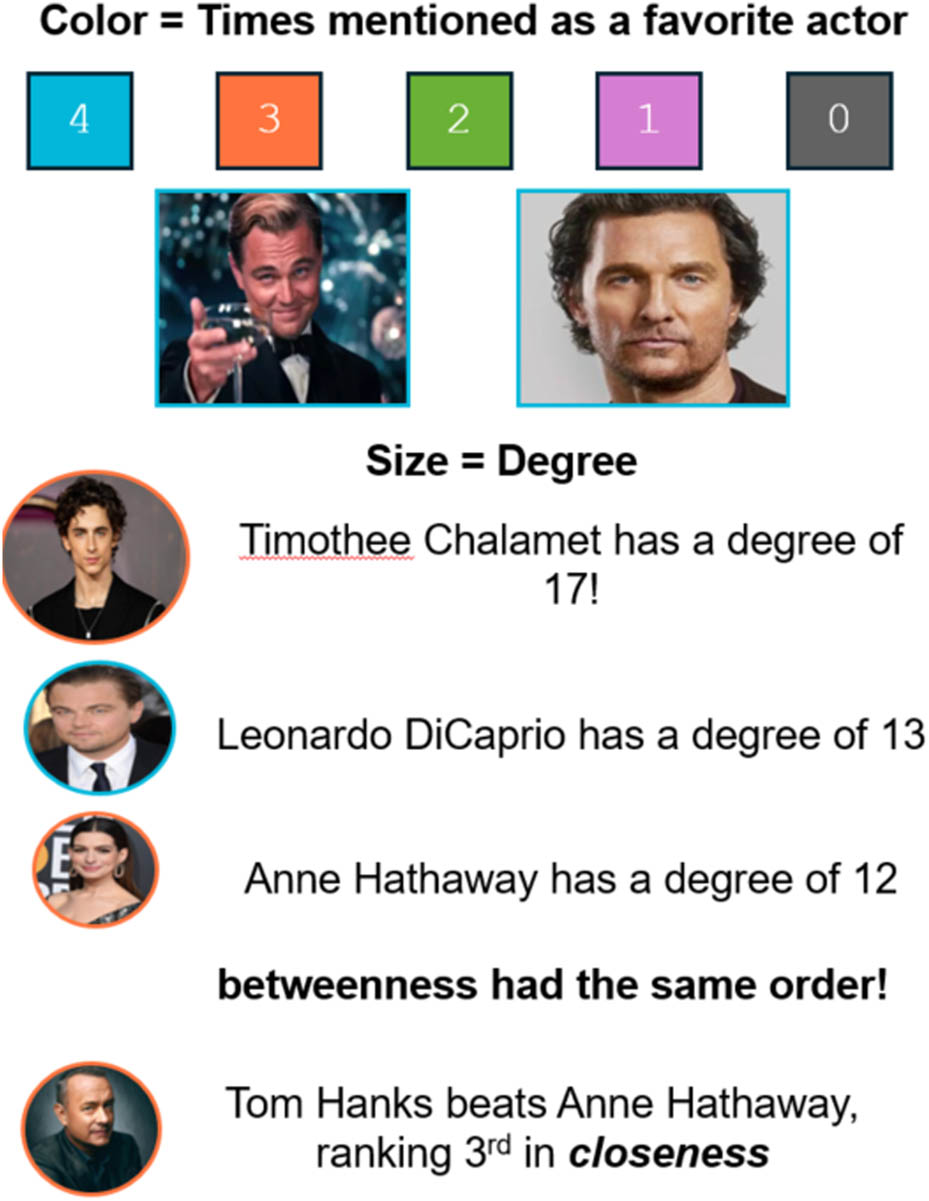
Figure 4
Brief Summary of Centrality Scores for the Most Frequently Listed Actors/Actresses, Computed from Combined Sociomatrices in Figure 3.
Source: Author’s contribution.
Acknowledgements
I thank special issue editor Zachary Neal, and the anonymous reviewer, for their helpful suggestions.
Funding information
Author states no funding involved.
Conflict of interest statement
Author states no conflict of interest.