

Background
Amidst the challenges of everyday life, experience teaches us that being able to bounce back with resilience contributes to coping. However, Western societies have experienced “a burgeoning lack of wellbeing”1 as an inverse of resilience, together with an increasing sense of the fragility of human existence. In recent years, the resilience of individuals, communities, and the entire world has been tested by the COVID-19 pandemic and many local and worldwide disasters.2 As part of a personal vocational response, the author actively reflected on the role of spirituality in supporting resilience in her everyday workplace, which included regular universitybased secular teaching. This was based on witnessing the very real challenges of the pandemic influencing tertiary students, who were panicked, losing their jobs and potentially their roof over their head, and struggling to put food on the table as part of basic human needs.
In addressing the issue, the author approached this situation from a Lutheran theological point of view, where the Christian call to imitate Christ is understood by Luther as a call to contribute to society, where each person (lay or ordained) has a vocation/calling as part of the whole church.3 This sense of vocation is understood to be a calling into the world, not away from the world, and is predicated on relationship with others and serving the needs of one’s neighbour. For Luther, vocation refers to “all of the whole theatre of personal, communal and historical relationships in which one lives”4 and consists of “a diversified, integrated network of relationships … concerned with inter-human relations.”5 In fact, “vocation is shaped solely according to the needs of others.”6 This is based directly on Luther’s teaching: that each person needs to exercise their vocational mission in the language and context of their everyday life in the world.7 In fact, Luther railed against prevailing attitudes to vocation in the Catholic church of the time, where he protested against the twotiered concept of callings or vocations: clergy and laity. Luther’s theology was based on texts such as Colossians 3:24, where Paul tells slaves that while they labour for their earthly masters they are also serving God. For Luther, “all callings are equal in moral and religious seriousness.”8 He saw God’s providence hidden in all vocations, where vocations may be seen as a mask of God, imbuing hidden presence into ordinary everyday life.9 According to Benne, Wingren sees the Christian under the reign of God’s gospel injecting “the love liberated by that gospel into one’s worldly occupation, transforming it into a genuine vocation,”10 where even the mundane aspects of ordinary life hide God’s life-giving presence in the community.11
Combining the context of theological study and everyday employment as a university academic,12 the author chose to explore in depth the spiritual needs of secular tertiary allied health students and apply her lay vocational ministry perspective to her everyday lecturing work. Development of this new approach was supported by active spiritual direction and ongoing professional supervision, during the period where resources were developed and applied with a view to helping the students. Responses to these resources were then later reviewed via a formal evaluation project. The focus of attention in this vocational approach linking resilience and spirituality considered questions such as:
How can resilience connect with health, spirituality, and current society, including needs such as those caused by the pandemic?
How can resilience and spirituality be connected to build an innovative tertiary teaching approach to support trainee health workers?
How can the communication of spiritual values of meaning and purpose support the resilience of young people as they transition into their field of work, and broadly foster strength and wellbeing to meet the everyday challenges of life?
Foundational and applied knowledge will now be explored in each of these areas.
Resilience
Resilience is consistently understood to refer to positive adaptation, or the ability to maintain or regain mental health, despite experiencing adversity, and this is influenced by personal, biological, and environmental or systemic factors.13 Human beings have typically applied resilience strategies to cope with stressors and difficulties across the entire history of the human race, and this basic concept is not new. However, in recent years increased interest in studying and understanding the factors involved in supporting and enhancing resilience have come into focus. Based on an extensive narrative review synthesis, concepts around resilience were extensively explored by Hiebel and colleagues.14 Based on their narrative critical systematic review of resilience publications over a recent five-year period, Hiebel and colleagues explored the adult resilience trajectory. They outlined concepts of 1) immunity/stability/resistance, 2) bouncing back/recovery, and 3) growth. They questioned a conception of resilience as a smooth, steady, and lasting invulnerability and resistance to adversity, where the person withstands challenges in a seemingly immune manner, as being too narrow in focus, and suggested that the absence of a stress response to adversity would seem to be rare. However, the negative effects of adversity with associated declining function followed by a return to similar pre-adversity levels of functioning conceptualises resilience as bouncing back and recovery, in line with concepts of homeostasis. Further, the concept of the resilience trajectory as contributing to individual growth contends that the resilient person grows stronger and functions above the previous pre-adversity level, learning to respond more efficiently to future challenges, and in line with concepts of post-traumatic growth.15 In a large study of tertiary students, Fullerton and colleagues found that a wide range of resources supported the resilience process. These include mental toughness, selfesteem, self-efficacy, optimism, meaning in life, and adaptability, which are in turn influenced by coping strategies and positive adaptation.16
Herrman and colleagues17 further explored the factors involved in resilience via a narrative review. They concluded that two key concepts are the dynamic nature of resilience throughout the lifespan and the interaction of resilience with all dimensions of an individual’s life function and experiences.18 Sources of resilience are complex, and include family-friends, social-economic, and cultural-spiritual factors, as delineated in Figure 1. Clearly, the concept of resilience connects between societal and spiritual understandings. Hoegl and Hartmann19 caution that resilience is not about risk management, but extends much more broadly into the human capacity to thrive and flourish within their world context.
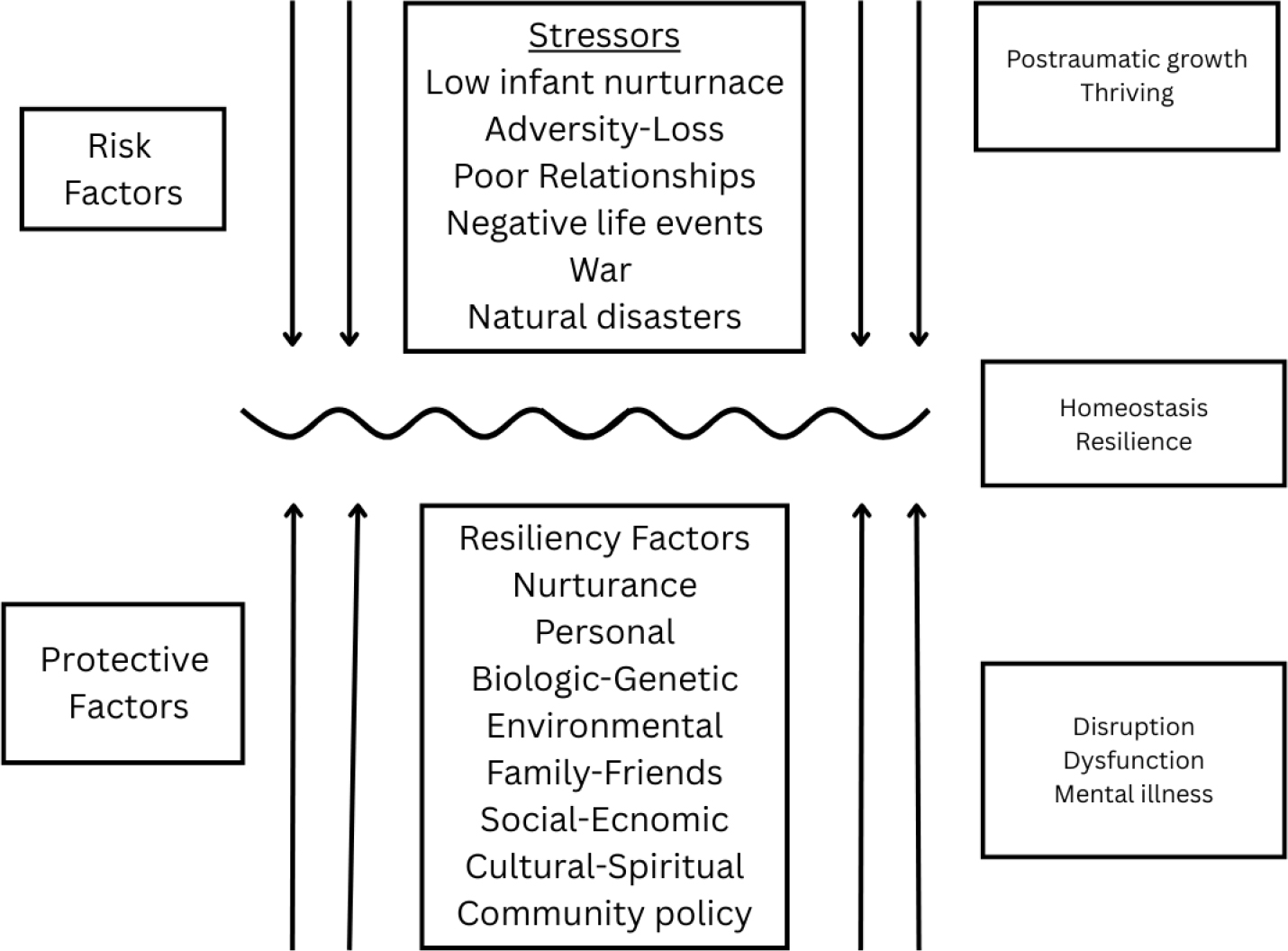
Figure 1.
Factors involved in resilience20
Health and Spirituality
Beyond the well-accepted physical, mental, and social dimensions of health, Dhar and colleagues argue the need for a fourth dimension of health, the spiritual wellbeing of individuals, as published in the World Health Organisation South-East Asia Journal of Public Health.21 Supporting the health and social sciences side of resilience, we find an increasing inclusion of spirituality within the widely taught ecological model of health, which is also based on the well-accepted Social Determinants of Health.22 Undoubtedly, the person is central to the ecological approach to health, embodying an integrated sense of mind, body, and spirit. Around them are their friends and family who have an influence on their health and health decisionmaking, and at the same time the individual is affected by other factors such as their own human biology, their personal behaviour choices, the physical environment in which they live, and the psychosocio-economic environment in which they function. More broadly, the individual’s health is influenced by the medical system around them including access and expertise, by their own lifestyle choices, by their work conditions. Even more broadly, the community in which the individual lives, including language groups and the human-made environment existing around them which may include crowding, pollution, and transportation, has a further effect on the individual’s health and health choices. Beyond this, the effect of culture and the biosphere influence the health of the individual within an ecological approach to health (see Figure 2).
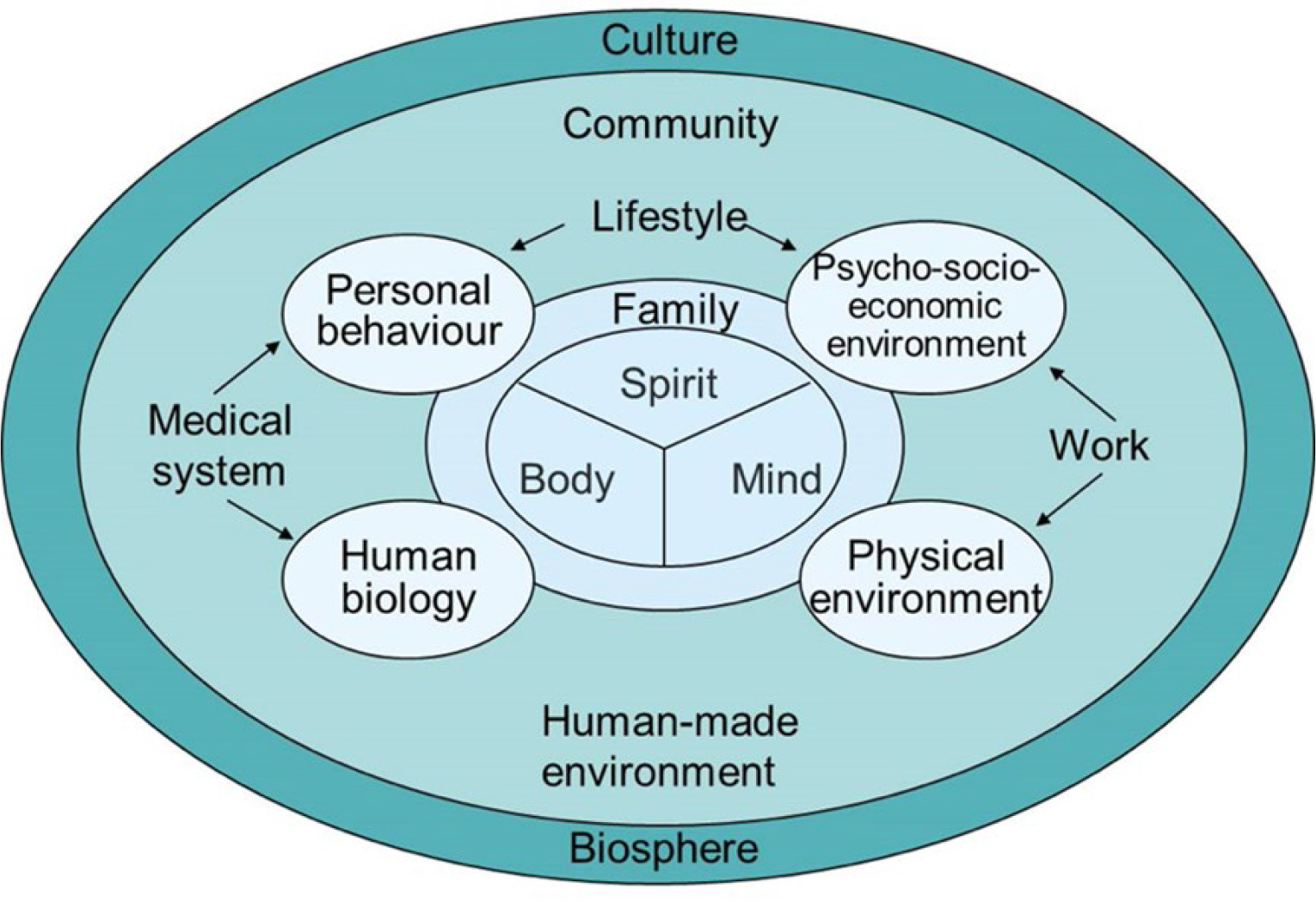
Figure 2.
The ecological model of health23
In exploring applications of this ecological approach to health, considerable literature now exists linking health and the person’s inner spirituality. In fact, “spirituality can be considered a source of coping to handle crisis and stressful moments, and related to positive meanings in the face of challenges, such as health problems.”24 Further applied research suggests that spirituality is related to reduced substance abuse, reduced depression and suicidality, less hospitalisation, and improved coping with disease.25 The fact that this ecological approach to health, including spiritual aspects of the person, is so widely taught and utilised across medical, nursing, and allied health training underpins the importance of connections between resilience and spirituality, which will now be further explored.
Spirituality and Resilience
Clearly, spirituality is concerned with a person’s inner life,26 which also relates to developing self-actualisation and self-transcendence as explained by humanistic and transpersonal psychologist Abraham Maslow.27 Over the years, many people have sought to explain and define spirituality, and this remains challenging: “no single universally acceptable operational definition of spirituality has yet been proposed to the spiritual and scientific intelligentsia.”28 Resulting from an extensive systematic review, Senna and colleagues distilled spirituality as having the following characteristics:29 (1) is a human individual, dynamic characteristic; (2) is expressed through beliefs, practices, and experiences in the search for connection promoting meaning and personal growth; and (3) leads to the development of values and positive inner feelings.
Broadly, many concepts already discussed about resilience also suggest a relationship to spirituality. These include the sense of bouncing back/recovery and individual growth by Hiebel and colleagues, paralleling many biblical passages about overcoming difficulties and metaphors of growth and restoration.30 Similarly, Fullerton and colleagues address aspects of optimism, meaning in life, and adaptability, which are likewise paralleled within biblical texts.31
As White and Cook point out,32 “one of the most significant constructs to impact resilience adaptation is the construction of human meaningfulness,” directly pointing towards spirituality and theological insights. Longstanding psychological understandings also see meaning as important in life, as a mechanism whereby a broad sense of spirituality underpins mental health and wellbeing within the individual’s belief system.33 Further, links have been found for resilience being supported by beliefs, and by resources such as spirituality and religiosity.34 Moss defines spirituality and religion as follows:
Spirituality refers to a personal quest for ultimate meaning in life and for a personal relationship with a transcendent or sacred realm. Religion refers to the organised system of beliefs, practices, rituals, and symbols that are designed to facilitate closeness to the sacred and that provide the average person with moral and social guidelines for behavior.35
In comparing the two terms, spirituality is seen as unifying, inclusive, inner-directed, unconditional and intrinsic, in contrast to religion which may be viewed as separating, exclusive, outer-directed, conditional, and extrinsic.36 Further, both “old” (traditional) and “new” (postmodern) forms of spirituality exist, reflecting different values, beliefs, and attitudes; in the context of descriptors such as meaning and purpose in life, creativity, and relationships.37 A taxonomy of spirituality delineates a “cocktail” of components describing spirituality. These include: a theistic deity; religious beliefs; language related to inner strength/inner peace; cultural, political, and social ideologies; phenomenological experiences; existential meaning, purpose, and fulfilment; implicit quality of life; and transcendent and transpersonal relationship.38 Resilience and spirituality are also seen as aspects of wellbeing and self-care, where self-care and reflective practice are important for sustained study and work in the healthcare workforce.
Resilience has also been investigated as being important in coping with disasters and crises. Lalani and colleagues found that factors such as belonging, a shared positive outlook, faith, hope, compassion, and gratitude contributed to individual and community resilience after the 2016 natural disaster of an extensive wildfire in Alberta, Canada, thereby addressing social, cultural and spiritual factors related to resilience.39
Birkett has also investigated empirical literature around resilience in relation to Christian ministry, with a view to successful thriving within a lifetime employed ministry lifestyle,40 noting that literature of stress and Christian ministry and studies of resilience have not often overlapped.41 Whilst resilience literature using empirical studies identifies spirituality as mediating and promoting resilience, few studies directly address resilience and the clergy.42 Birkett sees overlaps between Christian spirituality and resilience research as related to: 1) adversity leading to strength, 2) sense of meaning and purpose, 3) transcendence, 4) hope, optimism, and positive emotions, 5) altruism, 6) self-efficacy/God-efficacy, 7) forgiveness, and 8) social network.43
In exploring existing literature in 2011, Foy, Drescher, and Watson note that positive adjustment after crises and positive religious coping are strongly related, within their overall exploration of resilience and spirituality.44 Following on from Birkett’s important work in 2015, further empirical studies have emerged. Spirituality has been found to impact resilience by serving as a buffer for mental health issues arising as a result of the COVID-19 pandemic, in a study of 127 individuals spanning a range of ages, ethnicities, and beliefs.45 Related to the COVID-19 pandemic, spirituality has been noted to support the resilience of nurses working in the coronavirus ward during the pandemic.46 Further, there are calls for formal integration of spirituality into the healthcare curriculum.47 Therefore, using aspects of spirituality to increase resilience with trainee allied health workers is seen as potentially beneficial to both these students and their subsequent health practice. Some literature exists around the changes and challenges in teaching healthcare students during the pandemic, some of which has emerged in relation to the vocational setting of tertiary education.48 In practice, removing the in-person aspect of teaching to go fully online indeed changed the nature of interpersonal teaching relationships and provided challenges for students and teachers, as everyone experienced and addressed a sense of crisis with shutdowns, fears, and prohibitions, and this occurred in the context of many students experiencing great hardship and associated mental health issues.
A Vocationally Designed Spirituality-Based Resilience Program
The current author is known as a longstanding international leader in her field, representing the Australian and New Zealand region on the Council of the World Federation of Music Therapy and is in demand as an international conference speaker, academic writer, and researcher collaborator around the world. She is also an experienced health services researcher with well-developed mixed method and qualitative research skills, and highly skilled in leading group process and inclusive group discussions. As the pandemic unfolded, the author also commenced formal theological study for the first time, following up on a life-long interest in theology and a lifetime commitment to Lutheran approaches and understandings. This formal theological study encompassed didactic subjects, online prayer support groups, and local active spiritual direction/mentorship, leading to outputs of not only academic assessment tasks but also online leading of worship and invited reflective theological writing and publications.49 This author’s deep commitment to Lutheran theology was further noted in an additional publication by Vaernesbranden investigating attitudes to ordination of both men and women in the Lutheran Church of Australia and New Zealand. In particular, Vaernesbranden saw the theology of the current author as aligning with foundational Lutheran doctrine (sola scriptura, sola fide, and sola gratia), where faith itself arouses a call to serve, and where in fact the office of the ministry can actually potentially hinder “the outworking of a call to serve.”50
The author’s emergent vocationally designed resilience program reflected an everyday approach to integrating personal understandings of work and study into personal Christian service, living out the gospel of grace, and love embedded into everyday teaching as a way of promoting and supporting spiritual growth and development for students as part of the hidden presence of God. As the senior lecturer heading up this master’s level training program, the author sought to enhance wellbeing and spiritual connections for her students through classroom meaningmaking and discussion, with a view to supporting resilience both currently and in future work applications as a music therapist. In line with Birkett’s constructs,51 this add-in training approach incorporated aspects of 1) acknowledging adversity, 2) building a sense of meaning and purpose, 3) promoting hope and positive emotions, 4) engaging with altruism, 5) self-efficacy and beyond, 6) self-compassion, and 7) social networking.
The newly developed emergent Resilience Corner, as it came to be known, was a suitably meaningful question/topic which was presented with a couple of slides and some prompting questions, followed by collaborative discussion. This occurred in the author’s teaching of second/final year students at the beginning of each lecture. The aim was for 10–15 minutes discussion, although often in practice this became longer, depending on student engagement with the focusing topic. Discussion extended until interactive conversation came to a natural close, at which point the lecture process returned to the stated main learning topic/s for the day. Even when classes returned from online to on-campus, and despite several iterations of on-campus and online teaching, this lecturer continued the process of Resilience Corner given the obvious engagement of the students. Initial examples of Resilience Corner topics included: What gives you joy? What gives you meaning? What types of things are gifts for you? What gifts do you turn into a burden? What makes you feel fully alive? How do your personal experiences affect helping others? As time went on, additional topics of Resilience Corner included: perfection and imperfection; the wounded healer; imposter syndrome; coping with change; making it through; and who are you, at this point in time? In all instances, the aim was to engage in meaning-making discussion to support the overall growth and development of every student. The topics were designed to elicit inclusive discussion about beliefs, practices, and experiences connected to meaning, purpose, values, wellbeing, inner peace, personal growth, and support in the context of sacred/divine, community, self, nature, and spiritual being, thereby aligning the teaching with the spiritual framework of Sena and colleagues.52 Figure 3 provides a collage of some of the slides and topics presented.
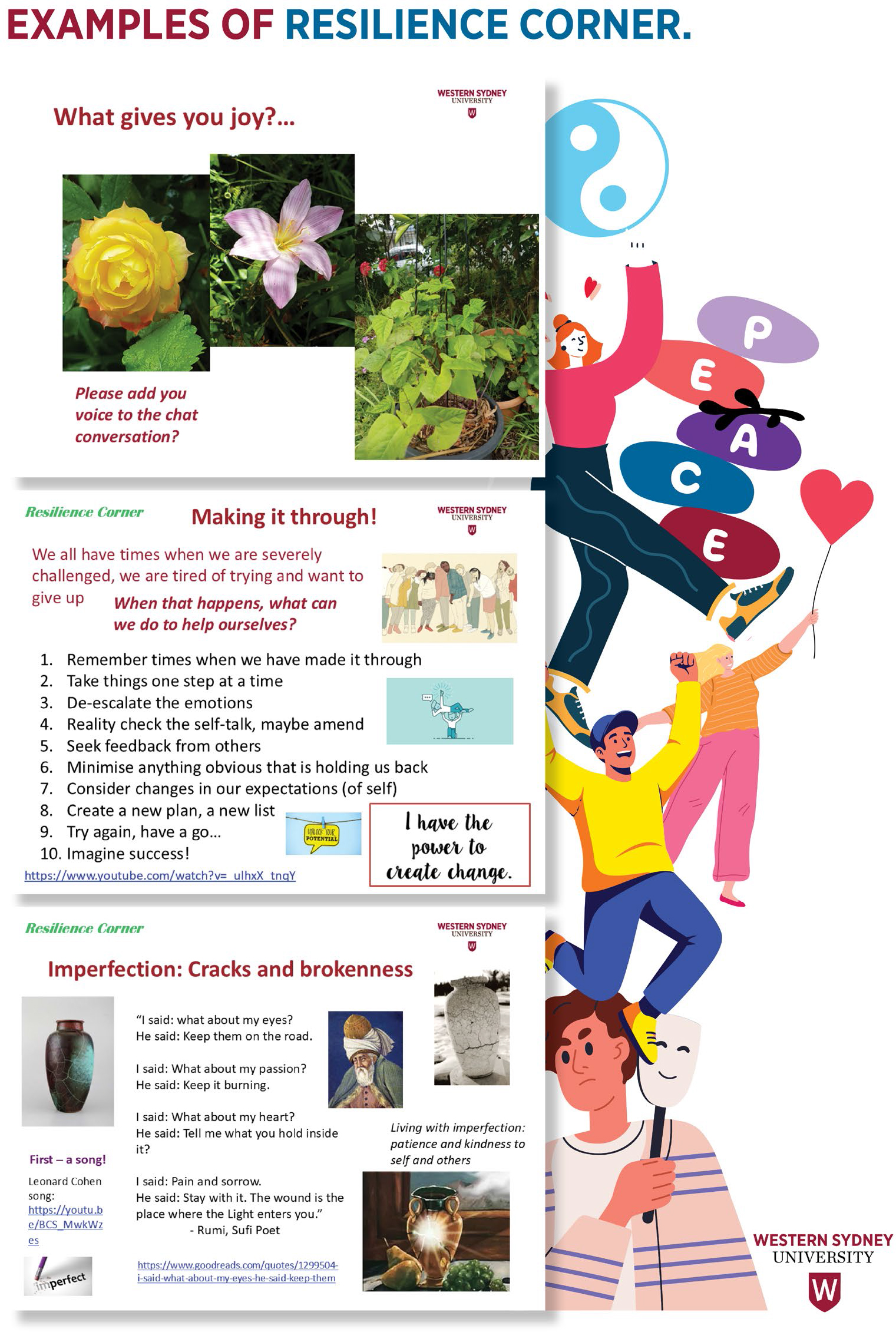
Figure 3.
Collage of examples of Resilience Corner
In reviewing routine anonymous student feedback via the standard university systems after the first semester of Resilience Corner in 2020, there were indications that it made a difference for the students, as shown by the following quotes:
[Teacher] was always so helpful during this pandemic situation. I really appreciated that she reminded us every lecture of what we are going through and it is okay to ask for help. Whenever we were struggling, [teacher] was always there to help us and give us a support in any ways possible. I really appreciated this and her structured teaching this semester, and I am very grateful to have her as our lecturer.
The best aspects of this unit are the amount of information you can learn in regards to client populations. I think in spite of some difficulties of being online, it was still run as well as could be. I really did like the checking in with everybody every week as I thought this really helped with cohesiveness.
In due course, a further empirical evaluation project proposal was developed. Emergent questions for the participating students, who were now alumni, focused on the following: How did the students’ experience of the pandemic affect their learning? How were the additional learning materials that were provided experienced by the students? Did the learning materials assist students with their transition into everyday work after graduation? Were there any effects on their general sense of resilience, wellbeing, and spirituality?
The detailed method and results of this evaluation project are further explored in a subsequent publication.53 In brief, and in the context of an academic year which runs March-November in the Southern Hemisphere, all Music Therapy alumni across the first two years of pandemic-affected teaching (2020 and 2021) were invited to participate in this ethics-approved evaluation project, as designed by the principal researcher/author and staffed initially by two Summer Research Scholarship students and then a Master of Clinical Psychology thesis student, with support from a further doctoral student. The mixed method study approach included both survey and individual interview data and was conducted entirely online for convenience and practical reasons, using both Qualtrics and Zoom platforms. The carefully selected surveys for this study included the Resilience at Work (R@W) Scale54 and the Spiritual Intelligence Self-Report Inventory (SISRI), 55 together with simple demographic information. The surveys were chosen for relevance and applicability, and relevant interview questions were developed. Quantitative data was analysed statistically and audio recorded/transcribed qualitative data was analysed thematically.56
Of the 34 alumni approached (2020=18, 2021=16), 13 completed surveys using the Qualtrics platform (2020=6, 2021=7) and 6 undertook online interviews via Zoom. Participants comprised 10 female and 3 males, with 11 currently employed. Most participants were in casual and part-time employment, and most were employed 10–20 hours per week. Results of quantitative analysis showed a correlation between overall spiritual intelligence scores and resilience at work scores; and a subscale of spirituality, personal meaning-making, and predicted resilience at work based on a regression analysis. Themes from the qualitative analysis included the influence of the pandemic on learning, self-care, the role of spirituality in resilience, and the importance of supportive academic communities. Two different quotes encapsulate the expressed views of the alumni participants:
I actually also found that having that Resilience Corner in a way allowed us to sort of, be able to connect on a deeper level, even though we weren’t face to face. I guess that allowed us to sort of see a little bit of each other in a different way … But get to know each other a little bit better, in terms of that. So I think it was really good to have that check in, and especially in the kind of work that we’re doing is in a way like it helps set us up a bit for supervision and things like that down the track … And at the time as well, it was also really helpful to sort of, have a bit more, I feel like it did lead to more of a connection and stuff.
I think it was when Alison would just sort of talk, there was like a section allocated of every lecture where we just talk about resilience in general and maybe have some discussion. Yeah. Which was definitely helpful. Just nice to have a discussion with everyone. I think resilience is obviously a very important thing … I can’t remember the actual content very well, but I do remember thinking that I just enjoyed listening to other people talk about their version of resilience. And it’s really nice that Alison sort of held space for that.
In light of the findings, results confirmed that a carefully devised educational program of additional coursework learning materials and resources which focused on supporting resilience, deeper wellbeing, and meaning-making during the pandemic had the capacity to provide spiritual support linking to resilience for final year students transitioning to ongoing healthcare practice. Limitations of the study included small participant numbers, and not being able to do before-and-after surveys with nonpandemic students—since the pandemic was an unexpected occurrence. Despite the limitations, results suggest that this vocational approach project linking resilience and spirituality provided a foundation for future research into resilience strategies for music therapy and other healthcare students, with implications for an enhanced focus on spirituality supporting sustainable professional practice into the future.
Conclusions
This paper has sought to draw together connections between resilience and spirituality within the context of health and healthcare education by using knowledge, research, and established conceptualisations to understand, inform, and integrate this knowledge across spiritual, health, and societal frames of reference. Clearly, spirituality is an important part of life for many, and indeed likely all, people within an ecological approach to health. This ecological approach to health is also linked to the social determinants of health as espoused by the World Health Organization, with further implications for the mental health of individuals. In fact, a critical narrative review linking mental health with resilience/coping during the COVID-19 pandemic found themes of mental health impact, impact in the workplace, and improving resilience in the light of stress and trauma in the pandemic.57 The practical role of addressing spirituality within the workplace to influence mental health and wellness lifestyles is further discussed by Badrinarayanan and Madhavaram,58 and links to current understandings of everyday vocational service.
Taken together, current explorations suggest the need for more attention to healthy coping strategies, resilience, and the need for additional preparedness and policy approaches,59 in order to support recovery from the pandemic. The need for flexible and individualised broad-based social support in the general community is crucial, and uniting people in the context of a pandemic with a collaborative goal of global mental wellness has the potential to increase society-level resiliency.60 Cultural and spiritual factors are closely linked and may together provide protective factors for post-traumatic growth and thriving, as depicted in the Herrman’s resilience model.61 How cultural factors may positively influence resilience and post-traumatic growth has been studied by an extensive critical literature view with an explicit focus on cultural factors.62 They found that culture, including an understanding of foundations of faith, brings order to a person’s everyday practices and principles, noting that “different cultures have different values which reflect culturally embedded patterns of coping of an individual.”63 Further, religion/spirituality as a resilience factor embraces increased meaning in life, broad and contextualised social support, and improved access to resources through regular group attendance such as in the form of church/services.64
It is clear from both the literature and empirical evidence that resilience and spirituality are indeed closely linked, and that broad-based initiatives linked to prevention, preparedness, and policy can be of assistance in increasing resilience and post-traumatic growth. In the context of secular tertiary education, there are increasing calls for the inclusion of teaching and experiences focusing on spirituality within the education of healthcare professions, especially with the additional challenges to resilience of the pandemic.65 After an extensive study of acquired education and links between spirituality and health, Bożek and colleagues state that “modern university study programs often lack deep philosophical content, which should play a significant role in shaping the spirituality of young people,” also suggesting that it is worth investing in developing curriculum resources associated with spirituality to support overall wellbeing.66
In view of this, this article has outlined an example of a lecturer’s vocational approach stemming from Lutheran theology, applied into everyday workplace activities in a way that is appropriate to the secular tertiary education context. This current context-based emergent initiative is simply one possible approach, which has subsequently been empirically demonstrated to support final-year students transitioning into the workplace. Based on concepts of resilience67 and spirituality,68 the Resilience Corner focused on individual and collective development of meaning, purpose, values, wellbeing, inner peace, personal growth, and support in the context of sacred/divine, community, self, nature, art, and spiritual being, thereby creating an integrated and context-driven educational initiative. This approach to attending to the spiritual needs of students has been demonstrated to be of value to students and their subsequent resilience at work after graduation, based on a further mixed method evaluation study as presented. In turn, this study and its context may further inform faith communities about resilience needs in society, especially the needs of younger adults in the tertiary context and beyond. This then opens up possibilities for fostering a deeper involvement with spirituality, in order to support individual resilience needs in a challenging and changing world. Clearly, further focused attention into both engaged curriculum development and evaluation research is urgently needed, with further implications for additional disciplines and age groups.
Bringing together the protective factors of spirituality to support individual and collective resilience has the potential to reduce stress and traumatic effects, thereby fostering growth and wellbeing within society. Based on their study of youth resilience in stressed communities, Theron and colleagues suggest that improving resilience requires interventions at a social and ecological level, and relies less on individual choices and more on societal co-facilitating of resilience-advancing changes at multiple system levels.69 In turn, increased resilience may contribute to harm reduction and the promotion of mental health protective mechanisms,70 likely through the generation of sacred positive emotions such as gratitude.71
Finally, this paper asserts that we need to vocationally cross boundaries to communicate spiritual values of meaning and purpose within both secular and sacred contexts, in order to support the resilience of young people as they transition into their field of work and cope with the everyday and extraordinary stresses in their lives. In doing so, we can foster and support their strength and wellbeing to meet the everyday challenges of life, creating stamina and resilience amongst adversities.
For I am convinced that neither death nor life, neither angels nor demons, neither the present nor the future, nor any powers, neither height nor depth, nor anything else in all creation, will be able to separate us from the love of God that is in Christ Jesus our Lord.72
Acknowledgements
Grateful thanks for support and mentorship are offered to my Discover Program Pastor/Mentor, Hans Peethala; former Australian Lutheran College Principal, James Winderlich; Discover Program Coordinator, Merryn Ruwoldt; Lutheran Theological Journal Editor, Anna Nürnberger; and my external professional supervisor. Together, all of you have supported my growth and development into the theological space and helped me span from health into spirituality, and I am most grateful to all of you. Thanks are also offered to my two Summer Research Scholarship Students, Abigail Latecka and Aaron Gunawickrema, and my Master of Clinical Psychology student, Stuart Lokhee, for their work on data collection and data analysis, and to my doctoral student, Lene Jeffrey, for her support with student supervisory activities. Finally, and most importantly, I thank all of the participants in this empirical study for their open and generous participation and sharing of their views and experiences.
Notes
[1] Nathan White and Christopher Cook, Biblical and Theological Visions of Resilience: Pastoral and Clinical Insights (Routledge, 2020), 1.
[2] Junaid Ahmad, Mokbul Morshed Ahmad, Zhaohui Su, Irfan Ahmad Rana, Asif Rehman, and Haleema Sadia, “A Systematic Analysis of Worldwide Disasters, Epidemics and Pandemics Associated Mortality of 210 Countries for 15 Years (2001–2015),” International Journal of Disaster Risk Reduction 76 (2022): 1–13, https://doi.org/10.1016/j.ijdrr.2022.103001.
[3] Marc Kolden, “Luther on Vocation,” Word and World 3, no. 4 (1983): 382–90, https://wordandworld.luthersem.edu/content/pdfs/3-4_Luther/3-4_Kolden.pdf; see also Jo Bertil R. Vaernesbranden, “Optimality Theory: LCANZ and the Ordination of Women: A Case Study,” Lutheran Theological Journal 56, no. 3 (December 2022): 143–54.
[5] W. D. Persaud, “Luther on Vocation, by Gustaf Wingren: A Twenty-First-Century Theological-Literary Reading,” Dialog 57 (2018): 84–90, https://doi.org/10.1111/dial.12387; Gustaf Wingren, Luther on Vocation (original thesis then book: 1942/1957/2004).
[6] Christopher J. Richman, Called: Recovering Lutheran Principles for Ministry and Vocation (Fortress Press, 2022).
[7] Friedemann Hebart, Luther’s Large Catechism, Rev. ed. (Australian Christian Resources, 2020); Gene E. Veith, The Spirituality of the Cross, 3rd ed. (Concordia Publishing, 2021), 89–114.
[8] Robert Benne, “Martin Luther on the Vocations of the Christian” (2016), Oxford Research Encyclopedias, https://doi.org/10.1093/acrefore/9780199340378.013.363.
[9] Eric Smith, “The Doctrine of Vocation: A Theology of Ordinary Life,” With Christ On the Ancient Paths, https://imsacape.christians.co.za/wp-content/uploads/sites/8/2019/06/The-Doctrine-of-Vocation-Theology-of-Ordinary-Life.pdf; Gene Edward Veith, “The Doctrine of Vocation,” Online essay for Modern Reformation (2012), https://www.modernreformation.org/resources/articles/the-doctrine-of-vocation-2.
[12] Discover Program, Australian Lutheran College/University of Divinity; Alison Short,”Hope-Makers in an Un-Peaceful World,” Lutheran Theological Journal 54, no. 2 (2020): 115–17; Alison Short,“Herzlich willkommen to our mob, nǐ hǎo and salam,” Lutheran Theological Journal 55, no. 2 (2021): 77–80; Alison Short, “Beyond an Earthly Reign: Changing Custom to Meet Context,” Lutheran Theological Journal 56, no. 2 (2022): 89–95.
[13] Helen Herrman, Donna E. Stewart, Natalia Diaz-Granados, Elena Berger, Beth Jackson, and Tracy Yuen, “What Is Resilience?,” Canadian Journal of Psychiatry 56, no. 5 (2011): 258–65.
[14] Nina Hiebel, Milena Rabe, Katja Maus, Frank Peusquens, Lukas Radbruch, and Franziska Geiser, “Resilience in Adult Health Science Revisited: A Narrative Review Synthesis of Process-Oriented Approaches,” Frontiers in Psychology 12 (2021): 659395, https://doi.org.10.3389/fpsyg.2021.659395.
[16] Dayna J. Fullerton, Lisa M. Zhang, and Sabina Kleitman, “An Integrative Process Model of Resilience in an Academic Context: Resilience Resources, Coping Strategies, and Positive Adaptation,” PLoS ONE 16, no. 2 (2021): e0246000, https://doi.org/10.1371/journal.pone.0246000, 4–5.
[19] Martin Hoegl and Silja Hartmann, “Bouncing Back, If Not Beyond: Challenges for Research on Resilience,” Asian Business and Management 20, (2021): 456–64, https://doi.org/10.1057/s41291-020-00133-z.
[20] Figure 1 reprinted from Herrman et al., “What Is Resilience?,” 261. Copyright © 2011 by Sage Publications. Reprinted with permission.
[21] Neera Dhar, S. K. Chaturvedi, and Deoki Nandan, “Spiritual Health, the Fourth Dimension: A Public Health Perspective,” WHO South-East Asia Journal of Public Health 2 (2013): 3–5.
[22] World Health Organization, Operational Framework for Monitoring Social Determinants of Health Equity (Geneva: World Health Organization, 2024), Licence: CC BY-NC-SA 3.0 IGO, https://iris.who.int/bitstream/handle/10665/375732/9789240088320-eng.pdf?sequence=1.
[23] Figure 2 reprinted with permission from The Association of Faculties of Medicine of Canada, AFMC Primer on Population Health (2014), 11, https://ubccpd.ca/sites/default/files/documents/AFMC_Primer_on_Population_Health_2014-12-23.pdf.
[24] Marina Aline de Brito Sena, Rodolfo Furlan Damiano, Giancarlo Lucchetti, and Mario Fernando Prieto Peres, “Defining Spirituality in Healthcare: A Systematic Review and Conceptual Framework,” Frontiers in Psychology 12 (2021): 756080, 4, https://doi:10.3389/fpsyg.2021.756080.
[26] Rajesh Ratnakar and Shreekumar Nair, “A Review of Scientific Research on Spirituality,” Business Perspectives and Research (2012): 1–12.
[27] Abraham Maslow, Religions, Values and Peak Experiences (Ohio State University Press, 1964); Abraham Maslow, The Farther Reaches of Human Nature (Penguin, 1971); Donald Moss, “The Circle of the Soul: The Role of Spirituality in Health Care,” Applied Psychophysiology Biofeedback 27, no. 4 (2002): 283–97, https://doi:10.1023/a:1021013502426.
[28] Vishag Badrinarayanan and Sreedhar Madhavaram, “Workplace Spirituality and the Selling Organization: A Conceptual Framework and Research Propositions,” Journal of Personal Selling and Sales Management 28, no. 4 (2008): 421–34, https://doi.org.10.2753/PSS0885-3134280406,4.
[33] Viktor Frankl, Man’s Search for Meaning (Beacon Press, 1946); Carl Jung, The Spiritual Problem of Modern Man: Civilization in Transition: The Collected Works of Carl G. Jung, translated by R. F. C. Hull (Princeton University Press, 1970).
[34] Fabio Duarte Schwalm, Rafaella Brugalli Zandavalli, Eno Dias de Castro Filho, and Giancarlo Lucchetti, “Is There a Relationship between Spirituality/Religiosity and Resilience? A Systematic Review and Meta-Analysis of Observational Studies,” Journal of Health Psychology (2021): 1–15.
[37] Wilfred McSherry and Keith Cash, “The Language of Spirituality: An Emerging Taxonomy,” International Journal of Nursing Studies 41 (2004):151–61, 157.
[39] Nasreen Lalani, Julie L. Drolet, Caroline McDonald-Harker, Matthew R. G. Brown, Pamela Brett-MacLean, Vincent I. O. Agyapong, Andrew J. Greenshaw, and Peter H. Silverstone, “Nurturing Spiritual Resilience to Promote Post-Disaster Community Recovery: The 2016 Alberta Wildfire in Canada,” Frontiers in Public Health 9 (2021): 682558.
[44] David W. Foy, Kent D. Drescher, and Patricia J.Watson, “Religious and Spiritual Factors in Resilience,” in Resilience and Mental Health: Challenges Across the Lifespan, eds. Steven M. Southwick, Brett T. Litz, Dennis Charney, and Matthew J. Friedman (Cambridge, UK: Cambridge University Press, 2011), 90–99.
[45] Anka Roberto, Alicia Sellon, Sabrina T. Cherry, Josalin Hunter-Jones, and Heidi Winslow, “Impact of Spirituality on Resilience and Coping during the COVID-19 Crisis: A Mixed Method Approach Investigating the Impact on Women,” Health Care for Women International 41, nos. 11–12 (2020): 1313–334.
[46] Alireza Rajabipoor Meybodi and Masoumeh Mohammadi, “Identifying the Components of Spirituality Affecting the Resilience of Nurses,” Journal of Nursing Management 29 (2020): 982–88.
[48] Jeffrey W. Redinger, Paul B. Cornia, and Tyler J. Albert, “Teaching during a Pandemic,” Journal of Graduate Medical Education 12, no. 4, (2020): 403–5, https://doi.org/10.4300/JGME-D-20-00241.1; Annie Heiderscheit and Alison Short, “Challenges and Innovations during the COVID-19 Pandemic: An International Survey of Music Therapy Educators,” Nordic Journal of Music Therapy (2024), https://doi.org.10.1080/08098131.2023.2283077.
[49] Alison Short, “Hope-Makers,” 115–17; Alison Short, “Herzlich willkommen to our mob, ni hao and salam,” Lutheran Theological Journal 55, no. 2 (2021): 77–80.
[50] Alison Short, “Beyond an Earthly Reign: Changing Custom to Meet Context,” Lutheran Theological Journal 56, no. 2 (2022): 89–95; Jo Bertil R. Vaernesbranden, “Optimality Theory: LCANZ and the Ordination of Women—A Case Study,” Lutheran Theological Journal 56, no. 3 (2022): 143–54, especially 171. Subsequent to this, the current author then went on to complete formal lay preacher training with formal authorisation into congregational activities.
[53] Stuart Lokhee and Alison Short, “Predictors of Resilience in University Students during the COVID-19 Pandemic: A Scoping Review,” [in prep] (2025): Western Sydney University.
[54] Peter C. Winwood, Rochelle Colon, and Kath McEwen, “A Practical Measure of Workplace Resilience: Developing the Resilience at Work Scale,” Journal of Occupational and Environmental Medicine 55, no. 10 (2013): 1205–212, https://doi.org.10.1097/JOM.0b013e3182a2a60a.
[55] David B. King and Teresa L. DeCicco, “A Viable Model and Self-Report Measure of Spiritual Intelligence,” The International Journal of Transpersonal Studies 28 (2009): 68–85, https://doi.org.10.24972/ijts.2009.28.1.68; David B. King, Constance A. Mara, and Teresa L. DeCicco, “Connecting the Spiritual and Emotional Intelligences: Confirming an Intelligence Criterion and Assessing the Role of Empathy,” The International Journal of Transpersonal Studies 31 (2012): 11–20.
[56] Virginia Braun and Victoria Clarke, “Using Thematic Analysis in Psychology,” Qualitative Research in Psychology 3, no. 2 (2006): 77–101, https://doi.org/10.1191/1478088706qp063oa.
[57] Amoneeta Beckstein, Marie Chollier, Sangeeta Kaur, and Ananta Raj Ghimire, “Mental Wellbeing and Boosting Resilience to Mitigate the Adverse Cconsequences of the COVID-19 Pandemic: A Critical Narrative Review,” SAGE Open (2022): 1–20, https://doi.org.10.1177/21582440221100455.
[62] Pankti Galia, Shrinidhi Karole, Renuka Kavishwar, Vainavi Kumta, and Mahimna Vyas, “Recognising Resilience and Post-Traumatic Growth in Adverse Situations: A Critical Literature Review,” IAHRW International Journal of Social Sciences Review 10, no. 3 (2022): 302–7.
[64] Dmitry M. Davydov, Robert Stewart, Karen A. Ritchie, and Isabelle Chaudieu, “Resilience and Mental Health,” Clinical Psychology Review 30, no. 5 (2010): 479–95, https://doi.org.10.1016/j.cpr.2010.03.003,35.
[66] Agnieszka Bożek, Paweł F. Nowak, and Mateusz Blukacz, “The Relationship Between Spirituality, Health-Related Behavior, and Psychological Well-Being,” Frontiers in Psychology 11 (2020): 1997, htttps://doi.org.10.3389/fpsyg.2020.01997.
[69] L. Theron, K. Murphy, and M. Ungar, “Multisystemic Resilience: Learning from Youth in Stressed Environments,” Youth and Society 54, no. 6 (2021): 1000–1022, https://doi.org/10.1177/0044118X211017335.
[71] B. Fredrickson, “How Does Religion Benefit Health and Well-Being? Are Positive Emotions Active Ingredients?,” Psychological Inquiry 13, no. 3 (2002): 209–13, https://www.jstor.org/stable/1449332.