

Introduction
Christian witness is generally framed as occurring through words and deeds. The Gospels present Jesus as an authoritative teacher speaking good news and enacting deeds of healing and mercy.1 Jesus instructs his disciples to continue his mission of teaching (Matt 28:18–20) and promises the Spirit to empower deeds of peace and forgiveness (John 20:22–23). Yet Matthew 28:18–20 also describes the making of disciples, and in Revelation 21:5, God is portrayed as making all things new. What might it mean for acts of craft to be understood as a participation in God’s mission of making?
Christian witness through acts of making invites research. Fujimara argues for a theology of making in which creative acts are a profound way of participating in God’s mission.2 In a culture saturated by words and cynical of deeds, Everett has argued that making and mending are ways of engaging in mission that rework “the scraps of history … for both utility and beauty.”3 Hence, research into making in general, and knitting in particular, can be woven in dialogue with theologies of mission.
Making in general, and knitting in particular, is popular in contemporary society. Knitting is among the top three crafts in the United Kingdom, while craft sales generated over £3 billion income in 2019.4 While knitting is popular, it is often perceived as “a female vocation,” suitable “only for grannies.”5 Hence, learning with and from knitters and crafters could have liberating dimensions, challenging stereotypes around gender and age and exploring ways of being, doing, and knowing that have historically been seen as less important in the Christian missions.
This paper researches how the understandings of mission were woven into two expressions of contemporary Christian witness. Beginning initially in England in 2014, then in Australia, Christians have yarn bombed thousands of knitted Christmas angels through their neighbourhoods.6 Beginning in Australia in 2020, Common Grace invited people to craft Knit for Action climate scarves.7 Interviews with knitters were conducted, then theorised using the Marks of Mission. The results suggest that making embodies distinct ways of relating, participating in community, and embodying Christian mission.
Literature Review
Making is a significant dimension of being human. Gauntlett defines making as “everyday creativity” that enhances connections between humans and their worlds.8 Eichler-Levine explores the ways in which making and everyday creativity in contemporary Judaism are crucial for a generative and resilient religious life.9 Research in Australia and internationally documents the ways in which knitting contributes to wellbeing, provides social networks, and brings structure to daily life.10
Western modernity has tended to place making in a binary relationship with art, using distinctions of professional and amateur.11 As a result, there is a “long history of using ‘craft’ and related terms” to suppress cultural activities.12 Yet feminist literature has argued that individual activities of making can be forms of resistance to the materialistic tendencies of Western modernity. Craft is seen as embodying “a particular outlook on the world … making a political statement.”13 As making reclaims spheres of activity artificially cleaved by the project of modernity it provides a schooling in new ways of being human.14 Hence, research into making can challenge stereotypes around culture and gender. The practices of adaptation, resistance, and innovation woven through making could offer new ways for the church to be in mission.
Christian witness has emphasised words and deeds rather than making. The Gospels present Jesus as an authoritative teacher announcing good news through sermons, parables, and questions in “a sustained ministry of public proclamation” and enacting moments of compassion and miraculous deeds.15 The disciples who bore witness to Jesus’ words and deeds are instructed to verbally share what they see and hear of the life and ministry of Jesus (John 20:21) and value practical acts of care and compassion (Matt 25:44–45). Research into the life of the church following Pentecost has focused on multiple moments of public speech-making and concluded that the book of Acts has a “framework dominated by the word.”16 At the same time, the disciples are described as witnessing through deeds (Acts 9:36).
Yet making is a consistent theme through Scripture. The creation narrative in Genesis 1 has an artistic patterning, while the narrative in Genesis 2 places Adam as a maker with the earth.17 God as Maker of Heaven and Earth is a common liturgical refrain (see for example Pss 115:15; 121:2; 124:8; 134:4, and 146:6). The wisdom literature portrays God as a shaper of creation (Ps 8:3) and delighting in acts of making (Prov 8:25). Amy Plantinga Pauw draws on this wisdom literature to document an ordinary times ecclesiology in which God’s creative and sustaining grace is a making new and a making do.18
In the New Testament, the identification of Jesus as a “carpenter’s son” (Matt 13:5) speaks to a childhood and vocation shaped by making, including the crafting of furniture and farm implements. There are no direct mentions of Jesus in his three years of ministry bearing witness through acts of making. However, Jesus used metaphors of making to explain the Kingdom of God as being like mending wineskins (Luke 5:36) and spinning of cloth (Luke 12:27–28).
Acts of making are an overlooked thread in Christian mission. Spencer describes the witness of three women “of the cloth” in Acts and outlines how Tabitha, Lydia, and Priscilla drew on making skills in commercial ventures.19 Skreslet outlines the importance of sculptors, carvers, painters, engravers, printers, silversmiths, weavers, embroiders, potters, and leatherworkers in mission history and how missionaries enlisted “skilled local artisans in the church’s ongoing task of indigenizing Christianity.”20 Mary has been portrayed in the Madonna Operosa (thirteenth century) and the Buxtehude Madonna (fifteenth century) as knitting as she watched over a young Jesus.21 Geoffrey Fisher, a keen knitter and Archbishop of Canterbury (1945–1961), declared knitting a virtue.22 In the Pacific, craft played a role both in civilizing and as a site of indigenous agency. Churches existed not only as places for prayer but “as dynamic hubs where cultural practices [of making] are maintained, sustained and innovated.”23 These historical threads invite examination of making in contemporary mission.
The Marks of Mission are a common contemporary framework used to define mission.24 Four Marks of Mission were initially defined in 1984. These were, first, to proclaim the good news of the Kingdom; second, to teach, baptise, and nurture new believers; third, to respond to human need by loving service, and fourth, to seek to transform unjust structures of society, challenge violence of every kind, and pursue peace and reconciliation. In 1990, a fifth mark was added to strive to safeguard the integrity of creation and sustain and renew the life of the earth.25 The Marks of Mission are commonly shortened to five words: tell, teach, tend, transform, and treasure. Anglican theologian Kwok Pui-Lan affirms how the Marks of Mission work to
balance the concerns of the local and the global and to mediate between those who see mission as evangelism or social action … evangelism and mission are not mutually exclusive but are entwined in hybrid relationships … The popular reception of the Five Marks of Mission challenges us not to use simple, binary conceptions of conservatives and liberals to understand the faith and practice of global Anglicanism.26
This endorsement demonstrates the value of the Marks of Mission in analysing mission, including contemporary expressions of knitting as making by Christians in Australia.
Methodologies and Methods in Researching Making
The aim of qualitative research is to learn from particularity. Aware that quantitative approaches can average differences, qualitative research values insights from a single conversation or act. Hence, one way to research making is through qualitative methods, including ethnography and interviews, that can illuminate individual insights.
Scavenge ethnography is a methodology (and a method) anchored in black, feminist, and indigenous studies. It is a way of valuing knowledge outside the bounds of academia and an ethical response to contexts with scarce resources.27 Scavenge ethnography, which has been used in researching Christian organisations, begins by looking for what is already there.28 In this paper, that meant conducting a “scavenger hunt” through organisations’ websites, online news articles, and ABC Radio interviews.29 The aim was to attend to existing reports of making.30 However, scavenge ethnography alone has limits. What is reported on websites and newspapers does not always illuminate individuals’ motivations and practices.31 Hence, interviews with individual knitters were also used to clarify experiences and explore the theological connections and prayers that might be present in the actions of knit and purl.
Ethical approval to interview makers was granted by the Adelaide College of Divinity. Participants were recruited in several ways. First, my scavenge ethnography through social media revealed individuals who had posted pictures on Facebook displaying their Knit for Climate Action scarves or tweeted about yarn bombing a Christmas angel. I contacted them and pointed them to a website about the research.32 If they responded, I outlined the consent processes and asked if they were willing to be interviewed. Second, Common Grace, the organisation that initiated the Knit for Climate Action scarf project, kindly offered to notify their stakeholders of the research website.33 If people contacted me, I explained the research and outlined the consent processes. Given the geographic distance, almost all participants were interviewed online.
Each interview began with an invitation to “show and tell” by sharing photos of the knitted objects or the wool used in the making. This approach is consistent with the material turn in humanities since the 1970s and the way objects offer insight regarding “power relations, social bonds and networks, gender interactions, identities, cultural affiliations and beliefs.”34 Semi-structured questions explored the motivations and experiences of making. All interviews were transcribed, and checked by participants, aware the results were for external publication.
Thematic analysis was used to interpret the interviews. Braun and Clarke propose a continuum of approaches to thematic analysis.35 At one end of the continuum is reflexive thematic analysis, where data analysis is an active and reflexive dialogue between the data and the researcher’s interests. At the other end of the continuum is coding reliability thematic analysis, where analysis of data is based on themes developed early in the analytic process, often before the processes of analysis begin. This paper uses coding reliability thematic analysis and the Marks of Mission as themes of analysis.36 Could a widely recognised and well-established contemporary mission framework help understand making in general, and knitting in particular, as Christian witness?
I did not anticipate that interview participants would use the vocabulary of the Marks of Mission. Instead, the analysis would identify if the marks were implicit in knitters’ motivations and experiences. If so, this would provide a way to theorise what it might mean for the contemporary church to be sent by Christ in the power of the Spirit (John 20:21).
Knitting as Making in Mission
The research demonstrates that crafting angels and scarves is a form of Christian witness in which all five Marks of Mission are present.
Angels
The Christmas angels project began in 2014 in the north of England. Members of a local Methodist circuit placed a knitting pattern online and encouraged members of local churches to knit angels, tag each with a message of Christian love, and distribute (yarn bomb) them to neighbours.37 The stated aim was to “share God’s love and to bless the community in public places and community spaces with a Christmas message.”38 In the first year, some 2,870 Christmas angels were knitted and released. By 2017, this had risen to 60,247.39 This increase suggests a significant and growing interest in making angels (Figure 1).40
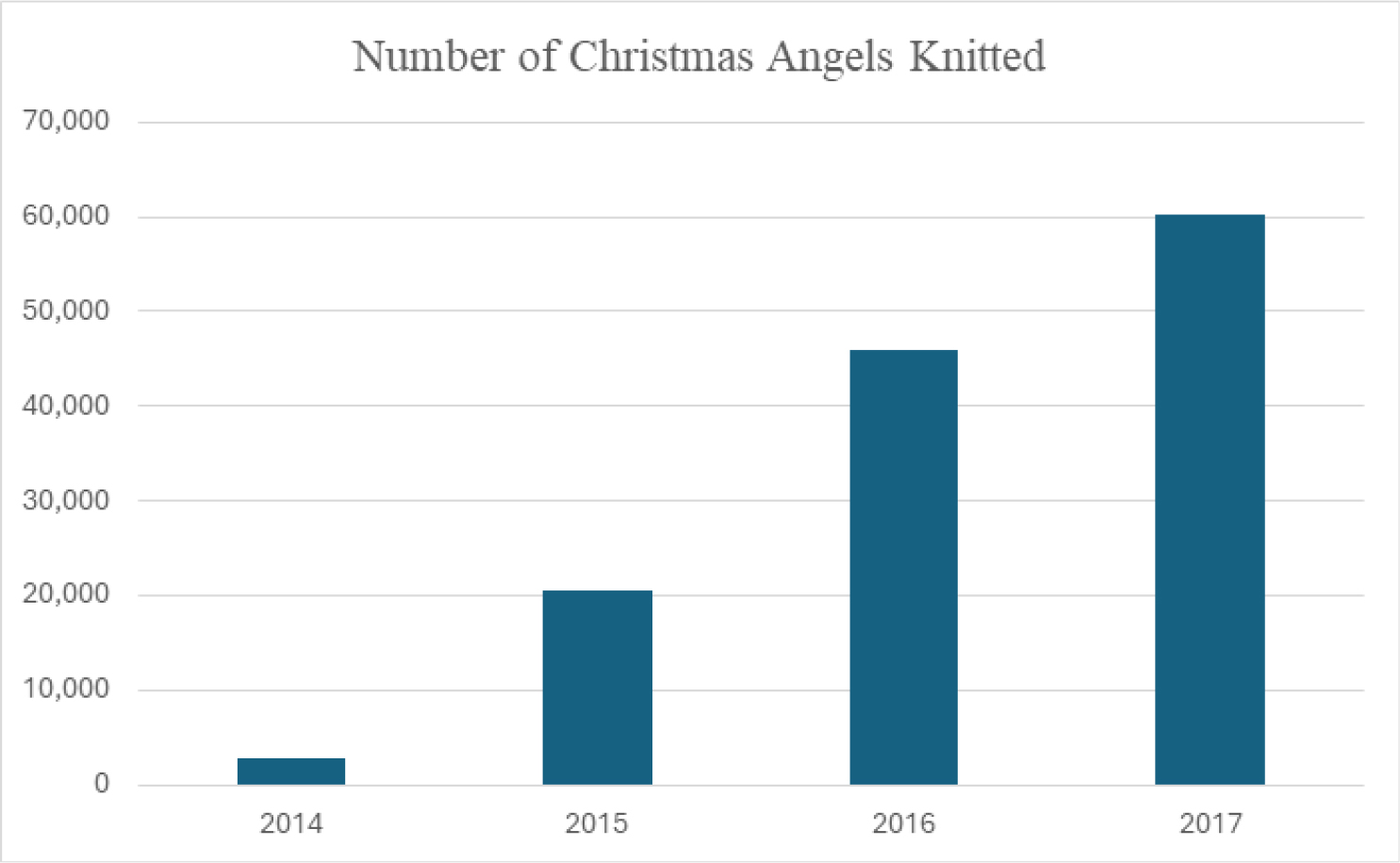
Figure1.
Number of Christmas angels knitted (2014–2017)
I interviewed six knitters in Australia to understand why a project begun in England might attract knitters’ time, energy, and missional attention in New South Wales, South Australia, and Queensland.
Tell
The knitters saw the angels as a “gift of faith” that made the church visible in their local communities. Theological language was used to describe each angel as “individually made with love and basically, I guess ‘I am with you.’”41 The telling had elements of mystery and curiosity. One knitter described the angel as telling of “the mystery of life.”42 Another knitter saw the angels as giving “something to think about, which is to do with our faith.”43 Another knitter described how they intentionally took their knitted angels to public places or to community knitting groups. “When I was showing them the angels that I was knitting led on to people saying, Do you believe in angels? Do you believe in angels in your life? Have you ever had an encounter with an angel?”44 The making of angels provided ways to prompt conversations about Christian spirituality.
Teach
The interviews indicated that making provided a unique environment for informal teaching about the practices of Christian faith. One knitter described how family members who had experienced different religious perspectives began asking questions: “What’s that angel got to do with praying? Why? Is that different to [a Muslim] praying? Can I do it? Do I have to use special words?”45 These moments of teaching occurred not in formal educational settings but through making, “around the table here where we’ve got paste and glue and wool and everything spread everywhere.”46 The knitting of angels provided unique opportunities for exploring the Christian faith and life.
Tend
The knitters wanted to express mission in ways that wove telling with tending. It was important that the angels had a tag that clearly identified the church. “We didn’t want to hide behind where we coming from. So [the tag] had the church’s details and … said something about please be in touch with us if we can help you in any way … There was no attempt … to pretend we weren’t the church.”47 This comment values the integration of telling with tending; tending that is not individual but is communal and ecclesial.
Transform
The knitted angels provided place-based moments of transformation, as angels were yarn bombed in local parks and places where the community walked. One knitter described the angels as “transforming areas in the neighbourhood and creating beauty or surprise or joy, transforming something that could either be mundane or ugly.” There was a belief that local places would be viewed in new ways through people “seeing the area that they know well being transformed into something else.”48 This transforming interplay between place and people also included knitters. Interview participants spoke of mentally workshopping how they would respond if they were asked about the angels by a member of the public. Mission as transforming is being woven with mission as telling because the yarn bombing requires a public expression of faith.
Treasure
The knitting of angels demonstrated several indirect connections with sustaining and renewing the life of the earth. Firstly, knitters often have a “stash,” consisting of balls of wool purchased in bulk or left over from a completed project. Several knitters expressed satisfaction in recycling and reusing wool from their stash when making angels. Secondly, the local Methodist circuit members who provided a knitting pattern online thought carefully about the risks of littering. Their website suggested using tags with a “Keep tidy” logo and words reminding people to treasure creation. “Our angels aren’t litter so pick them up and take them home.”49 Third, this wording invited those “found” by angels to participate in the treasuring of creation.50
Hence, in different ways, all five Marks of Mission were present in these acts of making. The knitters valued how making provided ways to weave several Marks of Mission together. What happens when we interview knitters of scarves?
Scarves
Since 2020, hundreds of knitters across Australia have knitted scarves to draw attention to the need for climate action. The average yearly temperature band from 1919 to the present was calculated and assigned a colour. Thus, the scarf visually demonstrated a long-term increase in average global temperatures. During 2021 and 2022, federal MPs and Senators were presented with scarves and invited to wear them in support of climate action. At COP26 in Glasgow and COP27 in Sharm el-Sheikh, Egypt, scarves knitted by Australians were presented to leaders including the US President, the First Minister of Scotland, Canada’s Minister of Environment and Climate Change, and the Archbishop of Canterbury.51 I interviewed eight people about the Knit for Climate action project to understand the motivations and experiences of those who knitted.
Tell
One knitter described the scarf as having a “non-verbal evangelical function.”52 Another described wearing the scarf in public as an act of witness. “I would throw it on when we’re sort of making public witness, giving public witness, about Christian faith in climate change or about climate change from the perspective of the church.”53 As with the knitted angels, the scarf helped create conversations with people who are “curious about what it was and come and ask.”54 Curiosity was cultivated through the wearing and the process of making. For one knitter, the scarf had a “story in it and that will be a conversation starter for all kinds of people.”55 Several knitters described how when they knitted in public places, people paused to chat, and this provided natural opportunities to tell about the Knit for Climate project. Making provided a side-by-side way of engaging, which was different from other verbal approaches to communication.
A different dimension of telling occurred when the knitted scarves were given to politicians. This was a vulnerable moment for knitters, as the “little private [scarf] becomes very very public when it goes out to your federal member of parliament.”56 Some knitters sent their scarves with a written message. “So having to think through in a short sentence or two what do you want to say to the politician was also kind of empowering.”57 Other knitters made an appointment. “I’ve never spoken to a politician in my life … I’m a little ordinary person. I’m a grandmother. I’m sitting here watching the world get hotter. And it gave me some agency.”58 Hence, a telling of Christian faith woven with concern for creation occurred in making, wearing, and gifting the scarf to a politician.
Teach
Several knitters experienced the process of knitting the scarves as a teaching time. First, the knitters were intellectually aware of a long-term increase in average global temperatures. Yet knitting in colours that represented increasingly warm temperatures was a formative experience. For Lynnette, “the process of knitting and changing the colours and realising you’re never going to go back to blue was—it’s disturbing. It really cemented the data for me.”59 Second, as with the Christmas angels, the scarves facilitated intergenerational moments of learning. One knitter described how an article about them knitting scarves appeared on the front page of their local newspaper.60 “I showed my grandkids the newspaper article … We had some really good conversations … It wasn’t just the politicians who got reached. It was my grandkids.”61 Making generates informal learning opportunities across generations.
Tend
Knitting is a common way of expressing care, including in handmaking garments that provide warmth and how care can be personalised through the choices of wool and the experiences of making. However, there was no evidence of tending as a Mark of Mission among those interviewed. My sense was that other Marks of Mission, particularly tell, transform, and treasure, were of greater importance.
Transform
Those interviewed understood their knitting as a direct expression of transformation. One participant who had a significant history in climate justice advocacy observed how they were “interested in matching my faith more with my action … the climate scarf was the most exciting and most impactful thing that I’ve done.”62 For Susan, climate change “seems to be a red flag for a lot of people. So to me knitting and showing these colours is a very kind of more gentle way to show people what’s going on.”63 Susan’s use of the word “gentle” suggests that knitting provides a distinct way of engaging in transformation compared to other prophetic actions, such as marching or civil disobedience.
Treasure
Knitting, in general, has dimensions of care for creation. Tanya began to craft Knit for Climate Action scarves because it aligned with her general commitments to what she described as the “re-homing of things.”64 However, the interviews indicated several ways in which the process of knitting the scarves had impacted on lifestyles and behaviours. Lynette described how learning to knit and making scarves had made her “much more aware of possessions … being aware of accumulation.”65 As a result, she was more attentive to the packaging of items and increasingly mindful of the original makers of items she purchased. Hence, knitting the scarves resulted in changes in patterns of consumption and a treasuring of things that were well made.
Analysis of the interview data about the Five Marks of Mission is summarised in Table 1.
Table 1:
Marks of Mission present in the knitting of Christmas angels and Knit for Climate Action scarves.
| Scarves | Angels | |
|---|---|---|
| Tell | Knitting provided opportunities for conversation Wearing the scarf in public Gifting the scarf to a politician | Yarn bombing expressed God’s love Knitting provided opportunities for conversation |
| Teach | Feelings of grief in the process of making Informal conversations across generations about Christian faith and creation care | Informal conversations about Christian faith and life |
| Tend | Make visible communal and ecclesial care | |
| Transform | “Gentle” calls for change in environmental policy | Place making in local communities |
| Treasure | Changes in lifestyle to reduce environmental impact Attention to practices of recycling, rehoming and making | Recycle wool Rehoming of angels |
In sum, the knitted angels provided ways to tell of faith, teach informally about prayer, offer communal and ecclesial ways to tend, transform local places, and treasure creation through the reuse of wool and the rehoming of angels. The knitted scarves provided ways to tell of faith, teach informally about care for creation, advocate in “gentle” ways for transformation in environmental policies, and treasure items and patterns of consumption that reduce environmental impact. The actions of knit and purl contribute toward a Christian witness in which all five Marks of Mission are present.
A Missiology of Making
Knitting not only demonstrated the Five Marks of Mission. As a way of making, it invites a distinct way of being in mission in which “ordinary” people, particularly women, find ways to participate.
First, making is a distinct way of being in mission. Knitting is a joyful experience of active praying that provides different ways of relating.
Regarding joy, while mission can sometimes seem earnest, my participants, particularly those knitting angels, communicated joy. “I enjoy knitting. I’ve usually got something on the go. So for me it’s a form of creativity.”66 This resonates with Gauntlett’s theorisation of making as providing a “sense of being alive with the process and the engagement with ideas, learning, and knowledge which come not before or after but within the practice of making.”67 Making in mission is joyous as it connects with God’s invitation to till and keep (Gen 2:15).
Regarding active praying, knitters described how knitting stitched together being and doing as the work of witness. “I often intentionally pray for the person who’s going to receive this as I’m knitting … Very basic prayers like that, you know, and surround them with your love and it’s a surrounding sort of prayer.”68 This stitching together of being and doing was also evident in the knitting of scarves. One climate scarf knitter, used the phrase “be knitty” to describe their knitting practice.69 The phrase suggests an active contemplation, “doing something with my hands” while in a posture of contemplation.
Regarding relating, knitting was seen as a distinct way of participating in mission, in contrast to other approaches. Knitters used the phrase “friendship in a new development” rather than outreach, which they saw as associated with colonial attitudes: “Where you as the people with all the good ideas went somewhere, to outreach to these poor people who need what you’ve got but don’t have … I would much prefer to put [knitting] as some sort of community connection where we sit together and share our life stories and maybe do something at the same time.”70 The ability to personalise the angels by using different colours, types of wool, and knitting needles contributed to this understanding. “They’re all individual. There wouldn’t be any two that were the same.” This personalisation was contrasted with switch-and-bait approaches to mission, when you are “invited to a meal or a coffee morning. And then after you’ve chatted … you find actually, it’s somebody wanting to sell you something.” Knitters in this focus group described their making as an approach to mission that was mutual (“sit together and share”), human (“share our life stories”), and active (“do something”).
This weaving of being and doing contributed to distinctive ways of relating in public spaces. As noted in the results, several knitters shared how their scarf was a conversation starter. Angel knitters described how people “come and do some knitting and then have a chat. Makes it much more accessible.”71 This is consistent with the argument that making is connecting, a way of doing and being that forms distinct ways of relating.72 The side-by-side nature of knitting, the presence of craft as a shared object, and the personalised dimensions of craft differ from the ways of relating embodied in words and deeds.
Second, knitting involved ordinary makers in mission. Jeff Astley argues for the need to value the everyday faith understandings of the whole people of God, which he calls “ordinary theology.”73 Applying Astley to knitting, people might not feel qualified to preach or serve people with mental health challenges. Yet the interviews demonstrate that knitting allows ordinary people to cast on and contribute to God’s mission in the world. “Knitting is something I can do. I’ve been knitting since I was probably about thirteen, fourteen and knitting ever since. And so it was something I could just pick up and do … And then to think that they were going to be used for a community purpose was really special.”74 Those I interviewed could not see themselves as standing before crowds to preach. But each knitter could tell of their faith in public places through side-by-side relating.
Gender is a significant thread in empowering ordinary makers in mission. My recruiting of research participants made no mention of gender, yet every participant I interviewed was female. Lynette observed that “generally the crafts of knitting and sewing and crocheting and all of those what I’d call the sort of the feminine crafts … [and] craft has sort of a connotation that it’s not important. It’s generally women’s business, especially if it’s knitting or sewing or something … It’s generally unthreatening. It’s a non-threatening craft. But so powerful.”75 In this interview, Lynnette articulated dimensions of making that included adaptation, resistance, and innovation. The use of craft considered “women’s business” was “powerful” in the making of Christian witness.
Males have dominated Christianity’s intellectual history. Given that women are more likely to knit than men, making in dialogue with women’s experience offers possibilities for reshaping the nature of mission. New ways of approaching doctrines of creation are offered when knitting is brought into conversation with “knit me together in my mother’s womb” (Ps 139:13).76 At Pentecost, the work of the Spirit is explained by drawing on phrases from Joel 2:28–32: “I will pour out my Spirit on all people … Even on my servants, both men and women, I will pour out my Spirit.” When we foreground the experience of making, we begin to retrieve the “women of the cloth” from the book of Acts. To use the words of Spencer, “As the earthly Jesus announced to his disciples in the upper room, ‘I am among you as one who serves,’ so the risen Jesus embodied in Tabitha might well have proclaimed in another upper room, ‘I am among you as one who sews.’”77 Learning with and from “ordinary” women knitters provides important contributions to the making of Christian witness. In Catholic theologian Joan Chichester’s words, “May the Jesus, who filled women with his Holy Spirit fill the world and the church with new respect for women’s power and presence.”78
Conclusion
The interviews demonstrate that knitting contributes toward a Christian witness in which all five Marks of Mission are present. Knitters experience making as a way of weaving doing and being through which ordinary people inhabit new ways of relating. Reflecting on the qualitative research, I found myself imaginatively thinking about God’s appearance to Moses in Exodus 3 and 4. What trajectories result if Moses was a knitter, not a shepherd, if he was holding not a staff, but needles and wool in his hand? The knitters I interviewed had undoubtedly heard the cry of the enslaved and were casting wool onto their “staff” to express care for communities and create conversation about faith and scarves to advocate for climate change.
Further research is needed. Reflection is needed on the limits and possibilities of theologies of craft and making as distinct ways of expressing Christian witness, different from words or deeds. Qualitative research into other areas of craft would deepen understanding of the role of making in worship and formation and how material objects, like angels and scarves, communicate meaning. Taylor and Taylor have analysed social media responses from people who found angels.79 Research is needed into how politicians respond to acts of personalised making.
However, the research invites new ways to think about how mission is researched and theorised in contemporary Australia and practised in local church contexts. Making offers a way of relating that is shaped by joy, individuality, and handmade care. In a culture saturated by words and cynical of deeds, knitting provides ways to conversationally tell of central convictions, informally teach of Christian practice, offer personalised expressions of care, advocate for climate policy change, and treasure creation.
Acknowledgements
My thanks to the knitters willing to show and tell, to peer reviewers for their attention to the craft of writing and to AngelWings Ltd for the allocation of pro-bono time to undertake this research project.
Notes
[1] Stanley H. Skreslet, Picturing Christian Witness: New Testament Images of Disciples in Mission (William B. Eerdmans, 2006).
[3] Laura Everett, “REPAIR & RENEW: Mending & Quilting as Models for Christian Institutional Innovation,” 2014, https://louisville-institute.org/our-impact/awards/pastoral-study-project/13694/
[4] “Facts & Figures: UK Hand Knitting,” accessed September 30, 2024, https://www.ukhandknitting.com/about-us/facts-figures; Crafts Council, “The Market for Craft: Commissioned by the Crafts Council and Partners,” 2020.
[5] AFP, “Knitting Surges in Popularity as US Men Unravel Stereotypes,” Deccan Herald, accessed April 29, 2024, https://www.deccanherald.com/world/knitting-surges-in-popularity-as-us-men-unravelstereotypes-1205383.html; Karl Chitham et al., Crafting Aotearoa: A Cultural History of Making in New Zealand and the Wider Moana Oceania (Te Papa Press, 2019), 13.
[6] “Christmas Angels—#xmasangels,” accessed April 17, 2024, https://www.christmasangel.net/.
[7] 7 “Knit For Climate Action,” Common Grace, accessed May 27, 2024, https://www.commongrace.org.au/knit_for_climate_action.
[8] David Gauntlett, Making Is Connecting: The Social Power of Creativity, from Craft and Knitting to Digital Everything, 2nd exp. ed. (Polity Press, 2018), 269.
[9] Jodi Eichler-Levine, Painted Pomegranates and Needlepoint Rabbis: How Jews Craft Resilience and Create Community (The University of North Carolina Press, 2020).
[10] Julie Baird, “How the Steady Click of Knitting Needles and Crochet Hooks Is Bringing Comfort, Mindfulness and Healing—ABC News,” accessed April 29, 2024, https://www.abc.net.au/news/2024-04-14/staying-upright-crochet-and-healing-power-of-knitting-needles/103700364; Joanna Nordstrand, A. Birgitta Gunnarsson, and Greta Häggblom-Kronlöf, “Promoting Health through Yarncraft: Experiences of an Online Knitting Group Living with Mental Illness,” Journal of Occupational Science 31(3), 504–15, https://doi.org/10.1080/14427591.2023.2292281.
[11] Amy E. Elkins, Crafting Feminism from Literary Modernism to the Multimedia Present (Oxford University Press, 2022), 13–17; Glenn Adamson, The Invention of Craft (Bloomsbury Publishing, 2018), xiii.
[13] Andrew Wagner, Faythe Levine, and Cortney Heimerl, “Craft: It’s What You Make of It,” in Handmade Nation: The Rise of DIY, Art, Craft and Design (Princeton Architectural Press, 2008), 1.
[16] Marion L. Soards, The Speeches in Acts: Their Content, Context, and Concerns (Westminster John Knox Press, 1993); Skreslet, Picturing Christian Witness, 52.
[17] Leland Ryken, Jim Wilhoit, and Tremper Longman, eds., Dictionary of Biblical Imagery (InterVarsity Press, 2005), 180–81.
[18] Amy Plantinga Pauw, Church in Ordinary Time: A Wisdom Ecclesiology (William B. Eerdmans, 2017).
[19] F. Scott Spencer, Dancing Girls, Loose Ladies, and Women of the Cloth: The Women in Jesus’ Life (Continuum, 2004).
[20] Stanley Skreslet, Constructing Mission History: Missionary Initiative and Indigenous Agency in the Making of World Christianity (Fortress Press, 2023), 329–30.
[21] Ann Kingstone, “Knitting Madonnas,” Ann Kingstone, December 13, 2021, https://annkingstone.com/knitting-madonnas/.
[22] Heather Nicholson, The Loving Stitch: A History of Knitting and Spinning in New Zealand (Auckland University Press, 1998), 5–6.
[24] Anglican Consultative Council, “Anglican Consultative Council, Bonds of Affection: Proceedings of ACC-6, Badagry, Nigeria” (London, 1984), 49.
[25] Anglican Consultative Council, “Anglican Consultative Council, Mission in a Broken World: Report of ACC-8, Wales 1990” (London, 1990), 101.
[27] Sophie Marie Niang, “In Defence of What’s There: Notes on Scavenging as Methodology,” Feminist Review 136, no. 1 (2024): 52–66, https://doi.org/10.1177/01417789231222606.
[28] Hillary Kaell, “Working in Between: Interdisciplinary and Multivalent Approaches to the Study of Religion,” Religion and Society 13, no. 1 (2022): 166, https://doi.org/10.3167/arrs.2022.130111.
[29] Erica Vowles, “Knitted Together in a Common Cause,” ABC Listen, May 27, 2021, https://www.abc.net.au/listen/programs/lifematters/knitted-together-in-a-common-cause/13362678.
[31] Brooke Auxier and Monica Anderson, “Social Media Use in 2021” (Pew Research Centre), accessed May 21, 2024, https://www.pewresearch.org/wp-content/uploads/sites/20/2021/04/PI_2021.04.07_Social-Media-Use_FINAL.pdf.
[33] “Common Grace,” Common Grace, May 20, 2024, https://www.commongrace.org.au/.
[36] This paper is one output from a wider, transnational research project, working with more than five different expressions of knitting from four countries. While this paper uses coding reliability thematic analysis, the broader research project utilises reflexive thematic analysis. This paper is thus unique because it uses coding reliability thematic analysis, is focused geographically on Australia, and works only with data from makers of knitted angels and climate scarves.
[37] “Christmas Angels,” Beachcomber FX, 2014, https://www.beachcomberfx.com/portfolio-item/christmas-angels/.
[39] Drawing on data from “Christmas Angels—#xmasangels.” By 2018, the website stated there were too many to count.
[40] Figure reproduced with permission of the publisher from Steve Taylor and Shannon Taylor, “When ‘#xmasangels’ Tweet: A Reception Study of Craftivism as Christian Witness,” Ecclesial Practices 7, no. 2 (2020), 151.
[48] Lydia, Angels Interview Australia 7, 2022. Throughout this article, names have been changed to ensure anonymity.
[49] “Information—Christmas Angels,” accessed May 22, 2024, https://www.christmasangel.net/info/.
[50] For discussion of the public understanding themselves as “found” by angels rather than finding angels, see Taylor and Taylor, “When ‘#xmasangels’ Tweet,” 151–52.
[51] “Knit for Climate: Latest Action,” Common Grace, accessed May 27, 2024, https://www.commongrace.org.au/knit_for_climate_latest_action.
[60] While I have a copy of the newspaper article, to ensure the anonymity of participants, a precise reference is not provided.
[73] Jeff Astley, Ordinary Theology: Looking, Listening, and Learning in Theology (Routledge, 2002).
[78] “My Prayer For Pentecost,” HuffPost, June 10, 2011, https://www.huffpost.com/entry/pentecost-prayer_b_872130.