
Introduction
Border security has emerged as a critical global concern in recent years. Largely due to instabilities such as armed conflicts and poor economic conditions, illegal migration, cross-border terrorist and armed groups, and smuggling incidents threatening national boundaries have significantly increased. Governments worldwide have implemented a wide array of measures, ranging from the construction of border walls to the integration of advanced technologies such as artificial intelligence in order to tighten border security.
Cognitive bias refers to the general human tendency towards irrationality in decision-making, systematically favouring certain types of information processing over others (MacLeod & Mathews, 2012). Cognitive biases such as confirmation bias, hindsight bias, and the availability heuristic (Tversky & Kahneman, 1974) also play roles in decision-making. This paper focuses on survivorship bias, while acknowledging its interplay with other biases. Although quite often neglected, survivorship bias is a very important statistical phenomenon and it deeply affects border security efforts. It occurs when only successful cases are taken into account and failures are ignored (Eldridge, 2025). Not surprisingly, survivorship bias often leads to incorrect conclusions.
A well-known example of survivorship bias is the analysis of aircraft damage during World War II. The analysis focused only on the planes which completed their missions, excluding those which did not return. This led to an illusion; in examining only the planes that “survived” the mission, holes on the wings were found. However, those which were hit on the engines, oil tanks or nose could not be examined, since they could not “survive”. It is obvious that the parts of a plane which, when hit, did not allow the aircraft to return could have been equally or even more vital to the plane’s performance. These parts could be more vital for the airplane’s successful operation (Wald, 1943; Yousefi et al., 2024; Stanley, 2024).
Similar to this famous case, survivorship bias can occur within the border security context. It may occur when decision-makers focus only on effective deterrents, apprehension rates, or security technologies which have worked so far. This may lead to them ignoring measures which have not been successful or have been circumvented. Consequently, the actual effectiveness of border security operations could be skewed, causing an excessively positive perspective and resulting in misguided conclusions leading to potentially wrong decisions.
Understanding survivorship bias and addressing its effects in border security is very important for many reasons. First, it is essential for effective policy formation. Only a comprehensive and unbiased understanding of the outcomes of the measures, regardless of their being successful or unsuccessful, can provide the necessary information for the decision-makers to address the complex border security challenges. The second reason is that a balanced perspective is a must for the optimization of resource allocation. Accounting for survivorship bias, this balanced perspective ensures that investments are made in strategies which are backed by concrete evidence, not by incomplete information. Lastly, if decision-makers consider human experiences with unsuccessful outcomes rather than just the successful border incidents, they can craft more humane and ethical approaches to border security.
This paper aims to investigate the impact of survivorship bias in border security operations. It uncovers the relevance of survivorship bias in border security and presents solutions for better choices and stronger security measures at borders. Section 1 explains the methodology followed, while Section 2 discusses the importance of survivorship bias in border security. Section 3 provides recommendations to address survivorship bias in the border security context. Last section summarizes the results, discusses the implications, and suggests directions for future research.
1. METHODOLOGY
The study follows a qualitative approach, using semi-structured interviews with subject matter experts. The aim was to understand the implications of survivorship bias on policy formation, resource allocation, and the success of border security measures. The experts were selected through the snowball sampling method; this involves asking the initial respondent to refer others who are expert in the area of the study (Hair et al., 2020). It is an effective technique for accessing hard-to-reach experts (Noy, 2008; Atkinson, Flint, 2001; Waters, 2015; Törnävä et al., 2025), and is particularly useful in studying sensitive or confidential topics, as it leverages trust within social connections to encourage participation (Ting et al.,2025). A total of seven experts were interviewed. Two were from academia, one from the security industry, one from the migration agency and three from enforcement agencies in Türkiye.
While the study investigated the effects of survivorship bias on border security activities, it had limitations. The expert pool consisted of seven individuals, all of whom were based in Türkiye due to the snowball sampling method. Although efforts were made to include diverse professional perspectives, as listed above, the geographic concentration limits our ability to generalize the findings. This represents a significant limitation, since border security challenges may vary greatly across different geopolitical regions. Future research should incorporate experts from a broader international context to validate and refine the conceptual findings presented in this study.
Each face-to-face interview took 35˗60 minutes. As the main topics, the experts were asked about their experiences and perceptions with regard to the impact of survivorship bias in border security, and their recommendations for mitigating it. They are also encouraged to express their own views and stories.
The interviews (Kantemir at al., 2025) were conducted as a part of a larger, unpublished, study, and anonymized transcriptions made available upon request.
The interviews were analysed following the first five steps of the thematic analysis process explained by Naeem at al. (2023). These steps are: familiarization with the transcripts; selection of key words; coding; theme development; and conceptualization (Figure 1).
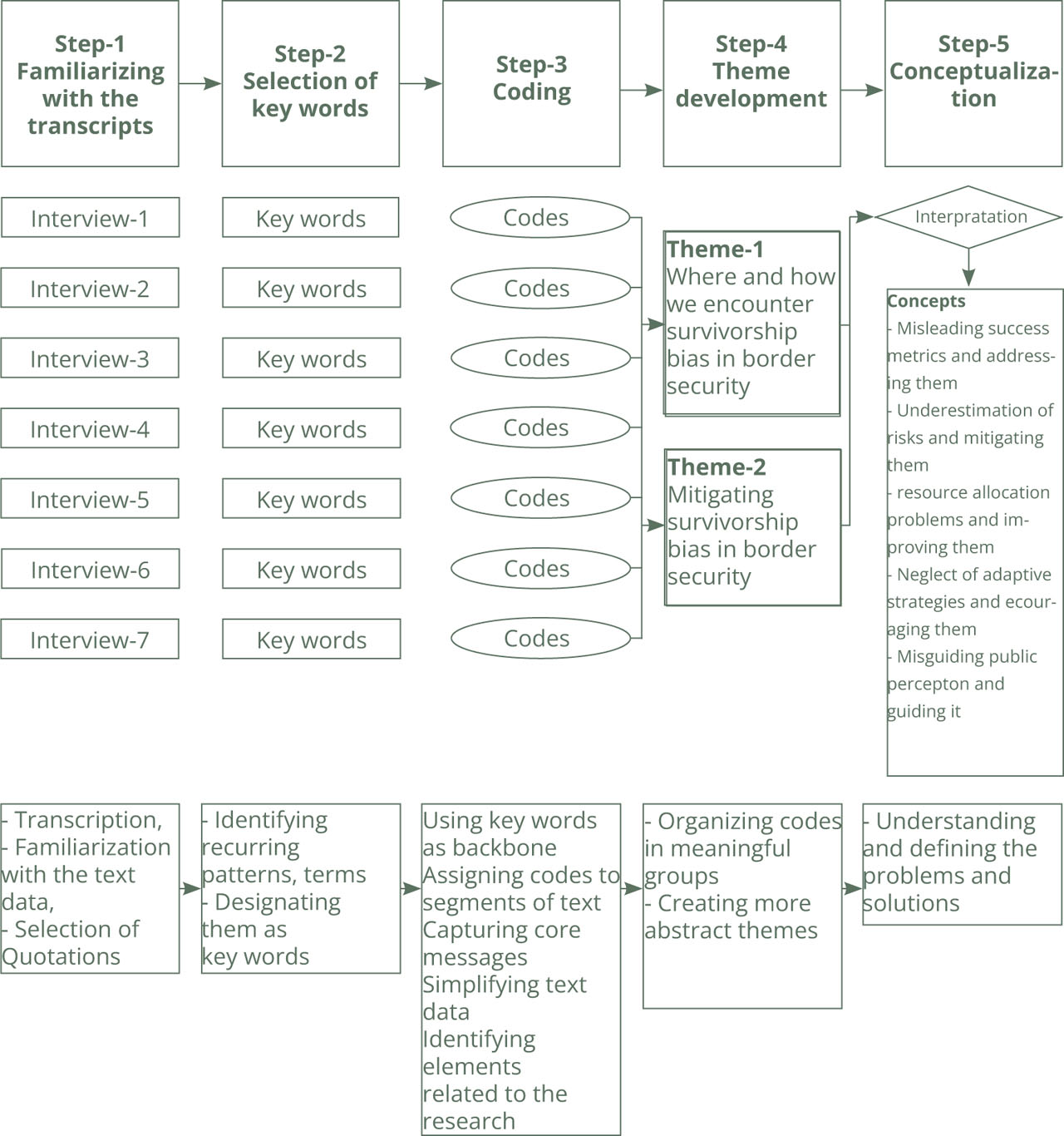
Figure 1:
Thematic Analysis Process (Adapted from Naeem at al. (2023, p 4))
In order to investigate the impact of survivorship bias in a border security context, the steps shown in Figure 1 were followed to analyse the interview data. After the familiarization step, the expert opinions were analysed by the selection of quotes from the transcriptions, followed by the selection of keywords. Consequently, coding was implemented, using the keywords as backbones for capturing the core messages. The codes, keywords and simplified text were combined into themes. Finally, the main problems caused by survivorship bias in the border security context, and the ways to mitigate them, were identified. This section outlines how each step was applied, and presents the core themes which emerged from the interviews.
1.1. Familiarization with the data
The transcriptions of the interviews (Kantemir at al., 2025) were read multiple times in this step-in order to become fully acquainted with the data. Notes were taken to capture the recurring patterns to help in identifying key words.
1.2. Key word identification
This step utilized frequently used terms and phrases identified in the previous step. These initial keywords were grouped in conceptual clusters to provide a foundation for developing codes. Examples of key words identified in the expert interviews are shown in Table 1.
Table 1:
Examples of Key Words
| Keyword | Meaning in Context |
|---|---|
| »Only successes are reported« | Survivorship bias in performance metrics |
| »We don’t record the failures« | Silencing of negative outcomes |
| »Public thinks everything works« | Distorted public perception |
| »They changed the route« | Need for adaptive operational tactics |
| »Technology failed in fog« | Overestimation of tech capabilities |
| »Caught = success« | Misleading metric for effectiveness |
1.3. Coding
In this step, the key words were translated into codes which represent categories. Each transcript was coded systematically. These codes serve as a bridge between the raw narratives and higher-order conceptual themes. Examples of the codes are “bias in reporting”, “overreliance on technology”, “undetected events”, “media influence”, “tactical rigidity”, and “data exclusion”.
1.4. Theme development
Through iterative comparison of the codes, five major themes were identified. As shown in Table 2, these themes encapsulate how survivorship bias influences border security activities. Each theme was substantiated by quotes and patterns found across the seven interviews. These themes represent the consequences of survivorship bias in border security efforts.
Table 2:
Themes Identified
| Theme | Description |
|---|---|
| Misleading Success Metrics | Metrics focus only on positive outcomes, ignoring failures or system gaps |
| Underestimation of Risks | Risks are underplayed due to lack of data from failed or undetected incidents |
| Resource Allocation Problems | Misguided investments are made based on biased evaluations of what is effective |
| Neglect of Adaptive Tactics | Lack of recognition of changing smuggling tactics |
| Misguiding Public Perception | Media and official reports emphasize success |
1.5. Conceptualization
The final step involved synthesizing the themes into a conceptual model in order to explain how survivorship bias affects border security effectiveness. The model presented in Figure 2 shows how survivorship bias distorts performance metrics, leads to inefficient resource allocation, limits tactical adaptability, and causes unrealistic public expectations.
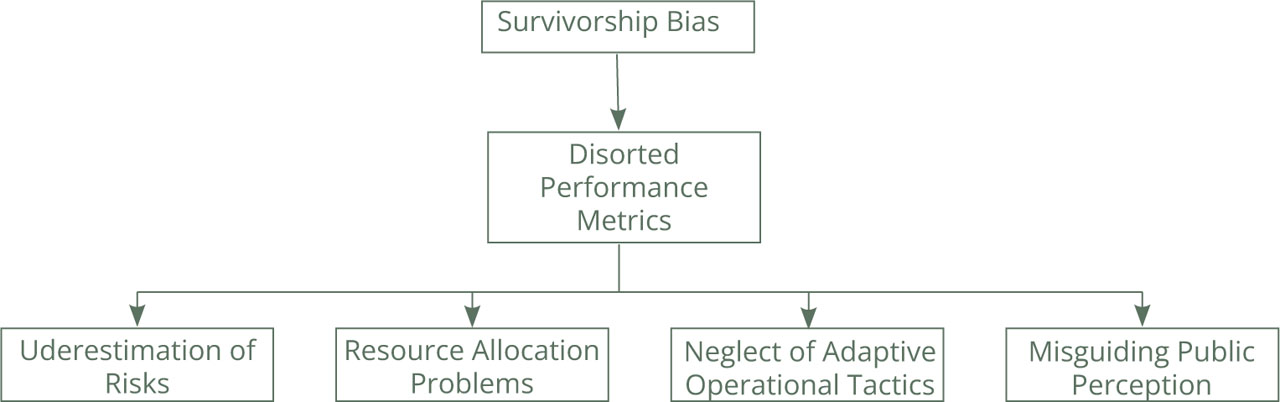
Figure 2:
Conceptual Model)
The conceptual model clearly shows that survivorship bias should be addressed through balanced performance indicators, transparent data reporting systems, inclusion of local and field-based knowledge and continuous learning from both successes and failures. This understanding guides the policy recommendations offered in Section 3 of this paper, while Section 2 discusses the consequences of survivorship bias in border security.
2. SURVIVORSHIP BIAS IN BORDER SECURITY
Survivorship bias is a methodological error that emphasizes the analysis of successful outcomes while omitting data on unsuccessful ones. This bias can cause problems within the context of border security. By following the methodology to process the border security expert interviews, this study has uncovered these problems as misleading success metrics, underestimation of risks, resource allocation problems, neglect of adaptive operational tactics, and misguiding public perception on border security matters. The following sections explain these problems in depth.
2.1. Misleading success metrics
If only successful cases are analysed, an illusion of effectiveness in security measures can be created. Policymakers may draw incorrect conclusions about what works or what does not, leading to the continuation of ineffective policies. Take, for instance, a border security initiative which employs state-of-the-art surveillance technology, such as unmanned aerial vehicles (UAVs) or electro-optical cameras. This approach may well demonstrate substantial decreases in illicit crossings within specific sectors. Nevertheless, if the assessment overlooks regions where such incursions have intensified, or instances where technology has proven ineffectual, decision-makers could erroneously deduce that the technology yields consistent success across the board. Consequently, they may persist in allocating substantial resources to these high-tech solutions, neglecting to scrutinize the broader effectiveness of the strategy or contemplate reallocating funds to alternative measures such as the enhancement of human resources through training, fortification of physical barriers, or fostering collaboration with local communities.
2.2. Underestimation of risks
By focusing on successful prevention or deterrent cases, the authorities may underestimate the tactics, technologies, or routes that smugglers and undocumented migrants use, resulting in gaps in security. Illegal border crossings are generally dangerous, and those attempting them are ready to take risks and are motivated to take those risks in innovative ways. For example, an analysis of apprehension rates may show that border security measures successfully caught a large number of unauthorized entrants. However, if this analysis neglects those cases in which individuals succeeded without being detected, it may underestimate the true scale of attempts to cross the border. This creates a false sense of security and may lead to slackness in improving security measures or adjusting tactics to counter new methods used by illegal traffickers.
2.3. Resource allocation problems
Survivorship bias can cause misallocation of the available resources. Some border security measures, such as border walls, may seem or be advertised to be successful without awareness of the complex underlying issues affecting their use. If construction of border walls becomes the focus or the goal because of the illusion created by survivorship bias, rather than the mitigating alternative illegal routes such as makeshift tunnels, resources may be inefficiently spent on expanding wall infrastructure instead of addressing the root causes, like poverty or violence in their countries of origin. This approach may perpetuate the problem, because the root causes remain untouched.
2.4. Neglect of adaptive operational tactics
Survivorship bias negatively affects a thorough evaluation of border security operations because it makes decision-makers ignore the necessity for flexible operational tactics. These back-up tactics are needed to react to the ever-changing methods of illegal border crossings; for example, an anti-trafficking unit may report substantial success by employing foot patrols, but neglects to account for traffickers who have swiftly altered their routes or employed new technology such as drones for smuggling purposes. If decision-makers fail to realize these adaptive tactics, the security measures may become obsolete. Moreover, if the decision-makers do not realize these tactics, this results in an illusion of success for law enforcement agencies and decision-makers. This may, in turn, cause a shift in focus from continuous innovation and adaptability to temporary solutions. To summarize, survivorship bias needs to be taken into account in order to address the evolving nature of border threats.
2.5. Misguiding public perception
Survivorship bias significantly impacts public opinion by creating false narratives based on biased data. For example, only successful interdictions of drug trafficking news appear in the media, usually advertising the success stories of sniffer dog teams. This can lead to a false narrative that suggests sniffer dog teams can prevent all drug trafficking anywhere and anytime.
Likewise, survivorship bias may cause false public support for ineffective border security policies. It may cause people to ignore the complexities of border security and to rule out the root causes and neglect individual unadvertised stories.
3. MITIGATING SURVIVORSHIP BIAS IN BORDER SECURITY
Having shed light on the problems stemming from survivorship bias in the context of border security, now this paper presents solutions to mitigate the effects of survivorship bias. These solutions have also been identified through the analysis of the border security expert interview data. The following sections explain the proposed solutions in detail.
3.1. Addressing Misleading Success Metrics
Combating survivorship bias in border security analysis requires a thorough examination of all incidents, whether they are successful or not. Only by studying all cases by implementing a comprehensive evaluation framework can the metrics show the actual situation. This should involve regular data collection and analysis which captures a range of outputs and outcomes. These data should include those that reflect failures. This data collection mechanism can provide a more accurate assessment of what works and what does not.
Addressing survivorship bias requires the creation of a set of meaningful performance indicators to measure not only apprehension rates but also the effectiveness of the deterrents. These metrics may include rates of successful crossings, shifts in smuggling routes, and community safety data to provide a more holistic view of the border security efforts. For example, collecting data on the recidivism rates of individuals previously apprehended may provide insights into whether the border security measures are truly deterring repeated attempts to cross or simply pushing individuals to try alternative and potentially more dangerous methods. The metrics can also include community crime rates in residential areas close to the border line before and after the implementation of security measures.
In order to measure the effectiveness of the border security measures, quantitative data should be used with qualitative data, so they can complement each other. For example, statistical data such as the number of apprehensions, successful illegal crossing cases, and resource allocation statistics should be compared with interviews with all stakeholders such as border security personnel, illegal migrants and captured smugglers. This approach may not only provide context to the numbers, but also reveals the human experiences and systemic issues that a purely quantitative assessment may have ignored.
Data collected from alternative sources such as community testimonies and unofficial reports, criticizing both successful and unsuccessful border security measures, can capture a more complete picture of the dynamics of the border.
It is of great importance to have unbiased panel data, involving repeated observations of the same border area over time. Studying longitudinal data to track various metrics over time, examining not just the immediate results, but also the outcomes of border security measures, is very important. Being transparent and allowing researchers access to the border security databases would provide a more open discussion for better solutions.
3.2. Mitigating Underestimation of Risks
It is vital to implement a dynamic risk assessment programme in order to effectively address the problem of underestimating the risks in border security. This programme must frequently analyse the evolving tactics employed by smugglers and illegal migrants, with particular focus on technological advancements and alternative routes.
As an example, the European Union uses the Common Integrated Risk Analysis Model as a conceptual model to assist countries in risk analysis, defining risk as a function of threat, vulnerability and impact in order to set priorities, implement countermeasures and define operational targets (FRONTEX, 2025).
Further, border security simulations and exercises are essential for preparing decision-makers, security forces and law enforcement. Using scenarios derived from historical data and current trends, these exercises can simulate crossing attempts. Simulations and exercises can significantly improve the responsiveness and efficiency of border security forces.
3.3. Improving Resource Allocation
To achieve more balanced resource allocation, there needs to be a shift from a singular reliance on border walls or surveillance technologies to a diversified approach which covers all aspects of border security operations. Resources should be used to deter, foresee, prevent, detect, identify, verify and intervene in illegal border crossing efforts. Necessary efforts and funding should be allocated to community support programmes, economic development, and conflict resolution in the countries of origin. The tactical posture, location of border outposts, border patrols, aerial surveillance and other tactical measures may provide deterrence.
Forecasting the location and time of illegal border crossing attempts and applying economy of force and mass principles may help law enforcement to take a tactical initiative. It is always preferred to have deterrence at the right time and location to prevent any illegal crossings before they happen. If law enforcement cannot prevent an illegal border event, detecting, identifying and verifying the incident becomes vital. Using sensor technologies and unmanned platforms to detect, identify and verify provides situational awareness to the intervening border unit.
By implementing appropriate success metrics and thorough risk assessments, resources can be mobilized to maximize their impact in the most critical locations and at the most necessary times to deter, foresee, prevent, detect, identify, verify and intervene in illegal border crossings.
3.4. Encouraging Adaptive Operational Tactics
It is important to train border security actors in innovation and to reward those who apply innovative tools, techniques and tactics in border security operations. Incentives such as prize money for successful counterdrug operations should be extended for agents who use innovative tools, techniques and tactics to deter, foresee or prevent border events before they actually occur.
The training activities should not only emphasize the importance of the implementation of adaptive operational tactics, but also facilitate the exchange of best practices. These activities should be designed as a means for collaboration between the various stakeholders involved in border security activities.
Another effective approach to encourage adaptive operational tactics in border security would be to effectively use technology management activities, considering survivorship bias. Technology management activities for border security should be designed in such a way as to negate the effects of survivorship bias during the identification, selection, acquisition, learning, exploitation and protection of new technologies. Applying technology management activities without a survivorship bias effect ensures that responsible agencies are prepared to anticipate and address challenges, rather than only responding to them. It involves the auditing of new technologies and conducting periodic assessments of existing ones.
An iterative approach to policy formulation based on feedback and lessons learned from both successes and failures is essential. Implementing pilot programmes to test new tools, techniques or technologies in border security on a smaller scale before broader implementation would allow for effective use of the resources.
In order to ensure an integrated and comprehensive response to border security challenges, it is of great importance to promote coordination, cooperation and integration of border security units with law enforcement and state or local level actors, as well as the official counterparts of the neighbouring countries.
3.5. Guiding Public Perception
Launching awareness initiatives to educate communities about the complexities of border security may help shape public perception. These campaigns should emphasize facts over stories, and highlight the impact of illegal border crossings on the everyday life of an ordinary person in terms of economic, social and cultural metrics.
Using social media platforms to promote diverse narratives and showing both success stories and the challenges of border security would positively affect public opinion. Encouraging media coverage of testimonies of law enforcement, border communities, smugglers and the illegal migrants themselves can help humanize the issues at stake and foster a more balanced public perception. Educating society about borders and border issues, and the problems encountered at borders, thus increasing the level of awareness, can help to gain support from the community.
Conclusion
This study has clearly shown that survivorship bias affects border security activities. Survivorship bias results in an illusional emphasis on achievements while overlooking unsuccessful incidents, which leads to a biased view of what truly works for border security, affecting the creation and execution of effective border security strategies. Survivorship bias can cause incorrect metrics of success, poor use of resources, and a misguided sense of security, which encourages the creation of policies that could potentially be ineffective or even damaging.
The study highlights the importance of using comprehensive data gathering methods in border security. These methods should include examining both successful and unsuccessful efforts to provide a clearer view of what works well and what does not. It also recommends sanitizing success metrics, risk assessment programmes, resource allocation processes and public opinion from survivorship bias, and encouraging adaptive operational tactics in order to achieve more secure borders.
Future studies, utilizing big data and artificial intelligence technologies, are encouraged to carry out panel data analysis to assess the effects of various border security measures. Additionally, comparing different border security programmes in case studies would provide significant insights. Finally, it is important to investigate the effects of the role of the media on border security policy activities. This will enhance our understanding of how narratives of success and failure shape legislative and operational results in border security. Future research should also incorporate a more geographically diverse set of participants to validate and expand upon the themes identified in this study.