
Introduciton
While China has always been a significant continental military power, maritime East Asia has traditionally been dominated by Japanese naval power, supported by the US. This arrangement has deterred any significant upset to the existing status quo, despite Chinese attempts to expand their sphere of influence. However, the continued survival of this arrangement is increasingly in question. The past ten years have seen concentrated efforts from China to overturn the regional order through the expansion of Chinese naval power. At the same time, Japan has gradually increased its own defence spending to try to fend off such attempts. Currently both China and Japan are engaged in an active contest for regional naval supremacy. China has greatly accelerated its acquisition of naval vessels and the development of domestic weapon systems to field an increasingly blue-water capable navy. In the meantime, Japan has gradually but firmly sought to expand its own naval power in response through successive formulations of its National Security Strategy (2013 and 2022) and the Defence Buildup Program initiated by NSS22.
As discussed below, one must continually assess and re-assess the relative distribution of power. This is especially true at a time when it is subject to active fluctuation. This provides the impetus of this paper: re-assessing the relative distribution of power after a period of successful Chinese naval expansion, and at a time when Japan is responding through the expansion of its own forces. This is especially so as current events indicate escalating tensions and growing concerns about the future security of maritime East Asia and Asia Pacific. China’s North Sea Fleet aircraft carrier strike group has been seen exercising in the East China Sea (Mahadzir, 2025) 1. Japan has been revising its defence posture to put a heavier emphasis on long-range strike capabilities and deterrence (Ministry of Defence of Japan, 2024). Tensions in the East China Sea are high, and Japan is increasingly concerned about its own security, especially given the military situation in Ukraine. While post-war Japan has always been eager to divert attention away from its military capabilities, it has been a fairly secure state in the post-Cold War landscape. This has been increasingly challenged by the growing military capabilities of China. This paper seeks to examine the relative distribution of power between China and Japan in order to assess the impact China’s military expansion has had on Japanese security.
The relative distribution of power is a core indicator for both national and regional security. Schelling has argued that military power is unique in its ability to only be constrained by opposing strength (Schelling, 2008). Accordingly, having a good understanding of the relative distribution of power is central to analysing the security or insecurity of a nation, as well as in guiding decisions concerning military budgets and expansion. The core realist doctrine is that for a country or region to be secure, there must exist a balance of power between opposing combatants. Sino-Japanese relations are dominated by a competitive dynamic and an intense rivalry, conforming to the expectations of realist thinking, even if one acknowledges the validity of the social constructivist argument that such a relationship is not inherent to the system.
Such intense rivalries are prone to descend into violent confrontation (Rasler, Thomphon, 2006). The main restraint on potential conflict escalation is the deterrent capacity of a relative balance in power. Such a balance is difficult to maintain as both parties are incentivized to gain an advantage, in order to ensure their own survival (Mearsheimer, 2014). In this instance, Japan has traditionally had an advantage which it is incentivized to maintain. At the same time, China is incentivized to seek to erode this advantage in order to increase its own security. This, as Morgenthau (2005) has pointed out, leads to a continuously fluctuating relative distribution of power. A failure to actively maintain an advantageous position will result in a weakening of one’s position, even if one’s total power has not declined. This provides the central analytical question to this paper: how have the recent years of active development by both the People’s Liberation Army Navy (PLA-N) and the Japanese Maritime Self-Defence Force (JMSDF) affected the relative distribution of power between China and Japan? The PLA-N has pursued a decade of expansion and modernization, while the JMSDF has been ramping up its capabilities in response, as part of Japan’s Defence Buildup Program (DBP). This paper seeks to explore whether under such conditions Japan’s traditional advantage in naval power has endured, or whether it has been successfully eroded by China. Practically speaking, this means that the relative distribution of power needs to be continuously reassessed to observe trends and shifts and to guide decision-making about defence procurement and force posture. This paper contributes to this discourse by providing an updated assessment on the relative distribution of naval and naval-adjacent power between China and Japan, at a time when both countries are actively seeking to alter their relative position. This is critical to the continued maintenance of regional security.
The importance of the relative distribution of power is further underpinned by military force being the last line of defence in international relations. Mearsheimer has referred to military power as the ultima ratio or final argument of politics, noting that all other aspects of statecraft are underpinned by the state’s ability to deter aggression and that force remains the only viable course of action if diplomatic efforts fail (Mearsheimer, 2014). Schelling (2008) has similarly noted that use of force is unique among the tools of statecraft for being the only tool which can be applied truly unilaterally. Through force one may take what they can, the only limit being the opponent’s strength to resist. Gray’s 23rd Maxim concurred by noting that “military power is trumps in politics”, highlighting the core role force plays in international politics (Gray, 2007). At the same time, proponents of soft power and non-violent conflict resolution have long sought to substitute force with alternate tools. Nye (2011) has been critical of efforts to not only recognize the importance of soft power but to declare it a universal alternative to hard power. Concepts like geoeconomic statecraft have sought to replicate the geopolitical logic of realist use of force without military power (Blackwill, Harris, 2016). Yet none of these attempts have borne fruit, despite over a century of argument on the barbarism of war. Mueller (1989) may have declared the use of force “subrationally unthinkable”, but, as Braumoeller’s Only the Dead (2019) has shown, conflict has hardly diminished. In an anarchic system, international politics continues to be underpinned by states’ military prowess, if for nothing else to deter the use of force as a viable avenue to pursue interests. However, in such a system the distribution of military capabilities remains a matter of great importance. The relative distribution of power determines the safety or insecurity of the state. It determines how far one can push the pursuit of interests, and whether they can avoid becoming a victim of aggression from other states. Morgenthau (2005) has long recognized the importance of having an accurate understanding of the relative distribution of power as a precondition to security, as well as the difficulty of achieving this.
Measuring the relative distribution of power is anything but straightforward, and ties into age-old debates on what makes a military a capable fighting force. It is also an endeavour fraught by imperfect information, especially in this instance, where neither the PLA-N nor the JMSDF has seen significant combat in almost a century, and thus combat verification, the only true test of a military according to Gray (2007), of their performance is unavailable. The most obvious indicator to rely on is the number of weapons systems available. All other things being equal, a nation possessing two destroyers will be at an advantage over a nation possessing only one. However, such a simple calculation is undone by a myriad of other factors. A nation that must defend twice the waters would not be able to fully take advantage of such a numerical advantage. One would also have to take into account the relative effectiveness of the system, as well as the people operating them (training, command, morale, etc.). Many of these are simply unknowable. A YJ-18 anti-ship missile has never been fired in anger, nor has a Type 052D destroyer engaged enemy vessels in real combat. Whether it would be successful in defeating an Asahi-class frigate in one-on-one combat or as part of a larger fleet is entirely speculative in the absence of glaring shortcomings on either side. Creating complex calculations about the relative distribution of power has been the Holy Grail of security studies, albeit their reliability remains questionable. Accordingly, this paper will not attempt a quantifiable measurement of the relative distribution of power. Instead, it seeks to capture current development in the PLA-N and JMSDF as an indication of the trajectory of the balance of power. As this paper concludes, there is a clear negative shift in Japan’s position and China has clearly caught up, all but eliminating the longstanding gap in naval power. The ability to observe these trends and to appreciate their significance is not dependent on a quantifiably precise measurement of the relative distribution of power, even if such a measurement were possible.
The following sections of the paper will look at the development of the key components of naval power in China and Japan at a time when both countries are actively seeking to expand their military forces, in order to see whether Japan has been successful in fending off Chinese attempts to overturn the status quo, or whether China has managed to considerably erode Japan’s advantage. While this is a more modest approach, it is more in line with a realistic analysis in the absence of combat verification or access to the actual weapons systems themselves.
1. CHINA’S NAVAL POWER
Urban Information on China’s military power is limited, and often comes from secondhand sources. Nevertheless, the available information shows that China is continuing to grow its military capabilities at a steady pace. As discussed above, the capabilities most relevant to a potential Sino-Japanese engagement would be naval/amphibious and air/missile capabilities, the nature of the conflict de-emphasizing ground forces. Furthermore, as the conflict would most likely be a limited engagement, rather than total war, nuclear capabilities and the possibility of a full-scale invasion of the Japanese home islands is further de-emphasized. Under these conditions, the section below shows that China has made steady gains in the development of its naval power, an area in which the PLA traditionally lagged behind, while maintaining and modernizing its already considerable air power. Overall, the PLA is increasingly well suited to taking on longer and more challenging operations at sea, rather than limiting itself to anti-access/area denial (A2/AD) defences in littoral waters where its ships can be supported by onshore assets. The Chinese surface fleet has expanded significantly, and presents one of the major navies of the region, equipped with new, modern vessels.
The section below will look at the current capabilities of China based on six core issues. The overview of the military budget provides an overall assessment of Chinese military investment. The other five sections look at specific capabilities relevant to the types of conflicts discussed above, mainly surface, sub-surface, amphibious, air and missile capabilities. These will serve as the basis for a comparison of Chinese and Japanese military capabilities.
1.1. Military Budget
While, as discussed earlier, total power indicators are not especially useful in judging the relative distribution of power between two countries, taking a look at military spending trends is nevertheless useful to discern how concerned a country is about security. It is not necessarily the total amount of spending that is meaningful, although that in itself can show under-preparedness or concerns over security; but how these trends change over time can provide crucial insights into a country’s strategic thinking.
China’s defence spending has been steadily growing over the decades. Official estimates on the actual budget can differ greatly. The official figure for 2024 is 1.78 trillion Yuan (~240 billion USD, depending on the exchange rate), representing a 7.2% growth year-on-year (Ministry of Finance (PRC)PRC 2025). SIPRI (2025) estimates are 313 billion USD. Other academic estimates put it at 471 billion USD in purchasing power (Fravel et al, 2024). While the actual number may be illusive and subject to debate, the overall growth is not, as shown in the graph below.
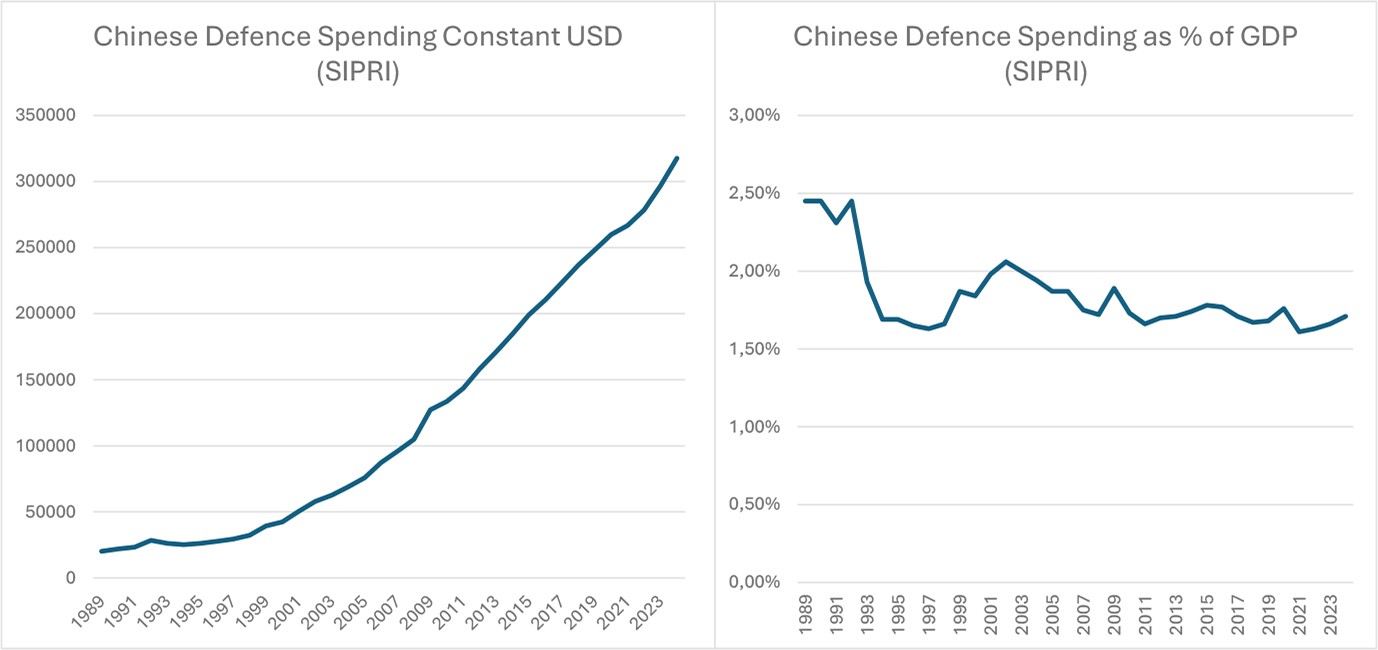
Figure 1:
Chinese Defence Spending
However, the increase in defence spending has not outpaced China’s general economic growth. If anything, as shown on the graph above, defence spending has remained constant or declined relative to the overall size of the Chinese economy. The expenditure of around 2% of GDP is not out of line with norms, and conforms to NATO members’ commitment to their own defence (NATO, 2025). China undeniably spends a lot on defence, but its spending is not out of line with its size and strategic importance, and falls significantly short of US defence spending. Military spending shows that the People’s Liberation Army, on paper at least, is an increasingly formidable fighting force, which other regional states such as Japan should take note of. It, on its own, does not demonstrate a clear offensive intent or that China is building up for war. China is a large country with a large economy and thus would have a correspondingly large military budget, regardless of its leaders’ intent. If anything, China’s growing military spending may seem disproportionately threatening as other advanced economies have neglected their own defence spending. The European Union continues to struggle to invest in defence at a level that would be needed to be effective in crises such as the one seen in Ukraine, and Japan must implement massive spikes to its defence budget to confront perceived future threats, including that of China.
1.2. Surface Combatants
Traditionally, the People’s Liberation Army – Navy (PLA-N) has been a less developed branch of the Chinese military, with the PLA’s long history of ground warfare. However, the sea has always been an important domain for the Chinese military. China’s imperial subjugation was underpinned by sea-power, naval power played a key role in the 1st Sino-Japanese War, and for much of the Cold War an invasion was expected from the sea. Yet fielding a strong enough navy has been a historical challenge. This has changed with the significant increase in both the size and capabilities of China’s surface fleets.
The overall Chinese surface combatant fleet is relatively large, with 102 principal vessels. However, almost half of this fleet is made up of frigates (50x). The core fleet is made up of forty-two destroyers and eight cruisers (International Institute for Strategic Studies, 2025).
The core of the surface fleet is made up of several variants of the Type-052D class destroyers, the new standard surface combatant of the PLA-N. A total of twenty-five, including twelve of the elongated variant, have been put to service since 2014 (International Institute for Strategic Studies, 2025). Eight of the Type-052D have been distributed to the North Sea Fleet (NSF) and the East Sea Fleet (ESF), the two fleets which would be most likely to come into contact with Japanese forces. The largest additions to the surface combatant fleet have been the Type-055 guided missile cruisers, 8 of which have entered service (International Institute for Strategic Studies, 2025). These cruisers are distributed between the North and South Sea Fleets (SSF), the North Sea Fleet having four of them. The smallest mass-produced vessel in service is the Type-054 frigate’s different variants. Of the forty or so vessels in total, fifteen are serving in the ESF and nine in the NSF (Janes, 2024). The PLA-N also maintains a broad array of older, small-production-run vessels, although most of the older frigates have been retired from service and passed to maritime law enforcement.
China has aircraft carriers in service (Type-001 and Type-002), one of which is attached to the NSF and one to the SSF. Type-001 is attached to the NSF and has recently been spotted near the disputed Senkaku/Diaoyu Islands (Mahadzir, 2025). The Type-001 is an older design and is less capable than other major aircraft carriers; for example, it relies on a ski-jump system rather than a catapult system, limiting the type and weight of aircraft operating from it.
The main armament of these vessels is the YJ-18 anti-ship missile (YJ-18A is the vertical launch system variant). The YJ-18 offers similar characteristics to the US Harpoon missile and the Japanese Type 90 ASM, although the YJ-18 is capable of supersonic speeds at terminal approach (Centre for Strategic and International Studies, 2024). The Sovremenny class destroyers are equipped with the supersonic Russian Moskit ASM or the Chinese YJ-12A ASM (International Institute for Strategic Studies, 2025).
1.3. Sub-surface Combatants
Submarines have traditionally played a key role in China’s naval strategy. They fit well into the People’s War doctrine’s ideas on guerilla warfare at sea. Today China maintains a relatively large submarine fleet with some forty-six submarines in service. The most numerous types are the Song-class (12) and the Yuan-class (20), confusingly marked as Type-039/039G and Type-039A/039B (International Institute for Strategic Studies, 2025). The subsurface fleet is relatively older than the surface fleet. The Type-052D destroyers have been in service since 2014 and the Yuan-class since 2006, while the Song-class is even older, having served since 1998.
Both classes are diesel-electric, with the Yuan-class being equipped with an air-independent propulsion system. China also operates six Type-094 nuclear ballistic missile submarines.
The core armament of these submarines is the same YJ-18 anti-ship missile as the surface fleet, although some may be armed with older YJ-82 missiles (International Institute for Strategic Studies, 2025). New armaments, including anti-ship missiles, have been displayed during the 2025 Victory Day Parade, but the extent to which these are deployed remains unknown.
1.4. Amphibious Capabilities
Amphibious capabilities have been a core question for China, whether it comes to potentially landing in Taiwan or remote Japanese territories. The PLA-N has eleven main amphibious vessels: three Type-075 helicopter-equipped landing docks, and eight Type-071 transport docks with more limited helicopter support. Both types can carry 800 troops and some 60 armoured vehicles (International Institute for Strategic Studies, 2025). In total the eleven ships could transport ~9000 troops and ~700 armoured vehicles for amphibious operations. This transport capacity would likely prove to be insufficient for a major amphibious assault, such as an invasion of Taiwan or the main Japanese islands. However, it could transport a sufficient force to establish a presence in remote Japanese territories. For larger amphibious operations the PLA has been training to utilize civilian ferries for transport, in combination with deploying floating piers, to transport a larger volume of troops and equipment (Dahm, Kennedy, 2021). While these may prove to be effective for short cross-strait operations, China would need to secure command of the sea for a substantial area to deploy them against Japan.
China operates a 35,000 strong marine force. They operate a number of light armoured vehicles (80x ZTD-05 light tanks, 50x ZTL-11 assault vehicles, 150x ZBL-08 infantry fighting vehicles and 240x ZBD-05 amphibious assault vehicles) (International Institute for Strategic Studies, 2025). The establishment of a dedicated marine force represents a major step in the development of China’s amphibious capabilities. The development of the amphibious capabilities at the moment focus on shorter-range cross-strait operations, but would still present a threat in a Sino-Japanese engagement.
1.5. Air Capabilities
China maintains a larger regular air force and a more modest naval aviation arm. The backbone of China’s fighter/ground attack force is made up of four main types: 608x J-10, 150x J-11, 300x J-16, and 230x J-20. The majority of this force consists of older 4th generation aircraft (J-10/J-11), but they are gradually being replaced by more modern types. The J-20 is China’s answer to US 5th generation fighter/attack aircraft, such as the F-22 and the F-35. There is some debate about the actual capabilities of the J-20. The naval aviation arm operates 50 J-11 and 70 J-15 fighters. The primary bomber type of the People’s Liberation Army – Air Force (PLA-AF) is the H-6 (219x), with the air force operating a number of modernized variants of the old Soviet design. The most numerous is the H-6K (110x), which has been modernized to be able to carry a larger missile load, as well as to have better electronics (International Institute for Strategic Studies, 2025).
1.6. Missiles
China’s military capabilities are rounded off by a large missile force. The People’s Liberation Army – Rocket Force (PLA-RF) operates a wide range of missiles, armed with both nuclear and conventional payloads. For a limited conflict, China’s conventional strike capabilities are more important, as the use of nuclear weapons would far surpass such a conflict. The PLA-RF operates 225 short-range, 78 medium-range and 250 intercontinental-range conventional or dual-capable ballistic missiles (International Institute for Strategic Studies, 2025). These could all potentially target Japanese territory in case of a conflict. Part of the missile force includes anti-ship ballistic missiles. These primarily target US carriers, but could potentially be used against larger Japanese vessels, such as the Izumo-class.
2. JAPAN’S NAVAL POWER
Japan has traditionally been uncomfortable with military power post-World War II, and has largely projected a pacifist image. This does not mean that Japan does not possess considerable military power. While the Japanese Self-Defence Forces (JSDF) are not officially classified as a military force in order to abide by the stipulations of Article 9 of the Constitution, they nevertheless represent a significant fighting force in the region. However, Japan’s traditional focus on strict homeland defence has impacted the constitution and capabilities of the JSDF. The core issue faced by Japan is that the gradual expansion of the JSDF cannot keep pace with the expansion of Chinese military power. This has forced Japan into taking extraordinary measures to react to the negative shifts in the balance of power under the 2022 National Security Strategy. The Defence Buildup Program is Japan’s attempt to address current trends in the relative distribution of power; however, it is questionable whether it is sufficient to meaningfully address the shifting relative distribution of power between China and Japan.
2.1. Military Budget
Japan has traditionally limited its defence spending, focusing on spending 1% of GDP on national defence. Defence spending has been further limited by Japan’s economic woes since the 1980s, leading to a growing number of ‘lost decades’ which restrained economic growth. Japan’s economic problems, combined with a strong reliance on the US as a security guarantor and a relatively peaceful post-Cold War environment, made defence spending a convenient avenue to save money. The JSDF experienced limited modernization or expansion during the post-Cold War period, despite changing regional security trends, such as the military growth of China.
Japan’s focus on non-military tools of statecraft limited the JSDF to home defence, and in Japan’s view no significant threat has emerged which would necessitate a more active expansion of its armed forces, especially as the status of the JSDF has been a domestically sensitive issue.
Compared to China, Japan’s defence spending is a lot more transparent, with a detailed breakdown of Japanese defence spending published by the Ministry of Defence. Japan’s defence budget for the fiscal year 2025 was 8.47 trillion Yen (~58 billion USD). This is a 9.7% increase over last year. The Japanese defence budget has seen significant increases in the past three years: +27.4% in FY2023 and +17% in FY2024 (Ministry of Defence (Japan), 2024). In recent years the relative growth of Japanese spending has outpaced that of China.
As the graphs above show, Japanese defence spending has been fairly flat for decades, portraying Japan as a mature power with established military capabilities, in contrast to emerging military powers such as China. This has dramatically changed in the past decade or so, with a significant spike to Japanese defence spending. This has been motivated by Japanese concerns that they allowed China not only to close the military gap over the decades, but to surpass Japan’s capabilities to the point where they represent a tangible threat to the security of Japan.
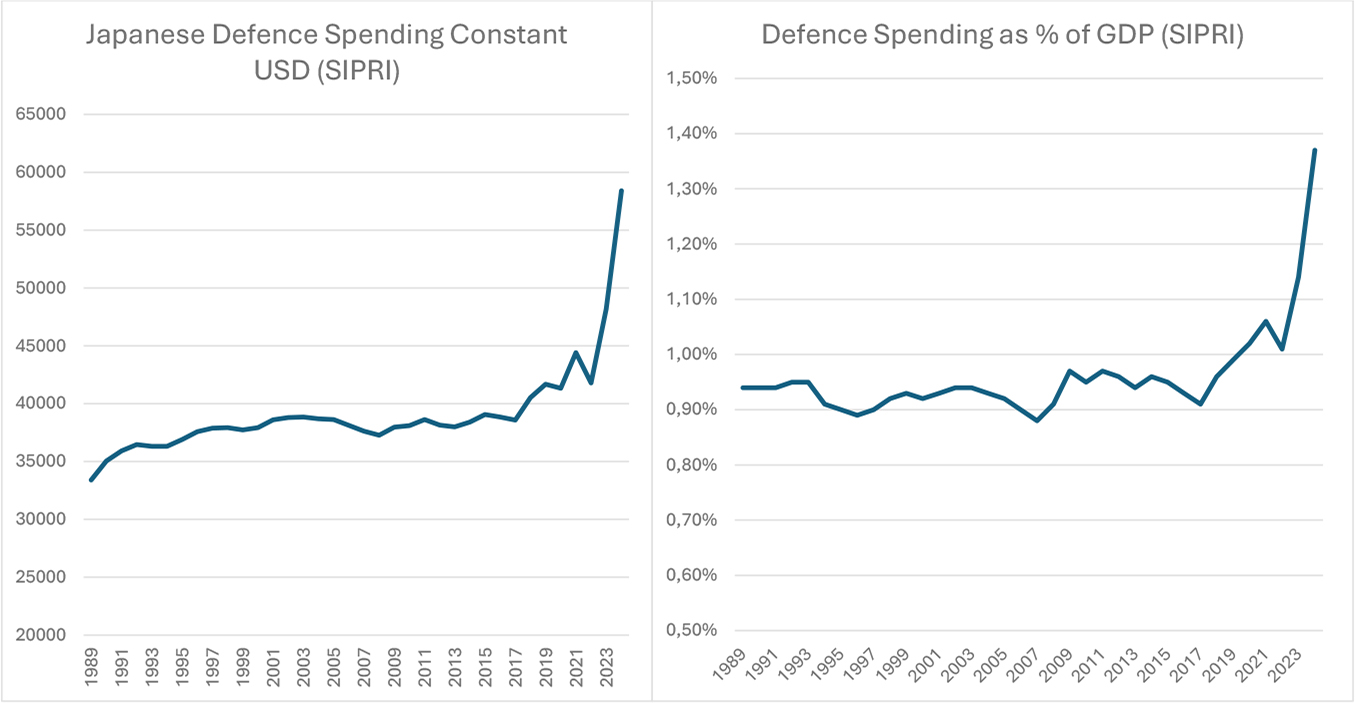
Figure 2:
Japanese Defence Spending
The current spike in Japanese defence spending is due to the Defence Buildup Program (DBP), an ambitious plan to acquire new capabilities and to expand the military power of Japan in response to the growing threat posed by China and North Korea. The DBP is part of a broader revision to Japan’s national security strategy (Cabinet Secretariat (Japan), 2022) in the light of military action in Ukraine and in the Middle East, which focuses on developing more offensive capabilities and stand-off weapons systems. The goal is to enable Japan to move away from a strictly reactive posture to be able to more actively counter threats and to assume a limited role as a security guarantor in the region, as concerns persists about US commitments towards the region. The DBP has massively increased Japan’s defence spending, both in terms of the amount of money spent and relative to the overall GDP of Japan (as shown in the graphs above).
Japan’s defence spending shows a country which is increasingly concerned about its own security in the light of perceived shifts in the relative distribution of power. The failure of Japan’s engagement diplomacy towards China, the growing military capabilities of China, and general Sino-Japanese animosity has pushed Japan into increasing insecurity. Limited investment in defence has left Japan ill-equipped to confront the current challenges, now that Russia’s actions in Ukraine have shattered the illusion of post-Cold War peace between major powers.
2.2. Surface Combatants
As an island nation, the navy has always been important for Japan. Unsurprisingly, the Maritime Self-Defence Force (and its predecessors) was one of the earliest branches of Japanese military power to be reconstituted after World War II. Increasing Japan’s naval power has been a core goal of the DBP. Some of the major projects of the DBP include the acquisition of a new frigate class, acquiring new submarines, and strengthening AEGIS air and missile defence capabilities (Ministry of Defence (Japan), 2024).
There is some disagreement on the classification of Japanese surface combatants. The MSDF classifies most of its vessels as destroyers, even if international observers would classify them differently. For example, the Abukuma-class is classified as an ‘escort destroyer’ by Japan, but as a frigate by Military Balance. Similarly, the Hyuga and Izumo classes are officially classified as ‘helicopter destroyers’ by Japan, but as carriers by Military Balance (Ministry of Defence (Japan), 2025). This difference can be partially explained by Japanese attempts to adhere to Article 9 of the Constitution, which is interpreted to forbid Japan from possessing certain weapons, such as aircraft carriers. For the purposes of clearer comparison, this paper will use Military Balance’s definition for these vessels as these have been used in the section above for Chinese vessels.
The core of the MSDF surface fleet is made up of thirty-four destroyers, divided between seven classes (International Institute for Strategic Studies, 2025).
While the MSDF has undertaken efforts to modernize the surface fleet, much of it is still constituted of older classes. However, the replacement of older vessels has been gradual, not comparable to China’s introduction of the Type-052D class. The destroyers are complemented by two cruiser classes: Atago (2x, 2007) and Maya (2x, 2020). The overall size of the core Japanese surface fleet has remained fairly constant over the past decade at around forty vessels, depending on the specifics of classification. Over time, older classes such as the Hatsuyuki-class have been retired, and vessels from newer classes have been acquired, but the fleet has not been significantly expanded.
The two largest classes of the MSDF are the Hyuga class (2x) and Izumo class (2x) helicopter carriers, although the Izumo-class offers limited capabilities to operate the F-35. While these vessels are technically carriers, they do not compare in capability to traditional aircraft carriers, even to the more modest carriers operated by the PLA-N, and they can be better understood as fleet support vessels. The Hyuga class can carry three to ten helicopters, while the Izumo class can embark seven to thirteen helicopters. The MSDF relies on AEGIS systems and shore-based aircraft for air defence, rather than the fighter capabilities of a carrier, and these vessels offer limited strike capabilities. This is in line with Japan’s focus on home defence, which traditionally does not require long-range capabilities.
The main armaments of the surface fleet are provided by the Type-90 anti-ship missile; however, some classes (primarily the older ones: Asagiri, Hatakaze and Kongou) are equipped with US Harpoon anti-ship missiles (International Institute for Strategic Studies, 2025). These are similar in character to the Chinese YJ-18 anti-ship missile.
2.3. Sub-Surface Combatants
The MSDF maintains a relatively large submarine fleet, consisting of twenty-five vessels distributed between three classes: Oyashio (10x, 1998) Soryu (12x, 2009) and Taigei (3x, 2022) (International Institute for Strategic Studies, 2025). Similarly to the surface fleet, the submarine fleet is made up of a mixture of older and newer vessels. Unlike the surface fleet, the submarine fleet has seen a substantial expansion over the past decade. It retired the older Harushio class, introducing the new Taigei class. It also expanded the Soryu class from four to twelve vessels. The fleet overall has grown from eighteen to twenty-five submarines, a roughly 30% expansion (International Institute for Strategic Studies, 2025; Szanto, 2017). The importance of the submarines is demonstrated by the fact that they benefitted from modernization even when the Japanese defence budgets remained otherwise restrained.
Japanese submarines have traditionally been technologically advanced. On the Taigei class, Japan has begun to implement a new propulsion system which relies on lithium-ion batteries to increase endurance and stealth (Naval Technology, 2022). All three classes of Japanese submarines are equipped with the US Harpoon anti-ship missile. While Japan is developing a ship-based variant of its new Type 12 anti-ship missile, it is unknown if it will be installed on Japanese submarines. While most Japanese surface combatants carry the domestic Type 90 missiles, Japanese submarines have so far stuck with the Harpoon missile. The UGM-84 underwater variant of the Harpoon is specifically prepared to be torpedo-tube launched by being encapsulated in a container. Domestic missiles have not been adapted to such a role so far.
2.4. Amphibious Capabilities
Traditionally, Japan has seen little need for amphibious capabilities, viewing them more through the lens of offensive war capabilities. This perspective has changed as tensions around the Senkaku/Diaoyu Islands have become more pronounced. The dispute has raised the possibility of having to recapture such remote territories, a mission the JSDF would have been ill-equipped for. It became headline news when Japan began training for such an operation with Japanese, rather than US, forces taking the lead (Stratrisks, 2013). Today, Japan has expanded its capabilities to counter such challenges, but its amphibious capabilities remain correspondingly modest.
Japan operates three Osumi class landing ships; however, these are much more modest in capability than their Chinese counterparts. Japan also only maintains a small fleet of landing craft (International Institute for Strategic Studies, 2025). While the PLA is constructing the core of an amphibious force capable of large-scale operations, the JSDF’s main interest is in landing a small force in remote territories where it only expects to encounter limited resistance. Remote territories such as the Senkaku/Diaoyu Islands do not offer space for hundreds of troops or large numbers of tanks to engage each other.
Japan has also sought to acquire V-22 Ospreys to respond to attacks in remote territories (Ministry of Defence (Japan), 2016). In the absence of a dedicated marine force, these are operated by the Ground Self-Defence Forces (JGSDF) and are aimed at the rapid movement of troops in response to potential incursions in remote areas.
2.5. Air Capabilities
Japan maintains a smaller air force than China, consisting of some 330 combat aircraft. The majority of these aircraft are variants of the F-15 (200x). Japan has also begun the acquisition of the F-35 (39x), some of which could potentially operate from its larger helicopter carriers. The F-15 has proved itself a capable design, and Japan has gradually upgraded its fleet. However, it would be disadvantaged by the introduction of more 5th generation fighters over time. Japan’s own 5th generation fleet is relatively small and is dependent on the US. For naval attack, Japan could rely on sixty-six P-1 and thirty-two P-3 patrol aircraft (International Institute for Strategic Studies, 2025). The new Type 12 anti-ship missile is being adapted for air launch.
2.6. Missiles
In the past Japan has not sought to develop long-range missile capabilities, such weapons being incompatible with a strict home defence focus. Japan also does not operate ballistic missiles. This attitude changed significantly with National Security 2022, which emphasized the need to acquire standoff (long-range) capabilities (Cabinet Secretariat (Japan), 2022). Accordingly, a large part of Japan’s Defence Buildup Program (DBP) is the acquisition of both new long-range anti-ship missiles (Type 12) and a high velocity guided projectile (HVGP) capable of attacking both ground and sea targets (Ministry of Defence (Japan), 2024). The HVGP is envisioned to be able to attack carriers, posing a counter to China’s growing carrier fleet. In this role, the HVGP is not unlike China’s DF-21 anti-ship ballistic missile, which was designed to threaten US carriers in the region. As a stopgap measure until these capabilities come online, Japan has also sought to acquire US Tomahawk missiles to rapidly establish long-range strike capabilities (Gwadera, 2025).
3. ASSESSING THE BALANCE OF NAVAL POWER BETWEEN CHINA AND JAPAN
The assessment of the balance of power in this section will focus predominantly on the maritime realm, including naval and air power. Were there to be an armed confrontation between China and Japan, this would most likely take place at sea. A potential trigger could be a confrontation over disputed territory, or China taking military action to limit foreign intervention during an attack on Taiwan. It is unlikely that either China or Japan would seek to directly invade each other as a war goal. Besides naval power, China and Japan are close enough for land-based aviation to play a role without reliance on carriers, so air power will be added to the calculations.
3.1. The Relative Expansion of the Chinese Surface Fleet
China has a clear numerical advantage in both surface combatants and submarines. This is a clear reversal in the relative distribution of power from 10 years ago, when Japan had nearly three times the destroyers China had. When it comes to overall displacement, the Chinese fleet offers a displacement of 791,430 tons (5653 tons average). In comparison, the Japanese fleet offers a displacement of 366,000 tons (4633 tons average). Limiting to just destroyers and cruisers, the PLA-N tonnage has risen from 98,544 tons (2016) to 387,544 tons (2025), while the JMSDF has stayed roughly the same, from 218,766 tons (2016) to 259,300 tons (2025). China has not only closed the gap, but the PLA-N has overtaken the JMSDF in surface combatants. However, it must be noted that while the JMSDF is limited to the defence of Japan, the PLA-N is divided between three fleets with two major theatres of operation. The PLA-N must maintain a presence in both the East and South China Seas, limiting its ability to bring ships into combat against Japan without leaving its Southern flank undefended. The South Sea Fleet has received a large share of modern equipment, including one of China’s carriers, as China is being drawn into increasing conflict with ASEAN states over maritime rights. Furthermore, China needs to counter a strong US presence in the region, as well as secure safe waters for its nuclear ballistic missile submarine fleet operating from Hainan Island. Essentially, these commitments would relatively equalize the distribution of surface combatants with Japan. While it is unfavourable for Japan that China has caught up in the number of surface combatants, China has not gained a massive advantage at sea despite the expansion of the PLA-N surface fleet.
When it comes to submarines, China has always had a numerical advantage. In 2016, the balance was 60 to 18, in favour of China (Szanto, 2017). However, much of China’s fleet consisted of older, less capable vessels. Therefore, while there has not been a significant quantitative improvement, there has been a qualitative one. In contrast, Japan’s submarine force has expanded. Even considering the PLA-N commitments in the South China Sea, China continues to enjoy a significant numerical advantage in subsurface combatants.
The two graphs below show the expansion of the PLA-N destroyer fleet (red) relative to the JMSDF (green), highlighting the erosion of Japan’s quantitative advantage in major surface combatants.
3.2. The Technological Advancement of the PLA
Both China and Japan have displayed technological advancements recently. Japan has unveiled a new propulsion system for its Taigei class submarines (Wertheim, 2022), as well developing new long-range missiles such as the Type 12 anti-ship missile and the high velocity gliding projectile (HVGP) (Ministry of Defence (Japan), 2024). China displayed a slew of new weapons systems at the 2025 Victory Day Parade, including new naval missiles, combat drones, and autonomous vessels (Luck, 2025). While the capabilities of these systems remain unknown, assuming that they function as expected, China has shown a high capacity for military development. While Japan has traditionally enjoyed a solid advantage in technology, both in the purchase/joint development of US systems and domestically developed systems, today the technological gap is much narrower. China no longer depends on Russian technology but has shown itself capable of developing and deploying weapon systems domestically which are expected to be equivalent to their Western counterparts. In some areas, such as in the development of stealth aircraft, China has secured a considerable advantage over Japan.
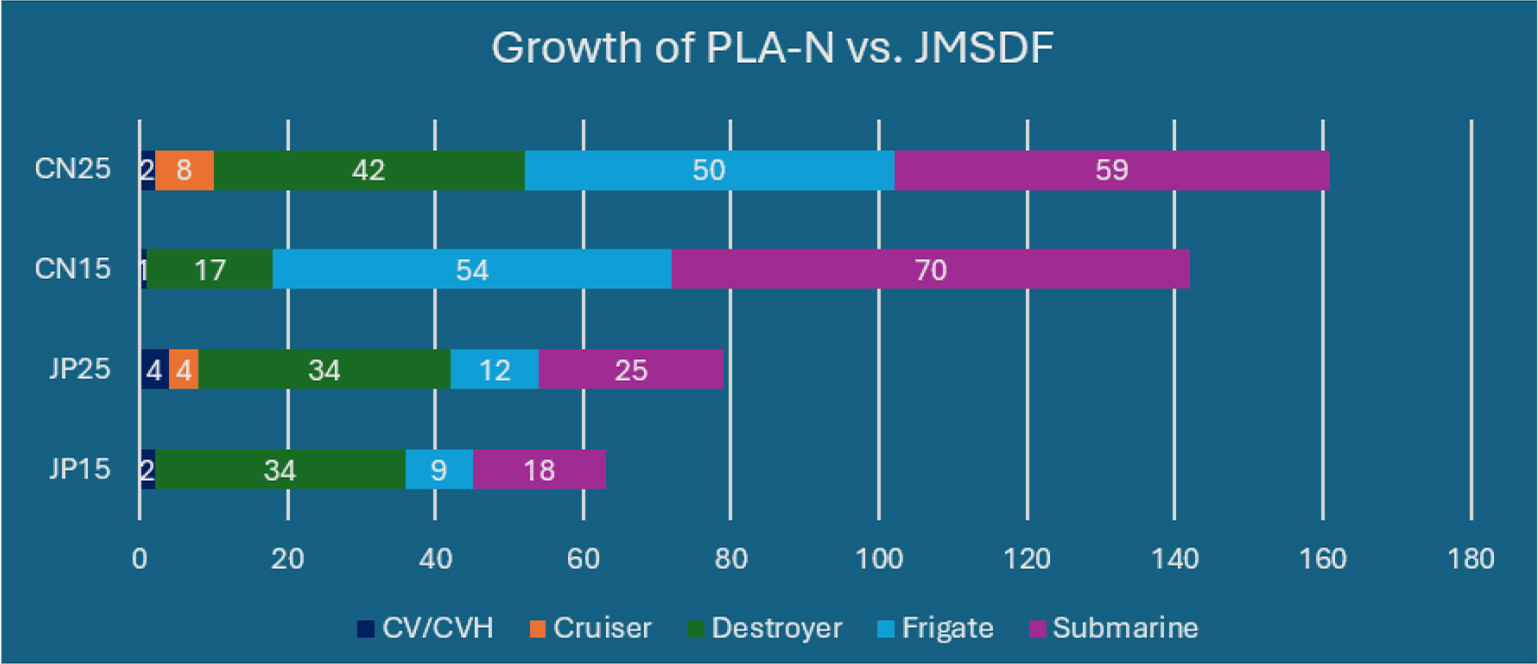
Figure 3:
Expansion of Fleets 2015–2025
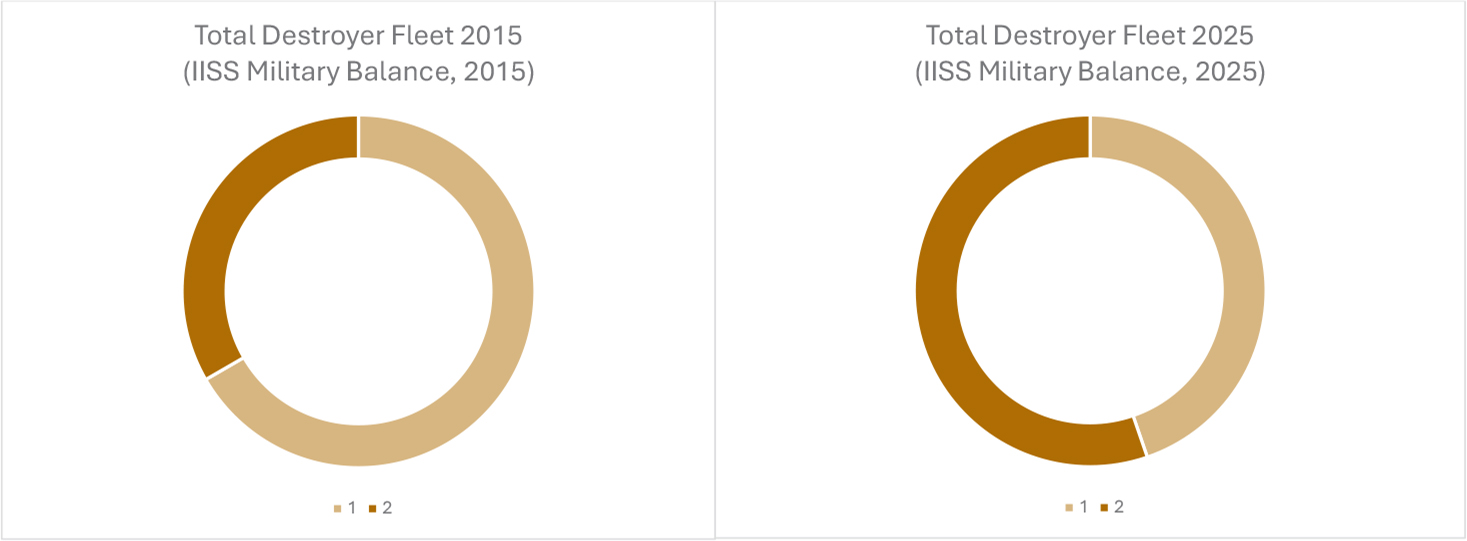
Figure 4:
Relative Distribution of Destroyers 2015–2025
3.3. Japan’s Weakening Airpower
The relative distribution of aircraft paints a grimmer picture for Japan. China has a massive advantage in the number of aircraft. A 6:1 ratio is not good, even taking into account the F-15’s impressive 104:0 kill ratio. However, once again, we should be mindful of operational demands. Japanese territory covers roughly 378,000 km2, while Chinese territory covers roughly 9.5 million km2. While not necessarily a crucial indicator, the JSDF can field 0.009 fighter/attack aircraft per square kilometre; in contrast, the PLA can field 0.0003 fighter/attack aircraft per square kilometre. This illustrates that while Japan has a much smaller airforce, they also have a much smaller airspace to defend. Were there to be a conflict between China and Japan, China would not be able to mobilize all of its air force to attack Japan, as this would leave the rest of its airspace undefended. While the numbers on paper show a large disparity, once relative commitments are taken into account the picture becomes less unequal.
3.4. Combat Effectiveness
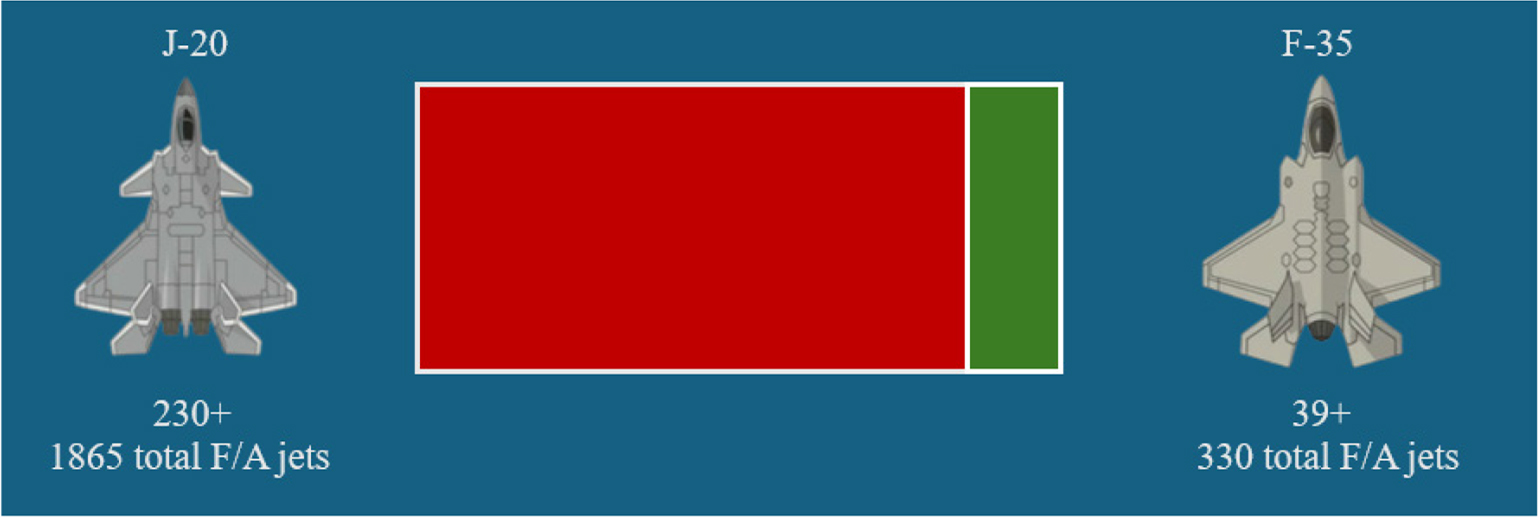
Figure 5:
Distribution of 5th Gen Fighters (IISS, Military Balance 2025)
Unfortunately, from the perspective of Gray’s 24th maxim, we have little tangible information on the quality of either the PLA or the JSDF. For obvious reasons, the JSDF has never engaged in substantial combat operations. Japanese attitudes towards the military have traditionally limited them strictly to home defence, and Japan has not been attacked since the end of World War II. While Japan played a supporting role to the US during the Cold War, its military forces were not committed to combat. The PLA similarly lacks combat verification. During the Cold War the PLA took part in a number of engagements (e.g. the 1962 Sino-Indian War, the 1969 Sino-Soviet War, the 1979 Sino-Vietnamese War); however, functionally these pre-dated the modern PLA, which has been established as a consequence of Deng’s economic reforms, and do not account for China’s shift away from its People’s War doctrine towards the Limited War under High Technology Conditions doctrine (Godwin, 1996; Po Ng, 2025). Also, most of these conflicts included PLA ground forces, rather than the PLA-N, which did not meaningfully participate in these conflicts. The PLA-N’s most recent combat experience is limited to small-scale skirmishes over remote islands in the South China Sea (the Paracel Islands and Spratly Islands). However, these offer little insight into the PLA-N’s ability to execute modern naval combat. Ultimately, both the JSDF and the PLA remain without combat verification, which greatly limits insights into their effectiveness.
China has long sought to project an image of strength, often through highly publicized military exercises, such as the amphibious drills in the Strait of Taiwan (Zhen, 2025). However, the actual capability of the PLA to effectively pursue modern combat has been under question for some time. The Strategic Rocket Force and other elements of the PLA saw significant purges in 2024 and 2025. While some of these were politically motivated, corruption has long been an issue in the PLA (Legarda, 2025). Russia’s performance in Ukraine has been significantly hindered by corruption in procurement and other areas (Wasielewski, 2023). Ultimately, corruption can hollow out an otherwise impressive-looking force and greatly reduce its combat effectiveness.
Japan in turn is affected by continued anti-militarist sentiments. Defence reforms have not been popular and have faced public opposition, based on worries that they would increase the risk of a military confrontation. Komiya has shown that casualties have undermined support for the use of the JSDF, even at small numbers of losses (Komiya, 2019). While there is no clear indication on how casualties would shape a Sino-Japanese conflict, similar studies in Taiwan (using independence as a scenario) have shown that only 32% of respondents would tolerate casualties above 50,000, and 20% would not tolerate a single casualty (Wu et al, 2023). While this does not offer a direct comparison, it suggests that Japan, where anti-militarism is strong, would have a similarly low or lower casualty tolerance in the event of a limited conflict with China over remote, potentially uninhabited, territories.
One issue that both Japan and China have struggled with is demographics. Both the JSDF and the PLA are having trouble attracting personnel, particularly the highly qualified personnel which would be needed for a modern war. Japan is facing an increasingly aging population and heavy competition for skilled workers. Accordingly, the JSDF has consistently missed recruitment targets. In 2023, the JSDF recruited only half the personnel targeted (Nagatomi, 2024). Similar problems exist in China. The PLA has similarly found it difficult to recruit skilled personnel due to a shrinking youth pool, competition for skilled labour, and the perceived relative harshness and low status of military life (Cozad, Wenger, 2025). Overall, both countries have struggled to gain the ‘right’ people needed for modern military operations, which would greatly affect their actual performance in combat.
Decision-making is also a problem for both China and Japan. Japan is affected by nemawashi, the slow process of multi-stakeholder consensus-building preceding an important decision (Hornung, 2025). A decision on how to respond to aggression or a challenge by China would likely be very difficult, requiring drawn out consensus-building. This could limit Japan’s ability to effectively and quickly respond, and would be a strategic disadvantage as it would force Japan into a reactive position. China, in turn, is hindered by rigid decision-making and a lack of initiative in the lower ranks. A political commissariat system focuses on rigid adherence to rules, and lower-ranked officers are often discouraged from taking the initiative in a top-down command structure (Wortzel, 2024).
Overall, both the PLA and the JSDF lack actual combat experience to effectively judge their capabilities. However, there are a number of concerns which call their ability to fight effectively into question. When it comes to a comparison between China and Japan, as both countries suffer from similar issues, neither country seems to possess a clear qualitative advantage. The absence of a qualitative advantage would put more focus on the quantitative distribution of power.
3.5. From Power Advantage to Balance of Power
Traditionally, Japan has enjoyed a considerable advantage in naval power, but this is no longer the case. Japan’s position today has weakened to the point where there is a balance of power between China and Japan. While this still allows the JSDF to safeguard the Japanese home islands, this mission has become considerably more difficult due to the erosion of Japan’s advantage in naval power. It is a fundamental tenet of realist thinking that a relative advantage in power is necessary for a position of security. Both Morgenthau (2005) and Measheimer (2014) have argued that due to unforeseen changes in the relative distribution of power it is prudent to pursue at least some advantage in power as a buffer. The erosion of Japan’s advantage at sea both puts Japan’s security at increased risk and limits Japan’s ability to deter China in Asia Pacific in the pursuit of its own regional interests.
Conclusion
Ultimately, while Japan has sought to modernize its naval force, it has simply failed to keep pace with the expansion of Chinese naval power in order to preserve its power advantage. As part of both the 2013 and 2022 National Security Strategy, Japan has recognized the need to expand its military, including its naval power, in order to counter a growing threat from China. This has three immediate consequences: (1) it puts the security of Japan at risk, (2) it increases the risk of a regional military confrontation as the balance of power breaks down and Japanese deterrence diminishes, and (3) it increases the importance of US deterrence in the region at a time when US commitments are becoming unreliable.
As an island nation, Japan’s security fundamentally rests in its navy. The relative weakening of the JMSDF then puts Japan’s security at risk. While the JMSDF continues to be able to protect Japan, its power advantage has been greatly eroded. It no longer enjoys a clear-cut advantage which would allow it to comfortably confront the PLA-N. This also undermines Japan’s capacity for deterrence. Were China to perceive a growing possibility of naval victory, it would be more likely to pursue the use of force to potentially settle disputes with Japan, such as the sovereignty of the Senkaku/Diaoyu Islands. While the current decline is not a survival level threat, China’s navy is only gaining momentum, while Japan is struggling to expand its own naval forces. This trajectory represents a present danger for long-term Japanese security; a danger that has not materialized for centuries.
The relative distribution of power is an essential indicator, as regional security largely depends on a balance of power between opposing states. China has long sought to expand its influence in Asia Pacific. This has been mostly constrained by an unfavourable balance of power: traditionally China simply lacked the naval power to effectively push into maritime East Asia. This has been evidenced by decades of mitigation strategies, such as seeking remote islands which could substitute for a substantial naval presence. However, as this paper demonstrates, this is no longer the case. The PLA-N has developed to become a formidable naval force, equalling any regional navy, including the JMSDF. This increases China’s ability to pursue an expansion of its influence into Asia Pacific, while also restricting Japan’s ability to oppose such an expansion. Thus, the relative decline of Japanese naval power is not simply a matter of Japanese security, but a risk factor to the broader Western allied coalition in the region, including the ASEAN states. In the absence of an effective counterbalance, they can expect a more assertive use of Chinese power to purse Beijing’s interest in the region, such as maritime territorial and resource rights.
A potential breakdown of the balance of power would also be an existential threat to Taiwan. A Chinese attack has been deterred by an unfavourable distribution of power relative to states friendly to Taiwan who might intervene in such a conflict. Even if Japan would not directly seek to intervene, its ability to protect its home territory will affect the availability of US forces. If Japan is able to safeguard its home territory, including the US bases located within it, it offers the US greater manoeuvrability in how to use its forces in the region. However, if Japan’s ability to resist potential Chinese hostile actions is reduced, the US would be forced to keep more forces to assist defence, reducing the availability of forces to intervene in such a conflict.
For centuries, the East and South China Seas have been defined by the competition between a maritime Japan and a continental China, the latter being able to leverage its naval power to pursue a dominant position. However, just as China has economically overtaken Japan, the PLA-N is now threatening to overtake the JMSDF. This would once again weaken the influence of Japan, and the Western norms it represents, relative to China and the norms and values it seeks to promote. Smaller states are likely to be more hesitant to oppose China in favour of the Western alliance system if the relative distribution of power is shifting in favour of China.
Unless the current trends in the relative distribution of power are halted, soon the US Navy will remain the only naval force in Asia Pacific able to counter the PLA-N.
While the US has strong interests in Asia Pacific, it remains an external security actor to much of East Asia, including the East and South China Seas. Furthermore, the US has been increasingly preoccupied with its own domestic political issues, which often lead to inaction or unpredictable foreign and security policy decisions. The convergence of the relative weakening of regional naval powers and the growing uncertainty about the reliability of US security commitments further undermines regional security. Ideally the presence of the US 7th Fleet is meant to tip the scale in favour of regional allies such as Japan, not become an essential necessity in countering Chinese naval power.
From a US perspective, the weakening of Japanese naval power presents a clear security problem. On the one hand, it makes the job of the US 7th Fleet harder and more dangerous, potentially necessitating the deployment of more naval and air assets to support regional allies effectively. On the other hand, it puts pressure on the US to make decisions quickly in the event of a regional contingency, as the weakening of allies’ relative power reduces their ability to withstand Chinese hostility while the US decides what to do.