
Tab. 1:
Demographics of survey participants.
| Variable | Level | Frequency (n) | Percentage (%) |
|---|---|---|---|
| Gender | Female | 333 | 61.8 |
| Male | 206 | 38.2 | |
| Academic stage | PhD student | 105 | 19.5 |
| Early-career researcher (0–10 years of research experience) | 67 | 12.4 | |
| Mid-career researcher (10–20 years of research experience) | 128 | 23.8 | |
| Advanced career researcher (more than 20 years of research experience) | 226 | 41.9 | |
| Other | 13 | 2.4 | |
| Scientific title | Doctor habilitat | 87 | 16.1 |
| Doctor | 327 | 60.7 | |
| No scientific title | 125 | 23.2 | |
| Scientific field | Natural sciences | 74 | 13.7 |
| Engineering sciences and technologies | 54 | 10.0 | |
| Medical sciences | 69 | 12.8 | |
| Agricultural sciences | 9 | 1.7 | |
| Economic sciences | 64 | 11.9 | |
| Social sciences | 98 | 18.2 | |
| Humanities | 171 | 31.7 |
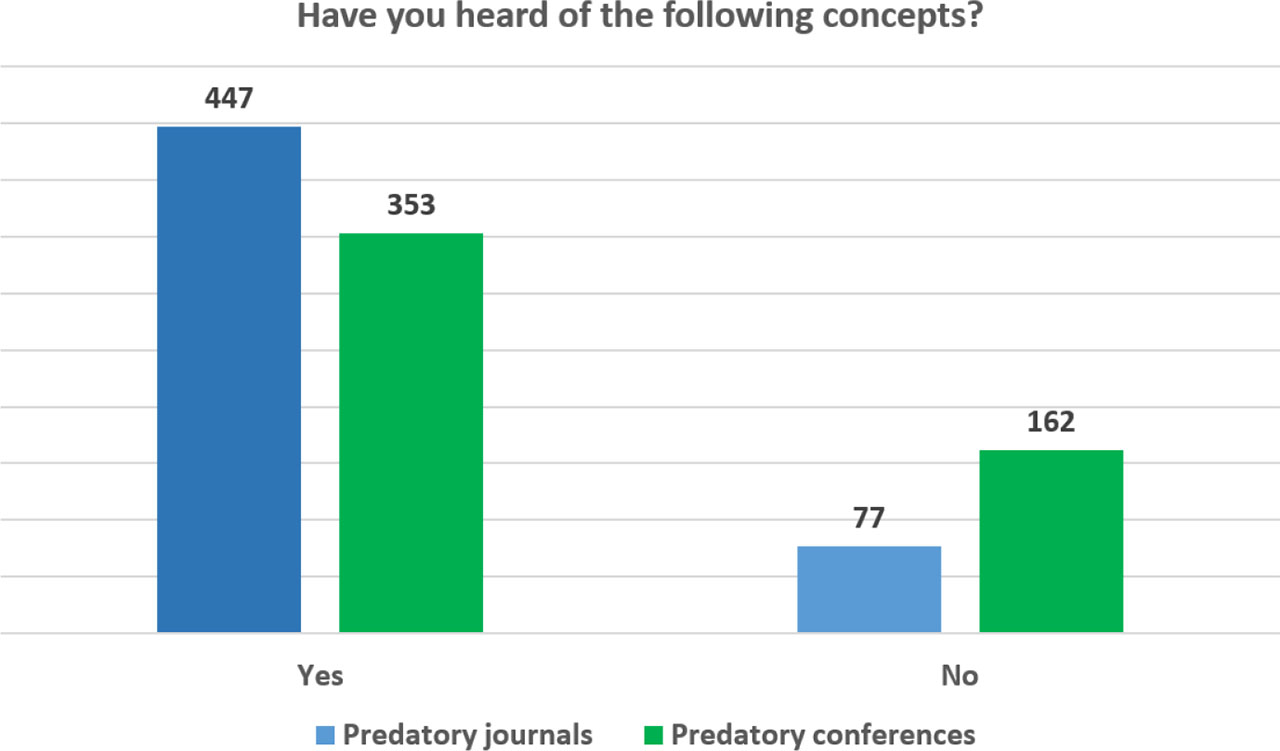
Fig. 1:
Familiarity of Moldovan researchers with the concepts of predatory journals and conferences (n = 524).
Source: Own elaboration based on the survey results.
Tab. 2:
Knowledge of predatory journals and conferences.
| Academic stage | Predatory journals | Predatory conferences | ||||||||||
|---|---|---|---|---|---|---|---|---|---|---|---|---|
| Yes | No | Total | Yes | No | Total | |||||||
| n | % | n | % | n | % | n | % | n | % | n | % | |
| PhD student | 72 | 72.7 | 27 | 27.3 | 99 | 18.9 | 47 | 48.0 | 51 | 52.0 | 98 | 19.0 |
| Early-career researcher | 55 | 83.3 | 11 | 16.7 | 66 | 12.6 | 39 | 60.9 | 25 | 39.1 | 64 | 12.4 |
| Mid-career researcher | 106 | 85.5 | 18 | 14.5 | 124 | 23.4 | 90 | 73.8 | 32 | 26.2 | 122 | 23.7 |
| Advanced career researcher | 203 | 91.0 | 20 | 9.0 | 223 | 42.7 | 166 | 75.8 | 53 | 24.2 | 219 | 42.5 |
| Others | 11 | 91.7 | 1 | 8.3 | 12 | 2.3 | 11 | 91.7 | 1 | 8.3% | 12 | 2.3 |
| Total | 447 | 85.3 | 77 | 14.7 | 524 | 100 | 353 | 68.5 | 162 | 31.5 | 515 | 100 |
Tab. 3:
Sources of information on the existence of predatory journals and conferences reported by respondents (n = 524).
| How did you find out about predatory journals or conferences? | n | % |
|---|---|---|
| Through colleagues | 191 | 36.5 |
| Through professional networks | 194 | 37.0 |
| Training courses or workshops organised by ANACEC | 150 | 28.6 |
| Training courses or workshops organised by other organisations | 63 | 12.0 |
| During a scientific presentation or conference | 82 | 15.7 |
| From information material provided by my institution | 98 | 18.7 |
| Through news, press articles or academic blogs | 161 | 30.7 |
| Through direct personal experience | 92 | 17.6 |
| Recommendations from librarians | 43 | 8.2 |
| From websites or lists dedicated to the prevention of predatory journals (e.g. ‚blacklists’) | 75 | 14.3 |
| From the ANACEC website | 133 | 25.4 |
| From the IBN website | 48 | 9.2 |
| Discussions in ethics or scientific review committees | 62 | 11.8 |
| I have not heard about it | 60 | 11.5 |
| Other | 17 | 3.2 |
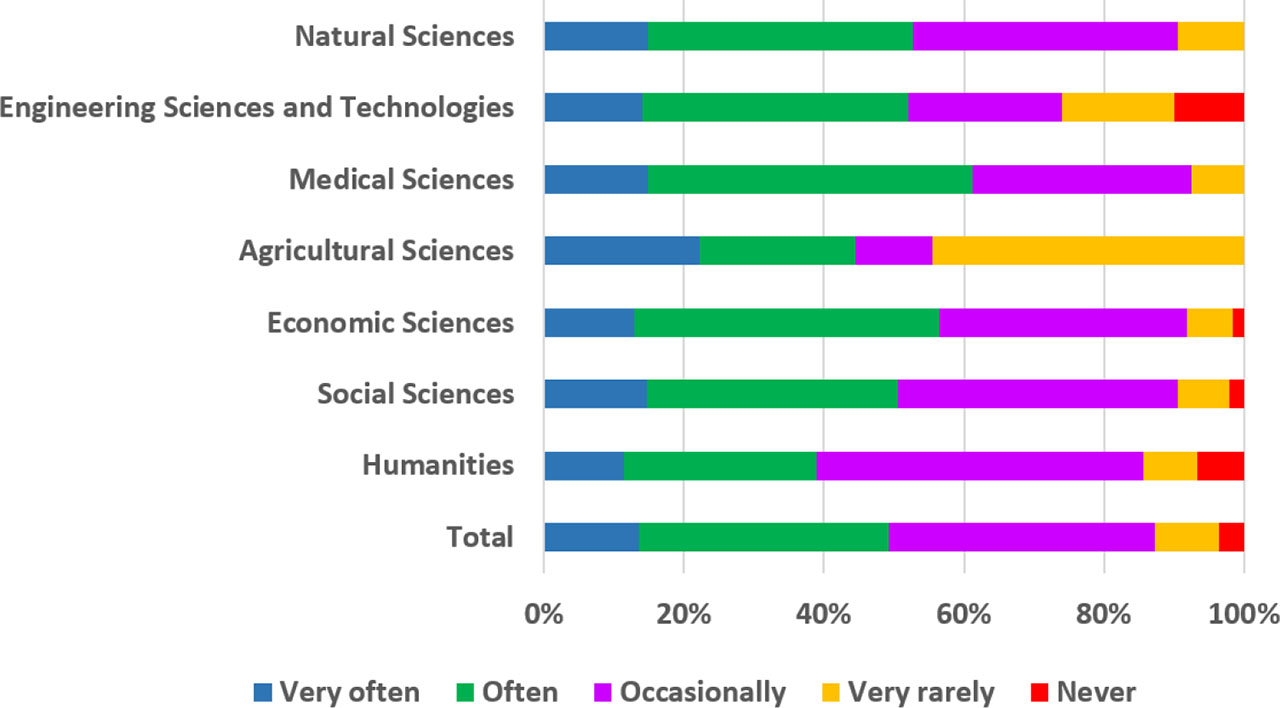
Fig. 2:
Respondents’ views on the prevalence of predatory journals and conferences in their research field (n = 524)
Source: Own elaboration based on the survey results.
Tab. 4:
Opinion on the knowledge to recognise a predatory journal or conference (n = 524).
| Scientific title | Yes, I feel well informed | To a certain extent | No, I need more | Total | ||||
|---|---|---|---|---|---|---|---|---|
| % | n | % | n | % | n | % | n | |
| Doctor Habilitatus | 35.6 | 31 | 48.3 | 42 | 16.1 | 14 | 16.6 | 87 |
| Doctor | 21.6 | 68 | 54.3 | 171 | 24.1 | 76 | 60.1 | 315 |
| No scientific title | 13.9 | 17 | 50.0 | 61 | 36.1 | 44 | 23.3 | 122 |
| Total | 22.1 | 116 | 52.3 | 274 | 25.6 | 134 | 100.0 | 524 |
Tab. 5:
Respondents’ views on the main characteristics of a predatory journal or conference (n = 524).
| Characteristics | n | % |
|---|---|---|
| Lack of or mimicry in manuscript evaluation (review) | 316 | 60.3 |
| Rapid manuscript acceptance and publication times | 327 | 62.4 |
| Unjustified publication or participation fees | 245 | 46.8 |
| Attractive, general, mimicry names | 266 | 50.8 |
| The editorial board and scientific committee are not functioning effectively and are often misrepresented | 215 | 41.0 |
| Broad scientific disciplines | 264 | 50.4 |
| Suspiciously high frequency of publication | 185 | 35.3 |
| Aggressive recruitment of authors, editorial board members and scientific committee members | 195 | 37.2 |
| Lack of indexing in major databases | 263 | 50.2 |
| False or inadequate bibliometric metrics | 208 | 39.7 |
| Lack of adherence to standards for conference proceedings and published articles | 181 | 34.5 |
| The website and its published materials are of low quality | 184 | 35.1 |
| Blacklisting of predatory pseudoscientific publishers | 208 | 39.7 |
| Other | 11 | 2.1 |
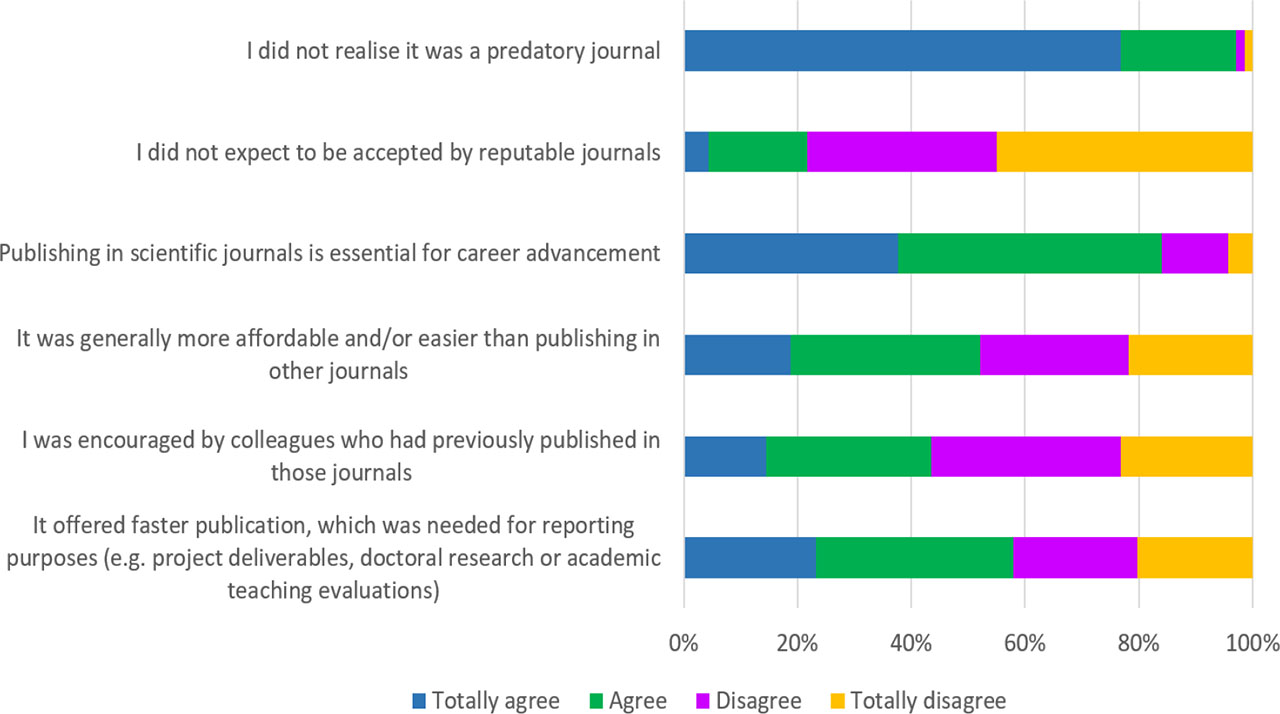
Fig. 3:
Respondents’ reasons for publishing in a predatory journal (n = 69)
Source: Own elaboration based on the survey results.
Tab. 6:
Reasons why researchers may choose predatory journals or conferences.
| Reasons | n | % |
|---|---|---|
| Lack of knowledge about their predatory nature | 418 | 83.9 |
| Desire to have a paper accepted and presented quickly | 352 | 70.7 |
| Need to meet requirements for conference participation and journal publication for career advancement and activity reporting | 304 | 61.0 |
| Lower costs for participation and publication | 282 | 56.6 |
| Encouragement from colleagues or superiors to participate and publish | 99 | 19.9 |
| Other reasons | 11 | 2.2 |
| Total options selected (not unique respondents) | 1466 |
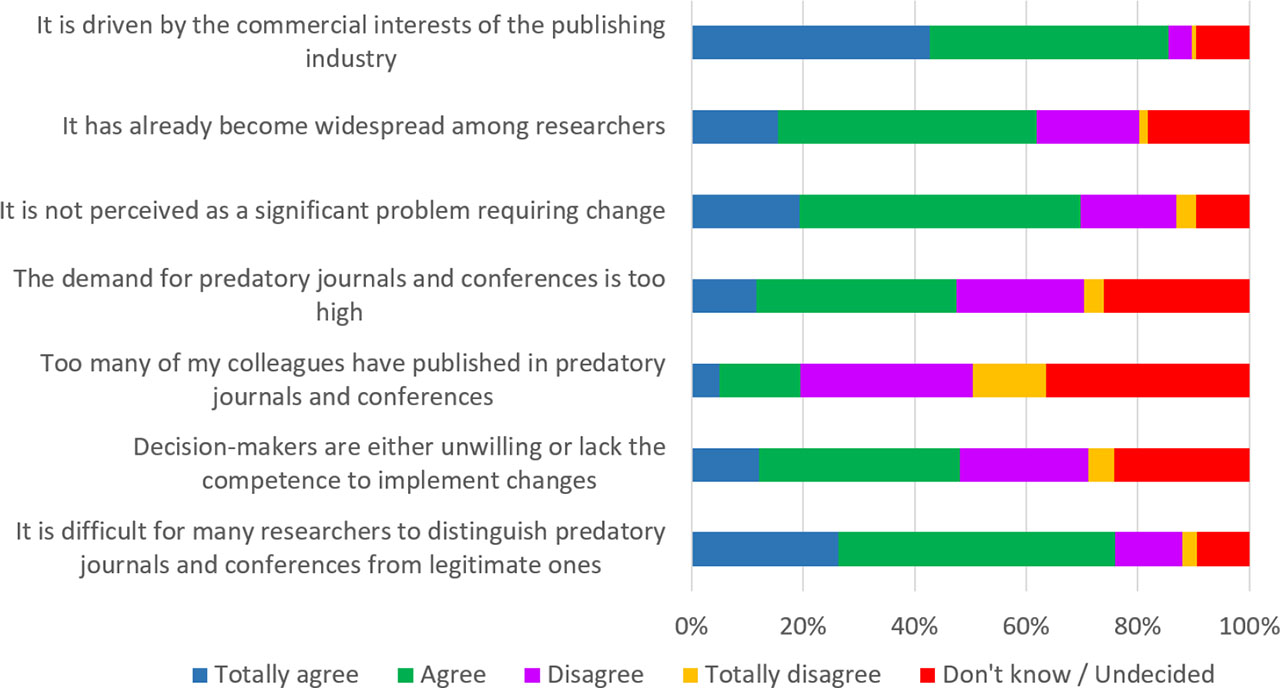
Fig. 4:
Key challenges and barriers to addressing predatory practices, as perceived by respondents (n = 482).
Source: Own elaboration based on the survey results.
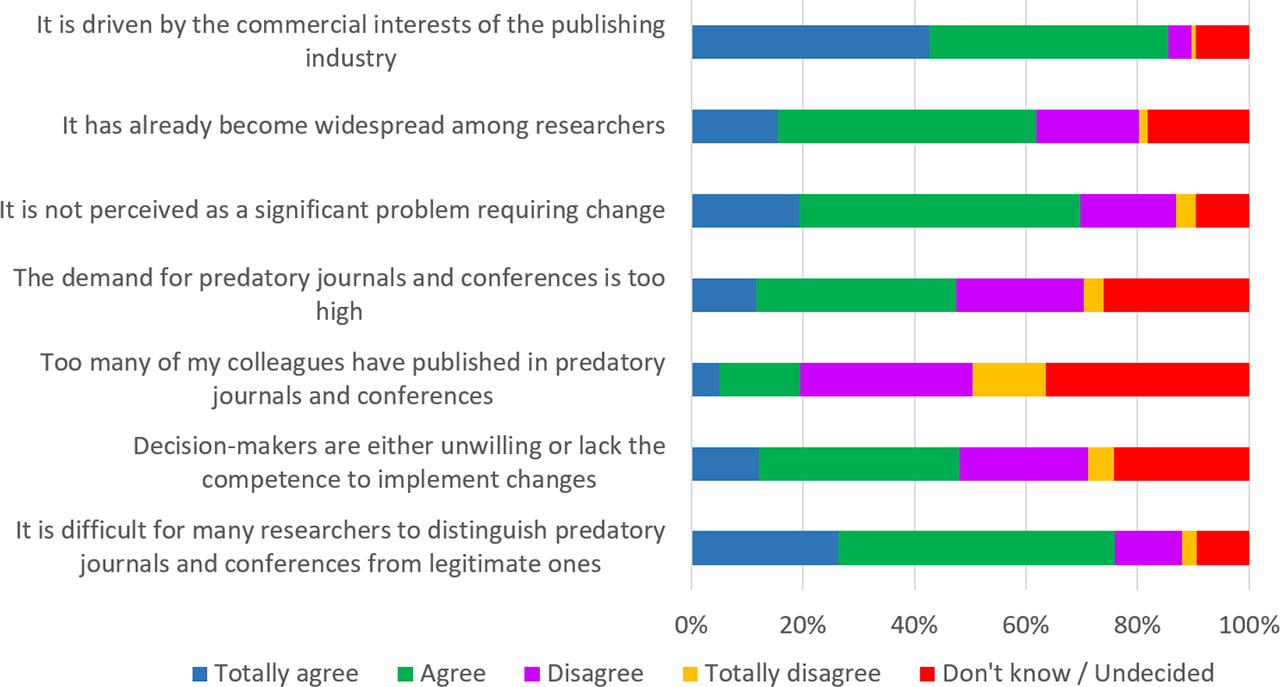
Fig. 5.
Respondents’ views on viable solutions to counter predatory practices (n = 482)
Source: Own elaboration based on the survey results.