
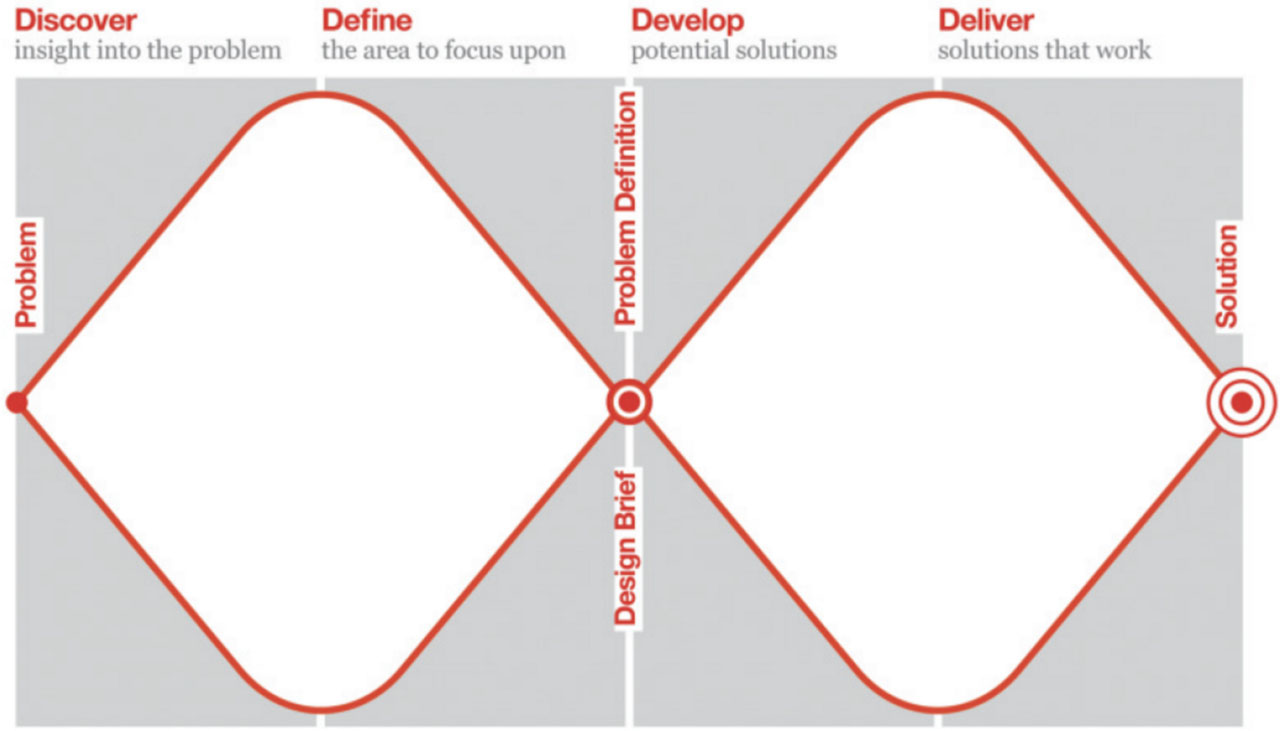
Fig. 1:
Double diamond model
Source: Design Council (2019)
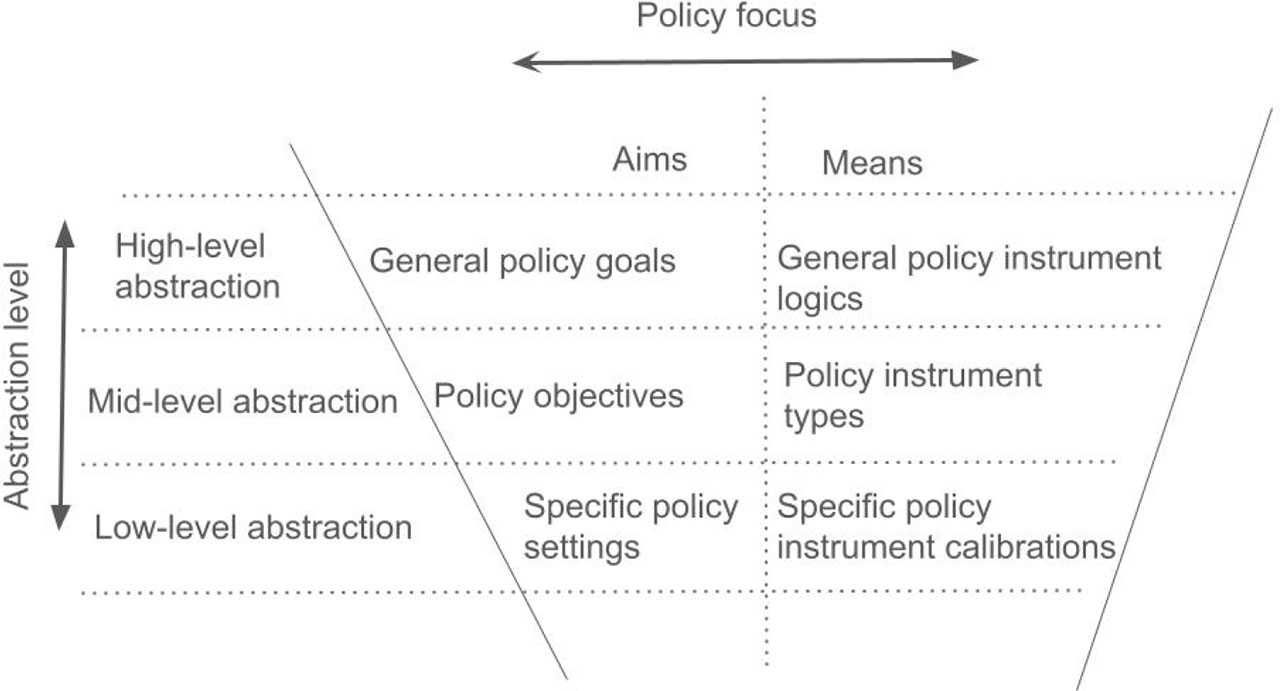
Fig. 2:
Policy elements in the policy mix
Source: Cashore and Howlett (2007) and Haelg et al. (2019)
Tab. 1:
Summary of the data collection and data processing processes.
| Stage | Step | Google search engine (GSE) results | Action | Output |
|---|---|---|---|---|
| Data collection | 1. Search query: “design*policy” “policy*design” to identify Policy * Design concepts | 20 (10 per query) | Identify concepts using the words “design” and “policy” | Four concepts were identified as common to both queries: policy design, design for policy, design policy, design in policy |
| 2. Search queries: “Policy Design,” “Design for Policy,” “Design Policy,” “Design in Policy” | 120 (10 per concept in three countries) | Obtain GSE results per query in three countries: Italy, Colombia, and the USA | Four concepts of GSE results were collected in a database for further analysis, classified by query, article title, article URL, and article description | |
| Data processing | 1. Categorize results | 120 | Read each URL and categorize GSE results manually in the database | 120 GSE results verified, categorized, and filtered:
|
| 2. Reclassify results under each query | 117 | Read GSE results in detail and move them to the list of another query due to better fitting | 36 results moved to the list of results of other queries | |
| Data visualization | Visualize results | 117 | Insert the reclassified results in a data visualization tool | Presents the four concepts categorization in the country, type of actor, and name of the key actor |
| Data analysis | Analyze the contents per concept | 117 | Examine the descriptions of each concept according to the key actors (higher number of GSE results) | Description of each concept elaborated from the content examined by the key actors |
Tab 2:
Distribution of countries.
| Country | Location (code) | Total |
|---|---|---|
| Austria | AUT | 1 |
| Canada | CAN | 6 |
| Croatia | HRV | 1 |
| Denmark | DNK | 28 |
| Germany | DEU | 1 |
| India | IND | 2 |
| Italy | ITA | 19 |
| The Netherlands | NLD | 3 |
| UK | GBR | 23 |
| USA | USA | 26 |
| Varied | Var | 4 |
| European Union | EU | 3 |
| Total | 117 |
Tab. 3:
Distribution of concepts.
| Query validation | Total |
|---|---|
| Policy design | 53 |
| Design for policy | 36 |
| Design in policy | 15 |
| Design policy | 13 |
| N/F | 1 |
| N/A | 2 |
| Total | 120 |
Tab. 4:
Distribution of the content type.
| Content type | Total |
|---|---|
| Journal article | 17 |
| Blog/post | 29 |
| Book/chapter | 44 |
| Course/program | 14 |
| Definition | 1 |
| Event/workshop | 7 |
| Group/network | 2 |
| Policy | 1 |
| Report | 1 |
| Toolbox | 1 |
| Total | 117 |
Tab. 5:
Distribution of author type.
| Author type | Total | |
|---|---|---|
| Individuals | Academic researchers | 40 |
| Civil servants | 8 | |
| Practitioners | 26 | |
| Organizations | EU-funded consortium | 1 |
| Nonprofit organizations | 15 | |
| Public sector agencies | 4 | |
| Research groups | 8 | |
| Universities | 14 | |
| Other entities | 1 | |
| Total | 117 |
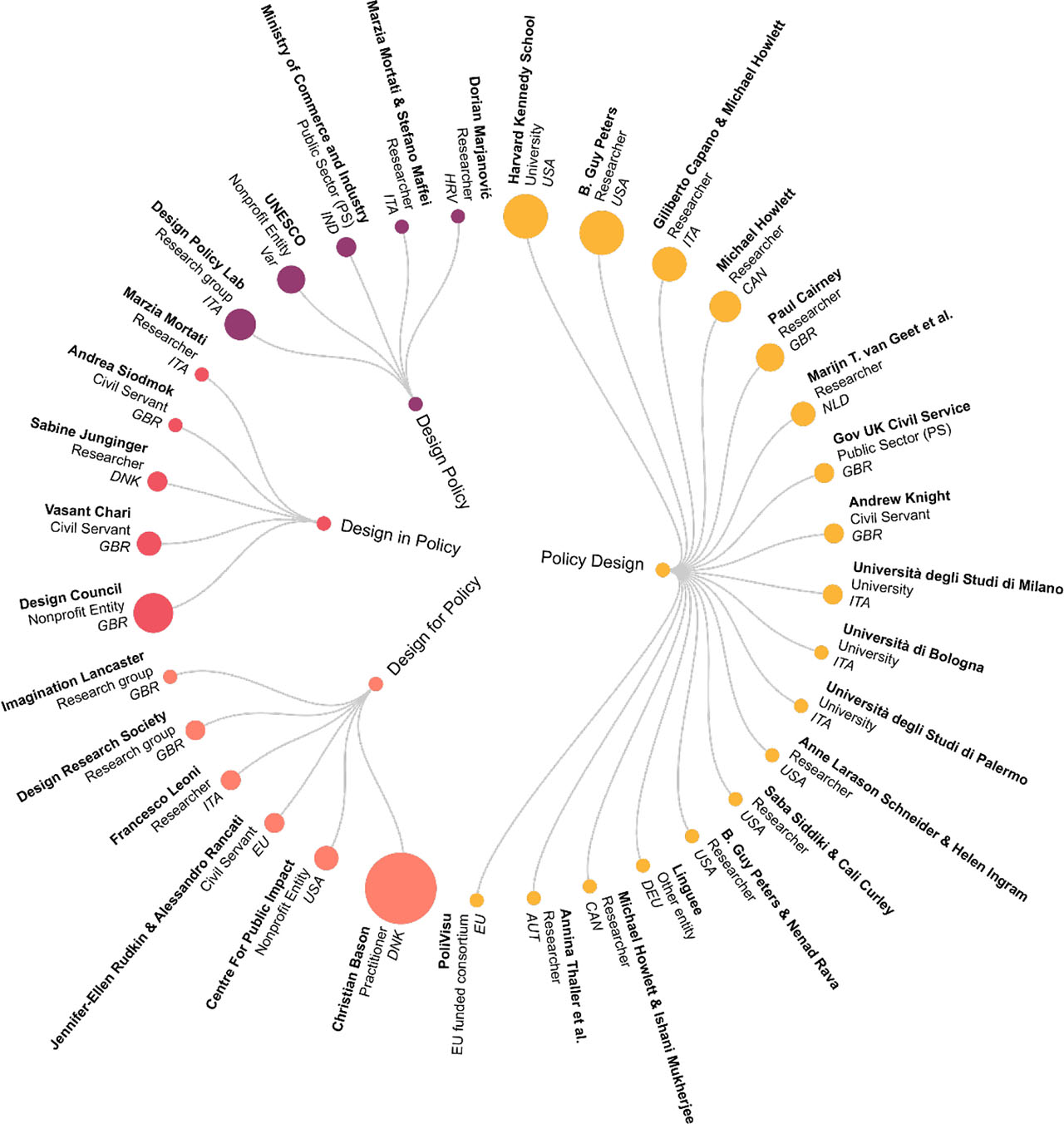
Fig. 3:
“Policy * Design” issue mapping visualization by concepts, actors, and location
Tab. 6:
Summary of Policy * Design characteristics.
| Policy Design | Design for Policy | Design in Policy | Design Policy | |
|---|---|---|---|---|
| Key actors | B. Guy Peters (co-author Nenad Rava), Michael Howlett (co-authors Gilberto Capano and Ishani Mukherjee), and the Harvard Kennedy School | Christian Bason and Design for Policy (book) authors | Design Council and Policy Lab – Vasant Chari and Andrea Siodmok | Design Policy Lab – professors Marzia Mortati and Stefano Maffei (Design Department at Politecnico di Milano) and UNESCO |
| Geographic location of key actors | Canada, USA, Italy, and Singapore | Denmark/Europe and worldwide | UK | Italy – Iceland/Europe |
| Orientation | Academic | Practitioner | Practitioner | Academic |
| Key messages | Design is focused on both the process and outputs with attention to political contexts | Design approaches to address public problems and innovate in public policy – particularly public services | Design methods applied with other methods in policymaking | Policies for broader application of design in the economy |
| Main theme | Design process and product (policy) | Design process and product (i.e., services) | Design in process to create policies | Design included in policies |
| Resources | Articles (for purchase) and open access | Book (for purchase) | Open-access blogs | Open-access reports and articles |