
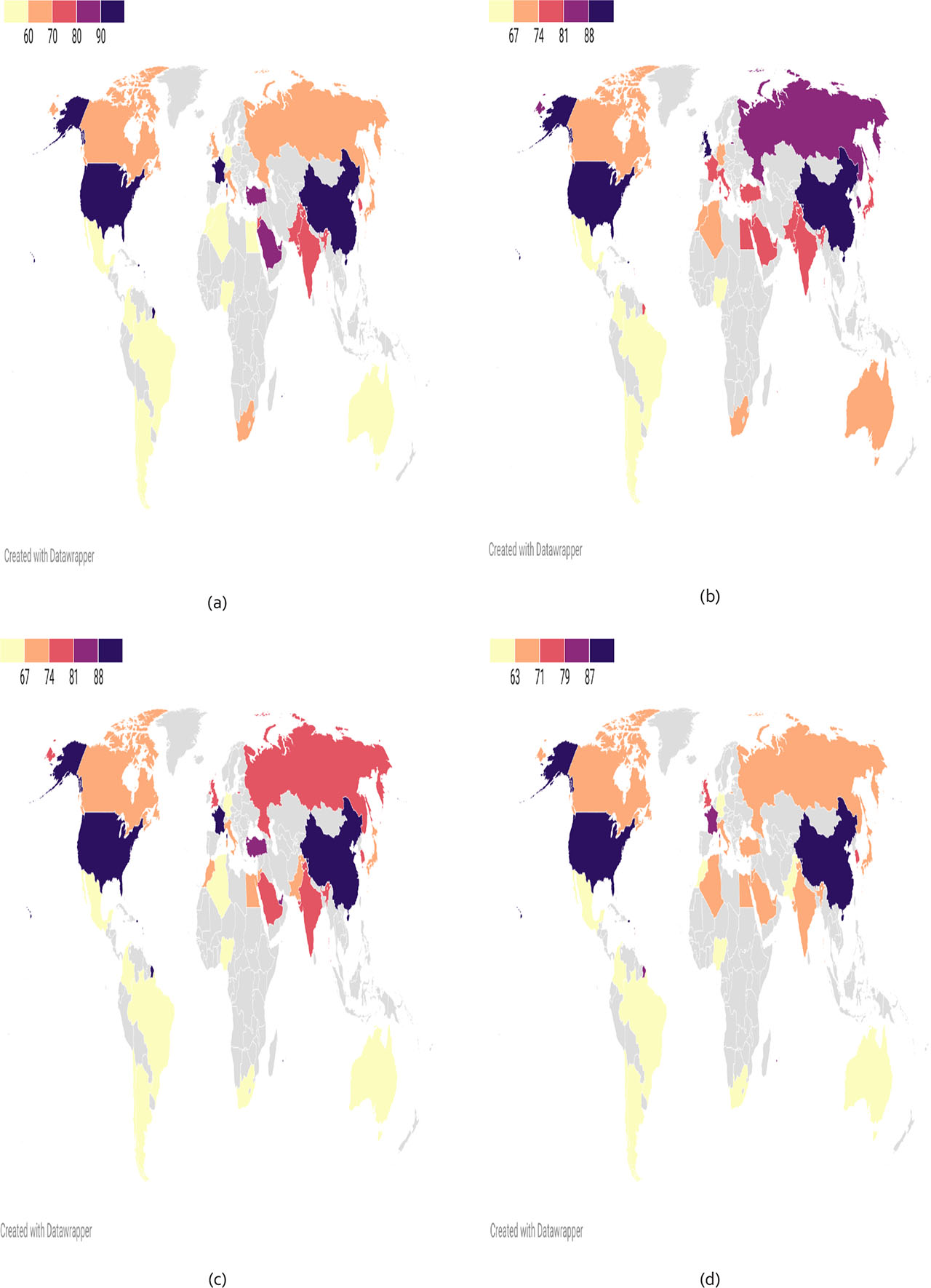
Fig. 1:
National Security Councils: (a) centralization, (b) advisory role, (c) focus areas, and (d) membership composition, created with Dataweapper.
Tab. 2:
Demographic analysis of respondents.
| Demographic variable | Category | Number of respondents | Percentage |
|---|---|---|---|
| Gender | Male | 180 | 53.57% |
| Female | 156 | 46.43% | |
| Age | 20–30 | 100 | 29.76% |
| 31–40 | 120 | 35.71% | |
| 41–50 | 85 | 25.30% | |
| 51 and above | 31 | 9.24% | |
| Experience | Less than 5 years | 90 | 26.79% |
| 5–10 years | 140 | 41.67% | |
| 11–20 years | 85 | 25.30% | |
| More than 20 years | 21 | 6.25% | |
| Position | Junior official | 120 | 35.71% |
| Mid-level official | 115 | 34.21% | |
| Senior official | 76 | 22.62% | |
| Executive official | 25 | 7.46% | |
| Other questions | Familiar with NSC framework | Yes | 70.54% |
| Involved in NSC implementation | Yes | 50.30% | |
| Received NSC training | Yes | 60.71% | |
| Utilizes AI in work | Yes | 45.54% |
Tab. 1:
Comparative analysis of National Security Council Frameworks.
| Country | NSC name | Established as | Key features | Structure and composition | Functions and strategic focus |
|---|---|---|---|---|---|
| United States | National Security Council (NSC) | Advisory Body | Centralized decision-making structure; President as Chairman | President, Vice President, Secretary of State, Secretary of Defense, and other key officials | National security, foreign policy matters |
| Russia | Security Council | Constitutional Advisory Body | Coordination and advisory functions | President, key government officials, and security advisors | National security issues, strategic coordination |
| United Kingdom | National Security Council (NSC) | Evolved from historical practices | Comprehensive coverage of security issues through subcommittees and temporary committees | Prime Minister, key ministers, and officials | National security, wide range of security-related issues |
| France | National Security Council (NSC) | Advisory and executive body | Centralized approach; focus on defense, crisis management, intelligence, and counter-terrorism | President, key ministers, and security officials | Defense, crisis management, intelligence, counter-terrorism |
| Turkey | National Security Council (NSC) | Advisory body | Emphasis on coordination and strategic guidance | President, key government officials, military leaders | Formulating and implementing national security policies |
| Egypt | National Security Council (NSC) | Advisory body | Focus on security strategies, crisis management, and threat assessment | Key government officials and security experts | Security strategies, crisis management, threat assessment |
| Algeria | Supreme Council for National Security | Advisory body | Emphasis on coordination and diverse expertise | President, key ministers, and security advisors | National security challenges, strategic coordination |
| Morocco | Supreme Security Council | Advisory body | Consults on security strategies, crisis management, and institutionalizing security governance | King, key ministers, and security officials | Security strategies, crisis management, institutional governance |
Tab. 3:
Descriptive statistics.
| Construct | Item | Mean | SD | Median | Mode | VIP | Cronbach’s α |
|---|---|---|---|---|---|---|---|
| Structure and functionality | 0.88 | ||||||
| SF1 | 3.5 | 0.5 | 3.5 | 3.5 | 1.2 | 0.88 | |
| SF2 | 3.45 | 0.55 | 3.5 | 3.5 | 1.15 | 0.85 | |
| SF3 | 3.6 | 0.52 | 3.6 | 3.6 | 1.18 | 0.89 | |
| SF4 | 3.4 | 0.6 | 3.4 | 3.4 | 1.21 | 0.72 | |
| Interagency coordination | 0.86 | ||||||
| IC1 | 3.55 | 0.5 | 3.5 | 3.5 | 1.18 | 0.89 | |
| IC2 | 3.6 | 0.53 | 3.6 | 3.6 | 1.22 | 0.86 | |
| IC3 | 3.5 | 0.55 | 3.5 | 3.5 | 1.19 | 0.74 | |
| IC4 | 3.45 | 0.58 | 3.5 | 3.5 | 1.24 | 0.7 | |
| Policy alignment | 0.75 | ||||||
| PA1 | 3.65 | 0.52 | 3.6 | 3.6 | 1.17 | 0.87 | |
| PA2 | 3.55 | 0.55 | 3.5 | 3.5 | 1.21 | 0.72 | |
| PA3 | 3.6 | 0.53 | 3.6 | 3.6 | 1.22 | 0.75 | |
| PA4 | 3.5 | 0.58 | 3.5 | 3.5 | 1.2 | 0.71 | |
| Democratic governance and parliamentary oversight | 0.76 | ||||||
| DGPO1 | 3.7 | 0.5 | 3.7 | 3.7 | 1.19 | 0.9 | |
| DGPO2 | 3.55 | 0.55 | 3.5 | 3.5 | 1.16 | 0.87 | |
| DGPO3 | 3.6 | 0.52 | 3.6 | 3.6 | 1.21 | 0.76 | |
| DGPO4 | 3.5 | 0.58 | 3.5 | 3.5 | 1.22 | 0.71 | |
| Key areas for improvement | 0.81 | ||||||
| KAI1 | 3.75 | 0.55 | 3.7 | 3.7 | 1.23 | 0.83 | |
| KAI2 | 3.8 | 0.52 | 3.8 | 3.8 | 1.25 | 0.82 | |
| KAI3 | 3.85 | 0.5 | 3.85 | 3.85 | 1.26 | 0.81 | |
| KAI4 | 3.9 | 0.58 | 3.9 | 3.9 | 1.28 | 0.8 | |
Tab. 4:
Correlation matrix.
| Constructs | SF | IC | PA | DGPO | KAI |
|---|---|---|---|---|---|
| SF | 1 | 0.7 | 0.65 | 0.68 | 0.72 |
| IC | 0.7 | 1 | 0.6 | 0.62 | 0.66 |
| PA | 0.65 | 0.6 | 1 | 0.64 | 0.61 |
| DGPO | 0.68 | 0.62 | 0.64 | 1 | 0.67 |
| KAI | 0.72 | 0.66 | 0.61 | 0.67 | 1 |
Tab. 5:
T-test analysis of NSC effectiveness.
| Questions | Original sample | T statistics | P values |
|---|---|---|---|
| What is the current structure and functionality of Jordan’s National Security Council (NSC)? | 0.85 | 16.78 | 0.001 |
| How effectively does the NSC coordinate interagency efforts in addressing national security challenges? | 0.78 | 11.14 | 0.000 |
| To what extent does the NSC align security policies with broader national priorities? | 0.8 | 13.33 | 0.002 |
| What role does the NSC play in democratic governance and parliamentary oversight? | 0.83 | 16.6 | 0.002 |
| What are the key areas for improving the NSC framework to enhance sovereignty and national security in Jordan? | 0.76 | 9.5 | 0.000 |
| Construct | Measurement | Sources |
|---|---|---|
| NSC structure | Assessment of the comprehensiveness of the NSC structure and its representation from relevant agencies | Burke (2018); Cutler (1956); Devanny (2015) |
| Interagency coordination | Evaluation of the effectiveness of coordination between agencies and the resulting unified approach to national security | DiCicco (2014); Fukushima & Samuels (2018) |
| Policy alignment | Analysis of how well the NSC’s security policies align with broader national priorities and contribute to development | Doyle (2007); Mabee (2011) |
| Democratic governance | Measurement of the NSC’s role in promoting democratic governance and ensuring parliamentary oversight | Engelbrekt (2015); Frison-Roche (2008) |
| Areas for improvement | Identification of specific areas within the NSC framework that need improvement to enhance sovereignty and national security | Kars Kaynar (2018); Ray (1990) |
| Statement | Strongly disagree | Disagree | Neutral | Agree | Strongly agree |
|---|---|---|---|---|---|
| 1. The NSC includes representation from all relevant security and policy-making agencies. | |||||
| 2. The current structure of the NSC allows for effective decision making. | |||||
| 3. The NSC effectively coordinates efforts between different agencies. | |||||
| 4. There is a cohesive approach to addressing national security challenges within the NSC. | |||||
| 5. NSC security policies are aligned with broader national priorities. | |||||
| 6. The NSC contributes to overall national development and stability through its policies. | |||||
| 7. The NSC promotes democratic governance effectively. | |||||
| 8. Parliamentary oversight is adequately ensured by the NSC. | |||||
| 9. There are clear communication workflows within the NSC. | |||||
| 10. The NSC has effective mechanisms for interagency coordination. | |||||
| 11. The NSC’s current structure facilitates the implementation of national security strategies. | |||||
| 12. The NSC’s policies reflect the national development goals. | |||||
| 13. There are specific areas within the NSC that need improvement. | |||||
| 14. The NSC framework enhances Jordan’s sovereignty. | |||||
| 15. The NSC effectively addresses national security challenges. | |||||
| 16. The NSC’s role in policy making is well-defined and understood. | |||||
| 17. There is sufficient oversight of the NSC’s activities by relevant authorities. | |||||
| 18. The NSC effectively balances national security with democratic values. | |||||
| 19. The NSC framework requires adjustments to improve its effectiveness. | |||||
| 20. The current NSC structure supports efficient decision-making processes. |