
Tab. 1
Comparison of the Countries of Central and Eastern Europe
| Countries | Brief Information | Main Problems | Management Model | Literature |
|---|---|---|---|---|
| Croatia | Croatia has the highest share of State-owned Enterprises (SOEs) in GDP among the European countries. SOEs are an important part of the Croatian economy and they are present in various sectors, including transport, energy, communication, forestry, agriculture, and manufacturing. | Basic principle of the Corporate Governance on separation of Ownership and Control is not implemented. Performance of SOEs in Croatia is weak and their profitability level is low. | Decentralized | Bajo and Primorac, 2017; Bajo, et al., 2018; Poljak Z, 2018; EBRD, Croatia, 2018; EBRD, Transition Report, Croatia, 2018–2019; European Commission, Country Report Croatia, 2018; European Commission, State-owned Enterprises in the EU, 2016. |
| Czech Republic | SOEs play a significant role in the State's economy. SOEs are mostly functioning in the key areas of State's economy, such as transportation, railway, electricity, forestry, postal services, and so on. | There is no unified state policy towards SOEs; there is a lack of transparency and openness; appointment of the Board Members is not standardized and there is a low level of diversity in management bodies. | Decentralized | Mertlik, 1997; OECD Guidelines, 2015; Ondrich and Sebastova, 2017; Transparency International, Corruption Risks in the Visegrad Countries, 2012; Krulis, 2017; Eichlerova, 2017. |
| Greece | Greece was not a Socialist country but it is still included in the discussion because the degree of state control over the economy is amongst the highest in OECD. | Specific commercial and social goals are not defined individually to all SOEs; politicians are serving on the Boards and there is a lack of independent and qualified representatives in the Supervisory Board. | Decentralized | Greece Policy Brief, OECD, 2016; Lampropoulou, 2017. |
| Poland | Due to the problems in the management of SOEs, Poland ranked at seventh lowest place out of the OECD's 33 countries in SOE governance. | There is limited transparency, inconsistent evaluation of boards, undue influence from politicians; obscure targets set for the financial performance; management is filled with people having political background. | Decentralized | Gliniecki, Zaleska-Korziuk, 2017; OECD, Ownership and Governance of State-owned Enterprises: A Compendium of National Practices, 2018; Poland SOEs Workshop, 2015. |
| Georgia | Georgia is an Associate Member of EU and a Post-Soviet country and faces number of severe problems in the management of SOEs, which are underlined by the local and international sources. | There is a problem in the separation of management and ownership; low level of accountability, transparency, and openness; lack of unified state policy; no clear rules for appointing the members of the Supervisory Board; violation of Labor Code, and so on. SOEs in Georgia are bearers of a significant financial risk. The paternalistic role of the state towards SOEs introduces a “soft budget constraint” (Pargendler, 2012), which reduces pressures to contain costs (Goldeng et al., 2008). For example, big SOEs in Georgia incur financial losses but their performance is crucial for the State, therefore, they are always subsidized from the central or local budgets. | Dualistic and Decentralized | Maisuradze (Zarandia eds) 2016; Law of Georgia “On Joint-Stock Corporation – Partnership Fund”, 13/04/2011; State Audit Office, “SOE's Management and Governance Efficiency Audit”, 2015; The Institute for Development of Freedom of Information, “SOE's in Georgia and their Efficiency“, 2014; Georgian Young Lawyers’ Association, “State Created Enterprises’ Transparency and Accountability”, 2015; Georgian Young Lawyers’ Association and the Institute for Development of Freedom of Information, 2016; Transparency International – Georgia, “Georgian SOE's: Transparency, Accountability and Preventing of the Corruption”, 2016; IMF, 2018. |
| Lithuania | Management of SOEs is performed by 12 Ministries and 5 other administrative bodies. | Management bodies are weak, and the directors of SOEs are appointed for political reasons and not for qualification; there is a high level of corruption. | Decentralized | OECD Lithuania, 2015; Baltic Institute of Corporate Governance, 2012; Baltic Institute of Corporate Governance, CEOs in Lithuanian State-Owned Enterprises, 2013. |
| Latvia | In 2009, Supervisory Boards were abolished in most SOEs and this worsened the overall situation. This step was later criticized by OECD and was followed by the restoration of supervisory boards in big state-owned corporations. | SOEs have weak supervisory boards. Management of SOEs are appointed for political reasons and not for qualification. There is a lack of unified approach, and a high level of corruption. | Decentralized | Baltic Institute of Corporate Governance, 2012; Baltic Institute of Corporate Governance, CEOs in Lithuanian State-Owned Enterprises 2013. |
| Romania | Romania is the owner of the largest number of SOEs in Europe. | There is corruption in SOEs, weak corporate governance framework, selective distribution of benefits to individuals or groups, and high level of political influence on management bodies. | Decentralized | Volintiru et al., 2018; Capannelli, 2017; Marrez, 2015. |
| Slovenia | Unlike other analyzed countries, SOEs in Slovenia are managed by a single ownership entity, which is responsible before the Parliament and its members of the supervisory board are considered as independent. | Challenges remain regarding the political influence of SOEs. | Centralized | The Slovenian Sovereign Holding Act, ZSDH-1, Official Gazette of RS, no 25/2014; OECD, Slovenia Policy Brief, 2015. |
Tab. 2
Current Theory vs. Alternative Theory
| Problems of SOEs | Theories | Solution | Link to the Theoretical Literature |
|---|---|---|---|
| Low level of openness and transparency | Current Theory | Single Ownership Entity supports the openness and transparency of business activities. | OECD Guidelines, 2015; World Bank Group, 2014. |
| Alternative Theory | CSR enhances the openness and transparency of the business activities. | Caroll, 1979; Elkginton, 1998; Garde-Sanchez et al., 2018; Aguinis and Glavas 2012; Cormier and Gordon, 2000; Lopatta et al., 2016. | |
| Low level of accountability | Current Theory | Single Ownership Entity strengthens the accountability in SOEs. | OECD Guidelines, 2015; World Bank Group, 2014. |
| Alternative Theory | CSR increases the measures for reporting, including the financial reporting, which leads to better accountability. | Elkginton, 1998; Garde-Sanchez et al., 2018; Aguinis and Glavas 2012; Cormier and Gordon, 2000; Lopatta et al., 2016. | |
| Violation of labor rights | Current Theory | There is no direct indication in the guidelines of international organizations that having a Single Ownership Entity improves the labor rights. Therefore, protection of the labor rights is not guaranteed by the Current Theory. | OECD Guidelines, 2015; World Bank Group, 2014. |
| Alternative Theory | One of the CSR dimensions is “the people”, which also includes improving the working conditions of the employees. Therefore, it is impossible to implement CSR without improving the labor conditions. | Jamali and Mirshak, 2007; Wood, 1991; Caroll, 1979; Elkginton, 1998; Garde-Sanchez et al., 2018; Aguinis and Glavas 2012; Barnett, 2005; Keasey et al., 2005. | |
| Violation of standards of Environmental Protection | Current Theory | Having the Single Ownership Entity does not mean that the environmental standards will be improved. As in case of labor rights, there is no direct link in literature about securing environmental protection rights by Single Ownership Entity. | OECD Guidelines, 2015, World Bank Group, 2014. |
| Alternative Theory | Implementing CSR means almost automatically improving the support for the environmental protection because taking care of the “planet” is one of the dimensions of CSR. | Caroll, 1979; Elkginton, 1998; Garde-Sanchez et al., 2018; Aguinis and Glavas 2012. | |
| Weak corporate governance mechanisms | Current Theory | Single Ownership Entity supports the corporate governance mechanisms only on particular direction (transparency and accountability) and not overall regarding strengthening the management bodies in SOEs | OECD Guidelines, 2015, World Bank Group, 2014, Slovenia Policy Brief, 2015. |
| Alternative Theory | CSR strengthens the corporate governance mechanisms overall including rights of the minority shareholders, stakeholders; accountability of the corporation and diversity of the management bodies. | Jamali and Mirshak, 2007; Wood, 1991; Caroll, 1979; Elkginton, 1998; Garde-Sanchez et al., 2018; Aguinis and Glavas 2012; Cormier and Gordon, 2000; Lopatta et al., 2016; Barnett, 2005. | |
| No clear separation of ownership and control | Current Theory | Transparency of business activities and disclosure of company information supports separation of the ownership and management; however, full separation is impossible to achieve because single ownership entity combines both functions—ownership and control. | OECD Guidelines, 2015, World Bank Group, 2014. |
| Alternative Theory | Independence of Boards and nominating the independent members for management bodies, disclosing the information on company and its business activities supports the effective separation of the functions of ownership and management. | Garde-Sanchez et al., 2018; Aguinis and Glavas 2012; Cormier and Gordon, 2000; Lopatta et al., 2016; Jamali and Mirshak, 2007; Barnett, 2005; Keasey et al., 2005. | |
| Lack of independence of the representatives on the supervisory boards | Current Theory | Single Ownership Entity is not a guarantee for the independence of the members of the supervisory board. The available literature does not give specific assurances for the independence of the members of the supervisory board in SOEs. | OECD Guidelines, 2015, World Bank Group, 2014, Corporate Governance Code of State-owned Enterprises 2016 (Slovenia), Slovenia Policy Brief, 2015. |
| Alternative Theory | CSR enhances the independence of the board members by ensuring their nomination from different group of stakeholders. | Jamali and Mirshak, 2007; Barnett, 2005; Keasey et al., 2005. | |
| Low level of diversity in management bodies | Current Theory | Single Ownership Entity cannot ensure the diversity of the management bodies and balancing the interests of the stakeholders. | OECD Guidelines, 2015; World Bank Group, 2014; Freeman and Mcvea, 2001; Corporate Governance Code of State-owned Enterprises 2016 (Slovenia). |
| Alternative Theory | CSR considers the interests of the stakeholders and ensures their participation in the management bodies. Balancing the interests of the stakeholders is firm specific, therefore, it can be achieved with the implementation of CSR individually in any given SOE. | Freeman and Mcvea 2001; Garriga and Mele 2004; Cormier and Gordon 2000; Jamali and Mirshak, 2007; Wood, 1991; Barnett, 2005; Keasey et al., 2005. | |
| No incentives for board members and managers | Current Theory | Single Ownership Entity will define remuneration policy, which will support appointment of qualified board members. | OECD Guidelines, 2015; World Bank Group, 2014. |
| Alternative Theory | CSR provides higher transparency and disclosure; therefore, the earnings of the company and performance of the managers is open to the public and increases managers’ accountability. At the same time, remuneration policy can be a part of the Corporate Governance Code, which will increase the chances for appointing the more qualified managers. | Cormier and Gordon, 2000; Lopatta et al., 2016; Wieland, 2005. | |
| Performance Challenges | Current Theory | Single Ownership Entity improves the management of the companies but it does not guarantee a better performance rate. | OECD Guidelines, 2015, World Bank Group, 2014. |
| Alternative Theory | CSR was positively linked with the reduction of financial risk and improved financial performance. At the same time, implementing CSR increases trustworthiness, lowers asymmetric information, and creates a positive image of the company, which positively affects profit generation. | Lopatta et al., 2016; Godfrey, 2005. | |
| No unified state policy and/or approach | Current Theory | Single Ownership Entity enhances the unified state policy towards the SOEs. | OECD Guidelines, 2015; World Bank Group, 2014. |
| Alternative Theory CSR itself is the unified policy of the principles, which can be implemented towards all SOEs. | Caroll, 1979; Elkginton, 1998; Garde-Sanchez et al., 2018; Aguinis and Glavas 2012. | ||
| Undue political interference | Current Theory | Single Ownership Entity cannot ensure the political independence of the management bodies, even in Slovenia, which is the best example of executing the OECD recommendations. | OECD Guidelines, 2015; World Bank Group, 2014; Chaney et al., 2011; Faccio et al., 2006; Slovenia Policy Brief, 2015. |
| Alternative Theory | CSR supports nomination of stakeholders’ representatives at Supervisory Boards, whilst increasing diversity and independence of management bodies. Furthermore, CSR supports managerial discretion, which leads to the diminishing of political dependence. | Jamali and Mirshak, 2007; Caroll, 1979; Aguinis and Glavas 2012. | |
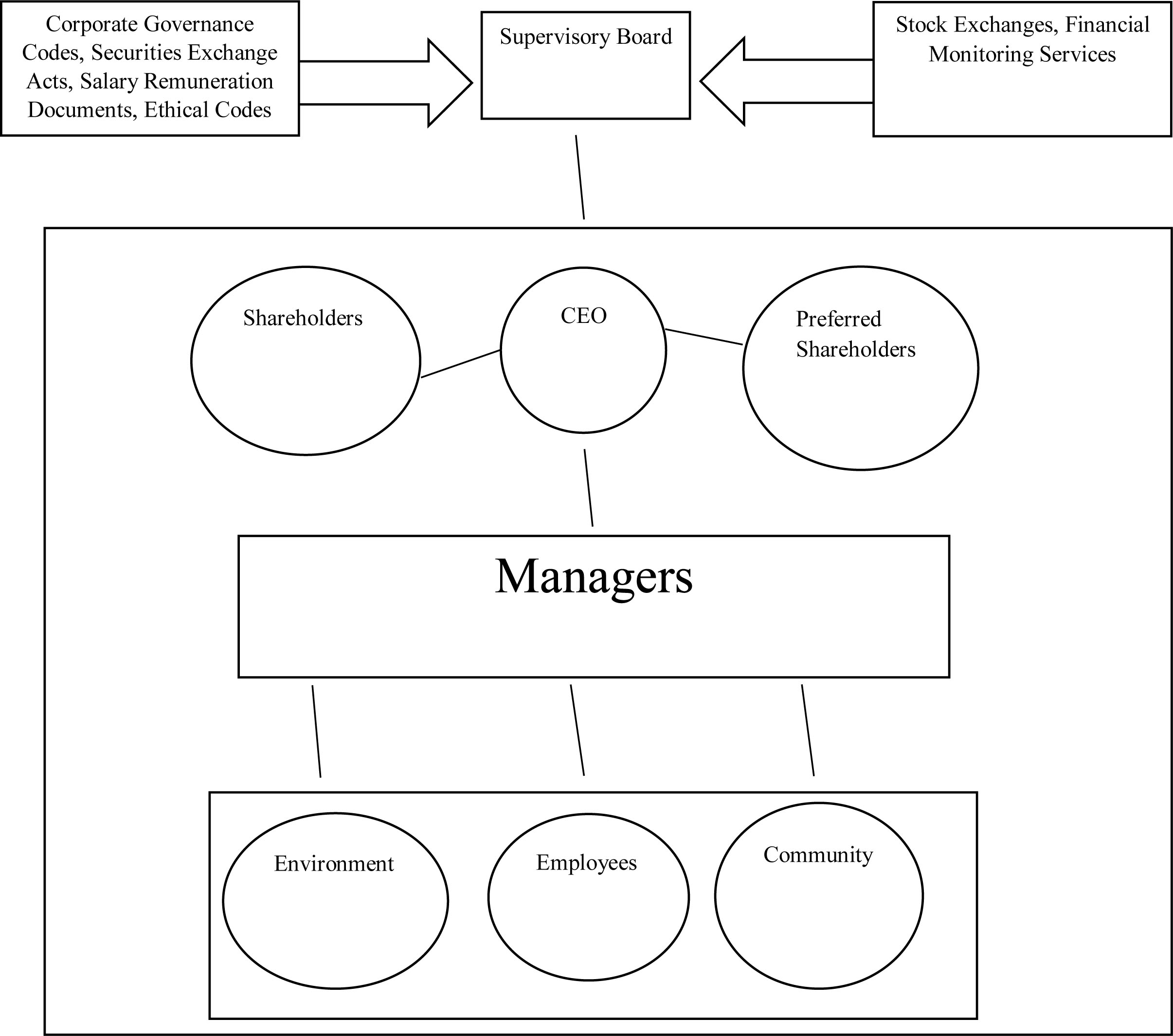
Fig. 1
Proposed balance of interests in SOE
Corporate Governance Code as a way of Implementing CSR