

1. Introduction
Renewable energy sources (RES) are sources of energy that are replenished naturally (Ellabban Abu-Rub & Blaabjerg, 2014) and their consumption does not lead to depletion (Kumar Jaiswal et al., 2022). RES include hydropower, modern biomass, geothermal, solar, direct solar, wind, wave, and tidal energy (Demirbaş, 2006). Renewable technologies are considered clean energy sources. When used effectively, they have a limited impact on the environmental well-being, generate a minimal amount of waste, and ensure sustainability regarding socioeconomic needs of the current and future generations (Panwar, Kaushik & Kothari, 2011). RES improve energy security and reduce the consumption of conventional fuels. They can help with local energy and water supply issues, support quality of life and the local labour market, imply sustainable development of peripheries (such as montane or desert areas), and contribute to compliance with international environmental agreements (Zakhidov, 2008). Renewable energy is critical to any energy transition and affects the entire economy. The degree of its impact hinges on the supply of and demand for the energy sources in individual sectors of the economy, as well as the substitution potential of various energy sources (Bali Swain Karimu & Gråd, 2022).
The European Union is perceived as a global leader in energy transition under intensified international linkages due to a globalised economy, the need to prevent energy security threats under new geopolitical circumstances, and climate challenges (Noja et al., 2022). RES affect energy security in three ways: increased share of RES, the national structure of energy sources, and the growth of individual types of RES (Trifonov et al., 2021). RES support energy security by contributing to resilience to geopolitical disturbances or instability of conventional fuel markets (Paravantis & Kontoulis, 2020) through secure energy supply and reduced energy dependency (Aslanturk & Kıprızlı, 2020). Growth in renewable energy can also help with climate challenges by reducing greenhouse gas emissions from the combustion of conventional fossil fuels to generate energy, thanks to clean production and low-emission technologies (Zhang et al., 2021). RES play a crucial role in curbing CO2 emissions, which have led to the greenhouse effect (Dong et al., 2021). Dwindling fossil fuels and their destructive impact on the environmental well-being call for adding RES to the energy mix as a foundation of sustainable development (Grodzicki & Jankiewicz, 2022).
European Union steers its energy policy towards an increased share of RES in the mix. The 2020 target was to reach a 20% share of RES in overall energy consumption (European Parliament and Council, 2009). Another Directive (European Parliament and Council, 2018) upgraded the target to 32%. It was then increased again to 42.5% in 2023. The REPowerEU Plan (European Commission, 2022) proposes to increase the target to 45% in light of the necessity to continue the energy transition towards clean energy and phase out energy imports from Russia. In 2022, the share of renewable energy in final energy consumption in the European Union was 23.1% (Eurostat, 2024).
The purpose of the study is to classify European Union member states according to similar developments in the consumption of RES. It is founded on empirical data for 2015–2022. The period begins in the first year of the 2030 Agenda for sustainable development and ends in the first year of the implementation of the REPowerEU plan. European Union member states were classified by RES consumption growth with selected ordering methods popular in socioeconomic research: the Hellwig method (HELLWIG), the technique for order preference by similarity to ideal solution (TOPSIS), the standardised sums method (SSW), and the zero unitarisation method (MUZ). The rankings were then juxtaposed to choose the optimal method. Next, the objects were categorised into four groups in line with the principle of three averages.
The article consists of several sections. It opens with background information on RES and their role in the economy. The introduction is followed by a literature review and elaboration on the hypotheses, where research on various dimensions of RES is presented, focusing on the demand side, supply side, or both at once. Then, the methodology is specified together with variables of interest and employs total ordering methods. The following section offers the results and a discussion, which juxtaposes the results with outcomes found in the literature. The article is summarised with a list of conclusions. The closing part also contains limitations of the study and potential future research.
2. Literature Review and Hypotheses Development
The literature review has demonstrated that RES development in European Union member states is a popular topic. The studies to date presented classifications of the states regarding the development of RES or identified clusters of countries similar in this regard. The publications differed regarding the econometric methods, variables, and the period under review. The substantial diversity of the numbers and types of variables investigated in the studies is particularly interesting. The review of studies on RES has demonstrated that they targeted diverse aspects of production (Pacesila, Burcea & Colesca, 2016; Simionescu et al., 2019), consumption (Simionescu, Strielkowski & Tvaronavičienė, 2020; Kacperska, Łukasiewicz & Pietrzak, 2021; Tutak & Brodny, 2022), and both consumption and production (Brodny, Tutak & Bindzár, 2021; Stec & Grzebyk, 2022).
2.1. Research on renewable energy production
Pacesila, Burcea and Colesca (2016) analysed the renewable energy sector in the European Union. They employed k-means clustering to identify three clusters of European Union member states similar in terms of renewable energy production and energy dependency in 2012. The first cluster consisted of five countries. One of their shared characteristic was energy dependency below 30%. Still, the countries in the cluster varied slightly. For example, Sweden had a high 50.97% share of renewable energy in total energy generated, with a 28.7% energy dependency. Denmark, on the other hand, was energy independent and could, in fact, export energy despite a 25.97% share of RES in its energy production mix. The second cluster contained 14 countries with energy dependency between 30% and 70%. Interestingly, the countries in the cluster were polarised regarding energy production from renewable sources in overall energy production. The leaders were Austria, Latvia, and Finland. The third cluster comprised nine countries with energy dependency above 70%. Lithuania and Portugal were the champions of this cluster, with more than a 20% share of renewable energy production in overall energy production. Other interesting cases in the cluster were Malta and Luxembourg. They had a very low share of energy from RES in total energy generated and extremely high energy dependency levels.
2.2. Research on renewable energy consumption
The authors concluded that developing national renewable energy production could be beneficial in controlling energy dependency. The article by Simionescu et al. (2019) investigated renewable energy in the electric power industry and gross domestic product (GDP) per capita in the European Union from 2007 to 2017 with panel data models. Their effort identified two clusters of countries varying in terms of the share of renewable energy in electricity production in 2017. The first cluster consisted of seven countries with high metric values. The other cluster had 20 countries, with the share of renewable energy in total electricity production below 40%. The authors additionally clustered European Union member states based on the share of renewable energy in electricity production and GDP per capita in 2017. This resulted in three clusters. The first one had six countries with a high GDP per capita and a relatively high share of renewable energy in electricity production. One of the members of the second cluster was Luxembourg, with an exceptionally high GDP per capita. The largest cluster contained 17 countries with a lower GDP per capita. The conclusion was that GDP per capita had a positive but low impact on the share of renewable energy in electricity production in the European Union in 2007–2017.
2.3. Research on both renewable energy production and consumption
Simionescu, Strielkowski and Tvaronavičienė (2020) investigated the share of RES in final energy consumption and income in EU-28 from 2007 to 2017 using panel data models. The first dividing line for the EU-28 was the share of renewable energy in electricity consumption. Nine countries with a high share of renewable energy in final energy consumption (above 20%) were assigned to the first cluster in 2017. The remaining 19 countries were in the other cluster. The criterion of the share of renewable energy in final electricity consumption and GDP per capita in 2017 led to three clusters of 10, 1, and 17 EU-28 countries, respectively.
Kacperska, Łukasiewicz and Pietrzak (2021) investigated renewable energy consumption in the European Union and the Visegrád Group countries in 2009–2019. They employed Ward’s method to identify six countries with the lowest share of renewable energy consumption in transport as cluster 1. Cluster 3 had nine counties with the lowest average consumption of renewable energy in electricity, heating, and cooling. Moreover, the average of all the analysed metrics was below the EU-27 average. The average consumption of renewable energy in electricity was the highest in the five countries of cluster 5. The results further indicated significant disparities among the countries regarding the share of consumption of renewable energy in electricity, heating and cooling, and transport.
Tutak and Brodny (2022) studied renewable energy consumption in economic sectors in 27 European Union member states from 2000 to 2019 using the self-organising map method. They identified four clusters in total by categorising the countries according to renewable energy consumption per GDP in 2019. The first cluster had nine countries with the lowest metric values. The second cluster contained eight countries with the highest values of the metric. The other dividing line was renewable energy consumption per capita in 2019. It yielded four clusters. The metric values were the highest in cluster 2 (three countries). Cluster 1 of 10 countries had the lowest average value of the metric. They further demonstrated that a high absolute value of renewable energy consumption in 2019 among the largest developed economies did not entail good results when juxtaposed with their GDPs or populations.
Brodny, Tutak and Bindzár (2021) evaluated the development of renewable energy in European Union member states from 2008 to 2018 using the TOPSIS method. They employed multiple metrics concerning the production and consumption of renewable energy. One outcome was the identification of four clusters of EU-27 member states divided according to the level of development of RES and biofuels in 2018. Cluster 1 had four countries with the highest level of development of RES and biofuels. Cluster 2 contained five countries with a moderately high level of development of RES and biofuels. Cluster 3 was assigned 14 countries with a moderately low level of development of RES and biofuels. The last cluster, cluster 4, had four countries with the lowest level of development of RES and biofuels. In addition to clustering, the study ranked the European Union countries by the development levels of RES and biofuels in 2018. Sweden was ranked the highest, with two other countries from cluster 1 right behind it.
The development of RES in European Union member states from 2011 to 2020 was analysed by Stec and Grzebyk (2022) with total ordering. The analysis involved several metrics of the development of RES (their production and consumption). The authors identified four clusters of countries that were similar in terms of renewable energy consumption in 2020. Cluster 1 contained three countries with a high level of renewable energy use. Cluster 2 consisted of six countries with a moderately high level of renewable energy development. Cluster 3 was the largest one, with 17 countries whose level of development of RES was moderately low. Renewable energy was poorly used in one country in cluster 4 (Poland).
2.4. The importance of Nordic countries in renewable energy development
The literature review revealed a very high level of development of RES in the Nordic European Union member states (Denmark, Finland, and Sweden). Sweden, Finland, and Denmark ranked first, second, and sixth in the ranking list of European Union member states regarding the development of RES in 2017, respectively (Brodny, Tutak & Bindzár, 2021). Almost all cluster sets presented above exhibit a specific pattern. All three or two Nordic European Union member states belong to the same cluster. In the study by Simionescu, Strielkowski and Tvaronavičienė (2020) (investigating the share of renewable energy in electricity and GDP per capita), Denmark, Finland, and Sweden were in the same cluster, accompanied by a few other countries. In the work by Stec and Grzebyk (2022), the countries formed a separate cluster on their own. Denmark and Sweden were classified into the same cluster by Pacesila, Burcea and Colesca (2016), Simionescu et al. (2019), and Simionescu, Strielkowski and Tvaronavičienė (2020), which considered the share of renewable energy in final electricity consumption. Similarly, Finland and Sweden were in the same cluster in publications by Kacperska, Łukasiewicz and Pietrzak (2021), Brodny, Tutak and Bindzár (2021), and Tutak and Brodny (2022), considering RES per GDP. Denmark and Finland shared a cluster in the article by Simionescu et al. (2019), which considered the share of renewable energy in electricity and GDP per capita. Only in the work by Tutak and Brodny (2022) was each Nordic European Union member state assigned to a different cluster.
The substantial role of RES in Nordic economies is reflected in international reports. One such report is The State of Renewable Energies in Europe (European Commission, 2023). It covers innovativeness and competitiveness of European Union member states regarding RES. Regarding RES R&D spending in 2020, Denmark, Finland, and Sweden came in sixth, eighth, and fifth, respectively, for public funding and second, ninth, and fifth, respectively, for private financing. Denmark was second, Sweden eighth, and Finland 10th in RES patent applications among European Union member states in 2020. Another report, Renewable Energy Country Attractiveness Index (Ernst & Young, 2023) on 40 top global economies regarding attractiveness for RES investments, Denmark, Finland, and Sweden were ninth, 20th, and 17th, respectively. Denmark, Finland, and Sweden were fourth, 11th, and ninth among the ranked European Union member states. Compared to their respective GDPs, the metric for Denmark fared the best among all countries. Finland was ninth, and Sweden ranked 15th. When only European Union member states are considered, Denmark, Finland, and Sweden came in first, sixth, and 11th.
2.5. Research gap and hypotheses development
The literature review presented in this section indicates that previous studies analysing selected aspects of renewable energy development—namely, production, consumption, or both—typically employ a single method for classifying countries. This reveals a research gap related to the limited number of studies comparing different total ordering methods to identify the most appropriate one for classifying countries from the perspective of the energy market considered (supply side, demand-side, or a combined supply–demand approach). A similar methodological approach has been applied in another study addressing the broader issue of clean and affordable energy in the context of sustainable development goal 7 (Firlej, Firlej & Luty, 2024). However, this study differs from it, among other things, in the method of grouping objects and in the scope of the variables considered, which relate exclusively and directly to the issue of the development of renewable energy consumption.
Addressing this research gap is important because the choice of a total ordering method may significantly influence the results of country classifications as well as the interpretation of renewable energy development across individual economies. In this study, the analysis focuses on renewable energy consumption due to its particular importance for the objectives of the European Union’s energy policy concerning RES. The research problem addressed in this article is the identification of the optimal total ordering method for classifying European Union member states regarding the development of renewable energy consumption.
This study contributes to the literature by providing a comparative evaluation of selected total ordering methods used to classify European Union member states in terms of renewable energy consumption development. Identifying the method that produces the most consistent and robust classification results may help improve methodological approaches used in comparative analyses of renewable energy development across countries. In this way, the study also supports more reliable assessments of countries’ positions in the process of energy transition.
The research to date and its empirical results prompt the following research hypotheses:
H1: Nordic European Union member states have high results in terms of RES consumption.
H2: Nordic European Union member states are very similar in terms of RES consumption.
3. Research Methodology
The input data for the diagnostic variables (Table 1.) is sourced from Eurostat databases (Eurostat, 2024). The period of interest is 2015–2022. The synthetic index for evaluating the level of consumption of RES in European Union member states in 2022 was designed with a multivariate statistical method, total ordering. Total ordering is founded on a synthetic variable. The synthetic variable is latent because its realisations are not directly observable.
Table 1.
Metrics for classifying European Union member states in terms of the level of consumption of RES
| Variable | Full name |
|---|---|
| x1 | Share of renewable energy in gross final energy consumption (total) |
| x2 | Share of renewable energy in gross final energy consumption in transport |
| x3 | Share of renewable energy in gross final energy consumption in electricity |
| x4 | Share of renewable energy in gross final energy consumption in heating and cooling |
The selection of variables used in this study is grounded in the objectives of the European Union’s energy policy aimed at systematically increasing the share of renewable energy in final energy consumption in order to support an effective energy transition, enhance energy security, and improve environmental well-being (European Parliament and Council, 2009; European Parliament and Council, 2018; European Commission, 2022). Indicators reflecting the share of renewable energy in final energy consumption provide a fundamental basis for a reliable assessment of the renewable energy sector in the European Union member states, as they reflect the actual level of renewable energy consumption within the energy systems of individual economies. These variables also support the evaluation of the effectiveness of implemented energy and climate policies aimed at advancing the energy transition. The set of variables included in this study is presented in Table 1.
The selection of total ordering methods used in this study was guided by several methodological considerations. First, the selected methods are increasingly used in the literature on multidimensional comparative analyses, including studies focusing on sustainable energy and the evaluation of energy systems (Wang et al., 2009). Second, the methods differ in how synthetic indicators are constructed and, in the procedures, used to classify the analysed objects. Methodological studies emphasise that different multi-criteria decision-making methods may produce different ranking outcomes. For this reason, comparative analyses often recommend applying more than one method, as this makes it possible to assess the robustness of the results and to identify potential differences arising from the adopted procedure for aggregating diagnostic variables (Triantaphyllou, 2000; Zavadskas & Turskis, 2011). Taking these considerations into account, four total ordering methods were used in the study: HELLWIG, TOPSIS, SSW, and MUZ. These methods represent different approaches to constructing synthetic indicators in multidimensional comparative analyses, and their joint application enables the comparison of classification results and the assessment of the stability of the obtained rankings.
The HELLWIG is one of the most widely used tools in multidimensional comparative analysis. It is based on constructing a synthetic development indicator calculated from the distance of analysed objects from the so-called development pattern, which represents the most favourable values of the diagnostic variables (Hellwig, 1968). The resulting values of the synthetic indicator make it possible to rank the analysed objects according to the level of the phenomenon under investigation (Młodak, 2006). The TOPSIS method assumes that the best alternative should be as close as possible to the ideal solution while simultaneously being as far as possible from the anti-ideal solution (Hwang & Yoon, 1981). Consequently, the ranking of objects is determined by their relative distance from these two reference points, which explains the widespread use of this method in economic and environmental analyses (Behzadian et al., 2012). The TOPSIS method, like Hellwig’s taxonomic method, enables the evaluation of objects using a set of diagnostic variables (Firlej, Firlej & Luty, 2023). Both Hellwig’s linear ordering method and the TOPSIS method are pattern-based approaches. In HELLWIG, objects in a multidimensional space are assessed relative to a single reference point (the pattern), while the TOPSIS method uses two reference points: the ideal and the anti-ideal solution (Bąk, 2016). The SSW involves aggregating standardised values of diagnostic variables into a single synthetic indicator describing the level of the analysed phenomenon, which enables comparison of the analysed objects and their ordering according to the level of the examined phenomenon (Młodak, 2006). Finally, the MUZ transforms the values of diagnostic variables into a common scale ranging from 0 to 1, allowing variables expressed in different units of measurement to be directly compared and used in constructing a synthetic development indicator (Kukuła, 2000).
Every stage of the total ordering of a set (such as the selection of diagnostic features, feature value coding, weighing scheme, normalisation formula, and distance measures) requires selecting a method. Therefore, before the algorithm for country ordering was selected, an auxiliary procedure was employed aiding with the selection of the total ordering method.
The author selected the ranking of n objects from among v rankings developed with various total ordering methods based on a synthetic variable, considering the state of a complex phenomenon described with m diagnostic variables, for which u̅p is maximal when:
where mpq is the measure of similarity of rankings p and q (Kukuła, 1989): cip,ciq are the positions of the ith object in rankings p and q, respectively; and P is the set of natural even numbers; mpq∈[0,1].The resulting ordering methods are shown in Table 2. As it was assumed that all variables contribute the same portion of information for ranking the objects, all variable weights are set to one. All the equations in Table 2 involve diagnostic variables with a positive relationship with the dependent variable because, in this case, an increase in the metrics’ value indicates an increase in the compound phenomenon.
Table 2.
Selected total ordering methods
| Method | Synthetic variable | Comments |
|---|---|---|
| Hellwig | ||
| TOPSIS | ||
| SSW | ||
| MUZ |
Values of the selected synthetic metric ordered the European Union member states by level of development of RES consumption and categorised them into groups using the principle of three averages (Młodak, 2006):
Group 1: very high ,
Group 2: high ,
Group 3: average ,
Group 4: low ,
Q̅ is the arithmetic mean of all values of the synthetic metric Qi,
Q̅[1] is the arithmetic mean of those values of the synthetic metric Qi that conform to: Qi>Q̅,
Q̅[2] is the arithmetic mean of those values of the synthetic metric Qi that conform to: Qi ≤Q̅,
The dynamics of metric changes over the years were evaluated using dynamic measures, i.e.
absolute change:
relative change:
4. Results and Discussion
The purposeful selection of the metrics followed a statistical analysis. All variables in the investigated group of objects conform to the basic criterion for selecting variables for a compound phenomenon: they are not quasi-constant variables (Kukuła, 2000). Some characteristics of the metrics are presented in Figure 1.
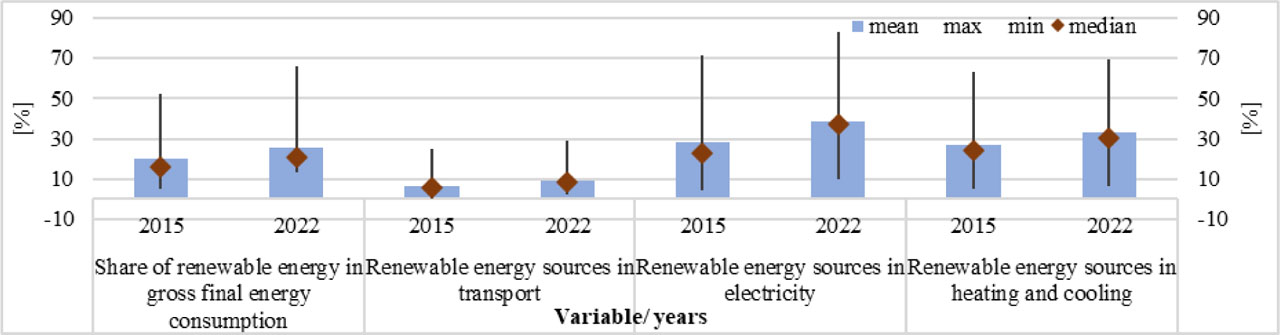
Figure 1.
Descriptive statistics for the diagnostic variables for 2015 and 2022.
Source: own elaboration based on results
The mean values of all metrics increased between 2015 and 2022. The minima and maxima for each feature also increased over the interval (Figure 1). The correlation between the selected metrics was investigated with the Pearson correlation coefficient (Table 3).
Table 3.
Coefficient of correlation between the variables in 2015 and 2022
| Year | 2015 | 2022 | ||||
|---|---|---|---|---|---|---|
| Variable | X1 | X2 | X3 | X1 | X2 | X3 |
| X2 | 0.525** | 0.590** | ||||
| X3 | 0.795*** | 0.351 | 0.742*** | 0.405* | ||
| X4 | 0.930*** | 0.369 | 0.574** | 0.859*** | 0.351 | 0.394* |
The selected metrics of development of RES consumption (Table 1) were used in combination with the four total ordering procedures shown in Table 2 to order European Union member states by values of synthetic measures. The orders are not concordant (Figure 2).
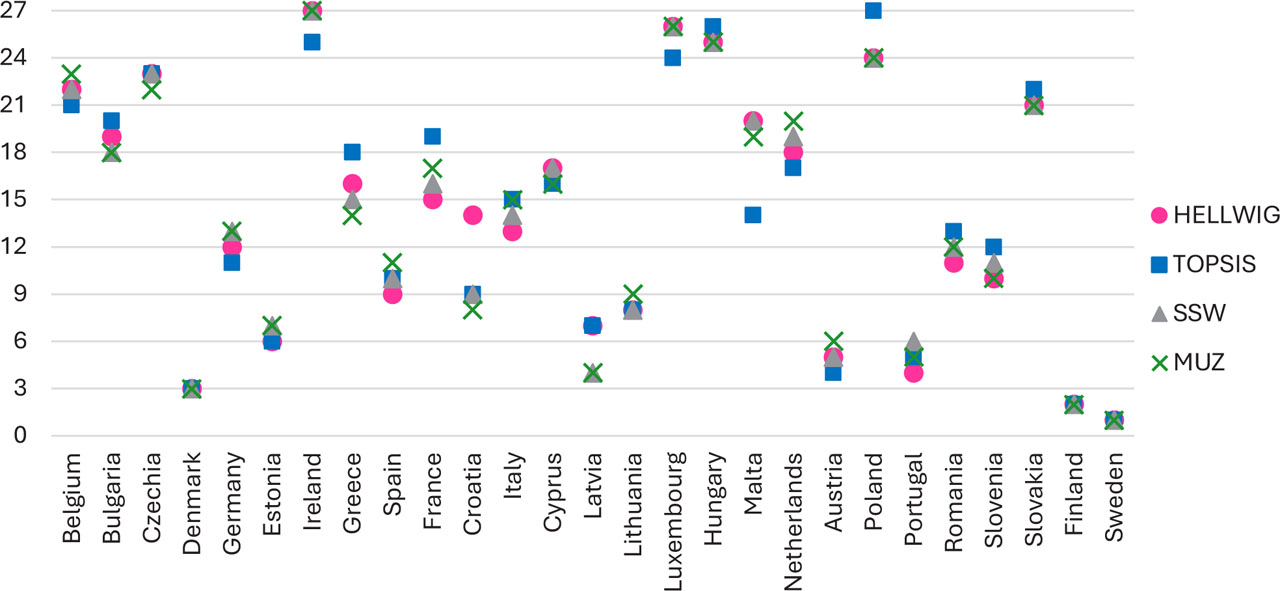
Figure 2.
Country ranks according to the four ordering procedures for 2022 data.
Source: own elaboration based on results.
Note: Method designations as in Table 2. HELLWIG, Hellwig method; MUZ, zero-based unitisation method; SSW, the method of sums of standardised values; TOPSIS, the technique for order of preference by similarity to ideal solution
The classifications obtained using different total ordering methods are not entirely identical; however, they display a similar overall structure of results (Figure 2). Importantly, countries with the highest levels of renewable energy consumption occupy leading positions in most of the applied methods. In contrast, countries with relatively low levels of renewable energy consumption are in the lower part of the generated rankings. Despite the methodological differences between the applied total ordering methods, the results provide a relatively stable picture of the development of renewable energy consumption across European Union member states.
The analysis of rankings created using different linear ordering methods indicates that the Nordic countries obtained identical results in all of them (Figure 2). Regardless of the method applied, Sweden ranked first, Finland second, and Denmark third. The full consistency of the results achieved by these countries indicates a high degree of stability of the constructed classifications. At the same time, the results obtained by the Nordic countries position them as leaders in terms of renewable energy consumption compared to all member states of the European Union.
Values of mpq and u̅p were estimated for each pair of the total orders (Table 4). The ranking based on the synthetic variable calculated with SSW is most similar to all the other rankings (u̅p = 0.934).
Table 4.
| Method | HELLWIG | TOPSIS | SSW | MUZ | u̅p |
|---|---|---|---|---|---|
| HELLWIG | 1.000 | 0.890 | 0.945 | 0.918 | 0.918 |
| TOPSIS | 0.890 | 1.000 | 0.896 | 0.885 | 0.890 |
| SSW | 0.945 | 0.896 | 1.000 | 0.962 | 0.934 |
| MUZ | 0.918 | 0.885 | 0.962 | 1.000 | 0.921 |
[i] Note: Method designations as in Table 2
The countries are ranked by the level of development of RES consumption in 2022 and 2015, with SSW in Figure 3. The Spearman rank correlation coefficient is 0.894, which indicates a strong positive correlation between the orders. The highest-ranked countries in 2022 were Sweden, Finland, and Denmark, while countries, such as Hungary, Luxembourg, and Ireland fared the worst.
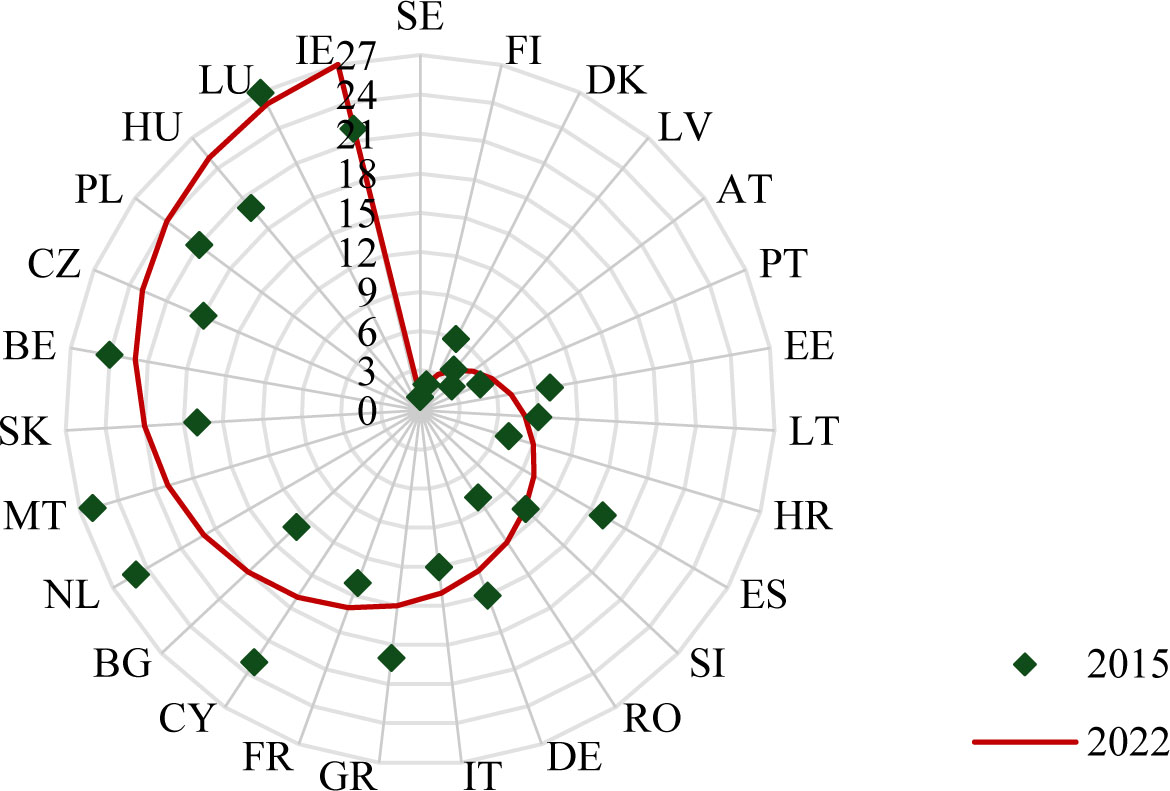
Figure 3.
Ranks of European Union member states for 2022 and 2015 by development of RES consumption calculated with the SSW method.
Source: own elaboration based on results. RES, renewable energy sources
The countries were assigned into four groups by development of RES consumption using the synthetic measure calculated with the SSW method for 2022 (Table 5).
Table 5.
Groups of European Union member states similar in terms of the development of RES consumption in 2022
| Group | Country (acronym) |
|---|---|
| Group 1 | Sweden (SE), Finland (FI), Denmark (DK) |
| Group 2 | Latvia (LV), Austria (AT), Portugal (PT), Estonia (EE), Lithuania (LT), Croatia (HR) |
| Group 3 | Spain (ES), Slovenia (SI), Romania (RO), Germany (DE), Italy (IT), Greece (GR), France (FR), Cyprus (CY) |
| Group 4 | Bulgaria (BG), Netherlands (NL), Malta (MT), Slovakia (SK), Belgium (BE), Czechia (CZ), Poland (PL), Hungary (HU), Luxembourg (LU), Ireland (IE) |
The grouping of European Union member states in terms of the development of renewable energy consumption indicates significant differences in this aspect and reflects diverse patterns of energy transition across individual EU economies. Among all EU countries, the first group clearly stands out, consisting of Nordic countries that achieve the highest average values of the variables included in the analysis. In contrast, the weakest results are observed among the countries classified in groups 3 and 4. The reasons for this situation in these economies may stem from various factors, including differing economic conditions and geographical circumstances, variations in the structure of the energy mix, the implementation of national energy and climate policies, as well as the level of public awareness and social acceptance regarding the implementation of initiatives aimed at promoting clean and accessible renewable energy.
The author calculated selected characteristics for the diagnostic variables within groups of countries similar in terms of the development of RES consumption (Table 6).
Table 6.
Descriptive statistics for group metrics, 2022
| Group | Characteristics | X1 | X2 | X3 | X4 |
|---|---|---|---|---|---|
| I | min. | 41.60 | 10.24 | 47.93 | 50.11 |
| max. | 66.00 | 29.16 | 83.34 | 69.39 | |
| mean | 51.83 | 19.41 | 69.50 | 59.35 | |
| II | min. | 29.35 | 2.40 | 26.46 | 30.58 |
| max. | 43.32 | 10.14 | 74.67 | 65.44 | |
| mean | 34.86 | 6.59 | 50.00 | 48.55 | |
| III | min. | 19.01 | 4.08 | 10.13 | 8.59 |
| max. | 25.00 | 10.81 | 50.90 | 41.56 | |
| mean | 21.68 | 8.64 | 33.94 | 26.79 | |
| IV | min. | 13.11 | 5.51 | 15.34 | 6.30 |
| max. | 19.10 | 10.35 | 36.78 | 25.80 | |
| mean | 15.65 | 7.75 | 22.37 | 17.28 |
Then, values of all the metrics for the groups were visualised referenced to average values for European Union member states (Figures 4 and 5).
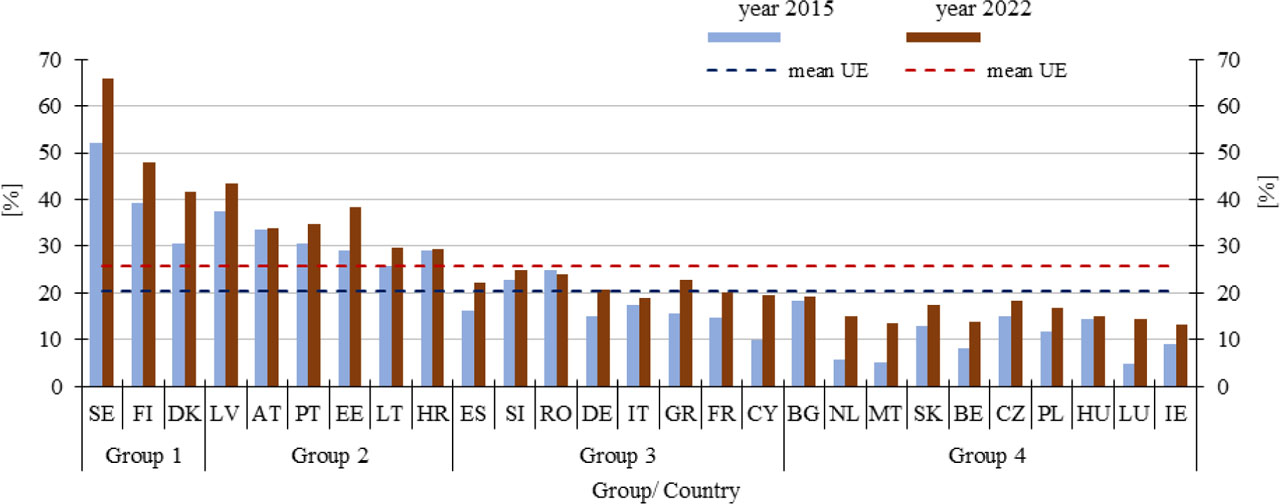
Figure 4.
Share of renewable energy in gross final energy consumption in European Union member states in 2015 and 2022 vs European Union averages.
Source: own elaboration based on: (Eurostat, 2024). AT, Austria; BE, Belgium; BG, Bulgaria; CY, Cyprus; CZ, Czechia; DK, Denmark; DE, Germany; EE, Estonia; ES, Spain; FI, Finland; FR, France; GR, Greece; HR, Croatia; HU, Hungary; IE, Ireland; IT, Italy; LT, Lithuania; LU, Luxembourg; LV, Latvia; MT, Malta; NL, Netherlands; PL, Poland; PT, Portugal; RO, Romania; SE, Sweden; SI, Slovenia; SK, Slovakia
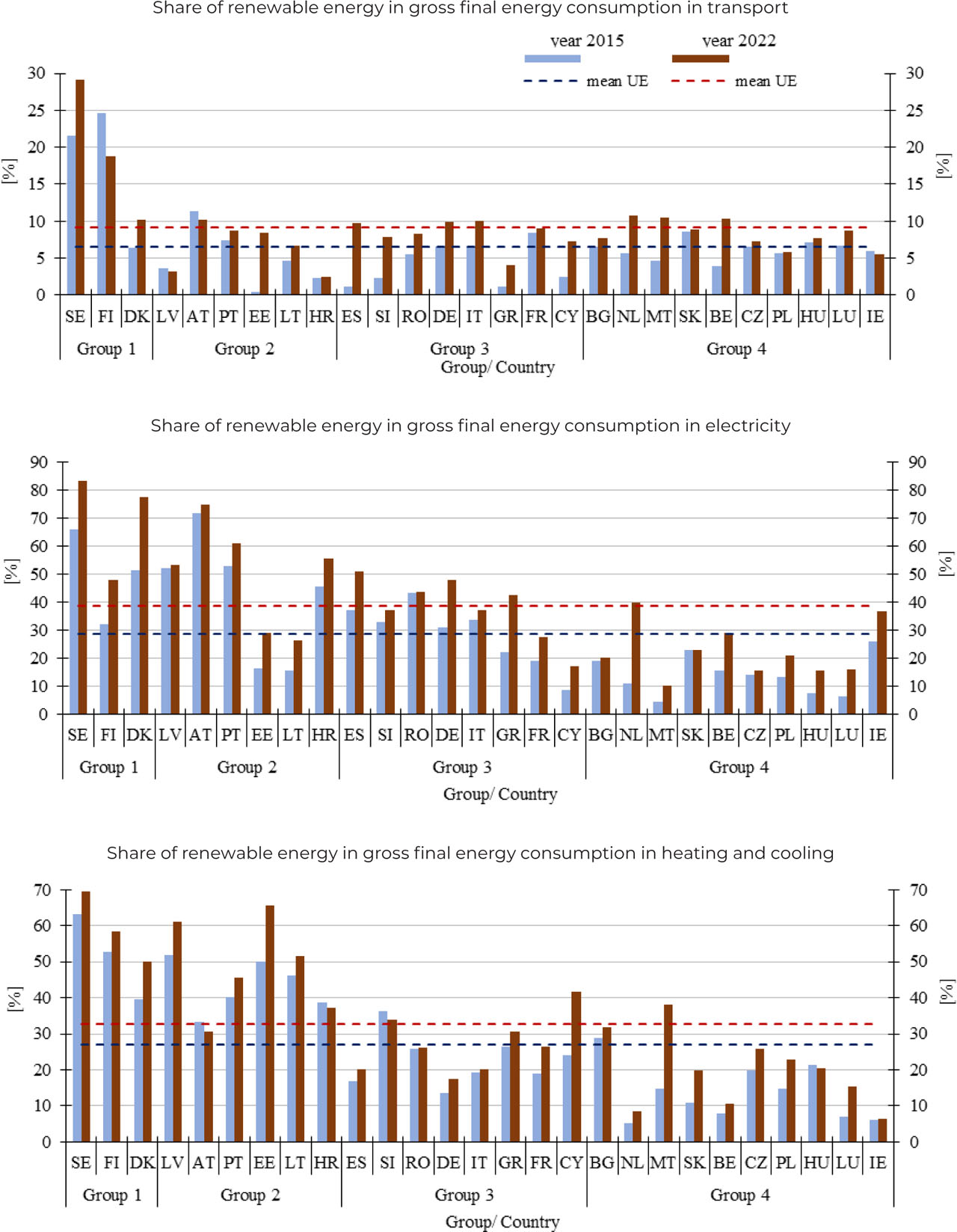
Figure 5.
RES in sectors [%] in European Union member states in 2015 and 2022 vs European Union averages.
Source: own elaboration based on: (Eurostat, 2024). AT, Austria; BE, Belgium; BG, Bulgaria; CZ, Czechia; CY, Cyprus; DK, Denmark; DE, Germany; EE, Estonia; ES, Spain; FI, Finland; FR, France; GR, Greece; HR, Croatia; HU, Hungary; IE, Ireland; IT, Italy; LT, Lithuania; LU, Luxembourg; LV, Latvia; MT, Malta; NL, Netherlands; PL, Poland; PT, Portugal; RES, renewable energy sources; RO, Romania; SE, Sweden; SI, Slovenia; SK, Slovakia
Group 1 contains three countries (Table 4). The group’s undisputed leader in 2022 is Sweden, with the best results in all attributes. The mean values of x1, x2, x3 and x4 for this group are higher than in the other groups and much above the EU-27 average. Group 1 is much more developed than the other groups in all the investigated aspects. The mean x1, x2, x3 and x4 in group 1 more than double those for group 3 and are over three times greater than for group 4. The most significant percentage point absolute change in the metrics in group 1 between 2015 and 2022 was for x1 and x2 in Sweden and for x3 and x4 in Denmark (Figures 4 and 5). The only decrease was in Finland’s x2. Group 2 covers six countries. It has two leaders for 2022. Latvia is ranked the highest for x1 and x4. Austria has the highest values of x2 and x3. Group 2 is the runner-up for the mean values of x1, x3 and x4, which are higher than the EU-27 average. Group 2 has the worst results for x2, with an average value that is the lowest among all the groups. This could be due to the very low x2 values in Croatia and Latvia. The most significant percentage point absolute change in the metrics (x1, x2, x3 and x4) in group 2 between 2015 and 2022 was in Estonia (Figures 4 and 5). At the same time, some metrics declined: x2 and x4 in Austria, x2 in Latvia, and x4 in Croatia. Group 3 consists of eight countries. In 2022, it was the second-best regarding the mean value of x2, which was above the EU-27 average. This group’s mean values of x1, x3 and x4 are higher than the average for group 4 only. They are also lower than the EU-27 average. Spain, with the highest value of x3, is the best-ranked country in this group. Group 3 is very diversified in terms of the results in individual domains. The best results of x1, x2 and x4 are noted for Slovenia, Italy, and Cyprus, respectively. The most significant percentage point absolute change in the metrics in group 3 between 2015 and 2022 was for x1 in Spain and Germany, x2 in Spain, x3 in Greece, and x4 in Cyprus (Figures 4 and 5). The only decreases over the period were in Romania (x1) and Slovenia (x4). The largest group, group 4, encompasses 10 countries. In 2022, group 4 had the lowest average values of x1, x3 and x4 among all the groups. They were also below the EU-27 averages. Only x2 was higher than in group 2, which scored the worst in this regard. The average value of x2 for group 4 was above the EU-27 average. Bulgaria reached the best results for x1 and x4. The Netherlands were the leader in x2 and x3. The group also contains countries with the worst results in the European Union: Ireland (x1, x2 and x4) and Malta (x3). The most significant percentage point absolute change in the metrics in group 4 between 2015 and 2022 was for x1 in Luxembourg, x2 in Belgium, x3 in the Netherlands, and x4 in Malta (Figures 4 and 5). Declines affected Ireland (x1) and Hungary (x4).
The 2022/2015 relative changes (i(2022/2015)) for the diagnostic variables vary depending on the country (Figure 6).
The most significant increases in 2022/2015 relative changes for the metrics were found for x1 in Luxembourg (2.88), the Netherlands (2.62), Malta (2.62); x2 in Estonia (20.52), Spain (8.89), Greece (3.71); x3 in the Netherlands (3.62), Luxembourg (2.57), Malta (2.35); and x4 in Malta (2.59), Luxembourg (2.25), and Slovakia (1.85). The only declines in 2022/2015 relative changes for the metrics were identified for x1 in Romania (0.97); x2 in Finland (0.77), Latvia (0.86), Austria (0.89), and Ireland (0.93); and for x4 in Austria (0.92), Slovenia (0.94), Hungary (0.95), and Croatia (0.96) (Figure 6).
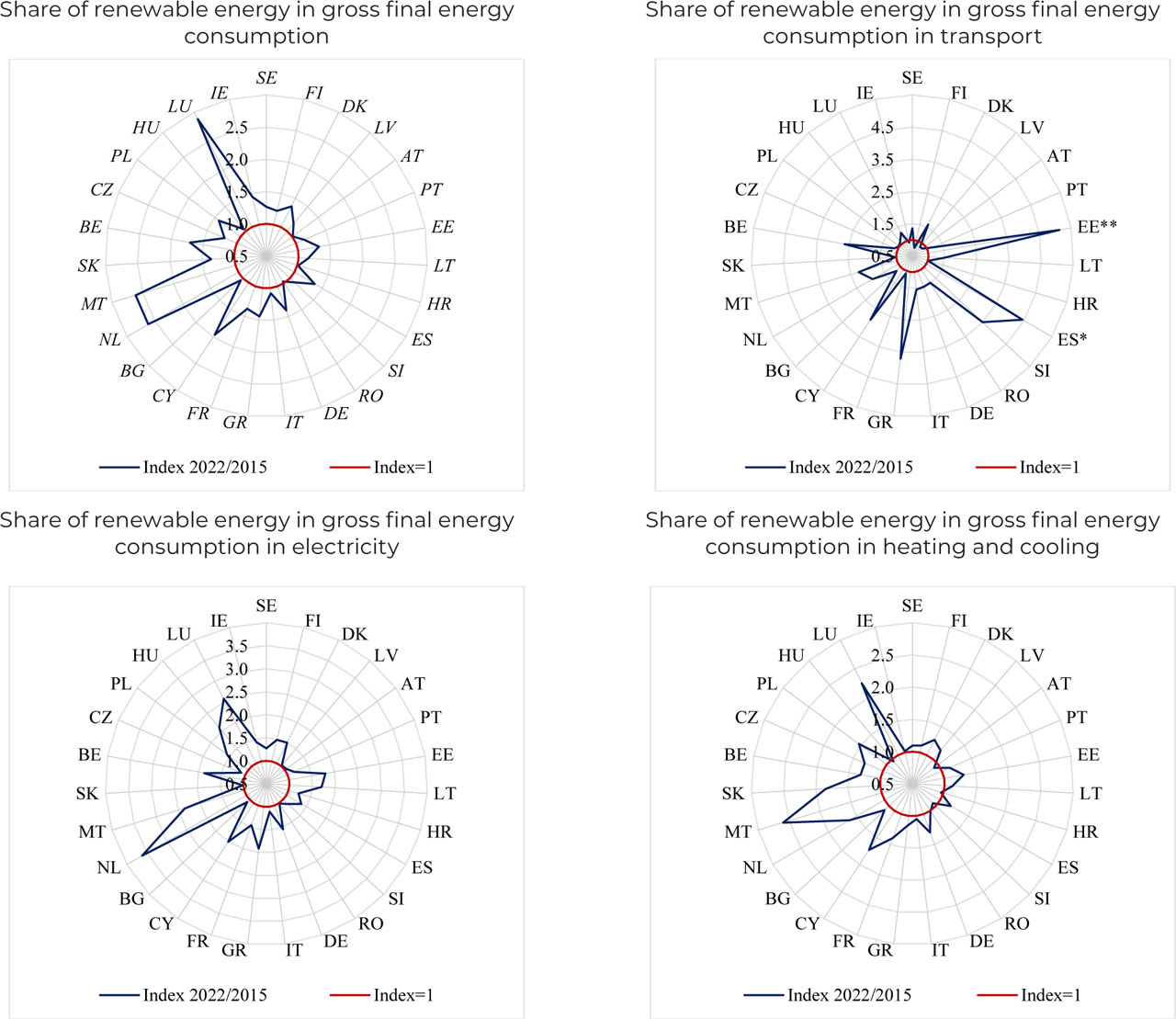
Figure 6.
2022/2015 relative changes for the diagnostic variables. *: double value; **: quadruple value
Source: own elaboration based on the results. AT, Austria; BE, Belgium; BG, Bulgaria; CY, Cyprus; CZ, Czechia; DK, Denmark; DE, Germany; EE, Estonia; ES, Spain; FI, Finland; FR, France; GR, Greece; HR, Croatia; HU, Hungary; IE, Ireland; IT, Italy; LT, Lithuania; LU, Luxembourg; LV, Latvia; MT, Malta; NL, Netherlands; PL, Poland; PT, Portugal; RO, Romania; SE, Sweden; SI, Slovenia; SK, Slovakia
Denmark, Finland, and Sweden are assigned to the group with the highest level of RES consumption in the European Union in 2022. This corresponds with the results by Stec and Grzebyk (2022), who also classified them into the same cluster in 2020. Their study employed several RES consumption and production metrics, while the present work considers only demand-side variables. Apparently, this does not cause the Nordic countries to be spread among the groups. In an article by Simionescu, Strielkowski and Tvaronavičienė (2020), Denmark, Finland, and Sweden are assigned to the same cluster based on two variables (share of renewable energy in electricity and GDP per capita) in 2017. Clustering involved only two variables (only one strictly linked to RES), which could account for the differences. Unlike the present study, most articles in the literature assign the Nordic countries to two groups. Pacesila, Burcea and Colesca (2016), Simionescu et al. (2019), and Simionescu, Strielkowski and Tvaronavičienė (2020) had Denmark and Sweden in one group and Finland in another. In the case of the article by Pacesila, Burcea and Colesca (2016), the difference could be due to the analysed year (2012). Discrepancies with the results of the two other studies could be because their authors built only two clusters, using a single variable: share of renewable energy in electricity in 2017 (Simionescu et al., 2019) and share of renewable energy in final electricity consumption in 2017 (Simionescu, Strielkowski & Tvaronavičienė, 2020). Both studies (Simionescu et al., 2019 and Simionescu, Strielkowski & Tvaronavičienė, 2020) offer two clustering processes each. The above conjecture applies only to the clustering with the relevant features. Articles by Brodny, Tutak and Bindzár (2021), Kacperska, Łukasiewicz and Pietrzak (2021), and Tutak and Brodny (2022) put Finland and Sweden in one group and Denmark in another. The differences between the present results and those of the other authors can have multiple causes. Some may be due to more metrics for 2018 (Brodny, Tutak & Bindzár, 2021) or many fewer variables (Tutak & Brodny, 2022). The relevant grouping in the latter was based solely on variable, RES per GDP in 2019. The article by Kacperska, Łukasiewicz and Pietrzak (2021) uses a similar set of variables as the present work, which has one more feature. The different clustering of Nordic countries can also be due to different numbers of clusters or years under analysis. In the part of their study employing two metrics (share of renewable energy in electricity in 2017 and GDP per capita in 2017), Simionescu et al. (2019) classified Denmark and Finland into one cluster and Sweden into another. The difference between their results and those in the present study is due to many factors, the primary one being the inclusion of the supply side by Simionescu et al. and the demand side here. Tutak and Brodny (2022) achieved significantly different results from those reported here. They assigned each Nordic country to a different group when clustering with a single metric, RES per capita in 2019. Similar to the other discussed studies, the difference in the results can be due to grouping with a single feature. In their classification of European Union member states regarding the development of RES and biofuels in 2018, Brodny, Tutak and Bindzár (2021) ranked Sweden, Finland, and Denmark first, second, and sixth, respectively. As regards the ranking of European Union member states by development of RES consumption, the present study (Figure 2) and Brodny, Tutak and Bindzár (2021) had Sweden and Finland in similar positions and Denmark in substantially different positions. The differences between the two classifications could be mainly due to Brodny, Tutak and Bindzár (2021) taking into account RES consumption and production, and the present study focusing on RES consumption only, in addition to different investigated years.
Different econometric perspectives, analysed periods, or sets of variables concerning only RES consumption, only RES production, or both in the studies listed in Table 1 make it difficult to juxtapose the results. Despite these issues, RES development is significantly similar across the Nordic European Union member states. Their leading role in the community is also undeniable. The present results confirm the research hypotheses. First, it has been demonstrated that Nordic European Union member states have high results in terms of RES consumption. Second, they have been shown to exhibit significant similarities in RES consumption, as evidenced by their classification into the same cluster.
As a result of the 1970s oil crisis, Sweden faced growing prices of heating oil, which was its sole source of heat. This kindled a discussion on phasing out imports of the carrier, which was decisive to the everyday comfort of the Swedish people. Sweden realised the high risk inherent in conventional fuels and the necessity to make efforts to transition into clean energy technologies (Neterowicz, 2020). RES became one of the foundations of its sustainable energy economy, also thanks to a growing public support for energy efficiency driven by social and environmental concerns (Lindgren et al., 2023). Today, Sweden is phasing out fossil fuels and switching to RES (Shan & Lü, 2021), as evidenced by curbed greenhouse gas emissions that would result from the combustion of fossil fuels. Sweden is considered a European leader in sustainable development, and it is putting forth various efforts to limit its environmental footprint (Hansson & Nerhagen, 2019). Renewable energy could grow in Sweden thanks to favourable environmental conditions, such as precipitation, its annual distribution (Pacesila, Burcea & Colesca, 2016), and abundant rapid rivers suitable for hydropower plants (Latoszek & Wójtowicz, 2020). This way, hydropower plants and the power industry founded on RES could be introduced to Sweden (Pacesila, Burcea & Colesca, 2016). The country has hydropower plants mainly near the largest rivers in its northern regions. They ensure clean and reasonably priced electricity to consumers (Zhong, Bollen & Rönnberg, 2021). Another common energy carrier in Sweden is biomass, which is used mainly for heat generation. Incentives to promote RES included various grants and tax regulations. Tax exemptions were applied to heating or transport using RES (Simionescu, Strielkowski & Tvaronavičienė, 2020).
Over the last decades, RES in Denmark have grown phenomenally (Shah, Kirikkaleli & Adedoyin, 2021). Renewable energy production was a milestone of the Danish energy policy, aiming at diversification and restricting greenhouse gas emissions (Pacesila, Burcea & Colesca, 2016). The growth of RES in the Danish economy reduced the country’s reliance on fossil fuel imports. It also facilitated a partial energy autarky, along with meeting a significant portion of energy transition targets (Wang, Espinosa & Huerta de Soto, 2022). Denmark started its energy transition in the 1980s when it devised a ‘green energy cluster’. The policy covered numerous renewable technologies, such as wind, solar, biomass, and energy-efficiency technologies (Hvelplund, 2013). The country focused particularly on wind energy, which has led to numerous wind farms and associated projects (Pacesila, Burcea & Colesca, 2016). Denmark is considered a global leader in wind energy thanks to its geographic location with strong winds from the North and Baltic Seas (Shah, Kirikkaleli & Adedoyin, 2021). The proximity of the seas allows Denmark to tap into the potential of wind energy in various ways. Wind energy and wind power technologies have strong historical foundations and are popular among the Danish population (Araújo, 2018; Johansen, 2019; Johansen, 2021). The widespread acceptance of wind turbines is linked to the fact that some are privately owned by people holding shares in local wind turbine cooperatives (Meyer, 2004). Another factor contributing to the increased popularity of wind power was incentives. These included loan guarantees and subsidies for wind farms or small renewable energy systems (Pacesila, Burcea & Colesca, 2016). Today, Danes grow even more interested in offshore wind power as a potential source of jobs and energy (Mortensen, 2018).
Finland’s energy and climate policy switched to RES several decades ago, following recession in the 1970s and 1980s and aiming to stop dependency on fossil fuel imports (Aslani, Antila, E & Wong, 2012). Today’s political decisions regarding RES are determined by the urge to reduce fossil fuel import dependency and improve the population’s well-being. Finland’s energy policy is set to reach carbon neutrality by 2035 through phasing out coal as an energy carrier by 2029 (Temmes et al., 2021). Finland’s climate neutrality will require intensified growth of wind power and improved electric power transmission capabilities (Koljonen et al., 2022; Hyvönen, Koivunen & Syri, 2023). Its developed industry and challenging climate escalate energy consumption (Esposito, 2023). Most of Finland’s primary energy needs are met with biofuels, nuclear energy, and imported oil (Kilpeläinen, 2020). The main sources of renewable energy are biomass and forests (solid biomass), which cover 86% of the country’s territory (Aslani, Helo & Naaranoja, 2014). Wood harvesting for cogeneration and heating has a long-standing history in Finland (Holma et al., 2018). Finland is the global leader in biomass production. It is also among the European Union member states with the most significant impact on energy transition, focusing on curbing adverse climate change (Esposito, 2023). In the short term, Finland’s energy policy efforts are set to ensure the economic feasibility of renewable energy production. The long-term strategy is to support experimental technologies, but not small-scale projects (Paukku, 2021).
The inclusion of the Nordic countries in the same group characterised by the highest level of renewable energy consumption has important implications for public policy in the context of the energy transition. The success of Sweden, Finland, and Denmark stems from long-standing energy policies oriented toward the development of clean energy from renewable sources. The gradual and effective implementation of stable regulatory frameworks and long-term energy strategies, combined with investments in low-emission technologies which would be difficult to implement without favourable natural conditions (such as strong wind resources or the availability of biomass) as well as a relatively high level of public acceptance, constitute a set of factors that have determined the success of the energy transition in Nordic countries. In some economies classified in groups three and four, the lower level of renewable energy consumption and the corresponding slower progress in the energy transition may have multiple causes. Among the most important barriers are dependence on fossil fuels, the structure of the national energy mix, the structure and innovativeness of the economy, and the availability of investment capital.
The combination of factors that contributed to the success of Nordic countries may serve as a reference model for countries classified in groups with lower levels of renewable energy consumption. In this context, particular emphasis should be placed on the implementation of long-term and stable energy policies based on effective support instruments promoting the development of renewable energy projects that are aligned with local geographic conditions. However, when drawing on these experiences, it is important to consider the specific conditions of individual economies, including their economic structures, natural resource endowments, and the level of social acceptance for measures supporting the energy transition.
5. Conclusions
The article reports a study on classifying European Union member states based on the development of consumption of RES from 2015 to 2022 using selected total ordering methods. The countries were then grouped by similarity of development. The employed procedure fully supported the objective set in the introduction. The research has led to the following conclusions:
The ranking of European Union member states based on a synthetic metric comprising variables concerning the share of RES in the total energy consumption and in final transport, electricity, heating, and cooling consumption identified substantial differences in the levels of development in this regard. The four groups contained countries with very high, high, moderate, and low levels of development. The scale of the disparities is clear, as only three and six countries were allocated to the first and second group, respectively, while groups three and four contained eight and 10 countries.
Hypothesis H1, which is that Nordic European Union member states achieve high results in RES consumption, has been confirmed. Sweden, Denmark, and Finland were ranked the highest among European Union economies in terms of RES consumption. Hypothesis H2, which states that Nordic European Union member states exhibit a high level of similarity regarding RES consumption, has also been confirmed. Only Sweden, Denmark, and Finland were assigned to the group with the highest RES consumption level, demonstrating the similarity.
The originality of the research lies in several aspects. The first is the in-depth literature review with a breakdown and characterisation of research to date into demand side, supply side, and demand and supply perspectives. The other original factor is the identified and partially addressed gap concerning the search for the optimal method for classifying European Union member states regarding RES consumption. Having juxtaposed several selected and commonly used total ordering methods, the author identified SSW as the optimal approach.
This input can support future research on RES consumption in the European Union. It can also help political and private decision-makers evaluate a country’s competitive position regarding the pursuit of a sustainable energy economy, which should inform political and economic decisions. The study has demonstrated that Sweden, Denmark, and Finland are the leaders in RES consumption in the European Union and can serve as energy transition models for other member states. Still, when considering the solutions for promoting RES employed in the Nordic countries, policy-makers should remember the characteristics of renewable energy schemes in these countries. Their actions are fuelled by several factors, such as geography, weather, financial capabilities, or the public perception of renewable energy projects.
The study has certain limitations. The first barrier to econometric research was the availability of valid empirical data. The other limitation was the selected research perspective on the objective to investigate the demand side of RES. However, this constraint offers a potential for further research on the development of RES in terms of both supply and demand, which could look for the optimal methods for classifying European Union member states. Naturally, the present perspective could also cover more variables, such as quantitative features, to complement the metrics employed in the study.