

1. Introduction
Political, financial and economic stability may create a supportive atmosphere for ongoing economic development. Political stability can promote reliable institutions and consistent policymaking, thus lowering uncertainty for both private investors and public ventures (Masry, 2015). In addition, well-established financial systems gather savings, direct capital towards productive investments, encourage technological advancements and consequently drive growth (King & Levine, 1993). These aspects of stability work together to support long-term planning, reduce systemic risk and improve the capacity of economies to grow in an efficient and equitable manner.
The worldwide movement towards green transformation and sustainability has emerged as a vital focus for tackling environmental degradation, climate change and resource scarcity. Green transformation involves fundamentally realigning economies to adopt low-carbon and resource-efficient systems, whereas sustainability underscores the need to harmonise economic, social and environmental goals (Udeagha & Muchapondwa, 2023). This dual approach is essential for building long-term resilience, enhancing competitiveness and achieving the sustainable development goals (SDGs) set forth by the United Nations. Research demonstrates that nations implementing green policies and sustainable finance tools not only reduce environmental risks but also boost innovation and productivity (Cheba, Bąk & Pietrzak, 2023). Therefore, integrating sustainability principles into policy frameworks and financial systems is crucial for fostering inclusive and sustainable development.
The connection between stability and green growth occurs through several important transmission channels. Firstly, when there is political stability, it enhances the credibility and consistency of environmental policies, which in turn diminishes regulatory uncertainty and fosters long-term investments in renewable energy and sustainable infrastructure (Apergis & Payne, 2014; Qamruzzaman & Karim, 2024). Secondly, financial stability enables the effective mobilisation and distribution of capital towards eco-friendly technologies and green innovation, allowing businesses to fund low-carbon production methods and clean energy projects (Safi et al., 2021; Zhang et al., 2024). Thirdly, macroeconomic stability, marked by controlled inflation, sustainable fiscal strategies and stable economic expectations, creates a positive investment landscape that promotes technological innovation, resource efficiency and the implementation of green technologies (Jiang et al., 2023; Chen et al., 2024). However, there is limited literature analysing the impact of stability’s political, economic and financial dimensions on green growth. The European Union serves as a particularly important setting for analysing the link between stability and green growth, given its prominent position in global sustainability and climate initiatives. Throughout the last 20 years, the EU has established extensive policy frameworks to foster low-carbon development, including the European Green Deal, the Emissions Trading System and various sustainable finance efforts. These policies aim to speed up the transition to a resource-efficient and climate-neutral economy while ensuring economic competitiveness and social cohesion. Additionally, the EU offers a distinctive institutional setting marked by relatively robust governance systems, integrated financial markets and coordinated environmental regulations among member countries. This unique combination enables researchers to investigate how variations in political, economic and financial stability interact (Dolge & Blumberga, 2021). This study aims to contribute to the literature by analysing the impact of stability on green growth in European Union countries during the 2012–2021 period.
Despite the growing literature on sustainability and green growth, several important gaps remain. First, most existing studies analyse the effects of political, financial, or macroeconomic stability separately, while empirical research examining their joint influence within a unified analytical framework remains limited, particularly in the context of European Union countries (Sajid et al., 2023; Liu & Zhang, 2024). Second, although the EU has implemented extensive policy initiatives such as the European Green Deal and sustainable finance frameworks, there is still insufficient empirical evidence on how variations in institutional, financial and macroeconomic stability among EU member states influence green growth outcomes.
To address these gaps, this study investigates the following research questions:
(i) Do political, financial and macroeconomic stability significantly influence green growth in European Union countries?
(ii) Which dimension of stability plays a more prominent role in shaping green growth performance?
(iii) How do financial and institutional conditions interact with sustainability policies in the EU context?
This study contributes to the literature in three main ways. First, it extends the stability–growth literature by examining the relationship between stability and green growth, thereby integrating sustainability considerations into traditional macro-financial analysis. Second, by jointly analysing political, financial and macroeconomic stability, it provides a more comprehensive framework for understanding the institutional and financial determinants of sustainable development. Third, by focusing on European Union countries, the study offers new empirical evidence for a region that has been at the forefront of global sustainability policies.
This paper is organised as follows: Section 2 discusses the theoretical framework, Section 3 examines the literature, Section 4 describes the methodology and data, Section 5 presents the empirical results and the study is concluded in Section 6.
2. Literature Review
Stability plays a significant role in determining economic growth in the literature. This study aims to analyse this topic from a green growth perspective. This Section reviews the literature to show how the study will fill the gap in the literature.
2.1. Studies analysing the impact of stability on economic growth
The relationship between stability and economic growth has been a longstanding focus of empirical and theoretical inquiry, reflecting the premise that sustained development is contingent upon predictable and secure economic, financial and political environments. In this context, the literature focuses on the impact of macroeconomic, financial, political and democratic stability on economic growth.
Political stability is expected to promote increased economic growth by minimising policy unpredictability, strengthening the trust in institutions and stimulating both local and international investments. Feng (1997) finds that democracy and political stability positively affect economic growth in 96 countries during the 1960–1980 period. Shabbir, Anwar & Adil (2016) show that political stability and corruption have significant impact on economic growth. Cox & Weingast (2018) demonstrate that democratic institutions can mitigate the adverse economic impacts associated with changes in leadership, especially when effective legislative oversight limits the power of the executive. Their results indicate that strong legislatures are more influential than elections by themselves in maintaining consistent economic growth during periods of political change. De Haan & Siermann (1996) find limited evidence that political repression hinders economic growth, with a notable exception in Latin America where some negative effects are observed. However, this result is highly sensitive to how political repression is measured. Overall, their analysis suggests that in many regions political repression is not consistently associated with lower economic performance, and in some cases, it even correlates positively with growth. Uddin & Rahman (2023) examine how corruption, unemployment, inflation and the quality of institutions impact economic growth in 79 developing nations from 2002 to 2018. Through the use of panel econometric methods, they discover that corruption, unemployment and political instability have a detrimental effect on gross domestic product (GDP) per capita, while inflation, effective governance and the rule of law have a beneficial effect. Their findings emphasise the significance of institutional reforms and strong governance in fostering sustainable economic growth in developing countries.
Financial stability is broadly acknowledged as a crucial prerequisite for ongoing economic growth, as it supports effective capital distribution, reduces systemic risk and creates a setting that encourages investment and productivity. Carbó-Valverde & Sánchez (2013) highlight the impact of financial stability on economic growth. Kurtoglu & Durusu-Ciftci (2024) investigate the relationship between financial stability and economic growth in F5 and G7 nations, revealing that the nature and intensity of this connection vary based on the specific indicators of stability utilised. They discover that credit market metrics, especially the Z-score and provisions for non-performing loans, show the strongest causal relationships with growth, while stock market-related indicators have weaker impacts. Their findings further suggest that economic growth affects financial stability primarily through credit market mechanisms in F5 countries, whereas no such causal relationship is observed for Canada, the UK and the USA. Stewart, Chowdhury & Arjoon (2021) examine how bank stability relates to economic growth, emphasising the importance of regulatory capital and the quality of institutions. Analysing panel data from more than 100 countries from 1995 to 2015, they discover no indication of a conflict between increased regulatory capital and economic growth; rather, they find a positive correlation. Their findings indicate that regulatory capital can enhance both robust economic performance and banking stability, while the quality of institutions strengthens these beneficial effects, even though it does not have a direct impact. Similarly, Bayar, Borozan & Gavriletea (2021) examine the dynamic and causal relationships between different indicators of banking sector stability and economic growth by utilising advanced panel cointegration and causality tests in post-transition European Union nations from 1998 to 2016. Findings show the positive effect of banking sector stability on economic growth. Manu et al. (2011) argue that financial stability affects GDP in the long and the short run.
A limited portion of the literature explores how macroeconomic stability influences economic growth. Sanchez-Robles (1998) analyses the Spanish economy from 1962 to 1995 to assess the effects of macroeconomic stability and market liberalisation on economic growth. Using cointegration techniques, they incorporate proxies of macroeconomic instability such as inflation, public deficit, various public expenditure shares and market distortions and find these factors to be negatively correlated with growth. Their results suggest that macroeconomic stability and market liberalisation are essential prerequisites for sustained economic expansion. Fischer (1992) emphasises the importance of macroeconomic policy stability on economic growth. Ehigiamusoe & Samsurijan (2021) argue that macroeconomic stability promote the impact of financial development on economic growth
2.2. Studies analysing the impact of stability on environmental development
As policymakers become more concerned about sustainability, the literature analysing the effects of stability on sustainable economic development grows. The studies examine the impact of stability on the transition to a green economy.
Some of the studies analyse the impact of stability on sustainable economic development from the perspective of renewable energy and environmental degradation. Al-Zubairi, AL-Akheli & Elfarra (2025) examine the factors influencing CO2 emissions in Arab nations from 2000 to 2020, placing special emphasis on the role of political stability. Their findings indicate a positive relationship between political stability and emissions, implying that stable political climates might foster economic activities that heighten environmental burdens. Nevertheless, they also discover that this impact is lessened when political stability is coupled with financial development, suggesting that robust financial institutions in stable political situations can encourage more environmentally friendly practices. Adebayo (2022) investigates how political stability influences the link between the use of renewable energy and CO2 emissions in Canada from 1990 to 2018. Using a dynamic ARDL methodology, the research concludes that political stability can attract foreign investments, which in turn can promote more effective climate initiatives and reduce environmental harm. Uzar (2020) argues that institutional quality positively affects renewable energy consumption. Behera et al. (2024) suggest that the utilisation of renewable energy, along with political stability and fiscal decentralisation, can reduce CO2 emissions and promote environmental sustainability in OECD countries. Shao et al. (2024) find that political stability has positive effect on renewable energy finance. Awosusi et al. (2023) show that political risk and environmental degradation are adversely related to renewable energy in the short and long run. Radu (2015) states that political stability has an important role on sustainable development in Romania
One of the focus topics of studies analysing the impact of stability on renewable energy and environmental degradation is financial stability. Ozili & Iorember (2024) investigate how financial stability affects sustainable development in 26 countries between 2011 and 2018, utilising an innovative financial stability index, a combined sustainable development index and four particular SDG indicators. Their results indicate that although financial stability typically has an impact on sustainable development, the nature and extent of this impact differ by region and method of measurement. Wahab et al. (2022) find that financial stability contributes to consumption-based carbon emissions. Yang et al. (2020) show that financial instability has a significant negative impact on CO2 emissions in 54 emerging economies. Adversely, Safi et al. (2021) argue that financial stability effects positively carbon emissions in G7 countries. Kirikkaleli & Sofuoğlu (2023) investigate the impact of financial stability on environmental degradation. Findings show that financial stability results in a reduction of environmental harm.
Macroeconomic stability is another topic analysed in the literature. Chen et al. (2024) analyse the impact of macroeconomic stability on environmental development in the European Union. The findings show that macroeconomic stability promotes environmental development. Aydın (2025) argues that price stability has no significant direct effect on carbon emissions. However, it emerges as a crucial environmental factor through consumption, investment and monetary policy channels. Khan (2019) shows that macroeconomic instability increases pollution emissions. Rakshit & Neog (2021) indicates that uncertainty in the macroeconomic environment has a beneficial impact on carbon emissions, suggesting that increased volatility in inflation, used as an indicator of macroeconomic uncertainty, negatively affects the environmental quality in India. Khan, Rana & Ghardallou (2022) state that developing economies should ensure economic stability to control their CO2 emissions.
In recent years, green growth, which approaches sustainability holistically and harmonises it with economic growth, has been analysed in the literature. These studies examine the determinants of green growth by reconsidering economic growth from a sustainability perspective. However, studies analysing the impact of macroeconomic, political and financial stability on green growth are quite limited. Qamruzzaman & Karim (2024) argue that political stability promotes green growth in OECD countries. Similarly, Liu & Zhang (2024) find that political stability has a positive effect on green growth. Sajid et al. (2023) discuss the relationship between sustainable finance and financial development theory. The findings indicate a positive correlation between financial inclusion and institutional quality and financial stability, while financial stability facilitates green growth, environmental sustainability and mechanisms for renewable energy. According to Yu et al. (2024), heightened economic instability slows down China’s green development. Jiang et al. (2023) find that macroeconomic stability has a positive effect on green growth.
Overall, the existing literature reveals both areas of consensus and debate regarding the relationship between stability and environmental sustainability. Many agree that political, financial and macroeconomic stability usually leads to better environmental results. This happens because it reduces uncertainty, encourages long-term investment and supports green finance. However, the data isn’t completely consistent. Some studies suggest that financial stability or economic growth can actually increase environmental pressures. This occurs when financial resources go to carbon-heavy sectors or when growth depends too much on energy use. Likewise, the impact of political and institutional stability can change based on regulatory systems, the quality of governance and the level of economic development. These varied results demonstrate that the relationship between stability and environmental performance is complicated and depends on the context, showing the need for more research.
Despite the increasing number of studies looking at the relationship between stability and environmental sustainability, several research gaps still exist. First, most current studies explore political, financial, or macroeconomic stability separately. However, there is limited research examining how these factors combined influence green growth within a single analytical framework. Second, while the European Union has become a global leader in sustainability policies and green transition initiatives, there is still not much empirical evidence on how various stability aspects affect green growth performance in EU member states. To address these gaps, this study will explore the following research questions: (i) Does political stability influence green growth in EU countries? (ii) Does financial stability help green growth by improving financial intermediation? (iii) Does macroeconomic stability support green growth by creating a stable economic environment for sustainable investment? Based on the theoretical framework and previous empirical findings, the study proposes these hypotheses: H1: Political stability positively influences green growth. H2: Financial stability positively influences green growth. H3: Macroeconomic stability positively influences green growth.
3. Theoretical Framework
Green growth constitutes a development model that aims to harmonise economic development with environmental sustainability. In contrast to traditional growth models that often overlook natural resources, green growth highlights the significance of environmental stewardship, eco-innovation and financial systems in fostering long-term growth (Smulders, Toman & Withagen, 2014). Backed by global entities such as the OECD, World Bank and UNESCAP, this approach emphasises the efficient use of resources, low-carbon development and resilience against ecological threats (Arzova & Şahin, 2024). Research indicates that innovation, education, human capital and green finance are essential components driving sustainable growth in various sectors (Wang et al., 2022).
Green growth, as a model for development, necessitates a supportive environment characterised by political, financial and economic stability. From an institutional standpoint, political stability fosters consistency and predictability in environmental regulations, which is crucial for long-term investments in sustainable infrastructure and renewable energy (North, 1990). Stable political environments lessen policy unpredictability, boost the trustworthiness of green initiatives and enable governments to incorporate environmental externalities through mechanisms like taxation, subsidies and regulatory frameworks (Barrett & Graddy, 2000). Conversely, political instability erodes confidence in institutions and dissuades both domestic and international investments in eco-friendly technologies, hindering the shift towards green growth (Ashraf, 2024).
Similarly, financial stability is essential for mobilising the necessary resources to promote sustainability. Financial development theory posits that stable financial systems facilitate efficient capital allocation, lower transaction costs and offer long-term financing for eco-friendly projects (Levine, 1997). This is especially pertinent, as green investments, such as renewable energy initiatives or climate adaptation infrastructure, frequently require significant upfront expenditures with delayed returns. Current literature on green finance highlights that stable financial systems encourage innovation in instruments like green bonds and climate funds, thereby ensuring that environmentally sustainable projects can access financial markets (Fu, Lu & Pirabi, 2023; Zhang & Sajid et al., 2023). Consequently, financial stability not only supports economic resilience but also enhances the ability of societies to fund the green transition.
Finally, economic stability serves as the macroeconomic base that green growth relies on. Endogenous growth theory highlights that a stable macroeconomic environment, characterised by low inflation, effective fiscal policies and consistent output, promotes innovation, human capital development and research and development, all of which are crucial for sustainability (Lucas, 1988; Romer, 1990). In contrast, unstable economic conditions hinder green investments, as both governments and businesses often focus on immediate stabilisation rather than long-term sustainability. Therefore, a stable economic landscape offers the necessary fiscal capacity and assurance needed for the continuous implementation of environmental policies, strengthening the synergies between stability and green growth (Zhang et al., 2024). Figure 1 illustrates the conceptual framework.
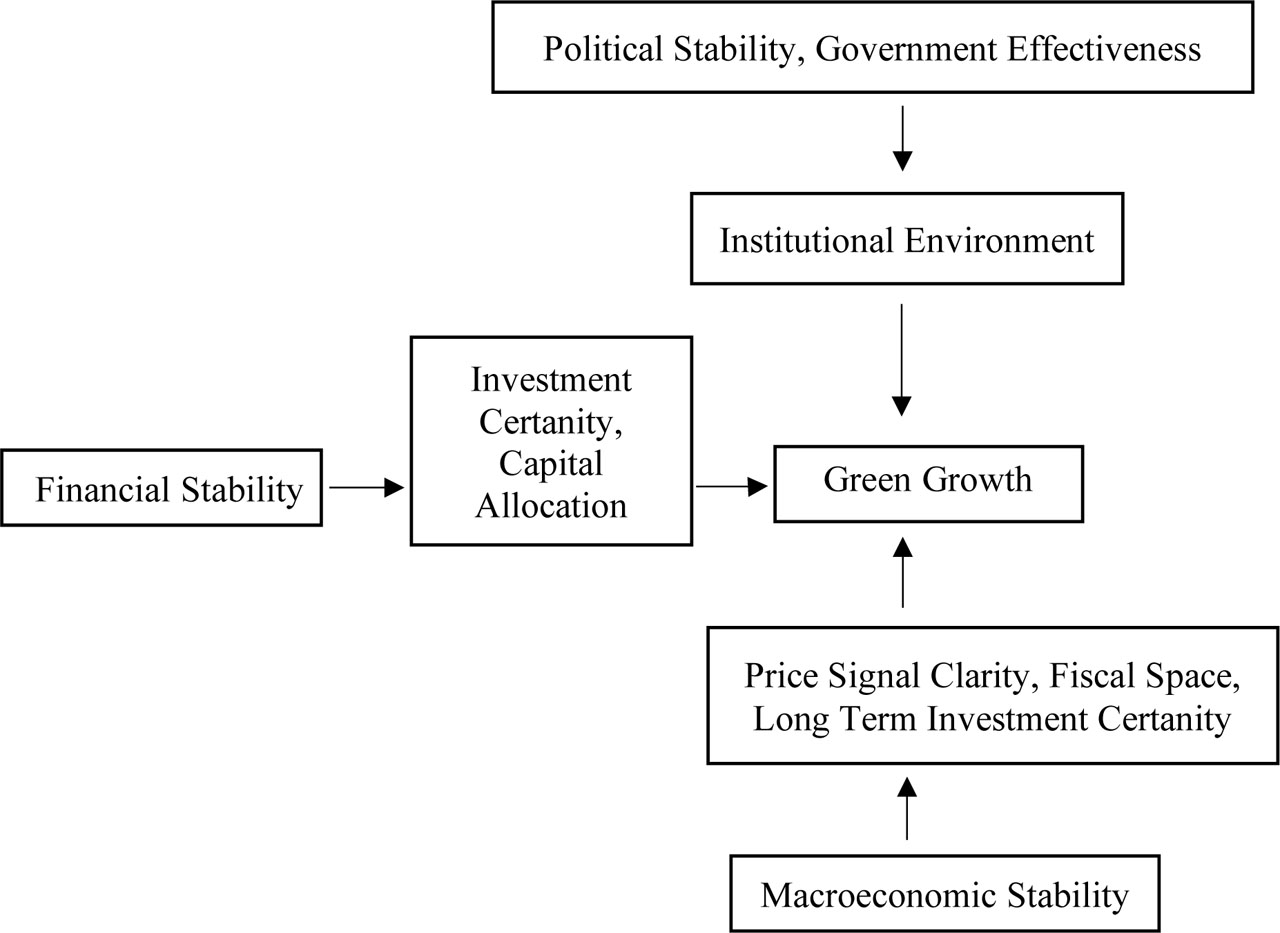
Figure 1.
Conceptual framework of the study
Although the theoretical framework suggests that stability usually helps sustainable development and green growth, the relationship may not always be straightforward or consistently positive. In some cases, stronger institutional capacity or effective government may lead to stricter environmental rules, higher compliance costs, or short-term adjustments in carbon-intensive industries. These changes could temporarily slow green growth indicators. Besides, Political stability, if the political order is aligned with the interests of existing carbon-intensive industries, can paradoxically create ‘institutional lock-in’, hindering the creative destruction necessary for the green transition. Furthermore, the impact of public debt on green growth may have a threshold effect; moderate debt can finance basic green infrastructure, while excessive debt can hinder sustainable private sector investment due to high interest rates. Recognising these potential negative externalities is crucial for interpreting situations where institutional power does not automatically translate into environmental progress. Similarly, financial stability can sometimes strengthen existing investment patterns that favour traditional sectors instead of environmentally friendly activities. Recent studies show that institutional and financial conditions can create different or non-linear effects on environmental results, depending on regulatory frameworks, policy priorities and the level of economic development (Safi et al., 2021; Agheli & Taghvaee, 2022). Therefore, while stability is generally seen as supporting green transformation, its effects may vary across different institutional settings and policy environments.
4. Data & Methodology
This study analyses the impact of political, financial and economic stability in European Union countries on green growth. Data for the period 2012–2021 related to the variables are analysed using panel models. This period is selected for data accessibility. The research sample consists of 27 EU countries. The European Union offers an especially promising context for exploring the connections between economic, financial and political stability alongside green growth. As a regional organisation, the EU has historically adopted integrated policies focusing on sustainability, climate issues and energy transition, while also upholding a strong level of institutional and economic cohesion among its member nations. This combination provides a distinctive setting in which variations in stability indicators among countries can be systematically studied within a framework that shares common policy goals. Additionally, the EU has put in place thorough statistical systems and standardised reporting practices, guaranteeing the availability and comparability of dependable data across various nations and over time (Dolge & Blumberga, 2021; Olczyk & Kuc-Czarnecka, 2025).
GG serves as a representative of the dependent variable. This research utilises the assessment of green economic growth applied by Global Green Growth Institute. The Green Growth Index evaluates how effectively a country progresses towards sustainability goals, such as those outlined in the SDGs, the Paris Climate Accord and the Aichi Biodiversity Targets. The index is structured around four key dimensions: efficient and sustainable resource utilisation, preservation of natural capital, promotion of green economic opportunities and social inclusiveness. The four dimensions of the Green Growth Index capture different but interrelated aspects of sustainable development. The first dimension, efficient and sustainable resource use, evaluates how effectively an economy utilises natural resources such as energy, water, land and materials while minimising environmental pressure. This dimension reflects the ability of countries to generate economic output with lower resource intensity and reduced environmental impact. The second dimension, natural capital protection, measures the extent to which ecosystems and biodiversity are preserved through indicators related to environmental quality, greenhouse gas emissions and ecosystem conservation. Protecting natural capital is essential for maintaining ecological balance and ensuring that economic development does not compromise long-term environmental sustainability. The third dimension, green economic opportunities, focuses on the capacity of an economy to generate environmentally friendly economic activities, including green investments, innovation, green employment and trade in environmentally related goods and services. This dimension reflects the role of the green economy as a driver of sustainable growth and structural transformation. Finally, the social inclusion dimension evaluates whether the benefits of green growth are broadly distributed across society by considering factors such as access to basic services, social equality, gender balance and social protection. By integrating these four complementary dimensions, the Green Growth Index provides a comprehensive framework for assessing how countries progress towards sustainability while balancing environmental protection, economic development and social well-being. Countries are assigned scores between 1 and 100, with values from 1 to 20 denoting very low performance, 20–40 low, 40–60 moderate, 60–80 high and 80–100 very high performance in green growth (Global Green Growth Institute, 2025).
The independent variables are political, financial and economic stability. Bank Z Scores (BANKZ) and Domestic Credit to Private Sector are proxies for financial stability. Financial stability plays a critical role in shaping the conditions under which countries can pursue sustainable and inclusive growth. Using indicators such as the Bank Z-Score and domestic credit to the private sector provides meaningful insights into the resilience and efficiency of financial systems. The Bank Z-Score reflects the soundness of banks and their ability to withstand financial shocks, while domestic credit indicates the extent to which financial resources are mobilised to support private sector activity. Together, these measures capture both the risk profile of the banking system and the depth of financial intermediation. Assessing their influence on green growth is particularly important, as stable and well-functioning financial systems are essential for channelling investment into environmentally friendly projects, supporting innovation and ensuring the continuity of long-term sustainability strategies. There are studies that include these two variables in the model as financial stability variables (Kasman & Kasman, 2015; Le & Nguyen, 2022). Data is accessed from the World Development Indicators database (World Bank, 2025a). Table 1 shows list of variables
Table 1.
List of variables
| Variable | Definition | |
|---|---|---|
| GG | Green Growth | Global Green Growth Index |
| POLS | Political Stability and Absence of Violence/Terrorism | Political Stability and Absence of Violence/Terrorism measures perceptions of the likelihood of political instability and/or politically-motivated violence, including terrorism. |
| GE | Government Effectiveness | Government Effectiveness reflects views on the quality of public services, the competence of the civil service and its level of independence from political influences, the effectiveness of policy development and execution and the reliability of the government’s dedication to these policies. |
| DC | Domestic Credit to Private Sector (% of GDP) | Domestic credit to private sector refers to financial resources provided to the private sector by financial corporations, such as through loans, purchases of non-equity securities and trade credits and other accounts receivable, that establish a claim for repayment. |
| BANKZ | Bank Z Scores | It reflects the likelihood of a country’s banking system failing. The Z-score evaluates the strength of a country’s banking system (measured by capitalisation and returns) against the fluctuations of those returns. |
| INF | Inflation, indicated by the consumer price index, shows the yearly percentage change in the expenses that an average consumer incurs to obtain a set of goods and services, which may either remain constant or be adjusted at designated times, like annually. | |
| GD | Government Debt | Government Consolidated Gross Debt% of GDP |
| UNEM | Unemployment Rate | Unemployment, total (% of total labour force) |
| EB | External Balance of Goods & Services% of GDP | The balance of international trade in goods and services is the difference between the exports and imports of goods and services. This indicator is expressed as a percentage of GDP |
| FDI | Foreign Direct Investment | FDI, net inflows/GDP |
| ERT | Green Patent | Patents on environment technologies |
[i] Source: Global Green Growth Institute (2025), OECD (2025), World Bank (2025a, 2025b).
Economic stability is indicated by the unemployment rate, inflation, the total government consolidated gross debt relative to GDP, and the external balance of goods and services expressed as a percentage of GDP. Unemployment and inflation are fundamental components of macroeconomic stability assessments and are often utilised in empirical studies on green development within the EU, as they reflect the availability of labour and fluctuations in price levels that can obstruct long-term, low-carbon investments. Government debt as a percentage of GDP indicates fiscal capacity and the reliability of public financial conditions that influence a government’s ability to maintain commitments to green investments and policies; recent research also associates elevated debt levels with the speed and structure of the energy transition (Aydın, 2025). The external balance concerning goods and services summarises trade exposure as well as dynamics between savings and investments; it is commonly regarded in macroeconomic literature as a key indicator of stability and is measured by the World Bank as the net trade position in relation to GDP (Chen et al., 2024). Collectively, these indicators represent various pathways demand and price stability, fiscal capacity and external adjustment through which macroeconomic factors can either promote or inhibit green growth by influencing financing costs, risk premiums and the acquisition of clean technologies (Klaassen & Opschoor, 1991).
Political stability and the effectiveness of governance are crucial elements of a nation’s institutional framework, significantly affecting sustainable development. The measure of Political Stability and Absence of Violence/Terrorism indicates the perceived risk of political unrest and conflict, including terrorism, which can jeopardise long-term investment choices and disrupt policy continuity. Conversely, Government Effectiveness assesses the perceived quality of public services, the professionalism and independence of the civil service, the robustness of policy formulation and execution and the reliability of government commitments. Together, these indicators offer a thorough perspective on institutional robustness and governance quality. Analysing their impact on green growth is vital, as stable political environments and efficient institutions foster the trust, predictability and administrative capability necessary to carry out ambitious environmental initiatives and allocate resources towards sustainable development objectives (Qamruzzaman & Karim, 2024). Data is accessed from the Worldwide Governance Indicators database (World Bank, 2025b).
Foreign direct investment (FDI) and patents related to environmental technologies are included as control variables due to their potential influence on green growth. FDI can contribute to sustainability by providing capital inflows, transferring advanced technologies and fostering environmentally friendly business practices. Similarly, patents in environmental technologies serve as a proxy for innovation capacity, indicating a country’s ability to develop and diffuse solutions that support the transition towards a greener economy. While not directly linked to stability, both variables may significantly shape the trajectory of green growth by expanding financial resources and technological opportunities for sustainable development (Hille, Shahbaz & Moosa, 2019; Danta & Rath, 2024). Data is accessed from World Development Indicators and OECD databases (OECD, 2025; World Bank, 2025a).
Although stability can also be shown through composite indices, this study uses multiple indicators to capture the different aspects of political, financial and macroeconomic stability. Creating a single composite stability index may hide the varying effects of each stability dimension on green growth. Political institutions, financial systems and macroeconomic conditions can influence environmental outcomes in different ways. Earlier studies have also taken a multi-indicator approach to explore the separate impacts of institutional quality, financial development and macroeconomic conditions on sustainability outcomes (Ehigiamusoe & Samsurijan, 2021; Ozili & Iorember, 2024). Therefore, using individual indicators allows for a clearer analysis of the specific role each stability dimension plays, instead of combining them into one overall measure.
In this study, ‘stability’ is conceptualised beyond mere short-term volatility; it is defined through the lens of structural and institutional resilience, which ensures long-term predictability for green growth investments. Therefore, the selected indicators serve as proxies for the structural dimensions of stability. Government effectiveness is employed as a measure of political stability, as it reflects the continuity of policy implementation and the bureaucracy’s resilience against political shifts. Without effective governance, even a peaceful political environment lacks the ‘policy stability’ necessary for long-term environmental commitments. Similarly, domestic credit to the private sector represents financial stability through the context of financial depth. In line with the ‘too-much-of-a-good-thing’ hypothesis in finance, a stable and deep financial system facilitates consistent capital flows towards green projects, reducing the systemic risks associated with credit rationing. Finally, government debt is used as a proxy for macroeconomic stability, as fiscal sustainability is a prerequisite for a stable investment climate and the preservation of ‘fiscal space’ for green subsidies. By adopting this structural approach, the study ensures conceptual coherence between the institutional quality of the EU and its environmental trajectory
To analyse the determinants of GG, we analyse GG as a function of macroeconomic, financial and political stability. Specifically, our panel regression is defined as:
Where GG is green growth rate, POLS is Political Stability and Absence of Violence/Terrorism, GE is Government Effectiveness, DC is Domestic Credit to Private Sector, BANKZ is Bank Z Scores, INF is Inflation, GD is Government Debt, UNEM is Unemployment, EB is External Balance of Goods & Services, FDI is Foreign Direct Investments, ERP is Environment Related Patents. In the panel data model, i represents the country and t denotes time. The coefficients of the regressors are labelled from 1 to 10, while ε represents the error term.
Panel data analysis can be conducted using either the fixed effects or random effects model, with the choice determined by the correlation structure of the regressors. To select the appropriate model, the Hausman test is employed. Since the p-values are <0.05, the fixed effect model is preferred (Tabash et al., 2022). Additionally, cross-sectional dependence is a critical diagnostic test for determining the appropriate unit root testing methodology. The presence of cross-sectional dependence influences the selection of unit root tests; in such cases, second-generation unit root tests are applied. Pesaran’s cross-sectional dependence test indicates that there is a cross-sectional dependence problem in the model (Pesaran, 2006).
Before conducting the panel data analysis, we investigate the autocorrelation and heteroscedasticity of the model. The autocorrelation issue reveals a systematic relationship between the variables. We assess this autocorrelation problem using the Baltagi Wu test. The test results indicate that values are below 2, confirming the presence of an autocorrelation problem (Born & Breitung, 2016). Heteroscedasticity pertains to the variation in error term variance; we evaluate this aspect of the model using the Modified Wald Test. The findings show that a heteroscedasticity problem exists (Le, Le & Taghizadeh-Hesary, 2020). The models have cross-sectional dependence, autocorrelation and heteroscedasticity problems. Therefore, we utilise a strong standard error estimator to address the issues of autocorrelation and heteroscedasticity. Thus, we implement cluster-robust standard errors as established by Arellano (1987), Froot (1989) and Rogers (1993).
Another potential econometric concern is endogeneity between green growth and stability indicators. For instance, while political, financial and macroeconomic stability may influence green growth, improvements in environmental performance and sustainable development may also strengthen institutional quality and financial systems. To mitigate potential endogeneity concerns, the study employs fixed-effects estimation, which controls for unobserved country-specific heterogeneity. In addition, the explanatory variables are interpreted as structural characteristics that evolve gradually over time, reducing the likelihood of short-term reverse causality. Similar empirical studies analysing sustainability and institutional stability relationships have adopted comparable panel approaches to address potential endogeneity issues (Safi et al., 2021; Sajid et al., 2023).
5. Empirical Results
This Section presents the results of the panel data analysis. Before the analysis results, descriptive statistics and unit root test results are presented. Table 3 shows descriptive statistics.
Table 2.
Hausman, cross-sectional dependence, autocorrelation and heteroscedasticity tests
| Hausman test | p-value: 0.00 |
| Pesaran cross-sectional dependence test | p-value: 0.00 |
| Durbin–Watson | Statistic value: 0.62 |
| Baltagi–Wu | Statistic value: 0.91 |
| Modified Wald test | p-value: 0.00 |
Table 3.
Descriptive statistics
| Variables | Obs. | Mean | Std. Dev. | Min | Max |
|---|---|---|---|---|---|
| GG | 270 | 65.87 | 5.16 | 52.3 | 74.88 |
| POLS | 270 | 0.72 | 0.35 | −0.23 | 1.43 |
| GE | 270 | 1.05 | 0.56 | −0.29 | 2.21 |
| DC | 270 | 82.07 | 41.09 | 24.56 | 254.67 |
| BANKZ | 270 | 15.38 | 10.26 | −0.32 | 57.44 |
| INF | 270 | 1.30 | 1.38 | −2.09 | 5.65 |
| GD | 270 | 70.16 | 39.13 | 8.5 | 209.4 |
| UNEM | 270 | 8.53 | 4.70 | 2.02 | 27.69 |
| EB | 270 | 4.54 | 7.99 | −7.49 | 41.69 |
| FDI | 270 | 16.60 | 66.25 | −296.01 | 452.22 |
| ERT | 270 | 12.74 | 4.63 | 0.84 | 45.20 |
The descriptive analysis of the Green Growth Index (GG) reveals notable cross-country differences within the European Union. Denmark records the highest GG values, reaching a maximum of 74.88 and maintaining the highest average score of 74.11, which underscores its strong performance in advancing sustainable development. By contrast, Malta exhibits the lowest outcomes, with a minimum score of 52.30 and the lowest mean of 53.45 across the sample, indicating relatively weaker progress in green growth.
According to the cross-sectional dependence analyses, the model has cross-sectional dependence. Therefore, CADF test, one of the second-generation unit root tests, is applied. Table 4 presents the unit root test results. Lag lengths are determined according to Akaike Information Criterion.
Table 4.
Unit root test
| Variable | Lag | CADF statistic |
|---|---|---|
| GG | 1 | −1.949** |
| D.POLS | 2 | −2.021** |
| GE | 1 | −2.241** |
| D.DC | 1 | −1.375*** |
| BANKZ | 1 | −4.146* |
| INF | 1 | −2.227** |
| GD | 1 | −2.228** |
| UNEM | 1 | −3.397* |
| EB | 1 | −2.196** |
| FDI | 2 | −1.524*** |
| ERT | 1 | −4.928* |
According to the unit root test results, all variables are stationary at the level or in the first difference. Due to the presence of autocorrelation and heteroskedasticity in the model, standard error correctors are used. Table 5 shows the standard error corrector model developed by Arellano (1987), Froot (1989) and Rogers (1993).
Table 5.
The empirical results of the Arellano, Froot, Rogers estimator
| Variable | Coef. | p-Val. |
|---|---|---|
| D.POLS | 0.31 | 0.32 |
| GE | −1.34 | 0.02** |
| D.DC | 0.03 | 0.06*** |
| BANKZ | 0.12 | 0.72 |
| INF | 0.08 | 0.31 |
| GD | 0.40 | 0.00* |
| UNEM | −0.33 | 0.30 |
| EB | 0.01 | 0.99 |
| FDI | 0.10 | 0.19 |
| ERT | 0.01 | 0.70 |
Empirical findings indicate that domestic credit positively impacts green growth. The observation that domestic credit has a beneficial impact on green growth indicates that improved credit accessibility promotes investments in sustainable technologies, clean energy initiatives and eco-friendly infrastructure. In situations where financial markets are more advanced, private sector loans can reduce the capital costs associated with green innovation and assist companies in complying with environmental regulations. Literature supports this process (Sol Murta & Gama, 2024; Bui & Doan, 2025).
Similarly, we find that government debt can promote green growth. The positive impact of government debt on green growth indicates that public borrowing could be supplying the necessary financial resources to support sustainable initiatives like renewable energy infrastructure, eco-friendly transportation and environmental conservation. When governments manage debt wisely, they are able to invest in enduring green assets that private entities may hesitate to finance due to extended payback durations or significant initial expenses. Some studies support our findings. Efthimiadis & Tsintzos (2023) argue that redirecting debt payments to green energy infrastructure can promote economic growth and debt sustainability. Auteri et al. (2024) show that government debt and renewable energy consumption have a bidirectional causal relationship, with implications for sustainable economic development. Greiner (2007) analyses an endogenous growth model with public capital and debt to derive conditions for sustainable government debt and growth effects of deficit-financed public investment.
The negative coefficient of government effectiveness is a significant finding. While we usually expect higher institutional quality to support sustainable development, several factors explain why stronger government effectiveness is linked to lower green growth outcomes in the EU. First, countries with efficient administrative systems often enforce stricter regulations and environmental standards. This can raise compliance costs for businesses and slow down short-term green growth indicators. Second, institutionalised policy environments may focus on economic stability and regulatory strictness. This focus can create red tape that delays green innovation projects or sustainable investments. Third, the EU already has relatively high institutional quality among member states. This consistency reduces variation in governance indicators, potentially weakening the direct statistical connection between government effectiveness and green growth outcomes. This view aligns with past studies showing mixed or even negative links between institutional quality and environmental performance in developed economies. For instance, Tran and Tran (2025) found that stronger government effectiveness can sometimes lead to more regulatory strictness and hinder the shift to low-carbon development. Similarly, Azwardi, Zainal & Igamo (2025) indicate that institutional structures may initially prefer economic stability over environmental concerns, leading to short-term trade-offs between governance quality and green growth indicators.
Although several explanatory variables are not statistically significant in the model, their interpretation provides additional insight into the relationship between stability and green growth in European Union countries. The coefficient of Political Stability and Absence of Violence/Terrorism is positive but insignificant, which may reflect the relatively high and homogeneous institutional quality across EU member states, limiting cross-country variation in political risk indicators. In such a context, political stability may influence environmental outcomes mainly through indirect channels such as institutional quality, regulatory capacity, or financial development rather than exerting a direct effect on green growth (Kirikkaleli & Sofuoğlu, 2023; Behera et al., 2024). Similarly, the insignificance of Bank Z-Scores suggests that banking sector soundness alone does not automatically translate into green economic outcomes. In developed financial systems like those in the EU, bank stability primarily reflects institutional resilience rather than the allocation of credit towards environmentally sustainable investments, indicating that green growth may depend more on targeted green finance instruments and regulatory incentives (Sajid et al., 2023; Ozili & Iorember, 2024). Furthermore, macroeconomic stability indicators, FDI and environment-related patents also appear statistically insignificant, possibly due to the highly coordinated fiscal and monetary frameworks within the EU and the indirect nature of their effects through complex transmission mechanisms. In particular, the contribution of FDI and green innovation to green growth often depends on complementary institutional conditions such as environmental regulations and financial support mechanisms that facilitate the diffusion and commercialisation of sustainable technologies across economies (Chen et al., 2024; Danta & Rath, 2024).
To further evaluate the strength of the findings, it is important to consider whether the results would stay the same if different indicators of stability were used in the model. In the literature, financial stability is sometimes measured by variables such as non-performing loans, financial development indices, or bank capitalisation ratios. Institutional stability can also be represented by indicators including rule of law, regulatory quality, or control of corruption. Likewise, macroeconomic stability is sometimes shown through variables like fiscal balance, exchange rate volatility, or economic policy uncertainty. Although this study uses common indicators such as bank Z-scores, domestic credit and political stability, these alternative measures usually capture similar institutional and financial trends. Given the relatively high level of institutional and macroeconomic coordination among EU member states, it is unlikely that swapping the current indicators for different proxies would significantly change the overall conclusions about the relationship between stability and green growth. Therefore, the main findings of the study can be seen as generally robust to possible changes in the specification of the independent variables.
Since the European Union includes countries with different levels of economic development, it is important to examine whether the relationship between stability and green growth varies across country groups. In particular, several Central and Eastern European (CEE) countries are considered transition or developing economies, while Western European countries generally represent advanced economies. Differences in institutional capacity, financial development and economic structure may lead to heterogeneous effects of stability on green growth. To investigate this issue, the sample was divided into two groups: developed EU countries and CEE economies. The empirical model was then re-estimated separately for each group using the same estimation approach applied in the baseline model. This sub-sample analysis allows us to assess whether the impact of political, financial and macroeconomic stability differs across levels of economic development. The results of the heterogeneity analysis are presented in Table 6.
Table 6.
The heterogeneity analysis
| Variable | Group 1 | Group 2 |
|---|---|---|
| D.POLS | 0.10 (0.83) | 0.59 (0.24) |
| GE | −1.81 (0.01**) | −0.69 (0.40) |
| D.DC | 0.03 (0.05***) | −0.00 (0.94) |
| BANKZ | 0.03 (0.49) | −0.16 (0.06***) |
| INF | 0.15 (0.10) | 0.01 (0.89) |
| GD | 0.03 (0.08***) | 0.07 (0.02**) |
| UNEM | −0.01 (0.78) | −0.06 (0.09***) |
| EB | −0.00 (0.74) | 0.0 (0.89) |
| FDI | 0.00 (0.17) | −0.00 (0.39) |
| ERT | 0.00 (0.79) | 0.02 (0.75) |
BANKZ, bank Z Scores; DC, domestic credit to private sector; EB, external balance of goods & services; FDI, foreign direct investment; GD, government debt; GE, government effectiveness; INF, Inflation; POLS, political stability and absence of violence/terrorism; UNEM, unemployment.
The analysis of heterogeneity highlights significant variations in how stability indicators relate to green growth between the two groups of countries. For Group 1, which includes the more developed economies of the EU, the effectiveness of the government shows a noteworthy negative impact on green growth, while domestic credit and government debt have weakly positive effects. These findings imply that in advanced institutional settings, more stringent regulatory frameworks and administrative processes may temporarily hinder observable green growth outcomes, whereas financial depth and public investment still contribute to sustainability transitions. In contrast, the findings for Group 2, primarily comprising CEE economies, reveal that macroeconomic stability plays a more crucial role. Specifically, government debt is seen to have a strong and positive influence on green growth, suggesting that public investment is beneficial in this context.
6. Conclusions
This study analyses the impact of political, economic and financial stability in EU countries on green growth. By combining institutional and financial indicators, the analysis provides new insights into the conditions under which sustainable development can be achieved in advanced regional economies. The findings highlight both supportive and unexpected dynamics, offering a basis for discussion on the role of financial systems, fiscal policy and institutional quality in shaping the path towards greener growth.
The findings show that domestic credit and government debt have a positive effect on green growth, while the government effectiveness variable has a negative effect. The findings may present crucial implications for researchers, businesses and policymakers. For researchers, the data indicating that domestic credit and public debt have a positive impact on green growth highlights the crucial importance of financial development and fiscal policy in sustainability research. These results imply that upcoming studies should explore how credit mechanisms, lending approaches and public investments financed by debt interact with environmental outcomes in various institutional settings. Additionally, the surprising negative impact of government effectiveness prompts scholars to reassess the relationship between institutional quality and the green transition, taking into account potential trade-offs or unintended effects.
The policy implications of the findings can be clarified by looking at the different aspects of stability discussed in this study. From a financial stability viewpoint, the positive role of domestic credit suggests that EU policymakers should boost sustainable finance methods. This includes green lending frameworks, green bonds and incentives for climate-focused investments to ensure financial resources are effectively directed towards environmentally friendly sectors. For macroeconomic stability, the positive impact of government debt shows that well-managed public borrowing can support large green investments. These include renewable energy infrastructure, sustainable transportation systems and climate adaptation projects within the European Green Deal framework. Regarding political stability and governance, the results emphasise the need to create institutional frameworks that ensure efficient administration. These frameworks should also focus on implementing environmental policies and coordinating regulations among EU member states. Therefore, matching institutional effectiveness with specific sustainability strategies may strengthen the ability of European economies to achieve long-term green growth goals while keeping economic and financial stability in place.
The heterogeneity analysis also provides important policy implications for different groups of EU member states. The results suggest that the drivers of green growth differ between developed and developing EU economies, implying that a uniform policy approach may not be equally effective across the Union. In developed EU countries, where institutional quality and financial markets are already relatively advanced, policies that improve the efficiency of sustainable finance mechanisms such as green lending programmes, climate-related financial disclosure and targeted incentives for environmentally friendly investments may further strengthen green growth performance. In contrast, for developing EU member states, particularly those in Central and Eastern Europe, maintaining macroeconomic stability and expanding public investment capacity appear to be more critical for supporting the green transition. In these countries, government borrowing directed towards renewable energy infrastructure, clean technologies and environmental innovation can play a key role in accelerating sustainable development.
This study has limitations. Due to the availability of data, the analysis period is limited to 2012–2021. Future studies may analyse a more recent and broader period. Furthermore, future studies may examine financial stability in relation to sustainability variables such as green loans and green bonds. Comparisons between different country groups may also reveal the income and geopolitical dimensions of stability.