

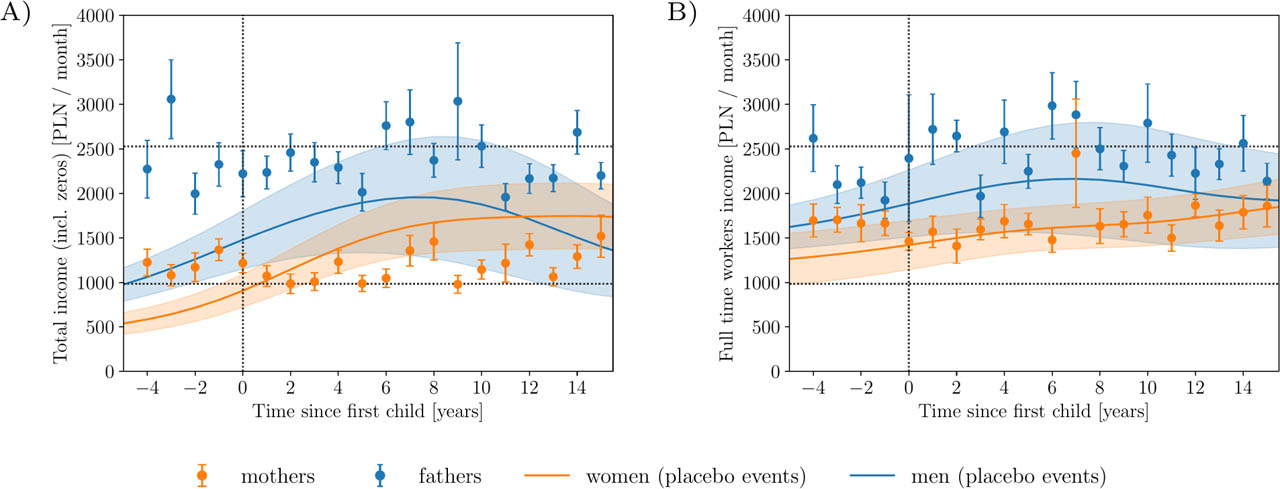
Figure 1.
(A) Mean of individual income of mothers and fathers (post-tax, including individual transfers and individuals with no income and excluding household transfers) as a function of time since first childbirth, compared with the control groups of childless individuals estimated with the placebo event method. The horizontal lines show the minimum wage post-tax (2010) and the mean wage of full time (40 hours/week) workers in companies employing more than 9 workers (2010, tax adjusted). (B) Analogous estimations to Panel A calculated for individuals working full time.
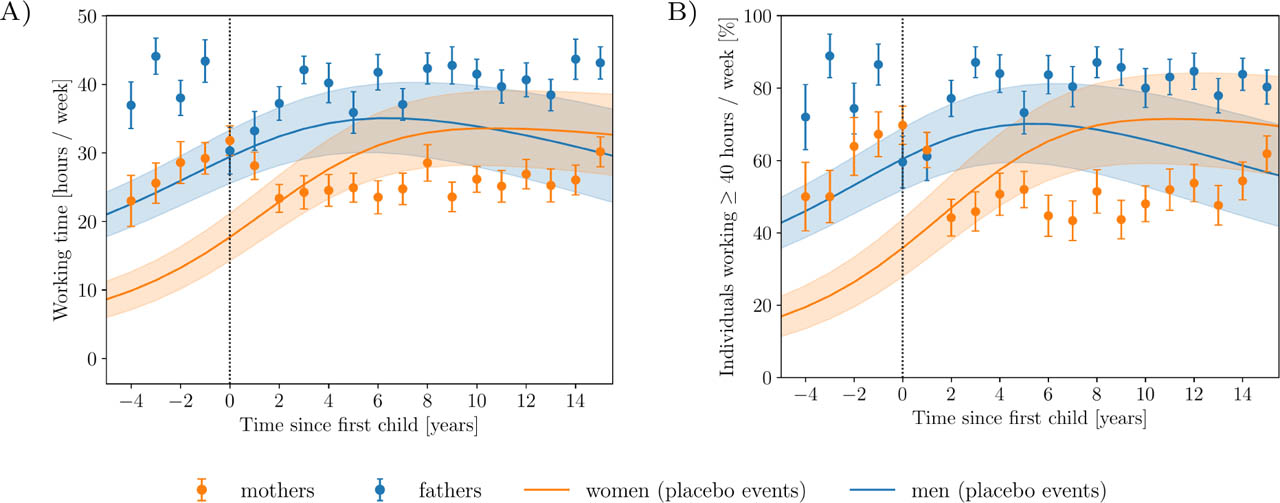
Figure 2.
(A) Mean number of hours worked as a function of time since first childbirth compared with the control group of childless individuals, estimated with the placebo event method (including the non-working population). The unexpectedly high number of hours worked for mothers in the first year after birth is an artefact of the questionnaire's design: women on maternity leave are asked about the number of hours in the last job before taking the leave. (B) Percentage of population working at least 40 hours a week.
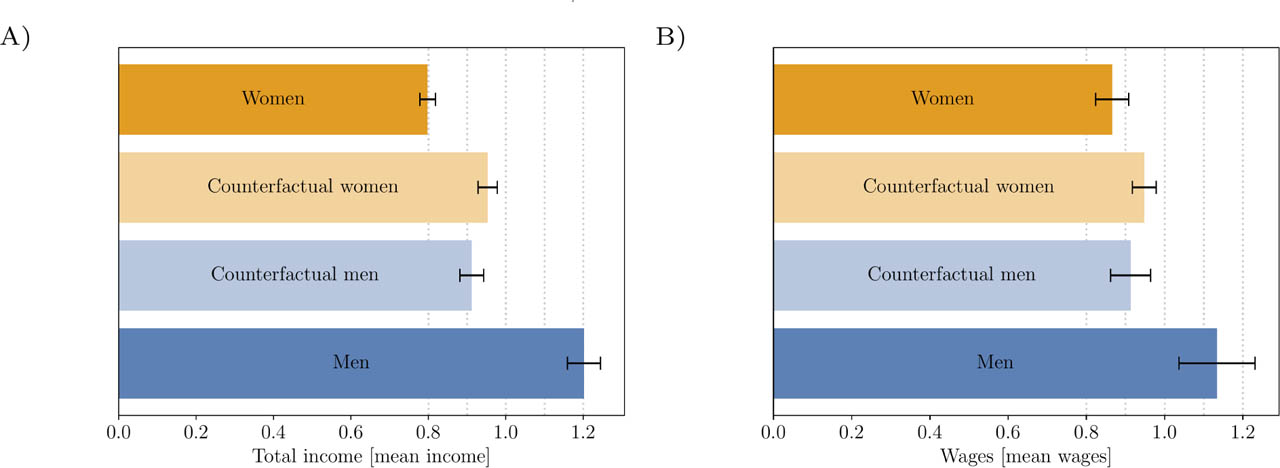
Figure 3.
(A) Total income and total counterfactual income as a multiple of the real mean total income with confidence bands determined by bootstrap (1σ CI of 50 rounds). Incomes taken from the 2010 survey and child data from the 2014 survey (hence the adjustment includes anticipatory behaviours). (B) Hourly wages of people working 40 hours a week as a multiple of the mean value in that group (1σ CI of 50 bootstrap rounds).
Table 1.
Sample means (2010) by gender and parental status (2014), unmatched
| Men | Women | |||
|---|---|---|---|---|
| Parents | Non-parents | Parents | Non-parents | |
| Mean total income (PLN) | 2015.19 | 1222.75 | 1222.58 | 1134.38 |
| Mean income (excl. zeros) | 2086.39 | 1557.66 | 1387.13 | 1482.71 |
| Mean hours worked | 24.71 | 21.85 | 15.20 | 14.88 |
| Mean income (full-time workers) | 2385.86 | 1871.62 | 1757.71 | 1840.50 |
| Percent working ≥5 hours | 54.34 | 51.16 | 38.32 | 37.19 |
| Percent working ≥40 hours | 49.34 | 43.59 | 29.55 | 30.38 |
| Percent working ≥60 hours | 8.09 | 4.45 | 1.88 | 2.33 |
| Number of observations | 3194 | 986 | 5766 | 962 |
Table 2.
Difference-in-differences estimates of the effect of childbirth on total income (including zeros), by gender
| Men | Women | |||||
|---|---|---|---|---|---|---|
| Pre (A) | Post (B) | Diff. (B–A) | Pre (C) | Post (D) | Diff. (D–C) | |
| Parents (1) | 2459.7 | 2403.9 | −55.8 | 1205.8 | 997.7 | −208.1 |
| (196.4) | (170.0) | (259.8) | (83.6) | (80.3) | (115.9) | |
| Non-parents (2) | 1369.1 | 1803.9 | 434.8 | 808.6 | 1323.9 | 515.3 |
| (56.3) | (116.5) | (78.5) | (37.3) | (71.3) | (45.9) | |
| Diff. (1–2) | −490.6 | −723.4 | ||||
| (271.4) | (124.7) | |||||
Table 3.
Difference-in-differences estimates of the effect of childbirth on the income of full-time workers, by gender
| Men | Women | |||||
|---|---|---|---|---|---|---|
| Pre (A) | Post (B) | Diff. (B–A) | Pre (C) | Post (D) | Diff. (D–C) | |
| Parents (1) | 2046.9 | 2306.6 | 259.7 | 1677.4 | 1501.5 | −175.8 |
| (114.0) | (148.3) | (187.0) | (94.9) | (112.1) | (146.8) | |
| Non-parents (2) | 1824.8 | 2083.0 | 258.2 | 1383.3 | 1550.8 | 167.6 |
| (65.6) | (129.3) | (80.1) | (74.0) | (63.6) | (51.2) | |
| Diff. (1–2) | 1.5 | −343.4 | ||||
| (203.4) | (155.5) | |||||
Table 4.
Difference-in-differences estimates of the effect of childbirth on working time (hours/week), by gender
| Men | Women | |||||
|---|---|---|---|---|---|---|
| pre (A) | post (B) | diff. (B–A) | pre (C) | post (D) | diff. (D–C) | |
| Parents (1) | 41.8 | 39.7 | −2.2 | 27.8 | 23.8 | −4.0 |
| (1.6) | (1.6) | (2.3) | (1.6) | (1.6) | (2.2) | |
| Non-parents (2) | 27.7 | 33.9 | 6.2 | 15.4 | 26.5 | 11.1 |
| (0.9) | (1.1) | (0.7) | (0.8) | (1.1) | (0.7) | |
| Diff. (1–2) | −8.4 | −15.1 | ||||
| (2.4) | (2.3) | |||||
Table 5.
Difference-in-differences estimates of the effect of childbirth on the share of people working full time (at least 40 hours a week), by gender
| Men | Women | |||||
|---|---|---|---|---|---|---|
| pre (A) | post (B) | diff. (B–A) | pre (C) | post (D) | diff. (D–C) | |
| Parents (1) | 0.832 | 0.821 | −0.011 | 0.604 | 0.451 | −0.153 |
| (0.037) | (0.033) | (0.049) | (0.042) | (0.037) | (0.056) | |
| Non-parents (2) | 0.568 | 0.689 | 0.121 | 0.310 | 0.549 | 0.239 |
| (0.020) | (0.025) | (0.016) | (0.018) | (0.026) | (0.015) | |
| Diff. (1–2) | −0.132 | −0.392 | ||||
| (0.052) | (0.058) | |||||
Table 6.
Difference-in-differences estimates of the effect of childbirth on the share of people working at least 5 hours a week, by gender
| Men | Women | |||||
|---|---|---|---|---|---|---|
| Pre (A) | Post (B) | Diff. (B–A) | Pre (C) | Post (D) | Diff. (D–C) | |
| Parents (1) | 0.926 | 0.867 | −0.060 | 0.715 | 0.616 | −0.099 |
| (0.025) | (0.029) | (0.039) | (0.039) | (0.036) | (0.053) | |
| Non-parents (2) | 0.646 | 0.779 | 0.133 | 0.388 | 0.650 | 0.262 |
| (0.019) | (0.021) | (0.014) | (0.019) | (0.024) | (0.014) | |
| Diff. (1–2) | −0.193 | −0.361 | ||||
| (0.041) | (0.055) | |||||
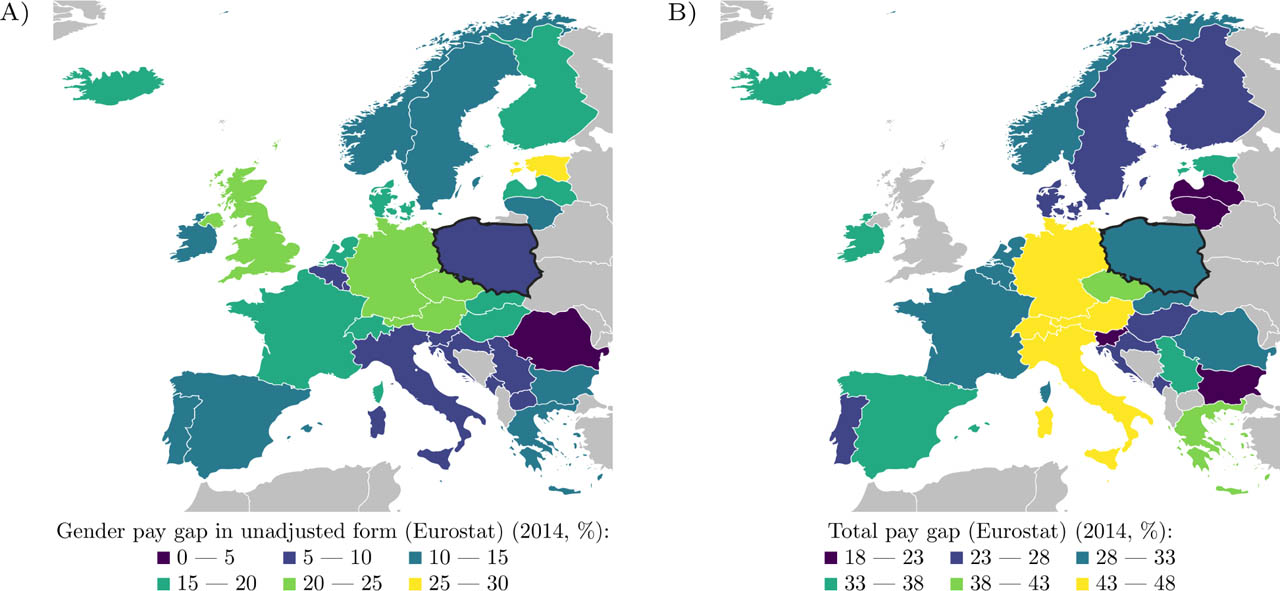
Figure A1.
(A) Unadjusted gender pay gap data from Eurostat show differences in hourly earnings. In this methodology, countries such as Romania, Italy and Poland share a very low (below 5%) value of GPG. (B) Gender overall earnings gap from Eurostat (2023): ‘The gender overall earnings gap is a synthetic indicator. It measures the impact of the three combined factors, namely: (1) the average hourly earnings, (2) the monthly average of the number of hours paid (before any adjustment for part-time work) and (3) the employment rate, on the average earnings of all women of working age - whether employed or not employed - compared to men.’ Here, countries with low female employment rates, which record the lowest gender wage gaps, such as Poland, Romania or Italy, actually score higher gender overall earnings gaps than the more gender-egalitarian Scandinavian countries, for example.

Figure A2.
Per cent of affirmative answers to two questions selected from the International Social Survey Programme: Family and Changing Gender Roles (ISSP Research Group, 2016). Data for 2012.
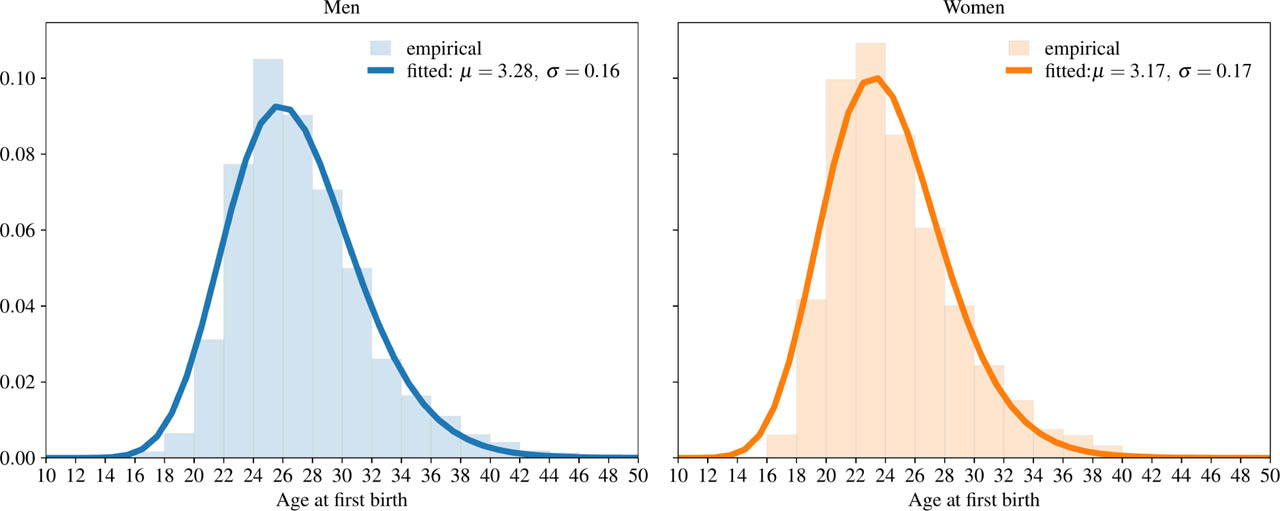
Figure A3.
Lognormal distributions were used compared with the empirical density of age at first birth.

Figure A4.
Share of working individuals as a function of time since first childbirth, compared with the control groups of childless individuals estimated with the placebo event method.