

1. Introduction
Poland has one of the lowest gender pay gaps in Europe (see Figure A1, Panel A). Additionally, it has one of the highest proportions of women employed in STEM 1 (Eurostat, 2022) and in managerial positions (Eurostat, 2021). Nevertheless, Poland remains a socially conservative country, with approximately 92% of the population aged 16 years and above identifying as Catholic (GUS [Statistics Poland], 2022; data for 2018). In recent years, women's rights have regressed, exemplified by the enactment of the abortion ban in January 2021, making Poland the only EU country where abortion is illegal. This disparity between the economic and social aspects of gender equality in Poland is the cornerstone of this study. We argue that the gender wage gap, which is the conventional way for assessing differential economic outcomes between women and men (e.g., Blau & Kahn, 2017; Goldin, 2014), is inadequate within the Polish labour market. The reason lies in Poland's low female labour force participation rates (Eurostat, 2025a). Framing the gender gap in economic outcomes through hourly wages overlooks nearly half of Poland's working-age population of women. Moreover, juxtaposing such calculations with those of Western European countries may inaccurately portray the economic equality seemingly experienced by Polish women. Instead, we focus on total personal monthly income after taxes (while also comparing it with standard calculations on hourly wages). Applying a modified placebo event method proposed by Kleven et al. (2019), we investigate the income trajectories of women and men in relation to their parental status. This approach quantifies the role of parenthood in shaping differential labour market outcomes of women and men and has been widely used in recent literature (e.g., Kleven et al., 2024, 2019).
While childless women often experience increasing earnings over their lifetimes, new mothers typically adjust their labour market behaviour and see declines in earnings, income, employment and hours worked, a phenomenon commonly referred to as the child penalty (Blau & Kahn, 2017). These penalties are intertwined with traditional gender norms (Cukrowska-Torzewska & Matysiak, 2020; Dominguez-Folgueras, 2022; Evertsson et al., 2025; van der Vleuten et al., 2024), although it remains unclear if such norms mediate or condition the declines in economic outcomes experienced by mothers. Initially, explanations for the causes of child penalties focused on disparities in human capital among workers (e.g., Altonji & Blank, 1999), but these theories were disproven, alongside explanations based on the biological costs of childbearing and access to policies that facilitate the combination of paid work and caregiving responsibilities (Andresen & Nix, 2022; Kleven, 2022; Kleven et al., 2021). This suggests that the origins of child penalties may lie elsewhere. While no research offers a definitive explanation for the causes of child penalties, a recent cross-country study by Kleven et al. (2024) has shown that they appear with increases in a country's development and wealth. However, two other studies set in Sweden and Norway identified a decrease in child penalties across generations, which coincided with economic growth and a substantial shift towards gender egalitarianism in those countries (Andresen & Nix, 2022; Sundberg, 2024).
In contrast to mothers, fathers are hypothesised to experience a child premium, typically defined by an increase in earnings following the birth of a child, which is not observed among childless men 2 . This premium arises from an uptick in hours worked, along with a propensity to take on additional jobs or pursue career changes leading to better-paying positions or promotions (Cukrowska-Torzewska & Matysiak, 2020). Previous studies primarily attributed these phenomena to the Beckerian specialisation hypothesis, rooted in neoclassical theories of time allocation (Becker, 1965). However, with the growing acceptance of women's employment and the narrowing of the gender gap in education, men's labour market advantages have substantially diminished, if not vanished entirely (Baranowska-Rataj & Matysiak, 2022). Recent research suggests that the relatively favourable labour market conditions of fathers compared to childless men may be influenced by normative perceptions of fatherhood (Hodges & Budig, 2010). In societies where masculinity is closely associated with the breadwinner role, fathers are perceived as ideal workers willing to commit to long hours with minimal disruptions from family obligations. Furthermore, the fatherhood child premium may be attributed to a selection mechanism, where men who are successful in the labour market and possess greater resources are more likely to have children (Baranowska-Rataj & Matysiak, 2022).
This paper offers two contributions. First, by focusing on Poland, we augment the gender economic literature on understudied Eastern European countries. Moreover, Poland presents an interesting case study in its own right due to the apparent gender neutrality of its labour market, as mentioned earlier and the largely ambiguous gender norms for women (see Section 2). We build upon two previous contributions on the gender gap in economic outcomes in Poland, both of which examined the gender pay gap (Cukrowska-Torzewska & Lovasz, 2016; Goraus et al., 2017). Through a decomposition approach, Cukrowska-Torzewska and Lovasz (2016) showed that the gender pay gap in Poland is primarily influenced by the fatherhood child premium, while the motherhood penalty plays a smaller yet significant role. Goraus et al. (2017) demonstrated that, after adjusting for employment selection, the gender pay gap doubles in magnitude compared to its unadjusted form. Although the study by Goraus et al. (2017) employed a different methodology from ours, its substantive contribution is the closest to ours in assessing the gender gap in income, that is, incorporating non-working women when investigating gendered labour market outcomes.
Similar to the aforementioned papers, much of the existing literature on this topic has relied methodologically on a decomposition approach (refer to Goraus et al., 2017, for a discussion), typically employing the Oaxaca–Blinder decomposition, occasionally supplemented by adjustments for selection into employment. Following the seminal work of Kleven et al. (2019), the literature has transitioned towards the event study approach (e.g., Andresen & Nix, 2022; Kleven, 2022; Kleven et al., 2021). The specific placebo event method shares similarities with the difference-in-differences design. However, this approach has seen limited application in studies conducted in countries lacking high-quality administrative birth registers accessible to researchers. This limitation may stem from the fact that, in the original approach of Kleven et al. (2019), counterfactual births are assigned to non-parents through numerical simulation 3 , introducing computer-generated noise into the estimates, which poses challenges with small sample sizes. Our second contribution to the literature is methodological: we modify the placebo event method by deriving an analytical solution for the numerical experiment (see Section 4), significantly reducing noise and enabling placebo event studies on a smaller sample – in our case, a limited-scale panel survey with two waves separated by 4 years, as opposed to longitudinal data in the method by Kleven et al. (2019) and repeated cross-sectional data in Kleven (2022) and Kleven et al. (2024). We illustrate the modified method using the Generations and Gender Survey (2010 and 2014 4 ), the only available Polish micro-level panel dataset containing information on both births (including parity) and income. Our proposed modification not only alleviates the difficulties of studying child penalties with smaller panel datasets but can also be applied in other settings where one is interested in outcome trajectories around an event. As such, it is a general use method for studying dynamic processes with limited data.
2. Background
Our focus in this contribution is on Poland, the largest post-communist EU economy. Poland offers a compelling case for studying child penalties due to its ambiguous gender norms. While employment rates for both women (56% in 2010, 73% in 2024) and men (69%, 84%, respectively) were low in 2010 by Western European standards (Eurostat, 2025a), part-time work was rare – only 7% of all employees worked part-time in 2010, compared to 26% in Germany (6% and 29% in 2024; Eurostat, 2025c). This suggests a stratified pattern: women worked either full time or not at all. Normatively, both women and men are expected to work full time (Matysiak & Steinmetz, 2008; O'Reilly et al., 2014), reflecting communist-era policies that mandated full-time employment. However, communism upheld the dual earner–female double burden model rather than dismantling traditional roles (Fidelis, 2010). These patterns persist today: mothers often withdraw from the labour market until children enter kindergarten, and then they re-enter work swiftly to support household income (Matysiak, 2011). However, women's domestic workload declines as their financial contribution to the household budget increases, except in couples with traditional beliefs about gender norms (Magda et al., 2023).
The state has reinforced this model through implicit familialism, putting families under economic strain (Javornik, 2014). Institutional childcare was limited in 2010–2014 (Saxonberg & Szelewa, 2007; Szelewa & Polakowski, 2008), and fathers received just 2 weeks of paternity leave during that time. Paid parental leave lasted up to 12 months, and it was shareable, but only if the mother met the eligibility criteria (employed under a work contract). These deeply ingrained gendered patterns were evident in Poles' attitudes towards gender roles in 2012 (Figure A2).
These norms have been at least partially shaped by Catholicism. Nearly all adults identify as Catholic (GUS [Statistics Poland], 2022; data for 2018). The Catholic Church promotes traditional gender roles and opposes so-called ‘gender ideology’ (Szelewa, 2021; Szwed & Zielińska, 2017). Post-WWII, it resisted women's employment, later accepting it as an economic necessity for poorer households (Fidelis, 2010). Today, while it does not fundamentally object to female employment, it underscores that a woman's primary role is that of a homemaker and caregiver (Szwed & Zielińska, 2017). The Church also opposes reproductive and anti-violence legislation, positioning itself as a guardian of the traditional family against Western ‘moral decay’ (Szwed & Zielińska, 2017). It is widely regarded as a major barrier to feminism in Poland (e.g., Bystydzienski, 2001; Graff, 2007) and the key political power behind Europe's most restrictive abortion law (Szelewa, 2016).
Poland's 2010–2014 labour market dynamics reinforced gendered outcomes. After the transition from communism to the market economy, unemployment peaked at 20%, but steadily declined – despite the Great Recession, COVID-19 and automation – reaching 5% in 2024 (vs 12% in 2010–2014; GUS [Statistics Poland], 2025). Yet, low unemployment does not imply job quality. Between 2012 and 2016, Poland had the highest proportion of temporary employment in the EU (Lewandowski & Magda, 2023). Polish workers logged on average more hours annually (1,829 in 2010) than those in most OECD countries (e.g., 1,425 in Germany; OECD, 2025a). Self-employment was also high – 23% in 2010 vs 12% in Germany (OECD, 2025b). At the same time, labour protections were weak in 2010: compensation as a share of GDP (49%) was among the lowest, compared to 61% in Germany (UNECE, 2023). While real wages rose by 87% (2000–2021) and earnings inequality fell, inequality remained higher than that in most European countries (Lewandowski & Magda, 2023).
3. Data
We used both waves of the Polish Generations and Gender Survey (GGS), conducted in 2010 and 2014, to construct a panel. The wave-matched database comprised 12,294 respondents, with 61% being women. The variables of interest include the respondent's age, the birth year of the first child, self-reported total post-tax income and hours worked.
We categorised respondents as belonging to the childless group if they reported having no children by the second wave of the survey. The childlessness rate was approximately 15% for both women and men. Respondents with children were allocated to the mothers/fathers group if the year of their child's birth was known. Whenever possible, we used the specific month and day of the child's birth; otherwise, the date was set to the first day/month of the respective year.
Data from the first wave of GGS (2010) were used to measure income, while first childbirth year was picked from the second wave (2014). We used birth events in the years 2010–2014 to assess the anticipatory behaviour of parents and earlier births to measure child penalties. These were compared with a control group of non-parents who were age-matched to parents using a modified placebo event method.
The total personal income of each respondent was computed using the following questions from the first wave of the survey, in order of priority: the exact value of income, income bands and no income flag. If income was specified using income bands (consisting of 13 possible bands), the midpoint of the band was assigned as the respondent's income, except for the 10,000+ band, where 10,000 PLN was used as the midpoint (this applied to 15 cases in the dataset). Of the respondents, 72% provided the exact value of their income, 16% provided income in bands, 3% indicated having no income, 7% refused to answer and the remaining data were missing.
Data on total hours worked were computed by summing the responses to questions about the number of hours in the primary job and the number of hours worked in additional jobs. For individuals reporting no income in the GGS, both total income and hours worked were set to zero. This means that all calculations presented in the paper include people who report having no personal income.
Even though the employment rate in 2010 was around 56% for women and 69% for men (Eurostat, 2025a), 88% of respondents in our sample reported a positive income. This is plausible because the GGS income question is not restricted to labour earnings and may also include capital gains, social transfers or income from informal work. During the period covered by our analysis (2010–2014), Poland did not have particularly generous social transfers compared with other large European countries. Expenditure on social protection comprised 19% of GDP in 2012 (the earliest available year), compared with 28% in Germany, 29% in Italy and 34% in France (Eurostat, 2025b). Thus, social transfers were unlikely to account for a substantial share of respondents' reported incomes. In contrast, informal employment was considerably more prevalent in Poland – 14% in 2012, compared with 4% in Italy and 6% in France (data for Germany are unavailable for 2012; International Labour Organisation, 2025). Since parenthood imposes opportunity costs, we would generally expect it to affect all forms of work, with unprotected workers in the informal economy potentially being more severely impacted. However, we cannot differentiate between formal and informal sources of income, given data limitations.
Table A1 reports unmatched sample means by gender and parental status, as well as the number of observations in the dataset. Both fathers and mothers had higher average income than their childless counterparts. When excluding individuals with zero income or restricting the sample to full-time workers, this income gap narrows and even reverses for women. Fathers worked on average 13% more hours than childless men, whereas the corresponding difference for women – 2% – was much smaller. A similar pattern emerges when considering the share of individuals working at least 5 hours a week. However, the patterns diverge at higher intensity thresholds. Fathers were nearly twice as likely as childless men to work at least 60 hours a week. In contrast, childless women were 24% more likely than mothers to work at least 60 hours a week. This latter disparity also appears, though to a lesser extent, when examining the share working at least 40 hours a week.
3.1. Methodology
Most measures of labour market outcomes, such as income, are highly time-dependent, influenced by both age and the time elapsed since childbirth for parents. This presents a challenge when assessing their dependence on parenthood. Consequently, a simple quantification of these effects is typically achieved by either calculating the difference between parents and non-parents (e.g., Bergsvik et al., 2019; Blau & Kahn, 2017; Cukrowska-Torzewska & Lovasz, 2016) or determining the difference between pre-child and post-child outcomes (e.g., Andresen & Nix, 2022; Angelov et al., 2016; Cortes & Pan, 2020; Kleven et al., 2019) but not both simultaneously.
Further insight can be gained from a difference-in-differences setting, which combines both aforementioned approaches. This method relies on an assumption that the pre-child behaviours of the reference and treatment groups are comparable. This condition holds true, for instance, in Denmark, as demonstrated by Kleven et al. (2019). However, as we illustrate in Section 5, this is not the case for Poland. To apply a difference-in-differences approach, the reference population must be matched with the treatment population by age.
The method employed in the robustness check of the seminal paper by Kleven et al. (2019, p. 195) involved generating a ‘placebo birth event’ for childless individuals by randomly drawing the age at first birth from an appropriate distribution. The resulting dataset could be analysed in a similar manner to the dataset of parents, enabling the quantification of a typical trajectory of, for instance, income given the number of years prior to or following the birth event (whether placebo or genuine).
The method, as used by Kleven et al. (2019), which relies on numerical simulation to assign placebo births to childless individuals, tends to increase the noise in the placebo sample unnecessarily. Although measurement uncertainty is typically negligible in population-wide datasets, it can become prohibitively large with smaller samples. Since we have no particular preference for one sample of age at first placebo birth over another drawn from the same distribution, we could, in theory, repeat the numerical experiment numerous times. Consequently, we could obtain estimates that are entirely independent of the idiosyncrasies of the computer-drawn sample. By computing (analytically) the expected value of the placebo group outcome measure under repeated re-randomisation of the placebo births, we completely eliminate the noise arising from the numerical randomisation procedure.
To obtain the placebo-event-centred trajectory Zτ of an outcome of interest (where τ represents the time since the event), one simply computes an appropriately weighted average of the outcome of interest Yt in age groups t, with the weights determined by the probability mass function p(t) of the age at the event
where the normalisation factor in the denominator arises from the age range available in the dataset. The weights p(t) can be in theory derived from any distribution. Similar to Kleven et al. (2019), we assume that the age at first birth follows a lognormal distribution, which also fits well our empirical data (see Figure A3).Since the transformation (1) is a linear map on the Yt vector of age group means (each with an independent error related to the precision of outcome measurement), the computation of the variance of each of the Zτ variables is straightforward and done with a similar expression (unfortunately, the covariance Zτ is not diagonal).
Consequently, compared to Kleven et al. (2019), we decrease the standard error by a factor of approximately √M, where M represents the number of bins in the age at first birth distribution (in our case, yearly bins, resulting in a reduction by a factor of approximately 5; for monthly bins, the reduction is by a factor of approximately 12). The difference stems entirely from the construction of the method: in Kleven et al. (2019), information for person a is used for computing the average of the outcome in one time point only, while in our approach, it is used for such computation in every time point present in the dataset, albeit with an appropriate weight p(t).
In contrast to the method employed by Kleven et al. (2019), we report the absolute values of income instead of the differences relative to the value just before the birth event. This enables us to graphically compare pre-event trajectories between the treatment and the control group, including a constant offset which would be eliminated by the normalising procedure.
Given that both the time since first birth and the age increase over time, distinguishing between cohort and event effects can pose a challenge. When we examine values proximate to the event, the time elapsed since the event becomes a more significant variable. Conversely, for larger values of lag, the cohort of the individual can be predicted with considerable accuracy based on the time elapsed since birth (all births under consideration happen within 4 years). The timescale of our analysis is therefore determined by the standard deviation of the age at first birth, which in our dataset amounts to 4.58 years. The concept of proximity to or distance from the event should be measured against this standard deviation. Consequently, data for lags smaller than 10 years can be interpreted akin to a pseudo-panel, while greater caution is needed for larger lags.
After investigating the time-dependent trajectories, we compute the value of the gender wage gap and the gender gap in income in the observed scenario and in the counterfactual one, where no one has any children. The counterfactual values of the variable of interest Y (income or wage) for an individual i of gender g and agei result from a regression of the form:
where c is a child dummy variable. Due to the small size of our dataset, the age variable was rounded to the nearest multiple of 5. The regression parameters from Eq. (2) are used to compute the counterfactual income for each individual in the counterfactual scenario where the entire population is childless, as A simple average over i is then computed to get a single value of income (or wage) in the counterfactual scenario for both genders. We then compare the counterfactual outcomes of women and men with the observed ones, thereby assessing the impact of parenthood on gender gaps in income and wages.The two exercises presented here, that is, the quantification of outcome trajectories for parents and the placebo sample, as well as the computation of outcome in the counterfactual scenario, represent two approaches to the same issue. The first exercise allows for a detailed examination of the outcome trajectories, while the second one can be characterised as presenting an aggregate statistic of those trajectories.
The data presented allow for a difference-in-differences analysis. We present DID estimates of the effects of childbirth on income and working time in Tables A2–A6 in the appendix. For the purpose of this exercise, we use the average of t – 3, t – 2 and t – 1 as the pre-treatment period and t + 2 and t + 3 as the post-treatment period, with the t + 0 and t + 1 periods excluded due to the pre-maternity leave income reporting methodology of the GGS. We view these estimates as misidentified because the parallel pre-trends assumption required for DID validity is violated, best exemplified by the fathers–non-fathers comparison.
The case of the mothers–non-mothers comparison is more subtle: while the pre-trend of mothers is generally parallel to that of non-mothers, the typical interpretation of the child penalty relies heavily on equal pre-trends (rather than just parallel pre-trends). When the motherhood penalty is analysed using a DID methodology, anticipation and follow-up effects are conflated into a single aggregate figure, which, when interpreted as a pure follow-up effect, exaggerates the true difference (17% compared to 60%).
4. Results
Figure 1 shows the income trajectories around the birth event for mothers, fathers and placebo parents. Mothers clearly fall behind the control group after birth if one compares the income trajectory of mothers to the trajectory of women without children (placebo events). Mothers' income declines by about 17% after birth when comparing the average level in t + 2 and t + 3 to the average level in t – 3, t – 2 and t – 1 (Table A2, column diff. D−C for mothers), a figure comparable with 21% in Pałka (2024) on population-wide register data. In contrast to countries such as Denmark (Kleven et al., 2019), Italy (Casarico & Lattanzio, 2023) or Norway (Andresen & Nix, 2022), it is not true that future mothers and fathers follow the same path as the counterfactual parents – they typically earn more in total, and this effect persists permanently after birth for fathers.
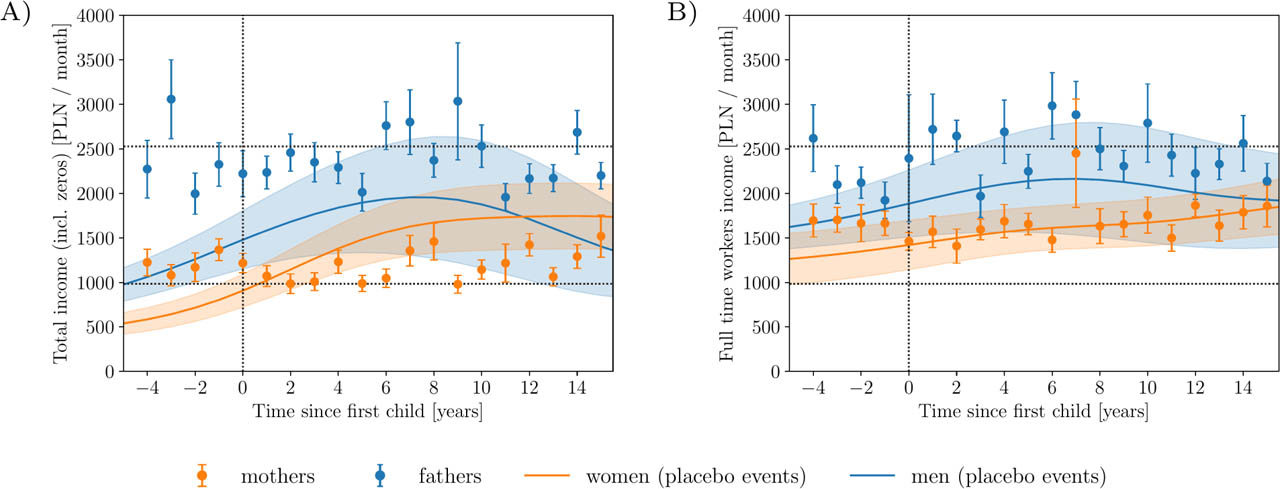
Figure 1.
(A) Mean of individual income of mothers and fathers (post-tax, including individual transfers and individuals with no income and excluding household transfers) as a function of time since first childbirth, compared with the control groups of childless individuals estimated with the placebo event method. The horizontal lines show the minimum wage post-tax (2010) and the mean wage of full time (40 hours/week) workers in companies employing more than 9 workers (2010, tax adjusted). (B) Analogous estimations to Panel A calculated for individuals working full time.
A further issue with the assumption that both mothers and fathers, as well as the respective control groups, follow the same trajectories before birth is that fathers are typically older than mothers at the moment of the first childbirth, and they are at a different stage of the typical income trajectory. This alone would result in a total income differential between the control groups at the moment of birth of nearly 100% based on the placebo-event estimates (Figure 1, Panel A).
The deviations in total income between control groups and treated groups almost disappear when we restrict the dataset to only workers working 40 hours a week (the standard work contract), as shown in Figure 1, Panel B. Both the counterfactual trends and parental observations eventually converge to a similar value. The drop in wages experienced by mothers around the birth event is smaller than in the case of income and equal to 10% (Table A3, column diff. D–C for mothers). Hourly wage rates (specifically of full-time workers) have often been a primary variable of interest in studies of the motherhood penalty (e.g., Blau & Kahn, 2017; Cukrowska-Torzewska & Matysiak, 2020; Goldin, 2014). However, in the case of Poland, it seems that parenthood's impact on earnings through that channel is smaller, albeit persistent over a long time.
Anticipatory behaviour is visible when comparing the mean values of the total number of hours worked per week for women (see Figure 2, Panel A). Here, future mothers work nearly 50% more hours than the control group just before giving birth, only to fall below the trend in the later years (but eventually rejoin the trend after about 15 years). At the same time, fathers work more hours (about 30%) than their control group, and this effect appears to be permanent. A very similar pattern emerges when analysing the share of individuals working at least 40 hours a week (Figure 2, Panel B, Table A5) or at the share of people working at least 5 hours a week, which is our approximation of the employment status (Figure A4, Table A6).
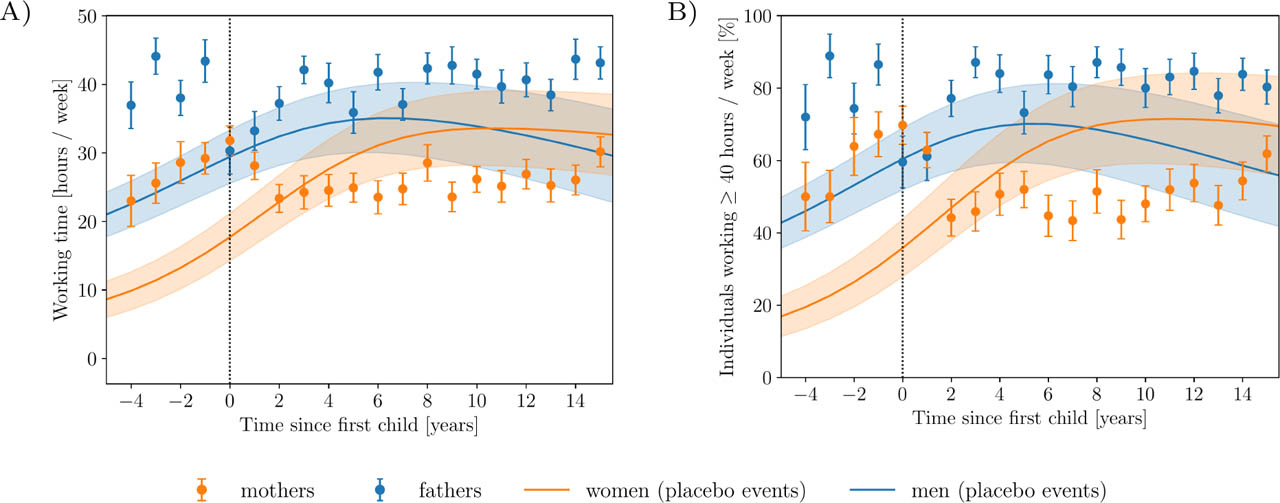
Figure 2.
(A) Mean number of hours worked as a function of time since first childbirth compared with the control group of childless individuals, estimated with the placebo event method (including the non-working population). The unexpectedly high number of hours worked for mothers in the first year after birth is an artefact of the questionnaire's design: women on maternity leave are asked about the number of hours in the last job before taking the leave. (B) Percentage of population working at least 40 hours a week.
Finally, we compare the income and wages (Figure 3, Panels A and B, respectively) of the women and men in the GGS with the counterfactual scenario where the entire population is childless. The real gender gap in income is around 33%, while the counterfactual gap is not statistically significant. Similarly, the gender wage gap of full-time workers is around 20%, while the counterfactual gap is not statistically significant.
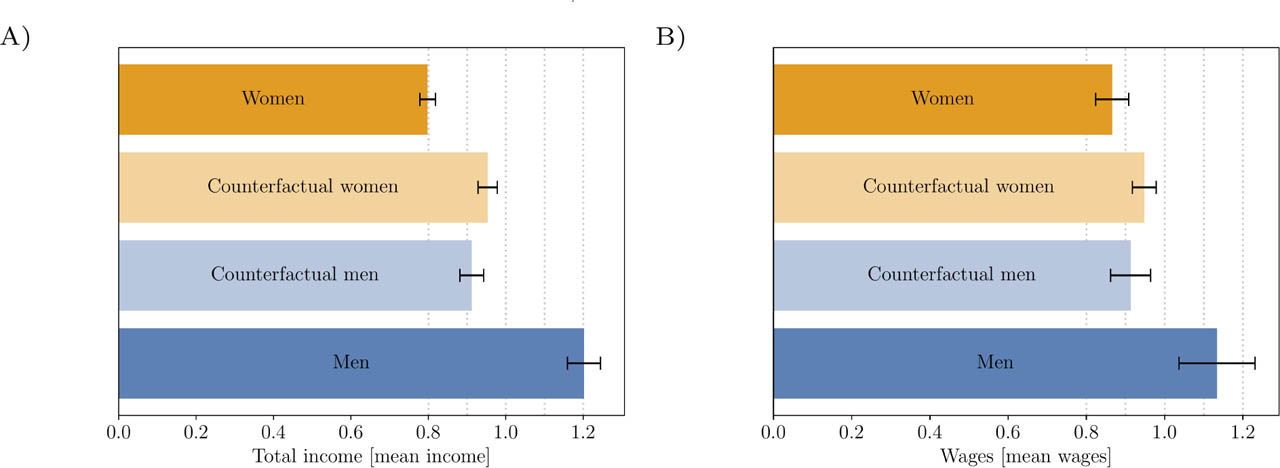
Figure 3.
(A) Total income and total counterfactual income as a multiple of the real mean total income with confidence bands determined by bootstrap (1σ CI of 50 rounds). Incomes taken from the 2010 survey and child data from the 2014 survey (hence the adjustment includes anticipatory behaviours). (B) Hourly wages of people working 40 hours a week as a multiple of the mean value in that group (1σ CI of 50 bootstrap rounds).
5. Discussion
We conclude that parenthood in Poland mainly has a significant impact on labour force participation and the willingness to work more hours than the standard contract.
First, concerning women, we find that the earnings penalty is transient and that this effect is almost entirely mediated by the mean number of hours worked. The fact that mothers return to their pre-birth income trajectory after 15 years might be driven by the normalisation of full-time employment for women in Poland. Consequently, even if women in Poland experience birth-related work disruptions, which can be especially long (until the child goes to primary school), they usually return to full-time employment. A general decrease in the number of hours worked by women in Poland is similar to the cases in Western Europe but is not universal worldwide or even in Europe, with opposite effects observed, for example, in Belarus (Ganguli et al., 2014).
Second, concerning men, we find that fathers consistently work more than the childless control group, both before and after childbirth. This shows that it is entirely possible to have a fatherhood premium without a significant jump at the birth event, likely due to a selection mechanism in which more affluent men have children.
Our comparison of the gender gaps in income and wages between women and men in the GGS sample and the counterfactual scenario uncovers that both gaps are driven by parenthood. However, our analysis of the income trajectories shows that these effects stem from differences in labour market participation and hours worked, rather than wage rates. Thus, our results suggest that more focus is needed on the number of working hours and labour force participation in general when assessing the impact of parenthood on the economic outcomes of women and men.
Previous research has developed event study methods using both longitudinal register data (Kleven et al., 2019) and large cross-sectional surveys (Kleven, 2022). Our proposed approach demonstrates that it is feasible to implement an event study with a control group even on unbalanced, small-sample panel data, such as the Generations and Gender Survey. Although our exercise relied on such data and matching was limited to only age, the resulting estimates are comparable to those obtained in previous studies on child penalties in Poland, which used substantially larger datasets (Kleven et al., 2024; Pałka, 2024). Consequently, we recommend applying our method primarily in small-sample panel settings where state-of-the-art approaches may be impractical.
Appendices
Appendix
Table 1.
Sample means (2010) by gender and parental status (2014), unmatched
| Men | Women | |||
|---|---|---|---|---|
| Parents | Non-parents | Parents | Non-parents | |
| Mean total income (PLN) | 2015.19 | 1222.75 | 1222.58 | 1134.38 |
| Mean income (excl. zeros) | 2086.39 | 1557.66 | 1387.13 | 1482.71 |
| Mean hours worked | 24.71 | 21.85 | 15.20 | 14.88 |
| Mean income (full-time workers) | 2385.86 | 1871.62 | 1757.71 | 1840.50 |
| Percent working ≥5 hours | 54.34 | 51.16 | 38.32 | 37.19 |
| Percent working ≥40 hours | 49.34 | 43.59 | 29.55 | 30.38 |
| Percent working ≥60 hours | 8.09 | 4.45 | 1.88 | 2.33 |
| Number of observations | 3194 | 986 | 5766 | 962 |
Difference-in-differences estimates
Below, we present the results of a difference-in-differences analysis of the placebo event–centred trajectories, using the average of t – 3, t – 2 and t – 1 as the pre-treatment observation and the average of t + 2 and t + 3 as the post-treatment observation, with standard errors in parentheses. The standard errors for the differences in non-parent outcomes account for the correlation structure of the placebo trajectories. These estimates are provided to facilitate comparison across methods, as the parallel trends assumption is violated in at least some cases.
Table 2.
Difference-in-differences estimates of the effect of childbirth on total income (including zeros), by gender
| Men | Women | |||||
|---|---|---|---|---|---|---|
| Pre (A) | Post (B) | Diff. (B–A) | Pre (C) | Post (D) | Diff. (D–C) | |
| Parents (1) | 2459.7 | 2403.9 | −55.8 | 1205.8 | 997.7 | −208.1 |
| (196.4) | (170.0) | (259.8) | (83.6) | (80.3) | (115.9) | |
| Non-parents (2) | 1369.1 | 1803.9 | 434.8 | 808.6 | 1323.9 | 515.3 |
| (56.3) | (116.5) | (78.5) | (37.3) | (71.3) | (45.9) | |
| Diff. (1–2) | −490.6 | −723.4 | ||||
| (271.4) | (124.7) | |||||
Table 3.
Difference-in-differences estimates of the effect of childbirth on the income of full-time workers, by gender
| Men | Women | |||||
|---|---|---|---|---|---|---|
| Pre (A) | Post (B) | Diff. (B–A) | Pre (C) | Post (D) | Diff. (D–C) | |
| Parents (1) | 2046.9 | 2306.6 | 259.7 | 1677.4 | 1501.5 | −175.8 |
| (114.0) | (148.3) | (187.0) | (94.9) | (112.1) | (146.8) | |
| Non-parents (2) | 1824.8 | 2083.0 | 258.2 | 1383.3 | 1550.8 | 167.6 |
| (65.6) | (129.3) | (80.1) | (74.0) | (63.6) | (51.2) | |
| Diff. (1–2) | 1.5 | −343.4 | ||||
| (203.4) | (155.5) | |||||
Table 4.
Difference-in-differences estimates of the effect of childbirth on working time (hours/week), by gender
| Men | Women | |||||
|---|---|---|---|---|---|---|
| pre (A) | post (B) | diff. (B–A) | pre (C) | post (D) | diff. (D–C) | |
| Parents (1) | 41.8 | 39.7 | −2.2 | 27.8 | 23.8 | −4.0 |
| (1.6) | (1.6) | (2.3) | (1.6) | (1.6) | (2.2) | |
| Non-parents (2) | 27.7 | 33.9 | 6.2 | 15.4 | 26.5 | 11.1 |
| (0.9) | (1.1) | (0.7) | (0.8) | (1.1) | (0.7) | |
| Diff. (1–2) | −8.4 | −15.1 | ||||
| (2.4) | (2.3) | |||||
Table 5.
Difference-in-differences estimates of the effect of childbirth on the share of people working full time (at least 40 hours a week), by gender
| Men | Women | |||||
|---|---|---|---|---|---|---|
| pre (A) | post (B) | diff. (B–A) | pre (C) | post (D) | diff. (D–C) | |
| Parents (1) | 0.832 | 0.821 | −0.011 | 0.604 | 0.451 | −0.153 |
| (0.037) | (0.033) | (0.049) | (0.042) | (0.037) | (0.056) | |
| Non-parents (2) | 0.568 | 0.689 | 0.121 | 0.310 | 0.549 | 0.239 |
| (0.020) | (0.025) | (0.016) | (0.018) | (0.026) | (0.015) | |
| Diff. (1–2) | −0.132 | −0.392 | ||||
| (0.052) | (0.058) | |||||
Table 6.
Difference-in-differences estimates of the effect of childbirth on the share of people working at least 5 hours a week, by gender
| Men | Women | |||||
|---|---|---|---|---|---|---|
| Pre (A) | Post (B) | Diff. (B–A) | Pre (C) | Post (D) | Diff. (D–C) | |
| Parents (1) | 0.926 | 0.867 | −0.060 | 0.715 | 0.616 | −0.099 |
| (0.025) | (0.029) | (0.039) | (0.039) | (0.036) | (0.053) | |
| Non-parents (2) | 0.646 | 0.779 | 0.133 | 0.388 | 0.650 | 0.262 |
| (0.019) | (0.021) | (0.014) | (0.019) | (0.024) | (0.014) | |
| Diff. (1–2) | −0.193 | −0.361 | ||||
| (0.041) | (0.055) | |||||
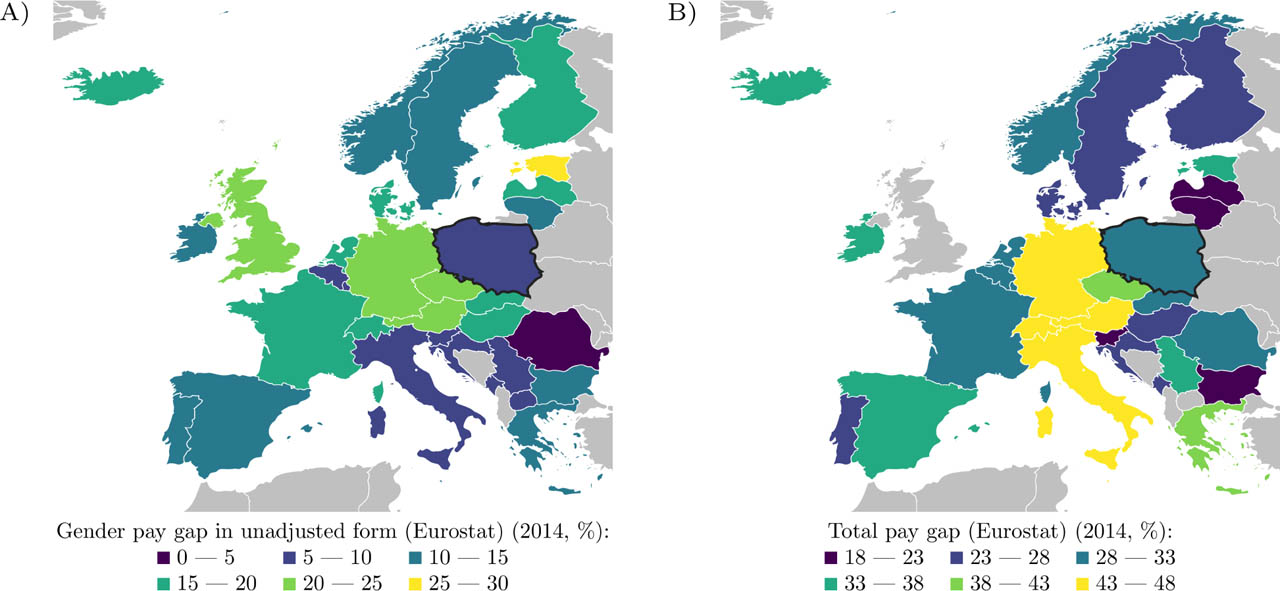
Figure A1.
(A) Unadjusted gender pay gap data from Eurostat show differences in hourly earnings. In this methodology, countries such as Romania, Italy and Poland share a very low (below 5%) value of GPG. (B) Gender overall earnings gap from Eurostat (2023): ‘The gender overall earnings gap is a synthetic indicator. It measures the impact of the three combined factors, namely: (1) the average hourly earnings, (2) the monthly average of the number of hours paid (before any adjustment for part-time work) and (3) the employment rate, on the average earnings of all women of working age - whether employed or not employed - compared to men.’ Here, countries with low female employment rates, which record the lowest gender wage gaps, such as Poland, Romania or Italy, actually score higher gender overall earnings gaps than the more gender-egalitarian Scandinavian countries, for example.
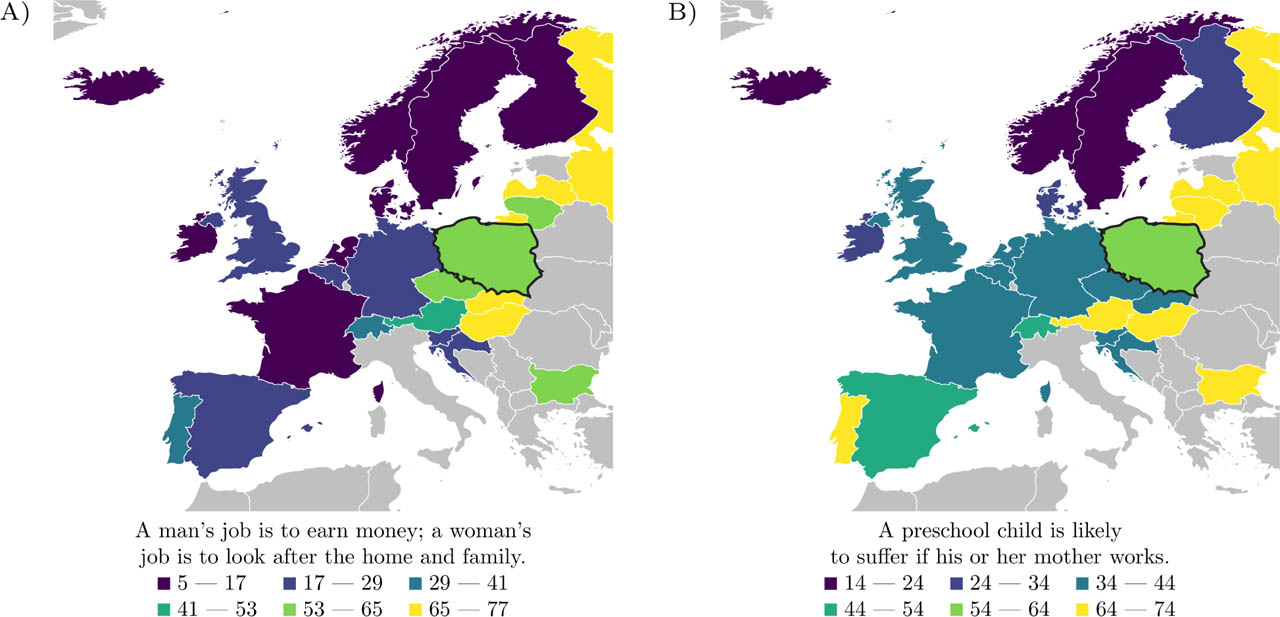
Figure A2.
Per cent of affirmative answers to two questions selected from the International Social Survey Programme: Family and Changing Gender Roles (ISSP Research Group, 2016). Data for 2012.
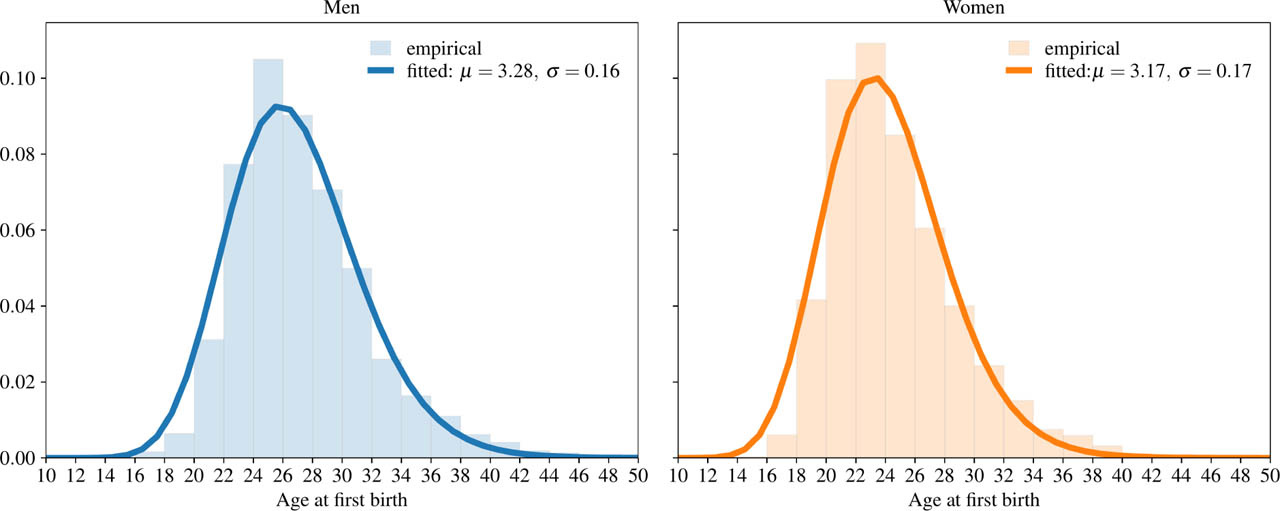
Figure A3.
Lognormal distributions were used compared with the empirical density of age at first birth.
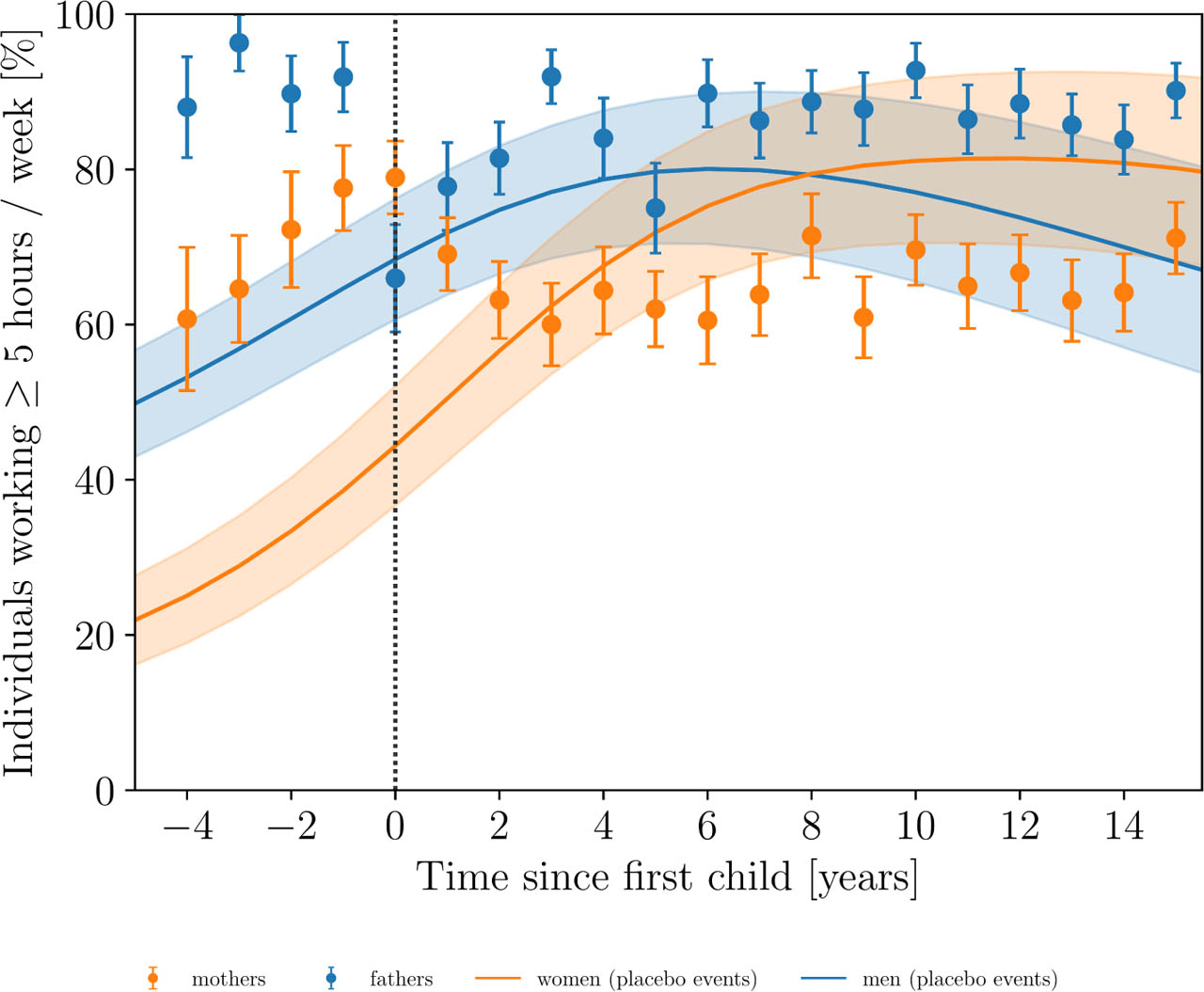
Figure A4.
Share of working individuals as a function of time since first childbirth, compared with the control groups of childless individuals estimated with the placebo event method.