

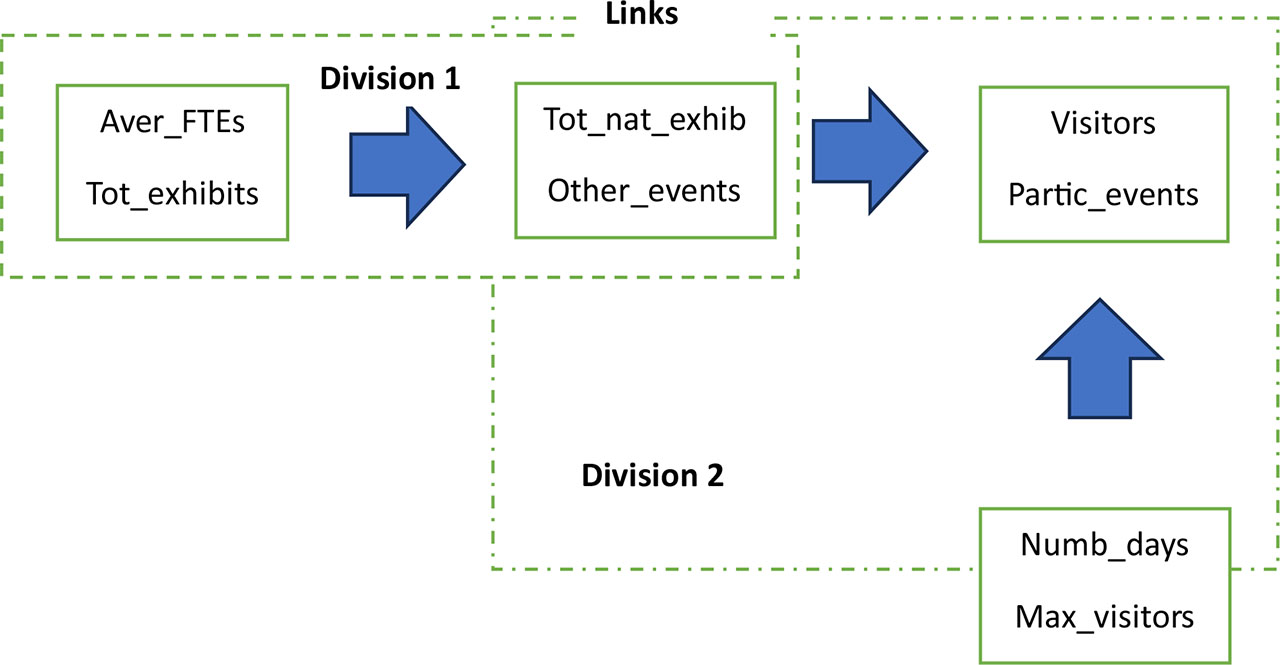
Figure 1.
The model of the study of museums adopted in the analysis
Source: own elaboration
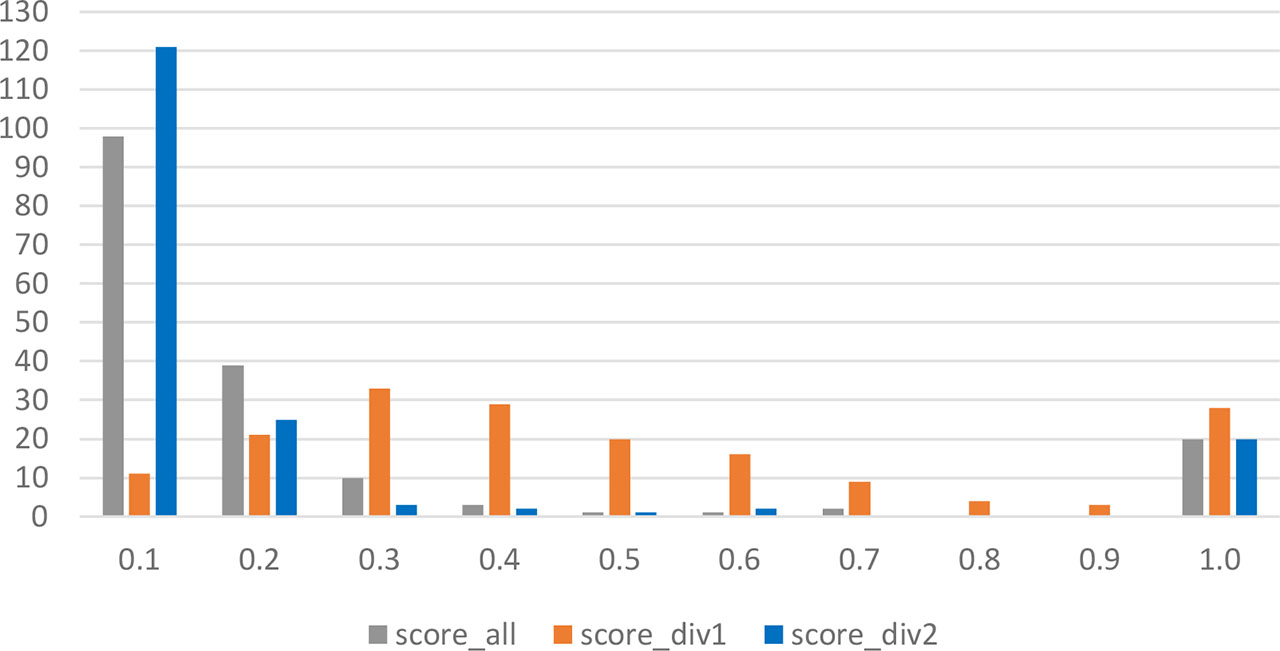
Figure 2.
Histograms of efficiency indicators
Source: own elaboration
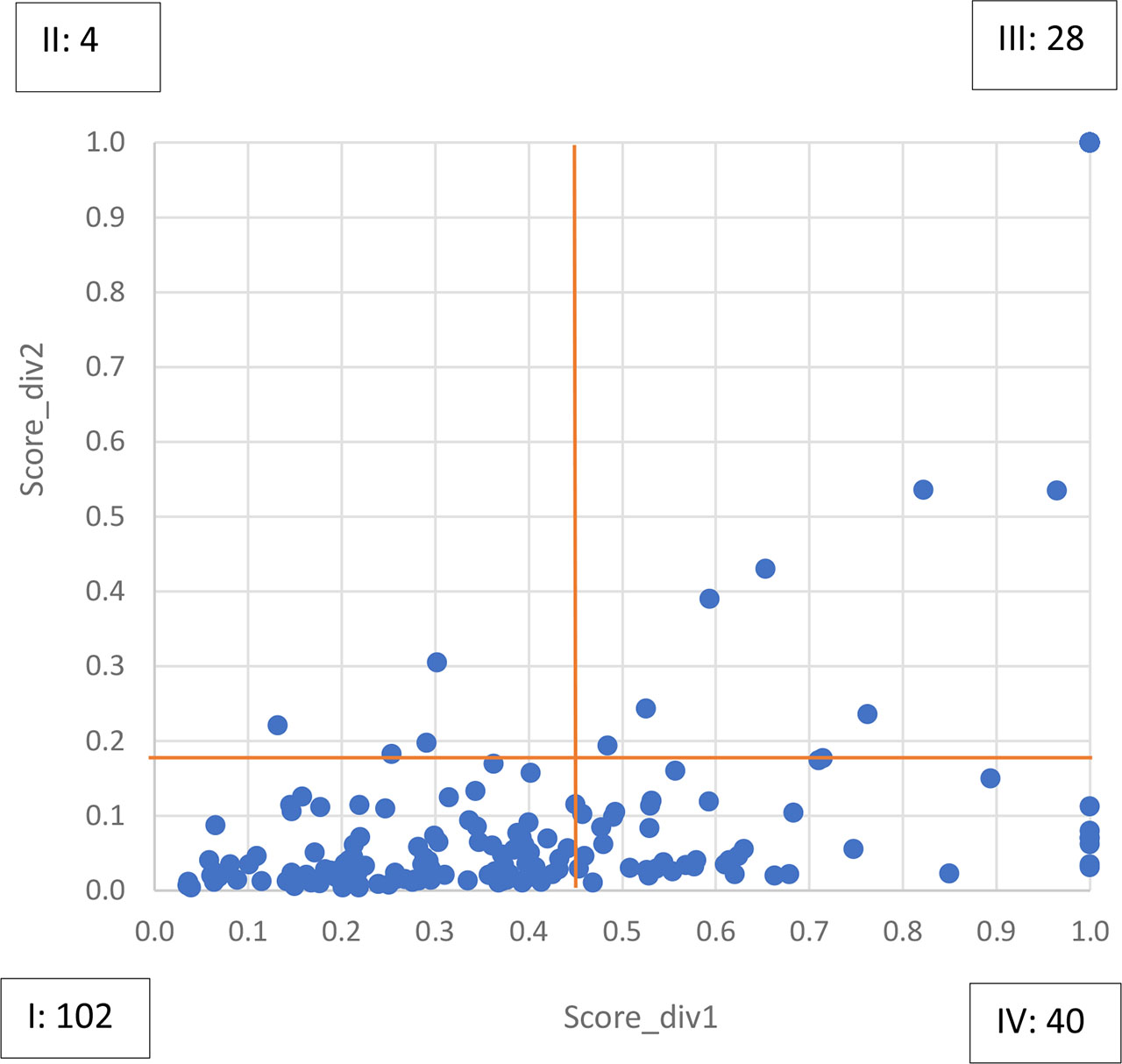
Figure 3.
Comparison of the efficiency of museums in individual divisions in relation to the average measure of efficiency for each
Source: own elaboration
Table 1.
A list of museums fully efficient in both divisions
| Name of the Museum | Div1 | Div2 | Managing Body |
|---|---|---|---|
| Central Museum of Prisoners-of-War | 1.00 | 1.00 | Voivodeship |
| Museum – House of the Pilecki Family in Ostrów Mazowiecki | 1.00 | 1.00 | MCNH |
| Museum - Manors of the Karwacjan and Gładysz Families in Gorlice | 1.00 | 1.00 | Voivodeship |
| Museum – Górków Castle in Szamotuły | 1.00 | 1.00 | District |
| Museum of the Battle of Grunwald in Stębark | 1.00 | 1.00 | Voivodeship |
| Częstochowa Museum | 1.00 | 1.00 | District |
| Museum of the History of the Polish People’s Movement in Warsaw | 1.00 | 1.00 | Voivodeship |
| Historical Museum in Lubin | 1.00 | 1.00 | Commune |
| Royal Łazienki Museum in Warsaw | 1.00 | 1.00 | MCNH |
| Museum of the City of Jaworzno | 1.00 | 1.00 | District |
| Dzierżoniów City Museum | 1.00 | 1.00 | Commune |
| The National Museum in Warsaw | 1.00 | 1.00 | MCNH |
| District Museum in Sieradz | 1.00 | 1.00 | District |
| Museum of King Jan III’s Palace at Wilanów | 1.00 | 1.00 | MCNH |
| Regional Museum in Kościan | 1.00 | 1.00 | Commune |
| Stanisław Staszic Museum in Piła | 1.00 | 1.00 | Commune |
| Stutthof Museum in Sztutowo | 1.00 | 1.00 | MCNH |
| Museum in Praszka | 1.00 | 1.00 | Commune |
| Armoury Museum at the Liw Castle | 1.00 | 1.00 | Voivodeship |
| Museum of the Sącz Land in Nowy Sącz | 1.00 | 1.00 | Voivodeship |
Table 2.
Museums that are most often components of benchmarks
| Name of the Museum | Division 1 | Division 2 |
|---|---|---|
| Museum - Manors of the Karwacjan and Gładysz Families in Gorlice | 126 | 0 |
| Museum of the Academy of Fine Arts in Warsaw | 0 | 44 |
| Henryk Sienkiewicz Museum in Wola Okrzejska | 11 | 37 |
| Royal Łazienki Museum in Warsaw | 26 | 152 |
| Museum of King Jan III’s Palace at Wilanów | 69 | 9 |
| Museum of Papermaking in Duszniki Zdrój | 95 | 0 |
| Armoury Museum at the Liw Castle | 0 | 41 |
| Museum of the Krajeńska Land in Nakło nad Notecią | 53 | 0 |
| Lp. | Objectives of the Museum’s Activities According to the Act | Name of the Report/Survey | Scope of Data |
|---|---|---|---|
| 1 | Collection of monuments in the statutorily defined scope | Report K-02 |
|
| Survey KK-3 DU | Section: Exhibition activities | ||
| 2 | Cataloguing and scientific processing of the collected collections | Report K-02 |
|
| Survey KK-3 ZZ |
| ||
| 3 | Storage of the collected artefacts in conditions ensuring their proper state of preservation and safety, and storing them in a manner accessible for scientific purposes | Report K-02 | Section: Storage and conservation (museum exhibitions are located in one object, Storage space) |
| Survey KK-3 IB |
| ||
| 4 | Securing and conservation of collections and, as far as possible, securing immovable archaeological monuments and other immovable objects of material culture and nature | Report K-02 | Section: Storage and conservation (number of exhibits subjected to conservation during the year) |
| Survey KK-3 ZZ | Section: Maintenance | ||
| 5 | Organization of permanent and temporary exhibitions | Report K-02 |
|
| 6 | Organizing research and scientific expeditions, including archaeological | ||
| 7 | Conducting educational activities | Report K-02 |
|
| 8 | Supporting and conducting artistic and cultural dissemination activities; | Report K-02 | Section: Other cultural, scientific and educational activities (number of events and number of participants: Lectures/lectures/meetings, Concerts, Film screenings) |
| 9 | Making collections available for educational and scientific purposes | Report K-02 |
|
| Survey KK-3 OZ | Question: Access to public information in the reporting period | ||
| Survey KK-3 DU | Section: Scientific activity Section: Educational activity | ||
| 10 | Ensuring appropriate conditions for visiting and using the collections and collected information | Report K-02 |
|
| Survey KK-3 OZ | Question: Availability of the museum/branch offer for visitors in the last reporting year (Number of days when the museum was open / branch was open to visitors, Total number of opening hours of the museum/branch in the last reporting year) | ||
| Survey KK-3 IB | Section: Architectural accessibility (What solutions ensuring the accessibility of horizontal and vertical communication were used in the building/buildings?) | ||
| Survey KK-3 DU |
| ||
| 11 | Conducting publishing activities | Report K-02 | Section: Publishing activity (number of titles divided into magazines and books, circulation) |
| Survey KK-3 DU | Section: Publishing activity |
| Autor | Inputs (I)/Outputs (O)/Intermediate inputs/outputs (Inter. I/O), Carry-over link (C-O) | Exogenous, external, environmental factors | Methodology | Country | Nr object | Period |
|---|---|---|---|---|---|---|
| Del Barrio-Tellado & Herrero-Prieto (2022) |
| - | Dynamic network SBM (DNSBM), dynamic Malmquist index based on DNSBM | Spain | 23 | 2008–2015 |
| Del Barrio-Tellado & Herrero-Prieto (2019) |
| No. of protected/listed cultural goods in the province, No. of hotel beds per km2 in the province, Km of motorway in the province, Institutions Dummy variable (Central/Regional Government), Years since it was opened, GDP per inhabitant in the region | SBM, Super-SBM, two-stage efficiency analysis (SBM, Super-SBM, SBM network + truncated regression) | Spain | 22 | 2008 and 2015 |
| Kim & Chung (2019) |
| - | SBM, Super-SBM | Korea | 13 | 2016 |
| Haruna et al. (2012) |
| - | SBM, network SBM | Japan | 49 | 1998 and 2006 |
| Plaček et al. (2017b) |
| The proportion of college graduates in population, self-sufficiency of municipalities (% share of own revenue from the total income of municipality, Debts/Net assets – expresses the share of municipality’s liabilities to the net assets of the municipality), Density of inhabitants, The average age of the municipality inhabitants, Share of households with the internet, The share of unemployed in the region, Number of public libraries in the region, GDP per capita of the region, Number of economic entities per inhabitant of the municipality | CCR, Regression OLS model | Czech Republic | 76 | 2015 |
| Guccio et al. (2020a) | I: Personnel, Exhibition space O: No. of total visitors, No. of visitors paying entrance fee, No. of visitors with free entrance, No. of temporary exhibitions, No. of visitors of temporary exhibitions | ICT services in museums: smartphone and tablet apps, multimedia devices, QR codes and PC/tablet devices, website, online catalogue, online ticket office, virtual visit, social media accounts, online selling of photos and prints, merchandising, newsletter and web community | 2-stage DEA | Italy | 107 | 2017 |
| Šebová (2018) |
| - | CCR, BCC | Slovakia | 11 | 2015 |
[i] Source: Brzezicki (2024)