


Fig. 1
Algorithm of model building
Source: Author
Algorithm 1
Hyperparameters tuning algorithm.
| 1. | For each pair of sets (Xi,Yi) ∈ S={(train, validation1), (train ∪ validation1, validation2), (train ∪ validation1∪ validation2, validation3)} next operations will be performed: |
| a. | the possibly largest group of hyperparameters will be selected according to best practice mentioned in literature, |
| b. | one-step-ahead prediction will be done, providing Xi as train set and Yi as test set, and then one model with the lowest RMSE will be chosen, with parameters Hi. |
| As a result, set {H1, H2, H3} is obtained. | |
| 2. | For Hi will be executed three predictions on each pair from S. In effect 3 RMSE will be received, from which the average will be calculated – Ai. As a result, set {A1, A2, A3} is obtained. |
| 3. | Hj will be chosen, where Aj = min{A1, A2, A3}. It is the best set of hyperparameters, which is believed to assure stable fit in future forecasts. |
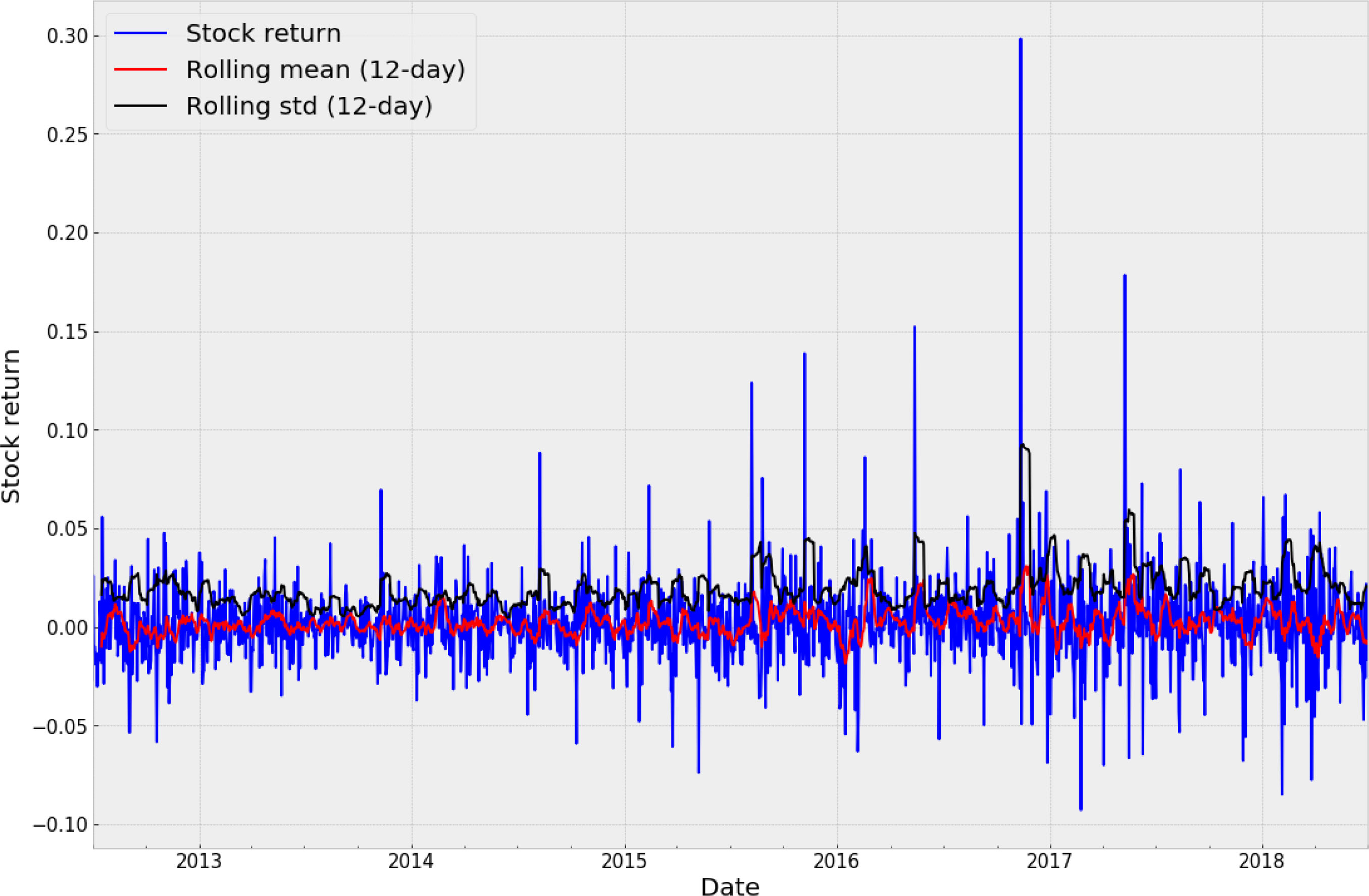
Fig. 2
Nvidia stock returns on in-sample set
Source: Authors calculations
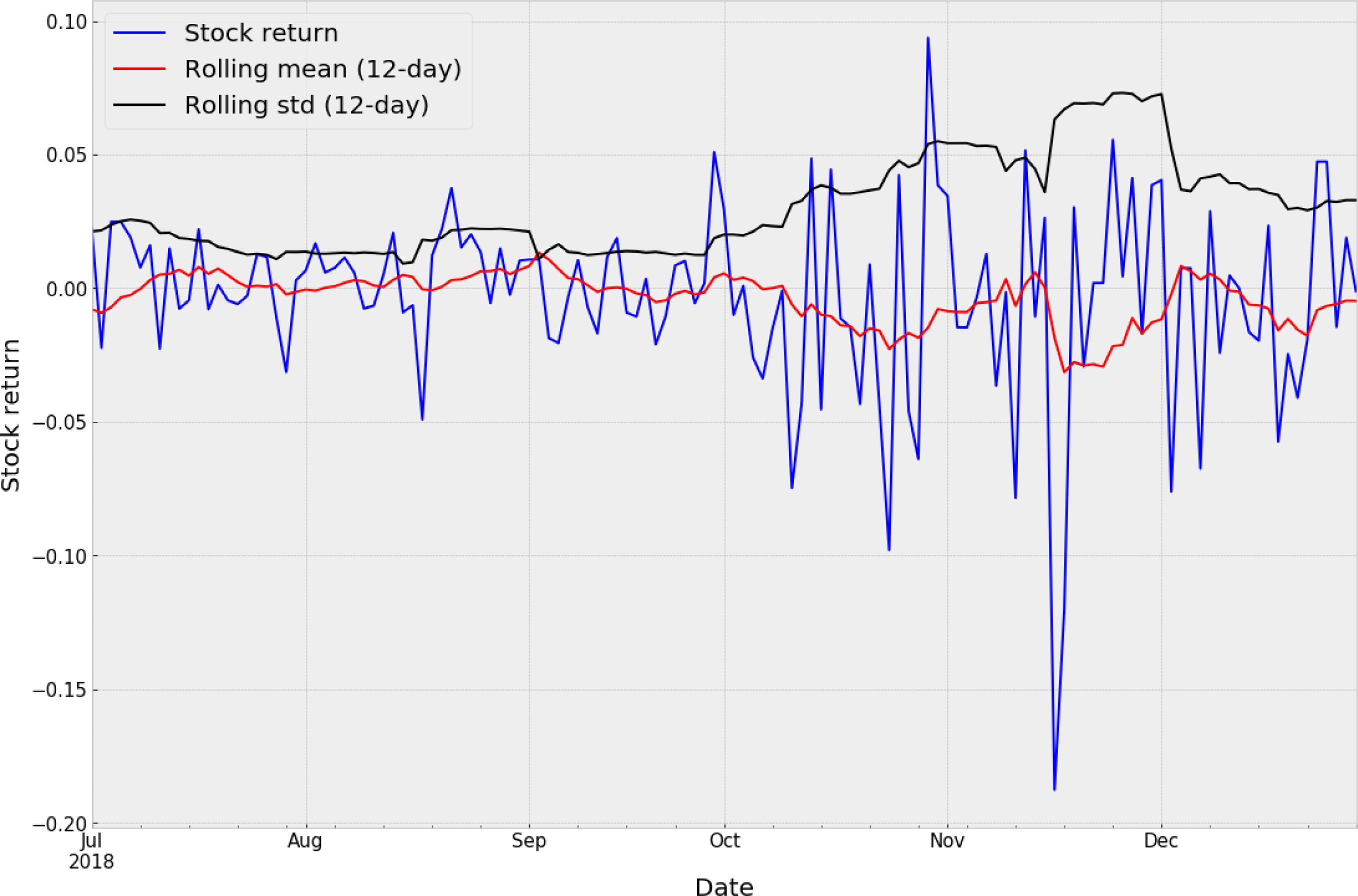
Fig. 3
Nvidia stock returns on out-of-sample set
Source: Authors calculations
Tab. 1
Results of Augmented Dickey-Fuller test for in-sample set and out-of-sample set
| Test statistic (in sample) | p-value (in sample) | Test statistic (out of sample) | p-value (out of sample) |
|---|---|---|---|
| −11.01 | <0.0001 | −11.09 | <0.0001 |
[i] Source: Authors calculations.
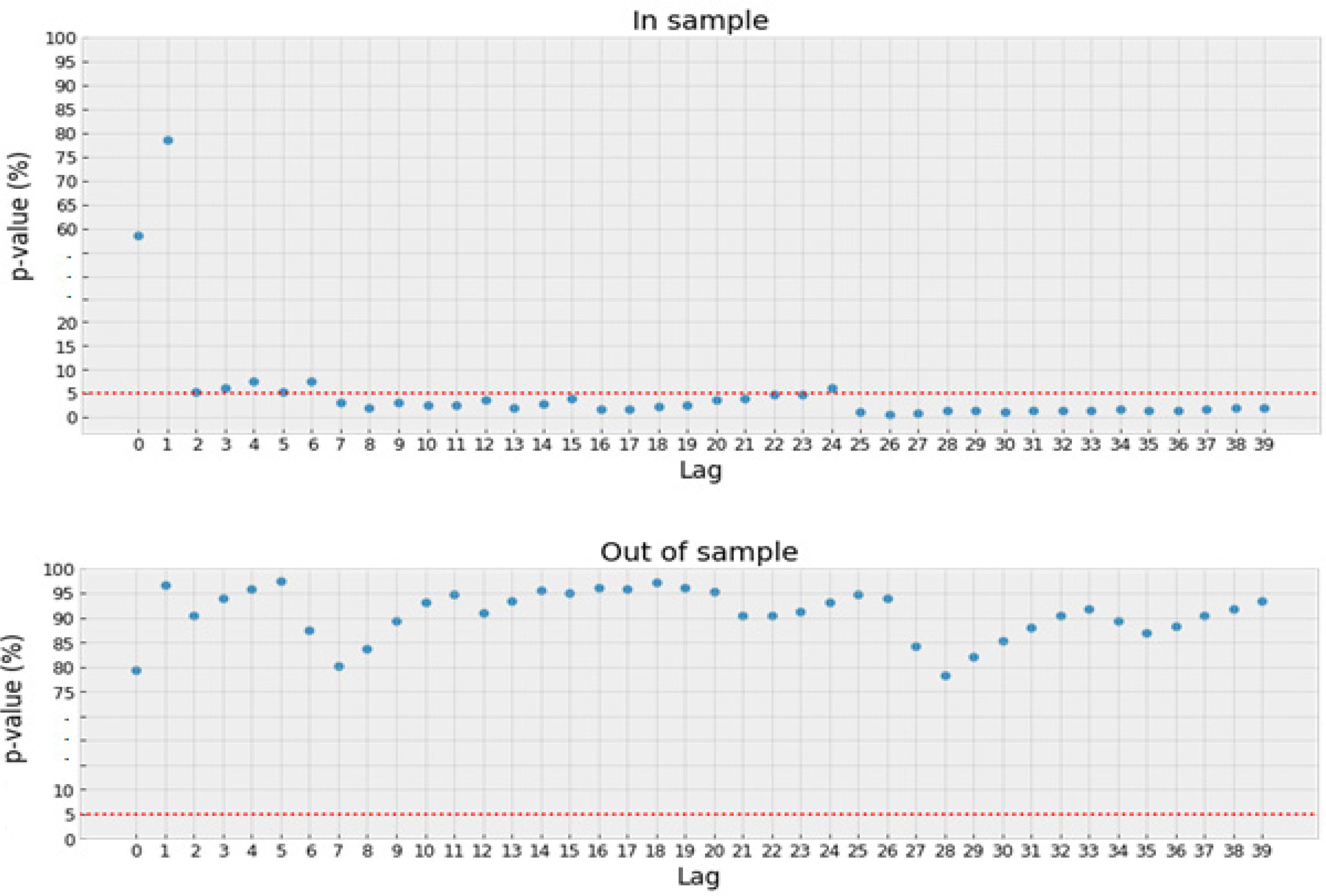
Fig. 4
Results of Ljung-Box test for in-sample set and out-of-sample set. Notes: Figure presents results of Ljung-Box test of white-noise hypothesis of Nvidia's stock returns on in-sample set and out-of-sample set
Source: Authors calculations
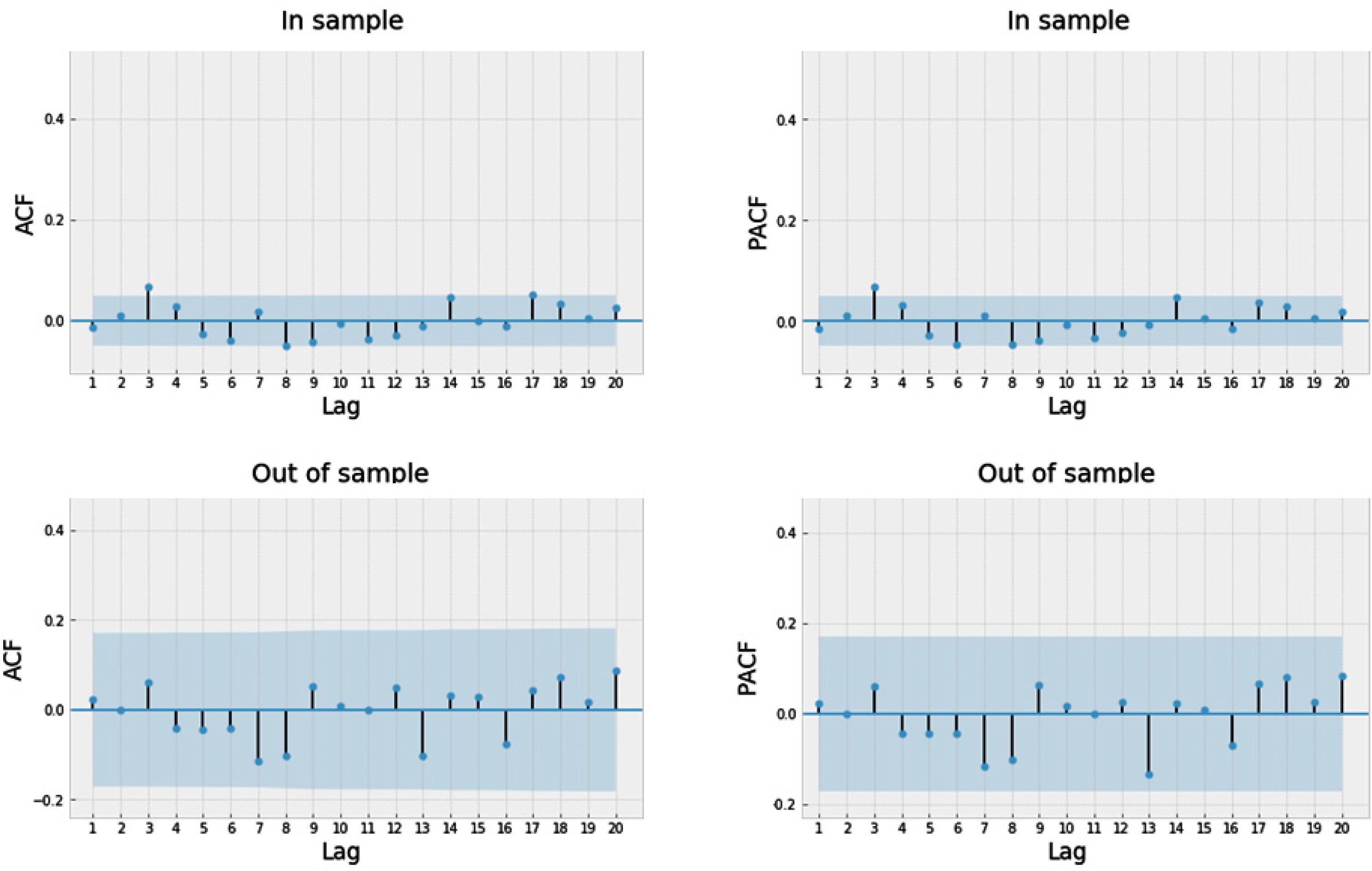
Fig. 5
ACF and PACF for in-sample and out-of-sample sets. Notes: Figure presents autocorrelation and partial autocorrelation plots of Nvidia's stock returns on in-sample and out-of-sample sets
Source: Authors calculations
Tab. 2
Results of singular models on validation and test set (based on stationary variables)
| Model (number of attributes) | Set | Hyperparameters | RMSE | MAE | MedAE |
|---|---|---|---|---|---|
| SVR (20) | Validation | C=0.005206 Epsilon=0.087308 | 0.026924 | 0.019478 | 0.014985 |
| SVR (20) | Test | C=0.005206 epsilon=0.087308 | 0.036014 | 0.024916 | 0.016682 |
| KNN (20) | Validation | Power of Minkowski metric=2 k=7 Weight function=uniform | 0.026328 | 0.020331 | 0.016199 |
| KNN (20) | Test | Power of Minkowski metric=2 k=7 Weight function=uniform | 0.039305 | 0.025935 | 0.017202 |
| XGBoost (27) | Validation | Max depth:7 Subsample: 0.760762 Colsample by tree: 0.199892 Lambda: 0.345263 Gamma: 0.000233 Learning rate: 0.2 | 0.027622 | 0.020678 | 0.016553 |
| XGBoost (27) | Test | Max depth:7 Subsample: 0.760762 Colsample by tree: 0.199892 Lambda: 0.345263 Gamma: 0.000233 Learning rate: 0.2 | 0.038848 | 0.027218 | 0.019782 |
| LGBM (43) | Validation | Number of leaves:58 Min data in leaf:21 ETA: 0.067318 Max drop: 52 L1 regularization: 0.059938 L2 regularization: 0.050305 | 0.025905 | 0.018803 | 0.014339 |
| LGBM (43) | Test | Number of leaves:58 Min data in leaf:21 ETA: 0.067318 Max drop: 52 L1 regularization: 0.059938 L2 regularization: 0.050305 | 0.038870 | 0.026283 | 0.016467 |
| LSTM (20) | Validation | H1 | 0.026565 | 0.019741 | 0.014537 |
| LSTM (20) | Test | H1 | 0.036705 | 0.024918 | 0.016772 |
[i] Notes: Table represents values of 3 metrics of estimation quality: RMSE; MAE; MedAE that SVR, KNN, XGBoost, LightGBM, LSTM (based on stationary variables) gained on validation and test set, number of attributes and values of hyperparameters.
[ii] H1: number of hidden layers: 1 LSTM layer with dense layer at the end; number of units on each layer: first layer with 20; number of epochs: 100; activation functions: sigmoid on first layer and linear on dense layer; optimiser function: Adam; batch size: 32; loss function: MSE.
[iii] Source: Author calculations.
Tab. 3
Results of singular models on validation and test set (based on stationary and non-stationary variables)
| Model (number of attributes) | Set | Hyperparameters | RMSE | MAE | MedAE |
|---|---|---|---|---|---|
| SVR (27) | Validation | C=0.005317, epsilon=0.092179 | 0.025632 | 0.019126 | 0.015488 |
| SVR (27) | Test | C=0.005317, epsilon=0.092179 | 0.041904 | 0.025875 | 0.017279 |
| KNN (40) | Validation | Power of Minkowski metric=1 k=6 Weight function=uniform | 0.027021 | 0.020110 | 0.013813 |
| KNN (40) | Test | Power of Minkowski metric=1 k=6 Weight function=uniform | 0.039313 | 0.026863 | 0.018946 |
| XGBoost (74) | Validation | Max depth:3 Subsample: 0.840403 Colsample by tree: 0.605006 Lambda: 4.461698 Gamma: 0.000808 Learning rate: 0.105 | 0.028021 | 0.021604 | 0.020396 |
| XGBoost (74) | Test | Max depth:3 Subsample: 0.840403 Colsample by tree: 0.605006 Lambda: 4.461698 Gamma: 0.000808 Learning rate: 0.105 | 0.040685 | 0.026906 | 0.016939 |
| LGBM (80) | Validation | Number of leaves:32 Min data in leaf:38 ETA: 0.099519 Max drop: 51 L1 regularization: 0.060221 L2 regularization: 0.050423 | 0.025840 | 0.019361 | 0.014083 |
| LGBM (80) | Test | Number of leaves:32 Min data in leaf:38 ETA: 0.099519 Max drop: 51 L1 regularization: 0.060221 L2 regularization: 0.050423 | 0.037284 | 0.026295 | 0.017959 |
| LSTM (20) | Validation | H2 | 0.028334 | 0.021702 | 0.018201 |
| LSTM (20) | Test | H2 | 0.039593 | 0.028891 | 0.020576 |
[i] Notes: Table represents values of 3 metrics of estimation quality: RMSE; MAE; MedAE that SVR, KNN, XGBoost, Light-GBM, LSTM (based on stationary and non-stationary variables) gained on validation and test set, number of attributes and values of hyperparameters.
[ii] H2: number of hidden layers: 2 LSTM layers with batch normalisation after both of them and dense layer at the end; number of units on each layer: first layer with 20 units and second with 32 units; number of epochs: 600; activation functions: sigmoid on first layer and linear on dense layer; optimiser function: SGD; regularization: bias regularizer at first layer and activity regularizer (L2) on second LSTM layer; dropout: 0.3 after first LSTM layer; batch size: 16; loss function: MSE.
[iii] Source: Authors calculations.
Tab. 4
Performance of ensemble models on test set (models based on stationary variables)
| Number of models | Models (weight) | RMSE | MAE | MedAE |
|---|---|---|---|---|
| 2 | LightGBM (0.508099), KNN (0.491901) | 0.038571 | 0.025784 | 0.017147 |
| 3 | LightGBM (0.342575), KNN (0.331655), LSTM (0.32577) | 0.037403 | 0.025111 | 0.015704 |
| 4 | LightGBM (0.260092), KNN (0.251801), LSTM (0.247333), SVR (0.240775) | 0.036181 | 0.024366 | 0.01599 |
| 5 | LightGBM (0.211671), KNN (0.204923), LSTM (0.201287), SVR (0.19595), XGBoost (0.18617) | 0.036106 | 0.024094 | 0.015307 |
[i] Note: Table represents performance of ensemble models on test set built of models based on stationary variables. Bold rows respond to the model with the lowest RMSE in that category of ensembling.
[ii] Source: Authors calculations.
Table 5
Performance of ensemble models on test set (models based on stationary and non-stationary variables)
| Number of models | Models (weight) | RMSE | MAE | MedAE |
|---|---|---|---|---|
| 2 | SVR (0.504057), LightGBM (0.495943) | 0.038730 | 0.025882 | 0.017714 |
| 3 | SVR (0.346773), LightGBM (0.341191), KNN (0.312036) | 0.038314 | 0.026003 | 0.016682 |
| 4 | SVR (0.268786), LightGBM (0.264459), KNN (0.241861), XGBoost (0.224895) | 0.038301 | 0.025793 | 0.016876 |
| 5 | SVR (0.220323), LightGBM (0.216777), KNN (0.198253), XGBoost (0.184346), LSTM (0.180301) | 0.038053 | 0.026068 | 0.016645 |
[i] Notes: Table represents performance of ensemble models on test set built of models based on stationary and non-stationary variables. Bold rows respond to the model with the lowest RMSE in that category of ensembling.
[ii] Source: Author calculations.
Tab. 6
Performance of ensemble models on test set (based on all models)
| Number of models | Models (weight) | RMSE | MAE | MedAE |
|---|---|---|---|---|
| 2 | S+NS SVR (0.504057), S+NS LightGBM (0.495943) | 0.03873 | 0.025882 | 0.017714 |
| 3 | S+NS SVR (0.337508), S+NS LightGBM (0.332075), S LightGBM (0.330417) | 0.038593 | 0.025959 | 0.017321 |
| 4 | S+NS SVR (0.255711), S+NS LightGBM (0.251594), S LightGBM (0.250338), S KNN (0.242357) | 0.038436 | 0.025665 | 0.017152 |
| 5 | S+NS SVR (0.206542), S+NS LightGBM (0.203217), S LightGBM (0.202202), S KNN (0.195756), S LSTM (0.192283) | 0.037734 | 0.025267 | 0.016599 |
| 6 | S+NS SVR (0.173976), S+NS LightGBM (0.171176), S LightGBM (0.170321), S KNN (0.164891), S LSTM (0.161965), S SVR (0.157671) | 0.03681 | 0.024751 | 0.01743 |
| 7 | S+NS SVR (0.150427), S+NS LightGBM (0.148006), S LightGBM (0.147266), S KNN (0.142572), S LSTM (0.140042), S SVR (0.136329), S+NS KNN (0.135359) | 0.036871 | 0.024897 | 0.016953 |
| 8 | S+NS SVR (0.133177), S+NS LightGBM (0.131034), S LightGBM (0.130379), S KNN (0.126223), S LSTM (0.123983), S SVR (0.120696), S+NS KNN (0.119837), S XGBoost (0.114672) | 0.036746 | 0.024681 | 0.01647 |
| 9 | S+NS SVR (0.119825), S+NS LightGBM (0.117896), S LightGBM (0.117307), S KNN (0.113568), S LSTM (0.111553), S SVR (0.108595), S+NS KNN (0.107822), S XGBoost (0.103175), S+NS XGBoost (0.100259) | 0.036898 | 0.024757 | 0.01645 |
| 10 | S+NS SVR (0.109125), S+NS LightGBM (0.107368), S LightGBM (0.106832), S KNN (0.103426), S LSTM (0.101591), S SVR (0.098897), S+NS KNN (0.098193), S XGBoost (0.093961), S+NS XGBoost (0.091305), S+NS LSTM (0.089302) | 0.036899 | 0.024915 | 0.016466 |
[i] Note: Table represents performance of ensemble models on test set built of all models. Bold rows respond to the model with the lowest RMSE in that category of ensembling.
[ii] Source: Author calculations.
Table 7
Performance of models on test set (based on stationary variables)
| Metric | SVR | KNN | XGBoost | LSTM | LGBM | Best ensemble | Naive model |
|---|---|---|---|---|---|---|---|
| RMSE | 0.036014 | 0.039305 | 0.038848 | 0.036705 | 0.038870 | 0.036106 | 0.050244 |
| MAE | 0.024916 | 0.025935 | 0.027218 | 0.024918 | 0.026283 | 0.024094 | 0.034908 |
| MedAE | 0.016682 | 0.017202 | 0.019780 | 0.016772 | 0.016467 | 0.015307 | 0.022378 |
[i] Note: Table represents performance of all models on test set based on stationary variables.
[ii] Source: Authors calculations.
Tab. 8
Performance of models on test set (based on stationary and non-stationary variables)
| Metric | SVR | KNN | XGBoost | LSTM | LGBM | Best ensemble model | Naive model |
|---|---|---|---|---|---|---|---|
| RMSE | 0.041904 | 0.039313 | 0.040685 | 0.039593 | 0.037284 | 0.038053 | 0.050244 |
| MAE | 0.025875 | 0.026863 | 0.026906 | 0.028891 | 0.026295 | 0.026068 | 0.034908 |
| MedAE | 0.017279 | 0.018946 | 0.016939 | 0.020576 | 0.017959 | 0.016645 | 0.022378 |
[i] Note: Table represents performance of all models on test set based on stationary and non-stationary variables.
[ii] Source: Authors calculations.
Tab. 9
Performance of best models on test set (ensemble and primary models)
| Metric | Best stationary ensemble model | Best stationary + non-stationary ensemble model | Best ensemble model based on all models | Best stationary model – SVR | Best stationary + non-stationary model − LGBM | Naive model |
|---|---|---|---|---|---|---|
| RMSE | 0.036106 | 0.038053 | 0.036746 | 0.036014 | 0.037284 | 0.050244 |
| MAE | 0.024094 | 0.026068 | 0.024681 | 0.024916 | 0.026295 | 0.034908 |
| MedAE | 0.015307 | 0.016645 | 0.01647 | 0.016682 | 0.017959 | 0.022378 |
[i] Note: Table represents compof performances of best singular and ensemble models from each category and naive model on test set.
[ii] Source: Authors calculations.
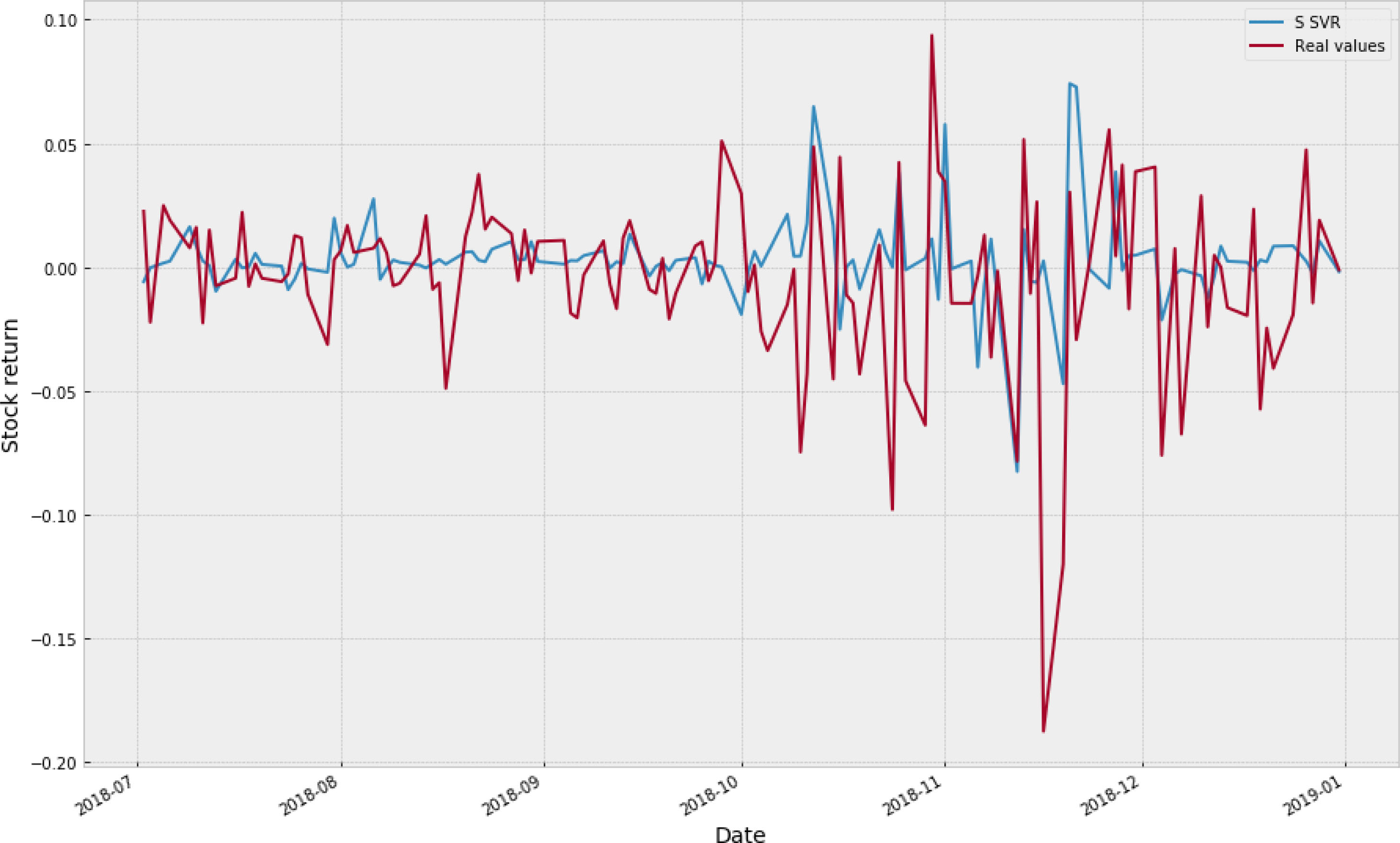
Fig. 6
Performance on test set of the best model in research – SVR (based on stationary variables)
Source: Authors calculations