

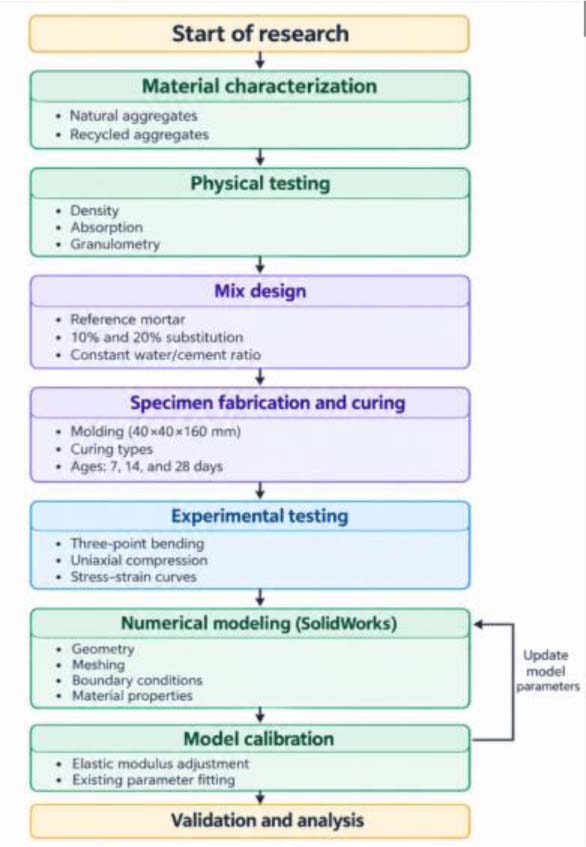
Figure 1:
Methodological study outline
Table 1:
Physical characterization tests of the constituent materials of the mortar
| Test | Applicable UNE Standard | Parameter Determined | Required Equipment | Number of Repetitions |
|---|---|---|---|---|
| Particle size analysis | [UNE-EN 933-1] | Particle size distribution | Standard sieves, balance 0.01 [g] | 3 samples per material |
| True density | [UNE-EN 1097-6] | True density, ρtrue [kg/m3] | Pycnometer, analytical balance | 3 determinations |
| Apparent density | [UNE-EN 1097-6] | Apparent density, ρapparent [kg/m3] | Graduated cylinder, balance | 3 determinations |
| Water absorption | [UNE-EN 1097-6] | Water absorption [%] | Oven 105[°C], containers, balance | 3 determinations |
| Residual moisture | [UNE-EN 1097-5] | Moisture content [%] | Oven 105[°C],, balance | 2 determinations |
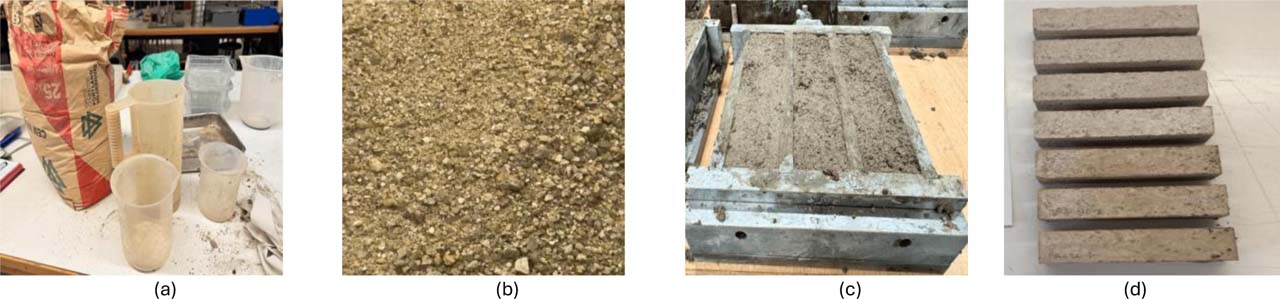
Figure 2:
Constituent materials used in the manufacture of mortars: (a) Portland cement CEM II/B-L 32.5 [N], (b) pre-dried sand, (c) mortar casting molds, (d) sample mortar
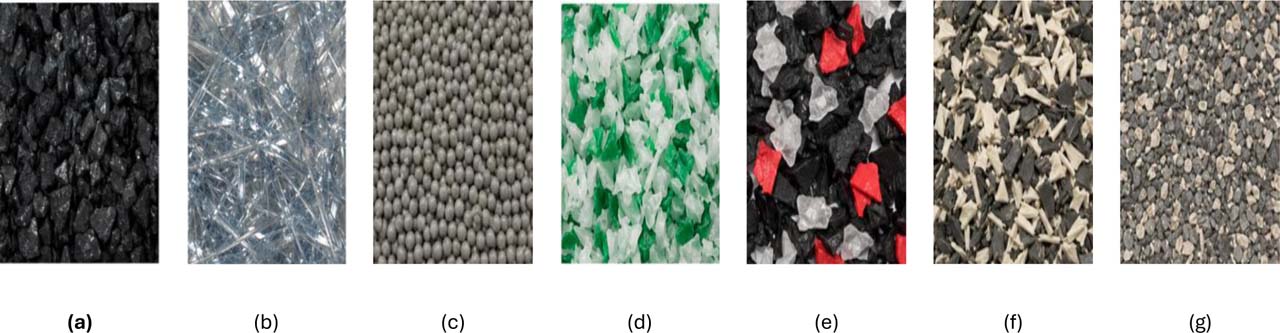
Figure 3:
Natural aggregates and recycled plastic materials used in the study, ground (a) polyamide 6 (PA6); (b) Polyethylene terephthalate (PET); (c) rPET pellets; (d) Polyethylene (PE-HD); (e) Polypropylene (PP); (f) Acrylonitrile Butadiene Styrene (ABS); (g) High-Impact Polystyrene (PS-HI)
Table 2:
Mix proportions and experimental program
| Mixture | Polymer type | Replacement level ([%] by aggregate volume) | Cement | Water | Natural sand [%] | Polymer inclusion [%] | Purpose |
|---|---|---|---|---|---|---|---|
| REF | None | 0 | Constant | Constant | 100 | 0 | Reference mortar |
| M1 | PA6 | 10 | Constant | Constant | 90 | 10 | Evaluate the influence of low PA6 content |
| M2 | PA6 | 20 | Constant | Constant | 80 | 20 | Evaluate the influence of high PA6 content |
| M3 | PET | 10 | Constant | Constant | 90 | 10 | Evaluate the influence of low PET content |
| M4 | PET | 20 | Constant | Constant | 80 | 20 | Evaluate the influence of high PET content |
[i] Note: The water-to-cement ratio and cement content were maintained constant for all mixtures to ensure comparability. Recycled polymer materials were incorporated as partial replacements of natural sand at replacement levels of 10[%] and 20[%] by aggregate volume. These percentages were selected based on previous studies reporting the influence of PA6 and PET inclusions on mortar mechanical performance (Pinilla-Hernandez et al., 2026).
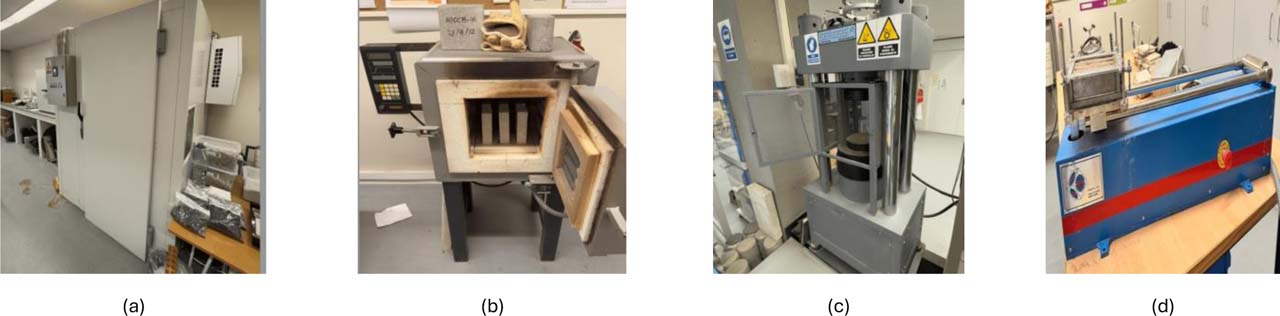
Figure 4:
Equipment used for mechanical testing (a) curing chamber (b) Nabertherm furnace, model N20/HR (c) IBERTEST universal testing machine, maximum capacity 600 kN (d) CE211 automatic cement compactor
Table 3:
Mix proportions of the investigated mortars
| Material | 10 [%] Replacement | 20 [%] Replacement |
|---|---|---|
| Cement [kg] | 2.58 | 2.58 |
| Water [kg] | 0.90 | 0.90 |
| Sand [kg] | 7.74 | 6.88 |
| Polymer [kg] | 0.45 | 0.90 |
| Superplasticizer [kg] | 0.0016 | 0.0016 |
And in volume:
| Material | 10 [%] Replacement [L] | 20 [%] Replacement [L] |
|---|---|---|
| Cement | 1.7925 | 1.7925 |
| Sand | 4.839 | 4.301 |
| Polymer | 0.537 | 1.076 |
| Water | 0.8955 | 0.8955 |
| Superplasticizer | 0.0015 | 0.0015 |
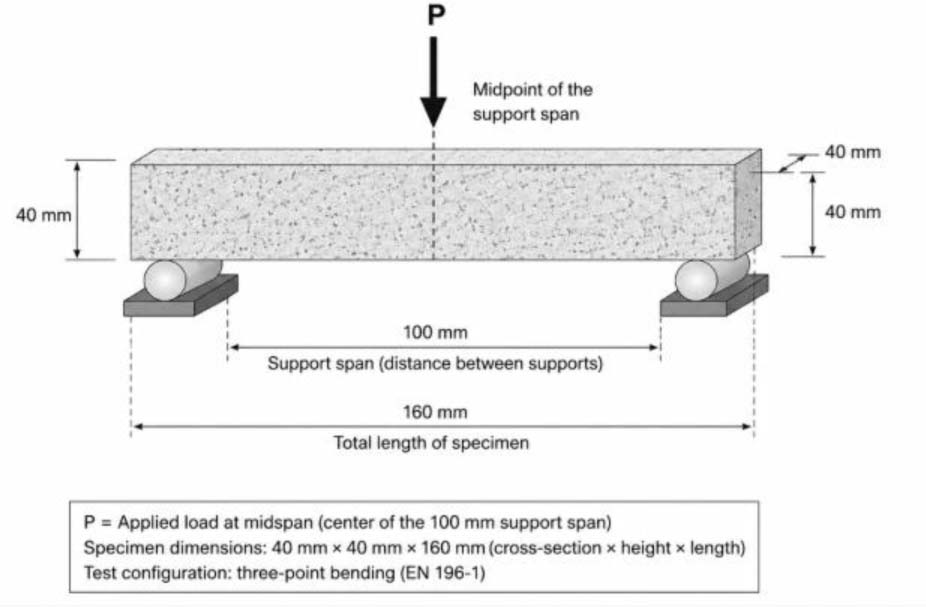
Figure 5:
Schematic representation of the three-point bending test configuration according to EN 196-1
Table 4:
Mesh characteristics used in the numerical model
| Parameter | Value |
|---|---|
| Element type | Tetrahedral solid |
| Element order | Second-order |
| Average mesh size | 2–4 mm |
| Number of elements | ≈ 32,800 |
| Convergence criterion | < 5[%] |
Table 5:
Mechanical parameters considered in the numerical model
| Property | Symbol | Unit | Description |
|---|---|---|---|
| Density | ρ | [kg/m3) | Experimentally determined mortar density |
| Elastic modulus | E | [GPa] | Material stiffness determined from mechanical tests |
| Poisson's ratio | ν | [–] | Ratio of transverse to longitudinal strain |
| Compressive strength | fc | [MPa] | Experimental compressive strength used for comparison |
| Flexural strength | ff | [MPa] | Experimental flexural strength used for comparison |
Table 6:
Boundary and loading conditions adopted in the experimental tests and numerical model
| Test type | Support condition | Load type | Load location | Experimental loading condition |
|---|---|---|---|---|
| Compression | Bottom surface restrained | Axial load applied to upper surface | Top surface | 2.49 [kN/s] |
| Three-point bending | Two simple supports | Concentrated load | Midpoint of the 100 [mm] support span | 0.05 [mm/min] |
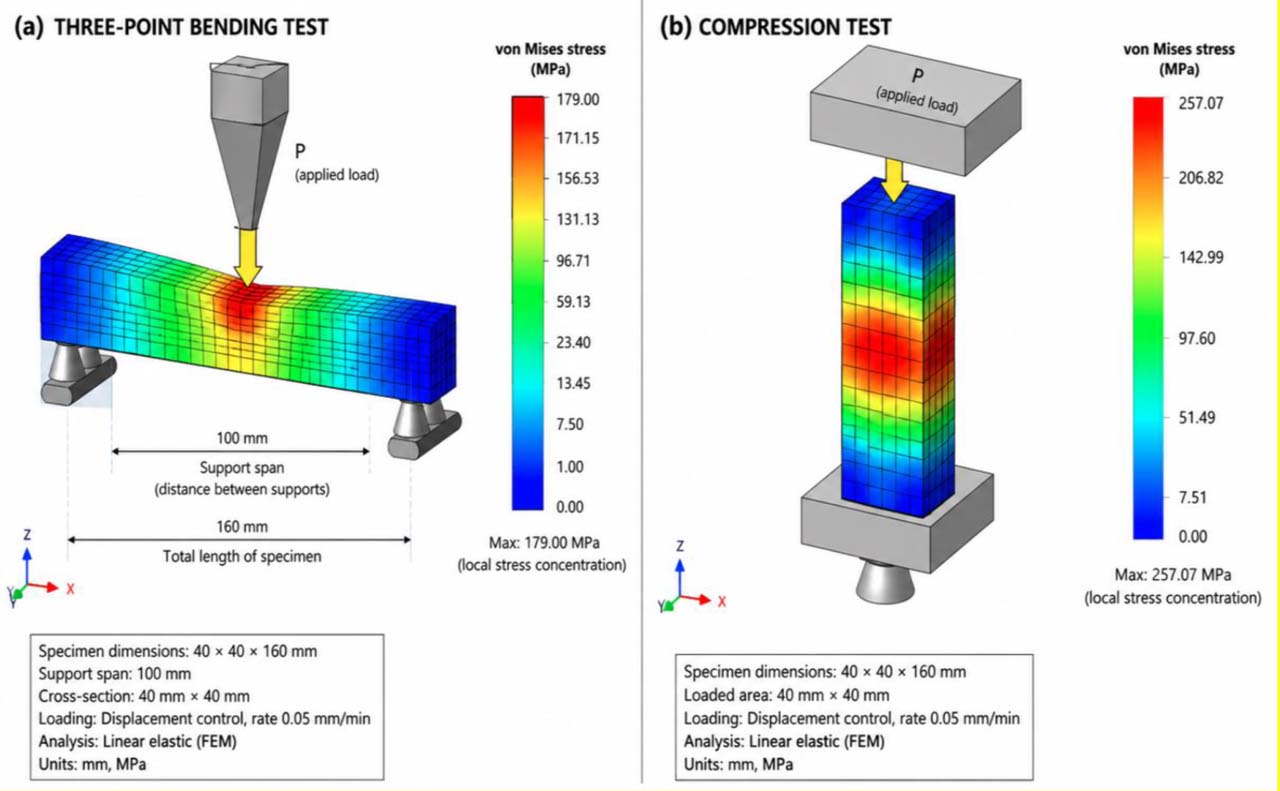
Figure 6:
Finite element stress distribution for (a) three-point bending and (b) compression tests. The maximum stress values shown correspond to localized numerical stress concentrations and should not be interpreted as the flexural or compressive strength of the mortar.
Table 7:
Mechanical properties obtained for mortars with different types and percentages of recycled aggregates
| Mixture | Aggregate type | [%]replacement | fcomp [MPa] | fflex [MPa] | E [GPa] | εmax | CV [%] |
|---|---|---|---|---|---|---|---|
| REF | Natural | 0 | 32.43 | 5.53 | 18.5 | 0.0021 | 2.0 |
| M1 | PA6 | 10 | 32.00 | 5.55 | 17.2 | 0.0024 | 2.3 |
| M2 | PA6 | 20 | 31.50 | 5.50 | 16.3 | 0.0026 | 2.4 |
| M3 | PET | 10 | 32.43 | 5.53 | 17.0 | 0.0023 | 2.0 |
| M4 | PET | 20[ | 32.43 | 5.53 | 16.0 | 0.0027 | 2.2 |
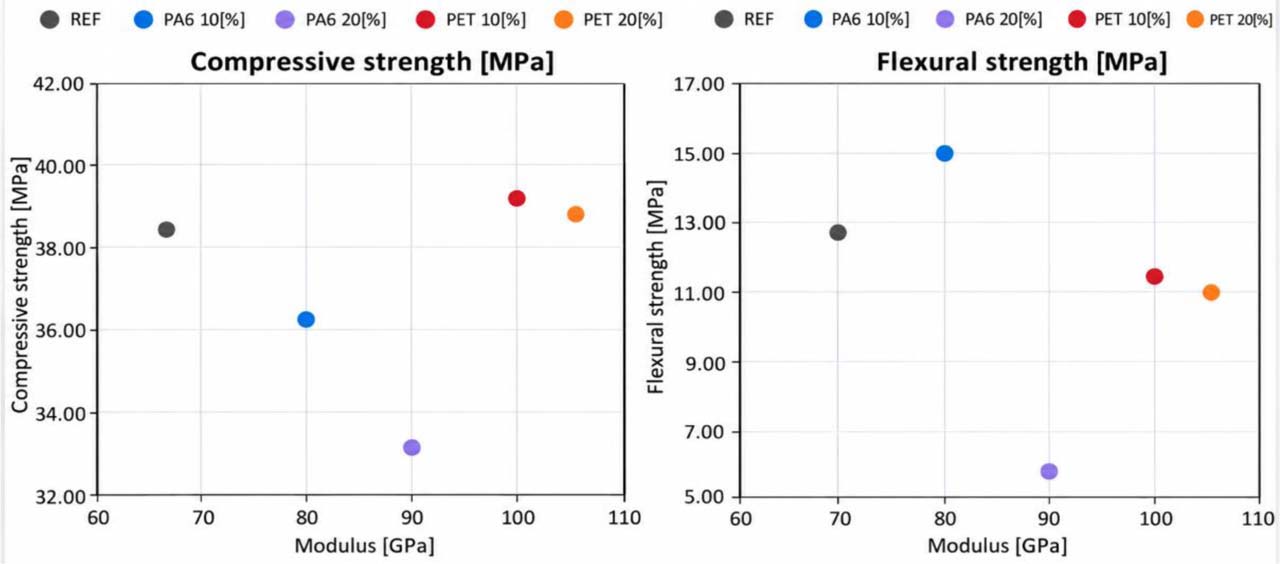
Figure 7:
Mechanical behavior of the investigated mortars: (a) compressive load–strain [MPa] response of the REF, M1 (PA6 10[%]), M2 (PA6 20[%]), M3 (PET 10[%]), and M4 (PET 20[%]) mixtures; (b) flexural load–strain [MPa] response of the same mixtures
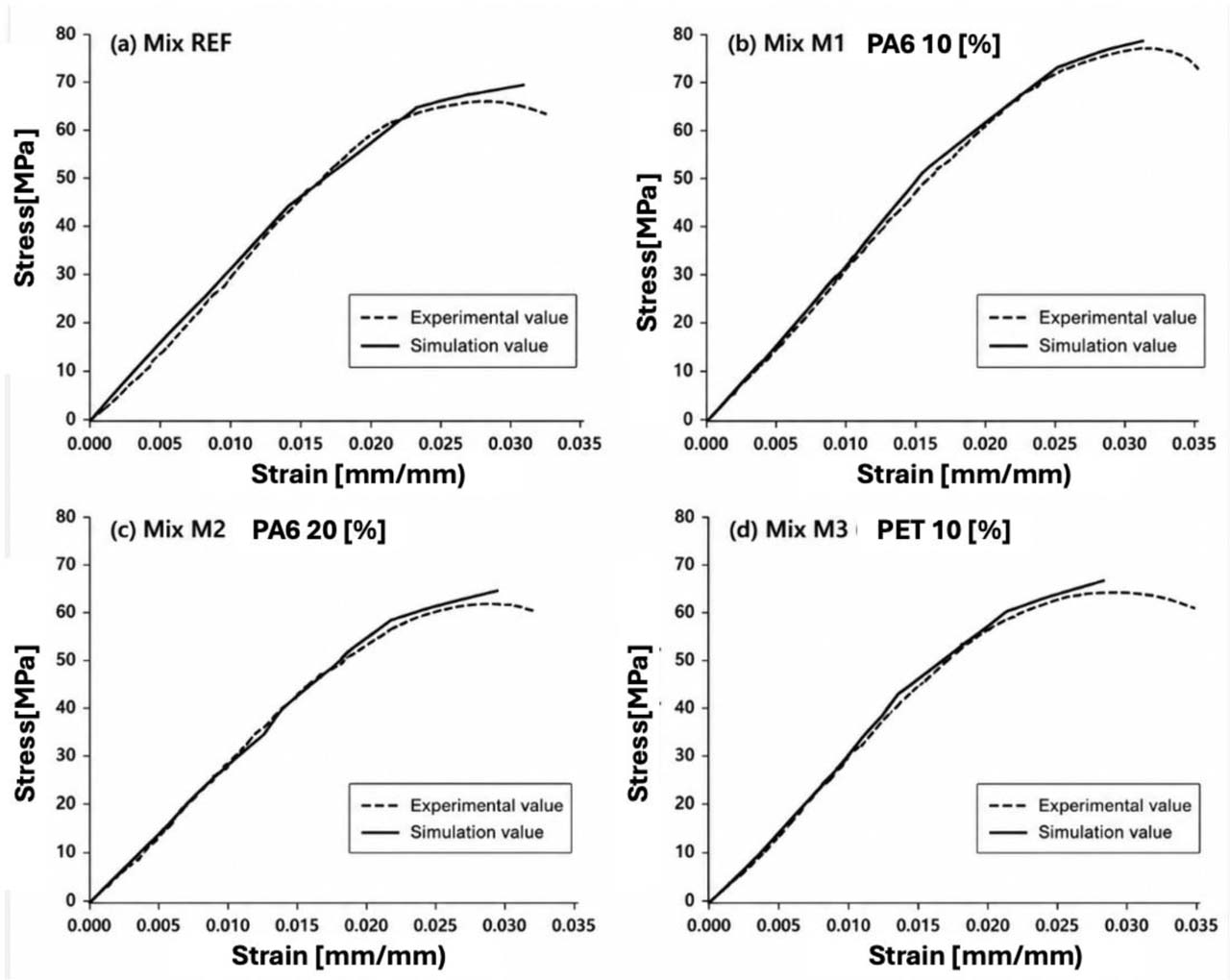
Figure 8:
Experimental compressive strength results for the investigated mortar mixtures and corresponding numerical stress-response analysis
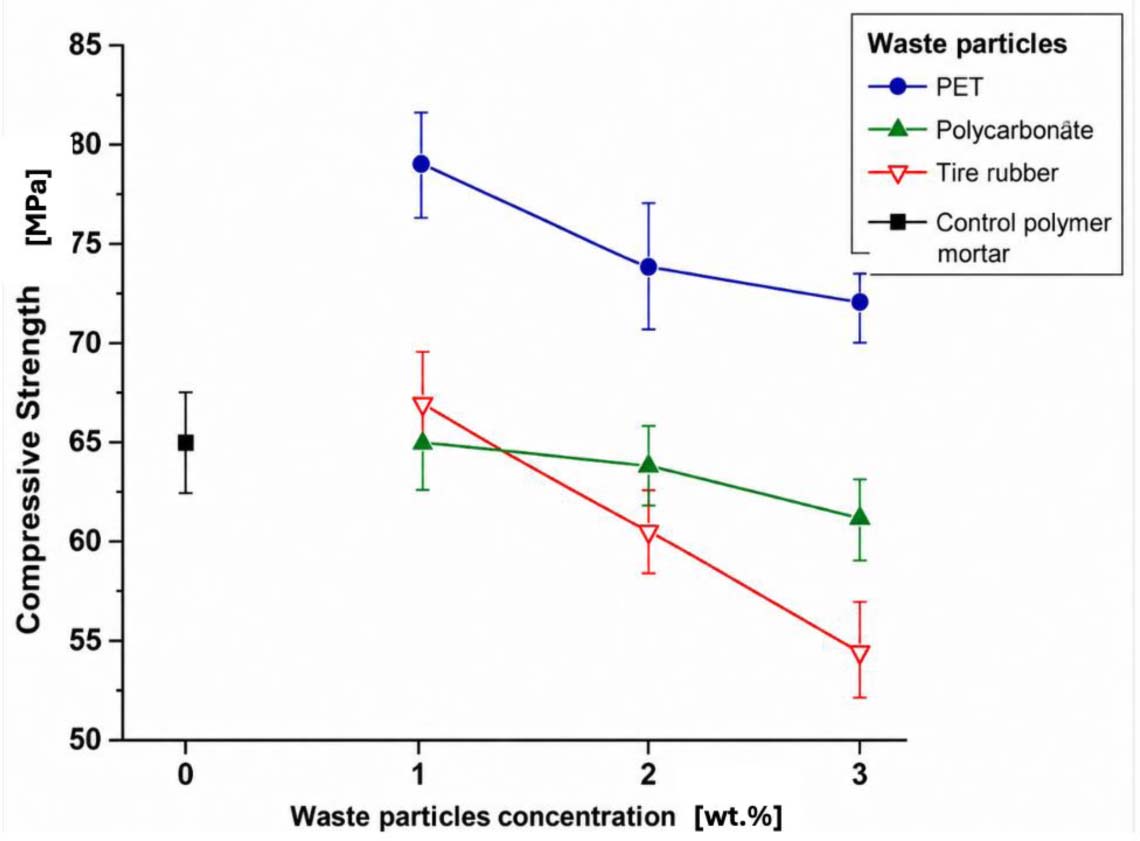
Figure 9:
Experimental flexural strength results and corresponding numerical stress–strain responses for the investigated mortar mixtures
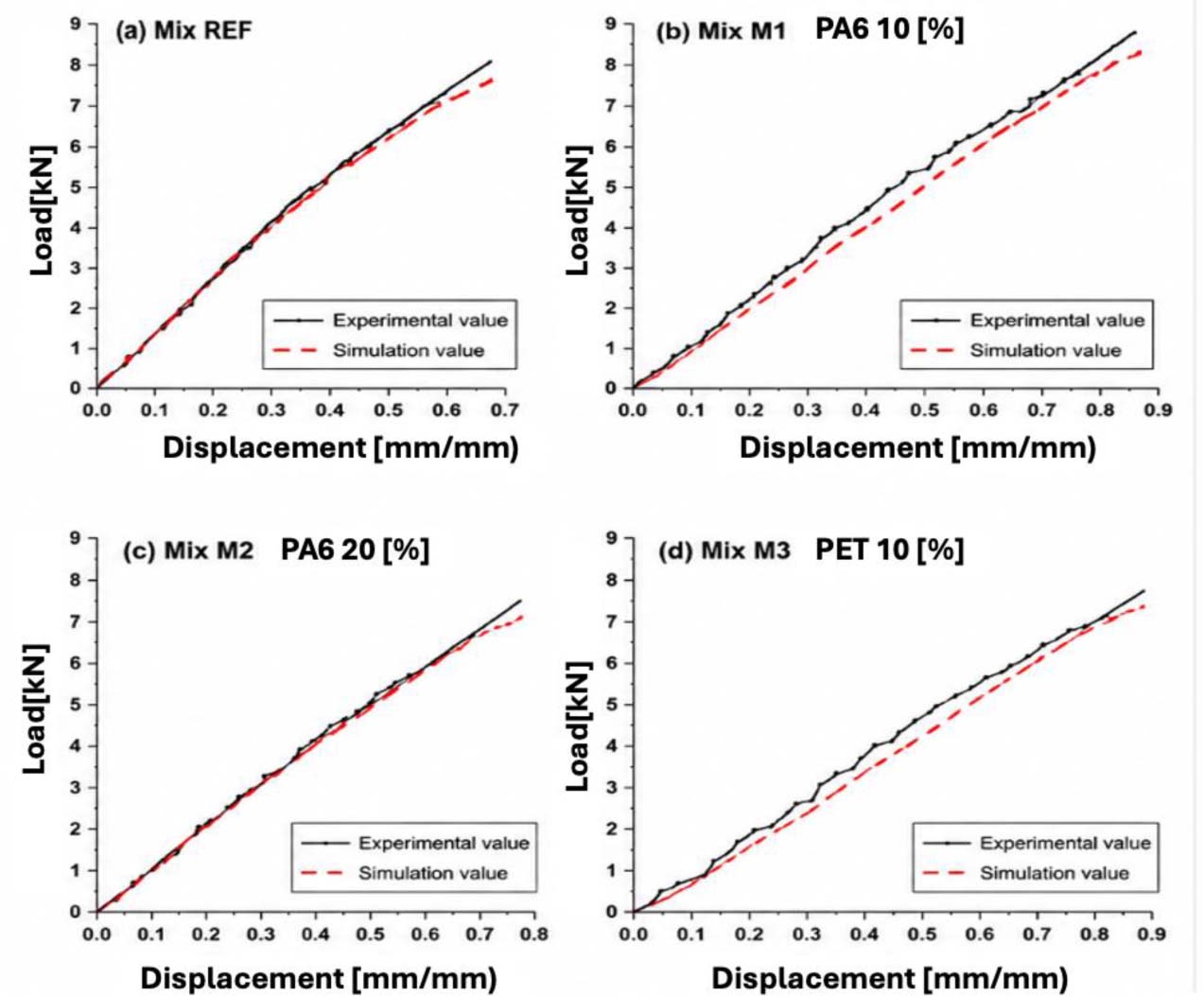
Figure 10:
Comparison between experimental and numerical load–displacement responses for the three-point bending tests: (a) reference mortar (REF), (b) mortar containing 10[%] recycled PA6 (M1), (c) mortar containing 20[%] recycled PA6 (M2), and (d) mortar containing 10[%] recycled PET (M3)
| Acronym | Full Name | Description |
|---|---|---|
| PA6 | Polyamide 6 | Polyamide 6 used as a recycled plastic aggregate in mortar. |
| PET | Polyethylene Terephthalate | Polyethylene Terephthalate, a polymer widely used in recycled plastic packaging. |
| rPET | Recycled Polyethylene Terephthalate | Recycled PET used in pellet form as an alternative aggregate. |
| PE-HD | High-Density Polyethylene | High-density polyethylene used as a recycled plastic material. |
| PP | Polypropylene | Polypropylene used as a lightweight plastic aggregate. |
| ABS | Acrylonitrile Butadiene Styrene | Thermoplastic polymer used in industrial applications and recycled in the study. |
| PS-HI | High Impact Polystyrene | High-impact polystyrene with greater mechanical strength than conventional polystyrene. |
| FEM | Finite Element Method | Finite element method used for the numerical simulation of the mechanical behavior of mortar. |
| ITZ | Interfacial Transition Zone | Interfacial transition zone between the cementitious matrix and the aggregate. |
| MPa | Megapascal | Unit of pressure used to express mechanical strength. |
| GPa | Gigapascal | Unit of elastic modulus used to describe material stiffness. |
| CV | Coefficient of Variation | A statistical measure that expresses the relative dispersion of experimental results. |
| Fmax | Maximum Load | Maximum load applied during the mechanical test. |
| A | Cross-sectional Area | Cross-sectional area of the test specimen. |
| E | Elastic Modulus | Secant elastic modulus of the material. |
| σ | Stress | Stress applied to the material. |
| ε | Strain | Unitary deformation produced by the load. |