

1. Introduction
The construction industry is one of the largest consumers of natural resources and a major contributor to global waste generation. Consequently, increasing attention has been devoted to the development of sustainable construction materials capable of reducing environmental impacts while maintaining adequate mechanical performance. Among the various strategies proposed, the incorporation of recycled materials into cement-based composites has emerged as an effective approach to promote circular economy principles, reduce landfill disposal, and decrease the consumption of virgin raw materials.
In recent years, the rapid growth in plastic waste generation has become a significant environmental challenge. Large quantities of post-consumer polymers are disposed of in landfills or released into the environment, creating long-term ecological concerns. To address this issue, researchers have investigated the incorporation of recycled polymers into cementitious materials as partial replacements for conventional aggregates. Such an approach not only contributes to waste valorization but may also modify the mechanical and physical properties of mortars and concretes.
Previous studies have demonstrated that recycled polymer inclusions can significantly influence the behavior of cement-based materials by affecting density, stiffness, strength, toughness, and crack propagation mechanisms. Safi et al. (2013) reported that replacing fine aggregates with plastic waste altered both the physical and mechanical properties of self-compacting mortars. Similarly, Legan et al. (2025) observed that recycled polyethylene terephthalate (PET) aggregate replacements modified the mechanical performance of mortar while contributing to environmental sustainability. Xiong et al. (2023) further demonstrated the feasibility of incorporating recycled PET powder into mortars while developing predictive models for strength estimation.
Among the recycled polymers investigated in cementitious materials, polyethylene terephthalate (PET) has attracted particular attention because of its widespread availability, low cost, and favorable mechanical properties. Several studies have reported that PET can be incorporated into mortars as fibers, particles, or aggregate replacements while maintaining acceptable strength levels and improving specific performance characteristics. Hong and Byun (2010) investigated polymer-modified mortars containing recycled PET and reported modifications in acoustic and mechanical behavior. More recently, Lazorenko et al. (2022) demonstrated the viability of using PET waste as a natural aggregate replacement in geopolymer mortars, while Wang et al. (2025) reported improvements in toughness and flexural performance through the incorporation of PET fibers.
Polyamide-based recycled materials have also emerged as promising alternatives for sustainable cementitious composites. Recycled nylon fibers obtained from waste fishing nets have been successfully incorporated into mortars, improving deformation capacity and crack-control mechanisms Orasutthikul et al. (2017) reported that recycled nylon fibers can improve the mechanical performance of cementitious mortars. Similarly, Spadea et al. (2015) demonstrated that recycled nylon fibers can effectively reinforce cement mortars while enhancing post-cracking behavior. Recent research by Pinilla-Hernandez et al. (2026a) further indicated that polyamide 6 (PA6) inclusions may reduce the elastic modulus of mortars while maintaining satisfactory mechanical performance, resulting in increased deformability and ductility. These findings suggest that polymer type plays a critical role in controlling the balance between stiffness, strength, and deformation capacity.
From a microstructural perspective, mortars containing recycled polymer inclusions can be regarded as multiphase composite materials consisting of a cementitious matrix, natural sand particles, polymer inclusions, and the interfacial transition zone (ITZ) formed between the polymer phase and the surrounding mortar. The interaction among these phases governs the overall mechanical response of the composite. In particular, the ITZ is often considered one of the most critical regions influencing stress transfer, crack initiation, and damage propagation in cement-based materials (Scrivener et al., 2004). The efficiency of the matrix–polymer bond and the mechanical properties of the polymer inclusions therefore play a significant role in determining the global response of the mortar.
Experimental testing remains the primary method for characterizing the mechanical performance of cementitious materials. Compression and flexural tests provide valuable information regarding strength, elastic modulus, deformation capacity, and failure mechanisms. Nevertheless, the intrinsic heterogeneity of mortar limits the ability of laboratory testing alone to fully explain local stress concentrations and internal damage processes. Consequently, researchers have increasingly adopted numerical simulation techniques to complement experimental investigations. Neupane et al. (2025) highlighted the importance of combining laboratory testing with numerical approaches for evaluating sustainable construction materials.
Finite element modeling (FEM) has become one of the most widely used numerical methods for investigating the behavior of cement-based composites. Numerical simulations enable the analysis of stress distributions, deformation fields, and critical regions susceptible to damage initiation under different loading conditions. When calibrated with experimental data, FEM models provide valuable insight into material behavior that is often difficult to observe directly during mechanical testing (Wu et al., 2022). Furthermore, hybrid methodologies integrating experimental characterization and numerical simulation have demonstrated considerable potential for improving the understanding of sustainable cementitious materials and optimizing mixture design (Martínez-López et al., 2018; Wang et al., 2020).
Recent studies have successfully applied finite element approaches to the analysis of mortars incorporating recycled polymers, highlighting their ability to predict stress distribution, deformation patterns, and failure mechanisms under both mechanical and thermal loading conditions (Maciá Torregrosa et al., 2026a, 2026b, 2026c, 2026 d).
Accordingly, the present study proposes a hybrid experimental-numerical methodology to evaluate the mechanical behavior of mortars incorporating recycled polymer inclusions. Particular attention is given to the influence of polyamide 6 (PA6) and recycled polyethylene terephthalate (PET) on compressive strength, flexural strength, elastic modulus, and deformation capacity. Experimental results are used to calibrate and validate finite element models developed in SolidWorks Simulation, enabling the assessment of stress distributions and potential failure mechanisms. The proposed methodology provides a comprehensive framework for the characterization and evaluation of sustainable mortars containing recycled polymer materials.
2. Methodology
2.1. General Study Design
This study combines experimental testing and finite element modeling to investigate the mechanical behavior of mortars incorporating recycled polymer aggregates. Compressive and flexural tests were carried out to determine the main mechanical properties of the mixtures, including strength, elastic modulus, and deformation capacity. The experimental results were subsequently used to calibrate and validate finite element models developed in SolidWorks Simulation. The proposed hybrid methodology enables direct comparison between experimental and numerical results and provides a framework for evaluating the influence of recycled polymer inclusions on mortar performance. The overall experimental and numerical workflow is summarized in Figure 1.
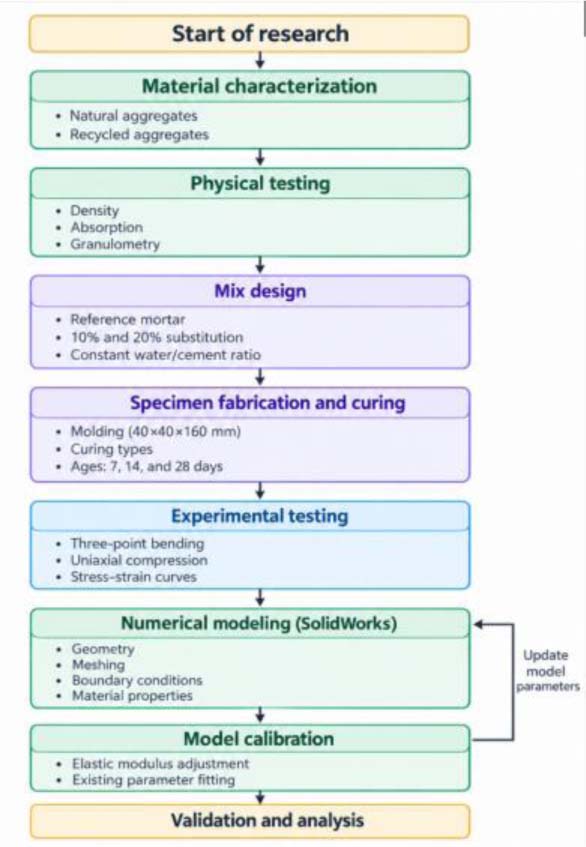
Figure 1:
Methodological study outline
2.2. Materials
Portland cement CEM II/B-L 32.5 N complying with EN 197-1 was used as the binder. Mixing water satisfied the requirements of EN 1008, and natural river sand (0–4 mm) was used as the reference aggregate. Prior to mixing, the sand was oven-dried at 100 °C for 24 h to minimize the influence of residual moisture on the water-to-cement ratio.
Recycled polymer materials were incorporated as partial replacements for natural aggregate. The investigated materials included polyamide 6 (PA6), recycled polyethylene terephthalate (rPET), and PET-derived fibers obtained from post-consumer plastic waste. The recycled polymer particles and fibers were mechanically processed to achieve a uniform geometry suitable for mortar production.
Two replacement levels, 10(%) and 20[%) by aggregate volume, were considered to evaluate the influence of polymer inclusions on the mechanical performance of the mortars. All constituent materials were characterized prior to mixing through particle size distribution, density, water absorption, and moisture-content tests in accordance with the relevant UNE standards. The physical characterization procedures are summarized in Table 1.
Table 1:
Physical characterization tests of the constituent materials of the mortar
| Test | Applicable UNE Standard | Parameter Determined | Required Equipment | Number of Repetitions |
|---|---|---|---|---|
| Particle size analysis | [UNE-EN 933-1] | Particle size distribution | Standard sieves, balance 0.01 [g] | 3 samples per material |
| True density | [UNE-EN 1097-6] | True density, ρtrue [kg/m3] | Pycnometer, analytical balance | 3 determinations |
| Apparent density | [UNE-EN 1097-6] | Apparent density, ρapparent [kg/m3] | Graduated cylinder, balance | 3 determinations |
| Water absorption | [UNE-EN 1097-6] | Water absorption [%] | Oven 105[°C], containers, balance | 3 determinations |
| Residual moisture | [UNE-EN 1097-5] | Moisture content [%] | Oven 105[°C],, balance | 2 determinations |
2.3. Mix Proportions and Specimen Preparation
Mortar mixtures were designed by maintaining a constant water-to-cement ratio and controlling the total aggregate volume to ensure comparability among all mixtures. The reference mortar [REF] contained only natural sand, while the modified mixtures incorporated recycled polymer materials as partial aggregate replacements. Replacement levels of 10[%] and 20[%] by aggregate volume were selected to evaluate the influence of recycled polymer inclusions on the mechanical behavior of the mortars. The constituent materials are shown in Figures 2 and 3.
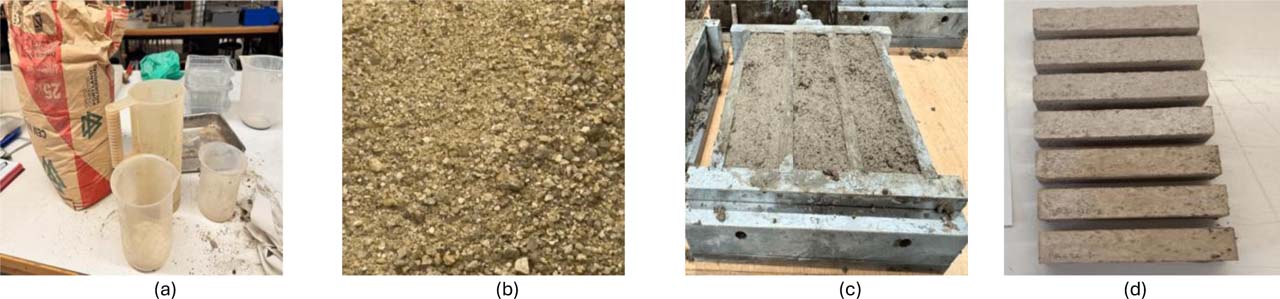
Figure 2:
Constituent materials used in the manufacture of mortars: (a) Portland cement CEM II/B-L 32.5 [N], (b) pre-dried sand, (c) mortar casting molds, (d) sample mortar
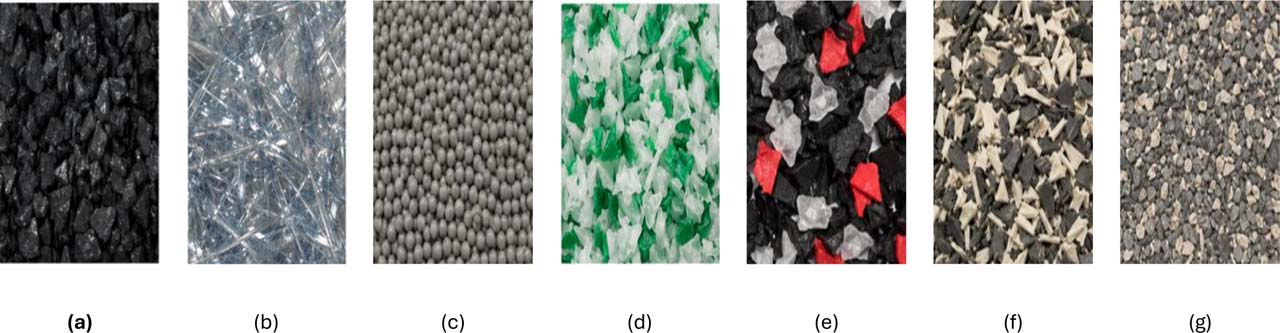
Figure 3:
Natural aggregates and recycled plastic materials used in the study, ground (a) polyamide 6 (PA6); (b) Polyethylene terephthalate (PET); (c) rPET pellets; (d) Polyethylene (PE-HD); (e) Polypropylene (PP); (f) Acrylonitrile Butadiene Styrene (ABS); (g) High-Impact Polystyrene (PS-HI)
The mixture design was developed based on the replacement of natural sand with recycled polymer inclusions at replacement levels of 10[%] and 20[%] by aggregate volume. The selected replacement ratios were established following the methodology proposed by Pinilla-Hernandez et al. (2026), which demonstrated that PA6 inclusions can modify mortar stiffness and deformation capacity while maintaining acceptable mechanical performance. The detailed composition of each mixture is summarized in Table 2.
Table 2:
Mix proportions and experimental program
| Mixture | Polymer type | Replacement level ([%] by aggregate volume) | Cement | Water | Natural sand [%] | Polymer inclusion [%] | Purpose |
|---|---|---|---|---|---|---|---|
| REF | None | 0 | Constant | Constant | 100 | 0 | Reference mortar |
| M1 | PA6 | 10 | Constant | Constant | 90 | 10 | Evaluate the influence of low PA6 content |
| M2 | PA6 | 20 | Constant | Constant | 80 | 20 | Evaluate the influence of high PA6 content |
| M3 | PET | 10 | Constant | Constant | 90 | 10 | Evaluate the influence of low PET content |
| M4 | PET | 20 | Constant | Constant | 80 | 20 | Evaluate the influence of high PET content |
[i] Note: The water-to-cement ratio and cement content were maintained constant for all mixtures to ensure comparability. Recycled polymer materials were incorporated as partial replacements of natural sand at replacement levels of 10[%] and 20[%] by aggregate volume. These percentages were selected based on previous studies reporting the influence of PA6 and PET inclusions on mortar mechanical performance (Pinilla-Hernandez et al., 2026).
Figure 3 shows the recycled polymer materials used as aggregate replacements. The selected polymers cover a range of densities and mechanical properties, enabling the evaluation of their influence on mortar stiffness, strength, and deformation capacity. Mortar specimens were prepared using 40 × 40 × 160 mm prismatic molds in accordance with EN 196-1. The fresh mortar was placed in two layers and compacted using an automatic cement compactor to minimize entrapped air and promote mixture homogeneity. After casting, the specimens were cured under controlled laboratory conditions (20 ± 2 °C) until testing. The main equipment used during specimen preparation and testing is presented in Figure 4.
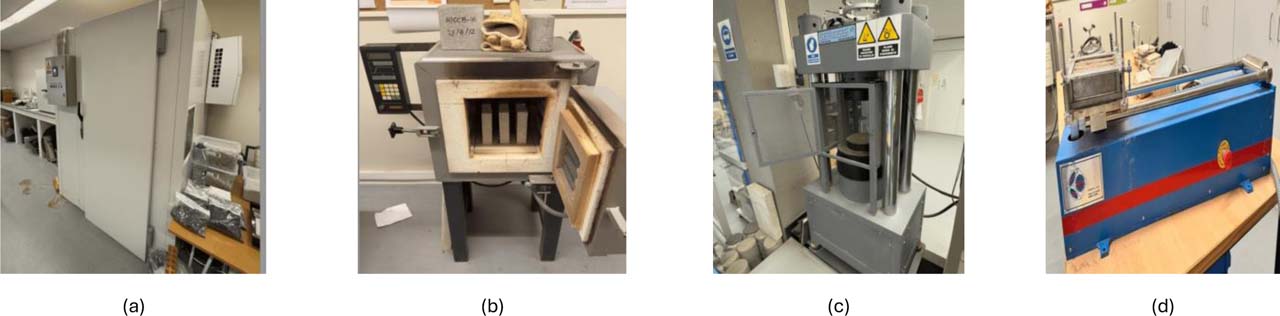
Figure 4:
Equipment used for mechanical testing (a) curing chamber (b) Nabertherm furnace, model N20/HR (c) IBERTEST universal testing machine, maximum capacity 600 kN (d) CE211 automatic cement compactor
The mortar mixtures were designed by maintaining a constant cement content, water content, and water-to-cement ratio while varying the amount of recycled polymer inclusions. Two replacement levels, 10[%] and 20[%] by aggregate volume, were selected to evaluate the influence of polymer content on the mechanical behavior of the mortars. The corresponding mix proportions are summarized in Table 3.
Table 3:
Mix proportions of the investigated mortars
| Material | 10 [%] Replacement | 20 [%] Replacement |
|---|---|---|
| Cement [kg] | 2.58 | 2.58 |
| Water [kg] | 0.90 | 0.90 |
| Sand [kg] | 7.74 | 6.88 |
| Polymer [kg] | 0.45 | 0.90 |
| Superplasticizer [kg] | 0.0016 | 0.0016 |
And in volume:
| Material | 10 [%] Replacement [L] | 20 [%] Replacement [L] |
|---|---|---|
| Cement | 1.7925 | 1.7925 |
| Sand | 4.839 | 4.301 |
| Polymer | 0.537 | 1.076 |
| Water | 0.8955 | 0.8955 |
| Superplasticizer | 0.0015 | 0.0015 |
Note: Polymer inclusions were incorporated as partial replacements of natural sand at replacement levels of 10[%] and 20[%] by aggregate volume. Cement content, water content, and curing conditions were kept constant for all mixtures to ensure comparability of the experimental results.
Table 3 presents the quantities of cement, water, natural sand, recycled polymer inclusions, and superplasticizer used for each replacement level. For consistency and reproducibility, both mass- and volume-based proportions are reported. The reduction in natural sand content was compensated by the incorporation of recycled polymer particles while maintaining the overall mixture volume. This approach ensured direct comparison between mixtures and enabled evaluation of the effect of polymer inclusions on compressive strength, flexural strength, elastic modulus, and deformation capacity.
2.4. Experimental Design
2.4.1. Flexural strength
Flexural strength was determined by three-point bending tests in accordance with EN 196-1. Prismatic mortar specimens measuring 40 × 40 × 160 mm were tested with a 100 mm distance between the supports. A concentrated load was applied vertically at the midpoint of the specimen, corresponding to the center of the 100 mm support span. The tests were conducted under displacement control at a rate of 0.05 mm/min until failure. During testing, the applied load and mid-span displacement were continuously recorded. For each mixture, at least three specimens were tested, and the mean value was calculated for subsequent analysis. The test configuration and the main specimen dimensions are shown in Figure 5.
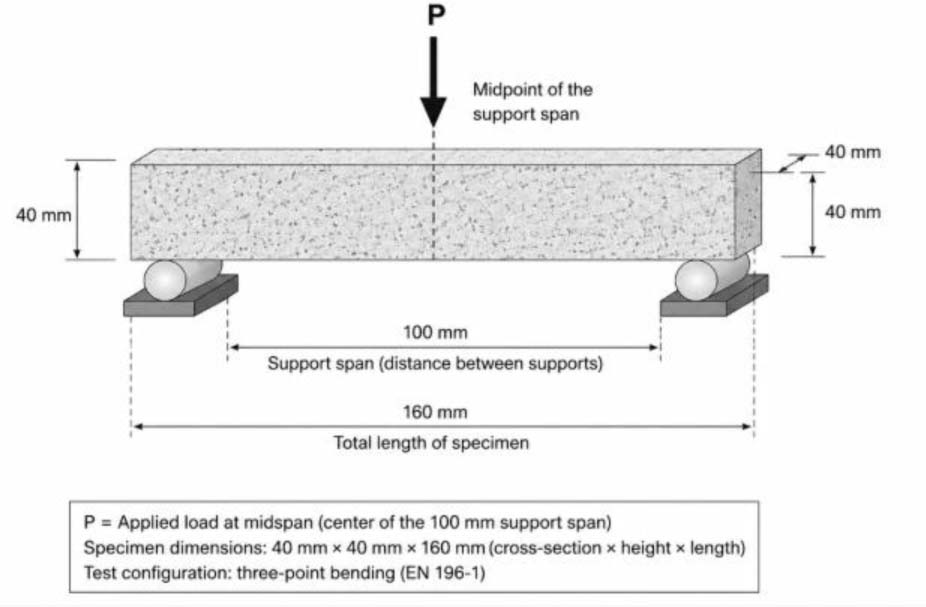
Figure 5:
Schematic representation of the three-point bending test configuration according to EN 196-1
2.4.2. Compressive Strength
Compressive strength tests were conducted in accordance with EN 196-1 using the halves of the specimens previously broken during flexural testing. The tests were performed on a universal testing machine with a maximum load capacity of 600 kN. The load was applied continuously at a rate of 2.4 kN/s until failure. At least six half-specimens were tested for each mixture and the compressive strength was calculated as the ratio between the maximum load and the loaded area.
2.4.3. Determination of the Elastic Modulus
The elastic modulus was determined from the stress-strain curves obtained during the compression tests. The secant modulus was calculated between 30[%] and 40[%] of the maximum stress in order to minimize the influence of initial nonlinear effects and ensure comparability between mixtures.
2.4.4. Statistical Analysis
The experimental results were evaluated using descriptive statistical parameters, including mean value, standard deviation, and coefficient of variation (CV). Outliers were identified as values differing by more than ±15[%] from the mean and were excluded only when an identifiable experimental cause was detected, such as specimen defects or testing errors.
The mechanical properties and statistical parameters were calculated using Equations (1)–(4). For each equation, all variables are defined individually below the equation together with their corresponding SI units in square brackets, following the journal formatting requirements.
Flexural strength
where:σf - flexural strength [MPa],
F - applied load [N],
L - support span [mm],
b - specimen width [mm],
h - specimen height [mm].
Compressive strength
Where:σc - compressive strength [MPa],
Fmax - maximum load recorded during the test [N],
A - loaded cross-sectional area [mm2].
Elastic modulus
where:E - secant elastic modulus [GPa],
σ1, σ2 - stress values [MPa],
ɛ1, ɛ2 - strain values [-].
Coefficient of variation
Where:CV - coefficient of variation [%],
s - standard deviation [-],
x̄ - mean value of the dataset [-].
2.5. Computational Modeling
Numerical simulations were undertaken with the finite element method, executed within SolidWorks Simulation. This endeavor sought to faithfully replicate the comprehensive mechanical behaviors documented during experimental bending and compression investigations. Predominantly, linear elastic static analyses were conducted. These were, however, augmented by uncomplicated nonlinear analyses designed to scrutinize the material's reaction in proximity to crack initiation sites. SolidWorks Simulation was selected due to the specific character of structural analyses this research necessitated.
2.5.1. Numerical Simulation Model
A finite element model (FEM) was developed in SolidWorks Simulation to reproduce the experimental compression and three-point bending tests performed on the mortar specimens. The model geometry was defined according to the dimensions of the experimental prismatic specimens (40 × 40 × 160 mm), following the test configuration specified in EN 196-1.
The numerical domain was discretized using second-order tetrahedral solid elements. An average element size ranging from 2 to 4 mm was adopted, with local mesh refinement in the regions subjected to load application and support conditions. A mesh sensitivity analysis was performed to assess the numerical stability of the model. Mesh convergence was considered to be achieved when the variation in the calculated stresses and displacements between successive mesh refinements was lower than 5[%]. The main characteristics of the computational mesh are summarized in Table 4.
Table 4:
Mesh characteristics used in the numerical model
| Parameter | Value |
|---|---|
| Element type | Tetrahedral solid |
| Element order | Second-order |
| Average mesh size | 2–4 mm |
| Number of elements | ≈ 32,800 |
| Convergence criterion | < 5[%] |
The numerical model was defined using the mechanical parameters experimentally determined for the investigated mortar mixtures. These parameters included density, elastic modulus, and Poisson's ratio. The experimentally determined compressive and flexural strengths were retained as reference values for comparison with the numerical response. The corresponding parameters used in the modelling framework are summarized in Table 5.
Table 5:
Mechanical parameters considered in the numerical model
| Property | Symbol | Unit | Description |
|---|---|---|---|
| Density | ρ | [kg/m3) | Experimentally determined mortar density |
| Elastic modulus | E | [GPa] | Material stiffness determined from mechanical tests |
| Poisson's ratio | ν | [–] | Ratio of transverse to longitudinal strain |
| Compressive strength | fc | [MPa] | Experimental compressive strength used for comparison |
| Flexural strength | ff | [MPa] | Experimental flexural strength used for comparison |
The mortar was represented at the macroscopic scale as a homogeneous, continuous, and isotropic material. This assumption was adopted to evaluate the overall mechanical response of the specimens without explicitly modelling the individual constituents of the mortar. Consequently, the recycled polymer inclusions, cementitious matrix, aggregate particles, and interfacial transition zones were not separately discretized.
The experimental test configurations were reproduced in the numerical model by applying equivalent boundary and loading conditions. For the compression tests, the bottom surface of the specimen was restrained, while the load was applied vertically to the upper surface. For the three-point bending tests, two simple supports were introduced with a support span of 100 mm, and a concentrated load was applied at the midpoint of the span. Thus, the specimen dimensions, support conditions, and loading positions were consistent with those adopted in the experimental programme.
For the experimental compression tests, the loading rate was 2.4 kN/s, whereas the three-point bending tests were performed under displacement control at 0.05 mm/min. These experimental loading conditions were considered when defining the numerical test configurations
The boundary and loading conditions adopted for the numerical simulations are summarized in Table 6.
Table 6:
Boundary and loading conditions adopted in the experimental tests and numerical model
| Test type | Support condition | Load type | Load location | Experimental loading condition |
|---|---|---|---|---|
| Compression | Bottom surface restrained | Axial load applied to upper surface | Top surface | 2.49 [kN/s] |
| Three-point bending | Two simple supports | Concentrated load | Midpoint of the 100 [mm] support span | 0.05 [mm/min] |
The finite element analysis was used to evaluate the internal mechanical response of the mortar specimens, including stress distributions, equivalent von Mises stress, principal stresses, strains, and displacement fields. Particular attention was given to the regions exhibiting elevated stress concentrations under the applied loading conditions. Figure 6 presents representative finite element stress distributions for the three-point bending and compression configurations.
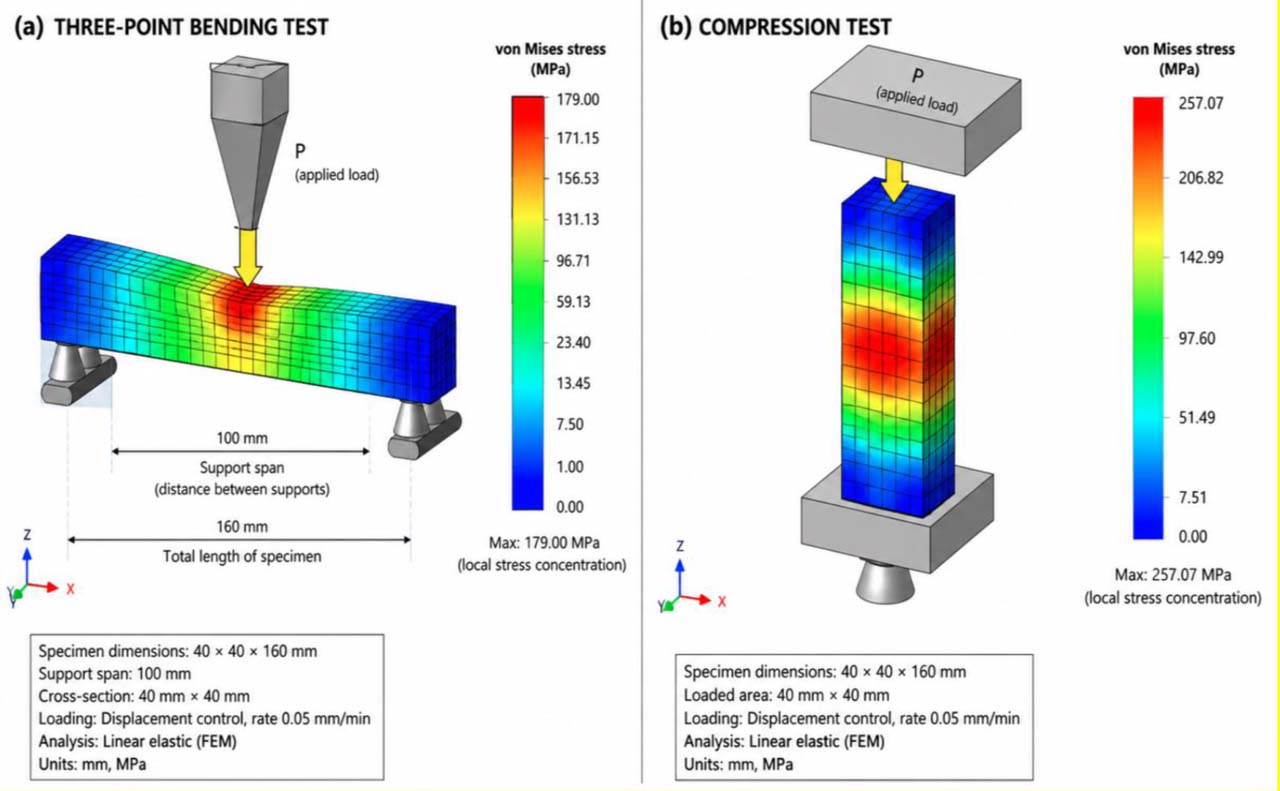
Figure 6:
Finite element stress distribution for (a) three-point bending and (b) compression tests. The maximum stress values shown correspond to localized numerical stress concentrations and should not be interpreted as the flexural or compressive strength of the mortar.
It should be emphasized that the maximum stress values displayed in the finite element contours represent localized numerical stress concentrations generated within the computational model, particularly in the vicinity of the load application and support regions. Therefore, the maximum values shown in Figure 6, namely 179 MPa for the three-point bending configuration and 257.07 MPa for the compression configuration, do not represent the experimentally determined flexural or compressive strength of the mortar. These values are reported exclusively to illustrate the spatial distribution and concentration of stresses within the numerical domain.
The numerical simulations were configured to reproduce the experimental procedures described in Section 2.4. For the compression tests, the lower surface of the specimen was fully restrained, while the load was applied to the upper surface. For the three-point bending tests, two simple supports were introduced with a 100 mm support span, and a concentrated load was applied at the midpoint of the span. The specimen geometry, loading conditions, and boundary conditions were identical to those adopted in the experimental programme to ensure direct comparability between the numerical and experimental results.
The finite element model was used to evaluate the mechanical response of the investigated mortars at the macroscopic scale. The analysis provided information on stress distribution, deformation fields, and the location of critical regions subjected to elevated stresses. These results complement the experimental measurements by providing information on the internal mechanical response that cannot be directly obtained from the laboratory tests.
Model validation was performed through comparison between the experimental and numerical responses obtained from the compression and three-point bending tests. The comparison considered the maximum applied load and the corresponding deformation response obtained from the numerical simulations and laboratory tests. The numerical results were assessed according to their ability to reproduce the overall mechanical behaviour observed experimentally.
The numerical model represents the mortar as a homogeneous, continuous, and isotropic material. Consequently, the adopted macroscopic approach does not explicitly reproduce the heterogeneous microstructure of the mortar, including the individual aggregate and recycled polymer particle geometry, matrix–particle interactions, the interfacial transition zone (ITZ), or the initiation and propagation of microcracks. The localized stress concentrations observed in Figure 6 should therefore be interpreted within the context of these modelling assumptions.
Despite these limitations, the proposed FEM approach provides useful information regarding the global mechanical response and internal stress distribution of the investigated mortar specimens. In particular, the numerical simulations allow the identification of regions subjected to elevated stresses and provide complementary information for interpreting the experimentally observed mechanical behaviour.
The comparison between numerical predictions and experimental measurements was subsequently used to assess the suitability of the model for the different mortar mixtures investigated. The numerical results were evaluated in terms of the overall mechanical response, deformation behaviour, and stress distribution. The maximum local stress values obtained from the FEM were not considered as material strength parameters.
Overall, the numerical framework provides a macroscopic representation of the mechanical behaviour of mortars containing recycled polymer inclusions while maintaining a reasonable balance between model complexity and computational cost. The combination of experimental testing and finite element modelling enables a more comprehensive assessment of the mechanical behaviour of the investigated mixtures and provides additional insight into the stress and deformation patterns developed under compression and three-point bending loading.
2.6. Model Validation and Calibration
To establish a reliable and reproducible link between the experimental results and the numerical simulations, a calibration and validation procedure was implemented. The mechanical properties obtained experimentally for each mortar mixture, including density, elastic modulus, Poisson’s ratio, and compressive strength, were initially assigned to the finite element model. These parameters provided the basis for subsequent nonlinear analyses and enabled a first approximation of the material response.
The experimental compression and three-point bending tests were then reproduced in SolidWorks Simulation using a nonlinear structural analysis approach. The numerical models were developed using the same specimen dimensions, loading configurations, and boundary conditions employed in the laboratory program. Contact interactions between the specimen, supports, and loading devices were modeled using non-penetrating contact definitions with limited friction effects. The domain was discretized using tetrahedral solid elements with local mesh refinement in regions subjected to high stress gradients, such as loading zones, support regions, and the central portions of the specimens.
An incremental loading strategy with automatic time-step adjustment and convergence control based on force equilibrium and internal energy criteria was adopted, allowing the simulation of the transition from elastic behavior to failure. The numerical analyses provided load–strain curves, principal stress distributions, equivalent von Mises stress fields, strain maps, and displacement distributions, enabling the identification of critical regions susceptible to damage initiation.
Model calibration was performed through direct comparison between the numerical predictions and the experimental results. Particular attention was given to the initial slope of the load–strain curve, the ultimate load capacity, and the deformation at failure. Differences between simulations and experiments were quantified using the relative error associated with maximum load, stiffness, and overall curve shape. The most influential material parameters, including elastic modulus, failure criteria, and post-peak response characteristics, were iteratively adjusted until satisfactory agreement was achieved.
The model was considered calibrated when the relative error in maximum load remained below 10[%], the simulated stiffness matched the experimental response, and both numerical and experimental load–strain curves exhibited similar behavior. Following calibration, the model was validated by evaluating its ability to reproduce the global mechanical response, stress distributions, deformation patterns, and failure mechanisms observed experimentally. The good agreement obtained between numerical and laboratory results confirms the suitability of the proposed finite element approach for investigating the mechanical behavior of mortars containing recycled polymer inclusions.
2.7. Analysis of Results
The mechanical performance of the studied mixes is provided in Table 7. At the same time, this table allows for the direct comparison of the mechanical characteristics of the reference mortar and modified mixtures. Indeed, the reference mixture has the highest modulus of elasticity (E = 18.5 GPa) and minimum maximum strain (εmax= 0.0021), typical for traditional mortars without flexible components.
Table 7:
Mechanical properties obtained for mortars with different types and percentages of recycled aggregates
| Mixture | Aggregate type | [%]replacement | fcomp [MPa] | fflex [MPa] | E [GPa] | εmax | CV [%] |
|---|---|---|---|---|---|---|---|
| REF | Natural | 0 | 32.43 | 5.53 | 18.5 | 0.0021 | 2.0 |
| M1 | PA6 | 10 | 32.00 | 5.55 | 17.2 | 0.0024 | 2.3 |
| M2 | PA6 | 20 | 31.50 | 5.50 | 16.3 | 0.0026 | 2.4 |
| M3 | PET | 10 | 32.43 | 5.53 | 17.0 | 0.0023 | 2.0 |
| M4 | PET | 20[ | 32.43 | 5.53 | 16.0 | 0.0027 | 2.2 |
The compressive and flexural strengths obtained for the PET-modified mixtures (M3 and M4) were comparable to those of the reference mortar. These findings are consistent with the results reported by Wang et al. (2025), who demonstrated that PET inclusions can preserve the overall mechanical performance of cementitious materials while improving toughness and post-cracking behavior. The slight differences observed in maximum strain for the PET-mixtures may be associated with the enhanced deformation capacity and energy absorption mechanisms attributed to PET particles and fibers.
In contrast, the PA6-modified mixtures (M1 and M2) exhibited a progressive reduction in elastic modulus, from 17.2 to 16.3 GPa, accompanied by an increase in maximum strain from 0.0024 to 0.0026. This behavior is consistent with the findings of Pinilla-Hernandez et al. (2026), who reported that polyamide 6 inclusions promote a more deformable mechanical response while maintaining acceptable strength levels. The observed reduction in stiffness can be attributed to the lower elastic modulus and higher deformability of the polymer phase compared with the cementitious matrix. Similar observations have also been reported for nylon-reinforced mortars, where the incorporation of polyamide-based materials contributes to greater ductility and deformation capacity (Spadea et al., 2015; Orasutthikul et al., 2017).
Figure 7 complements the interpretation of these results. In Figure 7a, the initial slopes of the load–strain curves corresponding to the PA6 and PET mixtures are slightly lower than that of the reference mortar, confirming the reduction in elastic modulus reported in Table 9. In Figure 7b, the similarity of the flexural response curves indicates that the incorporation of PET and PA6 does not significantly affect flexural strength. However, minor differences in deformation capacity can be observed, reflecting the influence of the polymer inclusions on the ductility and energy dissipation characteristics of the mortars.
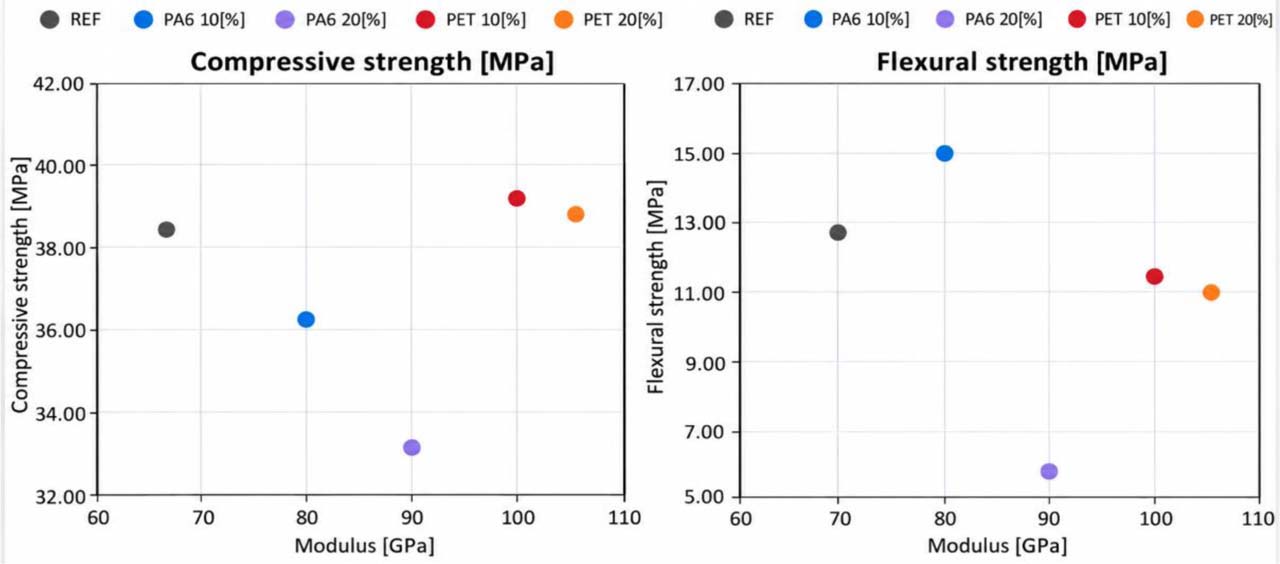
Figure 7:
Mechanical behavior of the investigated mortars: (a) compressive load–strain [MPa] response of the REF, M1 (PA6 10[%]), M2 (PA6 20[%]), M3 (PET 10[%]), and M4 (PET 20[%]) mixtures; (b) flexural load–strain [MPa] response of the same mixtures
Figure 7 illustrates the mechanical response of the investigated mortars under compression and flexural loading. Figure 7a shows the compressive behavior of the reference mixture [REF] and the mortars containing PA6 and PET inclusions, while Figure 7b presents the corresponding flexural response. The similarity of the load–strain curves confirms that the incorporation of recycled polymer inclusions does not significantly compromise the load-bearing capacity of the mortars. However, slight differences in the initial slope and deformation behavior indicate modifications in stiffness and ductility associated with the type and content of the recycled polymer.
Furthermore, the low coefficients of variation obtained for all mixtures (CV < 2.5%) demonstrate excellent experimental repeatability and confirm the reliability of the testing methodology. Such low dispersion indicates that the observed differences between mixtures are primarily related to material composition rather than experimental variability.
Overall, the results show that both PA6 and PET inclusions modify the mechanical response of the mortar in a predictable manner. PET inclusions preserve compressive and flexural strength while slightly improving deformation capacity, whereas PA6 promotes a more ductile behavior through a reduction in elastic modulus and an increase in maximum strain. These findings are consistent with recent studies on recycled polymers in cementitious materials and demonstrate that the incorporation of recycled PET and PA6 can contribute to the development of sustainable mortars without significantly compromising mechanical performance. The satisfactory agreement between the experimental and numerical results further supports the validity of the proposed hybrid experimental–numerical methodology.
2.8. Criteria for Analysis and Validation of the Methodological Approach
The analysis of the results was performed to evaluate the reliability of the experimental data and the capability of the proposed hybrid methodology to reproduce the mechanical behavior of mortars through finite element modeling. Attention was given to the consistency of the experimental measurements and the agreement between numerical predictions and laboratory observations.
Experimental reliability was assessed using statistical indicators, including the mean value, standard deviation, and coefficient of variation. These parameters were used to verify data reproducibility and identify potential outliers, thereby ensuring the robustness of the dataset employed for model calibration and validation.
The mechanical response of the mixtures was analyzed through load–strain curves obtained from compression and flexural tests. The evaluation focused on the initial stiffness, nonlinear behavior preceding failure, ultimate load capacity, and deformation at failure. Comparisons between mixtures were performed relative to the reference mortar in order to identify the influence of polymer type and replacement level on mechanical performance.
Model validation was conducted through direct comparison between experimental and numerical results. The agreement between both datasets was evaluated based on stiffness, maximum load, deformation capacity, and the overall shape of the load–strain response. Any discrepancies observed were interpreted considering the simplifying assumptions inherent to the numerical model.
The combined analysis of experimental and numerical results enabled the characterization of the mechanical behavior of mortars containing recycled polymer inclusions and provided a basis for assessing the applicability of the proposed methodology to sustainable cement-based materials.
3. Results
The experimental and numerical analysis results are shown together to allow the comparison of the experimentally obtained values with those estimated using the finite element model. Only the average value and dispersion are shown for each property under evaluation, as can be seen on the boxplots, without going into unnecessary details about the statistical analysis.
As in the previous case, when the numerical simulation based on finite elements is combined with the experimental data, it is possible to validate the mechanical performance of the material and analyze the stress-strain distribution. This approach has been used recently in the studies concerning the polymeric wastes-containing mortars, with good agreement being achieved between experimental and numerical results
3.1. Results of Mechanical Tests
3.1.1. Compression Test Results
The experimental compressive strength results obtained for the investigated mortar mixtures are presented in Figure 8. The experimental values show relatively small variability within each mixture, indicating a consistent mechanical response among the tested specimens.
The numerical model was used to analyse the mechanical response of the specimens under compressive loading, including the stress distribution and deformation behaviour. The maximum stress obtained from the finite element analysis should not be interpreted as the compressive strength of the mortar, since it represents a localized numerical stress concentration within the model. Therefore, the maximum FEM stress value of 257.07 MPa shown in Figure 6 is presented only to illustrate the stress distribution under the applied loading condition and is not directly compared with the experimentally determined compressive strength.
The experimental compressive strength was determined from the maximum load recorded during the compression tests and the loaded cross-sectional area of the specimen. The numerical analysis provides complementary information on the internal stress distribution and deformation of the specimen under compression, allowing critical regions subjected to elevated stresses to be identified.
Overall, the numerical model provides a macroscopic representation of the mechanical response of the investigated mortars under compressive loading. The results should therefore be interpreted in terms of stress distribution and deformation behaviour rather than as a direct prediction of the material compressive strength.
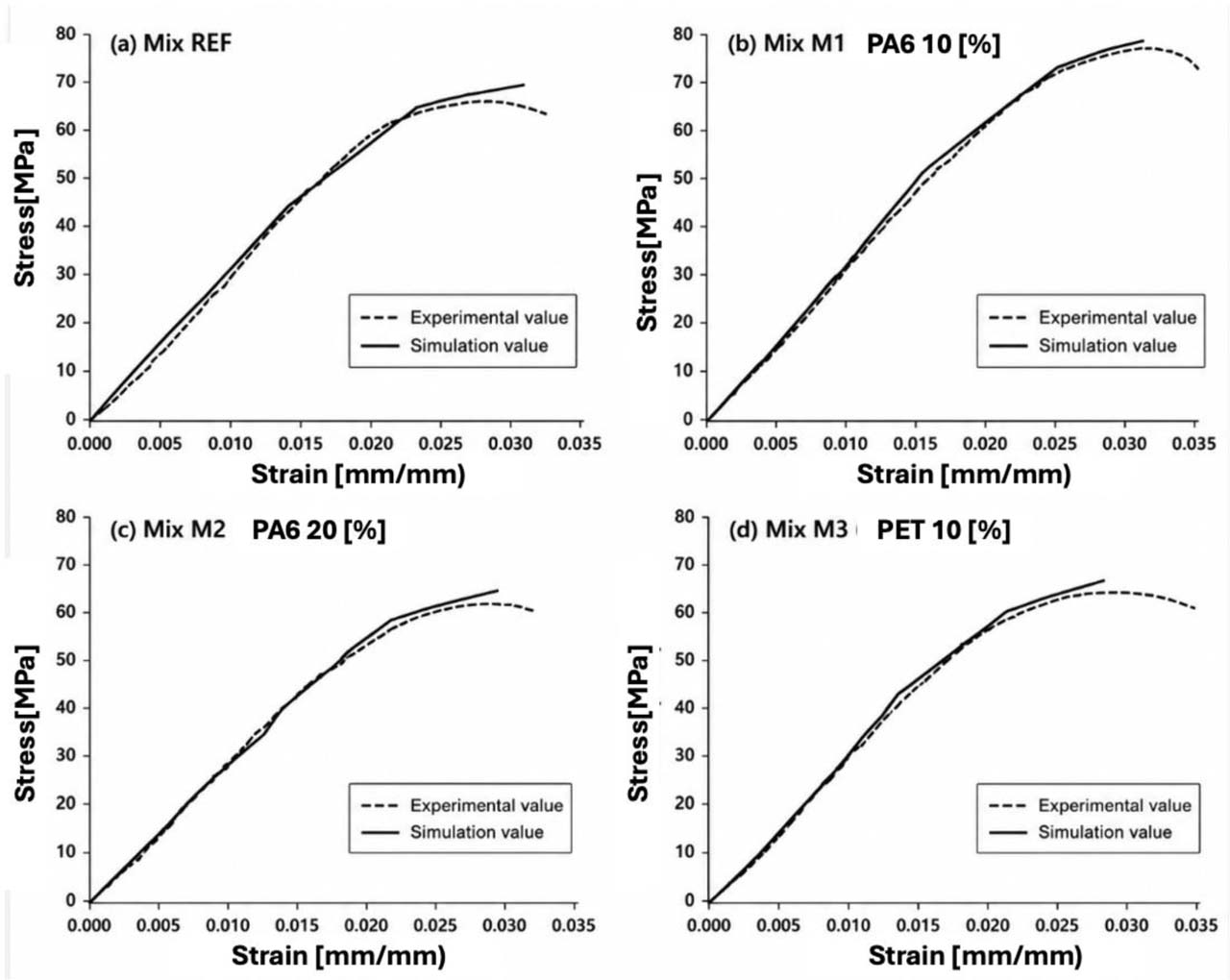
Figure 8:
Experimental compressive strength results for the investigated mortar mixtures and corresponding numerical stress-response analysis
3.1.2. Flexural Strength Results
Figure 9 presents the experimental flexural strength results together with the corresponding numerical responses obtained from the finite element simulations. The experimental results show relatively low dispersion among the tested specimens, indicating a consistent flexural response for the investigated mortar mixtures.
The stress–strain curves obtained from the numerical simulations show a similar overall evolution to that observed experimentally for the different mortar mixtures. In particular, the numerical curves reproduce the initial approximately linear response and the subsequent nonlinear behaviour observed as the applied load increases. This agreement indicates that the adopted finite element model provides a suitable macroscopic representation of the overall mechanical response of the investigated mortars under flexural loading.
It should be noted that the numerical results shown in Figure 9 represent the simulated mechanical response of the specimens and should not be interpreted as independent numerical values of flexural strength. The experimentally determined flexural strength was obtained from the maximum load recorded during the three-point bending tests according to EN 196-1. The FEM analysis was instead used to reproduce the mechanical response and to provide additional information regarding the stress and deformation behaviour of the specimens.
The close correspondence between the experimental and numerical curves indicates that the model adequately captures the main features of the flexural behaviour of the investigated mixtures. The differences observed near the maximum load and in the post-peak region can be attributed to the macroscopic representation of the mortar adopted in the numerical model, which does not explicitly account for the heterogeneous distribution of aggregates and recycled polymer inclusions, the interfacial transition zone, or crack initiation and propagation.
The numerical stress distributions presented previously in Figure 6 should also be interpreted in this context. The maximum local stress of 179 MPa obtained in the three-point bending simulation represents a localized numerical stress concentration and does not correspond to the experimentally measured flexural strength of the mortar. Therefore, this value is not used as a direct strength parameter in the comparison with the experimental results.
The results are consistent with previous studies reporting the applicability of finite element approaches for analysing the mechanical behaviour of cement-based materials incorporating recycled polymeric materials. Martínez-López et al. (2018) reported that finite element models can be used to reproduce the mechanical response and stress distribution of mortars incorporating polymer waste materials. Similarly, Xiong et al. (2023) and Wang et al. (2025) reported that recycled PET inclusions can modify the flexural behaviour of cement-based materials while maintaining adequate mechanical performance. These findings support the use of combined experimental and numerical approaches for evaluating sustainable cement-based composites.
Overall, the experimental results provide the basis for determining the flexural strength of the investigated mortars, while the numerical simulations provide complementary information regarding their stress–strain response, deformation behaviour, and internal stress distribution. The combined analysis therefore provides a more comprehensive assessment of the flexural behaviour of mortars containing recycled polymer inclusions.
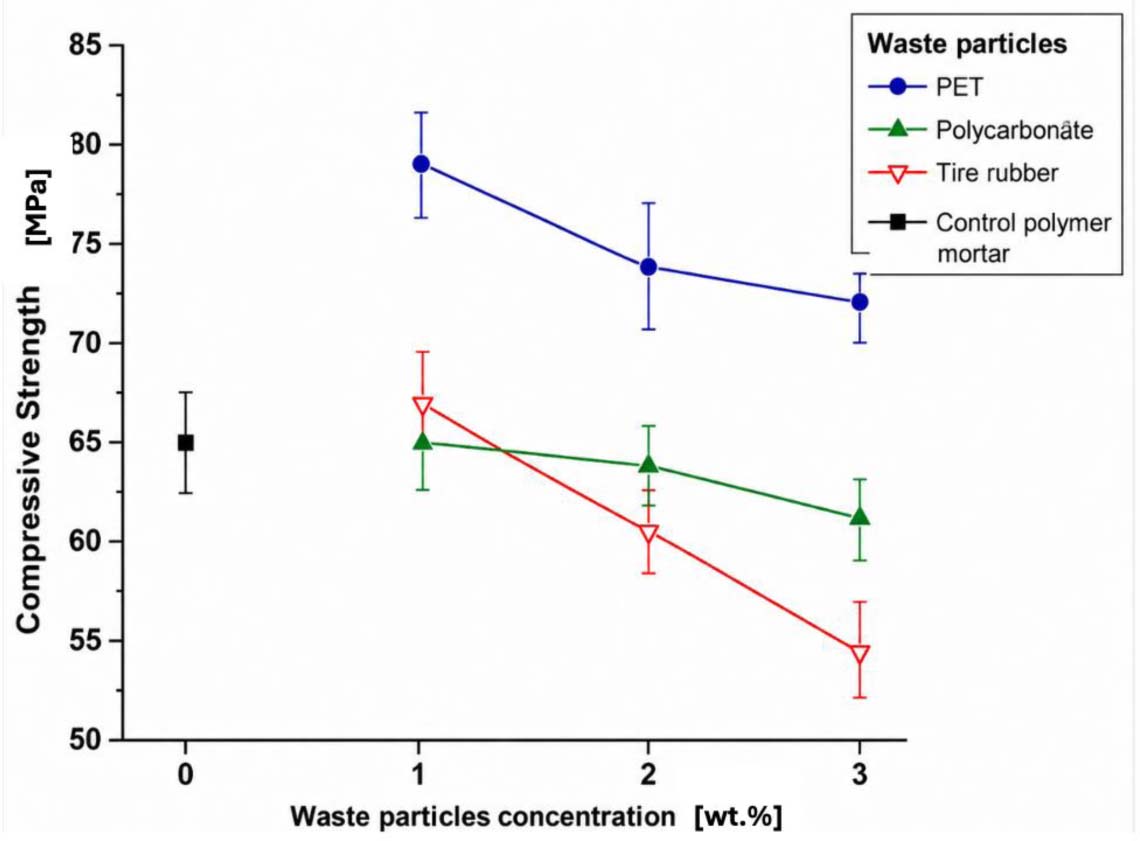
Figure 9:
Experimental flexural strength results and corresponding numerical stress–strain responses for the investigated mortar mixtures
3.2. Comparison between experimental results and numerical simulation
To validate the experimentally observed behavior, finite element simulations were performed using the mechanical properties obtained from the laboratory tests as input parameters.
Figure 8 compares the experimental compressive strength values with those predicted by the numerical model. A satisfactory agreement was observed between the two datasets, indicating that the proposed finite element model can reproduce the overall mechanical response of the investigated mortars with acceptable accuracy.
The numerical simulations also provided additional information regarding stress and deformation distributions within the specimens, allowing the identification of critical regions subjected to elevated stress concentrations during loading. These analyses complement the experimental results by providing insight into internal mechanical phenomena that cannot be directly observed during laboratory testing.
Figure 9 presents the stress distribution obtained from the finite element analysis. The results reveal localized stress concentration zones in the vicinity of the loading and support regions, which are identified as critical areas associated with damage initiation. The observed stress patterns are consistent with the experimentally detected failure mechanisms and contribute to explaining the differences in mechanical response among the investigated mixtures.
Similar observations have been reported by Martínez-López et al. (2018), who demonstrated that finite element models can successfully reproduce stress distributions and failure patterns in polymer-modified mortars. Furthermore, Wang et al. (2020) and Wu et al. (2022) highlighted the usefulness of numerical approaches for interpreting the mechanical behavior of cementitious materials and identifying critical stress regions that are difficult to evaluate using experimental techniques alone.
3.3. Analysis of Statistical Variability
Figure 10 presents the comparison between the experimental and numerical load–displacement responses obtained from the three-point bending tests for the reference mortar and the mortars containing recycled polymer inclusions. The four mixtures considered are the reference mixture (REF), the mortar containing 10[%] PA6 (M1), the mortar containing 20[%] PA6 (M2), and the mortar containing 10[%] recycled PET (M3).
For all mixtures, the numerical simulations show a similar overall trend to the experimental curves. The load initially increases approximately linearly with displacement, followed by a gradual deviation from linearity as the applied load increases. The numerical curves generally follow the experimental response throughout the loading range, although some differences can be observed, particularly at higher displacement levels and close to the maximum load.
For the reference mixture (Figure 10a), the experimental and numerical curves exhibit a close correspondence over most of the loading range. A similar behaviour is observed for the mortar containing 10[%] PA6 (Figure 10b), although a slightly greater difference between the experimental and numerical responses can be observed at higher displacement levels. For the mortar containing 20[%] PA6 (Figure 10c), the two curves remain relatively close, with the numerical response following the general evolution of the experimental data. In the case of the mortar containing 10[%] recycled PET (Figure 10d), the numerical curve also reproduces the general experimental trend, although differences become more noticeable in the later stages of loading.
The observed differences between the experimental and numerical responses can be attributed to the macroscopic assumptions adopted in the finite element model. The numerical model considers the mortar as a homogeneous and isotropic material and therefore does not explicitly reproduce the heterogeneous distribution of the cementitious matrix, aggregate particles, and recycled polymer inclusions. In addition, local defects, material heterogeneity, and crack initiation and propagation occurring during the experimental tests are not explicitly represented in the model.
It is important to distinguish the numerical load–displacement response shown in Figure 10 from the local stress values presented in Figure 6. The FEM stress values correspond to localized numerical stress concentrations and should not be interpreted as numerical flexural strength values. The experimentally measured maximum load remains the basis for determining the flexural strength of the mortar specimens, whereas the numerical analysis provides complementary information on the mechanical response, deformation, and stress distribution.
Overall, the comparison presented in Figure 10 indicates that the finite element model adequately reproduces the general load–displacement behaviour observed experimentally for the investigated mortar mixtures. The agreement between both approaches supports the use of the numerical model as a complementary tool for analysing the macroscopic flexural behaviour of mortars incorporating recycled PA6 and PET.
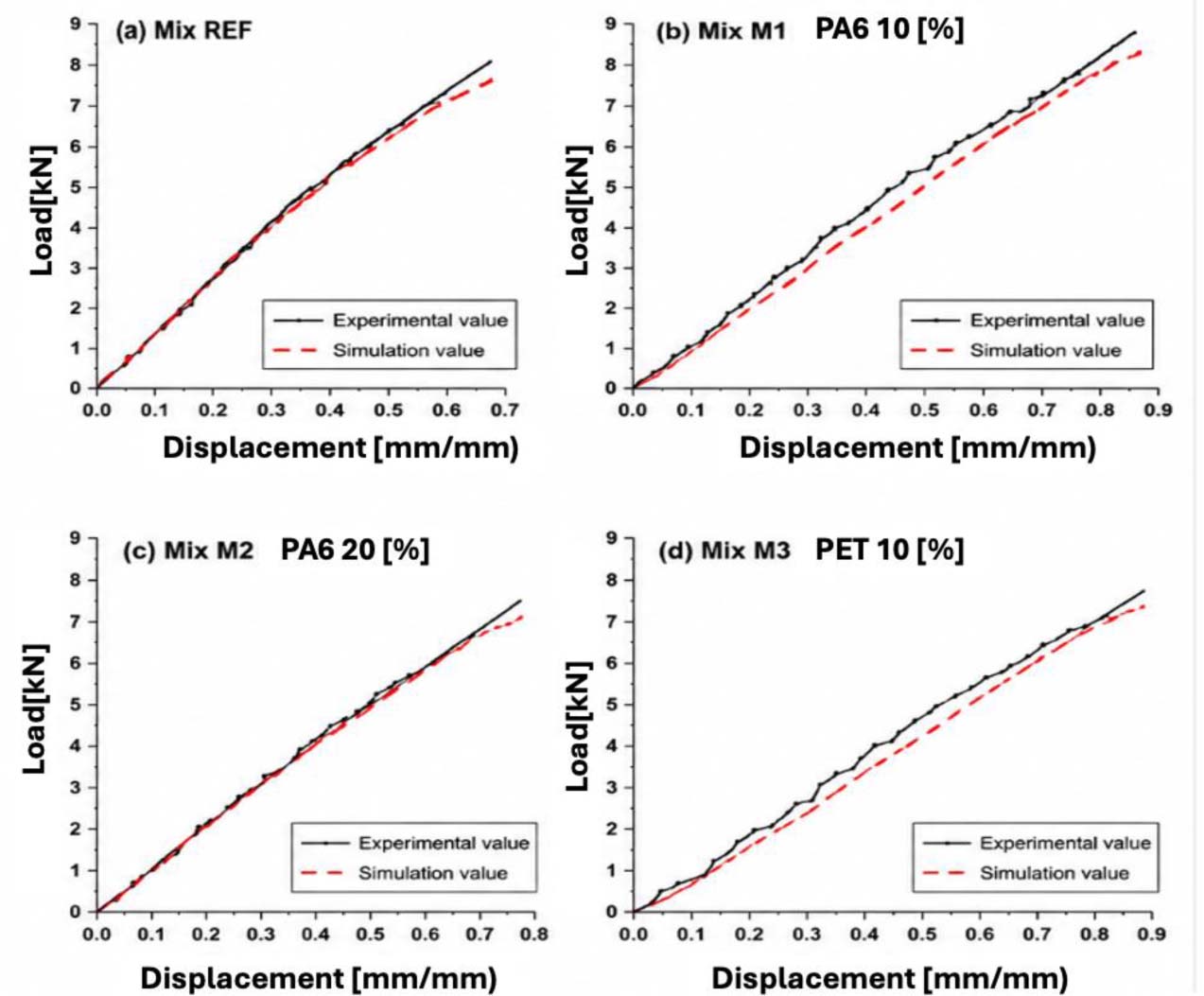
Figure 10:
Comparison between experimental and numerical load–displacement responses for the three-point bending tests: (a) reference mortar (REF), (b) mortar containing 10[%] recycled PA6 (M1), (c) mortar containing 20[%] recycled PA6 (M2), and (d) mortar containing 10[%] recycled PET (M3)
4. Discussion
The mechanical results indicate that the incorporation of recycled polymer inclusions modifies the stiffness and deformation capacity of mortars without causing substantial reductions in compressive or flexural strength. The decreases observed in mechanical performance remained within the ranges commonly reported for cementitious materials containing recycled polymers, suggesting that the selected replacement levels (10[%] and 20[%]) are compatible with maintaining satisfactory structural performance. Similar observations were reported by Safi et al. (2013), Legan et al. (2025), and Xiong et al. (2023), who found that recycled plastic inclusions can alter the mechanical response of mortars while preserving acceptable strength levels.
The reduction in elastic modulus observed in the PA6-modified mixtures reflects the lower stiffness of the polymer phase compared with the cementitious matrix. At the same time, the increase in maximum strain indicates a more deformable and ductile response. Similar behavior was reported by Pinilla-Hernandez et al. (2026), who found that the incorporation of polyamide 6 improved the deformation capacity of mortars while maintaining satisfactory mechanical performance. Comparable trends have also been observed in mortars reinforced with recycled nylon fibers, where the incorporation of polyamide-based materials promoted greater deformability and post-cracking energy absorption (Spadea et al., 2015; Orasutthikul et al., 2017).
In comparison with PET, PA6 produced a more pronounced reduction in stiffness. This behavior can be attributed to the lower elastic modulus and higher deformability of polyamide materials relative to both PET and the surrounding cementitious matrix. Under mechanical loading, PA6 particles are more susceptible to deformation, which reduces the efficiency of stress transfer between the polymer inclusion and the cement matrix. In addition, differences in particle morphology and interfacial bonding may contribute to a less rigid composite structure. Conversely, PET exhibits a comparatively stiffer response and more efficient load-transfer capacity, allowing the elastic modulus of the mortar to remain closer to that of the reference mixture. These observations highlight the importance of polymer type in controlling the balance between stiffness, strength, and ductility in recycled-polymer mortars.
The PET-modified mixtures exhibited compressive and flexural strengths comparable to those of the reference mortar. This behavior confirms that recycled PET can be incorporated at moderate replacement levels without significantly affecting the load-bearing capacity of the material. Similar findings have been reported by Hong and Byun (2010), Lazorenko et al. (2022), Legan et al. (2025), and Wang et al. (2025), who demonstrated that PET inclusions can preserve the mechanical performance of mortars while improving toughness, deformation capacity, and energy absorption mechanisms.
From a microstructural perspective, the observed trends may be associated with the characteristics of the interfacial transition zone (ITZ). As reported by Scrivener et al. (2004), weaker bonding at the matrix–inclusion interface may promote local stress concentrations and crack initiation. Although the present numerical model does not explicitly represent the ITZ, the stress concentration zones identified in the simulations are consistent with this mechanism and help explain the differences observed among the investigated mixtures.
The finite element model successfully reproduced the overall experimental response and provided additional information regarding stress distribution and deformation patterns that cannot be directly observed during laboratory testing. The agreement between experimental and numerical results confirms the suitability of the proposed hybrid methodology for evaluating the mechanical behavior of mortars containing recycled polymer inclusions. Similar results were reported by Martínez-López et al. (2018), who demonstrated that finite element models can effectively reproduce the behavior of polymer-modified mortars. Likewise, Wang et al. (2020) and Wu et al. (2022) highlighted the usefulness of numerical simulations for interpreting stress distributions and identifying critical regions susceptible to failure in cement-based materials.
Nevertheless, the adopted numerical approach considers the material as homogeneous and isotropic; therefore, local phenomena such as microcrack propagation, interface degradation, and particle-scale interactions are not explicitly represented. Future research should incorporate mesostructural models capable of simulating these mechanisms in greater detail and improving the representation of matrix–polymer interactions.
Finally, the low coefficients of variation obtained for all mixtures demonstrate good experimental repeatability and confirm the reliability of the testing procedure. Similar levels of consistency have been reported in mortars containing recycled PET and nylon inclusions (Spadea et al., 2015; Orasutthikul et al., 2017; Legan et al., 2025). The combined use of experimental testing and numerical modeling therefore provides a robust framework for assessing sustainable cement-based materials and supports the use of recycled PET and PA6 as viable alternatives for the development of environmentally friendly mortars.
5. Conclusions
Mechanical Performance of Recycled Polymer Mortars
The incorporation of recycled polymer inclusions modified the mechanical response of the mortars without causing significant reductions in strength. The experimental results showed that compressive and flexural strengths remained within acceptable ranges for all replacement levels investigated. Although slight decreases in stiffness were observed, particularly in the mixtures containing PA6, the overall mechanical performance remained satisfactory, demonstrating the feasibility of incorporating recycled polymers as partial aggregate replacements.
The effect of the recycled inclusions was strongly dependent on the polymer type. PA6-modified mortars exhibited a progressive reduction in elastic modulus accompanied by an increase in maximum strain, indicating a more deformable and ductile mechanical behavior. This response suggests that PA6 inclusions may improve the energy absorption capacity of the material while maintaining adequate strength levels. Conversely, PET-modified mortars showed mechanical strengths comparable to those of the reference mixture, indicating that recycled PET can be incorporated without significantly affecting load-bearing capacity.
Experimental Reliability and Variability
The statistical analysis confirmed the robustness of the experimental program. All mixtures exhibited coefficients of variation below 5[%], indicating low dispersion and good repeatability of the results. These values are consistent with those reported in the literature for cementitious materials incorporating recycled constituents and demonstrate that the adopted specimen preparation, curing, and testing procedures provided a reliable basis for evaluating mechanical performance.
The low variability observed among specimens also indicates that the incorporation of recycled polymer inclusions did not introduce significant uncertainty into the mechanical response of the mortars. Consequently, differences between mixtures can be attributed primarily to material composition rather than to experimental fluctuations.
Numerical Model Validation
The finite element model successfully reproduced the global response observed during the compression and flexural tests. The agreement between numerical predictions and experimental observations confirms the suitability of the adopted calibration procedure and validates the proposed hybrid methodology.
In addition to reproducing the overall mechanical behavior, the simulations provided valuable information regarding stress distributions, deformation fields, and critical regions susceptible to damage initiation. These aspects cannot be directly observed through conventional laboratory testing and therefore constitute an important contribution of the numerical approach.
Although the model assumes homogeneous and isotropic material behavior, it proved effective for evaluating the influence of recycled polymer inclusions on global mechanical performance. Nevertheless, local phenomena such as interfacial transition zone degradation, microcrack evolution, and particle-scale interactions were not explicitly represented and should be considered in future developments.
Contribution of the Hybrid Experimental-Numerical Methodology
One of the main outcomes of this research is the validation of a combined methodology integrating experimental testing, statistical evaluation, and finite element modeling. The proposed framework enabled a comprehensive characterization of mortar behavior, linking experimentally measured properties with numerical predictions of stress and deformation distributions.
The methodology also provides a practical tool for evaluating alternative mixture compositions while reducing the need for extensive experimental campaigns. Consequently, it can support future research focused on optimizing recycled-material content and improving the mechanical performance of sustainable mortars.
Sustainability Implications and Future Research
The results demonstrate that recycled polymer inclusions represent a viable alternative for the partial replacement of conventional aggregates in mortar production. Their incorporation contributes to the valorization of plastic waste, reduces consumption of natural resources, and supports the implementation of circular economy strategies within the construction sector.
Future research should investigate higher replacement percentages, long-term durability performance, thermal and environmental effects, and advanced numerical models capable of explicitly representing the interfacial transition zone and crack propagation mechanisms. Such developments would further improve the understanding of failure processes and facilitate the design of high-performance sustainable cement-based materials.
Acronyms
| Acronym | Full Name | Description |
|---|---|---|
| PA6 | Polyamide 6 | Polyamide 6 used as a recycled plastic aggregate in mortar. |
| PET | Polyethylene Terephthalate | Polyethylene Terephthalate, a polymer widely used in recycled plastic packaging. |
| rPET | Recycled Polyethylene Terephthalate | Recycled PET used in pellet form as an alternative aggregate. |
| PE-HD | High-Density Polyethylene | High-density polyethylene used as a recycled plastic material. |
| PP | Polypropylene | Polypropylene used as a lightweight plastic aggregate. |
| ABS | Acrylonitrile Butadiene Styrene | Thermoplastic polymer used in industrial applications and recycled in the study. |
| PS-HI | High Impact Polystyrene | High-impact polystyrene with greater mechanical strength than conventional polystyrene. |
| FEM | Finite Element Method | Finite element method used for the numerical simulation of the mechanical behavior of mortar. |
| ITZ | Interfacial Transition Zone | Interfacial transition zone between the cementitious matrix and the aggregate. |
| MPa | Megapascal | Unit of pressure used to express mechanical strength. |
| GPa | Gigapascal | Unit of elastic modulus used to describe material stiffness. |
| CV | Coefficient of Variation | A statistical measure that expresses the relative dispersion of experimental results. |
| Fmax | Maximum Load | Maximum load applied during the mechanical test. |
| A | Cross-sectional Area | Cross-sectional area of the test specimen. |
| E | Elastic Modulus | Secant elastic modulus of the material. |
| σ | Stress | Stress applied to the material. |
| ε | Strain | Unitary deformation produced by the load. |
Acknowledgments
The authors acknowledge the financial support provided by San Pablo CEU University through the research project “Analysis of the structural behavior of concrete subjected to high temperatures and manufactured with recycled materals to obtain sustainable materials (MCP22VEM),” carried out within the ARIE Research Group (registration number: G20/6-06, San Pablo CEU University). We thank the laboratory facilities of the Institute of Technology at San Pablo CEU University for their technical support during the experimental program. In addition, the authors thank the company SEVELAR for supplying the plastic waste used in this study.
This work was funded by San Pablo CEU University through the MCP22VEM research project, carried out within the ARIE Research Group (Registration number: G20/6-06, San Pablo CEU University). The authors acknowledge the technical support provided by the laboratory facilities of the Institute of Technology at CEU San Pablo University and thank SEVELAR for supplying the plastic waste used in this study.
Notes
[2] Disclosure of Interest
The authors affirm that no conflict of interest existed regarding the study, its interpretation, or the manuscript. They also declare that they have not received any benefits—whether financial, commercial, or personal—that could have unduly influenced the research. This work was completed independently and objectively, based solely on academic and scientific grounds.
[3] Contributed by Author Contributions
M.I.P.H. conceived and designed the study, developed the methodology, conducted the research, performed the formal analysis, curated the data, carried out the numerical simulations, visualized the results, and prepared the original draft of the manuscript. M.E.M.T. contributed to the conceptualization and methodology, validated the results, participated in the formal analysis, provided resources, reviewed and edited the manuscript, and supervised the study. R.A.G.L. contributed to the conceptualization and methodology, validated the results, supervised the project, managed project administration and funding acquisition, and reviewed and edited the manuscript. All authors critically reviewed and approved the final version of the manuscript and agreed to be accountable for all aspects of the work.