

1. Introduction
The rapid development of modern integrated infrastructure construction has led to the development of underground engineering represented by tunnelling (Deshpande & Hedaoo, 2024). Tunnel construction is faced with complex geological conditions(Hodas et al., 2023; Luo Yifan et al., 2025), frequent natural disasters (Han-Peng W, 2009; Guo Y, 2024), difficult construction conditions and other difficulties (Yang S, 2025; Dayong H, 2025; Luo Yifan et al., 2024), resulting in a large number of construction risk factors, and many factors are intertwined with each other. At the same time, following such risk incidents, it is necessary to rapidly resume tunnel excavation in order to minimize project delays and rescue trapped personnel and equipment. There is an urgent need to establish a scientific and reasonable evaluation system to scientifically assess the risk of tunnel construction and reduce the losses caused by construction risks.
Some scholars have already conducted research on risk management in tunnel construction. For example, Mikaeil et al. optimized and enhanced the risk control and assessment of geotechnical risks (2019). Sharafat et al. used generic bow-tie risk analysis approach to analyse the risk of TBM tunnels (2021). Liu et al. constructed a digital management and risk management system based on BIM for the construction of mountain tunnels (2023). Hai et al. used a combination of the latent Dirichlet allocation algorithm, the NK model and the system dynamics to evaluate the dynamic coupling of multiple risks during tunnel construction (2022). Paraskevopoulou et al. assessed the likelihood of different accidents in tunnelling and their impact on cost overruns and schedule delays (2022). These scholars have made important contributions to risk management in tunnelling. However, it is still worth noting that these approaches tend to focus on prevention and control of risks before they occur, namely by controlling the different tunnel construction risk factors in order to reduce vulnerability. However, it is not realistic to ensure that the tunnelling process is completely risk-free under the influence of many overlapping risks. It is also worthwhile for academics to investigate how to improve the resistance to risk during construction while ensuring that tunnelling can be quickly resumed if a risky incident has already occurred.
The concept of resilience was first proposed in the 1970s and has evolved to gradually receive more attention from scholars. The concept of resilience is now widely used in a variety of fields, including ecological resilience, psychological resilience, organizational resilience, urban resilience, and engineering resilience. In 1973, Holling was the first to extract resilience from stability from an ecological point of view and systematically elaborated the difference between stability and resilience (1973). He believed that stability refers to the steady state of a system and its ability to maintain that steady state. Resilience, on the other hand, refers to the ability of a system to recover quickly from a shock.
Subsequently, many scholars have interpreted the definition of resilience from different perspectives, and there are many understandings of the definition of resilience, but there are also differences. Macaskill points out that it is not realistic or scientific to give a strict and uniform definition of resilience, and that the connotation of resilience should be individually defined according to the scenarios in which it is applied (2014). That is, the connotations of resilience vary depending on the object of analysis, be it ecological, psychological, organizational, urban, engineering or other. Although resilience is defined differently in various disciplines, it essentially describes the ability of a research system to return to a normal state after being perturbed by an external shock through autonomous adjustment and adaptation, and to cope with the shocks and perturbations it encounters in a sustainable manner to achieve a safe and sustainable development of the system.
Combined with the basic characteristics of the concept of resilience and the characteristics of tunnel construction, this study defines tunnel construction resilience as the ability of a project to resist interference, restore construction operation and optimize the construction system in the process of tunnel construction when faced with the coupled interference of many risk factors. Strong tunnel construction resilience can ensure that when the tunnel project is disturbed by many risk factors, it not only has strong resistance to interference and rapid recovery ability but also can optimize the construction system after being disturbed by the risk factors, so as to further enhance the tunnel construction resilience.
The introduction of the concept of resilience into the study of tunnel construction risk management helps to recognize the inherent vulnerability of tunnel construction projects. It also becomes very meaningful to enable it to recover quickly and successfully when faced with destructive events, to overcome the limitations of the existing tunnel construction risk management research, and to improve the ability to cope with risks in the tunnel construction process. Based on this, this study introduces the concept of risk resilience into the study of risk management in tunnel construction, explores the impacts of different risk factors on tunnel construction and provides new guarantees to promote the smooth implementation of tunnel construction and the realization of expected goals.
Therefore, this paper is divided into five parts. Firstly, review resilience and tunnel construction resilience related research, clarify the conceptual connotation of tunnel construction resilience. Second, construct tunnel construction resilience indicator system. Third, use group decision-making AHP method to calculate the weights of tunnel construction resilience indicators. Fourthly, the tunnel construction resilience evaluation of Xiangyalu Cross-river Tunnel is carried out using fuzzy comprehensive evaluation method. Finally, the conclusions are summarized. The specific research process is shown in Figure 1.
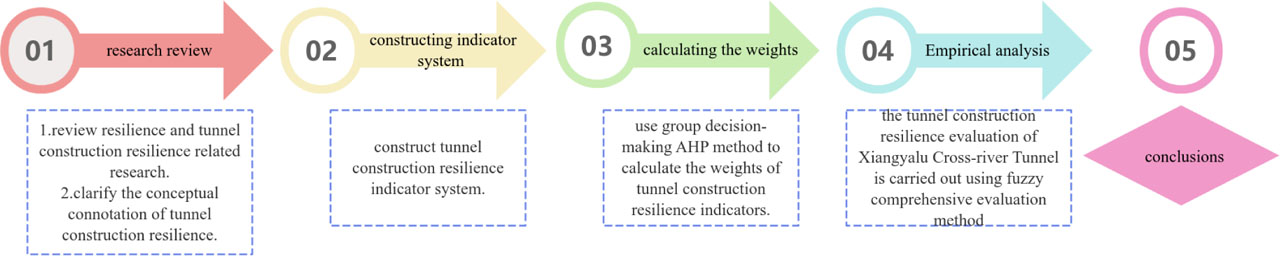
Figure 1:
Research process
2. Indicators for Tunnel Construction Resilience Evaluation
The construction of a sound tunnel construction resilience evaluation indicator system is crucial for the scientific and reasonable evaluation of tunnel construction resilience. At present, there is no sound tunnel construction resilience evaluation indicator, by comparing and discussing similar resilience evaluation indicators and analysing their advantages and disadvantages, which helps to form a sound tunnel construction resilience evaluation indicator.
Nicolosi et al. identify road network resilience evaluation indicators for stochastically assessing the economic resources needed to rehabilitate damaged infrastructure in terms of risk and resilience, which are a good complement to resilience (2022). However, these indicators focus too much on economic benefits and neglect other considerations. Rehak et al. constructed a critical infrastructure elements resilience assessment model in terms of robustness, recoverability, and adaptability, which can evaluate the three subdimensions of critical infrastructure resilience in a targeted manner (2019). However, it should be noted that the method involves as many as 62 primary and secondary evaluation indicators, and it is difficult to collect data on so many data indicators in the actual construction process. Saikia et al. proposed a three-tiered City Water Resilience Framework in terms of four dimensions: infrastructure and ecosystems, health and wellbeing, planning and finance, and leadership and strategy (2022). Although this framework can comprehensively evaluate and reflect City Water Resilience, the large number of indicators included in the three-tier framework cannot be generalized for use in most scenarios. Afrin et al. used machine learning methods and various spatio-temporal data sources to predict highway resilience, and this data-driven resilience prediction method can predict the recovery of highway resilience very well (2023). However, this prediction method is not perfect, and the disadvantage of over-reliance on past data is its main disadvantage. For tunnel construction safety resilience, Wei et al. proposed an evaluation indicator system consisting of three dimensions of resistance, adaptability, and recovery from the three characterization capabilities of resilience (2021), but there is overlap and crossover between the indicators subordinate to these three dimensions, which fails to form a resilience evaluation system that is clearly attributed to the three dimensions. Zhang identified deep foundation pit system resilience evaluation indicators from five dimensions: personnel, material & equipment, technology, management, and environment, and achieved good evaluation results (2022). Luo explored the impact of offshore wind turbines on undersea tunnels from the perspective of dynamic modeling (2023).
Analysing the above studies on the resilience evaluation system, this study believes that the evaluation indicator system needs to consider not only scientific and rationality but also ease of operation and replicability. Considering the practices of the above studies, the tunnel construction toughness indicators can be comprehensively identified from the constituent elements of the tunnel construction system, and at the same time, the crossover between the resilience indicators is also avoided. More importantly, this evaluation system is operable and replicable.
Starting from the principles of scientificity, systematicity, reliability, feasibility and generalizability, this study reviewed relevant literature and actual engineering documents, analysed risk factors during tunnel construction, and collected and screened preliminary indicators for tunnel construction resilience evaluation. Subsequently, this study invites the expert group to add, delete and merge the preliminary evaluation indicators to further ensure the accuracy of the evaluation indicators. The expert group consists of eight frontline managers with rich experience in tunnel construction. They are from different nature of companies, including developers, contractors, and consultants, in Changsha Metro Line 7 Jingwanzi Station Project and Xiangyalu Cross-river Tunnel Project. All of them have more than 10 years of tunnel-related work experience, and their education level is bachelor’s degree or above.
The final tunnel construction resilience evaluation indicator system has 5 secondary indicators, including personnel, material & equipment, technology, management and environment, and a total of 23 tertiary indicators. The specific tunnel construction resilience evaluation indicators are shown in Table 1 and Figure 2.
Table 1:
Indicators for tunnel construction resilience evaluation
| No. | Primary indicator | Secondary indicator | Tertiary indicators | Weight |
|---|---|---|---|---|
| 1 | Resilience | Personnel | Practitioner qualification level | 0.2510 |
| 2 | Practitioner experience | 0.3109 | ||
| 3 | Project organization structure | 0.2127 | ||
| 4 | Division of labor | 0.2254 | ||
| 5 | Materials & Equipment | Performance of materials & equipment | 0.1945 | |
| 6 | Use of materials & equipment | 0.2323 | ||
| 7 | Emergency supply of materials & equipment | 0.2473 | ||
| 8 | Rescue funding input | 0.3260 | ||
| 9 | Technology | Surrounding rock monitoring technology | 0.2360 | |
| 10 | Support system and technology | 0.1984 | ||
| 11 | Planning and programming of project construction | 0.1323 | ||
| 12 | Technical clarification | 0.1836 | ||
| 13 | Data collection and monitoring | 0.2497 | ||
| 14 | Management | Organizational and management processes | 0.2869 | |
| 15 | Construction protection management | 0.2469 | ||
| 16 | Implementation of the rules and regulations | 0.1490 | ||
| 17 | Emergency response plan and drill | 0.1167 | ||
| 18 | Construction management rules and regulations | 0.2004 | ||
| 19 | Environment | Climatic conditions | 0.3417 | |
| 20 | Hydrological conditions | 0.1667 | ||
| 21 | Geological conditions | 0.1339 | ||
| 22 | Construction site environment | 0.1686 | ||
| 23 | Surrounding environment | 0.1890 |
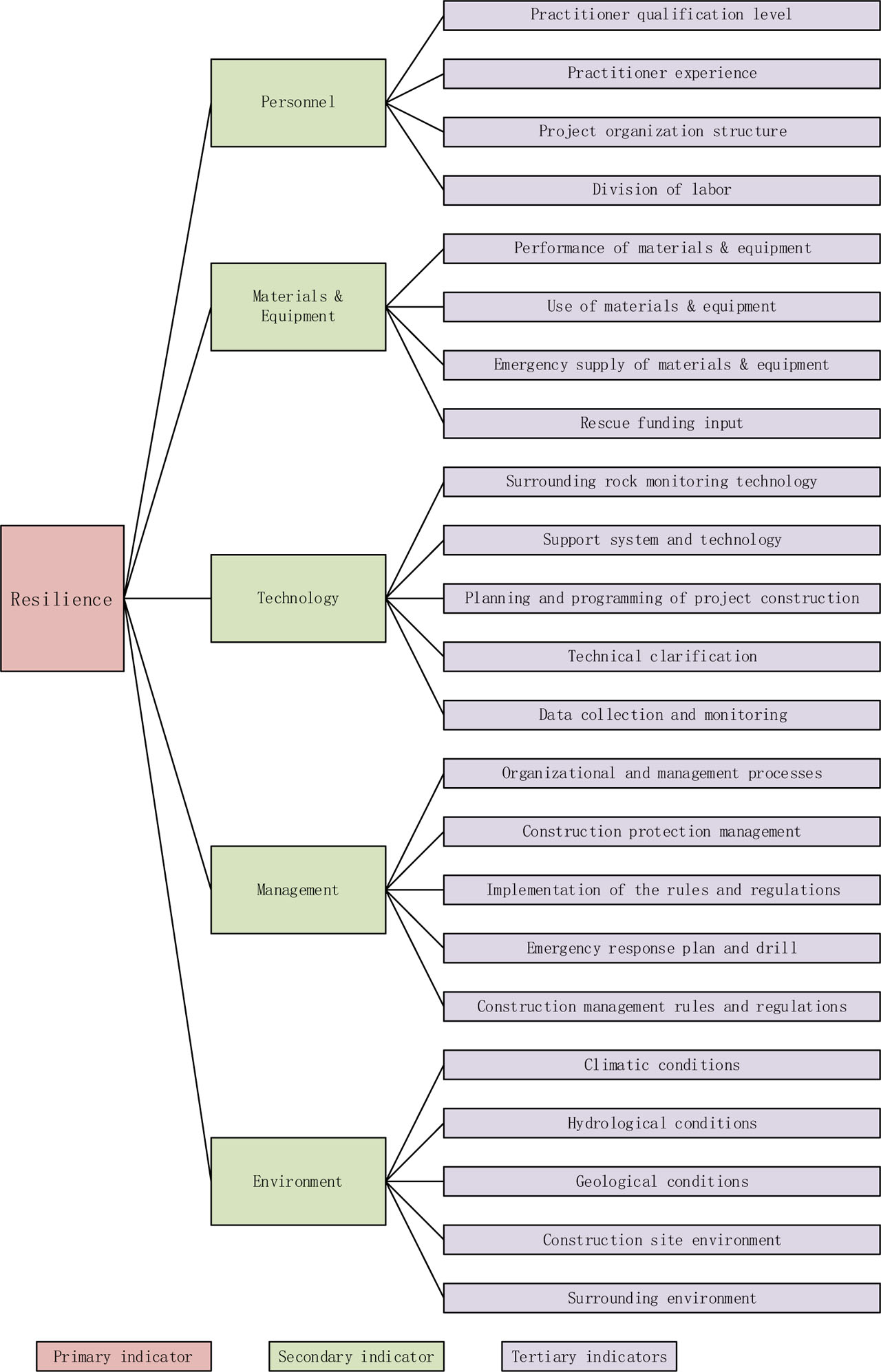
Figure 2:
Three-level indicator system
3. Calculation the Weights of Tunnel Construction Resilience Evaluation Indicators
The complexity of the various factors leading to the complexity of tunnel construction resilience evaluation, the using of Analytic Hierarchy Process (AHP) can stratify the evaluation indicator system and quantify the weight of indicators, to provide a basis for tunnel construction resilience evaluation. At the same time, to eliminate the impact of subjective bias of experts on tunnel construction resilience evaluation system, the study uses group decision-making method to improve the AHP method. That is, the study invites several experts to participate in the weighting of tunnel construction resilience indicators using AHP, assigns coefficients to the decision-making weights of each expert according to his/her level of experience and education, and finally synthesizes the weight vectors of the group decision-making. The use of the improved group decision-making AHP method enables a more accurate quantification of the weights of the tunnel construction resilience indicators.
The study takes the tunnel construction resilience as the target level, the secondary indicators as the criterion level, and the tertiary indicators as the indicator level, and the trilateration structure constitutes the hierarchical order of the evaluation indicators.
According to the group decision-making AHP, the study invites five experts to judge the tunnel construction resilience indicators, and through a series of calculations of each group's judgment matrix to get the maximum characteristic root, the corresponding eigenvector, the normalized weight vector, and the consistency test results. The consistency test results of the judgment matrices made by five experts are shown in Table 2.
Table 2:
Results of consistency test
| Judgement matrices | Expert 1 | Expert 2 | Expert 3 | Expert 4 | Expert 5 |
|---|---|---|---|---|---|
| Resilience | 0.004 | 0.004 | 0.009 | 0.002 | 0.003 |
| Personnel | 0.005 | 0.000 | 0.004 | 0.000 | 0.000 |
| Materials & equipment | 0.000 | 0.004 | 0.002 | 0.004 | 0.004 |
| Technology | 0.004 | 0.003 | 0.004 | 0.009 | 0.003 |
| Management | 0.003 | 0.000 | 0.025 | 0.002 | 0.004 |
| Environment | 0.003 | 0.001 | 0.011 | 0.000 | 0.003 |
As can be seen from the test results, all the consistency test results of the judgement matrix made by experts are less than 0.025. Referring to the mainstream consistency test threshold of 0.1 (Vinogradova-Zinkevič et al., 2021; Luo Yifan et al., 2024), the judgment matrix results produced by the five experts passed the consistency test. Therefore, the results can be used for subsequent research.
Based on the results of the judgement matrix, the study summarizes the weights of each indicator judged by different experts. The study assigned scores to each expert based on their years of tunnel construction experience and educational background. Specifically, each year of work experience was worth 1 point, while educational attainment was scored as follows: doctoral degree = 10 points, master's degree = 8 points, bachelor's degree = 6 points, and associate degree = 4 points. These scores were applied to the five experts. Weighting was then applied based on each expert's score as a percentage of the total combined score of all five experts. The basic information and weights of the five experts were shown in the Table 3. According to Table 3, the weights assigned to the five experts are 0.1835, 0.2110, 0.2661, 0.1651, and 0.1743, respectively.
Table 3:
Experts weights table
| Expert 1 | Expert 2 | Expert 3 | Expert 4 | Expert 5 | |
|---|---|---|---|---|---|
| Years of tunnel construction experience | 12 | 13 | 19 | 8 | 11 |
| Educational background | 8 | 10 | 10 | 10 | 8 |
| Weight | 0.1835 | 0.2110 | 0.2661 | 0.1651 | 0.1743 |
The study calculated the final weights of each evaluation indicator, as mentioned in detail in Table 1.
According to the criterion level and indicator level weighting can find out the key indicators affecting the tunnel construction resilience, help tunnel construction management organization to identify the key concerns and the weak aspects in the tunnel construction process to take targeted measures to enhance the tunnel construction resilience.
4. Case Study
4.1. Project Overview
Xiangyalu Cross-river Tunnel is located in Changsha, Hunan Province, China. As one of the important main roads in Changsha, it is between Yinpenling Bridge and Yingpanlu Tunnel, about 650 meters from Yinpenling Bridge in the north and about 1,000 meters from Yingpanlu Tunnel in the south. The total length of the Xiangyalu Cross-river Tunnel is about 4.18 kilometres, which is the first two-way six-lane river crossing in Changsha, and also the largest diameter shield tunnel in Hunan Province so far. The construction of Xiangyalu Cross-river Tunnel Project is faced with complex environment and geological conditions, long-distance rock boring, high starting difficulties and other construction challenges. During the construction process, the project needs to face the difficult construction phases such as penetrating ancient buildings, Xiangjiang River embankment and broken belt, spanning Changsha Metro Line 1 and intersecting with Changsha Metro Line 6. Xiangyalu Cross-river Tunnel has a complex external environment, which has a great impact on tunnel construction. This paper combines the weights of tunnel construction resilience evaluation indicators and uses the fuzzy comprehensive evaluation method to assess the construction resilience of Xiangyalu Cross-river Tunnel.
4.2. Evaluation of Tertiary Indicators
This paper invites 68 managers and technicians from the Xiangyalu Cross-river Tunnel Project to evaluate the tunnel construction resilience indicators. 68 managers and technicians have been involved in the Xiangyalu Cross-river Tunnel Project for more than one year, which means that they have enough understanding about the Xiangyalu Cross-river Tunnel construction to ensure the accuracy of the evaluation given by them. According to the actual situation of Xiangyalu Cross-river Tunnel Project, the respondents were asked to rate the 23 resilience indicators on a five-level scale: excellent, good, fair, poor, and bad. The ratings corresponding to the five scales were 1, 0.75, 0.5, 0.25, and 0, respectively. The evaluation results of the indicators in this study are shown in Table 4.
4.3. Final Evaluation Results
According to Table 3, the fuzzy evaluation matrix FCi = (fCi1, fCi2, fCi3, fCi4, fCi5) is obtained for each tertiary indicator. Multiplying FCi with the corresponding tertiary indicator weights can obtain the secondary indicator fuzzy evaluation matrix FBi = (fBi1, fBi2, fBi3, fBi4, fBi5). The statistics of the fuzzy evaluation results of the five secondary indicators are shown in Table 5.
After multiplying FBi = (fBi1, fBi2, fBi3, fBi4, fBi5) with the weights of the secondary indicators , we obtain the final fuzzy evaluation matrix of Xiangyalu Cross-river Tunnel construction resilience FA = (0.2714 0.3141,0.2585,0.1263,0.0297). Multiplying FA with weight yields a final composite evaluation score of 0.6678.
Therefore, the final evaluation value of the Xiangyalu Cross-river Tunnel construction resilience is between good and fair, which is in line with the actual situation and the evaluation model is effective.
Table 4:
Evaluation results for each indicator
| No. | Tertiary indicators | Excellent | Good | Fair | Poor | Bad |
|---|---|---|---|---|---|---|
| 1 | Practitioner qualification Level | 0.471 | 0.338 | 0.162 | 0.029 | 0.000 |
| 2 | Practitioner experience | 0.515 | 0.397 | 0.074 | 0.015 | 0.000 |
| 3 | Project organization structure | 0.221 | 0.382 | 0.265 | 0.132 | 0.000 |
| 4 | Division of labor | 0.118 | 0.221 | 0.338 | 0.250 | 0.074 |
| 5 | Performance of materials & equipment | 0.221 | 0.353 | 0.265 | 0.162 | 0.000 |
| 6 | Use of materials & equipment | 0.324 | 0.338 | 0.132 | 0.118 | 0.088 |
| 7 | Emergency supply of materials & equipment | 0.338 | 0.265 | 0.250 | 0.147 | 0.000 |
| 8 | Rescue funding input | 0.353 | 0.368 | 0.191 | 0.088 | 0.000 |
| 9 | Surrounding rock monitoring technology | 0.191 | 0.353 | 0.368 | 0.088 | 0.000 |
| 10 | Support system and technology | 0.368 | 0.338 | 0.294 | 0.000 | 0.000 |
| 11 | Planning and programming of project construction | 0.368 | 0.338 | 0.250 | 0.000 | 0.044 |
| 12 | Technical clarification | 0.191 | 0.338 | 0.353 | 0.118 | 0.000 |
| 13 | Data collection and monitoring | 0.265 | 0.353 | 0.235 | 0.147 | 0.000 |
| 14 | Organizational and management processes | 0.162 | 0.368 | 0.338 | 0.132 | 0.000 |
| 15 | Construction protection management | 0.338 | 0.368 | 0.235 | 0.059 | 0.000 |
| 16 | Implementation of the rules and regulations | 0.324 | 0.368 | 0.265 | 0.044 | 0.000 |
| 17 | Emergency response plan and drill | 0.000 | 0.118 | 0.368 | 0.338 | 0.176 |
| 18 | Construction management rules and regulations | 0.132 | 0.265 | 0.368 | 0.235 | 0.000 |
| 19 | Climatic conditions | 0.515 | 0.368 | 0.118 | 0.000 | 0.000 |
| 20 | Hydrological conditions | 0.000 | 0.118 | 0.353 | 0.338 | 0.191 |
| 21 | Geological conditions | 0.000 | 0.103 | 0.529 | 0.235 | 0.132 |
| 22 | Construction site environment | 0.000 | 0.000 | 0.250 | 0.485 | 0.265 |
| 23 | Surrounding environment | 0.000 | 0.103 | 0.397 | 0.338 | 0.162 |
Table 5:
Results of fuzzy evaluation of secondary indicators
| No. | Secondary indicators | Excellent | Good | Fair | Poor | Bad |
|---|---|---|---|---|---|---|
| 1 | personnel | 0.3516 | 0.3394 | 0.1960 | 0.0965 | 0.0166 |
| 2 | materials & equipment | 0.3167 | 0.3325 | 0.2064 | 0.1239 | 0.0205 |
| 3 | technology | 0.2679 | 0.3454 | 0.3017 | 0.0791 | 0.0058 |
| 4 | management | 0.2047 | 0.3178 | 0.3112 | 0.1457 | 0.0206 |
| 5 | environment | 0.1759 | 0.1785 | 0.2871 | 0.2337 | 0.1248 |
4.4. Resilience Optimization and Enhancement Strategies
According to the indicator weights, technology's weight is the highest among the five secondary indicators (0.2318), it has the greatest influence on the construction resilience, which deserves the most attention. And from the evaluation results of the indicators, hydrological conditions, geological conditions, construction site environment, surrounding environment, emergency response plan and drill, those five tertiary indicators’ evaluation result below 0.5. During the construction of Xiangyalu Cross-river Tunnel, the four environmental conditions of hydrological conditions, geological conditions, construction site environment, and the surrounding environment on the construction are greater threats to the construction of Xiangyalu Cross-river Tunnel, and the project managers should pay more attention to these four types of environmental indicators. At the same time, during the construction of Xiangyalu Cross-river Tunnel, project managers should pay attention to the emergency response plan as well as the daily rehearsal of the emergency plan.
5. Conclusion
Tunnel construction resilience evaluation helps tunnel construction resilience enhancement, which ensures rapid recovery of tunnel construction after being disturbed by risky events, and facilitates the normal operation of tunnel construction. This study proposes the concept of tunnel construction resilience by combining the resilience and the characteristics of tunnel construction. A three-level indicator system is proposed, which contains five secondary evaluation indicators of personnel, materials & equipment, technology, management and environment and 23 tertiary evaluation indicators. Through the comprehensive use of group decision-making AHP and fuzzy comprehensive evaluation method, this study proposes a tunnel construction resilience evaluation model, which can provide more intuitive feedback on the degree of tunnel construction resilience through the quantification of evaluation results. Subsequent studies can further improve the tunnel construction resilience evaluation model by enriching the evaluation indicator system and introducing more objective evaluation methods. Furthermore, this study focuses solely on two construction cases. Subsequent research could validate findings across a broader range of engineering examples to enhance the generalizability of the conclusions.
Acknowledgements
The authors thank anonymous reviewers and the editor for helpful comments on this paper. This work is supported by Xiangyalu Cross-river Tunnel Project and related experts.
Notes
[1] Contributed by Author Contributions
J.G. conceived and designed the study. D.P. conducted the experiments and collected the data. D.P. and H.T. performed the statistical analysis. J.G. and D.P. contributed to data interpretation and manuscript drafting. All authors critically reviewed and approved the final version of the manuscript and agreed to be accountable for all aspects of the work.