

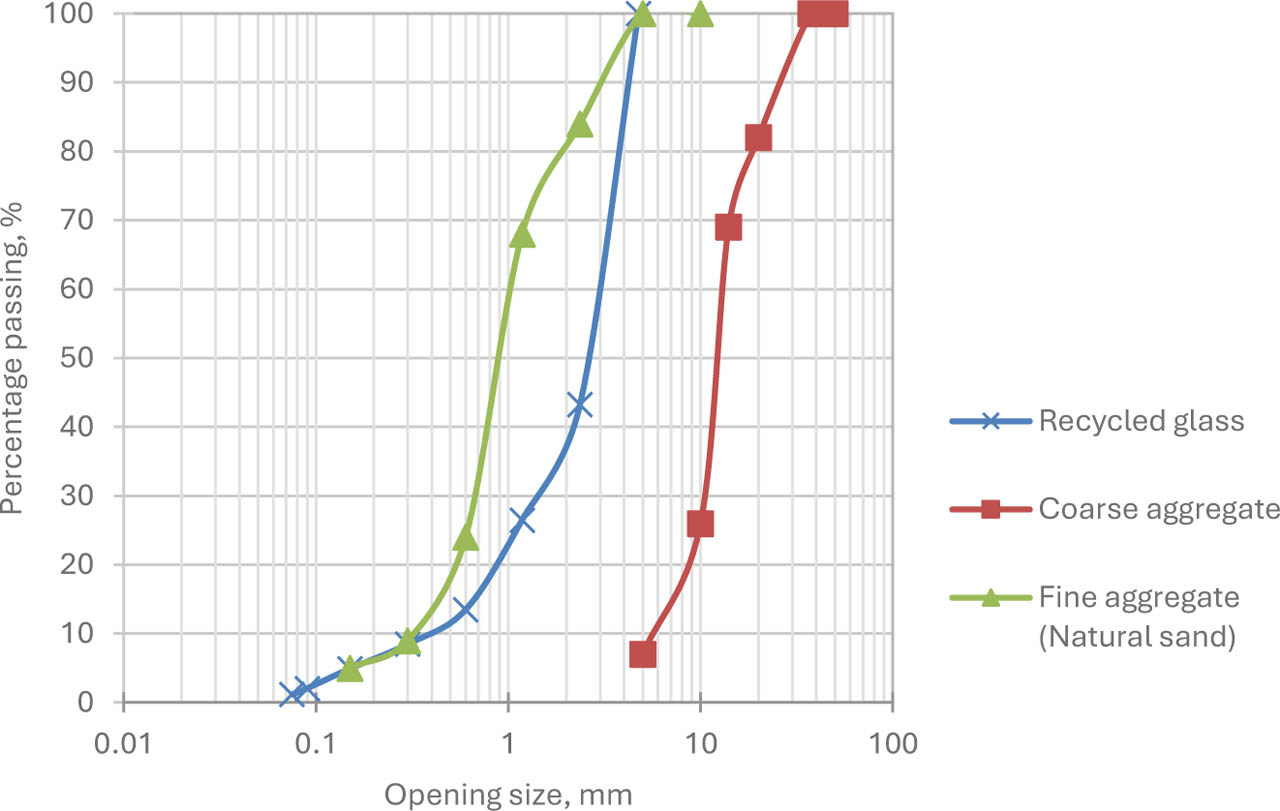
Figure 1:
Grading curves for recycled glass, fine aggregate, and coarse aggregate
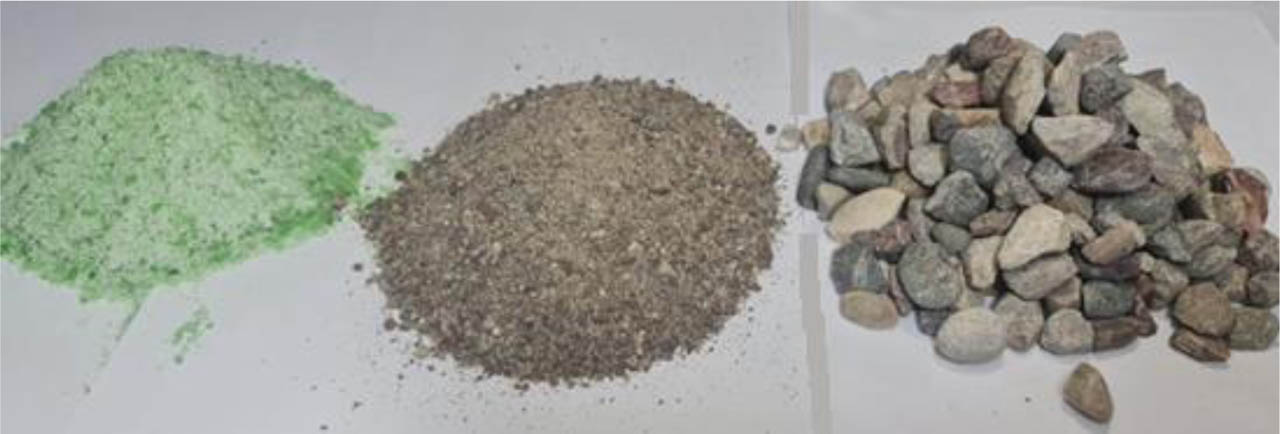
Figure 2:
Sample of recycled glass, fine aggregate, and coarse aggregate
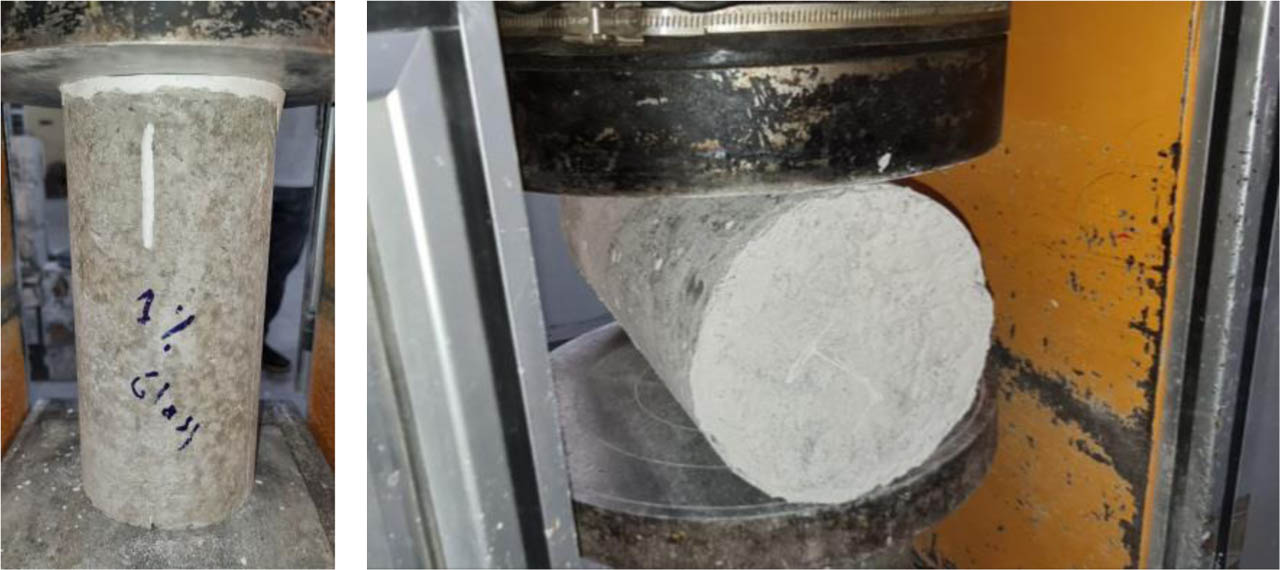
Figure 3:
Compressive and Splitting tests by the universal testing machine
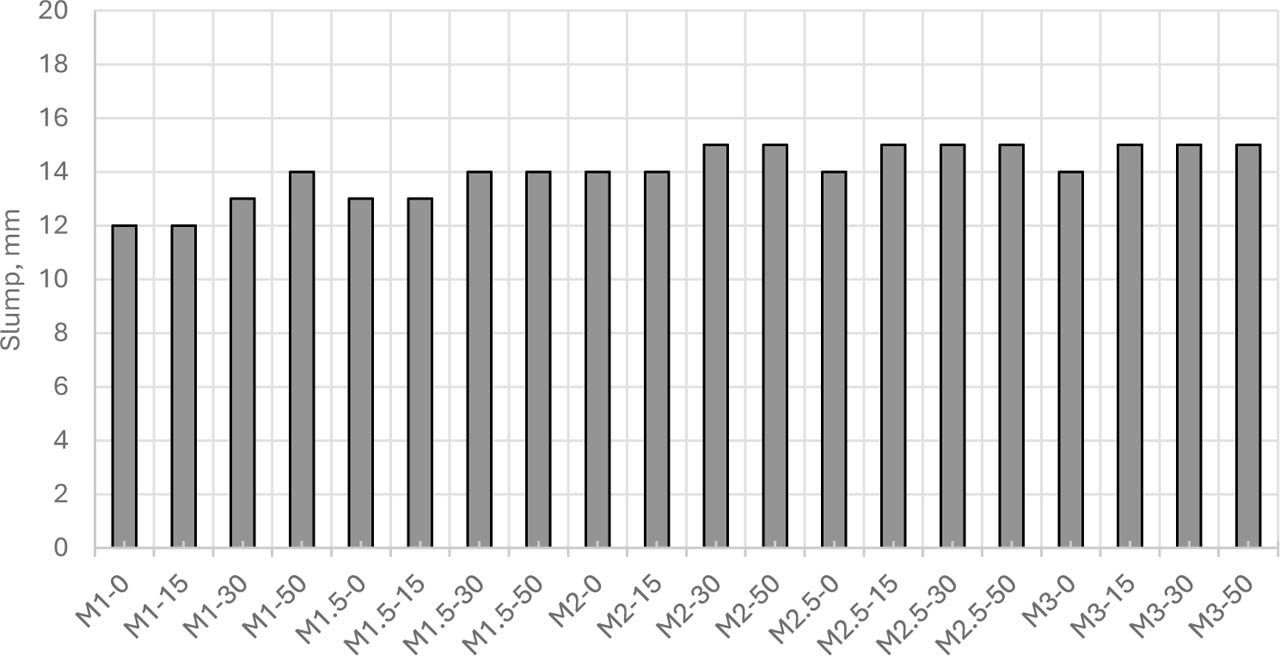
Figure 4:
Slump vs. concrete mixtures
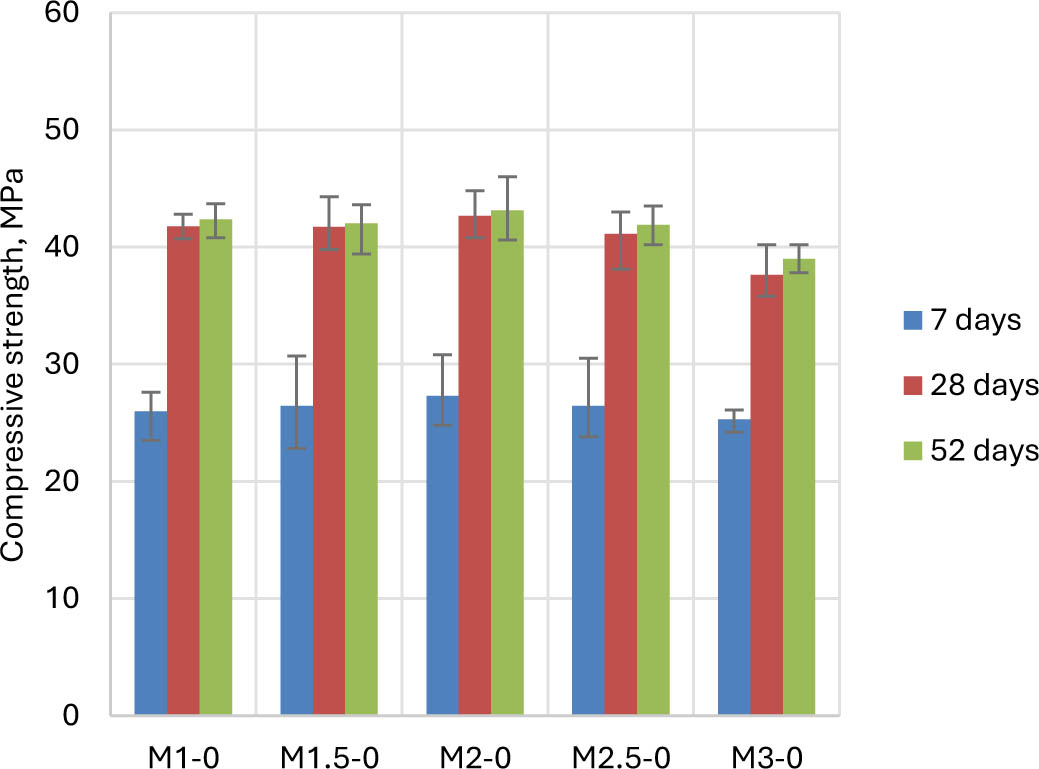
Figure 5:
Compressive strength vs. proportioanl weight of coarse aggregate with no recycled glass
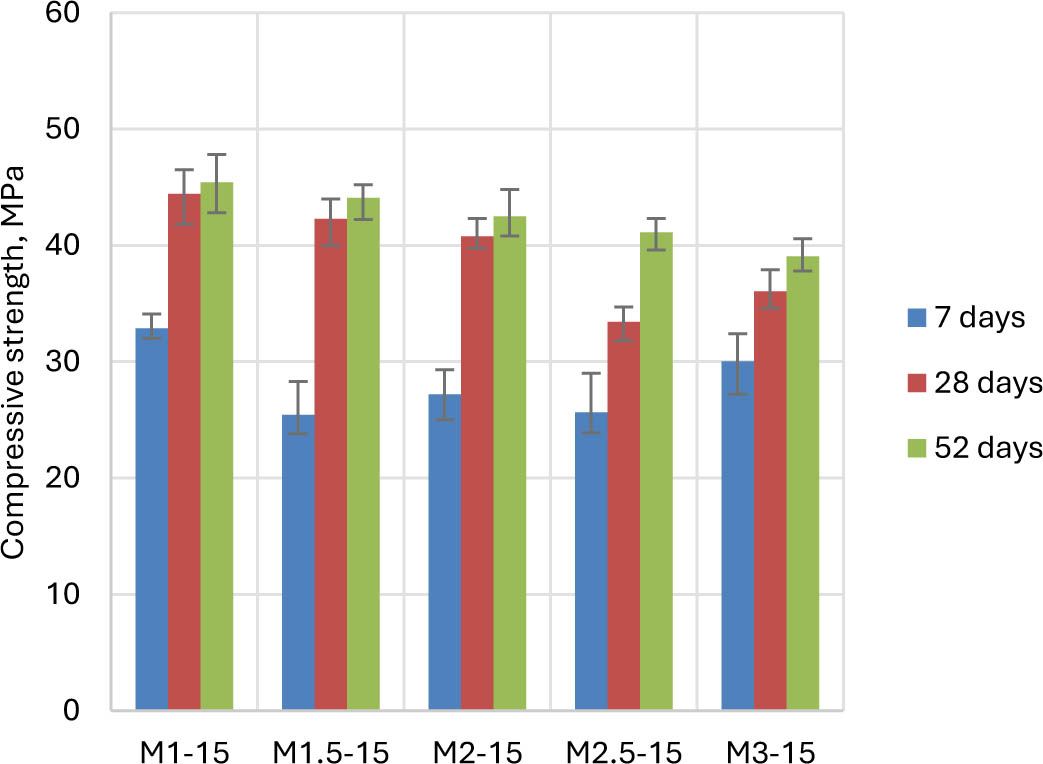
Figure 6:
Compressive strength vs. proportioanl weight of coarse aggregate with 15% recycled glass
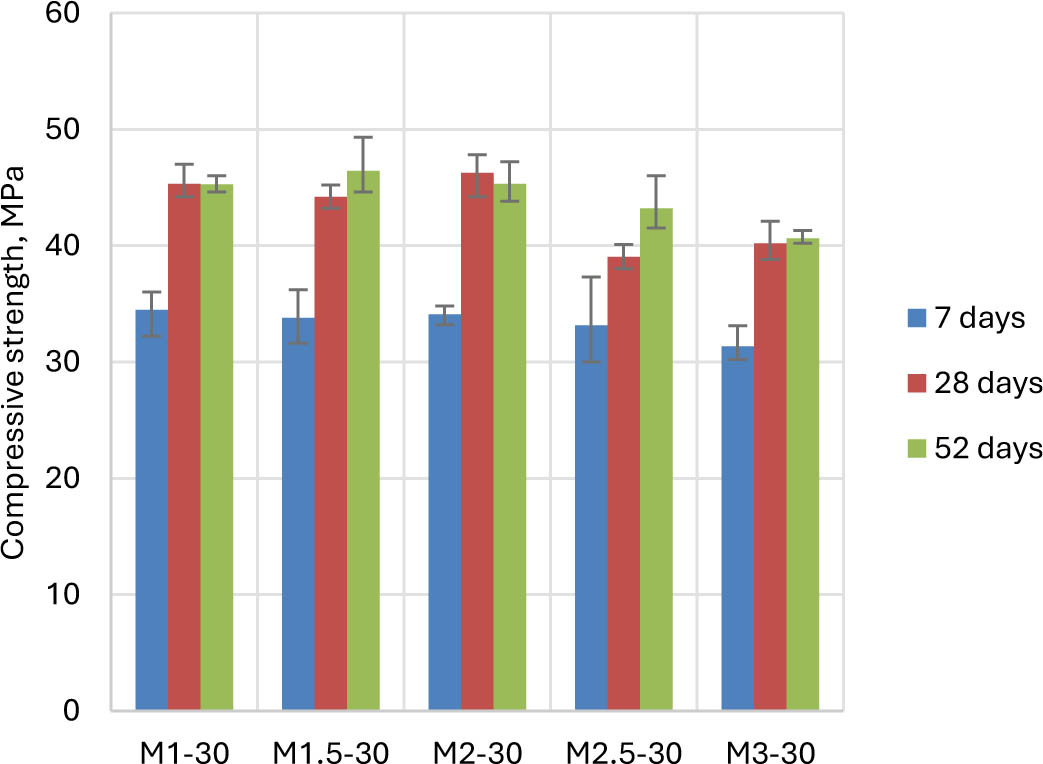
Figure 7:
Compressive strength vs. proportioanl weight of coarse aggregate with 30% recycled glass
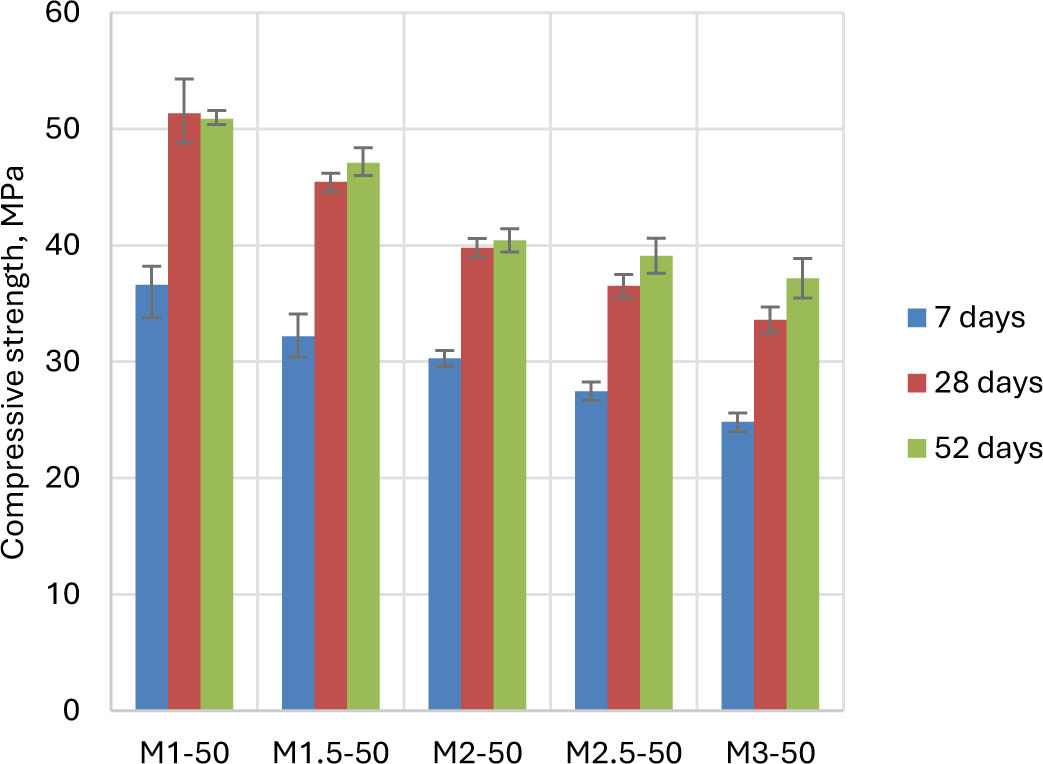
Figure 8:
Compressive strength vs. proportioanl weight of coarse aggregate with 50% recycled glass
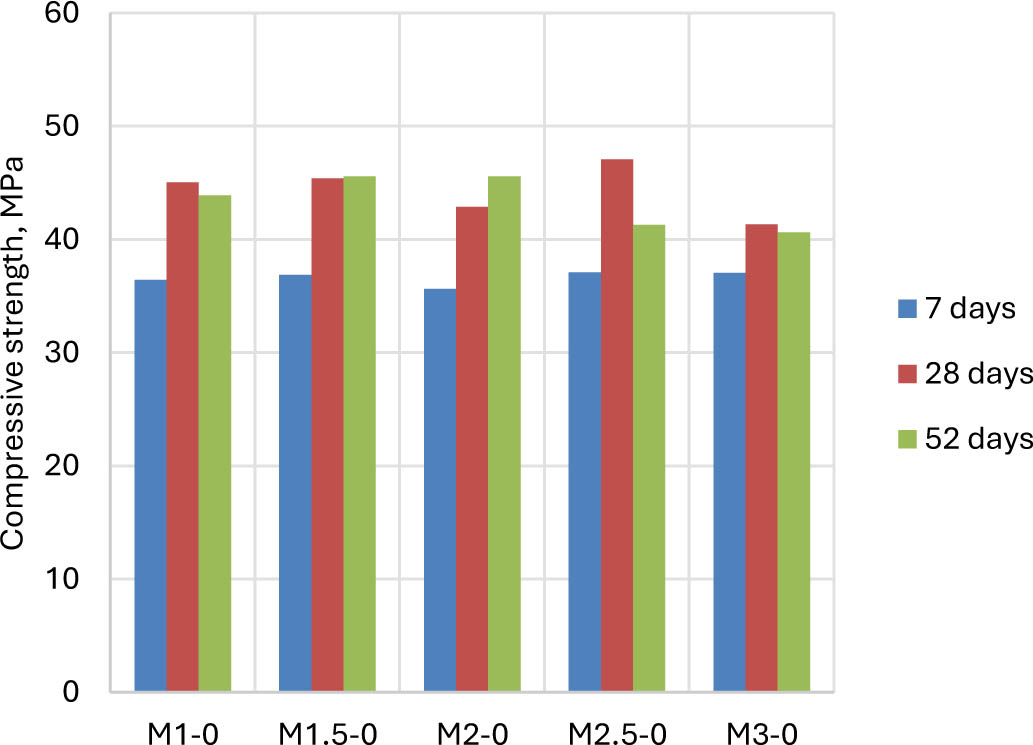
Figure 9:
Compressive strength (ultrasonic test) vs. proportioanl weight of coarse aggregate with no recycled glass
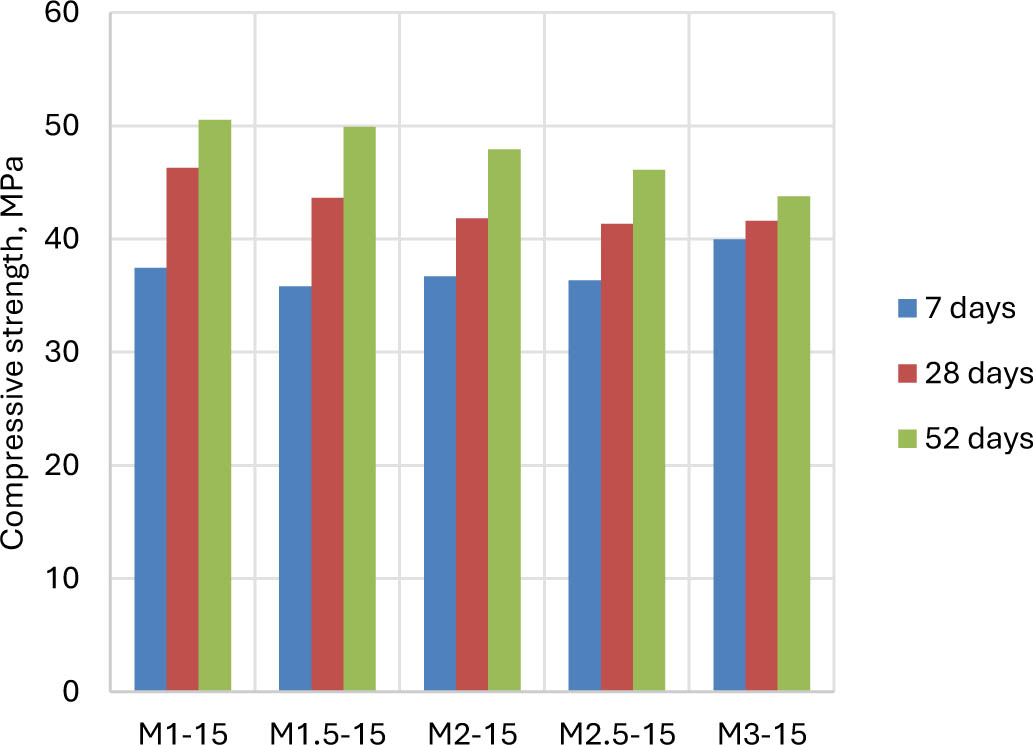
Figure 10:
Compressive strength (ultrasonic test) vs. proportioanl weight of coarse aggregate with 15% reycled glass
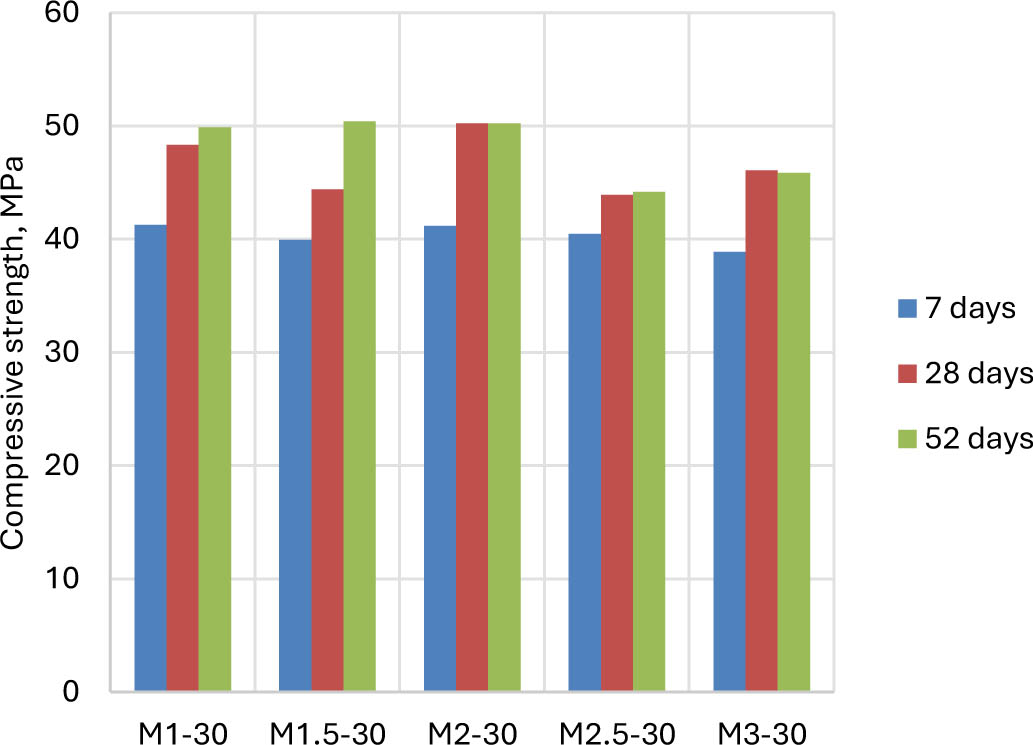
Figure 11:
Compressive strength (ultrasonic test) vs. proportioanl weight of coarse aggregate with 30% recycled glass
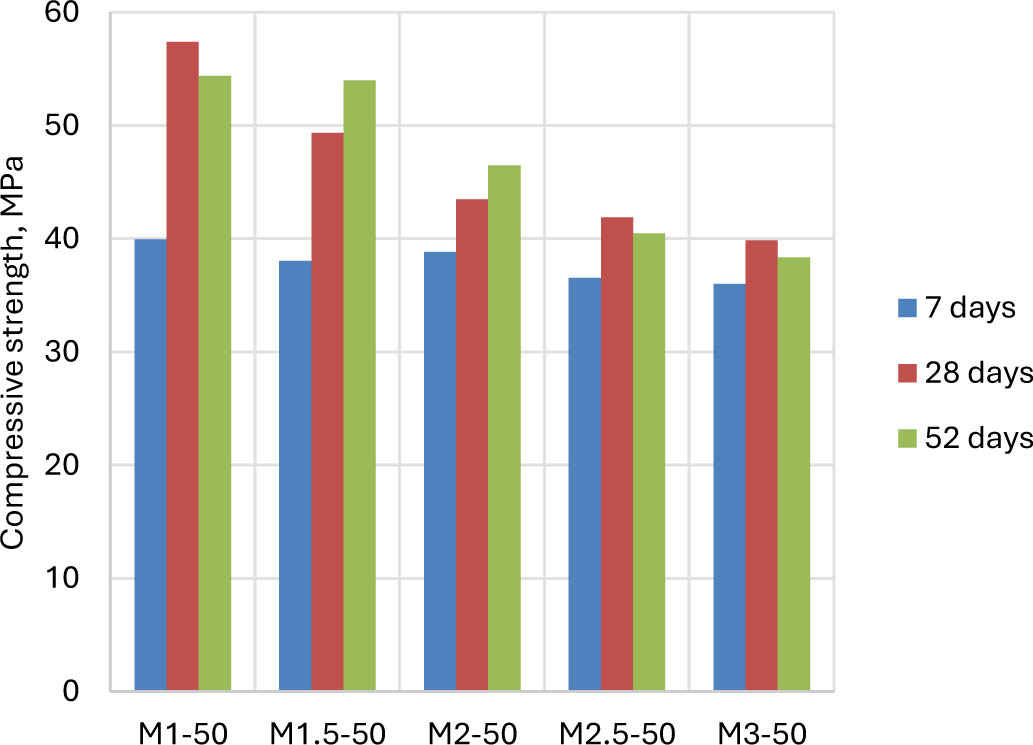
Figure 12:
Compressive strength (ultrasonic test) vs. proportioanl weight of coarse aggregate with 30% recycled glass
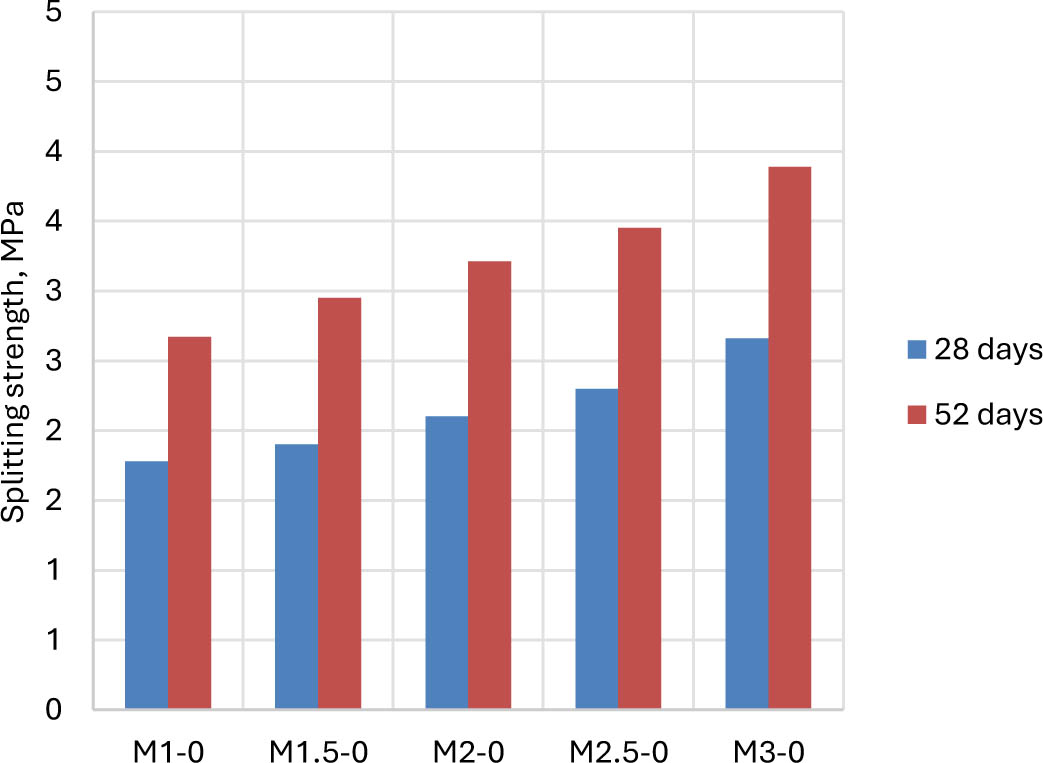
Figure 13:
Splitting strength vs. proportioanl weight of coarse aggregate with no recycled glass
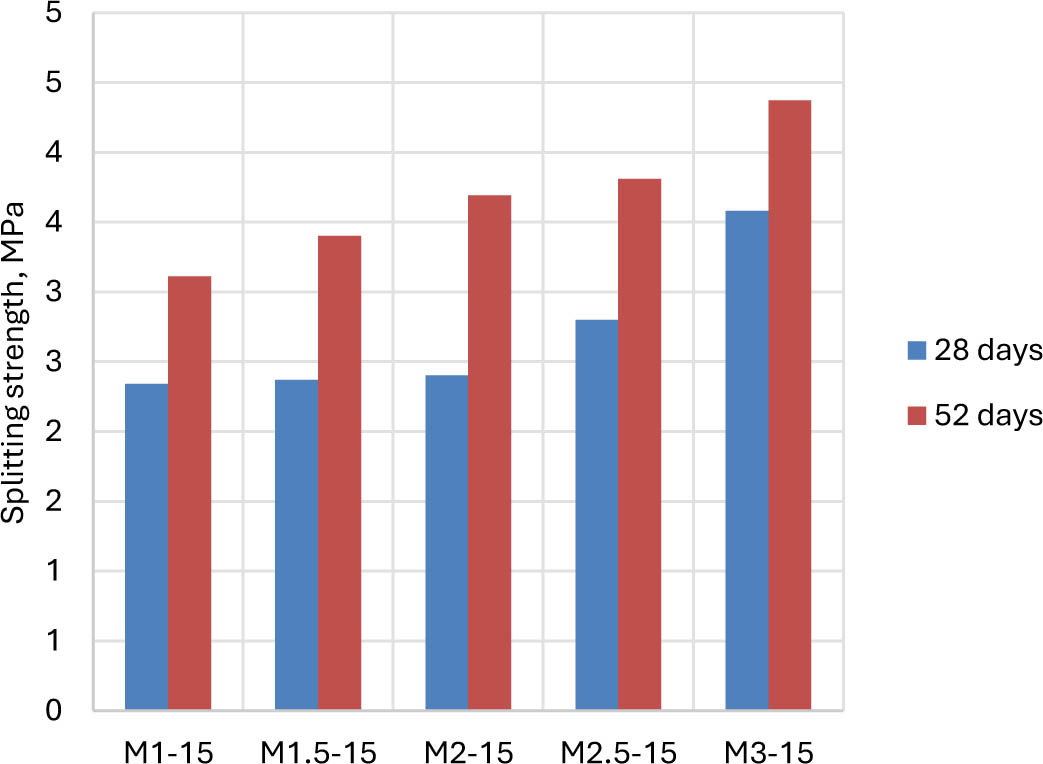
Figure 14:
Splitting strength vs. proportioanl weight of coarse aggregate with 15% recycled glass
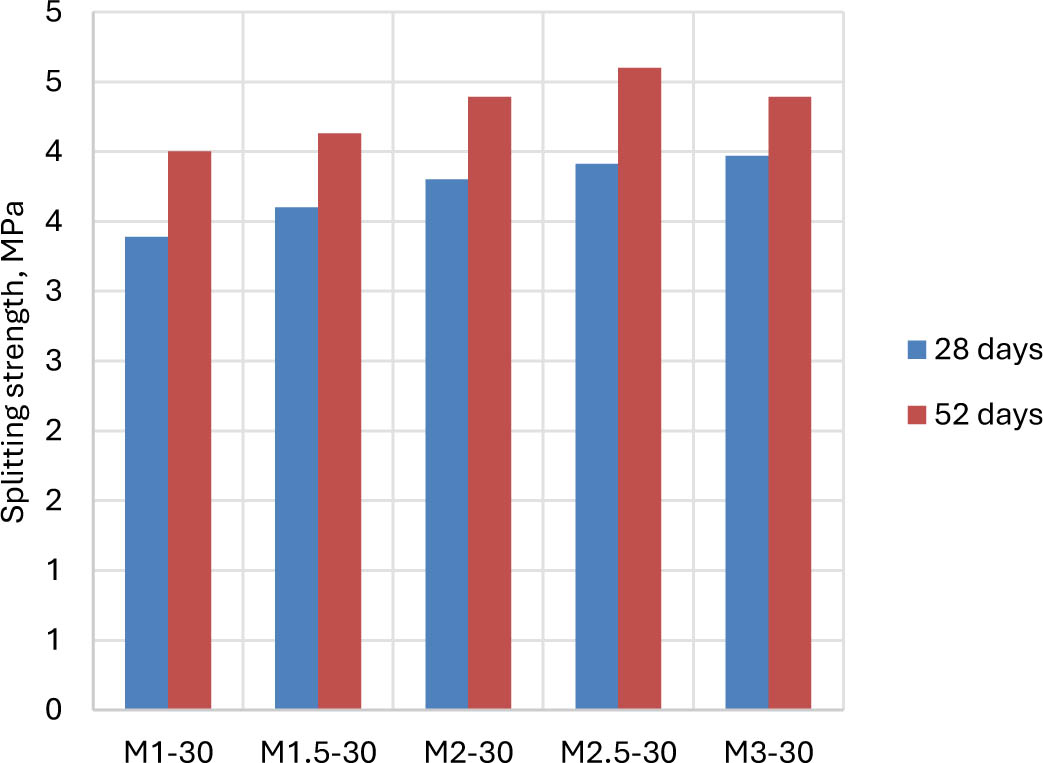
Figure 15:
Splitting strength vs. proportional weight of coarse aggregate with 30% recycled glass
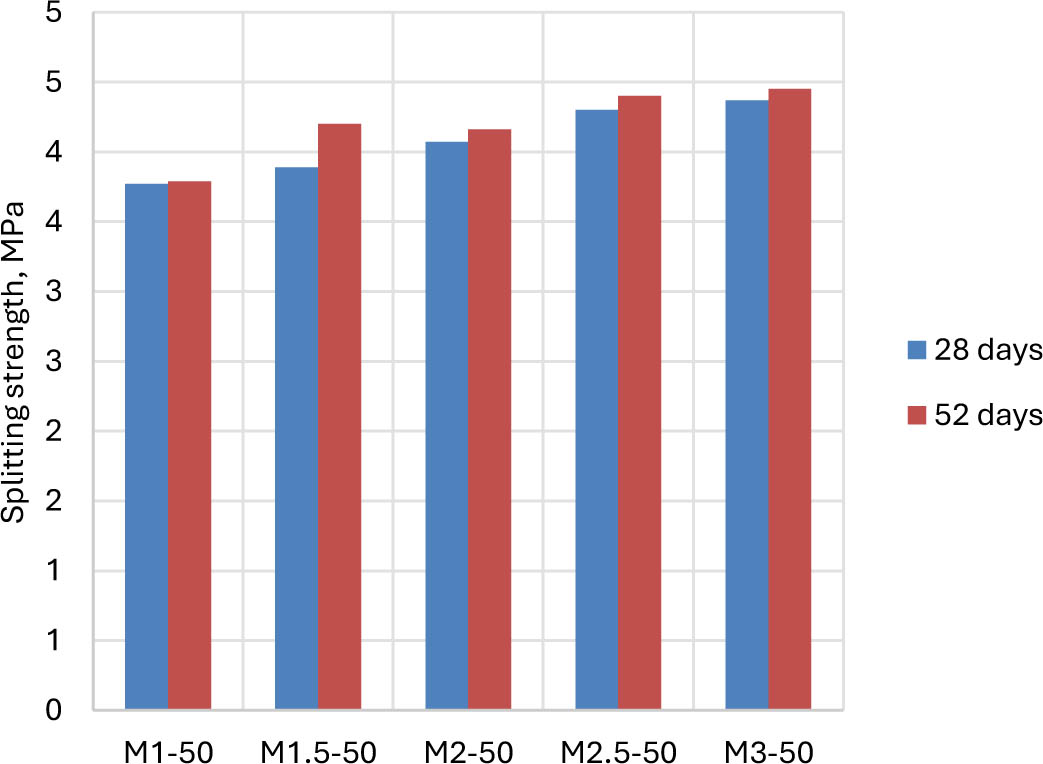
Figure 16:
Splitting strength vs. proportional weight of coarse aggregate with 50% recycled glass
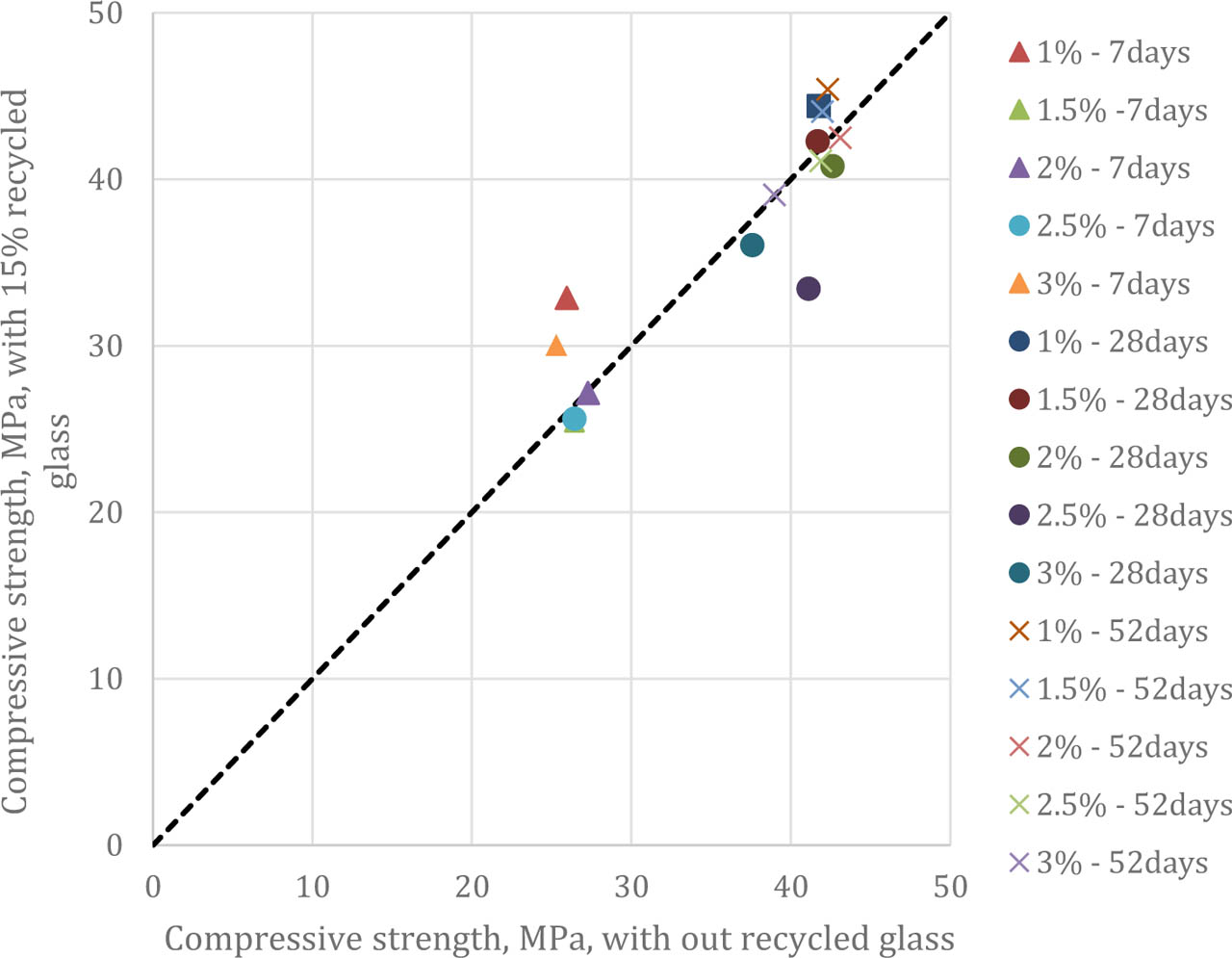
Figure 17:
Comparison of compressive strength of concrete mixtures without recyled glass and with 15% recycled glass
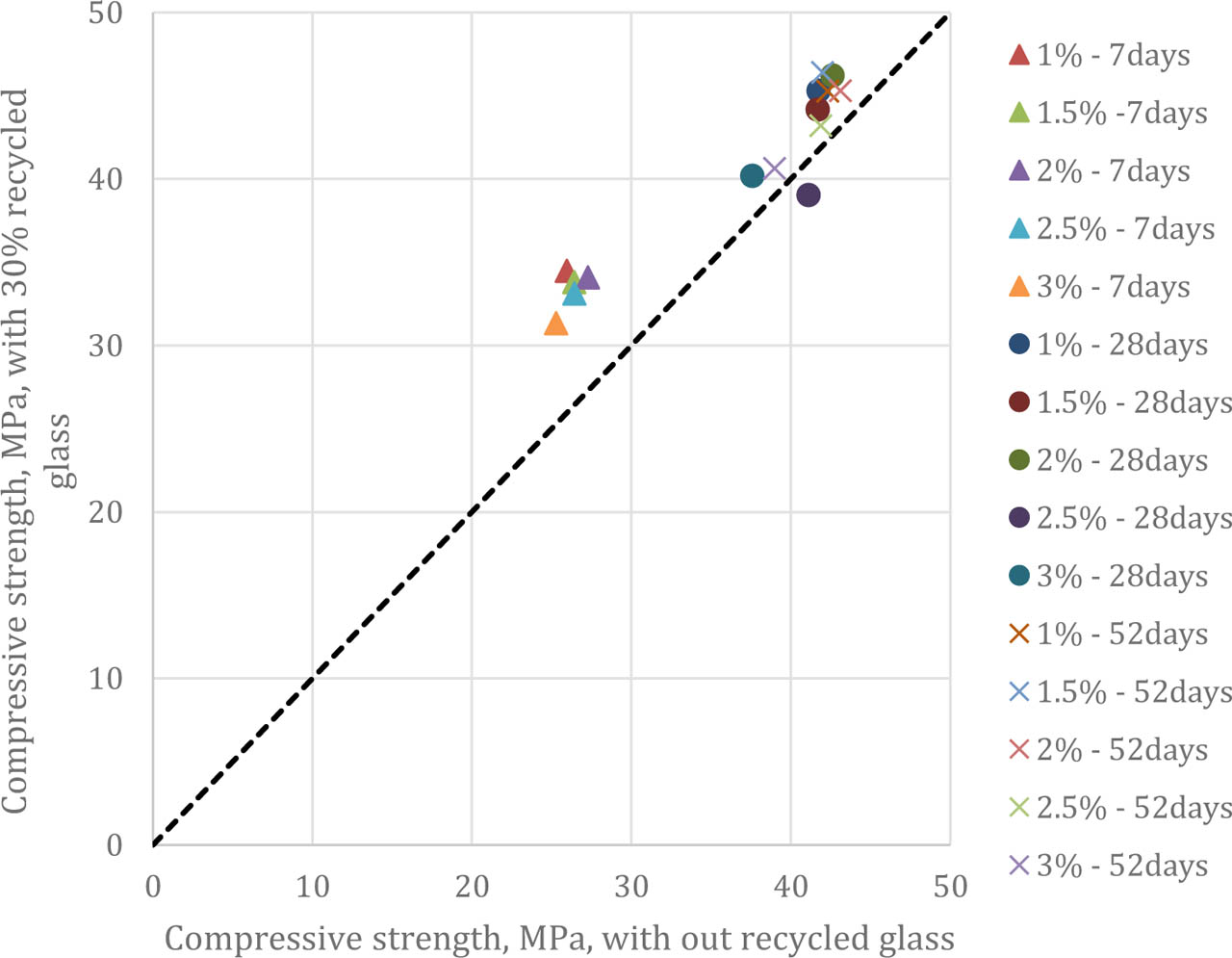
Figure 18:
Comparison of compressive strength of concrete mixtures without recyled glass and with 30% recycled glass
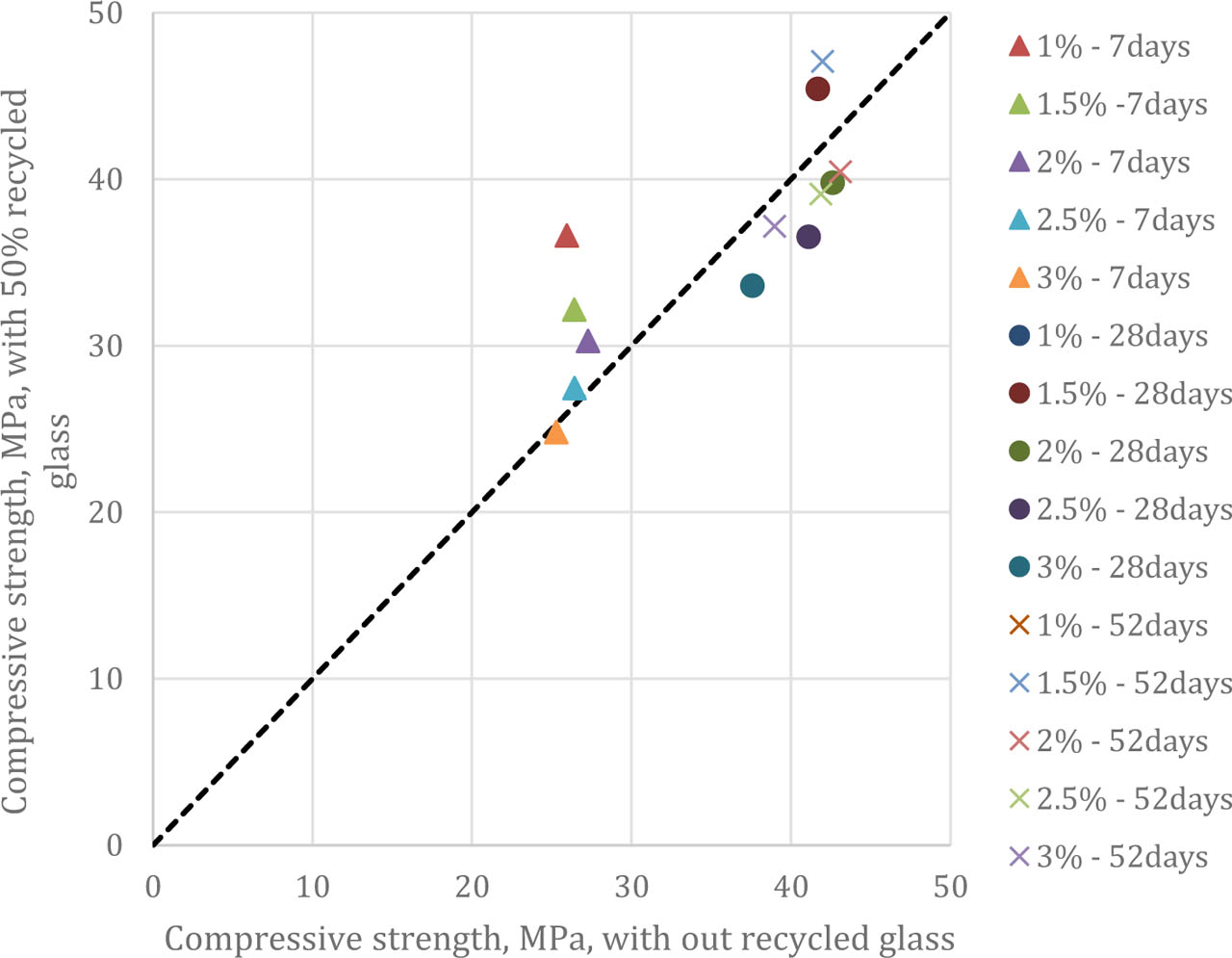
Figure 19:
Comparison of compressive strength of concrete mixtures without recyled glass and with 50% recycled glass
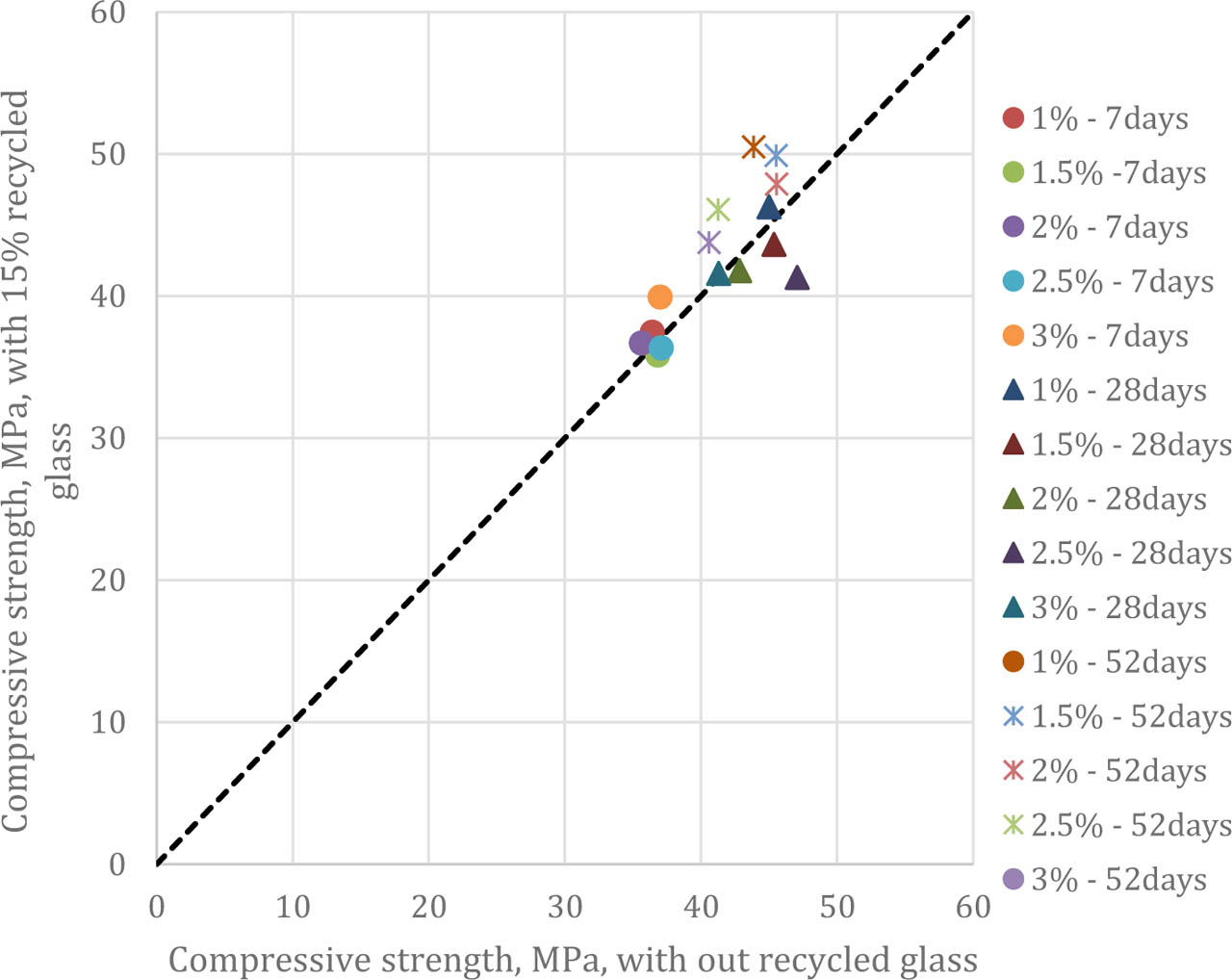
Figure 20:
Comparison of compressive strength (ultrasonic test) of concrete mixtures without recyled glass and with 15% recycled glass
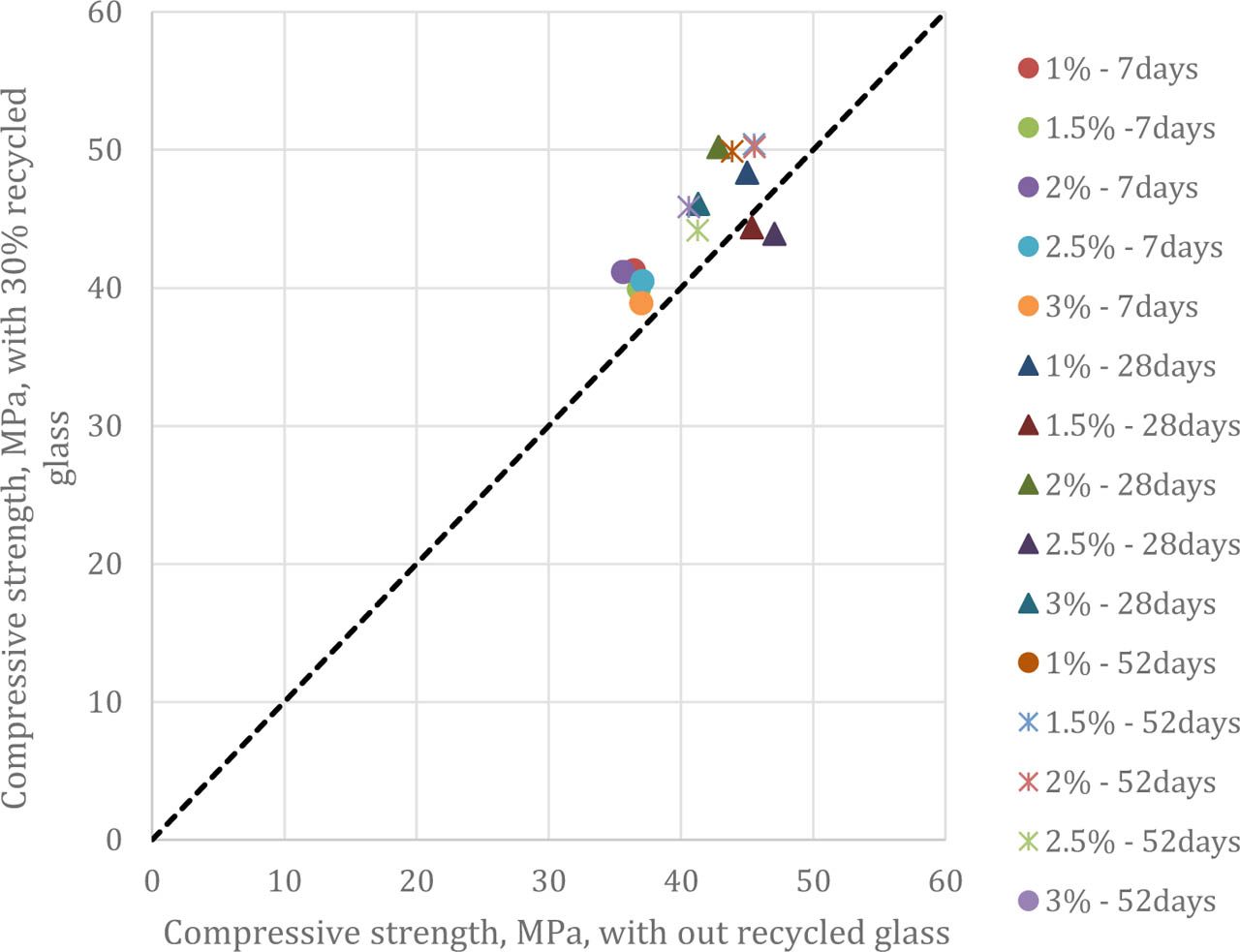
Figure 21:
Comparison of compressive strength (ultrasonic test) of concrete mixtures without recyled glass and with 30% recycled glass
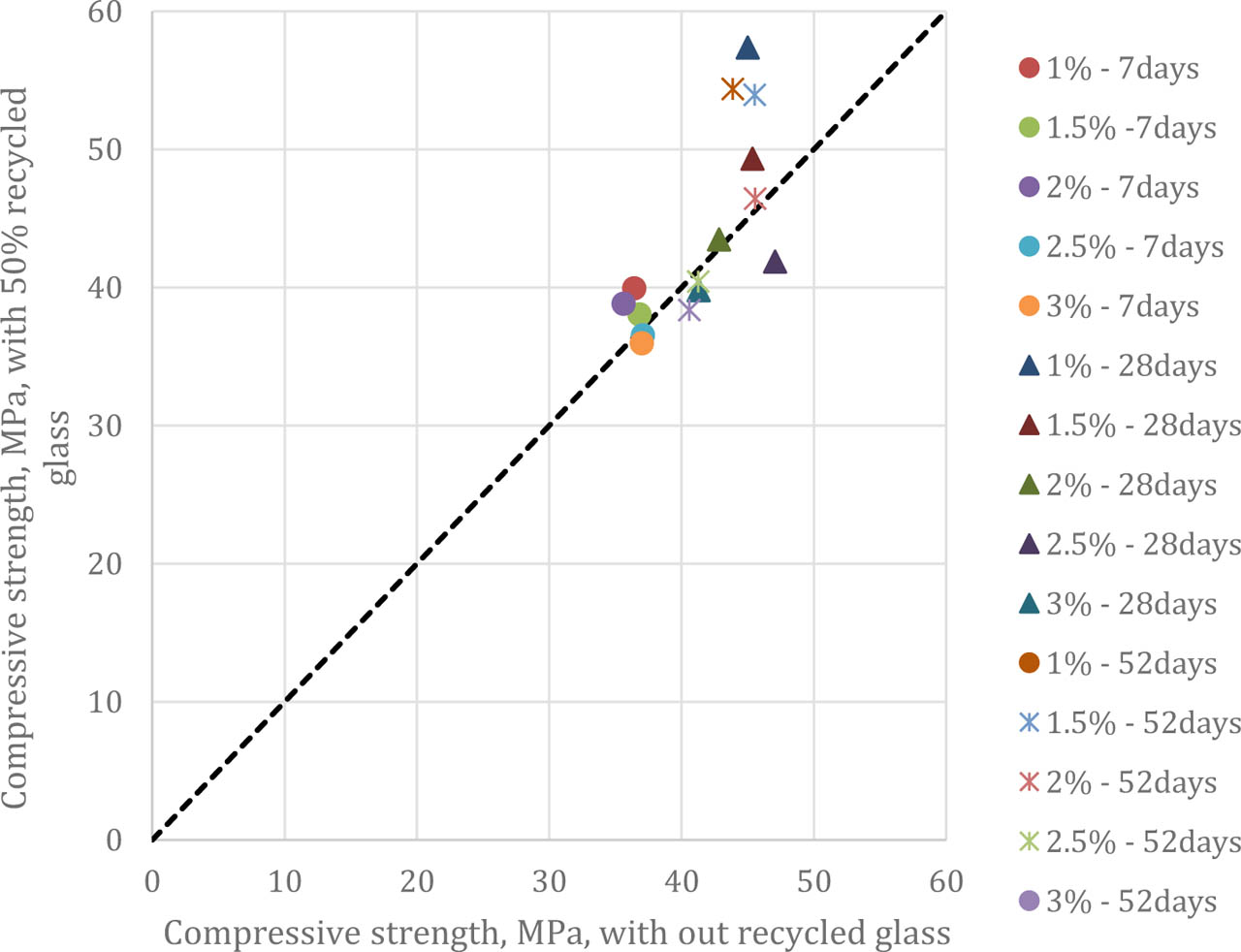
Figure 22:
Comparison of compressive strength (ultrasonic test) of concrete mixtures without recyled glass and with 50% recycled glass
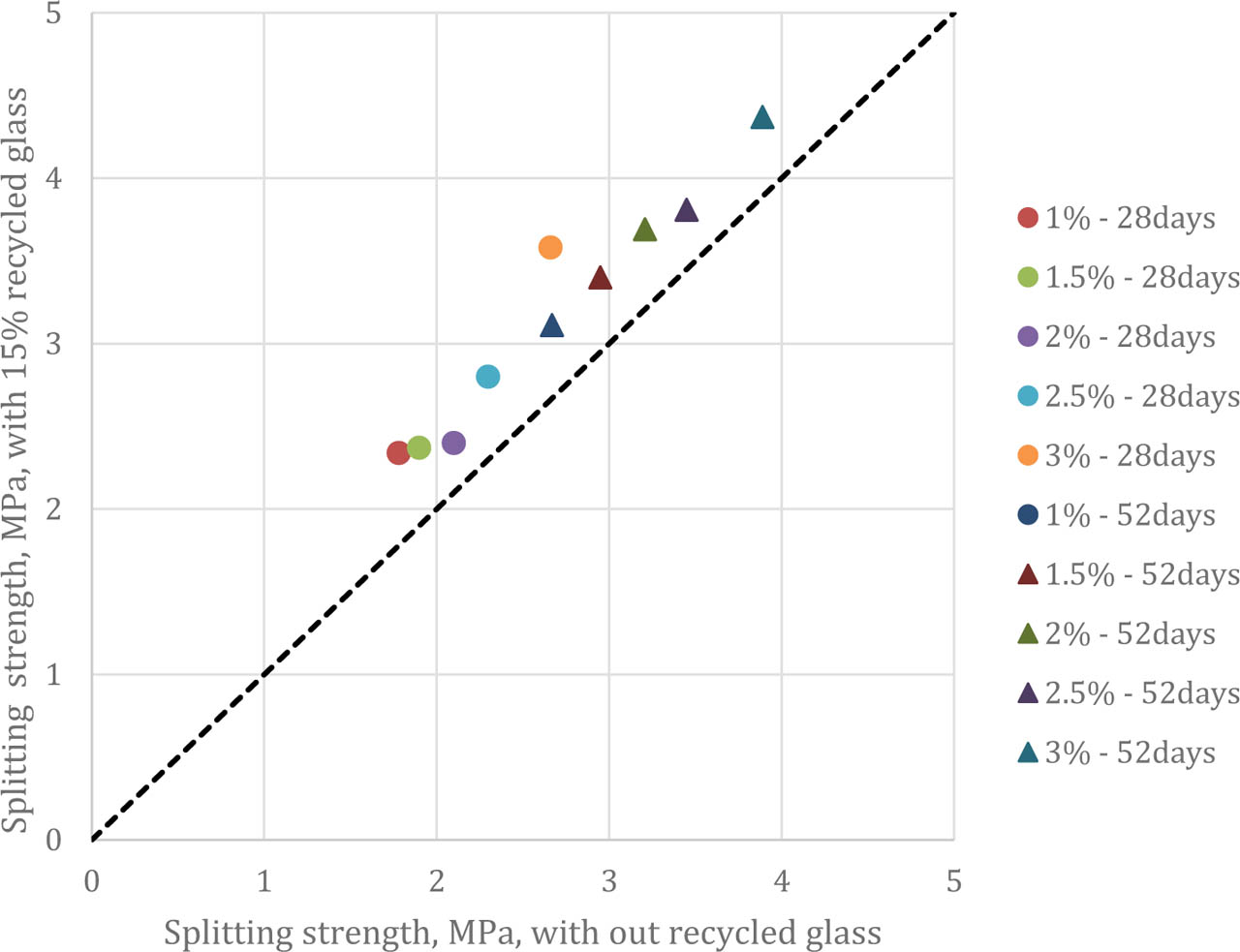
Figure 23:
Comparison of splitting strength of concrete mixtures without recyled glass and with 15% recycled glass
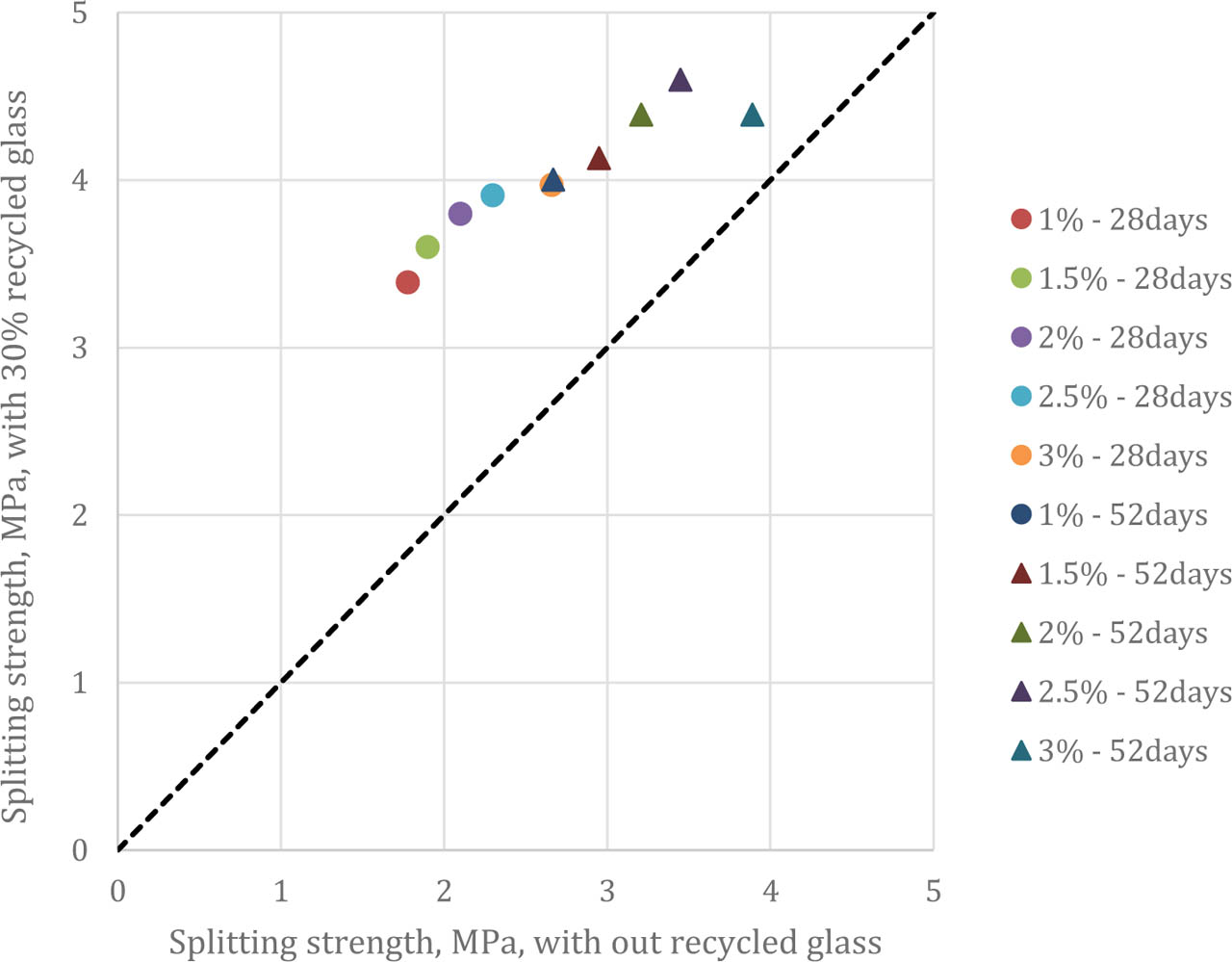
Figure 24:
Comparison of splitting strength of concrete mixtures without recyled glass and with 30% recycled glass
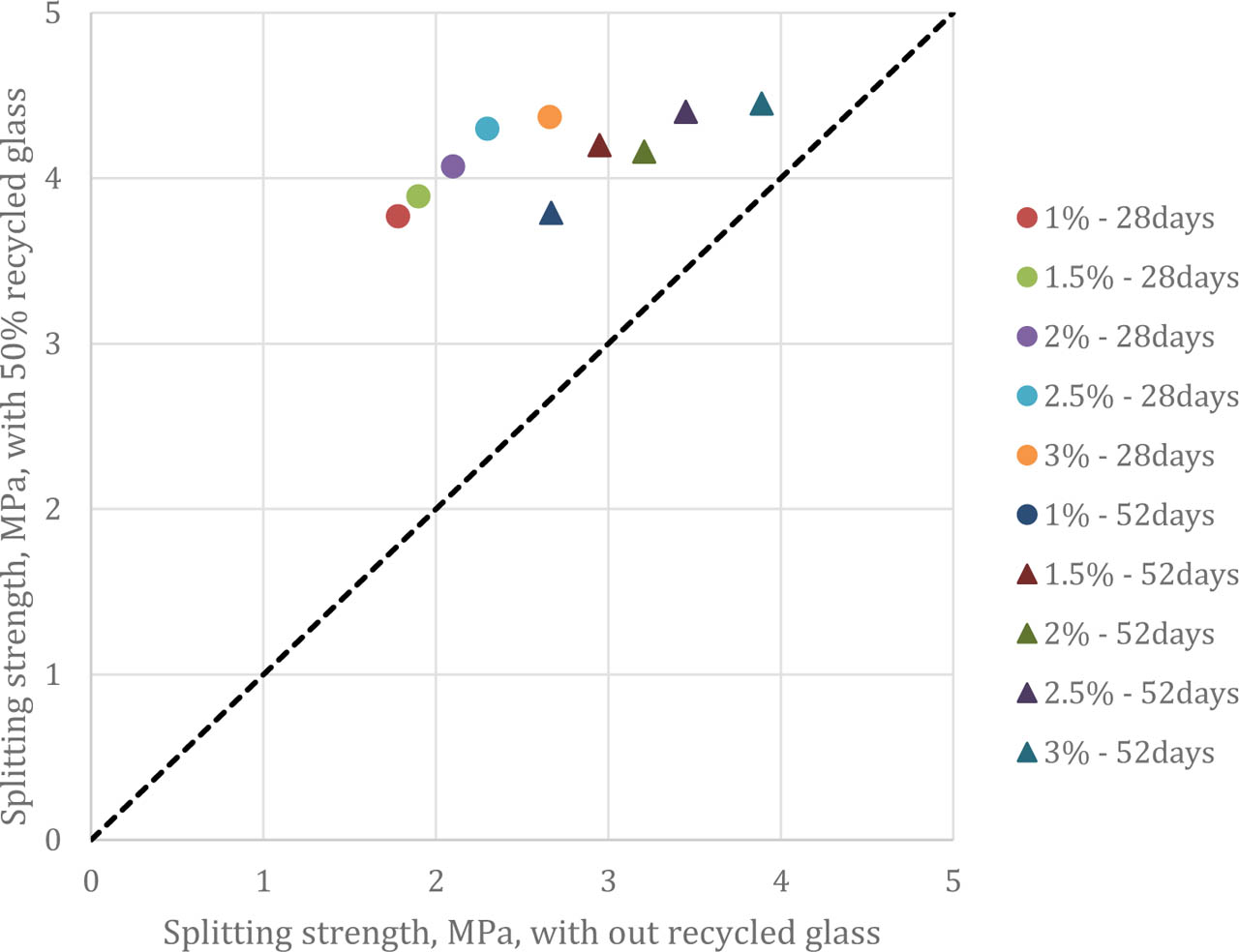
Figure 25:
Comparison of splitting strength of concrete mixtures without recyled glass and with 50% recycled glass
Table 1:
Chemical composition (percentage) and specific gravity of ordinary portland cement
| Component | Portland cement |
|---|---|
| SiO2 | 19.8 |
| Al2O3 | 4.13 |
| Fe2O3 | 3.85 |
| CaO | 61.87 |
| MgO | 3.52 |
| SO3 | 1.79 |
| Cl− | 0.01 |
| LOI | 2.35 |
| Specific Gravity | 3.15 |
Table 2:
Physical properties of ordinary portland cement
| Initial setting time (Minutes) | 125 |
| Final setting time (Minutes) | 300 |
| Blaine (m2/kg) | 300 |
| Expansion (%) | 0.04 |
| 3 days compressive strength (MPa) | 11 |
| 7 days compressive strength (MPa) | 18 |
| 28 days compressive strength (MPa) | 29 |
Table 3:
Mixture proportions (kg/m3)
| Mixtures* | Weight proportion (Cement: Fine agg.: Recycled glass: coarse agg.) | w/c | Cement kg/m3 | Water kg/m3 | Fine aggregate kg/m3 | Recycled glass kg/m3 | Coarse aggregate kg/m3 |
|---|---|---|---|---|---|---|---|
| M1-0 | 1:2:0:1 | 0.46 | 370 | 170 | 740 | 0 | 370 |
| M1-15 | 1:1.7:0.3:1 | 0.46 | 370 | 170 | 629 | 111 | 370 |
| M1-30 | 1:1.4:0.6:1 | 0.46 | 370 | 170 | 520 | 220 | 370 |
| M1-50 | 1:1:1:1 | 0.46 | 370 | 170 | 370 | 370 | 370 |
| M1.5-0 | 1:2:0:1.5 | 0.46 | 370 | 170 | 740 | 0 | 555 |
| M1.5-15 | 1:1.7:0.3:1.5 | 0.46 | 370 | 170 | 629 | 111 | 555 |
| M1.5-30 | 1:1.4:0.6:1.5 | 0.46 | 370 | 170 | 520 | 220 | 555 |
| M1.5-50 | 1:1:1:1.5 | 0.46 | 370 | 170 | 370 | 370 | 555 |
| M2-0 | 1:2:0:2 | 0.46 | 370 | 170 | 740 | 0 | 740 |
| M2-15 | 1:1.7:0.3:2 | 0.46 | 370 | 170 | 629 | 111 | 740 |
| M2-30 | 1:1.4:0.6:2 | 0.46 | 370 | 170 | 520 | 220 | 740 |
| M2-50 | 1:1:1:2 | 0.46 | 370 | 170 | 370 | 370 | 740 |
| M2.5-0 | 1:2:0:2.5 | 0.46 | 370 | 170 | 740 | 0 | 925 |
| M2.5-15 | 1:1.7:0.3:2.5 | 0.46 | 370 | 170 | 629 | 111 | 925 |
| M2.5-30 | 1:1.4:0.6:2.5 | 0.46 | 370 | 170 | 520 | 220 | 925 |
| M2.5-50 | 1:1:1:2.5 | 0.46 | 370 | 170 | 370 | 370 | 925 |
| M3-0 | 1:2:0:3 | 0.46 | 370 | 170 | 740 | 0 | 1110 |
| M3-15 | 1:1.7:0.3:3 | 0.46 | 370 | 170 | 629 | 111 | 1110 |
| M3-30 | 1:1.4:0.6:3 | 0.46 | 370 | 170 | 520 | 220 | 1110 |
| M3-50 | 1:1:1:3 | 0.46 | 370 | 170 | 370 | 370 | 1110 |
Table 4:
Experimntal program
| No. of casted cylinders | Compressive strength test No. of cylinders | Splitting test No. of cylinders | Ultrasonic test | ||||
|---|---|---|---|---|---|---|---|
| For each concrete mixture | 15 | 3 cured for 7 days | 3 cured for 28 days | 3 cured for 52 days | 3 cured for 28 days | 3 cured for 52 days | Same cylinders that were cured for the splitting test were used for ultrasonic test first. |
Table 5:
Concrete properties
| Mixtures* | w/cm | Slump, (mm) | Temp., °C |
|---|---|---|---|
| M1-0 | 0.46 | 12 | 25 |
| M1-15 | 0.46 | 12 | 24 |
| M1-30 | 0.46 | 13 | 26 |
| M1-50 | 0.46 | 14 | 23 |
| M1.5-0 | 0.46 | 13 | 25 |
| M1.5-15 | 0.46 | 13 | 26 |
| M1.5-30 | 0.46 | 14 | 24 |
| M1.5-50 | 0.46 | 14 | 27 |
| M2-0 | 0.46 | 14 | 23 |
| M2-15 | 0.46 | 14 | 24 |
| M2-30 | 0.46 | 15 | 25 |
| M2-50 | 0.46 | 15 | 28 |
| M2.5-0 | 0.46 | 14 | 22 |
| M2.5-15 | 0.46 | 15 | 24 |
| M2.5-30 | 0.46 | 15 | 26 |
| M2.5-50 | 0.46 | 15 | 23 |
| M3-0 | 0.46 | 14 | 25 |
| M3-15 | 0.46 | 15 | 27 |
| M3-30 | 0.46 | 15 | 24 |
| M3-50 | 0.46 | 15 | 28 |
* Mixture designation: See Table 3
Table 6:
Mechanical properites of concrete
| Mixtures* | Compressive strength of concrete cylinders (MPa)** | Compressive strength of concrete cylinders (Ultrasonic test) (MPa) | Splitting strength of concrete cylinders (MPa)** | |||||
|---|---|---|---|---|---|---|---|---|
| 7 days | 28 days | 52 days | 7 days | 28 days | 52 days | 28 days | 52 days | |
| M1-0 | 26.0 | 41.8 | 42.3 | 36.4 | 45.0 | 43.9 | 1.8 | 2.7 |
| M1-15 | 32.9 | 44.4 | 45.4 | 37.4 | 46.3 | 50.5 | 2.3 | 3.1 |
| M1-30 | 34.5 | 45.3 | 45.3 | 41.3 | 48.3 | 49.9 | 3.4 | 4.0 |
| M1-50 | 36.6 | 51.3 | 50.9 | 39.9 | 57.4 | 54.4 | 3.8 | 3.8 |
| M1.5-0 | 26.4 | 41.7 | 42.0 | 36.9 | 45.4 | 45.5 | 1.9 | 3.0 |
| M1.5-15 | 25.4 | 42.3 | 44.1 | 35.8 | 43.6 | 49.9 | 2.4 | 3.4 |
| M1.5-30 | 33.8 | 44.2 | 46.4 | 39.9 | 44.4 | 50.4 | 3.6 | 4.1 |
| M1.5-50 | 32.2 | 45.4 | 47.1 | 38.0 | 49.4 | 54.0 | 3.9 | 4.2 |
| M2-0 | 27.3 | 42.6 | 43.1 | 35.6 | 42.9 | 45.6 | 2.1 | 3.2 |
| M2-15 | 27.2 | 40.8 | 42.5 | 36.7 | 41.8 | 47.9 | 2.4 | 3.7 |
| M2-30 | 34.1 | 46.2 | 45.3 | 41.2 | 50.2 | 50.2 | 3.8 | 4.4 |
| M2-50 | 30.3 | 39.8 | 40.4 | 38.8 | 43.5 | 46.5 | 4.1 | 4.2 |
| M2.5-0 | 26.4 | 41.1 | 41.9 | 37.1 | 47.1 | 41.3 | 2.3 | 3.5 |
| M2.5-15 | 25.6 | 33.4 | 41.1 | 36.3 | 41.3 | 46.1 | 2.8 | 3.8 |
| M2.5-30 | 33.1 | 39.0 | 43.2 | 40.5 | 43.9 | 44.2 | 3.9 | 4.6 |
| M2.5-50 | 27.5 | 36.5 | 39.1 | 36.5 | 41.9 | 40.5 | 4.3 | 4.4 |
| M3-0 | 25.3 | 37.6 | 39.0 | 37.0 | 41.3 | 40.6 | 2.7 | 3.9 |
| M3-15 | 30.0 | 36.0 | 39.1 | 39.9 | 41.6 | 43.7 | 3.6 | 4.4 |
| M3-30 | 31.3 | 40.2 | 40.6 | 38.9 | 46.1 | 45.9 | 4.0 | 4.4 |
| M3-50 | 24.8 | 33.6 | 37.2 | 36.0 | 39.8 | 38.3 | 4.4 | 4.5 |
* Mixture designation: See Table 3