

1. Introduction
Glass waste is one of the solid wastes that are produced daily in cities around the world. The solid wastes in the left side of the city of Mosul is about 780 tons/day in the year of 2021–2022; 3.1% of that solid waste is glass, which means 24.2 tons/day of glass is gone to landfills (Alzuhairy and Fadhel, 2022). Unfortunately, there is no existing project to recycle this glass waste in the city of Mosul. On the other hand, using this waste glass after grinding as a partial replacement of fine aggregates in producing green concrete could help in solving environmental issues in the city of Mosul.
Prior studies have investigated the using of recycled waste glass as a replacement of fine or coarse aggregates, as shown in the following studies. Du and Tan, 2014 studied the behaviour of concrete mixtures incorporating recycled waste glass as a replacement of sand, the replacement ratios of (25%, 50%, 75%, or 100%). It was found that there were no significant effects of using waste glass on the properties of fresh and hardened concrete, while using waste glass caused a reduction in the drying shrinkage and an improvement in the resistance to chloride ion penetration. Du and Tan, 2015 investigated the ability of using glass powder as a supplementary cementitious material; the glass powder is used as a partial replacement (15%, 30%, 45%, or 60%) of Portland cement by weight. In addition, glass powder was used as a replacement of the fine aggregates with 15% by weight. The study revealed that 30% replacement of Portland cement by glass powder is the optimum ratio among the studied ones. The using of glass powder caused a reduction on the compressive strength at 7days of curing, while an increase in the compressive strength had occurred when cylinders were cured for 28 or 91 days. A noticeable improvement in the compressive strength for mixture with 15% glass powder as a replacement of fine aggregates compared to mixture with 100% Portland cement. Using glass powder as a partial replacement of Portland cement showed a higher resistance for both of water penetration and chloride ion.
Adaway and Wang, 2015 investigated the mechanical properties of concrete mixtures including various replacement ratios of recycled glass as a partial replacement of fine aggregates. These ratios were (15%, 20%, 25%, 30%, or 40%). Concrete mixtures with recycled glass up to 30% showed an increase in the compressive strength compared to the control mixture (no recycled glass), while a sharp decrease was shown at 40%. The workability was decreased by increasing the replacement ratio of recycled glass.
Tamanna et al., 2020 studied experimentally the effect of using recycled glass as a partial replacement of natural sand with replacement ratios of (20%, 40%, or 60%). There was no negative impact of using recycled glass on compressive, tensile, and flexural strengths. The workability of concrete was reduced by increasing the replacement ratio of recycled glass. In addition, the incorporating of recycled glass caused a reduction in the alkali-silica reaction and increasing in the resistance to chloride ion penetration.
Devaraj et al., 2021 cast 6 concrete mixtures including replacing natural sand by grinded glass with replacement ratios of (0%, 10%,15%,30%,50%, or 100%). The results revealed that a slight increase in the mechanical properties of concrete, which includes compressive, splitting and flexural strengths, when 15% of grounded glass was used as a partial replacement of natural sand. Based on findings, using more than 30% of grounded glass is not recommended to be used in concrete mixtures. The incorporating of grounded glass caused a reduction in the workability, fresh density, and water absorptivity of concrete.
Çelik et al. 2022, investigated the mechanical behaviour of concrete mixtures including grounded glass as a partial replacement of fine or coarse aggregates. Two particle sizes of grounded glasses, which are fine grounded glass or coarse grounded glass, were used as a partial replacement of fine and coarse aggregates, respectively. The replacement ratios were (10%, 20%, 40%, or 50%). It was found that glass powder in the fine grounded glass gave a strong bond with the cement due to the pozzolanic effect. That behaviour caused an increase in the compressive, tensile, and flexural strengths of concrete. While the use of coarse grounded glass caused a reduction in the compressive, tensile, and flexural strengths of concrete.
SHAREEF et al. 2023, cast 6 concrete mixtures incorporating different replacement ratios of grounded glass as a partial replacement of sand. These replacement ratios were (10%, 20%, 30%, 40%, and 50%) by weight of sand. For the compressive strength test, cylinders were cured for 7, 14, 21, 28, 56, or 90 days. For the splitting test, cylinders were cured for 7, 14, or 21 days. The results revealed that the workability of concrete mixtures was clearly decreased by increasing the replacement ratio of grounded glass. Based on the compressive and splitting tests, it was found that sand can be replaced by grounded glass no more than 30%.
ISMAEEL et al. 2024, performed an experimental study to evaluate the behaviour of Ultra-high performance concrete mixtures when cement is partially replaced by slag and grounded waste glass. The replacement ratios were 0%, 10%, and 20%. Based on the results, it was found that 10% is the best replacement ratio for both workability and mechanical properties of concrete mixtures.
Gholampour et al. 2025, conducted an experimental study to investigate the properties of concrete incorporating glass powder, glass sand, and supplementary cementitious materials (slag or fly ash). Seventeen concrete mixtures were cast to study workability, density, water absorption, elastic modulus, and compressive strength. It was revealed that the particle size of glass powder, which was used as a partial replacement of Portland cement (15% by weight), had a significant impact on the compressive strength of concrete. The use of larger particle size of glass powder caused a reduction in the compressive strength. A slight reduction in the compressive strength and the modulus of elasticity, when glass sand was used as a partial replacement (up to 25%) of natural sand. The use of glass sand as a partial or total replacement of natural sand caused a reduction in both: workability and water absorption of concrete mixtures.
Prior studies, as explained earlier show conflicting results regarding the strength and workability of concrete mixtures incorporating recycled glass. In addition, the effect of proportional weight ratio of coarse aggregate on the behaviour concrete mixtures with recycled glass has not been studied in prior studies. Therefore, this study will investigate the effect of using recycled glass as a partial replacement of natural sand and the effect of using different proportional weight ratios of coarse aggregate.
2. Experimental Work
2.1. Materials
Ordinary Portland Cement (OPC), which is produced by Badossh cement plant, was used in the current study. Tables 1 and 2 show the chemical compositions and physical properties of cement, respectively. Kanhash river sand (fine aggregate) and rounded river gravel (coarse aggregate) are used in the current study. Fine aggregate had a specific gravity (saturated-surface dry, SSD) of 2.60 and an absorption of 1.52. Coarse aggregate had a specific gravity (saturated-surface dry, SSD) of 2.65 and an absorption of 0.93. Recycled glass is made from grinding soft drink bottles. Figure 1 illustrates the grading for recycled glass, fine aggregate, and coarse aggregate. Figure 2 shows sample of recycled glass and aggregates that are used in the current study. Twenty concrete mixtures (300 concrete cylinders) were cast to investigate the properties of green concrete incorporating recycled glass. The mixtures had water-to-cement ratio of 0.46, recycled glass percentage partial replacements of natural sand of 0%, 15%, 30%, or 50% by weight, and different proportional weight ratios of coarse aggregates of 1.0%, 1.5%, 2.0%, 2.5%, or 3.0%. Concrete cylinders were cured at different curing periods of 7 days, 28 days, or 52 days. Table 3 shows the concrete mixtures proportions.
2.2. Test Procedures
Twenty concrete mixtures (300 cylinders) we cast in the current study. Fifteen concrete cylinders with diameter of 6 in. (152 mm) and height of 12 in. (305 mm) were cast for each mixture. The cylinders were prepared in accordance with ASTM C31. A thick layer of plastic sheet was placed on the top of concrete cylinders and tightened with a rubber band. After 24 hours, cylinders were demolded and immersed in a lime saturated water tank until reaching the required curing period. For the compressive strength test, 3 cylinders were cured for 7 days, 3 cylinders were cured for 28 days, and 3 cylinders were cured for 52 days. For the splitting test, 3 cylinders were cured for 28 days, and 3 cylinders were cured for 52 days. Table 4 shows the experimental program. Figure 2 illustrates the compressive and splitting tests.
The compressive and splitting tests were achieved in accordance with ASTM C39 and ASTM C496, respectively. For the compressive strength test, the ends of concrete cylinders were grinded to maintain a flat surface. The ultrasonic test was performed according to ASTM C597 on cylinders before achieving the compressive test. The ultrasonic test was achieved on 3 cylinders, which were cured for 28 days or 52 days. The velocity's value, which was obtained from the ultrasonic test (based on time and distance), was used to calculate the compressive strength based on the Eq. (1) proposed by (Mahure et al. 2011).
3. Experimental Results and Discussion
Twenty concrete mixtures (300 cylinders) were evaluated based on the results plastic concrete's properties and hardened concrete's mechanical properties. The student's t-test is utilized to testify the statistical significance of differences of compared results. In the current study, if the p-value, which means the probability of observing differences in means due to random variation, is less than or equal to 0.05, the difference between results is statistically significant.
3.1. Effects of Recycled Glass on the Workability of Concrete
The workability of concrete mixtures was measured based on the slump test in accordance with ASTM C143. Table 5 shows the values of slump and temperature of plastic concrete for each mixture. Figure 4 illustrates the values of slump versus concrete mixtures. The results revealed that the presence of recycled glass as a partial replacement of natural sand caused an increase in slump, especially at high replacement ratios of 30% and 50%. The increase in slump at high replacement ratios of recycled glass is in the same line with the study of (Terro, 2006). The reason behind that could be the reduction in cohesion between cement paste and recycled glass due to the impermeability and smoothness of glass surface. In the current study, the increase in slump was ranged between 7.1% to 16.6% compared to the value of slump for mixture without recycled glass.
3.2. Effects of Curing Period on the Mechanical Properties of Concrete
3.2.1. Compressive Strength
Table 6 shows the compressive strength of concrete cylinders for the 20 concrete mixtures. Figure 5 shows the compressive strength of concrete mixtures without recycled glass. The student's t-test shows that the increase in the compressive due to extending the curing period from 7 days to 28 is statically significant, (where p values are ranged between = 3.5×10⁻⁴ to 46.1×10⁻⁴). The increase in the compressive strength due to extending curing period from 7 days to 28 days are ranged between 49% to 61%. Figure 6 illustrates the compressive strength of concrete mixtures incorporating 15% recycled glass as a partial replacement of natural sand. The student's t-test shows that the increase in the compressive due to extending the curing period from 7 days to 28 is statically significant, (where p values are ranged between = 7.5×10⁻⁴ to 293.2×10⁻⁴). The increase in the compressive strength due to extending curing period from 7 days to 28 days are ranged between 20% to 66%. Figure 7 illustrates the compressive strength of concrete mixtures incorporating 30% recycled glass as a partial replacement of natural sand. The student's t-test shows that the increase in the compressive due to extending the curing period from 7 days to 28 is statically significant, (where p values are ranged between = 4.8×10⁻⁴ to 26.3×10⁻⁴), except mixture M2.5-30, where p=588.7×10⁻⁴. The increase in the compressive strength due to extending curing period from 7 days to 28 days are ranged between 18% to 36%. Figure 8 illustrates the compressive strength of concrete mixtures incorporating 50% recycled glass as a partial replacement of natural sand. The student's t-test shows that the increase in the compressive due to extending the curing period from 7 days to 28 is statically significant, (where p values are ranged between = 2.5×10⁻⁴ to 22.9×10⁻⁴). The increase in the compressive strength due to extending curing period from 7 days to 28 days are ranged between 31% to 41%.
Extending curing period for majority of concrete mixtures from 7 days to 28 days showed a statically significant increase in the compressive strength, as shown above. This increase in the compressive strength could be due to pozzolanic reaction of very small particles of recycled glass (Çelik et al. 2022). Whereas, extending curing period beyond 28 days up to 52 days did not have a noticeable impact on the compressive strength.
3.2.2. Ultrasonic Test (Compressive Strength)
Table 6 shows the compressive strength of concrete cylinders by performing the Ultrasonic test. The results from the ultrasonic tests are consistent with results in the previous article, where cylinder tested under ASTM C39. Extending curing period from 7 days to 28 days or 52 days caused a noticeable increase or comparable results in the compressive strength, as shown in Figures 9, 10, 11 and 12.
3.2.3. Splitting Strength
Table 6 shows the splitting strength of concrete cylinders. Figures 13, 14, and 15 show the splitting strength of concrete mixtures without recycled glass, with 15% recycled glass, and 30% recycled glass, respectively. Extending curing period from 28 days to 52 days has a noticeable increase in the splitting strength. These increases are ranged between 11% to 55%. That increase in the splitting strength could be due pozzolanic reaction of very small particles of recycled glass (Çelik et al. 2022). The pozzolanic reaction of very small particles of recycled glass caused an increase in the bond between recycled glass surface and the cement paste. While extending curing period from 28 days to 52 days for mixture with 50% recycled glass does not have a noticeable effect.
3.3. Effects of Proportional Weight Ratio of Coarse Aggregates on the Mechanical Properties of Concrete
3.3.1. Compressive Strength
For the concrete mixtures without recycled glass, increasing the proportional weight ratio of coarse aggregates does not have a noticeable impact on the compressive strength, as shown in Figure 5. Increasing the proportional weight ratio of coarse aggregates in concrete mixtures including 15% recycled glass causes a reduction in the compressive strength. These reductions are ranged between 2.9% to 24.7% compared to concrete mixture with 1% proportional weight ratio of coarse aggregates, as shown in Figure 6. The results show that increasing the proportional weight ratio of coarse aggregates in concrete mixtures including 30% recycled glass causes a reduction or comparable values in the compressive strength compared to concrete mixture with 1% proportional weight ratio of coarse aggregates, as shown in Figure 7. At 50% recycled glass, as shown in Figure 8, the increasing in the proportional weight ratio of coarse aggregates causes a statically significant reduction in the compressive strength, (where p values are ranged between = 1.1×10⁻⁴ to 240.7×10⁻⁴); except the mixture of M1.5-50 at 7 days of curing (where p=660.9×10⁻⁴). The decrease in the compressive strength due to the increase of the proportional weight ratio of coarse aggregates are ranged between 7.5% to 34.5%. In general, the results revealed that in case of using recycled glass in a concrete mixture, the proportional weight ratio of coarse aggregate should be reduced to maintain the value of compressive strength. For example, at 50% recycled glass, as shown in Figure 8, reducing the proportional weight ratio of coarse aggregate to 1% (M1-50) had an average compressive strength of 51.3 MPa for cylinders cured for 28 days. Comparing this value with compressive strength of cylinders without recycled glass (M1-0), which was 41.7 MPa, reveals that the proportional weight ratio has a noticeable impact on the concrete mixtures with recycled glass.
3.3.2. Ultrasonic Test (Compressive Strength)
The ultrasonic test's results show that in general increasing the proportional weight ratio of coarse aggregates in all concrete mixtures causes a reduction or comparable values in the compressive strength compared to concrete mixture with 1% proportional weight ratio of coarse aggregates.
3.3.3. Splitting Strength
Increasing the proportional weight ratio of coarse aggregates in majority of concrete mixtures causes an increase in the splitting strength of concrete. These increases are ranged between 10% to 112%, as shown in Figs. 13, 14, 15, and 16.
3.4. Effects of Replacement Ratio of Recycled Glass on the Mechanical Properties of Concrete
3.4.1. Compressive Strength
Figures 17 and 18 show the comparison of compressive strength of concrete mixtures without recycled glass and with 15% or 30% recycled glass, respectively. The results revealed that use of recycled glass causes a comparable or higher compressive strength compared to concrete mixtures without recycled glass. There is one exception at concrete mixture with 2.5% proportional weight of coarse aggregates and cured for 28 days. Figure 19 illustrates the comparison of compressive strength of concrete mixtures without recycled glass and with 50% recycled glass. Majority of concrete mixtures showed that the use of recycled glass did not cause a noticeable reduction in the compressive strength.
Among the three replacement ratios of recycled glass (15%, 30%, and 50%) in the current study, concrete mixtures with 50% recycled glass can be used in case of reducing the proportional weigh ratio of coarse aggregates to 1%.
3.4.2. Ultrasonic Test (Compressive Strength)
Figures 20, 21, and 22 show the comparison of compressive strength (ultrasonic test) of concrete mixtures without recycled glass and with 15%, 30%, or 50% recycled glass, respectively. In general, the use of recycled glass as a partial replacement of natural sand did not have a clear negative impact on the compressive strength of concrete.
3.4.3. Splitting Strength
Figures 23, 24, and 25 show the comparison of compressive strength of concrete mixtures without recycled glass and with 15%, 30%, and 50% recycled glass, respectively. The results showed that the use of 30% or 50% recycled glass caused a noticeable increase (13% to 112%) in the splitting strength of concrete mixtures compared with others without recycled glass. While the use of 15% recycled glass shows an increase in the splitting strength ranged between 10% to 31%.
3.5. Figures and Tables
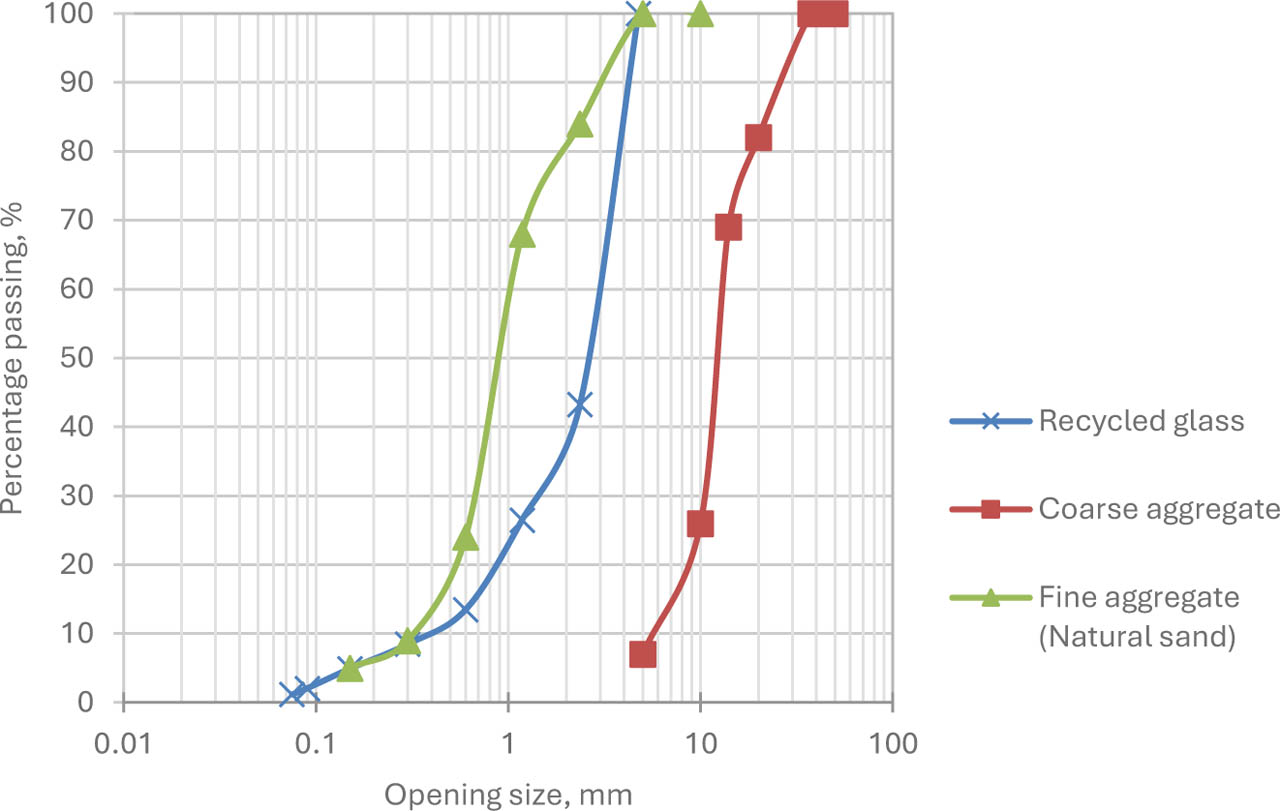
Figure 1:
Grading curves for recycled glass, fine aggregate, and coarse aggregate
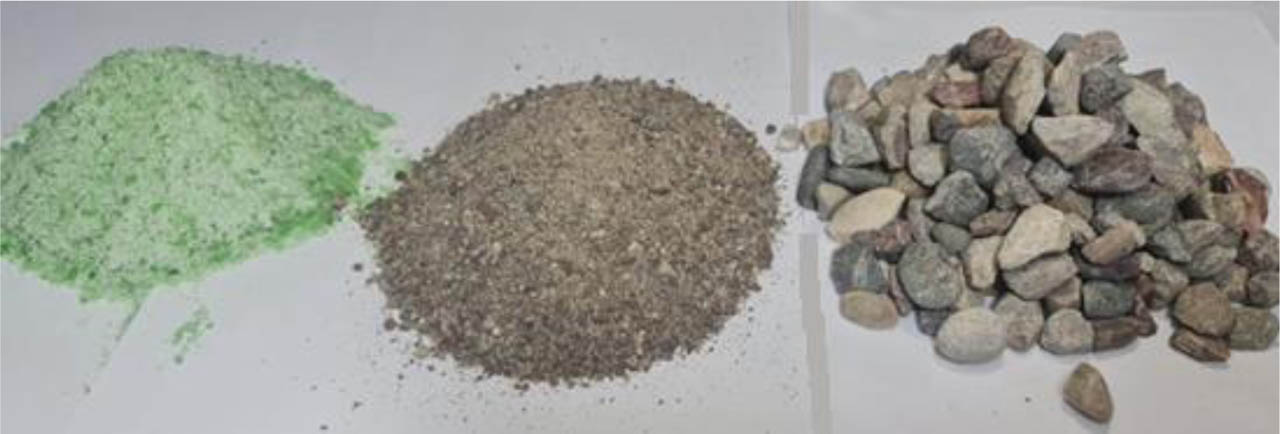
Figure 2:
Sample of recycled glass, fine aggregate, and coarse aggregate
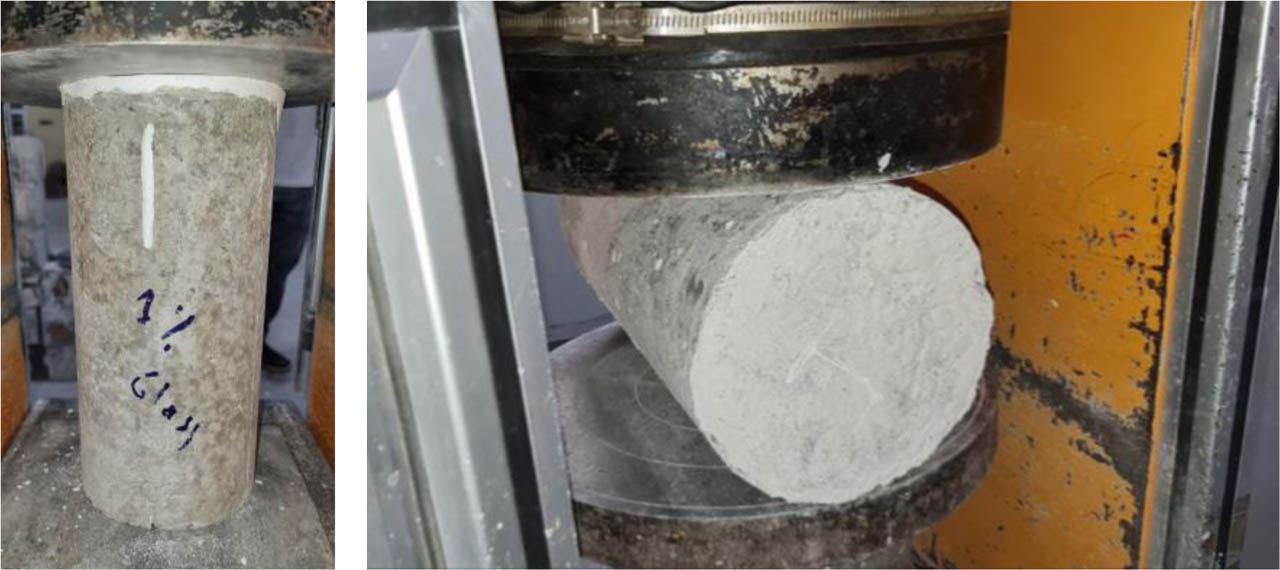
Figure 3:
Compressive and Splitting tests by the universal testing machine
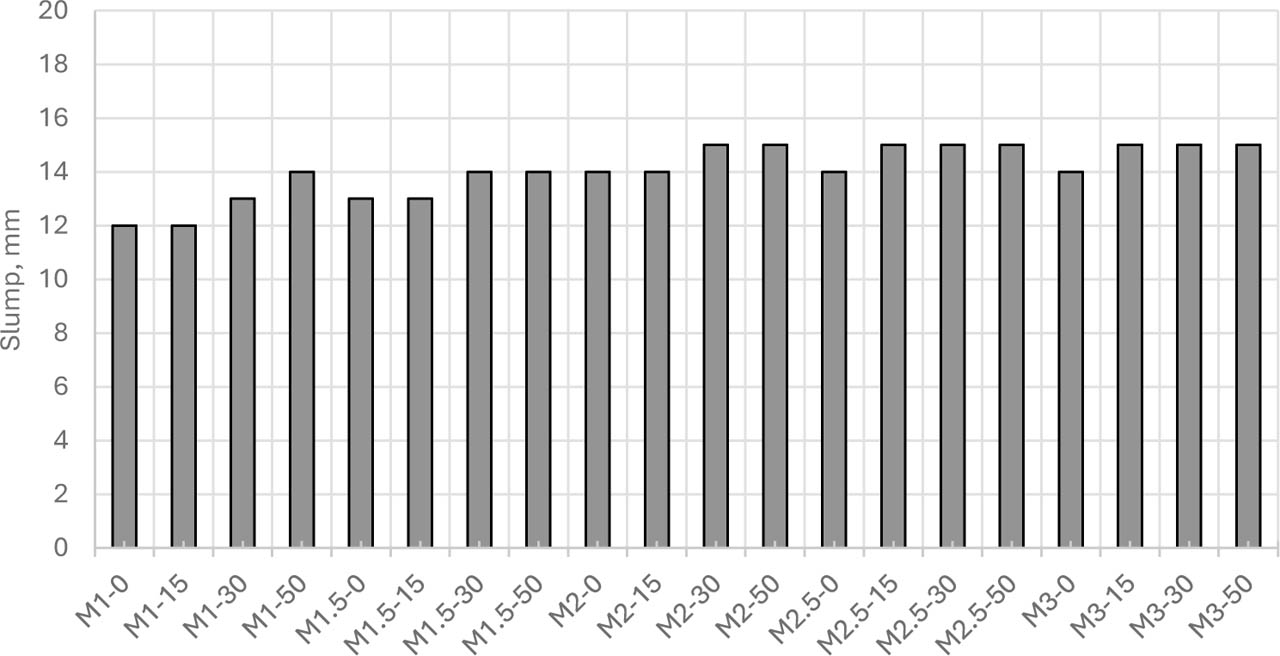
Figure 4:
Slump vs. concrete mixtures
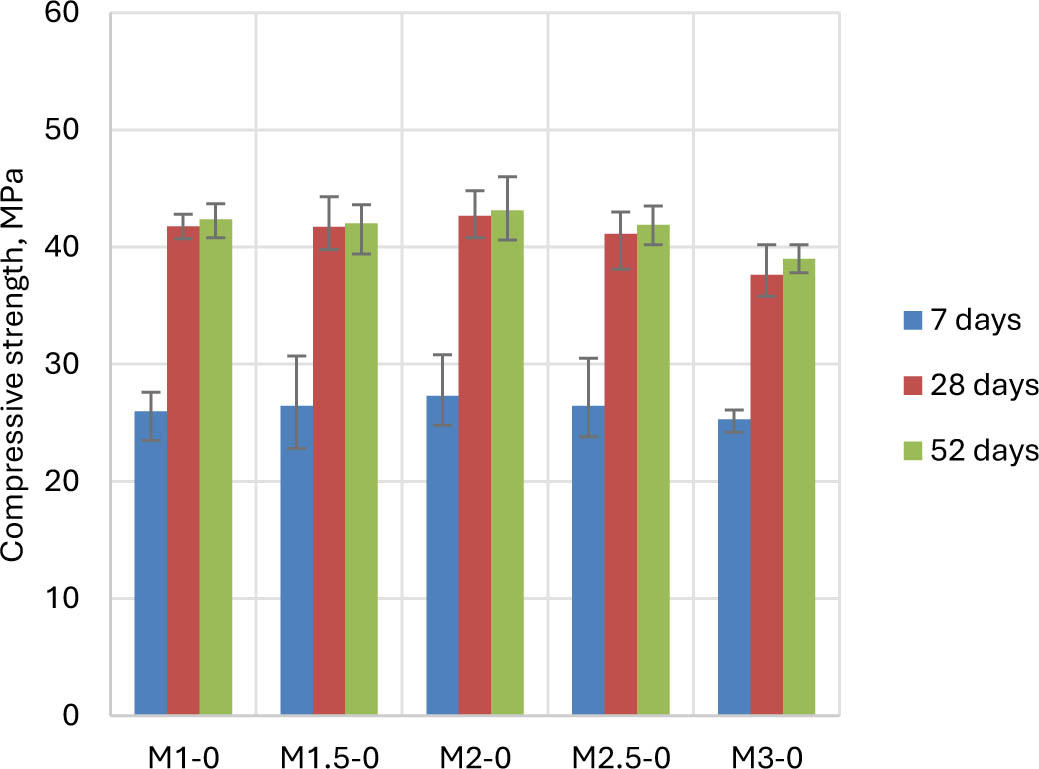
Figure 5:
Compressive strength vs. proportioanl weight of coarse aggregate with no recycled glass
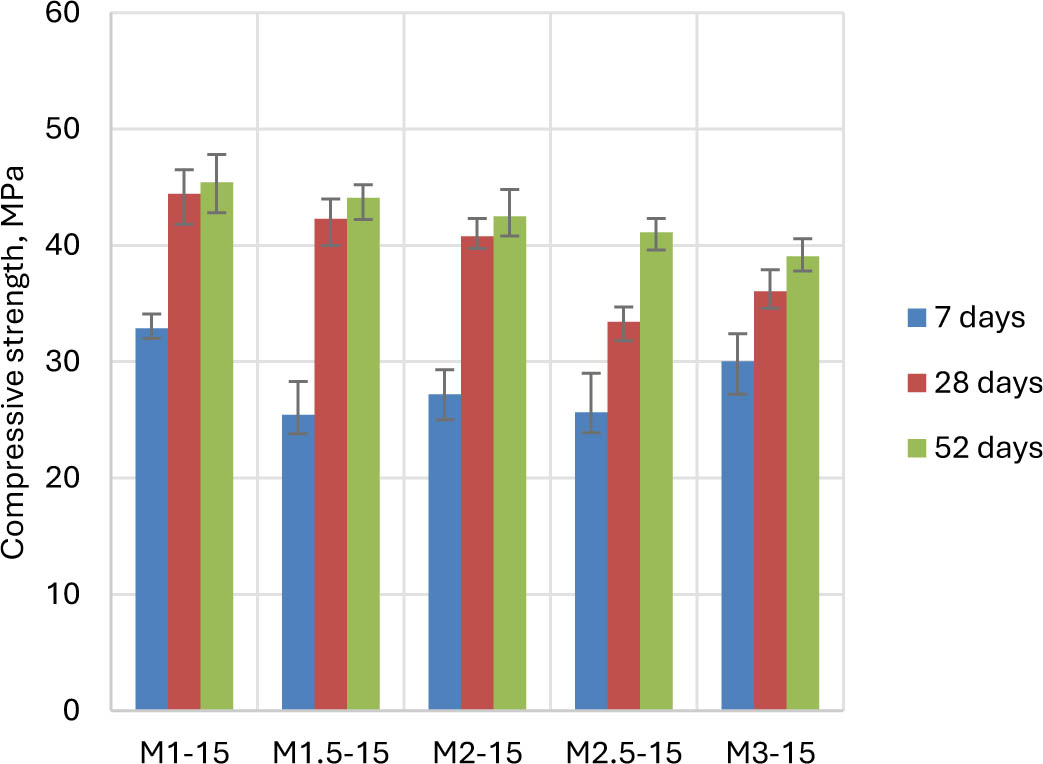
Figure 6:
Compressive strength vs. proportioanl weight of coarse aggregate with 15% recycled glass
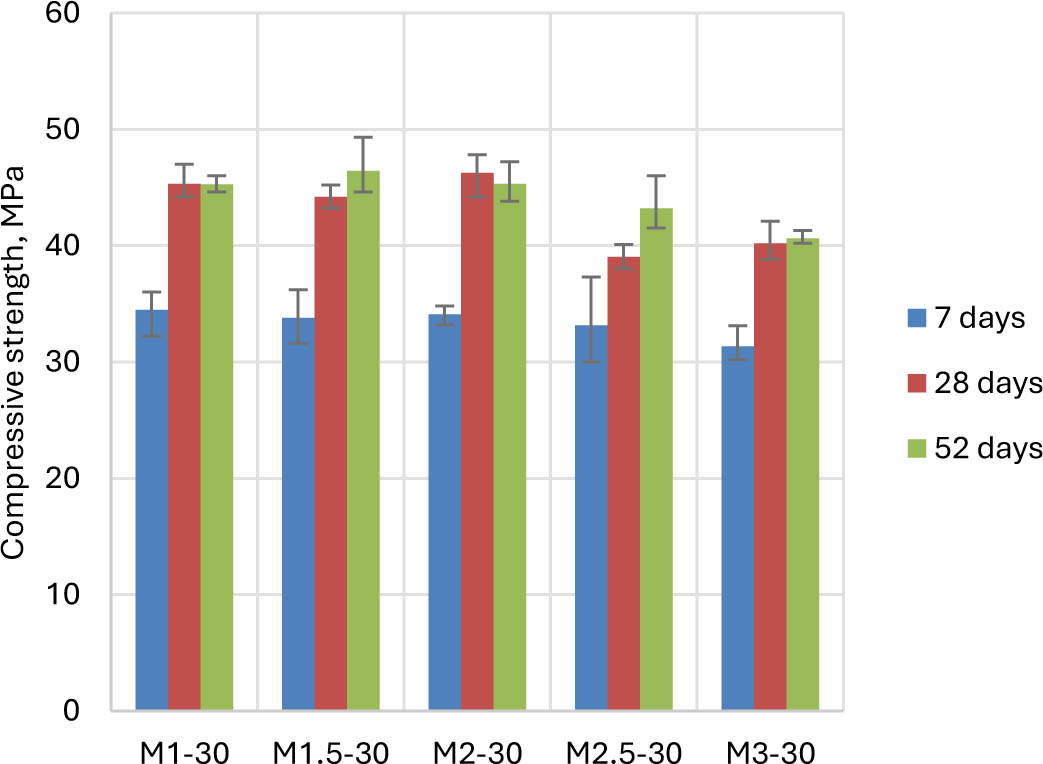
Figure 7:
Compressive strength vs. proportioanl weight of coarse aggregate with 30% recycled glass
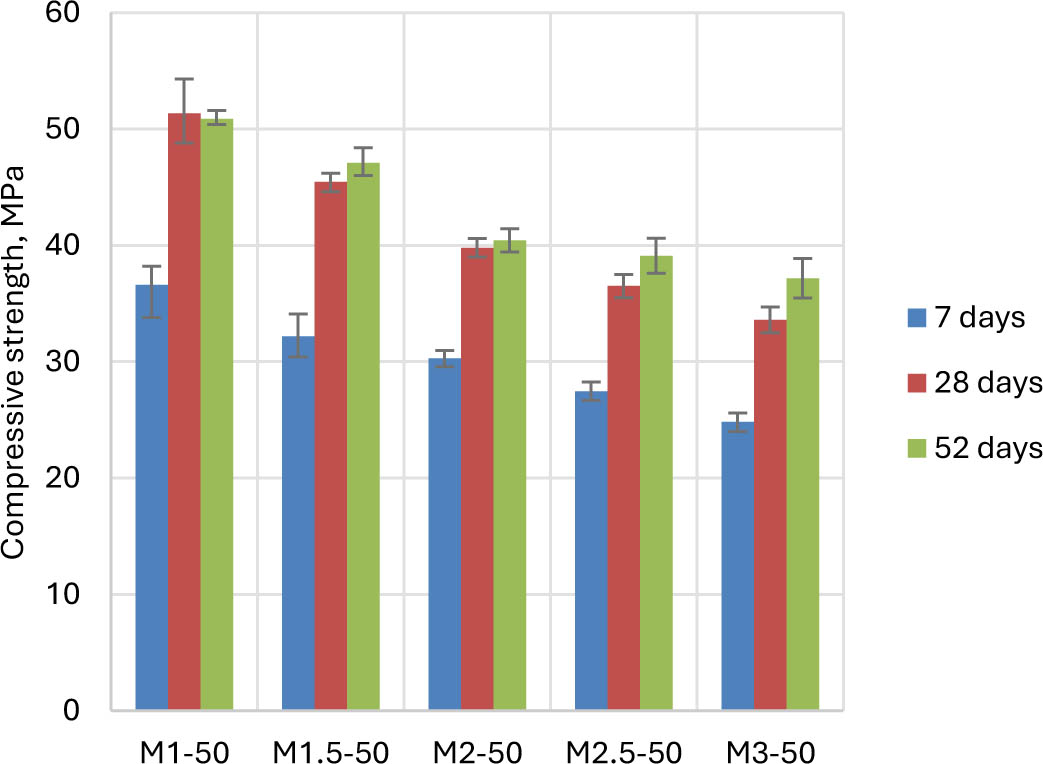
Figure 8:
Compressive strength vs. proportioanl weight of coarse aggregate with 50% recycled glass
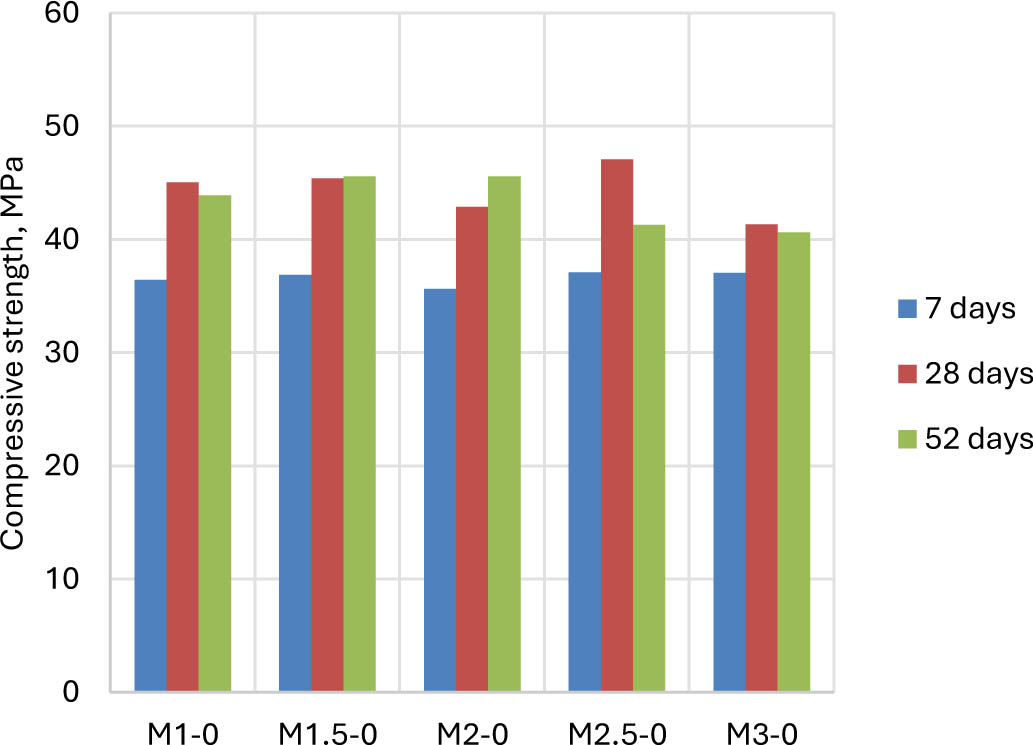
Figure 9:
Compressive strength (ultrasonic test) vs. proportioanl weight of coarse aggregate with no recycled glass
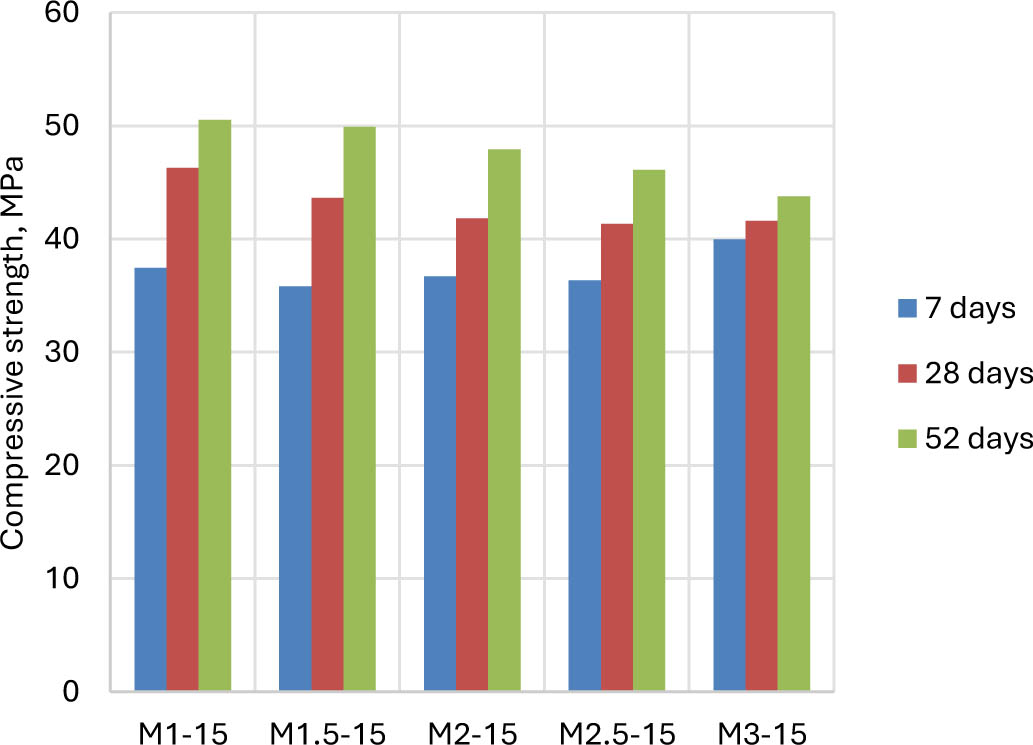
Figure 10:
Compressive strength (ultrasonic test) vs. proportioanl weight of coarse aggregate with 15% reycled glass
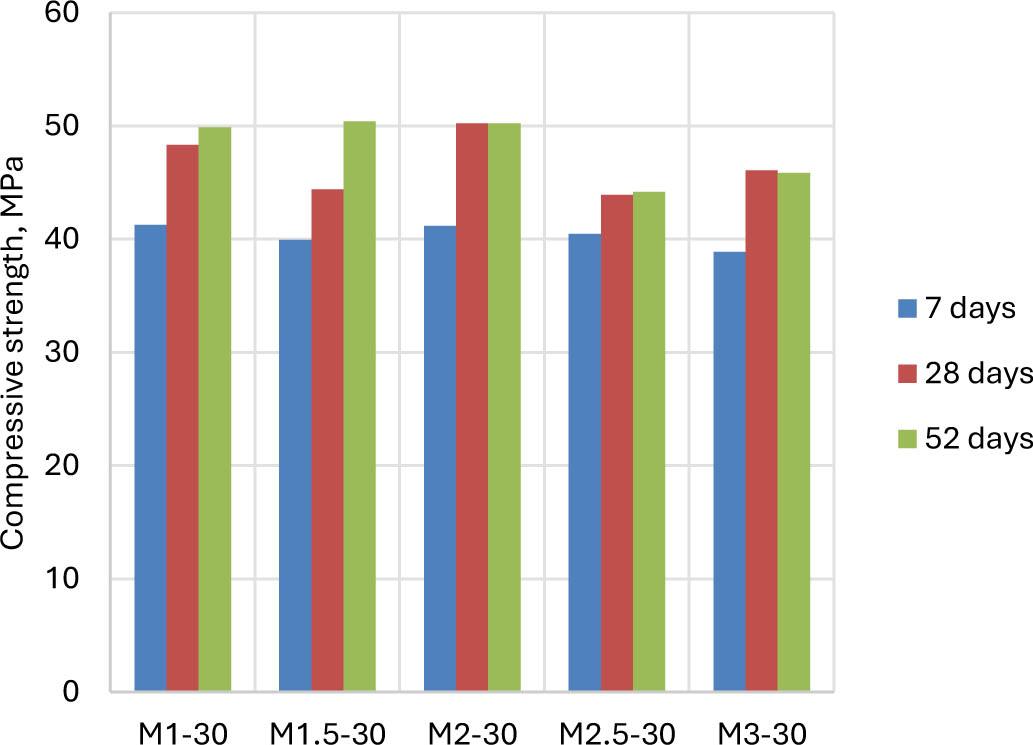
Figure 11:
Compressive strength (ultrasonic test) vs. proportioanl weight of coarse aggregate with 30% recycled glass
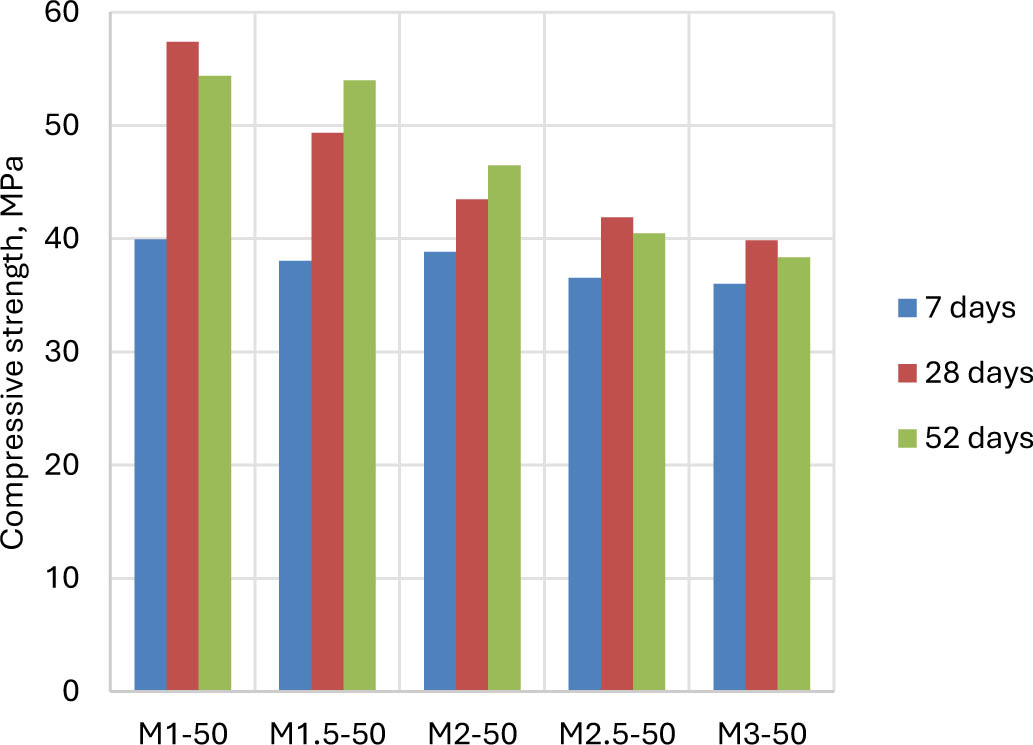
Figure 12:
Compressive strength (ultrasonic test) vs. proportioanl weight of coarse aggregate with 30% recycled glass
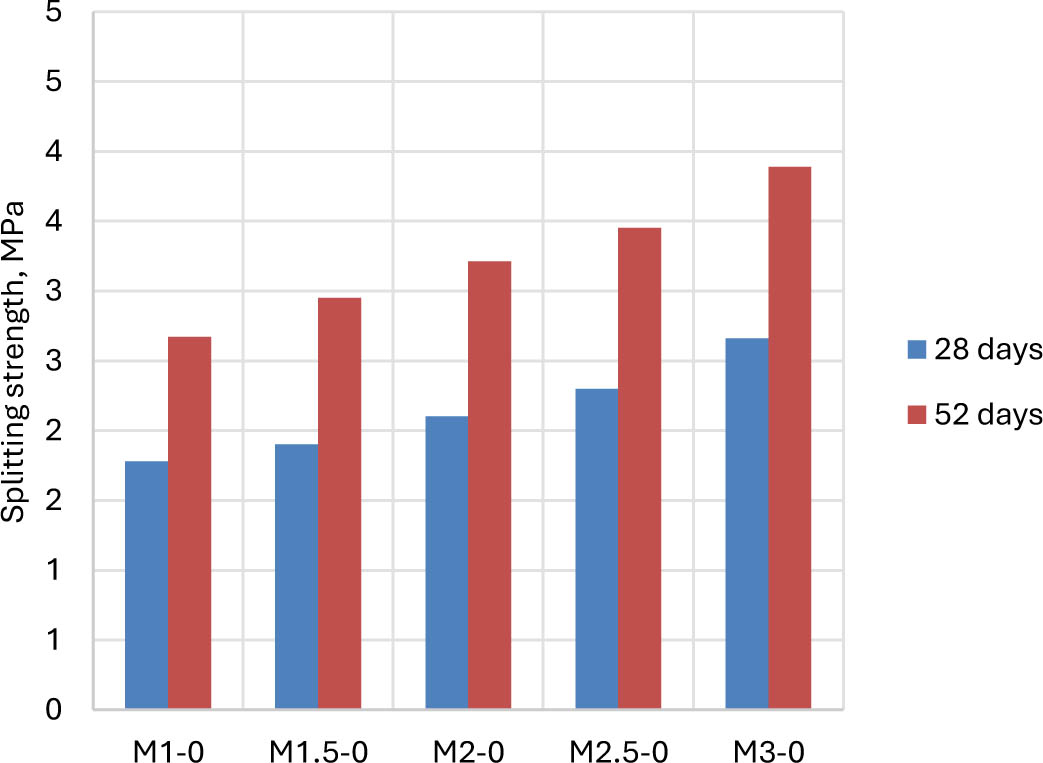
Figure 13:
Splitting strength vs. proportioanl weight of coarse aggregate with no recycled glass
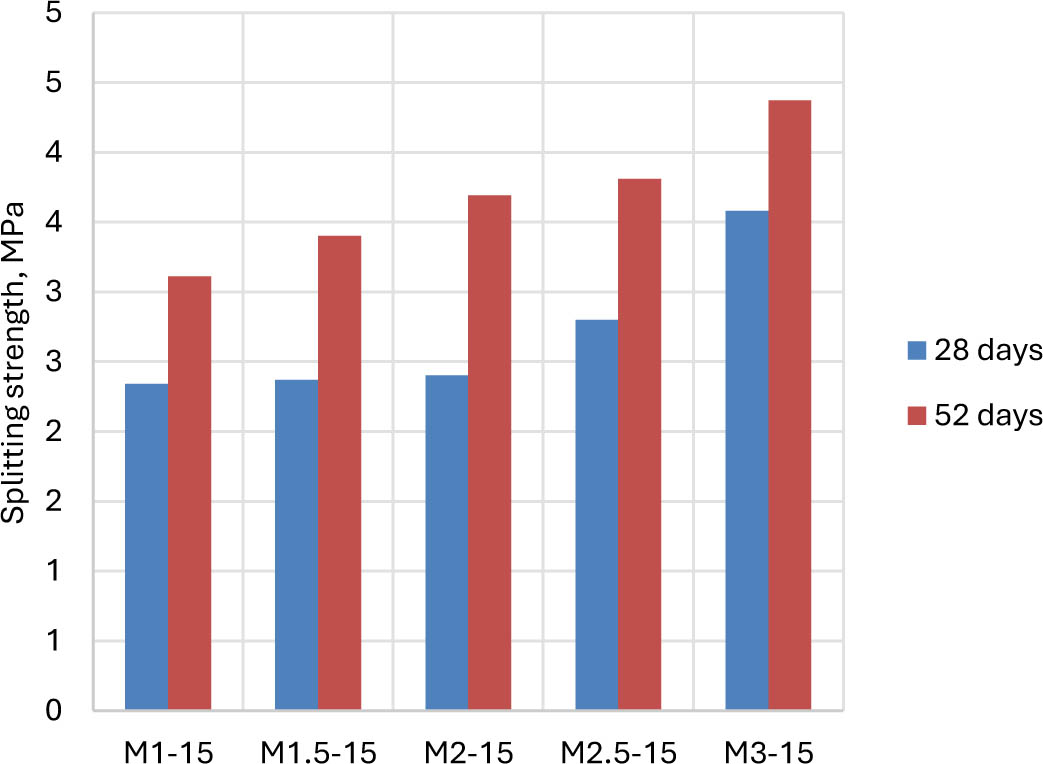
Figure 14:
Splitting strength vs. proportioanl weight of coarse aggregate with 15% recycled glass
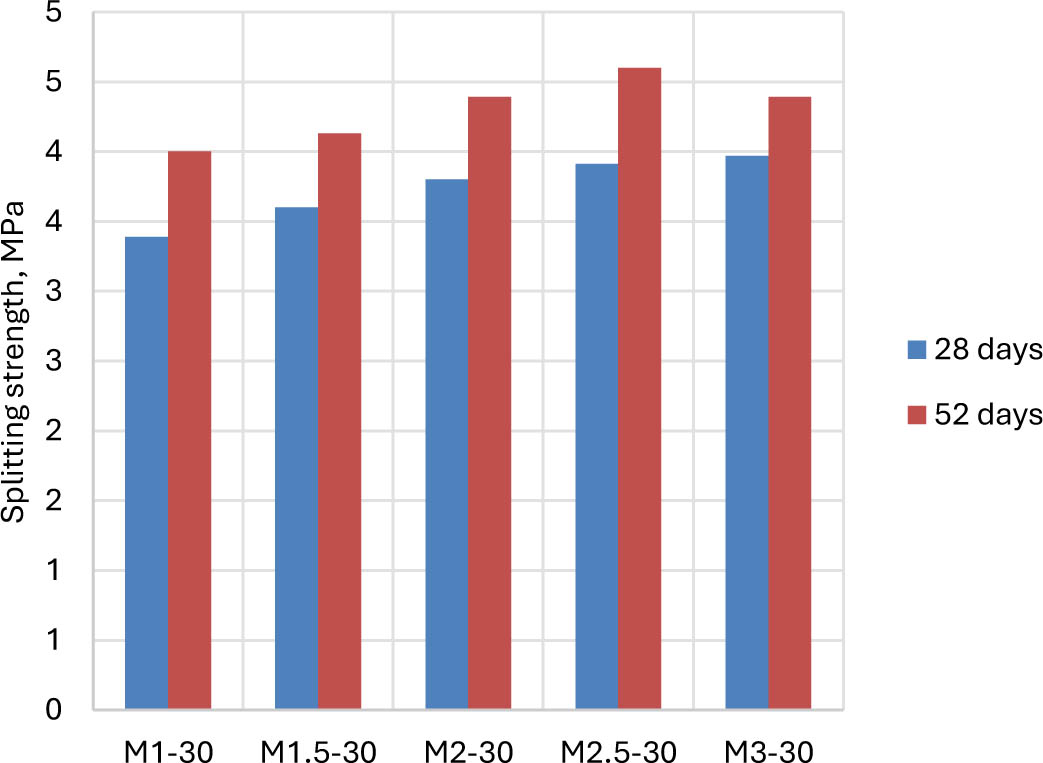
Figure 15:
Splitting strength vs. proportional weight of coarse aggregate with 30% recycled glass
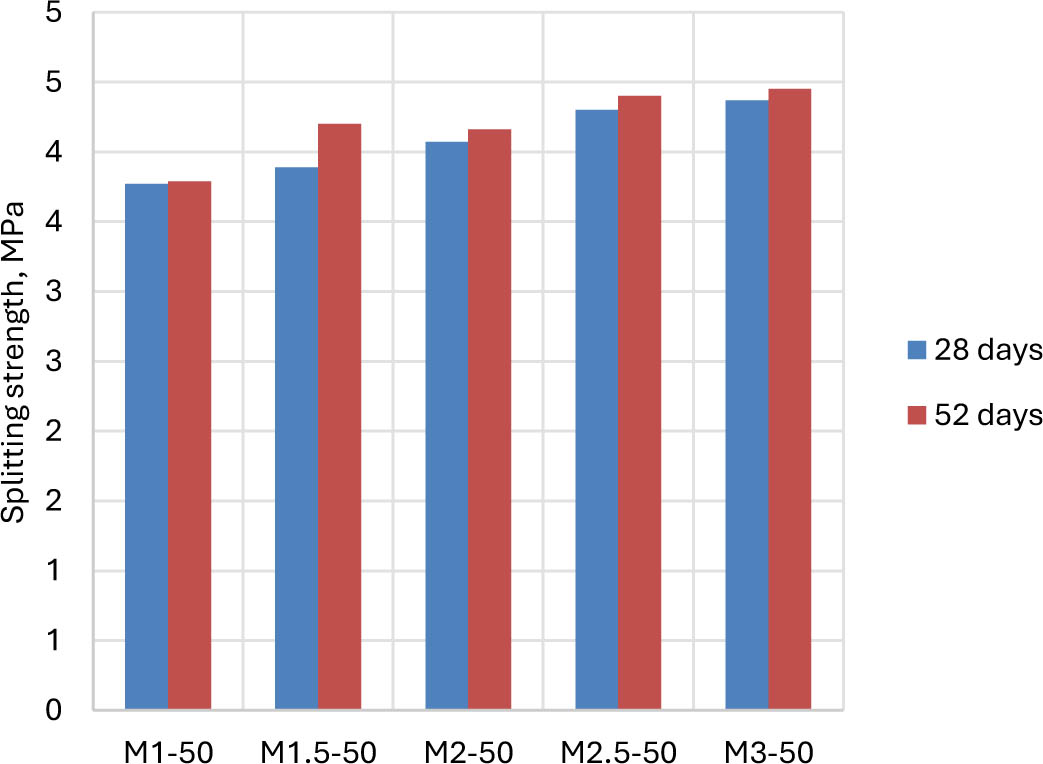
Figure 16:
Splitting strength vs. proportional weight of coarse aggregate with 50% recycled glass
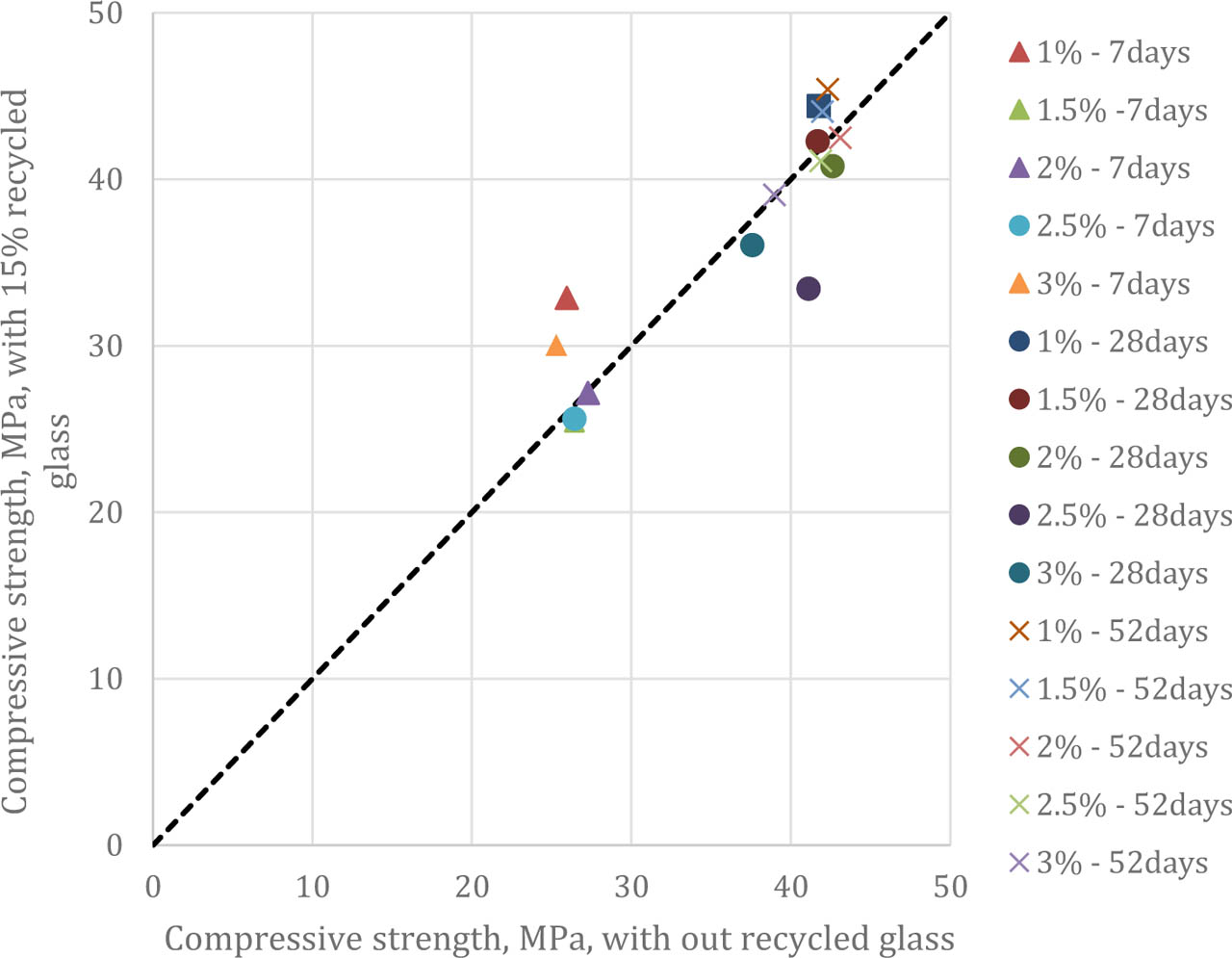
Figure 17:
Comparison of compressive strength of concrete mixtures without recyled glass and with 15% recycled glass
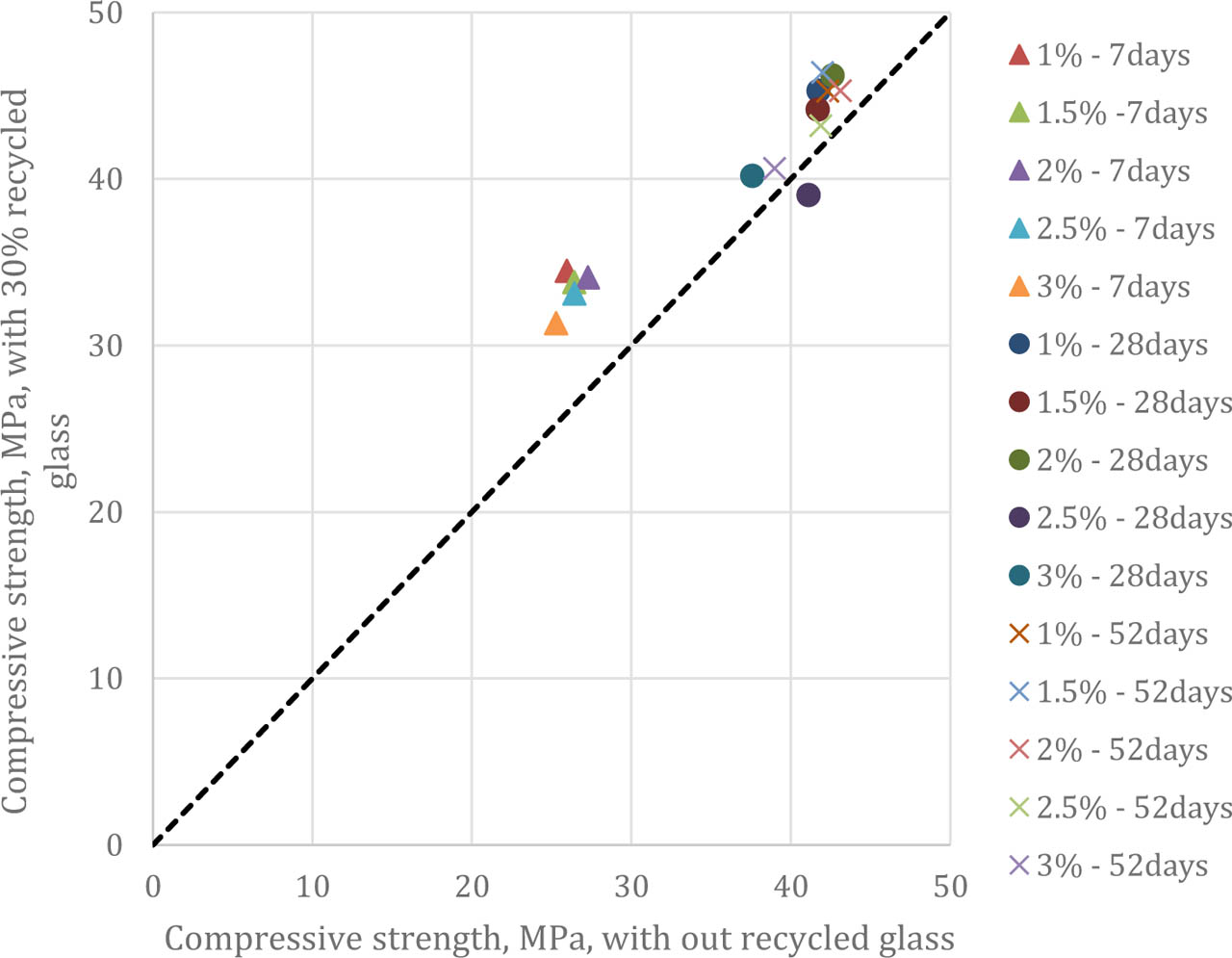
Figure 18:
Comparison of compressive strength of concrete mixtures without recyled glass and with 30% recycled glass
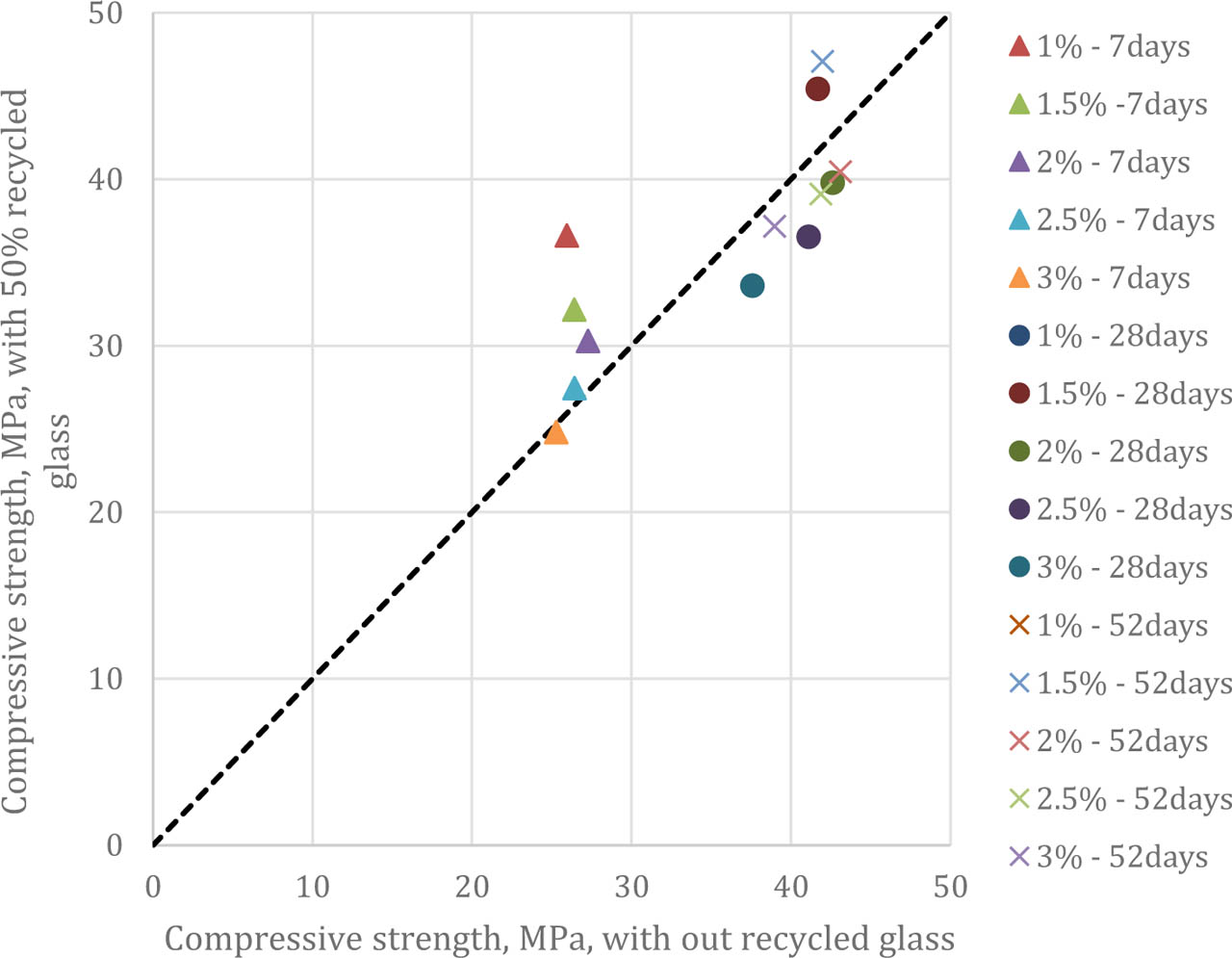
Figure 19:
Comparison of compressive strength of concrete mixtures without recyled glass and with 50% recycled glass
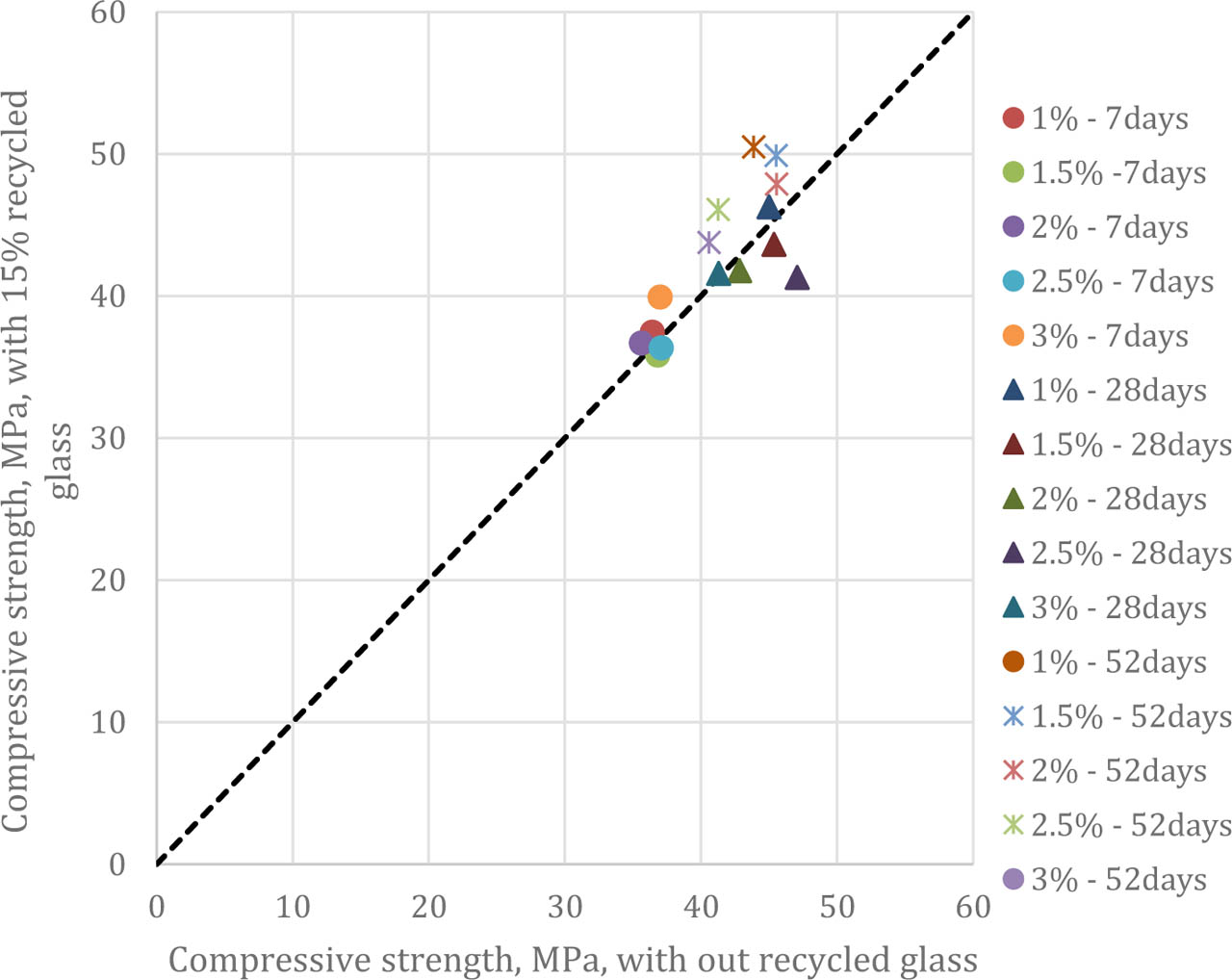
Figure 20:
Comparison of compressive strength (ultrasonic test) of concrete mixtures without recyled glass and with 15% recycled glass
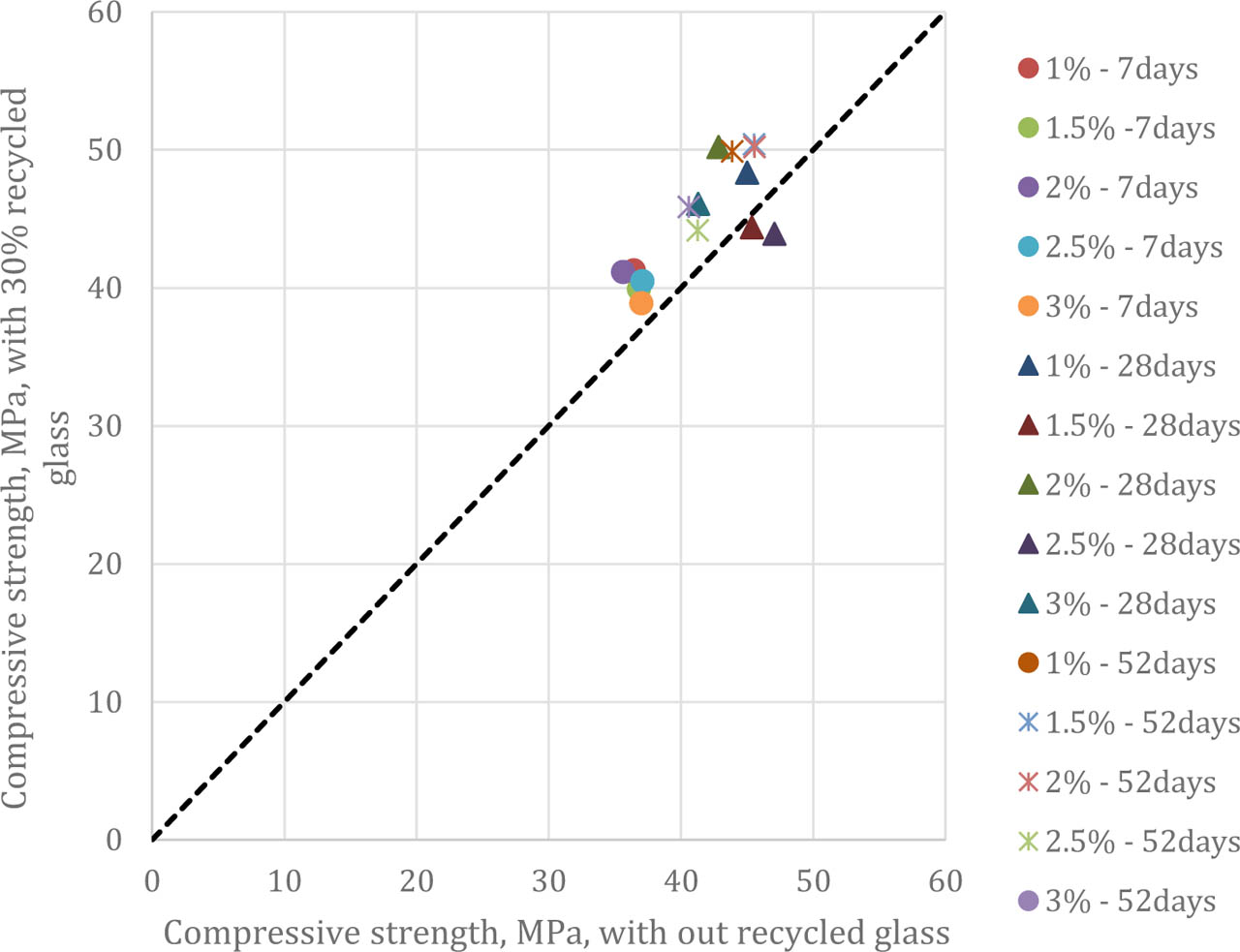
Figure 21:
Comparison of compressive strength (ultrasonic test) of concrete mixtures without recyled glass and with 30% recycled glass
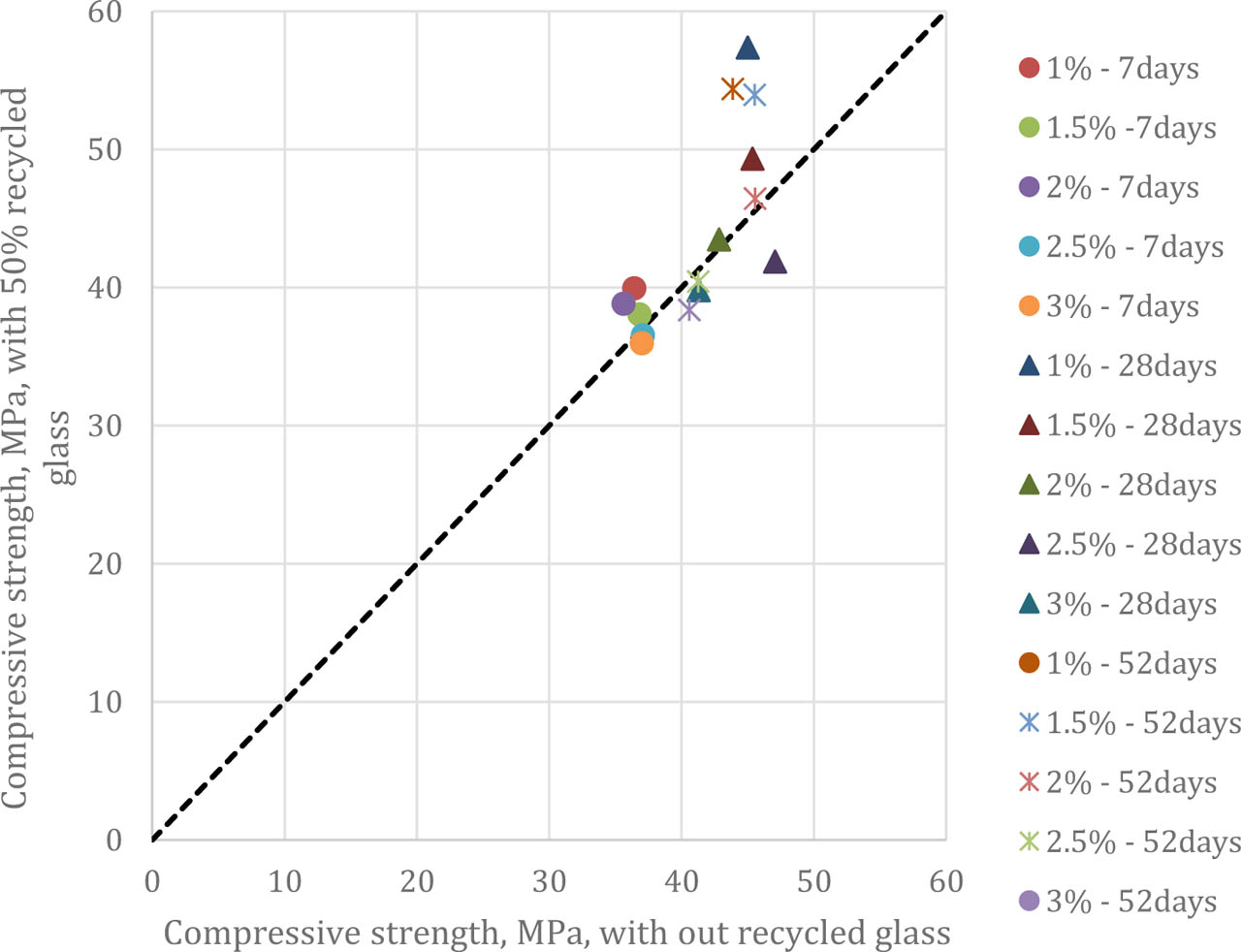
Figure 22:
Comparison of compressive strength (ultrasonic test) of concrete mixtures without recyled glass and with 50% recycled glass
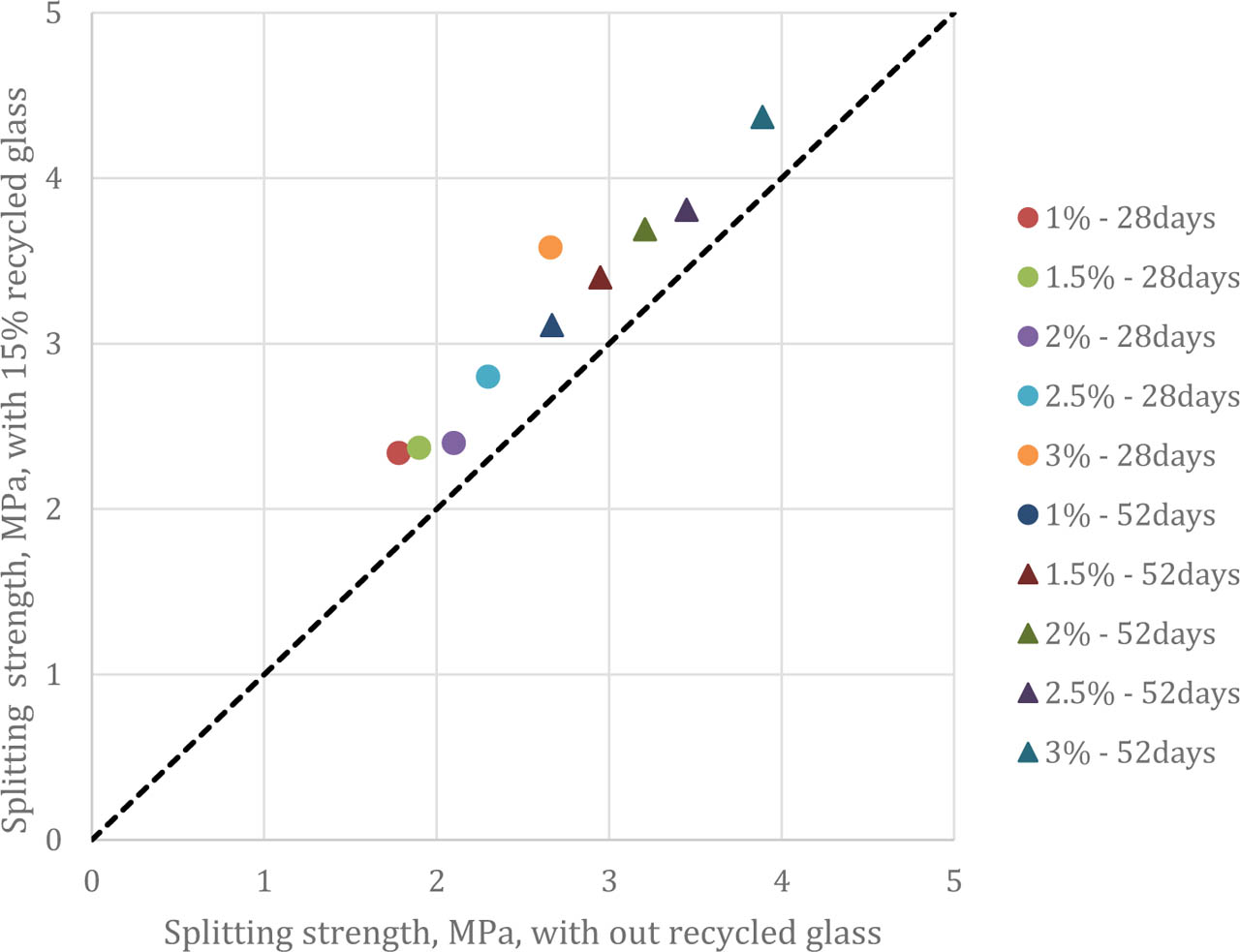
Figure 23:
Comparison of splitting strength of concrete mixtures without recyled glass and with 15% recycled glass
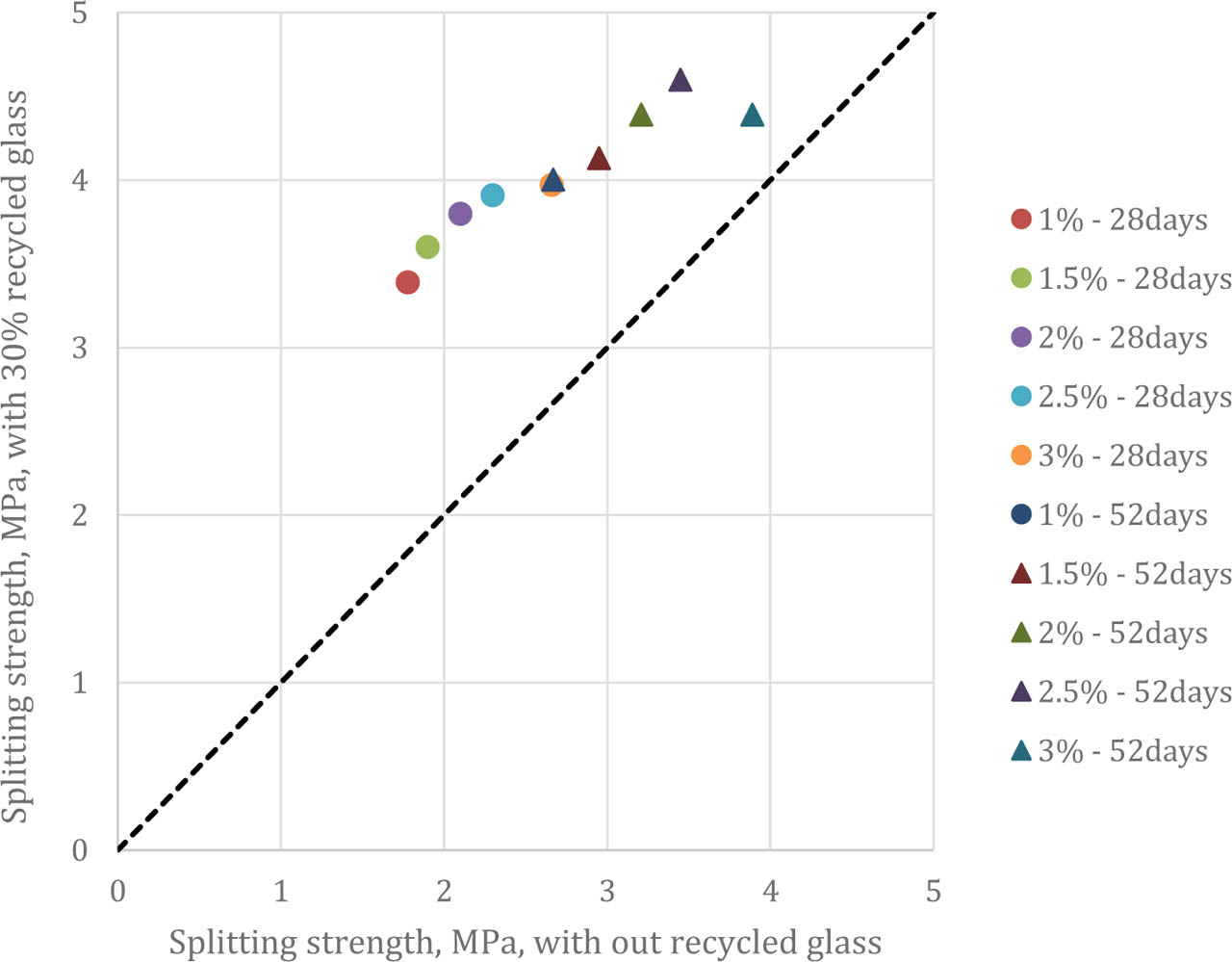
Figure 24:
Comparison of splitting strength of concrete mixtures without recyled glass and with 30% recycled glass
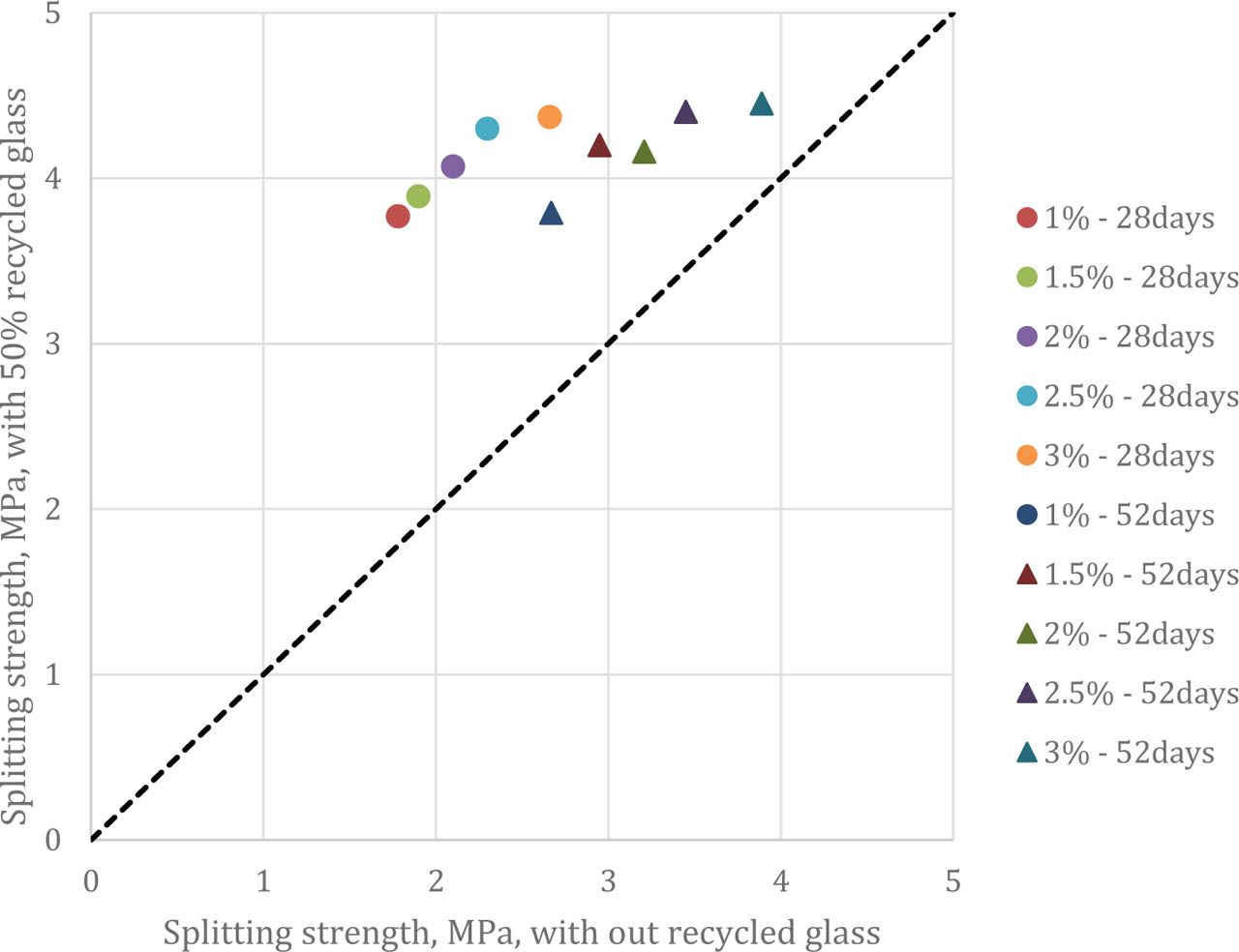
Figure 25:
Comparison of splitting strength of concrete mixtures without recyled glass and with 50% recycled glass
Table 1:
Chemical composition (percentage) and specific gravity of ordinary portland cement
| Component | Portland cement |
|---|---|
| SiO2 | 19.8 |
| Al2O3 | 4.13 |
| Fe2O3 | 3.85 |
| CaO | 61.87 |
| MgO | 3.52 |
| SO3 | 1.79 |
| Cl− | 0.01 |
| LOI | 2.35 |
| Specific Gravity | 3.15 |
Table 2:
Physical properties of ordinary portland cement
| Initial setting time (Minutes) | 125 |
| Final setting time (Minutes) | 300 |
| Blaine (m2/kg) | 300 |
| Expansion (%) | 0.04 |
| 3 days compressive strength (MPa) | 11 |
| 7 days compressive strength (MPa) | 18 |
| 28 days compressive strength (MPa) | 29 |
Table 3:
Mixture proportions (kg/m3)
| Mixtures* | Weight proportion (Cement: Fine agg.: Recycled glass: coarse agg.) | w/c | Cement kg/m3 | Water kg/m3 | Fine aggregate kg/m3 | Recycled glass kg/m3 | Coarse aggregate kg/m3 |
|---|---|---|---|---|---|---|---|
| M1-0 | 1:2:0:1 | 0.46 | 370 | 170 | 740 | 0 | 370 |
| M1-15 | 1:1.7:0.3:1 | 0.46 | 370 | 170 | 629 | 111 | 370 |
| M1-30 | 1:1.4:0.6:1 | 0.46 | 370 | 170 | 520 | 220 | 370 |
| M1-50 | 1:1:1:1 | 0.46 | 370 | 170 | 370 | 370 | 370 |
| M1.5-0 | 1:2:0:1.5 | 0.46 | 370 | 170 | 740 | 0 | 555 |
| M1.5-15 | 1:1.7:0.3:1.5 | 0.46 | 370 | 170 | 629 | 111 | 555 |
| M1.5-30 | 1:1.4:0.6:1.5 | 0.46 | 370 | 170 | 520 | 220 | 555 |
| M1.5-50 | 1:1:1:1.5 | 0.46 | 370 | 170 | 370 | 370 | 555 |
| M2-0 | 1:2:0:2 | 0.46 | 370 | 170 | 740 | 0 | 740 |
| M2-15 | 1:1.7:0.3:2 | 0.46 | 370 | 170 | 629 | 111 | 740 |
| M2-30 | 1:1.4:0.6:2 | 0.46 | 370 | 170 | 520 | 220 | 740 |
| M2-50 | 1:1:1:2 | 0.46 | 370 | 170 | 370 | 370 | 740 |
| M2.5-0 | 1:2:0:2.5 | 0.46 | 370 | 170 | 740 | 0 | 925 |
| M2.5-15 | 1:1.7:0.3:2.5 | 0.46 | 370 | 170 | 629 | 111 | 925 |
| M2.5-30 | 1:1.4:0.6:2.5 | 0.46 | 370 | 170 | 520 | 220 | 925 |
| M2.5-50 | 1:1:1:2.5 | 0.46 | 370 | 170 | 370 | 370 | 925 |
| M3-0 | 1:2:0:3 | 0.46 | 370 | 170 | 740 | 0 | 1110 |
| M3-15 | 1:1.7:0.3:3 | 0.46 | 370 | 170 | 629 | 111 | 1110 |
| M3-30 | 1:1.4:0.6:3 | 0.46 | 370 | 170 | 520 | 220 | 1110 |
| M3-50 | 1:1:1:3 | 0.46 | 370 | 170 | 370 | 370 | 1110 |
Table 4:
Experimntal program
| No. of casted cylinders | Compressive strength test No. of cylinders | Splitting test No. of cylinders | Ultrasonic test | ||||
|---|---|---|---|---|---|---|---|
| For each concrete mixture | 15 | 3 cured for 7 days | 3 cured for 28 days | 3 cured for 52 days | 3 cured for 28 days | 3 cured for 52 days | Same cylinders that were cured for the splitting test were used for ultrasonic test first. |
Table 5:
Concrete properties
| Mixtures* | w/cm | Slump, (mm) | Temp., °C |
|---|---|---|---|
| M1-0 | 0.46 | 12 | 25 |
| M1-15 | 0.46 | 12 | 24 |
| M1-30 | 0.46 | 13 | 26 |
| M1-50 | 0.46 | 14 | 23 |
| M1.5-0 | 0.46 | 13 | 25 |
| M1.5-15 | 0.46 | 13 | 26 |
| M1.5-30 | 0.46 | 14 | 24 |
| M1.5-50 | 0.46 | 14 | 27 |
| M2-0 | 0.46 | 14 | 23 |
| M2-15 | 0.46 | 14 | 24 |
| M2-30 | 0.46 | 15 | 25 |
| M2-50 | 0.46 | 15 | 28 |
| M2.5-0 | 0.46 | 14 | 22 |
| M2.5-15 | 0.46 | 15 | 24 |
| M2.5-30 | 0.46 | 15 | 26 |
| M2.5-50 | 0.46 | 15 | 23 |
| M3-0 | 0.46 | 14 | 25 |
| M3-15 | 0.46 | 15 | 27 |
| M3-30 | 0.46 | 15 | 24 |
| M3-50 | 0.46 | 15 | 28 |
* Mixture designation: See Table 3
3.6. Equations
Where:
CS and PV are the compressive strength (MPa) and the ultrasonic pulse velocity (km/s), respectively.
Table 6:
Mechanical properites of concrete
| Mixtures* | Compressive strength of concrete cylinders (MPa)** | Compressive strength of concrete cylinders (Ultrasonic test) (MPa) | Splitting strength of concrete cylinders (MPa)** | |||||
|---|---|---|---|---|---|---|---|---|
| 7 days | 28 days | 52 days | 7 days | 28 days | 52 days | 28 days | 52 days | |
| M1-0 | 26.0 | 41.8 | 42.3 | 36.4 | 45.0 | 43.9 | 1.8 | 2.7 |
| M1-15 | 32.9 | 44.4 | 45.4 | 37.4 | 46.3 | 50.5 | 2.3 | 3.1 |
| M1-30 | 34.5 | 45.3 | 45.3 | 41.3 | 48.3 | 49.9 | 3.4 | 4.0 |
| M1-50 | 36.6 | 51.3 | 50.9 | 39.9 | 57.4 | 54.4 | 3.8 | 3.8 |
| M1.5-0 | 26.4 | 41.7 | 42.0 | 36.9 | 45.4 | 45.5 | 1.9 | 3.0 |
| M1.5-15 | 25.4 | 42.3 | 44.1 | 35.8 | 43.6 | 49.9 | 2.4 | 3.4 |
| M1.5-30 | 33.8 | 44.2 | 46.4 | 39.9 | 44.4 | 50.4 | 3.6 | 4.1 |
| M1.5-50 | 32.2 | 45.4 | 47.1 | 38.0 | 49.4 | 54.0 | 3.9 | 4.2 |
| M2-0 | 27.3 | 42.6 | 43.1 | 35.6 | 42.9 | 45.6 | 2.1 | 3.2 |
| M2-15 | 27.2 | 40.8 | 42.5 | 36.7 | 41.8 | 47.9 | 2.4 | 3.7 |
| M2-30 | 34.1 | 46.2 | 45.3 | 41.2 | 50.2 | 50.2 | 3.8 | 4.4 |
| M2-50 | 30.3 | 39.8 | 40.4 | 38.8 | 43.5 | 46.5 | 4.1 | 4.2 |
| M2.5-0 | 26.4 | 41.1 | 41.9 | 37.1 | 47.1 | 41.3 | 2.3 | 3.5 |
| M2.5-15 | 25.6 | 33.4 | 41.1 | 36.3 | 41.3 | 46.1 | 2.8 | 3.8 |
| M2.5-30 | 33.1 | 39.0 | 43.2 | 40.5 | 43.9 | 44.2 | 3.9 | 4.6 |
| M2.5-50 | 27.5 | 36.5 | 39.1 | 36.5 | 41.9 | 40.5 | 4.3 | 4.4 |
| M3-0 | 25.3 | 37.6 | 39.0 | 37.0 | 41.3 | 40.6 | 2.7 | 3.9 |
| M3-15 | 30.0 | 36.0 | 39.1 | 39.9 | 41.6 | 43.7 | 3.6 | 4.4 |
| M3-30 | 31.3 | 40.2 | 40.6 | 38.9 | 46.1 | 45.9 | 4.0 | 4.4 |
| M3-50 | 24.8 | 33.6 | 37.2 | 36.0 | 39.8 | 38.3 | 4.4 | 4.5 |
* Mixture designation: See Table 3
4. Summary and Conclusions
Twenty concrete mixtures (300 cylinders) were evaluated based on the results plastic concrete's properties and hardened concrete's mechanical properties.
The presence of recycled glass as a partial replacement of natural sand caused an increase in slump, especially at high replacement ratios of 30% and 50%.
Extending curing period for majority of concrete mixtures from 7 days to 28 days showed a statically significant increase in the compressive strength. Whereas, extending curing period beyond 28 days up to 52 days did not have a clear impact on the compressive strength.
A clear impact of the proportional weight ratio of coarse aggregate on the mechanical properties of concrete mixtures incorporating recycled glass. In case of using recycled glass in a concrete mixture, the proportional weight ratio of coarse aggregate should be reduced to maintain the value of compressive strength.
Recycled glass up to 50% can be used as a partial replacement of natural sand in case of using the proportional weigh ratio of coarse aggregates equals to 1%.
Acknowledgements
The research described in this paper was supported by the Construction Materials Laboratory / Civil Engineering department of the University of Mosul.
Notes
[7] Contributed by Author Contributions
K.A. conceived and designed the study and contributed to data interpretation and manuscript drafting. A.A. conducted the experiments and collected the data, performed the statistical analysis, and contributed to data interpretation and manuscript drafting. All authors critically reviewed and approved the final version of the manuscript and agreed to be accountable for all aspects of the work.